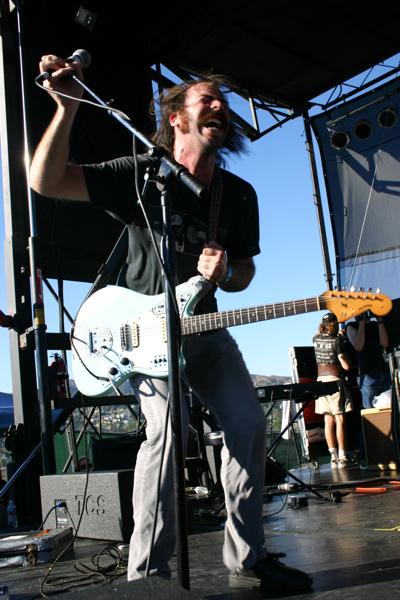
C & D: Two guys reason together about some new records (Arthur No. 24/Oct. 2006)

Originally published in Arthur No. 24 (October 2006)

C & D: Two guys reason together about some new records

AKRON/FAMILY
Meek Warrior
(Young God)
C: [Looking at publicity photo of band] I’m surprised these guys haven’t featured in Arthur magazine yet. They appear to meet many if not all of this magazine’s apparent requirements for coverage.
D: What, they have beards?
C: Yes. I think the magazine is pretty clearly a beards-only policy. It’s pretty clearly where the underground beard was re-born. Or should I say, re-grown. Remember Alan Moore on the cover of Arthur No. 4?
D: That was a beard to be reckoned with. No razors and shaving cream in the Moore household!
C: Total ‘Lord of the Beards.’ On the other hand, Alan’s finger armor stylings haven’t caught on yet.
D: I will keep an eye out for the beard as we check out these records today. I assume there will be ladies, too?
C: Yes, of course.
D: Who presumably are not of the bearded variety.
C: One never knows, does one? [arches eyebrow meaningfully] Anyways, Akron/Family not only have some beardage, they have four-part harmonies, great cascading drumflows, sprawling late Trane skronk, and that’s all on the first track! I saw these guys once in L.A., they were like a devotional Animal Collective…
D: [smiling upon hearing the refrain “Gone, gone, gone/gone completely beyond.”] Ah yes. Beyond. One of my favorite places.
C: [ignoring, continuing] … in Oshkosh overalls, without the echo delays. Like Lubavitchers gone Sun Ra or Ya Ho Wha—
D: Say wha?
C: [snobbishly] Those who know, know. [continuing] They were awesome, in complete uni-mind synch. The audience made backward-and-forward ocean ripples and sounds at their command: ‘Shhh, shhh.’ It was beautiful.

BEACH HOUSE
Beach House
(Carpark)
C: Lovely—possibly perfect?—debut album from this girl-and-boy lovebird combo who sound like they’re living down by the sea on some magic moonlit beach that stretches from France to Baja to Bali.
D: [looks at biographical notes and photo] Actually they live in Baltimore. And there is no beard.
C: Waiter, get this man a beard, se vous plais.
D: [ignoring] But Victoria Legrand—
C: Is that a real name???
D: —is definitely a lady. A lady who knows how to wear an aqua dress.
C: [looking at the photo] And a big gold amulet as well.
D: I would say this is late summer music, recorded at the beach house after everybody else has gone back to the city.
C: It’s kind of minimal naturalismo—organ, drum machine, gorgeous female voice: Stereolab, minus le krautrock propulsion. Midway between Brightblack slow-to-stillness, Beach Boys “Pet Sounds” melancholism and Air and another Carpark artist, Casino vs. Japan. Also, what the heck, I’ll throw in that first Bjorn Olson record on Omplatten [Instrumentalmusik: Instrumental Music…to Submerge in…and Disappear Through, 1999]. Nordic beaches. As you can see, D, it’s a very particular, yet universal, mood. I see soundtracks in their near-future. [picks up phone] “Hello, Beach House? This is Sofia…”
D: Her voice reminds me a bit of Sigur Ros. Hey, whatever happened to those guys? It’s like they evaporated.
C: She can really SING, when it’s called for, which is in creamy middle of the album on the song “Auburn and Ivory.”
D: Is Auburn the new Ebony?
C: All the songs have some sophisto pop songwriting going on: bridges, key changes, et cetera. And the sounds… when the organ comes in on “House on the Hill,” it’s like Captain Nemo down in the Nautilus playing pipe organ for the octopi. Whew! Can you imagine these guys with a big budget…?
D: Ahoy! Captain Nemo: ANOTHER famous bearded musician.

MICK BARR & ZACH HILL
Earthship
(5RC)
C: New summit album by underground instrumental speed kings: guitarist Mick Barr of Ocrilim, and drummer Zach Hill of Hella. It’ll tighten yer wig!
D: Well, I won’t need coffee for the next five months.
C: They’re going in for the kill like two old ladies speed-crocheting. Mind the wheedlework.
D: They are the speed criminals who no doubt are under surveillance by the authorities of rock. There’s a NEW MOTHER IN THE TEMPLE if you know what I mean!
C: It does have that High Rise/Mainliner/Musica Transonic thing going a bit. Ah, Japan. Some people may also be put in mind of the Peter Brotzman Octet classic assault album, Machine Gun.
D: That’s a ripping title, “Earthship.” [considers] If you lived there, you’d be home by now.
C: Sometimes they’re against each other, sometimes they unify.
D: I must ask: is there a beard?
C: [looks at publicity photo] Have beard, will rock.These guys are the opposite of Sunn o))): they do as many notes and beats as possible per hour. It’s anti-void music, filling everything with sound.
D: Without the benefit of riffage.
C: There ARE riffs—you just need to adjust your attention to catch them. It’s condensed free rock. Like the instruments are too hot to handle. Except for this one song I keep coming back to… [plays “Closed Coffins and Curtains.”]
D: Whoa! What…is…THAT???
C: It’s like some super-processed symphonic tri-guitar. Like what that weird Godley & Creme instrument was supposed to sound like, remember that? The Gizmo. They made a whole triple-album with it, and Peter Cook too. Bonkers stuff.
D: [playing the 30-second track again] I am totally spooked. [musing] Perhaps if Mr. Ocrilim slowed down and contemplated like this occasionally, he’d get to somewhere really rewarding.
C: Rewarding to you.
D: [laughs] Of course, me! Who else matters?

THE HORRORS
The Horrors ep
(Stolen Transmission)
D: [Reading song titles] They have a song called “Sheena Was a Parasite”? I worship them already.
C: Frantic organ and guitar-driven psychobilly freakbeat rock’n’roll by five sharply dressed’n’coiffed Dickensian Brits from the belfry.
D: They look like they live in chimneys and spend all day drinking red wine and listening to The Cramps, Tav Falco & Panther Burns…probably the Hives too, and the Birthday Party and Screaming Jay Hawkins (who they cover here) and Screaming Lord Sutch and of course the right honorable Arthur Brown. I think they like bourbon and some pretty nasty stuff.
C: [listening to “Excellent Choice”] They’ve got a good look and a good sound and they seem up for a good party. They’ll come to your town and help you burn it down. And then dance in the ashes.

PRIMAL SCREAM
Riot City Blues
(Capitol)
C: They’re been around approximately forever. And this is their once-a-decade “rock n roll is dumb fun” concept record, apparently.
[C & D cringe for 15 minutes]
C: Talk about the horrors.
D: Where’s the pooper scooper?
C: Rock n roll should be fun, it can be stoopid, but it should never, ever be tedious. One hates to witness someone failing at slumming. It’s embarrassing to all involved. Does [Primal Scream singer] Bobby Gillespie seriously think this band can boogie? Ha ha ha. Poor Mani…
D: [thoughtful] Every once in a while an object is mysteriously withdrawn from stores by its manufacturer shortly after its introduction. That kind of decisive action may be appropriate here.

THEUSAISAMONSTER
Sunset at the End of the Industrial Age
(Load)
C: You will recall that both members of THEUSAISAMONSTER are members of Black Elf Speaks, which is one of the great band names ever.
D: What did Black Elf have to say?
C: I don’t know, it was this kind of gibberish? But it seemed important. [sadly, as if narration] ‘And Black Elf spoke, but no one could understand what he said.’
D: [helpfully] Maybe he had something in his mouth.
C: ….
D: Or, he might have a speech impediment.
C: …
D: [looking at album cover] Naturally I am wondering, what kind of monster?
C: Probably some kind of troll. On PCP.
D: That’s pretty negative. … Um…. Idiocracy got you down again?
C: Yeah… Between seeing that and re-reading Chris Hedges’s War Is a Force That Gives Us Meaning last week, I guess I’m feeling more bleh about human life than ever. The idiots don’t know when to stop. And there’s more and more of them. They want war and fast food and spectacle. They’re bad at learning. We’re outnumbered, and it’s only getting worse because the herd never gets culled, since we lack exterior predators.
D: [considers] No more trolls.
C: What are we gonna do? I don’t see a way out. Ah, hell. Maybe that’s why the industrial age is going to end, as it says here on the album cover. [reading from the press sheet] “Of course The USA Is A Monster wants to turn the tide and prepare us for the time after the lights go dim on Western Civilization’s exhaust pipe party.” Sounds good to me! Let’s engage. [starts “The Greatest Mystery”]
D: YEARGH!!! THUNDERAMA!
C: Whoa. [45 minutes later…]Whoa.
D: A shining path indeed! Was that all one song?
C: Unbelievable, just ridiculous. The Who, Bruford-era Kid Crimson, Oneida, minutemen, Lightning Bolt, Liars, Rush. Homeopathic progrock with a lot of heavy spiritual-political truths and theories (“We are only holograms”) and jokes and accusations (“You’re a liar! And a CROOK!”) and digs (“My favorite subject is…me!”). That last song, the three-section “The Spirit of Revenge”…
D: What a giant marching groover that one is! These guys must be super-fit. I’m guessing it’s a lentil and walnut-heavy diet.

WOLF EYES
Human Animal
(Sub Pop)
D: [listening to “A Million Years”] This makes me insanely happy but I can’t put my finger on why exactly.
C: I feel like it’s 4am at the docks and we’re hearing the soundtrack to some new-millennium industrial-environmental horror show. To update Funkadelic: Mother Earth is REALLY screaming now. [listening to “Lake of Roaches”] Especially now that these noise dudes have a horn. Yikes.
D: I see scrapheap monsters vomiting spare parts and microchips.
C: Urgh, this is uncomfortable in a really good way, like a good ol’ Khanate death-slog through the bog. It’s the feel-nothing hit of the fading summer.
D: “Rusted Mange” sounds like somebody getting run over.
C: “Leper War” is more queasy listening. I’m thinking of torture gardens and animal abuse science labs. All the atrocities going on behind the curtain. Machines playing with their prey. Angry dogs chomping on kids’ talking playtoys. Trains full of prisoners.
D: [thoughtfully] This is music to blow up Monsanto to.
C: Wolf Eyes: for when you want to detonate your day.

Continue reading

“SEASONED GREETINGS: Deck the blahs with boughs of holly” by Molly Frances (Arthur, 2006)

Originally published in Arthur No. 25 (Winter 2006)

THE NEW HERBALIST
By Molly Frances

The holiday commonly called Christmas brings with it general feelings of dread and depression, as well as the intrusion of traffic, crowds, family, chocolate-covered everythings, large rectangular boxes, turtlenecks, and relatives with weird hair giving even weirder gifts. Well friends, I’m here to tell you: It has nothing to do with that!

Whichever winter holiday you choose to celebrate, from the Winter Solstice on down to Kwanzaa, I think we can do it better. We can make new rituals and traditions to define what these holidays are really supposed to reflect: faith, love, and rebirth.

The recently published Pagan Christmas: The Plants, Spirits, and Rituals of Yuletide by Christian Rätsch and Claudia Müller-Ebeling (Inner Traditions Press) is a fascinating resource to explore the origins and varieties of our holiday traditions. If you thought Christmas was a time to lay low the libido and close your heart for the season, this book begs you to reconsider. Resist the mood-killing family gatherings and neutering woolen sweaters and breathe in the seductive aroma of the ages. The very spices, plants, and incense that make us cringe when encountered in uncomfortable holiday environments have been used for hundreds of years to invoke fertility, love, and magic during the winter “feast of love.” Nutmeg, cinnamon, cloves, anise, saffron, ginger and vanilla were used in ancient Roman kitchens in baking and beverages, and many of these spices were considered to be aphrodisiacs. The authors instruct that “in medieval times festive meals were sprinkled to the thickness of a finger with spice powder, most often pepper, nutmeg, and cloves.” So gather the freshest ingredients you can find and get to work on those gingerbread houses, cookies, and spiced ciders to rekindle ye olde ancient holiday magic.

The greatest burden of the holiday season is of course the madness surrounding the selection of gifts, but it needn’t be this way. Why not offer your friends a bowl of steamed kale greens garnished with olive oil, lemon juice and a festive toss of dried cranberries? Tell them you offer this bowl of nutrient-rich greens to open their heart chakras. They will be so overcome by your gesture of goodwill and caring that that marshmallow santa will be thrown to the ground in favor of real nourishment. Give your beloved a pomegranate, the symbol of Aphrodite, the goddess of love. This deeply romantic gift will sweep away all previous longing for that iPod or riding lawnmower they were expecting. Traditional and modest gifts of candles, plants, and incense are often the most potent and symbolically rich. Frankincense is described in the book as stimulating feelings of intense sensual joy and, due to its THC content, can create “pharmacological effects.”

When we decorate and give gifts of green plants and flowers we are maintaining an ancient connection to faith and the hopeful message that winter will pass into spring. This is a time to celebrate the cycles of life, the light that we know will follow the dark winter days. Pagan Christmas reminds us that the Christmas tradition contains many holdovers of pagan rituals that were adopted by Christianity due to their undying presence in the popular mind. The disconnected presence of the living room tree can bounce back to a joyous significance when you consider that “pines are a symbol of immortality and resurrection. The idea that lucky children could find treasure hidden under them may come from the tree’s long history as an object of pagan worship. Like fir and spruce, the perfume of the pine needles and pine resin was considered forest incense.” The beauty of nature can thrive even in the dead of winter—or the suburban horror of Uncle Frank’s den.

Let’s not allow the manufactured and cynical distractions of the winter season to bully the magic from our thoughts. Creativity and passion can inspire us to cultivate new ideas about sharing time and and gifts with the people we love most. The authors of Pagan Christmas point out that even normally bummed-out Nietzsche would perk up in anticipation of Christmas approaching. Instead of dredging your defeated soul to the mall, pay a visit to your local farmers market and browse the bounty of the fall harvest. Spread nature’s sweetest gifts of tangerines or bags of pecans. Plant a tree in someone’s name (http://www.americanforests.org/planttrees) to celebrate the proliferation of nature. Break out of your Jello mold and create a spicy new holiday dish. And If you find yourself alone this winter, as all of us do one time or another, why not adopt a cat or dog? They will keep you warm, and if you feed them they will love you forever. Isn’t that what it’s all about?

“Wise Walnut” by Molly Frances (Arthur, 2006)

Originally published in Arthur No. 24 (September 2006)

THE NEW HERBALIST
By Molly Frances

“Wise Walnut”

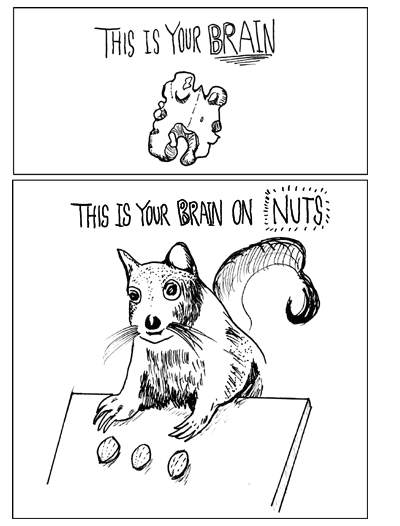
Fall is here. Embrace the wisdom of the squirrel and gather up your nuts. We need them more than they do.

One of the most ancient of foods, walnut fossils have been found dating from the Neolithic period over 8,000 years ago. Rumors of the walnut groves in the hanging gardens of Babylon have been circulating for some time, and King Solomon is said to have often strolled among his walnut trees “into the garden of nuts to see the fruits of the valley” (Song of Solomon 6:11).

In the Middle Ages, the “Persian” walnut became known as the “English” walnut as colonial-minded English sailors carted off loads of the nutty bounty and spread them about Europe, and eventually the “new world.”

Jupiter’s royal acorns, as the ancient Romans liked to call them, bear a suspicious resemblance to the human brain. That makes walnuts brain food in every sense of the word. They’re loaded with Omega 3 essential fatty acids, vitamin E, and minerals necessary for mental and heart health. It’s no coincidence that as our intake of omega 3s have decreased drastically, depression and heart disease have risen. Get this, slim jim: Your brain is 60% fat, and cell membranes will build themselves out of whatever fats are available. Omega 3s are the optimum choice, but most people fill up on omega 6s, found in polyunsaturated vegetable oils and animal products. An imbalance skewed towards Omega 6 fats are associated with inflamation, degenerative diseases, and mental disorders of all kinds, including increased violent activity. Sound like anyone you know?

Dr. Andrew Weil believes that the lack of Omega-3s in our diet is “the most serious nutritional deficiency we have in this country.” This deficiency is believed to be responsible for a wide range of diseases such as alzheimer’s, arthritis, ADD, diabetes, heart disease, PMS, and severe and manic depression. Omega 3 oils are found in oily fish, walnuts, flaxseeds, hemp seeds, and sea greens such as hijiki and kombu. They are essential for retinal function and vision, immunity, promoting good cholesterol, and cancer prevention.

Got the blues? Skip the sundae and go right to the nuts. Omega 3s stabilize moods and increase energy levels. They are also beauty oils, keeping skin youthful and glowing and hair soft and shiny. Get healthy and happy by replacing some of those 6s with 3s. How about a handful of walnuts as a snack or on a salad? How about some ground-up flax seeds? Why not? Let’s all learn how to cook up some delicious sea greens like Hijiki; it’s fun to say and more fun to eat.

Make certain to store shelled walnuts in the refrigerator (up to six months) to keep the oils from going rancid, as they can become carcinogenic. Chopped and ground nuts go bad more quickly than whole raw nuts. You can tell a bad bag of nuts by the smell – if they have the aroma of oil paint throw them away.

Enjoy a bag of organic raw walnuts or whole fresh walnuts from your local farmer’s market. Nothing says “I have arrived” like a big bowl of walnuts on your table and a nutcracker placed just so. You’ll have a potential moneymaker on your hands as well, playing the shell game with your friends. The increased walnut-fueled brain power is sure to benefit your sleight of hand.

“A Better Way to Cool Off” by Molly Frances (Arthur, 2006)

Originally published in Arthur No. 23 (July 2006)

The New Herbalist
By Molly Frances

“A Better Way to Cool Off”

As spring fever’s eager blossoming inevitably withers into the summertime blues, we seek quick relief among the abundance of icy blended concoctions that our advanced civilization offers us. Unfortunately, though that iced coffee provides a momentary respite on a balmy day, it will also quickly return you to a state of dehydration and turn up the heat of your internal thermostat.
The ingredient for the most soothing and refreshing of summer drinks is probably already growing in your garden. For a deeply cooling drink, brew up a tasty pot of mint tea.

A handful of the fresh herb plucked from your garden and tossed into a carafe of hot water will have you living the good life in no time at all. Be sure to include the stems of the plant. This tea may be served cold as well, but resist the temptation of pulling out your blender. Frozen drinks and ice cream will hold heat in your body and freeze digestion. To really keep extra cool this summer, avoid your freezer and enjoy your summer beverages without ice.

For a truly sublime experience, serve your friends a pot of Atay bi Na’na’. Made from boiling water, fresh mint, a small amount of green tea and honey to taste, Morocco’s most popular drink is consumed all day long. Usually served in ornate silver pots and small decorated glasses, it is customary for three servings to be offered by the host, who pours the tea from a distance of up to several feet above to aerate the brew and show off his skills. Practice this before the guests arrive.

In addition to its cooling properties, Mint tea settles the stomach and digestive disorders, eases migraines, and helps draw out infection upon first signs of a sore throat. The powerful antiviral properties of peppermint are due to its main active ingredient, menthol oil, which opens and heals sinuses, bronchial tubes, and vocal chords. It is also said to create a mentally stimulating and relaxing vibration that reduces stress and anxiety.

So what have we done to deserve this magical leaf? As the legend goes, Hades, god of the underworld, was busted by his wife Persephone in mid-frolic with a hot young wood nymph named Mintha. Persephone, who had been somewhat rudely snatched down to the underworld by Hades in the first place, was in no mood to overlook this infidelity and stomped the little nymph underfoot, transforming her into the plant we know today as Mint. In a gesture of atonement to Mintha, Hades would endow the plant with its sweet and unmistakable aroma.

Persephone may have extinguished Mintha in the flesh, but her spirit has lived on in this most promiscuous of plants. There are few lands that the wildly propagating mint has not traveled to, and few cultures that she has not seduced. As 16th century herbalist John Gerard declared, “The smelle rejoiceth the heart of man.” From Egyptian temples to Roman baths, Mint has been used for all varieties of healing and pleasure. The Pharisees even paid their taxes with it, as revealed by this scolding from Jesus: “Woe to you, Pharisees! You tithe mint and rue and every edible herb but disregard justice and the love of God.” Ouch!

While perhaps more prized for its pleasure-inducing than medicinal properties, the mint julep has been the preferred drink of the Southern Aristocracy. Accept nothing less than fresh mint, water, sugar, and Kentucky bourbon. As one of its key proponents, S.B. Buckner, Jr. warned in 1937: “A mint julep…is a ceremony… a rite that must not be entrusted to a novice, a statistician, nor a Yankee.” He instructs, “Go to a spring where cool, crystal-clear water bubbles from under a bank of dew-washed ferns. In a consecrated vessel, dip up a little water at the source. Follow the stream through its banks of green moss and wildflowers until it broadens and trickles through beds of mint growing in aromatic profusion and waving softly in the summer breezes. Gather the sweetest and tenderest shoots and gently carry them home.”

As Mintha clearly gets around, she has crossbred into hundreds of varieties including chocolate mint, basil mint, ginger mint, Persian mint, Corsican mint and Pineapple mint. All this intermingling frustrated one ninth-century monk, who declared, ” I would rather count the sparks in Vulcan’s furnace than count the varieties of mint.” The most popular forms are spearmint and peppermint, the former most often used in cooking but the latter more medicinally potent.

As Buckner proclaimed, “bury your nose in the mint, inhale a deep breath of its fragrance and sip the nectar of the gods.”

BAD GUYS: JOHN PATTERSON on “The Road to Guantanamo” (Arthur, 2006)

Originally published in Arthur No. 23 (July 2006)

Bad Guys
The Road to Guantanamo is a thoroughgoing demolition of the lies and unlimited incompetence of Powell, Bush and Rumsfeld says John Patterson

“We are Americans. We don’t abuse people who are in our care.” Thus spake Gen. Colin Powell in reference to the United States’ grotesque and immoral confinement of “unlawful combatants” at Guantanamo Bay in Cuba. Those remarks would have been news to the prisoners who committed suicide there recently, but also to the three kidnapped and incarcerated young Britons of Pakistani descent known as the Tipton Three—if they’d had access to news of any sort at Gitmo. It turns out that, having also been deprived of access to lawyers, the Red Cross or even their own families, the Tipton Three knew as little of the outside world for two-and-a-half years as the outside world knew of the goings-on inside Guantanamo’s gruesome Camp Delta.

Not any more. Thanks to co-directors Michael Winterbottom (24-Hour Party People, In This World) and Mat Whitecross, the Guantanamo genie is forever out of its bottle. Using interviews with the three men, who were finally released from Gitmo in March 2004, interspliced with harrowingly persuasive recreations of their journey to Guantanamo via Pakistan and Afghanistan, and of their terrifying experiences in US military custody, The Road To Guantanamo constitutes the first corroborated witness account of America’s Gulag to stand a chance of being widely seen in the United States, whose populace has hitherto seemed disturbingly content to snore its way through the progressive dismantling of its Constitution.

The shattering experiences of Ruhal Ahmed, Asif Iqbal and Shafiq Rusal – which included being abducted by Afghanistan˙s Northern Alliance and sold to US Forces as Taliban members (for a cool $10,000-per-head bounty—this is where our money is going?), solitary confinement, torture, 5-on-1 beatings, hoods, shackles, blinders, sensory deprivation and being witness to extrajudicial murders—make for a thoroughgoing demolition of the lies of Powell, Bush and Rumsfeld. American viewers, long accustomed to our child president˙s characterization of Gitmo inmates as “bad guys,” may find themselves asking how their own military could be so fascistic, so cruel and, most dispiriting of all, so fucking stupid.

Named for the West Midlands town where they grew up, the three young men flew to Pakistan, the home of their parents, to attend the wedding of one of their number, but also to enjoy a holiday in their land of origin, in the aftermath of 9/11. Foolishly, they took a side-trip into Afghanistan, where they were caught up in the US bombing of Taliban bases and cities, and then captured in the confused retreat from Kunduz.

Accused of consorting with Bin Laden and the Taliban, the Three in fact had watertight, easily verified alibis. Two of them were—and how hard is it to check this out?—on police probation in Tipton for petty criminal acts, the other had a full-time job. That wasn’t enough for their captors, gut-wrenching proof that American military xenophobia extends not merely to hated enemies, but also to valued allies. Unlawful combatants: meet unlimited incompetence.

The imagery confronting us in The Road to Guantanamo suggests that the United States has abandoned its sanctimoniously proclaimed fealty to such secular gods as Jefferson, Madison and Hamilton, only to replace them with Orwell, Kafka and Koestler. Two years of nonstop torture, interrogation and physical abuse—stress-holds, strobelights, earsplitting death-metal, enforced silence, isolation cells —strongly recall Gestapo or KGB information-gathering techniques, Room 101, Darkness at Noon. All that is lacking are electrodes, waterboards and clocks striking 13. And Big Brother? He’s already here. Learn to love Him.

AT HOME, AT WORK, AT PLAY: A listener’s guide to Sparks’ first 20 albums by Ned Raggett (Arthur, 2008)

Originally published in Arthur No. 29 (May 2008) (which also featured a lengthy interview with the Maels)

At Home, At Work, At Play
A listener’s guide to Sparks’ first 20 albums by Ned Raggett

There aren’t many recording artists in their fourth decade of recorded work whose new albums consistently merit not only attention but, more often than not, a round of applause. But Sparks were an unusual band from the start, so perhaps, perversely, their virtually unprecedented no-fade career arc is to be expected. The full story of the musical partnership of brothers Ron and Russell Mael is worthy of a thick book or two (or at least a really good documentary), but the basic body of their musical work—20 studio albums preceding their newest, the forthcoming Exotic Creatures of the Deep—can at least be talked about here. Not all are front-to-back classics, some may not even be keepers, but the standard of excellence is so high, the continuous artistic risk-taking so audacious, and the number and range of artists they’ve inspired in the last 35 years so vast—from Queen to Morrissey to Pet Shop Boys to Faith No More to Bjork to Franz Ferdinand—that even the rare misstep deserves examination. Onward, then…

SPARKS (1972)
Though L.A. performances and a number of demos helped get the initial word out about their distinctly unusual take on pop and rock—the demos still for the most part unreleased, though noted Sparks freak Morrissey has showcased a couple here and there over the years via compilations and show intro tapes—it was the self-titled debut album that first brought the Maels and company into the public eye.
Getting Todd Rundgren as producer was key. Probably no one else in America had both the relatively high profile to get the recording ball rolling and the artistic appreciation for the curious yet compellingly catchy pop the Maels and their band were creating. Balanced between a whimsical fragility and a dramatic rock punch that stacks up to any proto-metal group of the era, it’s not merely the tension between the sides that makes Sparks’ first album so memorable, it’s the fact that it’s so instantly enjoyable.
If, as the story goes, opening track “Wonder Girl” was a hit in Montgomery Alabama and nowhere else, it wasn’t because it couldn’t be hummed. It can. The band’s whole approach can be heard in this single song: the intentional use of a cliché in the title, Russell’s sweet-with-a-twist-of-sour singing (then and now, one of the most uniquely beautiful vocals in modern pop), Ron’s sprightly keyboards and lyrics which are sunny only if you’re not listening closely. But it’s also a tour de force of production—listen to the crisp hits of Harvey Feinstein’s cymbals and the almost electronic smack of the beats. On the rest of Sparks, songs change tempo on a dime, harmonies swirl in and out of nowhere, strutting rock snarling melts into boulevardier swing, with the monstrous album closer “(No More) Mr. Nice Guys” rocking just as hard as the similarly-titled song by Alice Cooper that it predates. The sense of theatricality so integral to Sparks is already present, but this is as far away from the inanities of such ‘rock’ Broadway efforts as Rent as you can get—and thank heavens for it. The whole shebang really is art rock without apology.
Note: This album was released under the original band name of Halfnelson, with the brothers then switching to Sparks after the prompting of their then-manager/label head Albert Grossman, who was convinced this was the key to success. There have been stranger solutions.

A WOOFER IN TWEETER’S CLOTHING (1973)
In some ways A Woofer in Tweeter’s Clothing is the first album redux. Unchanged lineup, same number of songs, and the first song on the album is, again, about a girl. But this time the stakes were a little higher:

Oh, no! Bring her home and the folks look ill
My word, they can’t forget, they never will
They can hear the stormtroops on our lawn
When I show her in…

Imagine that being sung by Russell with an almost sweetly diffident air over a chugging rhythm, with a chorus that soars down to the backing pseudo-Col. Bogey whistles and you’ve got “Girl From Germany,” one of the wickedest songs ever. From there Woofer’s could do whatever it damn well pleased, and did. Beergarden polka singalongs crossed with minimal drones that transmute into a rapid roll of drums, frenetic high-speed instrumentation and a mock Mickey Mouse-style letter-by-letter cheerleader/gangshout for the titular character, “Beaver O’Lindy.” A tune called “The Louvre” sung, but of course, in French, sounding—at least initially—like a random 1968 Beach Boys number drop-kicked across the Atlantic, trailing sparkling keyboards in its wake. A concluding song, “Whippings and Apologies,” begins like Stereolab warming up for a 20-minute freakout and then keeps stop-starting—including a great fake ending —so Russell can discuss the situations a tender-hearted sadist must face. “Do-Re-Mi”—yes, THAT “Do-Re-Mi,” from The Sound of Music, not one of the lyrics changed, turns into a high-speed gallop halfway through the second repetition of the words and gets even more over the top after that point. Nearly the whole album is so insanely fractured, and once again, so astonishingly catchy, that it’s hard to know what to highlight.
At the heart of the album lies “Moon Over Kentucky,” the only song bassist Jim Mankey wrote for the band (with Ron sharing the credit), and arguably the landmark of the first incarnation of Sparks. It’s all five members at their most dramatic, with the opening piano and wordless vocals given a steady, darker counterpoint with Mankey’s bass. This gets contrasted with verses shot through with a nervous keyboard rhythm, Feinstein’s rolling drums and a snarling riff that sounds like a Tony Iommi line delivered in two seconds. Russell yodels like a lost ghost somewhere in the woods and the end result feels like what Nelson Eddy and Jeanette Macdonald would have done if James Whale had directed one of their films, down to the horror-movie organ final flourish.

KIMONO MY HOUSE (1974)
What to say about an album that endless amounts of musicians openly refer to as a touchstone? The one that was Bjork’s first record she bought with her own money (“My mum and my stepdad didn’t like it and I did, so that was my statement.”), the album that turned Morrissey into the massive fan he is (“Ron Mael’s lyrical take on sex cries out like prison cell carvings. It is only the laughing that stops the crying. Russell sings his words in what appear to be French italics, and has less facial hair than Josephine Baker.”), the album with the cabaret-rock-opera sound that Queen, who were opening for Sparks at the time, would appropriate immediately? Where to begin? Easy—the beginning.
It starts, not like a thunderclap, but like a gentle shimmer of spring rain, a keyboard figure easing up in volume step by step. Then a voice zooms in, almost but never once tripping over itself at high speed, building up to the briefest pause, and then: “This town ain’t big enough for both of us!” A massive pistol shot rockets across the speaker range. “AND IT AIN’T ME WHO’S GONNA LEAVE!” The full band kicks in and it is all OVER. And it’s only just begun.
Kimono My House shouldn’t have been; had Ron and Russell decided not to take the chance they did in moving to London and signing to Island Records after initial UK appearances before the release of Woofer turned out splendidly, it wouldn’t have been. They did, and “This Town Ain’t Big Enough For Both of Us” crashed into the UK Top Five in early 1974 and what had been a low-key pleasure for some turned into pop star mania. Tales of suicides happily singing down to girlfriends in the still-living world, celebrations of the most exclusive genealogical background ever (concluding with “Gonna hang myself from my family tree”) and specifically uncelebratory non-holiday carols were suddenly all the rage. The lunatics hadn’t taken over the asylum, but their observers were genii at portraying their foibles in entertaining form.
The new backing band—guitarist Adrian Fisher, bassist Martin Gordon and drummer Dinky Diamond—weren’t necessarily as outré as the first, but as a crackerjack combo, perfectly in tune with the over-the-top glam hysteria of the day, they were essential. “This Town” is just one example of many songs displaying Ron’s ever-increasing compositional talents—consider other smash U.K. singles like “Amateur Hour,” with its quick, ascending main guitar line completely working against the typical descending rock melodies of the time and place, or “Talent Is an Asset,” a music-box riff accompanied by hand-clapping and foot-stomping rhythms celebrating the young life of one Albert Einstein. If Ron’s keyboards often times seemed drowned in the mix of the songs that he himself wrote, they weren’t absent—the organ adding further beef to the mix of “Here in Heaven,” the combination barrelhouse R&B swing and cabaret glow on the concluding “Equator.” Perhaps the album’s most emblematic song was “Hasta Manana, Monsieur,” with its lovely piano melody at the start and Russell’s bravura extended vocal break towards the end … oh, and the words too:

Leaving my syntax back at school
I was thrown for a loss over gender and simple rules
You mentioned Kant and I was shocked
You know, where I come from, none of the girls have such foul tongues.

And that was just one verse.

PROPAGANDA (1974)
Propaganda—featuring the band’s first outright classic album cover, showing the Maels as bound and gagged kidnap victims—was a logical follow-on from Kimono, much as Woofer’s had continued onward from the debut. The producer remained the same. The backing band jiggled a bit, with Ian Hampton replacing Martin Gordon on bass and Trevor White starting to handle the guitar. (Queen’s Brian May alleges the Maels tried to persuade him to join them by proclaiming his band were “washed up”—which makes that group’s Sparks-like breakthrough hit “Killer Queen” all the more eyebrow-raising.) Otherwise Sparks kept up the same glam-rampage approach. But here, everything was more in sync then ever.
The album begins with something new—an a cappela performance from Russell, his overdubbed singing providing wordless melody and rhythm as well as words, packing wartime slogans, militaristic imagery and that thing called love into about 20 seconds. Then a stentorian delivery from the full band heralds “At Home At Work At Play,” whose combination of volume, giddiness, hyperspeed melodies and Sparks-trademarked tempo shifts and pauses is clear evidence that by this time Sparks had come pretty close to being sui generis. Even songs like “BC,” which on this album feels just a touch like a “typical” Sparks number, would be utterly atypical for practically anyone else.
There’s a winsome jauntiness on Propaganda at points, musically if not necessarily lyrically, almost as if Ron and Russell were creating World War II vaudeville singalongs for their temporarily adopted home country. “Reinforcements,” playing around again with ideas of love and/as war, almost begs a high-kicking chorus line to back Russell on stage. In a different vein entirely is a power ballad of the most arch sort, “Never Turn Your Back On Mother Earth,” which has it all: strings, heroic guitar solo, a lot of background echo (check out the drums at the end!), Ron on what must be harpsichord, and a beautifully alien mid-song break where Russell sings in fragile tones over heavily flanged violins. On the lyrical front, Ron’s eye for the knowing cliché in the title again reigned supreme—besides “At Home At Work At Play,” we get “Thanks But No Thanks,” “Something For the Girl With Everything” and the concluding “Bon Voyage.” And then there’s “Achoo,” probably the only song in existence with a sneeze as its title. And even if it isn’t, it’s definitely the only one that starts, “Who knows what the wind’s gonna bring when the invalids sing.”

INDISCREET (1975)
Indiscreet ended up being the conclusion of Ron and Russell’s first run of hit UK albums, as well as their English residency. If nothing else, they wrapped it up in style, working with an emblematic producer of the era—fellow US expatriate Tony Visconti, whose collaborations with T. Rex and David Bowie helped define the times as much as anything. It turned out to be an inspired combination as Visconti’s ear for orchestral arrangements, familiar from T. Rex’s many singles, was in top form. The result is a rich sounding album, a big-budget effort that doesn’t sound overblown.
The band personnel remains essentially the same from Propaganda, though songs like the opening “Hospitality on Parade”—part neo-Gilbert and Sullivan triumph, part hypnotic proto-Suicide drone—suggest that the Maels were starting to feel that their band was holding them back creatively as much as they were crucial to their success. That tension shoots through the entire album, with more conventional rock-band compositions contrasting sharply to such songs as the merry 1930s kick of “Without Using Hands” or the wonderfully energetic big-band recreation of “Looks, Looks, Looks.” “Under the Table With Her” is that tendency in excelsis, with string and flute accompaniment as the sole musical element to match one of Russell’s most elfin vocals.
That said, the Sparks instinct for pop smashes in their own particular vein remains strong. There’s the careening blast of “Happy Hunting Ground”—the mid-song dropout to just drums and vocals is sheer pleasure and opening single “Get In the Swing” is an everything-and-the-kitchen sink affair with a marching band strut, band majorette whistles, a message from God to his creations and the memorable line “Well I ain’t no Freud, I’m from LA.”
The sleeper hit, though, has to be “Tits”—a thematic sequel of sorts to the previous album’s “Who Don’t Like Kids,” but which, in its slow unfolding musical drama, resembles the epochal “Moon Over Kentucky,” shot full of sequins. For all the celebrations of the female bosom in pop music before and since, this is probably the only one narrated by a married man complaining over an increasing number of “drinks that are something warm and watered down” about how the presence of a kid alters a certain dynamic in their household:

Continue reading

Sunday, Public Fiction, 8pm, L.A.: TRINIE DALTON, RON REGÉ, JR. and CATHERINE TAFT

PRESS RELEASE TEXTAGE

RAINBOWS, CAPRICORNS, VIRGOS & ALCHEMY…
This Sunday March 13th please join us for a series of events at THE FREE CHURCH:

Beginning promptly at 8pm:
A lecture about rainbows by TRINIE DALTON:
Trinie will give a slide-talk about rainbows what they are, how they’re formed, and their roles in the history of art, spiritualism, mythology, and color theory.

at 8:45pm
A video screening curated by CATHERINE TAFT:
Catherine Taft presents a Capricorn/Virgo-inspired selection of videos by Dale Hoyt, Lauren Lavitt and Andrew Steinmetz

and at 9:30pm
RON REGÉ, JR. will read (and project!) comics from The Cartoon Utopia concerning the basic tenants of Alchemy and Hermetic Philosophy in Fairy Tale.”

This event will be situated in LUX, an installation by Maureen Keaveny

come!

Public Fiction in Highland Park
749 Avenue 50, 90042
http://www.publicfiction.org/

SERIOUS FUN: Sparks, interviewed by Chris Ziegler and Kevin Ferguson (Arthur, 2008)

Originally published in Arthur No. 29 (May 2008) (which also featured a massive Sparksography by Ned Raggett).

SERIOUS FUN
Chris Ziegler and Kevin Ferguson visit veteran sui generis pop duo SPARKS in L.A. as they prepare to perform their 240-song oeuvre in a single month-long London engagement in May. “We’re actually better than we thought,” say the brothers Mael…

Sparks have about 60 days to finish learning the five million notes necessary to reproduce live their entire 38-year discography—20 old albums, select b-sides, one new album, and a special song for anyone willing to buy tickets for the entire month-long event in London—but brothers Russell and Ron Mael remain relaxed and ready in Russell’s home studio, where a portrait of Elvis watches over rehearsals so intense that Russell can’t stop singing his songs even in his dreams. Brand-new album Exotic Creatures Of The Deep will debut live this summer in London after prior nights each dedicated to an existing Sparks album—a marathon physically and psychologically and an occasion to revisit a band almost totally untangled from the industry music mess just miles away from Russell’s Los Angeles home…

Arthur: Ron said that you’ll be playing 4,825,623 notes during the complete 21-show run. That works out to about 230,000 notes per album and maybe 34 notes per second. Does that seem accurate?
Russell: On some of the early albums it’s probably true—the Island albums are probably 64 notes per second. Those were really hyper.

Did doing that kind of statistical analysis on your lifetime of work reveal any greater truths?
Ron: It’s actually a leveling. A lot of the ones we had maybe less love for are kind of good in retrospect. It would have been sad to go back and realize they weren’t very good.
Russell: Fortunately that wasn’t the case.
Ron: But we are prejudiced.
Russell: We’re actually better than we thought.

So you’re not nervous.
Ron: We’re still nervous. It’s awesome.

Awesome in the sense that building a pyramid is awesome?
Ron: On all kinds of levels. It’s like going back to school. We haven’t even heard most of the songs for 20 or 30 years, and most of them we never played live anyway, so part of the process was figuring out how to do that. We couldn’t cut any corners—we’re doing everything, including a lot of b-sides as well. We’re figuring out how to be true to the original records and doing it live. It’s a good concert experience.

Are you offering any kind of Sparks Value Pack for the entire run?
Russell: The golden ticket! For that you also get—we’re gonna record one song and give a CD of this one song to the people that choose to dedicate an entire month of their lives to Sparks. That warrants receiving a song that no one else will get.
Ron: And there’s gonna be at least one book or maybe two about the whole experience afterward, and we’re thinking if we can get up the energy, we’ll try to keep a journal.

Why no hometown show in Los Angeles?
Ron: We have a larger following in London. It’s so expensive to put this on that the only viable way was to do it in London.

Will you be including any Sparks alumni in the live bands?
Russell: Each of the bands had a certain character to them—someone even suggested it’d be great if we had each of those bands. In a conceptual way, that’s good. In a practical way, I don’t know if it would work. It’s a real test to find people—the fans who are going to spend a month of their lives with us, and then for the band, musicians who want to stick it out for three-and-a-half months of preparation, which is unheard of. When you prepare for tour, you have maybe 20 songs, and this is 240. And you might say, ‘Oh, that’s not so hard,’ but when you think of songs on the albums that fade out and you have to have an ending for that song now. To figure things like that out times 240 is so time-consuming. Just the sheer volume you have to digest.

Are you dreaming Sparks songs yet?
Russell: I’m singing songs when I wake up—I swear. And it’s not a happy dream. It’s like, ‘Oh my God, I can’t even shut them off!’

Can you think of an equivalent to the total creative energy invested in the Sparks discography? Half a cathedral or the Pennsylvania tablet from the Epic of Gilgamesh?
Ron: It could never be done by a visual artist, really—we don’t feel like we’re doing imitation, and we don’t see them as finished, necessarily. When we play live, we’re kind of inventing them again. You hear of classical musicians that do a composer’s complete piano works—that kind of thing. But this is kind of trickier. I don’t know for a fact because I’ve never done that, but it seems like more things are involved.
Russell: We’d be allowed to read music, but we don’t read music.

Continue reading

C & D: Two guys reason together about some new records (Arthur No. 23/July 2006)

Originally published in Arthur No. 23 (July 2006)

Ethan Miller of Comets on Fire onstage at ArthurFest, 2005 (photo by Jeremiah Garcia/IceCreamMan.com)

C and D: Two fellas reason together about some new records

C: We resume not far from where we left off last issue. Only without D, our lovable excitable German, who has vacated the rumble seat to return to Der Fatherland to observe the World Cup. In his place, quaffing D’s beers for this issue only, ladies and gentlemen of the court, may I present to you: F.
F: Happy to be here, C. Those are big shoes to fill.
C: Relax. After three beers and the proper auditory stimulation, your feet will swell to fit.

Comets on Fire
Avatar
(Sub Pop)
F: After five seconds of this record, I can confidently say: Comets on Fire, you made an excitable German out of me. Pummely stuff.
C: This blasts off from where their last record left off: frequent flyer acid rock mentality, virtuous verses and choruses, oodles of audible poem lyrics, spry jams, and serious assblasting. A couple songs are slow burners…
F: …that put the power back in balladry.
C: The album-opening epic “Dogwood Rust” slithers into a Hawkwind-Ash Ra Tempel-Stereolab-Oneida locked groove around the six minute mark, then ignite into dueling guitar spirals, then some Von Harmonson echotronix. Plus the kind of casual avant garde move that’s so natural you almost don’t notice it: the electric birdsong at end of “Jaybird,” a nice fresh-air breather.
F: A muscle-relaxer for the brain.
C: For me, this album plugs back into what their labelmates Sleater-Kinney did on their most recent album: laying sweet waste to the center of Ted Nugent’s mind by power tripping from the top of the randiest redwoods. This is the Comets’ answer record, at least in my personal universe.
F: I grok that. Fight fire with Fire! Those dark noontide chimes at the beginning of “The Swallow’s Eye,” and the chorus guitars on “Lucifer’s Memory”…it’s crystal clear: Cosmic soul rock kills pain dead.
C: And it arrives just two months after the Howlin’ Rain album. Howlin’ Rain, of course, is the new band spotlighting Comets on Fire singer-guitarist Ethan Miller’s songwriterly aspect, which leans to the Allmans/Dead/Faces side of the highway. And just a few months after Comets guitarist Ben Chasny’s latest Six Organs of Admittance pan-cultural acid-folk stunner, The Sun Awakens.
F: Not to mention Comets pianist/drummer Utrillo’s nuevo Elton John/Bill Fay song project, The Colossal Yes.
C: That one 11-minute song on the Colossal Yes album? Wow… [listening to “Holy Teeth”] But back to the album at hand. This is total High Rise/Acid Mothers Temple/Kiss destruction boogie.
F: A strange thing about “boogie” is it’s been Not Cool for a period about ten times longer than it was Cool. [standing up from the couch] But it never left my behind!
C: [averting eyes, mumbling] Christ, F. Boogie if you must but please do it where I don’t have to see it. This one [“Sour Smoke”] is like keyboard-driven Fela Kuti meets Television. Can a band be this good?
F: Felavision: I wish they had that on the Dish.
C: Call your cosmic cable company…
F: To paraphrase Foster’s: Comets on Fire—it’s American for rock.

Vetiver
To Find Me Gone
(diCristina)
F: The second album from San Francisco’s haziest, gentlest canyon-folk drifters, Vetiver.
C: There’s a bucolic feel to this I love.
F: True, but what’s up with the word “bucolic”? The sound of words should correlate to their meaning, and there’s something about “bucolic” that always makes me think of a baby with a wet, hacking cough.
C: Whereas this music would more likely cure a baby of such a cough.
F: Readers with babies might let us know how it works…
C: Vetiver’s music evokes all those little phases or episodes along a dayhike in the country: the initial entry into the wilderness…the part where you’re making serious headway, alone with your thoughts…the moment when the senses are overwhelmed by the nature stimuli, the dew and the sap, the sun’s heat and the insects’ hum…when you finally you stop for water by a brook, and take a nap in the shade. When Andy Cabic sings, “I climbed so high/the sky dropped down to teach me,” he’s tapping into the naturalist in all of us.
F: I heard somebody say you could call this kind of music ‘naturalismo.’
C: I also heard somebody say that the real reason music originating from the West Coast underground—all the aforementioned bands, Brightblack Morning Light, etc etc etc—is so beautifully gone right now is because of the high potency of the marijuana out here.
C: While I am not stoned at this time, I swear I just looked out the window and saw a burrito fly past.
F: Yeah, that’s Vetiver, working the California tradition: Flying Burrito Brothers, Neil Young, the Mac of course, the original Charlatans from San Francisco…
C: And of course the late under-lamented Beachwood Sparks, whose final EP had some of this same swooshy nature euphoria and next-afternoon melancholia. Not that this is mimicry. Cabic’s songwriting here goes beyond recidivist texture gesture. It’s a very subtle, tricky thing Vetiver does, mellowing the harsh but resisting the corn. They use violins instead of fiddles.
F: Whoa, this song [“Red Lantern Girls”] is amazing! It’s like a horse just trotting along, and then alluvasudden, this squalling and sustained one-note electric guitar solo [courtesy of guest Brad Laner (Medicine/Electric Company guitarist-composer)] kicks in and the band breaks into a gallop.
C: Vetiver: cures coughs, cleanses palates. Use hourly.

Awesome Color
Awesome Color
(Ecstatic Peace/Universal)
C: Whoa!
F: Yowza!
C: These guys get on that train and ride it back to Cincinnati 1969! Total Stooges in Iggy’s-Got-the-Peanut-Butter-Again mode…
F: Yeah, but even more than that— Sound of Confusion-era Spacemen 3, especially on this track “Dinosaur”: that’s the sound of a band refusing to learn more chords or grooves because they already found the best ones.
C: Concentrating on tone and psychotic drive, like all the greats, like our national treasures The Cramps and Tav Falco and of course the 13th Floor Elevators…Awesome Color are…uh…awesome.
C: I’ve got to admit that my inner adolescent thinks this is the coolest shit possible.
F: I hope they’re all under 18, and there better be some brothers in this band.
C: This song [“It’s Your Time”] features some actual choogle.
C: Which brings us to the question that has haunted many a rock fan: what, exactly, is the difference between the boogie and the choogle?
F: Would that be choogie or boogle?

Zizek! dvd
(Zeitgeist)
C: Dude, I’m trying to play this DVD, but you totally messed up my system while reconnecting the TV to the stereo so you could watch the World Cup in surround-sound.
F: I think that D, absent as he is, would’ve approved. Anyways, it was worth it to hear the Mexican TV commentators hollering so sonorously.
C: Okay, here we go… This is a documentary about Slavoj Zizek, the Solvenian philosopher who’s known as “a one-person culture-muncher” and “the Elvis of critical theory.”
F: He looks more like Klaus Kinski. Or Yakoff Smirnoff.
C: Blame it on the beard. Zizek’s basically this super erudite dude who is also a willfully contrary polemicist commentating on everything under the sun as he goes. As he says, “The duty of philosophy is to redefine problems, not to solve them.” Here he is on a tour of colleges…he sees a girl carrying some Evian and remarks, “Water in a bottle —it reminds me of socialism.”
F: This guy’s great! Reminds me of the biting, death-obsessed comedy of the late great Brother Theodore. I believe Zizek speaks as a friend although he expounds with fiendish fervor.
C: Fiendish fervor is right. Zizek is a pre-postmodern man. He was raised in Communist Yugoslavia, but when that all went to bloody hell, he became a Christian atheist.
F: I knew I dug this guy. He’s got some zingers, like when he talks about being “up to your shit in ideology.”
C: Zizek cuts through the tripe. Here he is watching an old televised broadcast of Lacan giving a lecture. Lacan is one of Zizek’s primary influences, but he is not in awe of Lacan: “I find his emphasis and gestures ridiculous…. I’m a total enlightenment person, I believe in clear statements.”
F: Like Zizek says: “I always tell the truth. Not the whole truth, because one can’t.”
C: My favorite part about this film is where Zizek proudly shows us that he keeps his clean laundry in the kitchen cupboard.
F: You’ve got that much in common…

Beavis and Butthead: The Mike Judge Collection, Volume 2 DVD
(Paramount)
C: Meanwhile, at the other end of the philosophical spectrum…
F: Beer me!
C: Y’know, there’s so much product that comes out these days, so many records, DVDs and CDs, but I still feel like there’s a void Beavis & Butthead left that remains unfulfilled.
F: Hey, Zizek’s doing his best.
C: Hard to imagine Zizek calling Lacan a “dillhole” though. It would be so cool if they made a new Beavis & Butthead movie, like, checking in with them ten years later…
F: In the meantime, creator Mike Judge is putting out these super-packed DVDs, and it’s amazing to watch the classic cartoons uninterrupted by erase-your-blemish commercials.
C: The titles alone are remarkable: “Wet Behind The Rears” — “Premature Evacuation”—”Here Comes The Bride’s Butt.”
F: “Bang The Drum Slowly, Dumbass.”
C: I love when the screen goes dark, right before the show starts, and you can only hear their immortal “hunh-huh-unh” laughter. Ohmigod, I love this one, where they go in to the plastic surgeon to get their “thingies” made bigger, but [uncontrollable laughter] instead the doctor gives them boobs! [falls off the couch]
F: Settle down, C. How many brownies did you eat?
C: I dunno. Is the baggie half full or half-empty, buttmunch?

Phi Ta Khon: Ghosts of Isan dvd
Directed by Robert Millis
(Sublime Frequencies)
F: Feature-length film about a weird three-day street festival in Thailand, sometimes referred to as “Mardi Gras from Hell.” Whoa. Talk about awesome colors.
C: You see, this is what America should have learned from pre-Katrina New Orleans. All this industrial technology and computer whatsits and the Intervoid is so much unnecessary fuzz. To coin a paraphrase, what the world needs now is less competitive work-laboring and more communal partying.
F: Preferably in blazing demon masks made from cocount husks.
C: Yes, decadence on the cheap. Whiskey drinking at dawn and total second-line parades featuring guitar-and-flute ragas on flatbed trucks, amps powered by car batteries, people waving hand-painted papier mache phalluses with strange tips. When the grid crashes, this is how I hope we’ll party. Of course we’ll probably have to wait til then. You’d never be able to get a permit for something like this in public in America, home of the so-called free.
F: I like the Sublime Frequencies approach. They stand in awe of this planet’s inhabitants’ strange beauty: they bear witness. They just say LOOK, they don’t even try to explain—well, not much—what’s going on. Their approach is, This shit is so deep you don’t even have to know anything about what it is you’re seeing to receive some its power. It’s that rich. They’re busy grokking. They’re feeling fascination.
F: They are the real human league.

Continue reading

“Rage, Rage Against the Stuffing of the Couch” by Peter Relic (Arthur, 2006)

Originally published in Arthur No. 22 (May 2006)

PETER RELIC’S BOOK CORNER

Rage, Rage Against the Stuffing of the Couch
Two poets delve deep into worlds of work and non-work

Reviewed:

Alex Mitchell
Life Is A Phantom K-Mart Horse Starting Up In The Middle Of The Night
(Yahara Design Press, Madison, WI)

John Tottenham
The Inertia Variations
(Kerosene Bomb Publishing, Los Angeles)

If their styles couldn’t be more contrary, they do have one thing in common: poets Alex Mitchell (neckburned nailgun grindhouse tripper) and John Tottenham (couch-crowned prince of lethargy) have both created, by force of will or resigned declension, their own poetic form.

Mitchell is a rock’n’roll addicted sweetly emotional fellow traveler. His poems are as much about himself as the characters they co-star: a mushroom-juicing buddy from back in Pompano Beach with a suicidal brother; a friendly transvestite crackwhore outside a Hollywood 7-11. He is as much of the barroom as he is anti-boardroom, his impulsive tales [impulsions] leading us through corners of associative memory emotional and imagistic. There is a lot of power in his poems—they inspire you to write, my highest praise. In a poem called “if penguins could talk” Mitchell is a bruiser with a bruised heart (“once a speedfreak, always a speedfreak,” he writes) trying to quit Starbuck’s. After going without coffee for two weeks (“although I was feeling better physically I was jonesing for a blast”) he caves: “I greedily slammed down some of / evil black poison.” And then he’s off on a tale that goes for five pages.

Tottenham’s eight line withdrawals from ambition barely give the reader time to get out of bed, and he wouldn’t have it any other way. A resigned indentation is what he wishes to leave (if he aspires to anything at all). In poems like “Time Moves, But Not I” and “I’m Not Tired,” he discharges himself of will, while subtly sublimating his own state of stagnation. He declares he lacks the energy required to laugh, and one chuckles. The brief nature of his poems allow him to maintain the guise that he isn’t doing shit—but when you read them together, you feel the import of the block he pushes up against the eternal pyramid of poetic ambition, and one realizes: all progress is incremental…to the point of imperceptibility..despite any onanistic self-recrimination.