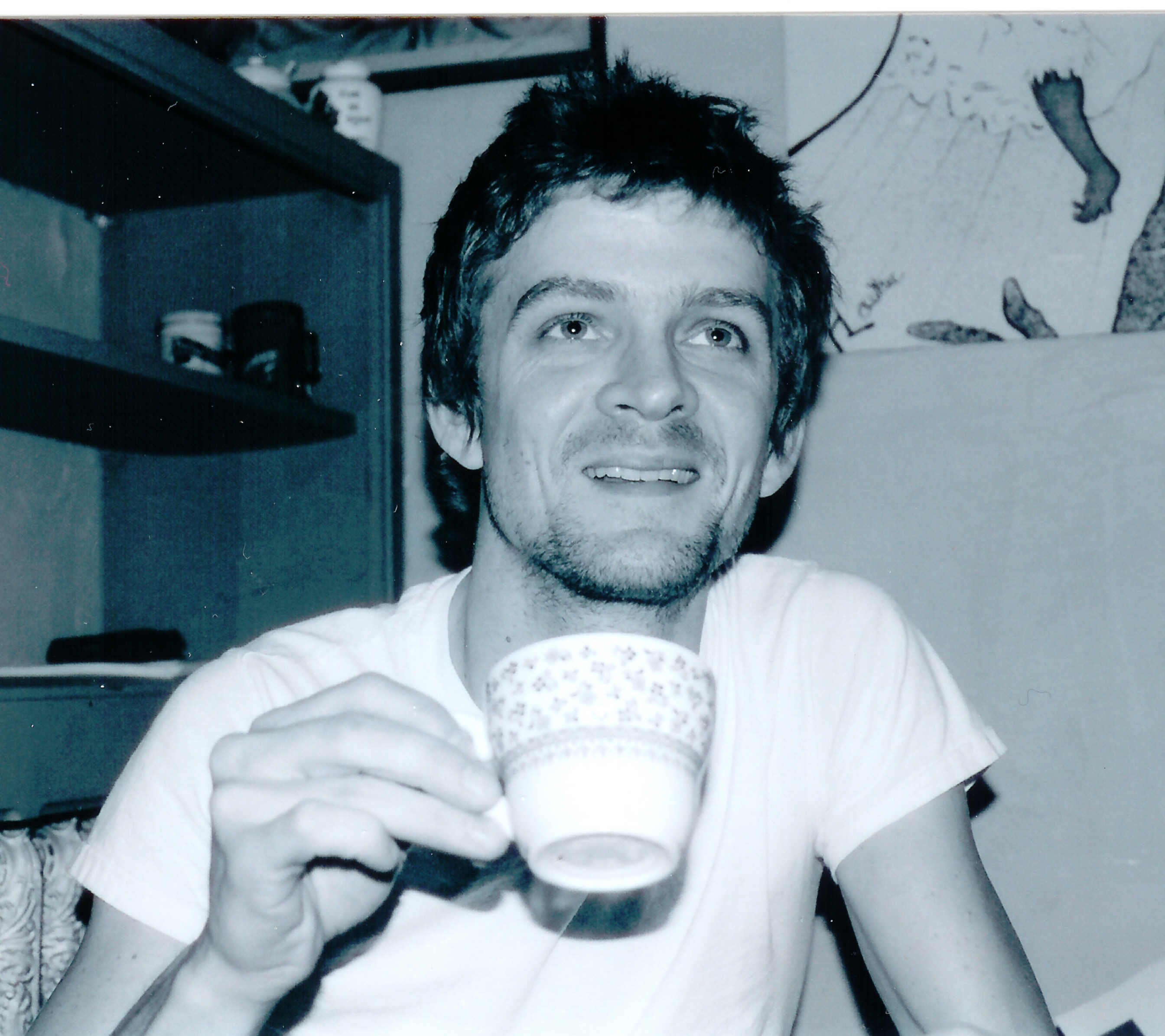
If a band rocks in the woods, will anyone hear them?: Brian J. Barr on PEARLS AND BRASS (Arthur, 2006)

SONS OF NAZARETH

How blues rock thunder chooglers Pearls & Brass found their sound in rural Pennsylvania.

by Brian J. Barr

Photography by Maria Tessa Sciarrino

Originally published in Arthur No. 21 (March, 2006)


I.

Pennsylvania is a gentle state, its curving hills blanketed by lush maple, oak and chestnut trees whose leaves all turn to a dazzling spectrum of red, orange and yellow each year around October. Over the past several million years the glacial run-off carved deep river valleys into the land, and in the mid-state region left the soil flat and fertile enough for farms and high school football fields. Outside the concrete sprawl of Pittsburgh and Philadelphia (the port cities bookending the southern region) Pennsylvania is pock-marked by countless factory and agricultural towns, nearly all long past their economic peak.

Pearls and Brass hail from Nazareth, Pennsylvania, a rural nowhere of about 6.000 situated near the New Jersey border, a mile from the Appalachian Trail that stretches from Maine to Georgia. The Martin Guitar factory, maker of acoustic guitars, is in Nazareth; so, too, is the Nazareth Speedway. But like most rural Pennsylvania towns, Nazareth is desperately non-descript; its smallness is its defining characteristic.  

“Nazareth was your typical small, working class town,” says Randy Huth, Pearls and Brass’ guitarist and vocalist. “Not a whole lot going on, y’know. But that pretty much made us do our thing.”

Alumni of Nazareth High School, the members of Pearls and Brass (Huth plus Josh Martin, drums; Joel Winter, bass vocals) come off as sincere and plainspoken guys whose roots run deep through their town. Together, they play a bluesy power trio rock that has as much to do with Skip James as it does Blue Cheer; loud, melodic, eerie and crammed with enough riffs to dizzy Tony Iommi or Matt Pike. It’s as if they successfully boiled down the basics of the blues, cranked the volume and carried on the tradition of early Black Sabbath and The Groundhogs. Not to mention they narrowly avoided a case of blue-collar ennui by investing in the healing powers of rock n roll.

If we are to ascribe a myth to Pearls and Brass, it will be one of “local boys make good” romanticism. One imagines Pearls and Brass as the Cobainesque outcasts of Nazareth High, taking refuge in their record collections and loud guitars. We picture them drinking whiskey and smoking grass in a parked car out in the middle of the woods on Friday nights while their classmates cheered on the home team. Most likely they’re holding down low-paying jobs to afford their vices; bagging groceries at Giant Food or bussing tables at De Nisi’s Family Restaurant, whatever teenagers do to get by in these places, the weary townships of rural America. 

If we were to ascribe such a myth it wouldn’t be far from the truth. Huth, Martin and Winter went to school, smoked grass, worked shitty jobs, went for long walks alone in the woods, playing guitar. Individually they’ve spent their post-high school years either in-and-out of college, or employed at labor-intensive, low-wage jobs. As a band, they’ve released a single little-heard album on a tiny label—2003’s Pearls and Brass, on Doppelganger—which may have sold in the low triple digits. They’ve never toured for more than two weeks. 

And yet, despite this relative isolation and obscurity, Pearls and Brass scored a gig at February, 2005’s Slint-curated All Tomorrow’s Parties festival at Camber Sands, recorded a new album in California with Fucking Champs’ Tim Green, and have found a higher profile home at indie label Drag City—all the result of a single right-place, right-time event. 

Continue reading
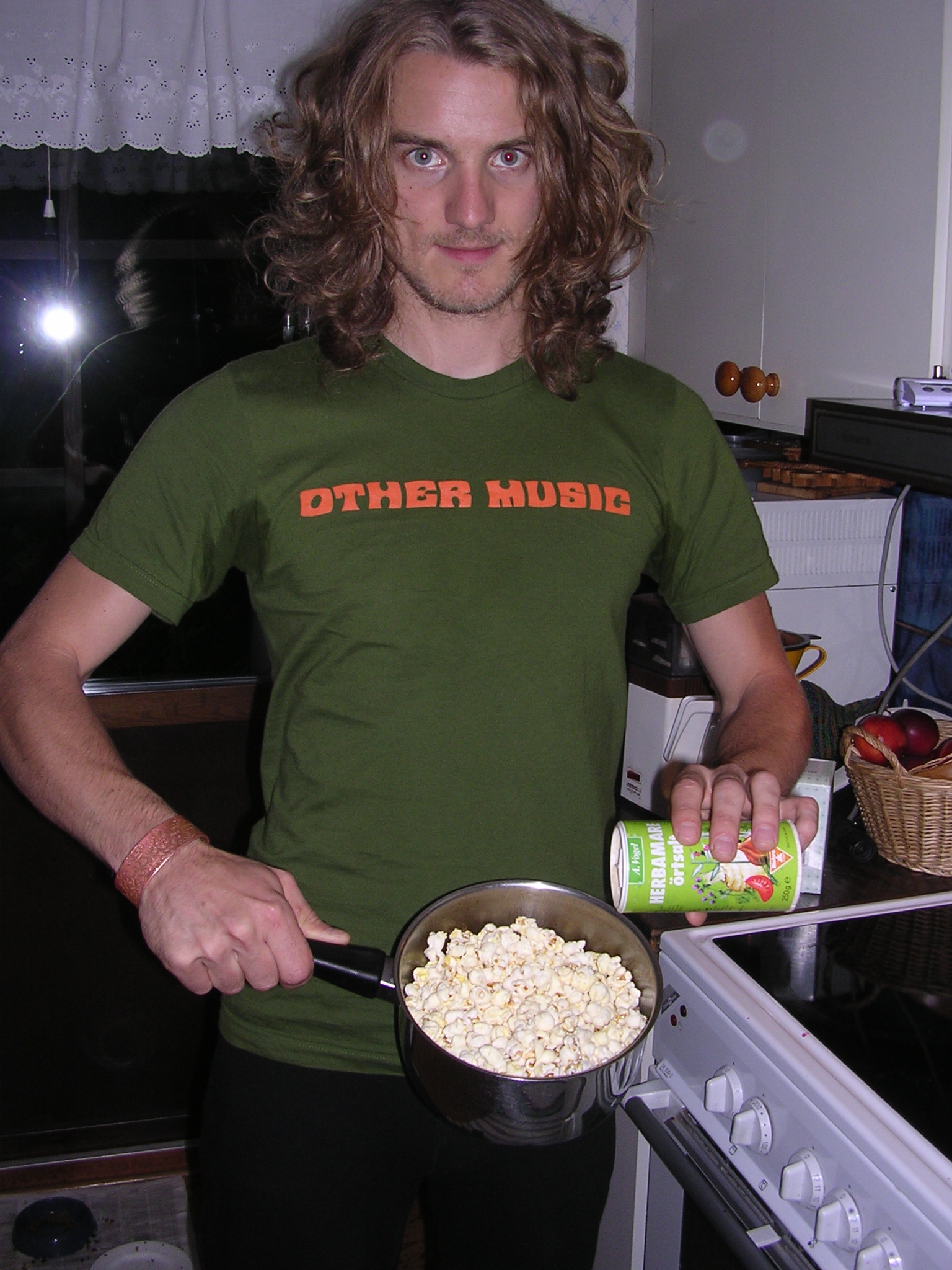
Dungen’s Popcorn in 16/4 (Arthur, 2005)

Come On In My Kitchen

Dungen’s Popcorn in 16/4

Originally published in Arthur No. 18 (Sept. 2005)


Dungen is a prodigiously talented twentysomething Swede called Gustav Ejstes, whose sunnily melodic psychedelic delight rock, much heralded in the music press when his album Ta Det Lungt was available only as an expensive import (see Arthur No. 14, Jan 05), is finally getting a proper American release late this summer via the kind hand of Kemado, who’ve changed nothing—every lyric is still Swedish, every tune is still universal—and added something (a disc full of bonus tracks). Here’s Gustav’s recipe for popcorn—something familiar, something added…

Gustav Ejstes of Dungen: I used to be called the king of pop. Not to be confused with Mr. Jackson’s title in the ’80s music press. This refers to the art of making good-tasting popcorn. It is probably the ultimate snack, but could also be the most delicious substitute for a well-made meal. 

The thing is, my skills as a Swedish chef are a bit limited. I have never been interested in learning and that has led to experiments with the  interesting vegetable corn. Did the Indians discover it first? Is it healthy or not? 

I think it is. I have survived for days by only eating popcorn. And now you all say: making popcorn is the easiest thing to do. Well, if you choose to use microwaved popcorn maybe, but if your only tools are a pot, oven, oil and salt, it suddenly gets a little bit more complicated. The secrets behind my well-tasting popcorns are olive oil and herbal salt.

Everyone knows the basic recipe for making it, but here are a few tricks that you can pick up that will help you avoiding some of the classic mistakes: for instance, half of them stays un-popped, or all of it gets burned.

Fill the bottom of the pot with popcorn and drench them in virgin olive oil and add some herbal salt. Herbal salt is made from pure certified organic ingredients. I use the Herbamare brand, which is based on Swiss naturopath Alfred Vogel’s formula: it’s made up of sea salt, celery stalk, celery leaves, leeks, watercress, garden cress, onions, chives, parsley, lovage, garlic, basil, marjoram, rosemary, thyme and kelp. 

Electric stove: Start out at high heat. When they start to pop, lower the heat to medium. Wait until there is four seconds between the pops, take off the lid and add some more herbal salt, put on the lid and your favorite record and shake the pot in 16/4 beat and then take it off the stove and call your friends. It’s time to eat.

Gas stove: Start out with full temperature, but since gas gets hot quicker, make sure you turn off the heat as fast as you hear the corns begin their dance inside of the pot. When using a gas oven it is even more important that you shake the pot in 16/4 beat to your favorite record, otherwise the popcorns gets as burned as Swedes on an Asian holiday.

Mike Patton’s “Carne Crude Squarciata Dal Suono Di Sassofono” (Arthur, 2005)

COME ON IN MY KITCHEN

What Mike Patton learned in his days of toil at Benihana’s

Originally published in Arthur No. 16 (May 2005)


Few working vocalists have done as much with their vocal chords as ex-Faith No More frontman Mike Patton. In the years since that Bay Area bizarro rock band’s demise, Patton has built an impressively wide-ranging C. V., including collaborations with jazz composer John Zorn, Japanese noisegod Merzbow and hip-hop concept squad the Handsome Boy Modeling School. His latest projects to see release through Ipecac Recordings, the post-genre label he co-founded and co-owns, are Suspended Animation—a bonkers 30-track tribute to the month of April by his band Fantomas (featuring members of Slayer, Mr. Bungle and Melvins)—and the battle album, General Patton vs The X-ecutioners, featuring turntablists DJ Rob Swift, Grandmaster Roc Raida and DJ Total Eclipse. For his turn in the Arthur kitchen, Patton selected a dish that was featured on his record of futurist recipes Pranzo Oltranzista: Musica da Ravola per Cinque (Banquet Piece for Five Players), released on Zorn’s Tzadik label in 1997. The tracks were instrumental but had sounds associated with cooking and eating—chopping, slicing, chewing, etc.—while the booklet contained recipes. Says Patton, “This is one of my favorites.”


Carne Crude Squarciata Dal Suono Di Sassofono

(tr. “Raw meat torn by saxophone blasts”)

Cubes of beef marinated in rum, cognac and white vermouth are served on a bed of black pepper and snow. Each mouthful is separated by saxophone blasts blown by the eater himself.

Have a Cup of Brendan Benson’s Tea (Arthur, 2005)

Come On In My Kitchen

Have a Cup of Brendan Benson’s Tea 

Originally published in Arthur No. 15 (March, 2005)


It’s nice to know that the meticulous and charming nature of Brendan Benson’s songwriting carries over to his kitchen as well. Thanks to the track “Tea” on his debut album, letters from die-hard Japanese fans are usually coupled with a bag or two for Benson’s boiling. His latest album, Alternative to Love, is out March 22 on V2. Here’s how to make the perfect cup of tea, as told to Ben Cass.

What you’ll need

Water: This is the most important ingredient. It should be clean, but not loaded with chlorine or other such additives. I take it from the tap, but I’m fortunate to live in a city which boasts a premium grade drinking water. Others may not be so lucky and therefore should substitute using bottled water (just remember: no Coke or Pepsi products, as they undergo a heavy treatment process and are stripped of all character. I recommend Evian or Volvic). Water has flavor, however subtle it may be, and a little of that “regional essence” in the water is a good thing when making tea. If you dislike the taste of your tap water, you might try letting it stand or “mellow” in a clean glass for an hour prior to boiling, thereby allowing the detergents to evaporate and the particles to settle. Pour the water into your kettle, taking care to not disturb the sediment.

A kettle: I have the electric variety which I like very much. You may also use the stovetop variety. I don’t recommend using a cooking pot as it only provides for a poor aesthetic. Attention to such detail is critical in the tea-making process.

Tea bag: I’ve chosen to use the tea bag over the teapot for our purposes. Although the teapot method is more desirable, the tea bag will do just fine as long as it is of the highest quality. Twinnings, Red Rose and Lipton, contrary to popular belief, are not teas suitable for drinking at any time by any man. Avoid these brands at all costs. Ideally your tea should be purchased somewhere in the UK from an ordinary grocery store. Brands such as PG Tips and Tetley are good. Barry’s is a wonderful tea but not as common. If it’s not convenient for you to travel abroad to buy tea then I suggest you search the Internet. I’m sure there is a service from which you can order tea from the UK. Yet another option is to buy Tetley “British Blend” bags if you can find them. Nothing else will do.

Milk and Sugar: Your tea must contain milk in order for it to be deemed proper.  Milk neutralizes the tannic acid found naturally in tea. Cream should never be used. Organic, 2% milkfat is ideal; whole milk may be used, but often eclipses the delicate flavor of the tea. Skimmed milk should be avoided. If you are lactose intolerant perhaps you might try an herbal tea (which I personally despise) instead, but under no circumstances should lemon be used as a substitute. Sugar, on the other hand, is an option which you may choose to forgo. I take a little sugar to excel and enhance the effects of the tea.

What to do

Bring water to a rolling boil and let stand for 30 seconds. Swish a little in your cup to warm it and pour it out. Drop the tea bag in and pour the water gently over the bag. Let steep, undisturbed for exactly four minutes. Do not stir. Use a small spoon to remove the tea bag, letting the water drain from the bag. Do not squeeze the bag and do not let the spoon remain in the cup, as it conducts precious heat and will prematurely cool the tea. Add sugar if you’d like, then milk. Stir and enjoy.

Some thoughts about tea: Tea has been enjoyed for centuries throughout the world by the elite and affluent as well as pauper and common man alike. For this reason, I believe its reputation should be upheld, its tradition maintained and the very ceremonious and calming properties, for which it is so loved, preserved.

Wayne Coyne’s Coffee Recipe and Philosophy (Arthur, 2004)

Come On In My Kitchen

This issue’s chef: Wayne Coyne of Flaming Lips

Originally published in Arthur No. 12 (Sept. 2004)


Wayne Coyne’s Coffee Recipe and Philosophy

To begin with, I have not willingly become a “coffee snob.” It was not something I ever aspired to. Christ, we used to drink coffee at Denny’s…and we liked it!!! But it’s not simply a matter of flavor. The process of preparing it seems to have become significant as well… Like any addiction there is a sense of pride associated with being so enslaved.

1. First: my choice of apparatus is the “french press” that holds about six cup-size cups…about 50 ounces….

2. Use freshly roasted beans, if this can be done. If not, roast some, say, on Monday and use them through, oh maybe, Friday…

3. I like to use a lot of coffee, you know, to get more flavor. But the unfortunate side-effect is absorbing too much caffeine…this is easily fixable by mixing de-caf with regular beans. This, to some coffee snobs, may seem like poor judgement…they will claim de-caf’s flavor is inferior. But this argument is only valid in a purists’ agenda-type debate, kind of like trying to hear the difference between analog and digital. If you know what you are doing, it’s imperceptible; in other words the regular and the de-caf taste virtually the same. Anyway, like I said, I like to use a lot of coffee. So in a “french press” that holds about five or six cups, use about a cup’s worth of coffee.

4. Grind these beans as fine as they can be ground, making it appear like black Kool-Aid. Plus you can wash these down the kitchen sink without worrying too much about clogging.

5. Part of what is enjoyable about making coffee is the smell of it. Freshly ground beans are a wonderful pleasure trigger. So try not to have too many other smells competing with it, stuff like bacon…wait till the coffee’s done, then cook it. Nail polish, wet dogs and potent perfumes can collide with the coffees’ aroma creating a horrible combination. Kind of like playing a Belle and Sebastian CD and a Miles Davis CD at the same time—both are great on their own—but together, probably unpleasant.

6. Pour the boiling water over the black powder. DO NOT POUR TOO MUCH, for the beans will expand quite a bit…so pour ‘til about half full. Wait a couple of minutes…shake and wiggle the “french press”…this will gently blend the water and coffee together. DO NOT STIR. Once it has settled pour some more water—do some more wiggling.

7. Use wide-mouthed coffee cups, so the smell can go more easily into the nostrils. Small cups are better, not little espresso cups, but small enough that the coffee stays hot for the duration of the drinking.

8. Use dark brown sugar and thick half and half mixture at your liking.

9. Drink five to ten cups… be close to a bathroom…enjoy life…..

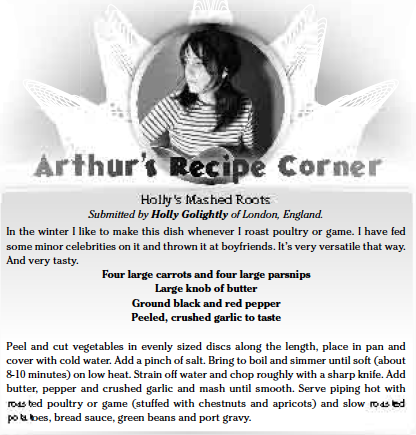
Holly’s Mashed Roots — a recipe from Holly Golightly (Arthur, 2004)

Art direction by W.T. Nelson.

Originally published in Arthur No. 8 (Jan. 2004).


Holly’s Mashed Roots

Submitted by Holly Golightly of London, England.

In the winter I like to make this dish whenever I roast poultry or game. I have fed some minor celebrities on it and thrown it at boyfriends. It’s very versatile that way. And very tasty.

Four large carrots and four large parsnips

Large knob of butter

Ground black and red pepper

Peeled, crushed garlic to taste

Peel and cut vegetables in evenly sized discs along the length, place in pan and cover with cold water. Add a pinch of salt. Bring to boil and simmer until soft (about 8-10 minutes) on low heat. Strain off water and chop roughly with a sharp knife. Add butter, pepper and crushed garlic and mash until smooth.

Serve piping hot with roasted poultry or game (stuffed with chestnuts and apricots) and slow roasted potatoes, bread sauce, green beans and port gravy.

Some Kind of Megalomaniac: James Parker on the Dandy Warhols-Brian Jonestown Massacre documentary Dig! (Arthur, 2004)

Some Kind of Megalomaniac

The unfamous also feud, as James Parker finds in Dig!, a feature-length film documenting the decade-long love/hate thing between the leaders of the Dandy Warhols and the Brian Jonestown Massacre

Originally published in Arthur No. 12 (Sept. 2004)


Reviewed:

DIG!

(Palm Pictures, released October 1)

Directed by Ondi Timoner

In order to really dig DIG!—an intimate, warmly detailed portrait of the decade-long love/hate thing between Courtney Taylor (of the Dandy Warhols) and Anton Newcombe (of the Brian Jonestown Massacre)—you have to buy into the idea that Newcombe is a genius. It’s important, this, and just about everyone onscreen testifies to it sooner or later: Newcombe is a GENIUS. He pushes the boundaries, burns with a hard, gem-like flame, is monstrous in his talent, must be compared with Manson, God, Hitler and Lou Reed, and so on. It’s the one point on which this otherwise swinging, confident movie insists a little anxiously.

The Dandy Warhols and the BJM were, very briefly, artistic confederates. Fellow retro-ites and stylists, they played together, swapped ideas and—doubtless—pairs of trousers, and their careers advanced in parallel for about two minutes before the Dandys got the major label deal which still eludes the BJM. Thereafter, the two bands were each other’s nemeses. Anton Newcombe became the unrewarded GENIUS raging in obscurity, Courtney Taylor the limelit, slightly guilt-afflicted music-biz hustler. DIG!, narrated by Taylor (because history is written by the winners), covers just about every key point in the relationship, from Newcombe’s innocent rhapsodies about “this really rad band, the Dandy Warhols” to his first anti-Dandy song “Not If You Were the Last Dandy On Earth” (a riposte to the Dandys’ radio hit “Not if You Were the Last Junkie on Earth”) to the moment he sends the band a box of individually wrapped shotgun shells with their names on them.

Success, in our imaginations at least, is just success —static, constant,some sort of white-lit plane, like heaven. Failure on the other hand is many things, a very mulchy and soulful state, and so DIG is inevitably more interested in the disastrous trajectory of the BJM, about whom the first thing you notice is not the blurting and blustering Newcombe—“I play 80 instruments. Yeah! Weird fuckin’ Chinese shit!”— but the amazingly pointless Joel Gion. Gion (hairstyle, cigarettes) is one these extra or ‘trophy’ members that a lot of your more berserk bands seem to have, to signal the sheer anarchic superfluity of their energy—like Bez in Happy Mondays, or almost any of the Butthole Surfers. In Gion’s case he implements the BJM aesthetic by standing at stage-front looking down his nose and half-arsedly wagging a tambourine. A very pure artist, untainted by actual creation, Gion’s main job seems to be keeping his balance after monster ingestion of drugs. On his little Chelsea bootsoles he teeter-totters, sneering. His clothes are black, his hair is classic through-a-hedge-backwards, and on his pear-shaped face is that expression of somnolent haughtiness we associate with Dr Seuss characters; in fact the longer you look at him the more Seussian he gets—remote, effete, insolent, with tassels for hands, and a name like the Fazoon or the Sprong . ‘Do not look long on the infamous Sprong/ The tilt of his chin is wrong wrong wrong’…

Anyway, Gion turns out to be a witty fellow and quite undeluded—the yang of BJM, if such a thing could be said to exist. Newcombe on the other hand has no sense of humor—none. You can’t be a megalomaniac perfectionist and have a sense of humor.

Continue reading

TRUST AND LOVE: Ladies and Gentlemen, the Fabulous Sharp Ease (Chris Ziegler, Arthur, 2006)


The Sharp Ease: Dana Barenfeld, Christene Kings, Paloma Parfrey and Aaron Friscia.

Trust and Love

Ladies and Gentlemen, the Fabulous Sharp Ease

By Chris Ziegler

Photography by Molly Frances

Originally published in Arthur No. 24 (August 2006)


A slightly injured and slightly drunk Sunday afternoon with the Sharp Ease: singer Paloma Parfrey is tipsy with a beer and a bent trumpet and one sprained ankle, still limping after the part in last night’s show when she fell into a hole in the stage. But Sharp Ease write off injuries instantly. Two shows ago, Paloma had scribbled some broken glass all over her arm, and she was completely recovered within hours. That’s the resilience of the Los Angeles native—the same thing that keeps coyotes and deer poking around the edge of Echo Park also keeps the Sharp Ease alive and thriving. Early 45s like “T-Spin” and first album Going Modern (released last year on olFactory Records in cooperation with LA’s landmark all-ages space the Smell) outlined the Sharp Ease sound: Pixies and Slits with sax (by Anika Stephen) and keys (by Paloma’s brother Isaac) and cut-above lyrics by Paloma, who grew up in a commune and graduated into teenage rock ‘n’ roll band the Grown-Ups before she even graduated high school. Newest EP Remain Instant finds Sharp Ease recovering after a line-up shake-up (longtime producer/supporter Rod Cervera played guitar on this one, following original guitarist Sara Musser) for seven of their best new songs about life in still-unheard Los Angeles—the never-seen-on-TV co-ops and galleries and collectives that keep an out-of-breath outsider community breathing, where the Sharp Ease play their shows and sprain their ankles. Paloma and bassist Dana Barenfeld, drummer Christene Kings and new guitarist Aaron Friscia meet for beer and photographs at Paloma’s 1957 Airstream trailer.

Arthur: Paloma, exactly what kind of commune did you grow up in?

Paloma: My parents were both extremely politically active and they decided to join this commune after I was six months old to be able to protest regularly and feed the homeless. It was this thing in East LA—the Catholic Worker. It’s Christian-oriented, but not like hyper-Christian. Their work is to serve the hungry and protest nuclear weapons. So I’ve been protesting since I was six months old.

Christene: Paloma came out of the womb with a NO NUKES sign.

Continue reading

“It’s Medicinal!: The Hand-Sewn Power Of Little Wings” by Trinie Dalton (Arthur, 2008)

It’s Medicinal!: The Hand-Sewn Power Of Little Wings

by Trinie Dalton

Originally published Jan 16, 2008 on Arthur’s Yahoo blog


Soft Pow’r, the new Little Wings album, wields its quietude like a sword. Lead singer Kyle Field rambles through tunes pondering solitude and longing, but his sad songs have an acidic, transformative edge: gentle guitar lullabies strummed underneath harmonized, twangy vocals that are often compared to Neil Young’s. Current bandmates Lee Baggett, Curtis Knapp, Adam Forkner, and Jona Bechtolt amp up the enterprise in parts; some songs, like “Free Bird,” have a simple country edge, while others, like “Beep About,” are more jazzy and abstract. Field mentions via email that he likes playing loud live, but hadn’t had the desire to record loud music in awhile. He says Soft Pow’r has a “mediciney” feel.

Soft Pow’r is less wizard-inflected than Little Wings’ previous album, Magic Wand: there’s more direct lyrics about the songwriter’s moods, and the musings detail specific people and settings. In the past Field has eschewed blunt narrative messages, mostly declining interviews in favor of writing songs cryptic or whimsical enough to encourage interpretive guessing.

Listening to Magic Wand, I’d suspected that Little Wings were mellow, canyon-dwelling elves who played crystal-powered, ancient machines for their songs featuring whale mountains and a wand who hides inside someone’s robe. Field has described exploring mystical themes through harmonic music as his desire “to study the patterns and relationships between lines, and to think of singing as weaving the sound’s fabric.”

But with Soft Pow’r‘s first line, “Totally lost in the fog, who’s not?” Little Wings launch into several tracks about memory—remembering the past to grasp the present. “Gone Again,” a bluesy tune about someone sitting on a beach, “out of touch,” conjures up a narrator lamenting a missing loved one. The lyric, “I feel a breath but it’s not from my mouth,” in “Warming” evokes an image of a ghost searching for signs of life.

Nature is the buoy keeping characters afloat in Little Wings’ music, providing the free, open space where one discovers feelings long buried. Emotional states in Field’s music have always been conveyed through nature metaphors. Throughout my favorite Soft Pow’r song, “Scuby,” about a boy mysteriously departed, sun slants through windows, pumpkins are carved and candlelit, and tall trees sway in an Autumn tribute heralding a change of season as much as change of friendship. Field feels that describing human conditions through nature’s cues creates timeless songs that remind the listener of mortality. Soft Pow’r offers nature as solace: self-reflecting and medicinal, like the album itself.

Soft Pow’r, just released on Field’s new imprint RAD with upstream support from Marriage Records, links Field’s visual talents with the musical. Field is an exhibiting artist who makes earthy yet ethereal colored pencil and watercolor drawings–he has already designed a skateboard deck for RAD, and his friend Richard Swan has artfully hand-sewn Soft Pow’r promotional patches to sell on RAD’s website. These are no average patches; Swan once mailed me a customized wool sweater covered with Sasquatch patches, including a giant, brown foot with a question mark cut out of it, and a patchwork Bigfoot scene depicting the beast caught by a camera lens. I love men who sew!

Check out RAD: marriagerecs.com/rad/ rad.html

Check out Kyle Field’s drawings: www.kyledraws.com

http://www.littlewingsnow.com/


TRINIE DALTON is an author and frequent contributor to the free transgenerational counterculture bimonthly Arthur Magazine. Her latest books are the illustrated novella A Unicorn Is Born (Rizzoli) and Wide Eyed (Akashic), a collection of short stories.