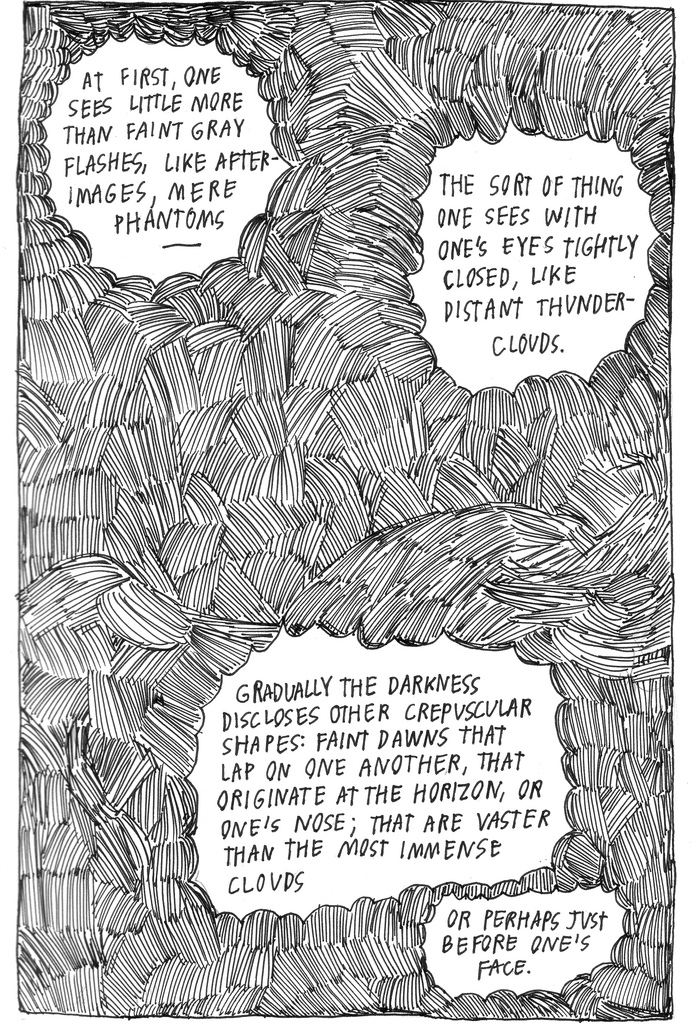
“Just because it is totally dark does not mean there is nothing to see.”
Maria Sputnik does the pictures. She’s been living in New York studying science writing and thinking about chromosomes and the moon. She misses Oregon. Van Choojitarom collaborated on the writing. He’s in Bangkok preparing to join a monastery. — Jason Leivian
This poem by Peter Lamborn Wilson was published as a letter to the editor in the final issue of Arthur, No. 31 (Oct 2008). It was in response to the piece by Alejandro Jodorowsky in the previous issue, an excerpt from his newly translated memoirs, The Spiritual Journey of Alejandro Jodorowsky, detailing his informal apprenticeship to Leonora Carrington in Mexico City in the late ’50s…
FOR LEONORA CARRINGTON
# 1 Mexico City is absolutely. Or was. With a claridad that would’ve seemed glossy as bone except for the fecality of its plutonian fruit. Especially Leonora Carrington – the secret hardness of colonial baroque – its refusal to be reasonable – its crown of owls
#2 Chocolate is Mexico’s great contribution to Surrealism. With unbroken incantations in the voice of a lion prepare (on wild rocks) a soup made of half a pink onion, a bit of perfumed wood, some grains of myrrh, a large branch of green mint, 3 belladonna pills covered with white swiss chocolate, a huge compass rose (plunge in soup for one minute) Just before serving add Chinese “cloud” mushroom which has snail-like antennae & grown on owl dung
#3 As modern Hermeticist she ranks with Fulcanelli a Madame Paracelsa who tells yr fortune in the sense of buried treasure. It seems you yourself have psychic gifts which are only exacerbated by her soups. Molé as Dalí realized surrealizes all dishes via its resemblance to excrement e. g. over boiled lobsters (serve with pink champagne). Shit you can sculpt.
#4 Like gunpowder which was invented solely to exorcize demons – a secret passed along the Silk Road to Roger Bacon who unfortunately leaked the recipe to the uninitiated – Carrington embodies both the siesta & the anti-siesta. A Madam Adam with a handcranked gramophone with a horn lacquered black with gold pinstriping that plays only beeswax cylinders of Erik Satie or Gesualdo. Here alone exile attains an elegance & impassibility known only to stoned Rosicrucians.
#5 To live absolutely. A tricky trajectory between clinical dementia & the sloppy lace curtain Irish kitchen gemütlichkeit that usually passes (present company excepted of course) for life outside literature & even for true love. Or else it’s the altitude — mushrooms & chocolate — under the asphalt the bloodsoaked landfill — cactus cowskulls & drunken fusillades of flowers.
HIGH FIVE Detroit’s visionary MC5 receive a film tribute that aims to rewrite rock history By Steffie Nelson
On New Year’s Eve, 1972, the MC5 took the stage at Detroit’s Grande Ballroom, a vast psychedelic venue where they’d held court as the “house band” between 1966 and 1969. Their live shows had been so incendiary, the five band members so arrogant, that even a huge star like Janis Joplin, no slouch in the live department, once refused to go on after them. This gig, their swan song as it were, was sloppy and dispassionate; the ghosts of past glories even more unforgiving than the sparse, cynical crowd. Guitarist Wayne Kramer took off mid-performance to go cop dope, and the MC5 never played again. Kramer and guitarist Fred “Sonic” Smith were 22; singer Rob Tyner and drummer Dennis Thompson were 24; bassist Michael Davis was 26. In the end they’d effectively been “pulled apart by the killer forces of capitalism and competition,” which their manager John Sinclair had railed against, perhaps presciently, in the liner notes to their now-legendary debut album Kick Out The Jams.
The MC5 hold a curious place in rock history. Their ascendance represented a moment in America when art and commerce converged, when all that was vital and visceral was also the pinnacle of hip. As the flamboyant and badass musical mouthpiece of the White Panther Party, the MC5 did embody the soul of the late ‘60s counterculture: one foot in the optimistic past and the other in the disillusioned, deadly future; one hand holding a guitar, the other a shotgun. It’s an irresistible image, one which was unappetizingly co-opted by Levis last spring for a series of T-shirts. A promotional performance in London by the three surviving Five (Rob Tyner suffered a fatal heart attack in 1991; Fred Smith died of heart failure in 1994) was seen by detractors as a final, sad sellout.
The question of whether or not the MC5 failed at the end of the day is much debated in the riveting feature-length documentary MC5: A True Testimonial, directed by David Thomas and produced by Laurel Legler. All parties agree, however, that for a fleeting, incandescent moment the MC5 were “at the center of the yin-yang,” as Michael Davis philosophizes in the film, “and it was our job to keep it going in a positive direction.”
But the proverbial yin-yang was already spinning into darkness, and it took the MC5 with it. Like fireworks on the fourth of July, they rose with a bright, beautiful bang and, as far as mainstream America was concerned, disappeared with a puff of smoke into the night. They were, ultimately, sacrificial – the artistic entity that was the MC5 didn’t survive more than seven years—but their legacy has continually inspired legions of punks, rockers, artists and freaks, who got turned on to their music through word-of-mouth, or more than likely though the persistent echo of a call to arms that rings with timeless resonance: “kick out the jams, motherfucker.”
As David Thomas says, “The people who know, know. The other people don’t get it.” The Chicago-based Thomas and his wife Laurel Legler began working on MC5: A True Testimonial in 1995, spurred on through financial troubles and licensing hassles by sheer love and respect and the determination to do justice to these American legends. As Legler points out, few bands have received this sort of filmic treatment, and if they have their way MC5: A True Testimonial will revise rock history. On the eve of a limited theatrical release and the worldwide release of a nearly four-hour DVD edition of the film (including deleted scenes, complete live performances, interview outtakes and fan testimonials), David Thomas and Laurel Legler are ready to testify.
Recently Discovered Musical and Sundry Delights By Eddie Dean
Chango Spasiuk, free concert at the Millennium Stage, Kennedy Center “I refuse to look like an old woman knitting,” said tango great Astor Piazolla, who broke tradition by always playing his bandoneon while standing. And here’s Chango Spasiuk, another Argentinian bandoneon master, sitting in a chair onstage with his instrument slinking over his knees draped with—a QUILT. But the wild-eyed, long-haired son of Ukrainian immigrants by way of Misiones province looks more like Rasputin than a knitter, like he’s ready to ambush the black-tie Bushcovites gathering down the red-carpeted Hall of Nations at another gala benefit for the masters of war. This isn’t the city music of Piazzolla. This is chamame, a down-home country music like the kind you’d hear at a backwoods wedding in northern Argentina when everybody’s had too much vino tinto and a summer storm’s brewing and the bride and groom have fled the scene. Spasiuk’s chamame has his own touches, a Marc Chagall-fiddler and “cajon peruano” percussionist. His bandoneon is a magic box that breathes, stirring the stilted, conditioned air inside the Kennedy Center, as the chandeliers weep and even the ushers prick up their ears, while outside the Potomac River turns into the coffee-hued, snaking Rio Parana. After the show, Spasiuk talks about his influences: “My father was a carpenter and musician who played at local dances and parties, and my uncle was a singer. I grew up listening to the music from the region of the rivers, the folk music, the polkas and the shotis, and chamame is the strongest color of this mestizo music. I didn’t become a musician after I saw or heard music being played on TV or in a movie or on a stage. Music was everywhere, in every social situation. My music is an utterly happy music but at the same time melancholic and sad.” His favorite musician, he says, is Beethoven.
Magnificent Fiend, Howlin Rain (Birdman/American, 2008) The Black Crowes have been trying to make a record this good for 20 years, and these young bucks nail it right out of the shoot. Horns of plenty, and heaping helpings from the bottomless well of deep groove. As Greg Allman sang, “The road goes on forever.”
Country Music Originals: The Legends and the Lost by Tony Russell (Oxford Press, 2007) You’ve already heard about Jimmie Rodgers and the Carter Family, now meet their kinfolk, the thousand-and-one tongues of pre-Nash Trash hillbilly music: Seven Foot Dill and his Dill Pickles, South Georgia Highballers, Bascam Lamar Lunsford, Red Fox Chasers, Dr. Smith’s Champion Hoss Hair Pullers. They’re all here looking alive as you and me. Old-time music fiend Tony Russell came from England to travel the dusty backroads and knock on many a screen door to find the stories behind the mysterious names emblazoned on the old 78s. The meaty bios are salted with rare photos and period illustrations, such as a Depression-Era newspaper ad for a $3.85 Disston Hand Saw (“Mirror polish, striped back, beautifully etched, Applewood handle, fully carved”) of the sort played by Highballer Albert Eldridge, whose expert bowing “produced a sweet otherworldly humming that anticipates the oscillating electronic sounds of the Theremin.” Seems like it’s always Brits like Russell and Dickens and D.H. Lawrence with the keenest insights into the old, weird America.
Death Comes for the Archbishop by Willa Cather (Vintage, 1990) Before Sam Peckinpah and Cormac McCarthy, the Spanish-American Southwest had Willa Cather to make an epic of its bleak and beautiful landscape. Instead of horse rustlers and outlaws, the male-bonding celebrated in this novel is the friendship between a pair of French Catholic priests out to save souls in mid-19th-century New Mexico. They’re not just packing Bibles and rosary beads, though, they’re packing heat: “‘You dare go into my stable, you [blank] priest.’ The Bishop drew his pistol: ‘No profanity, Senor. We want nothing from you but to get away from your uncivil tongue.’” Gimme that old-time religion, it’s good enough for me.
The U.S. Navy Band Brass Quartet show at Rockville Town Center Good to hear the tuba out in the open. A century ago, it was the original Miami Bass, and it can still get to the bottom like nothing else. Except Bootsy.
C & D: Two guys who will remain pseudonymous reason together about new records
C: [While rummaging through the teeming mail bin.] Hey, look at this. It must be from that new guy who’s always lurking around. What’s his dealio anyway? He’s what my gran would call a nosey nelly.
D: I think he’s here to like, streamline shit. [Reading aloud] To Whom It May Concern: “In my private meetings with Arthur staff and contributors, we have received many disturbing reports regarding the personal, professional and spiritual-energetic conduct of C & D, or as they fancy themselves, ‘The Arthur Music Potentate.’
“There is widespread unease amonst Arthur staff about C & D’s taste in mucic, which has been described to us as ‘bewildering,’ ‘psychedelic parochial,’ ‘arguably harmful,’ ‘contrary to the public’s interest,’ ‘more narrow than their trousers’ and ‘frankly vampiric.’ I don’t quite know what all that means but it’s interesting.
“Moving forward, I have been unable to confirm that C & D are receiving payola from 86 record companies and nineteen out of our fair nation’s top twenty coolmaking marketing firms, but verification of such nefarious activity is only a matter of time.
“I am also unable to confirm their membership in the ‘Brownie-Meinhaus gang.’
“However, in my own cross-examination sessions with C & D, in which, I am preparted to testify, we did not waterboard at all 😉 , I was able to determine that they have indeed ‘lost the keys’—their words—for two of Arthur humor/motorcycle advisor Peter Alberts’ Royal Enfield motorcycles; they have indeed borrowed Arthur contributor Paul Cullum’s all-region DVD player for an ‘increasingly indefinite period’; they confess to doing two cut-and-runs at Sugar Hair Salon in Silver Lake; plainly abused Mandy Kahn’s standing offer to drive them to and from various watering holes of ill repute; and, as you may have surmised, it was indeed they — or them? I can never remember ;-( — who affixed ‘Ex Libris C &/or D’ label-plates to all the reference books in the staff library.
“Furthermore, C & D have charged 38 parking tickets to the Arthur expense account since last June. Woe betide their decision to start chillaxing out in Malibu. “C & D have presumptuously intercepted others’ mail, especially advance vinyls from the Holy Mountain label. They play the Carbonas self-titled LP at bicuspid-crushing volume everyday before lunch. They crack each other up at staff meetings by prefacing every statement with ‘You must learn, we are the Gods of this magazine!’ They are always ordering curry. Plus they’ve used up all the paperclips, and not, I am saddened to report, in a fashion that paperclips were designed to be used.
“The Editor-in-chief, art directors and even the printer have complained that C & D are always late with their copy, which in turns holds up production of the magazine and inhibits crucial cashflow, all for something that, quoting the Editor, ‘nobody really reads or cares about anyway.’
“In my many years of optimal-sizing firms, I have been forced to make many difficult and even gut-wrenching decisions. This however is not one of them! ;-)- C & D should be shown the door, and the sooner the better. We will call it a suspension of enduring duration. Now would really be the time to pull the trigger on this. I know people who can do it.
“JUST SAY THE WORD.”
D: [gulps] Doh! C: I always told you we would are the men who knew too much. [puzzles] But how did they find out about the brownies? I told you to watch out for those new surveillance cams. D: I thought they were fake. And chicken tikka is not a curry. C: Ha! And neither is lamb biryani. Wait a second… Fake surveillance cams? That’s a GREAT idea. D: I know a guy! Just say the word! C: [cackling] Okay but first let’s get one more column in, shall we? “They” never read this so we can say whatever we like and they won’t know til it’s at the printer, hahaha! The funny thing is we REALLY ARE the potentate around here. But if our services are no longer required here, we’d like to say one thing: D: SAYONARA BITCHES!!! C: Because we are in control of the horizontal. We’re the last people that see this bad boy before it’s sent to the printer… D: Oh yeah! Heh heh. C: …which means whatever we type here gets printed. D: Which means…
The Carbonas The Carbonas (Goner) C: They come from Memphis, they sound like Wire and the Buzzcocks, nine songs in 22 minutes. You know what you have to do. D: Wire and the Buzzcocks? More like attach a wire to your bollocks! [helpfully] And they have a song called “Assvogel.” C: That’s not a song, it’s a movement. And I think you know what kinda movement I mean… D: Ahem. It is on the Goner record label. Which is what we are now. Goners. C: Memphis is the one place I’d be interested in moving to. Start the car, I’ll get my duffel. Here’s to life in exile after abdication! D: [brightens] I’ve been a goner since the beginning. C: Being a goner is a serious thing. Who do you think is the original goner? D: Robert Mitchum, no question. Yeah, that’s it, the Carbonas are the Robert Mitchum of rock!
Dead Meadow Old Growth (Matador) C: I’ve been into these guys since before everyone else! D: Except for me. I invented these guys. I put a bunch of purple pills in a blender along with a soiled Led Zep patch from my older sister’s jean jacket. Shazam! C: ‘Old Growth’ is on the shortlist for greatest album title ever, and it’s a pretty good description of the music. D: Here’s a better one: take a grandfather clock made of diamond-cut crystal, fill it with molasses and drop in on your head! C: I can’t believe they’re firing you, D. You just keep getting better. Woah, this song is some serious blues shufflage. It’s like a beer commercial for really stinky homebrew. D: There’s something about this guy’s voice that hits me like a arctic wind. Pass me my mittens. And the b-o-n-g. It’s been a bong time since I rock ‘n’ rolled!
Graveyard Graveyard (Tee Pee) D: Graveyard, eh. Must be a Goth band. C: Actually they’re not Goth. They’re not even American! D: [listening to first track, ‘Evil ways’] Right away you know that no matter what happens, you’re gonna at least hear good tone guitar. This is far too good to be American. C: You are correct sir. They are in fact Swedish. D: The world’s greatest mimcs. The arch-inhabitors. C: He pitches his vocal a bit Danzig, a little bit Bobby from Pentgaram. A little bit Jim Morrison. A little bit of the mighty John Garcia. D: And it must be admitted, a little Cornell. C: A little bit’ll do ya. This is Ween-quality mimicry here! Reminds me of that band Witchcraft in that they’re going further out. [listening to “Lost In Confusion”] That’s basically the Doors, right there. D: It is like Witchcraft, but this singer has more hair on his chest. C: … So, what do you think of that drumming? D: Kinda…jazzy. C: Well you know, all those old rock drummers used to play jazz drums too: Ginger, Graham… D: Keith, Charlie… C: I listened to this album several times without realizing it. Just kept coming back. I keep coming back to the Graveyard, D. D: That’s where you’re gonna end up. Might as well get there early and check it out.
Harmonia Live 1974 (Water) C: Vintage live recording from krautrock greats Harmonia, never-before-released! D: How is this possible? Harmonia are some of the original electronic goners. C: If you turn it up loud enough you can hear people talking— D: I can’t hear anything except analog electronic perfection. C: Frankly I am perplexed by the liners which talk that like this Harmonia are barely known, even to konfirmed krautrock fans. Says here, these guys exist somewhere out beyond the “how to buy Krautrock section in your local record shop.” Is this guy insane??? D: There is no local record shop! C: No, I mean I don’t think I’ve ever seen a Krautrock section at a record store that DIDN’T include Harmonia. And there is a local record shop, actually. It’s not final for vinyl just yet, my friend.
Originally published in Arthur No. 25 (Winter 2006)
White Magic: Meanwhile, outside the city gates…
Black Hole White Magic By Chris Ziegler
Reviewed: Sunn O))) & Boris Altar (Southern Lord)
White Magic Dat Rosa Mel Apibus (Drag City)
I had Altar complete in my head before I ever heard it: Sunn O))) and Boris together to make the heaviest thing ever, an album that would burst cochlear membranes and the confines of three-dimensional spacetime. Modern music’s two most immovable objects: what would happen when they met? Maybe nothing—in fact, hopefully nothing, and Altar would be pure void, a subatomic drone that would go beyond Sunn O))) and Earth and Flood to the low slow B-flat hum NASA heard coming from a black hole around the same time Sunn O)))’s White 1 came out. “A million billion times lower than the lowest sound audible to the human ear!” NASA said, complete with exclamation point. That was the true sound of the universe, and if any humans could play along, well, here they were: two bands with discographies so colossal that you couldn’t deploy anything less than three syllables per adjective without feeling cheap and weak. (Cyclopean? Titanic? Hephaestean?) NASA called this new science “black hole acoustics” and that was the best explanation yet—better than the New York Times’ cutesy ‘heady metal,’ anyway.
But Altar is the un-heaviest. Six or seven minutes into opener “Etna” (played in the spirit of the volcano that will devour Sicily) presents the riff-vs.-drone grappling match the collaboration demanded, and it is satisfactorily hephaestean. Last year’s Black One and Pink anticipate these moments—Pink’s intro “Parting” especially, though Boris drummer Atsuo rarely pushes a straight 4/4 rock beat, instead mating drums to drone with a rush/recede dynamic that must have cheered the Coltrane students in Sunn O))). Black hole acoustics is science for space and gravity and not amplifier athleticism, though, so credit to Boris and Sunn O))) for Altar’s sidewise moves. Sunn O))) provokes orgasm and Boris melts minds—we know that and so do they, so let’s improv something else.
“Sinking Belle (Blue Sheep)” is probably the songiest thing to ever bear a Sunn O))) stamp; Internet drones are straight-facedly calling it “folk pop” and while that’s a bit broad, it’s … understandable. Earth’s Hex had passages of twilight-zone quiet and “Sinking Belle” collects them together: reverbed piano that blooms and dissolves like ink into water with Jesse Sykes (singer from Seattle’s Sweet Hereafter) sounding like Nico at her frowniest, or actually sounding a lot like Sybille Baier, another dissipated ‘60s teuton-chanteuse. After that is “Akuma No Kuma,” an all-synth-no-guitar track (with Joe Preston growling through a vocoder) that fits the fire-and-fog Blade Runner opening, and after that the desolate “Fried Eagle Mind,” a wave of tube tone washing over Boris guitarist Wata’s ghost vocals. “Blood Swamp” has to float back home: rumble finally turns to roar as Soundgarden’s Kim Thayil gets a guitar to sound like something that breathes mud—or blood?—to stay alive. A hephaestean finale, sure, but not the truncated concussion both bands favor. There is clear-to-cloudy precedent for everything on Altar in the million billion minutes of discography belonging to Boris and Sunn O))), but it’s softness as much as the UNNNNNNNNNNNNNNNNNworgworgUNNNNNNNNNN we’ve known and absorbed. Three songs into Altar, the album start to float. Heavy is light.
* * *
I would hate to just bluntly ask White Magic if they actually believe in magic—too obvious, too impolite. But even a lump like me can tell that Mira Billotte’s songs about trees and wine and sun and sea refer to more than just a holiday fit for Fairport Convention. White Magic sings one thing and secretly means another, or several secret other things aligned in symbolic harmony. The band put a labyrinth on the back cover where they could have put a map. So I can’t say I wasn’t warned.
Billotte and a new set of supporters—including partner Douglas Shaw, Jim White from Dirty Three, Tim DeWit from Gang Gang Dance and noted New York percussionist Tim Barnes—built White Magic’s first full-length Dat Rosa Mel Apibus around her famously agile voice and the cascading piano melodies she plays to match Bert Jansch’s precision fingerpicking. Rosa is gentle on solemn guitar-and-voice songs like “Katie Cruel” (also covered by probable White Magic inspiration Karen Dalton) and “What I See,” but spins into psychedelic experiment like the sitar raga on “All The World Went” and the dub/reggae arrangement (and production!) for finale “Song of Solomon,” which is almost an Althea and Donna song until the accordion starts pumping toward climax. That’s a dizzy finish to a record that begins with a single piano note, and a happy release for the ideas half-hatched on 2004’s Through The Sun Door EP.
Billotte’s voice is (as always) a bird in flight, and she writes lyrics in careful camouflage, packing love songs and lonely songs with loaded notions of sleep and night and sun and light. It’s potent imagery that just begs projection from the listener. One verse of “Hold Your Hand In The Dark” and I was convinced we’d read the same Philip K. Dick essay: he said, “Sleepers awake!” and she sings, “You’ve been sleeping well, my friends/sleeping well/but if you wake, it may be too late.” Her tense mention of hands in chains and waiting in secret are from a particular idea Dick had about … well, too much of this might put this review to sleep. Different listeners discover different things.
Maybe that means Billotte is just writing easy absolutes—like everyone else, she loves love and dislikes… chains? But of course not. That seven-petaled rose on the cover is too close a copy of a Rosicrucian engraving; the translated title “the rose gives the bees honey” was a line used by alchemists to distinguish the search for spiritual truth from the search for worldly gain, and on Rosa’s second song Billotte sings, “Gone was our need for the things of this world/all we had was love.” Rosa feels full of these century-to-century connections. Hidden in this post-Pentangle piano-psych record is something ferociously righteous. White Magic believes in good research.
C & D: Two guys reason together about some new records
AKRON/FAMILY Meek Warrior (Young God) C: [Looking at publicity photo of band] I’m surprised these guys haven’t featured in Arthur magazine yet. They appear to meet many if not all of this magazine’s apparent requirements for coverage. D: What, they have beards? C: Yes. I think the magazine is pretty clearly a beards-only policy. It’s pretty clearly where the underground beard was re-born. Or should I say, re-grown. Remember Alan Moore on the cover of Arthur No. 4? D: That was a beard to be reckoned with. No razors and shaving cream in the Moore household! C: Total ‘Lord of the Beards.’ On the other hand, Alan’s finger armor stylings haven’t caught on yet. D: I will keep an eye out for the beard as we check out these records today. I assume there will be ladies, too? C: Yes, of course. D: Who presumably are not of the bearded variety. C: One never knows, does one? [arches eyebrow meaningfully] Anyways, Akron/Family not only have some beardage, they have four-part harmonies, great cascading drumflows, sprawling late Trane skronk, and that’s all on the first track! I saw these guys once in L.A., they were like a devotional Animal Collective… D: [smiling upon hearing the refrain “Gone, gone, gone/gone completely beyond.”] Ah yes. Beyond. One of my favorite places. C: [ignoring, continuing] … in Oshkosh overalls, without the echo delays. Like Lubavitchers gone Sun Ra or Ya Ho Wha— D: Say wha? C: [snobbishly] Those who know, know. [continuing] They were awesome, in complete uni-mind synch. The audience made backward-and-forward ocean ripples and sounds at their command: ‘Shhh, shhh.’ It was beautiful.
BEACH HOUSE Beach House (Carpark) C: Lovely—possibly perfect?—debut album from this girl-and-boy lovebird combo who sound like they’re living down by the sea on some magic moonlit beach that stretches from France to Baja to Bali. D: [looks at biographical notes and photo] Actually they live in Baltimore. And there is no beard. C: Waiter, get this man a beard, se vous plais. D: [ignoring] But Victoria Legrand— C: Is that a real name??? D: —is definitely a lady. A lady who knows how to wear an aqua dress. C: [looking at the photo] And a big gold amulet as well. D: I would say this is late summer music, recorded at the beach house after everybody else has gone back to the city. C: It’s kind of minimal naturalismo—organ, drum machine, gorgeous female voice: Stereolab, minus le krautrock propulsion. Midway between Brightblack slow-to-stillness, Beach Boys “Pet Sounds” melancholism and Air and another Carpark artist, Casino vs. Japan. Also, what the heck, I’ll throw in that first Bjorn Olson record on Omplatten [Instrumentalmusik: Instrumental Music…to Submerge in…and Disappear Through, 1999]. Nordic beaches. As you can see, D, it’s a very particular, yet universal, mood. I see soundtracks in their near-future. [picks up phone] “Hello, Beach House? This is Sofia…” D: Her voice reminds me a bit of Sigur Ros. Hey, whatever happened to those guys? It’s like they evaporated. C: She can really SING, when it’s called for, which is in creamy middle of the album on the song “Auburn and Ivory.” D: Is Auburn the new Ebony? C: All the songs have some sophisto pop songwriting going on: bridges, key changes, et cetera. And the sounds… when the organ comes in on “House on the Hill,” it’s like Captain Nemo down in the Nautilus playing pipe organ for the octopi. Whew! Can you imagine these guys with a big budget…? D: Ahoy! Captain Nemo: ANOTHER famous bearded musician.
MICK BARR & ZACH HILL Earthship (5RC) C: New summit album by underground instrumental speed kings: guitarist Mick Barr of Ocrilim, and drummer Zach Hill of Hella. It’ll tighten yer wig! D: Well, I won’t need coffee for the next five months. C: They’re going in for the kill like two old ladies speed-crocheting. Mind the wheedlework. D: They are the speed criminals who no doubt are under surveillance by the authorities of rock. There’s a NEW MOTHER IN THE TEMPLE if you know what I mean! C: It does have that High Rise/Mainliner/Musica Transonic thing going a bit. Ah, Japan. Some people may also be put in mind of the Peter Brotzman Octet classic assault album, Machine Gun. D: That’s a ripping title, “Earthship.” [considers] If you lived there, you’d be home by now. C: Sometimes they’re against each other, sometimes they unify. D: I must ask: is there a beard? C: [looks at publicity photo] Have beard, will rock.These guys are the opposite of Sunn o))): they do as many notes and beats as possible per hour. It’s anti-void music, filling everything with sound. D: Without the benefit of riffage. C: There ARE riffs—you just need to adjust your attention to catch them. It’s condensed free rock. Like the instruments are too hot to handle. Except for this one song I keep coming back to… [plays “Closed Coffins and Curtains.”] D: Whoa! What…is…THAT??? C: It’s like some super-processed symphonic tri-guitar. Like what that weird Godley & Creme instrument was supposed to sound like, remember that? The Gizmo. They made a whole triple-album with it, and Peter Cook too. Bonkers stuff. D: [playing the 30-second track again] I am totally spooked. [musing] Perhaps if Mr. Ocrilim slowed down and contemplated like this occasionally, he’d get to somewhere really rewarding. C: Rewarding to you. D: [laughs] Of course, me! Who else matters?
THE HORRORS The Horrors ep (Stolen Transmission) D: [Reading song titles] They have a song called “Sheena Was a Parasite”? I worship them already. C: Frantic organ and guitar-driven psychobilly freakbeat rock’n’roll by five sharply dressed’n’coiffed Dickensian Brits from the belfry. D: They look like they live in chimneys and spend all day drinking red wine and listening to The Cramps, Tav Falco & Panther Burns…probably the Hives too, and the Birthday Party and Screaming Jay Hawkins (who they cover here) and Screaming Lord Sutch and of course the right honorable Arthur Brown. I think they like bourbon and some pretty nasty stuff. C: [listening to “Excellent Choice”] They’ve got a good look and a good sound and they seem up for a good party. They’ll come to your town and help you burn it down. And then dance in the ashes.
PRIMAL SCREAM Riot City Blues (Capitol) C: They’re been around approximately forever. And this is their once-a-decade “rock n roll is dumb fun” concept record, apparently. [C & D cringe for 15 minutes] C: Talk about the horrors. D: Where’s the pooper scooper? C: Rock n roll should be fun, it can be stoopid, but it should never, ever be tedious. One hates to witness someone failing at slumming. It’s embarrassing to all involved. Does [Primal Scream singer] Bobby Gillespie seriously think this band can boogie? Ha ha ha. Poor Mani… D: [thoughtful] Every once in a while an object is mysteriously withdrawn from stores by its manufacturer shortly after its introduction. That kind of decisive action may be appropriate here.
THEUSAISAMONSTER Sunset at the End of the Industrial Age (Load) C: You will recall that both members of THEUSAISAMONSTER are members of Black Elf Speaks, which is one of the great band names ever. D: What did Black Elf have to say? C: I don’t know, it was this kind of gibberish? But it seemed important. [sadly, as if narration] ‘And Black Elf spoke, but no one could understand what he said.’ D: [helpfully] Maybe he had something in his mouth. C: …. D: Or, he might have a speech impediment. C: … D: [looking at album cover] Naturally I am wondering, what kind of monster? C: Probably some kind of troll. On PCP. D: That’s pretty negative. … Um…. Idiocracy got you down again? C: Yeah… Between seeing that and re-reading Chris Hedges’s War Is a Force That Gives Us Meaning last week, I guess I’m feeling more bleh about human life than ever. The idiots don’t know when to stop. And there’s more and more of them. They want war and fast food and spectacle. They’re bad at learning. We’re outnumbered, and it’s only getting worse because the herd never gets culled, since we lack exterior predators. D: [considers] No more trolls. C: What are we gonna do? I don’t see a way out. Ah, hell. Maybe that’s why the industrial age is going to end, as it says here on the album cover. [reading from the press sheet] “Of course The USA Is A Monster wants to turn the tide and prepare us for the time after the lights go dim on Western Civilization’s exhaust pipe party.” Sounds good to me! Let’s engage. [starts “The Greatest Mystery”] D: YEARGH!!! THUNDERAMA! C: Whoa. [45 minutes later…]Whoa. D: A shining path indeed! Was that all one song? C: Unbelievable, just ridiculous. The Who, Bruford-era Kid Crimson, Oneida, minutemen, Lightning Bolt, Liars, Rush. Homeopathic progrock with a lot of heavy spiritual-political truths and theories (“We are only holograms”) and jokes and accusations (“You’re a liar! And a CROOK!”) and digs (“My favorite subject is…me!”). That last song, the three-section “The Spirit of Revenge”… D: What a giant marching groover that one is! These guys must be super-fit. I’m guessing it’s a lentil and walnut-heavy diet.
WOLF EYES Human Animal (Sub Pop) D: [listening to “A Million Years”] This makes me insanely happy but I can’t put my finger on why exactly. C: I feel like it’s 4am at the docks and we’re hearing the soundtrack to some new-millennium industrial-environmental horror show. To update Funkadelic: Mother Earth is REALLY screaming now. [listening to “Lake of Roaches”] Especially now that these noise dudes have a horn. Yikes. D: I see scrapheap monsters vomiting spare parts and microchips. C: Urgh, this is uncomfortable in a really good way, like a good ol’ Khanate death-slog through the bog. It’s the feel-nothing hit of the fading summer. D: “Rusted Mange” sounds like somebody getting run over. C: “Leper War” is more queasy listening. I’m thinking of torture gardens and animal abuse science labs. All the atrocities going on behind the curtain. Machines playing with their prey. Angry dogs chomping on kids’ talking playtoys. Trains full of prisoners. D: [thoughtfully] This is music to blow up Monsanto to. C: Wolf Eyes: for when you want to detonate your day.
Originally published in Arthur No. 25 (Winter 2006)
THE NEW HERBALIST By Molly Frances
The holiday commonly called Christmas brings with it general feelings of dread and depression, as well as the intrusion of traffic, crowds, family, chocolate-covered everythings, large rectangular boxes, turtlenecks, and relatives with weird hair giving even weirder gifts. Well friends, I’m here to tell you: It has nothing to do with that!
Whichever winter holiday you choose to celebrate, from the Winter Solstice on down to Kwanzaa, I think we can do it better. We can make new rituals and traditions to define what these holidays are really supposed to reflect: faith, love, and rebirth.
The recently published Pagan Christmas: The Plants, Spirits, and Rituals of Yuletide by Christian Rätsch and Claudia Müller-Ebeling (Inner Traditions Press) is a fascinating resource to explore the origins and varieties of our holiday traditions. If you thought Christmas was a time to lay low the libido and close your heart for the season, this book begs you to reconsider. Resist the mood-killing family gatherings and neutering woolen sweaters and breathe in the seductive aroma of the ages. The very spices, plants, and incense that make us cringe when encountered in uncomfortable holiday environments have been used for hundreds of years to invoke fertility, love, and magic during the winter “feast of love.” Nutmeg, cinnamon, cloves, anise, saffron, ginger and vanilla were used in ancient Roman kitchens in baking and beverages, and many of these spices were considered to be aphrodisiacs. The authors instruct that “in medieval times festive meals were sprinkled to the thickness of a finger with spice powder, most often pepper, nutmeg, and cloves.” So gather the freshest ingredients you can find and get to work on those gingerbread houses, cookies, and spiced ciders to rekindle ye olde ancient holiday magic.
The greatest burden of the holiday season is of course the madness surrounding the selection of gifts, but it needn’t be this way. Why not offer your friends a bowl of steamed kale greens garnished with olive oil, lemon juice and a festive toss of dried cranberries? Tell them you offer this bowl of nutrient-rich greens to open their heart chakras. They will be so overcome by your gesture of goodwill and caring that that marshmallow santa will be thrown to the ground in favor of real nourishment. Give your beloved a pomegranate, the symbol of Aphrodite, the goddess of love. This deeply romantic gift will sweep away all previous longing for that iPod or riding lawnmower they were expecting. Traditional and modest gifts of candles, plants, and incense are often the most potent and symbolically rich. Frankincense is described in the book as stimulating feelings of intense sensual joy and, due to its THC content, can create “pharmacological effects.”
When we decorate and give gifts of green plants and flowers we are maintaining an ancient connection to faith and the hopeful message that winter will pass into spring. This is a time to celebrate the cycles of life, the light that we know will follow the dark winter days. Pagan Christmas reminds us that the Christmas tradition contains many holdovers of pagan rituals that were adopted by Christianity due to their undying presence in the popular mind. The disconnected presence of the living room tree can bounce back to a joyous significance when you consider that “pines are a symbol of immortality and resurrection. The idea that lucky children could find treasure hidden under them may come from the tree’s long history as an object of pagan worship. Like fir and spruce, the perfume of the pine needles and pine resin was considered forest incense.” The beauty of nature can thrive even in the dead of winter—or the suburban horror of Uncle Frank’s den.
Let’s not allow the manufactured and cynical distractions of the winter season to bully the magic from our thoughts. Creativity and passion can inspire us to cultivate new ideas about sharing time and and gifts with the people we love most. The authors of Pagan Christmas point out that even normally bummed-out Nietzsche would perk up in anticipation of Christmas approaching. Instead of dredging your defeated soul to the mall, pay a visit to your local farmers market and browse the bounty of the fall harvest. Spread nature’s sweetest gifts of tangerines or bags of pecans. Plant a tree in someone’s name (http://www.americanforests.org/planttrees) to celebrate the proliferation of nature. Break out of your Jello mold and create a spicy new holiday dish. And If you find yourself alone this winter, as all of us do one time or another, why not adopt a cat or dog? They will keep you warm, and if you feed them they will love you forever. Isn’t that what it’s all about?
Originally published in Arthur No. 24 (September 2006)
THE NEW HERBALIST By Molly Frances
“Wise Walnut”
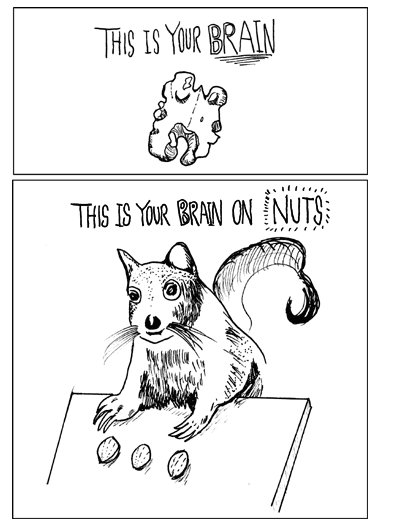
Fall is here. Embrace the wisdom of the squirrel and gather up your nuts. We need them more than they do.
One of the most ancient of foods, walnut fossils have been found dating from the Neolithic period over 8,000 years ago. Rumors of the walnut groves in the hanging gardens of Babylon have been circulating for some time, and King Solomon is said to have often strolled among his walnut trees “into the garden of nuts to see the fruits of the valley” (Song of Solomon 6:11).
In the Middle Ages, the “Persian” walnut became known as the “English” walnut as colonial-minded English sailors carted off loads of the nutty bounty and spread them about Europe, and eventually the “new world.”
Jupiter’s royal acorns, as the ancient Romans liked to call them, bear a suspicious resemblance to the human brain. That makes walnuts brain food in every sense of the word. They’re loaded with Omega 3 essential fatty acids, vitamin E, and minerals necessary for mental and heart health. It’s no coincidence that as our intake of omega 3s have decreased drastically, depression and heart disease have risen. Get this, slim jim: Your brain is 60% fat, and cell membranes will build themselves out of whatever fats are available. Omega 3s are the optimum choice, but most people fill up on omega 6s, found in polyunsaturated vegetable oils and animal products. An imbalance skewed towards Omega 6 fats are associated with inflamation, degenerative diseases, and mental disorders of all kinds, including increased violent activity. Sound like anyone you know?
Dr. Andrew Weil believes that the lack of Omega-3s in our diet is “the most serious nutritional deficiency we have in this country.” This deficiency is believed to be responsible for a wide range of diseases such as alzheimer’s, arthritis, ADD, diabetes, heart disease, PMS, and severe and manic depression. Omega 3 oils are found in oily fish, walnuts, flaxseeds, hemp seeds, and sea greens such as hijiki and kombu. They are essential for retinal function and vision, immunity, promoting good cholesterol, and cancer prevention.
Got the blues? Skip the sundae and go right to the nuts. Omega 3s stabilize moods and increase energy levels. They are also beauty oils, keeping skin youthful and glowing and hair soft and shiny. Get healthy and happy by replacing some of those 6s with 3s. How about a handful of walnuts as a snack or on a salad? How about some ground-up flax seeds? Why not? Let’s all learn how to cook up some delicious sea greens like Hijiki; it’s fun to say and more fun to eat.
Make certain to store shelled walnuts in the refrigerator (up to six months) to keep the oils from going rancid, as they can become carcinogenic. Chopped and ground nuts go bad more quickly than whole raw nuts. You can tell a bad bag of nuts by the smell – if they have the aroma of oil paint throw them away.
Enjoy a bag of organic raw walnuts or whole fresh walnuts from your local farmer’s market. Nothing says “I have arrived” like a big bowl of walnuts on your table and a nutcracker placed just so. You’ll have a potential moneymaker on your hands as well, playing the shell game with your friends. The increased walnut-fueled brain power is sure to benefit your sleight of hand.
As spring fever’s eager blossoming inevitably withers into the summertime blues, we seek quick relief among the abundance of icy blended concoctions that our advanced civilization offers us. Unfortunately, though that iced coffee provides a momentary respite on a balmy day, it will also quickly return you to a state of dehydration and turn up the heat of your internal thermostat. The ingredient for the most soothing and refreshing of summer drinks is probably already growing in your garden. For a deeply cooling drink, brew up a tasty pot of mint tea.
A handful of the fresh herb plucked from your garden and tossed into a carafe of hot water will have you living the good life in no time at all. Be sure to include the stems of the plant. This tea may be served cold as well, but resist the temptation of pulling out your blender. Frozen drinks and ice cream will hold heat in your body and freeze digestion. To really keep extra cool this summer, avoid your freezer and enjoy your summer beverages without ice.
For a truly sublime experience, serve your friends a pot of Atay bi Na’na’. Made from boiling water, fresh mint, a small amount of green tea and honey to taste, Morocco’s most popular drink is consumed all day long. Usually served in ornate silver pots and small decorated glasses, it is customary for three servings to be offered by the host, who pours the tea from a distance of up to several feet above to aerate the brew and show off his skills. Practice this before the guests arrive.
In addition to its cooling properties, Mint tea settles the stomach and digestive disorders, eases migraines, and helps draw out infection upon first signs of a sore throat. The powerful antiviral properties of peppermint are due to its main active ingredient, menthol oil, which opens and heals sinuses, bronchial tubes, and vocal chords. It is also said to create a mentally stimulating and relaxing vibration that reduces stress and anxiety.
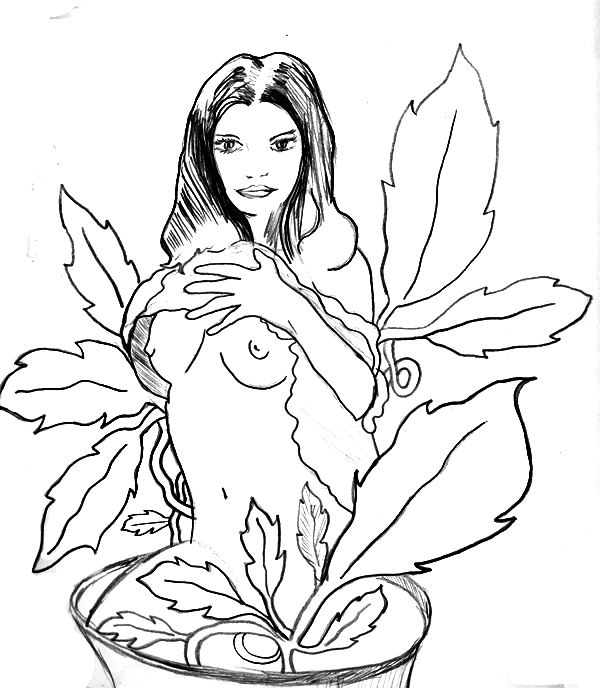
So what have we done to deserve this magical leaf? As the legend goes, Hades, god of the underworld, was busted by his wife Persephone in mid-frolic with a hot young wood nymph named Mintha. Persephone, who had been somewhat rudely snatched down to the underworld by Hades in the first place, was in no mood to overlook this infidelity and stomped the little nymph underfoot, transforming her into the plant we know today as Mint. In a gesture of atonement to Mintha, Hades would endow the plant with its sweet and unmistakable aroma.
Persephone may have extinguished Mintha in the flesh, but her spirit has lived on in this most promiscuous of plants. There are few lands that the wildly propagating mint has not traveled to, and few cultures that she has not seduced. As 16th century herbalist John Gerard declared, “The smelle rejoiceth the heart of man.” From Egyptian temples to Roman baths, Mint has been used for all varieties of healing and pleasure. The Pharisees even paid their taxes with it, as revealed by this scolding from Jesus: “Woe to you, Pharisees! You tithe mint and rue and every edible herb but disregard justice and the love of God.” Ouch!
While perhaps more prized for its pleasure-inducing than medicinal properties, the mint julep has been the preferred drink of the Southern Aristocracy. Accept nothing less than fresh mint, water, sugar, and Kentucky bourbon. As one of its key proponents, S.B. Buckner, Jr. warned in 1937: “A mint julep…is a ceremony… a rite that must not be entrusted to a novice, a statistician, nor a Yankee.” He instructs, “Go to a spring where cool, crystal-clear water bubbles from under a bank of dew-washed ferns. In a consecrated vessel, dip up a little water at the source. Follow the stream through its banks of green moss and wildflowers until it broadens and trickles through beds of mint growing in aromatic profusion and waving softly in the summer breezes. Gather the sweetest and tenderest shoots and gently carry them home.”
As Mintha clearly gets around, she has crossbred into hundreds of varieties including chocolate mint, basil mint, ginger mint, Persian mint, Corsican mint and Pineapple mint. All this intermingling frustrated one ninth-century monk, who declared, ” I would rather count the sparks in Vulcan’s furnace than count the varieties of mint.” The most popular forms are spearmint and peppermint, the former most often used in cooking but the latter more medicinally potent.
As Buckner proclaimed, “bury your nose in the mint, inhale a deep breath of its fragrance and sip the nectar of the gods.”







 Arthur Magazine