Bad Guys The Road to Guantanamo is a thoroughgoing demolition of the lies and unlimited incompetence of Powell, Bush and Rumsfeld says John Patterson
“We are Americans. We don’t abuse people who are in our care.” Thus spake Gen. Colin Powell in reference to the United States’ grotesque and immoral confinement of “unlawful combatants” at Guantanamo Bay in Cuba. Those remarks would have been news to the prisoners who committed suicide there recently, but also to the three kidnapped and incarcerated young Britons of Pakistani descent known as the Tipton Three—if they’d had access to news of any sort at Gitmo. It turns out that, having also been deprived of access to lawyers, the Red Cross or even their own families, the Tipton Three knew as little of the outside world for two-and-a-half years as the outside world knew of the goings-on inside Guantanamo’s gruesome Camp Delta.
Not any more. Thanks to co-directors Michael Winterbottom (24-Hour Party People, In This World) and Mat Whitecross, the Guantanamo genie is forever out of its bottle. Using interviews with the three men, who were finally released from Gitmo in March 2004, interspliced with harrowingly persuasive recreations of their journey to Guantanamo via Pakistan and Afghanistan, and of their terrifying experiences in US military custody, The Road To Guantanamo constitutes the first corroborated witness account of America’s Gulag to stand a chance of being widely seen in the United States, whose populace has hitherto seemed disturbingly content to snore its way through the progressive dismantling of its Constitution.
The shattering experiences of Ruhal Ahmed, Asif Iqbal and Shafiq Rusal – which included being abducted by Afghanistan˙s Northern Alliance and sold to US Forces as Taliban members (for a cool $10,000-per-head bounty—this is where our money is going?), solitary confinement, torture, 5-on-1 beatings, hoods, shackles, blinders, sensory deprivation and being witness to extrajudicial murders—make for a thoroughgoing demolition of the lies of Powell, Bush and Rumsfeld. American viewers, long accustomed to our child president˙s characterization of Gitmo inmates as “bad guys,” may find themselves asking how their own military could be so fascistic, so cruel and, most dispiriting of all, so fucking stupid.
Named for the West Midlands town where they grew up, the three young men flew to Pakistan, the home of their parents, to attend the wedding of one of their number, but also to enjoy a holiday in their land of origin, in the aftermath of 9/11. Foolishly, they took a side-trip into Afghanistan, where they were caught up in the US bombing of Taliban bases and cities, and then captured in the confused retreat from Kunduz.
Accused of consorting with Bin Laden and the Taliban, the Three in fact had watertight, easily verified alibis. Two of them were—and how hard is it to check this out?—on police probation in Tipton for petty criminal acts, the other had a full-time job. That wasn’t enough for their captors, gut-wrenching proof that American military xenophobia extends not merely to hated enemies, but also to valued allies. Unlawful combatants: meet unlimited incompetence.
The imagery confronting us in The Road to Guantanamo suggests that the United States has abandoned its sanctimoniously proclaimed fealty to such secular gods as Jefferson, Madison and Hamilton, only to replace them with Orwell, Kafka and Koestler. Two years of nonstop torture, interrogation and physical abuse—stress-holds, strobelights, earsplitting death-metal, enforced silence, isolation cells —strongly recall Gestapo or KGB information-gathering techniques, Room 101, Darkness at Noon. All that is lacking are electrodes, waterboards and clocks striking 13. And Big Brother? He’s already here. Learn to love Him.
At Home, At Work, At Play A listener’s guide to Sparks’ first 20 albums by Ned Raggett
There aren’t many recording artists in their fourth decade of recorded work whose new albums consistently merit not only attention but, more often than not, a round of applause. But Sparks were an unusual band from the start, so perhaps, perversely, their virtually unprecedented no-fade career arc is to be expected. The full story of the musical partnership of brothers Ron and Russell Mael is worthy of a thick book or two (or at least a really good documentary), but the basic body of their musical work—20 studio albums preceding their newest, the forthcoming Exotic Creatures of the Deep—can at least be talked about here. Not all are front-to-back classics, some may not even be keepers, but the standard of excellence is so high, the continuous artistic risk-taking so audacious, and the number and range of artists they’ve inspired in the last 35 years so vast—from Queen to Morrissey to Pet Shop Boys to Faith No More to Bjork to Franz Ferdinand—that even the rare misstep deserves examination. Onward, then…
SPARKS (1972) Though L.A. performances and a number of demos helped get the initial word out about their distinctly unusual take on pop and rock—the demos still for the most part unreleased, though noted Sparks freak Morrissey has showcased a couple here and there over the years via compilations and show intro tapes—it was the self-titled debut album that first brought the Maels and company into the public eye. Getting Todd Rundgren as producer was key. Probably no one else in America had both the relatively high profile to get the recording ball rolling and the artistic appreciation for the curious yet compellingly catchy pop the Maels and their band were creating. Balanced between a whimsical fragility and a dramatic rock punch that stacks up to any proto-metal group of the era, it’s not merely the tension between the sides that makes Sparks’ first album so memorable, it’s the fact that it’s so instantly enjoyable. If, as the story goes, opening track “Wonder Girl” was a hit in Montgomery Alabama and nowhere else, it wasn’t because it couldn’t be hummed. It can. The band’s whole approach can be heard in this single song: the intentional use of a cliché in the title, Russell’s sweet-with-a-twist-of-sour singing (then and now, one of the most uniquely beautiful vocals in modern pop), Ron’s sprightly keyboards and lyrics which are sunny only if you’re not listening closely. But it’s also a tour de force of production—listen to the crisp hits of Harvey Feinstein’s cymbals and the almost electronic smack of the beats. On the rest of Sparks, songs change tempo on a dime, harmonies swirl in and out of nowhere, strutting rock snarling melts into boulevardier swing, with the monstrous album closer “(No More) Mr. Nice Guys” rocking just as hard as the similarly-titled song by Alice Cooper that it predates. The sense of theatricality so integral to Sparks is already present, but this is as far away from the inanities of such ‘rock’ Broadway efforts as Rent as you can get—and thank heavens for it. The whole shebang really is art rock without apology. Note: This album was released under the original band name of Halfnelson, with the brothers then switching to Sparks after the prompting of their then-manager/label head Albert Grossman, who was convinced this was the key to success. There have been stranger solutions.
A WOOFER IN TWEETER’S CLOTHING (1973) In some ways A Woofer in Tweeter’s Clothing is the first album redux. Unchanged lineup, same number of songs, and the first song on the album is, again, about a girl. But this time the stakes were a little higher:
Oh, no! Bring her home and the folks look ill My word, they can’t forget, they never will They can hear the stormtroops on our lawn When I show her in…
Imagine that being sung by Russell with an almost sweetly diffident air over a chugging rhythm, with a chorus that soars down to the backing pseudo-Col. Bogey whistles and you’ve got “Girl From Germany,” one of the wickedest songs ever. From there Woofer’s could do whatever it damn well pleased, and did. Beergarden polka singalongs crossed with minimal drones that transmute into a rapid roll of drums, frenetic high-speed instrumentation and a mock Mickey Mouse-style letter-by-letter cheerleader/gangshout for the titular character, “Beaver O’Lindy.” A tune called “The Louvre” sung, but of course, in French, sounding—at least initially—like a random 1968 Beach Boys number drop-kicked across the Atlantic, trailing sparkling keyboards in its wake. A concluding song, “Whippings and Apologies,” begins like Stereolab warming up for a 20-minute freakout and then keeps stop-starting—including a great fake ending —so Russell can discuss the situations a tender-hearted sadist must face. “Do-Re-Mi”—yes, THAT “Do-Re-Mi,” from The Sound of Music, not one of the lyrics changed, turns into a high-speed gallop halfway through the second repetition of the words and gets even more over the top after that point. Nearly the whole album is so insanely fractured, and once again, so astonishingly catchy, that it’s hard to know what to highlight. At the heart of the album lies “Moon Over Kentucky,” the only song bassist Jim Mankey wrote for the band (with Ron sharing the credit), and arguably the landmark of the first incarnation of Sparks. It’s all five members at their most dramatic, with the opening piano and wordless vocals given a steady, darker counterpoint with Mankey’s bass. This gets contrasted with verses shot through with a nervous keyboard rhythm, Feinstein’s rolling drums and a snarling riff that sounds like a Tony Iommi line delivered in two seconds. Russell yodels like a lost ghost somewhere in the woods and the end result feels like what Nelson Eddy and Jeanette Macdonald would have done if James Whale had directed one of their films, down to the horror-movie organ final flourish.
KIMONO MY HOUSE (1974) What to say about an album that endless amounts of musicians openly refer to as a touchstone? The one that was Bjork’s first record she bought with her own money (“My mum and my stepdad didn’t like it and I did, so that was my statement.”), the album that turned Morrissey into the massive fan he is (“Ron Mael’s lyrical take on sex cries out like prison cell carvings. It is only the laughing that stops the crying. Russell sings his words in what appear to be French italics, and has less facial hair than Josephine Baker.”), the album with the cabaret-rock-opera sound that Queen, who were opening for Sparks at the time, would appropriate immediately? Where to begin? Easy—the beginning. It starts, not like a thunderclap, but like a gentle shimmer of spring rain, a keyboard figure easing up in volume step by step. Then a voice zooms in, almost but never once tripping over itself at high speed, building up to the briefest pause, and then: “This town ain’t big enough for both of us!” A massive pistol shot rockets across the speaker range. “AND IT AIN’T ME WHO’S GONNA LEAVE!” The full band kicks in and it is all OVER. And it’s only just begun. Kimono My House shouldn’t have been; had Ron and Russell decided not to take the chance they did in moving to London and signing to Island Records after initial UK appearances before the release of Woofer turned out splendidly, it wouldn’t have been. They did, and “This Town Ain’t Big Enough For Both of Us” crashed into the UK Top Five in early 1974 and what had been a low-key pleasure for some turned into pop star mania. Tales of suicides happily singing down to girlfriends in the still-living world, celebrations of the most exclusive genealogical background ever (concluding with “Gonna hang myself from my family tree”) and specifically uncelebratory non-holiday carols were suddenly all the rage. The lunatics hadn’t taken over the asylum, but their observers were genii at portraying their foibles in entertaining form. The new backing band—guitarist Adrian Fisher, bassist Martin Gordon and drummer Dinky Diamond—weren’t necessarily as outré as the first, but as a crackerjack combo, perfectly in tune with the over-the-top glam hysteria of the day, they were essential. “This Town” is just one example of many songs displaying Ron’s ever-increasing compositional talents—consider other smash U.K. singles like “Amateur Hour,” with its quick, ascending main guitar line completely working against the typical descending rock melodies of the time and place, or “Talent Is an Asset,” a music-box riff accompanied by hand-clapping and foot-stomping rhythms celebrating the young life of one Albert Einstein. If Ron’s keyboards often times seemed drowned in the mix of the songs that he himself wrote, they weren’t absent—the organ adding further beef to the mix of “Here in Heaven,” the combination barrelhouse R&B swing and cabaret glow on the concluding “Equator.” Perhaps the album’s most emblematic song was “Hasta Manana, Monsieur,” with its lovely piano melody at the start and Russell’s bravura extended vocal break towards the end … oh, and the words too:
Leaving my syntax back at school I was thrown for a loss over gender and simple rules You mentioned Kant and I was shocked You know, where I come from, none of the girls have such foul tongues.
And that was just one verse.
PROPAGANDA (1974) Propaganda—featuring the band’s first outright classic album cover, showing the Maels as bound and gagged kidnap victims—was a logical follow-on from Kimono, much as Woofer’s had continued onward from the debut. The producer remained the same. The backing band jiggled a bit, with Ian Hampton replacing Martin Gordon on bass and Trevor White starting to handle the guitar. (Queen’s Brian May alleges the Maels tried to persuade him to join them by proclaiming his band were “washed up”—which makes that group’s Sparks-like breakthrough hit “Killer Queen” all the more eyebrow-raising.) Otherwise Sparks kept up the same glam-rampage approach. But here, everything was more in sync then ever. The album begins with something new—an a cappela performance from Russell, his overdubbed singing providing wordless melody and rhythm as well as words, packing wartime slogans, militaristic imagery and that thing called love into about 20 seconds. Then a stentorian delivery from the full band heralds “At Home At Work At Play,” whose combination of volume, giddiness, hyperspeed melodies and Sparks-trademarked tempo shifts and pauses is clear evidence that by this time Sparks had come pretty close to being sui generis. Even songs like “BC,” which on this album feels just a touch like a “typical” Sparks number, would be utterly atypical for practically anyone else. There’s a winsome jauntiness on Propaganda at points, musically if not necessarily lyrically, almost as if Ron and Russell were creating World War II vaudeville singalongs for their temporarily adopted home country. “Reinforcements,” playing around again with ideas of love and/as war, almost begs a high-kicking chorus line to back Russell on stage. In a different vein entirely is a power ballad of the most arch sort, “Never Turn Your Back On Mother Earth,” which has it all: strings, heroic guitar solo, a lot of background echo (check out the drums at the end!), Ron on what must be harpsichord, and a beautifully alien mid-song break where Russell sings in fragile tones over heavily flanged violins. On the lyrical front, Ron’s eye for the knowing cliché in the title again reigned supreme—besides “At Home At Work At Play,” we get “Thanks But No Thanks,” “Something For the Girl With Everything” and the concluding “Bon Voyage.” And then there’s “Achoo,” probably the only song in existence with a sneeze as its title. And even if it isn’t, it’s definitely the only one that starts, “Who knows what the wind’s gonna bring when the invalids sing.”
INDISCREET (1975) Indiscreet ended up being the conclusion of Ron and Russell’s first run of hit UK albums, as well as their English residency. If nothing else, they wrapped it up in style, working with an emblematic producer of the era—fellow US expatriate Tony Visconti, whose collaborations with T. Rex and David Bowie helped define the times as much as anything. It turned out to be an inspired combination as Visconti’s ear for orchestral arrangements, familiar from T. Rex’s many singles, was in top form. The result is a rich sounding album, a big-budget effort that doesn’t sound overblown. The band personnel remains essentially the same from Propaganda, though songs like the opening “Hospitality on Parade”—part neo-Gilbert and Sullivan triumph, part hypnotic proto-Suicide drone—suggest that the Maels were starting to feel that their band was holding them back creatively as much as they were crucial to their success. That tension shoots through the entire album, with more conventional rock-band compositions contrasting sharply to such songs as the merry 1930s kick of “Without Using Hands” or the wonderfully energetic big-band recreation of “Looks, Looks, Looks.” “Under the Table With Her” is that tendency in excelsis, with string and flute accompaniment as the sole musical element to match one of Russell’s most elfin vocals. That said, the Sparks instinct for pop smashes in their own particular vein remains strong. There’s the careening blast of “Happy Hunting Ground”—the mid-song dropout to just drums and vocals is sheer pleasure and opening single “Get In the Swing” is an everything-and-the-kitchen sink affair with a marching band strut, band majorette whistles, a message from God to his creations and the memorable line “Well I ain’t no Freud, I’m from LA.” The sleeper hit, though, has to be “Tits”—a thematic sequel of sorts to the previous album’s “Who Don’t Like Kids,” but which, in its slow unfolding musical drama, resembles the epochal “Moon Over Kentucky,” shot full of sequins. For all the celebrations of the female bosom in pop music before and since, this is probably the only one narrated by a married man complaining over an increasing number of “drinks that are something warm and watered down” about how the presence of a kid alters a certain dynamic in their household:
RAINBOWS, CAPRICORNS, VIRGOS & ALCHEMY…
This Sunday March 13th please join us for a series of events at THE FREE CHURCH:
Beginning promptly at 8pm:
A lecture about rainbows by TRINIE DALTON:
Trinie will give a slide-talk about rainbows what they are, how they’re formed, and their roles in the history of art, spiritualism, mythology, and color theory.
at 8:45pm
A video screening curated by CATHERINE TAFT:
Catherine Taft presents a Capricorn/Virgo-inspired selection of videos by Dale Hoyt, Lauren Lavitt and Andrew Steinmetz
and at 9:30pm
RON REGÉ, JR. will read (and project!) comics from The Cartoon Utopia concerning the basic tenants of Alchemy and Hermetic Philosophy in Fairy Tale.”
This event will be situated in LUX, an installation by Maureen Keaveny
Originally published in Arthur No. 29 (May 2008) (which also featured a massive Sparksography by Ned Raggett).
SERIOUS FUN Chris Ziegler and Kevin Ferguson visit veteran sui generis pop duo SPARKS in L.A. as they prepare to perform their 240-song oeuvre in a single month-long London engagement in May. “We’re actually better than we thought,” say the brothers Mael…
Sparks have about 60 days to finish learning the five million notes necessary to reproduce live their entire 38-year discography—20 old albums, select b-sides, one new album, and a special song for anyone willing to buy tickets for the entire month-long event in London—but brothers Russell and Ron Mael remain relaxed and ready in Russell’s home studio, where a portrait of Elvis watches over rehearsals so intense that Russell can’t stop singing his songs even in his dreams. Brand-new album Exotic Creatures Of The Deep will debut live this summer in London after prior nights each dedicated to an existing Sparks album—a marathon physically and psychologically and an occasion to revisit a band almost totally untangled from the industry music mess just miles away from Russell’s Los Angeles home…
Arthur: Ron said that you’ll be playing 4,825,623 notes during the complete 21-show run. That works out to about 230,000 notes per album and maybe 34 notes per second. Does that seem accurate? Russell: On some of the early albums it’s probably true—the Island albums are probably 64 notes per second. Those were really hyper.
Did doing that kind of statistical analysis on your lifetime of work reveal any greater truths? Ron: It’s actually a leveling. A lot of the ones we had maybe less love for are kind of good in retrospect. It would have been sad to go back and realize they weren’t very good. Russell: Fortunately that wasn’t the case. Ron: But we are prejudiced. Russell: We’re actually better than we thought.
So you’re not nervous. Ron: We’re still nervous. It’s awesome.
Awesome in the sense that building a pyramid is awesome? Ron: On all kinds of levels. It’s like going back to school. We haven’t even heard most of the songs for 20 or 30 years, and most of them we never played live anyway, so part of the process was figuring out how to do that. We couldn’t cut any corners—we’re doing everything, including a lot of b-sides as well. We’re figuring out how to be true to the original records and doing it live. It’s a good concert experience.
Are you offering any kind of Sparks Value Pack for the entire run? Russell: The golden ticket! For that you also get—we’re gonna record one song and give a CD of this one song to the people that choose to dedicate an entire month of their lives to Sparks. That warrants receiving a song that no one else will get. Ron: And there’s gonna be at least one book or maybe two about the whole experience afterward, and we’re thinking if we can get up the energy, we’ll try to keep a journal.
Why no hometown show in Los Angeles? Ron: We have a larger following in London. It’s so expensive to put this on that the only viable way was to do it in London.
Will you be including any Sparks alumni in the live bands? Russell: Each of the bands had a certain character to them—someone even suggested it’d be great if we had each of those bands. In a conceptual way, that’s good. In a practical way, I don’t know if it would work. It’s a real test to find people—the fans who are going to spend a month of their lives with us, and then for the band, musicians who want to stick it out for three-and-a-half months of preparation, which is unheard of. When you prepare for tour, you have maybe 20 songs, and this is 240. And you might say, ‘Oh, that’s not so hard,’ but when you think of songs on the albums that fade out and you have to have an ending for that song now. To figure things like that out times 240 is so time-consuming. Just the sheer volume you have to digest.
Are you dreaming Sparks songs yet? Russell: I’m singing songs when I wake up—I swear. And it’s not a happy dream. It’s like, ‘Oh my God, I can’t even shut them off!’
Can you think of an equivalent to the total creative energy invested in the Sparks discography? Half a cathedral or the Pennsylvania tablet from the Epic of Gilgamesh? Ron: It could never be done by a visual artist, really—we don’t feel like we’re doing imitation, and we don’t see them as finished, necessarily. When we play live, we’re kind of inventing them again. You hear of classical musicians that do a composer’s complete piano works—that kind of thing. But this is kind of trickier. I don’t know for a fact because I’ve never done that, but it seems like more things are involved. Russell: We’d be allowed to read music, but we don’t read music.
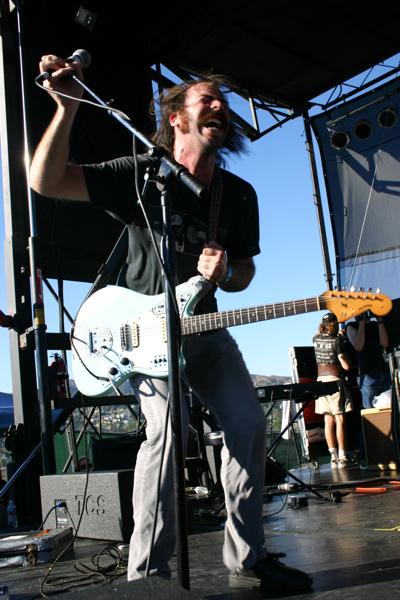
Ethan Miller of Comets on Fire onstage at ArthurFest, 2005 (photo by Jeremiah Garcia/IceCreamMan.com)
C and D: Two fellas reason together about some new records
C: We resume not far from where we left off last issue. Only without D, our lovable excitable German, who has vacated the rumble seat to return to Der Fatherland to observe the World Cup. In his place, quaffing D’s beers for this issue only, ladies and gentlemen of the court, may I present to you: F. F: Happy to be here, C. Those are big shoes to fill. C: Relax. After three beers and the proper auditory stimulation, your feet will swell to fit.
Comets on Fire Avatar (Sub Pop) F: After five seconds of this record, I can confidently say: Comets on Fire, you made an excitable German out of me. Pummely stuff. C: This blasts off from where their last record left off: frequent flyer acid rock mentality, virtuous verses and choruses, oodles of audible poem lyrics, spry jams, and serious assblasting. A couple songs are slow burners… F: …that put the power back in balladry. C: The album-opening epic “Dogwood Rust” slithers into a Hawkwind-Ash Ra Tempel-Stereolab-Oneida locked groove around the six minute mark, then ignite into dueling guitar spirals, then some Von Harmonson echotronix. Plus the kind of casual avant garde move that’s so natural you almost don’t notice it: the electric birdsong at end of “Jaybird,” a nice fresh-air breather. F: A muscle-relaxer for the brain. C: For me, this album plugs back into what their labelmates Sleater-Kinney did on their most recent album: laying sweet waste to the center of Ted Nugent’s mind by power tripping from the top of the randiest redwoods. This is the Comets’ answer record, at least in my personal universe. F: I grok that. Fight fire with Fire! Those dark noontide chimes at the beginning of “The Swallow’s Eye,” and the chorus guitars on “Lucifer’s Memory”…it’s crystal clear: Cosmic soul rock kills pain dead. C: And it arrives just two months after the Howlin’ Rain album. Howlin’ Rain, of course, is the new band spotlighting Comets on Fire singer-guitarist Ethan Miller’s songwriterly aspect, which leans to the Allmans/Dead/Faces side of the highway. And just a few months after Comets guitarist Ben Chasny’s latest Six Organs of Admittance pan-cultural acid-folk stunner, The Sun Awakens. F: Not to mention Comets pianist/drummer Utrillo’s nuevo Elton John/Bill Fay song project, The Colossal Yes. C: That one 11-minute song on the Colossal Yes album? Wow… [listening to “Holy Teeth”] But back to the album at hand. This is total High Rise/Acid Mothers Temple/Kiss destruction boogie. F: A strange thing about “boogie” is it’s been Not Cool for a period about ten times longer than it was Cool. [standing up from the couch] But it never left my behind! C: [averting eyes, mumbling] Christ, F. Boogie if you must but please do it where I don’t have to see it. This one [“Sour Smoke”] is like keyboard-driven Fela Kuti meets Television. Can a band be this good? F: Felavision: I wish they had that on the Dish. C: Call your cosmic cable company… F: To paraphrase Foster’s: Comets on Fire—it’s American for rock.
Vetiver To Find Me Gone (diCristina) F: The second album from San Francisco’s haziest, gentlest canyon-folk drifters, Vetiver. C: There’s a bucolic feel to this I love. F: True, but what’s up with the word “bucolic”? The sound of words should correlate to their meaning, and there’s something about “bucolic” that always makes me think of a baby with a wet, hacking cough. C: Whereas this music would more likely cure a baby of such a cough. F: Readers with babies might let us know how it works… C: Vetiver’s music evokes all those little phases or episodes along a dayhike in the country: the initial entry into the wilderness…the part where you’re making serious headway, alone with your thoughts…the moment when the senses are overwhelmed by the nature stimuli, the dew and the sap, the sun’s heat and the insects’ hum…when you finally you stop for water by a brook, and take a nap in the shade. When Andy Cabic sings, “I climbed so high/the sky dropped down to teach me,” he’s tapping into the naturalist in all of us. F: I heard somebody say you could call this kind of music ‘naturalismo.’ C: I also heard somebody say that the real reason music originating from the West Coast underground—all the aforementioned bands, Brightblack Morning Light, etc etc etc—is so beautifully gone right now is because of the high potency of the marijuana out here. C: While I am not stoned at this time, I swear I just looked out the window and saw a burrito fly past. F: Yeah, that’s Vetiver, working the California tradition: Flying Burrito Brothers, Neil Young, the Mac of course, the original Charlatans from San Francisco… C: And of course the late under-lamented Beachwood Sparks, whose final EP had some of this same swooshy nature euphoria and next-afternoon melancholia. Not that this is mimicry. Cabic’s songwriting here goes beyond recidivist texture gesture. It’s a very subtle, tricky thing Vetiver does, mellowing the harsh but resisting the corn. They use violins instead of fiddles. F: Whoa, this song [“Red Lantern Girls”] is amazing! It’s like a horse just trotting along, and then alluvasudden, this squalling and sustained one-note electric guitar solo [courtesy of guest Brad Laner (Medicine/Electric Company guitarist-composer)] kicks in and the band breaks into a gallop. C: Vetiver: cures coughs, cleanses palates. Use hourly.
Awesome Color Awesome Color (Ecstatic Peace/Universal) C: Whoa! F: Yowza! C: These guys get on that train and ride it back to Cincinnati 1969! Total Stooges in Iggy’s-Got-the-Peanut-Butter-Again mode… F: Yeah, but even more than that— Sound of Confusion-era Spacemen 3, especially on this track “Dinosaur”: that’s the sound of a band refusing to learn more chords or grooves because they already found the best ones. C: Concentrating on tone and psychotic drive, like all the greats, like our national treasures The Cramps and Tav Falco and of course the 13th Floor Elevators…Awesome Color are…uh…awesome. C: I’ve got to admit that my inner adolescent thinks this is the coolest shit possible. F: I hope they’re all under 18, and there better be some brothers in this band. C: This song [“It’s Your Time”] features some actual choogle. C: Which brings us to the question that has haunted many a rock fan: what, exactly, is the difference between the boogie and the choogle? F: Would that be choogie or boogle?
Zizek! dvd (Zeitgeist) C: Dude, I’m trying to play this DVD, but you totally messed up my system while reconnecting the TV to the stereo so you could watch the World Cup in surround-sound. F: I think that D, absent as he is, would’ve approved. Anyways, it was worth it to hear the Mexican TV commentators hollering so sonorously. C: Okay, here we go… This is a documentary about Slavoj Zizek, the Solvenian philosopher who’s known as “a one-person culture-muncher” and “the Elvis of critical theory.” F: He looks more like Klaus Kinski. Or Yakoff Smirnoff. C: Blame it on the beard. Zizek’s basically this super erudite dude who is also a willfully contrary polemicist commentating on everything under the sun as he goes. As he says, “The duty of philosophy is to redefine problems, not to solve them.” Here he is on a tour of colleges…he sees a girl carrying some Evian and remarks, “Water in a bottle —it reminds me of socialism.” F: This guy’s great! Reminds me of the biting, death-obsessed comedy of the late great Brother Theodore. I believe Zizek speaks as a friend although he expounds with fiendish fervor. C: Fiendish fervor is right. Zizek is a pre-postmodern man. He was raised in Communist Yugoslavia, but when that all went to bloody hell, he became a Christian atheist. F: I knew I dug this guy. He’s got some zingers, like when he talks about being “up to your shit in ideology.” C: Zizek cuts through the tripe. Here he is watching an old televised broadcast of Lacan giving a lecture. Lacan is one of Zizek’s primary influences, but he is not in awe of Lacan: “I find his emphasis and gestures ridiculous…. I’m a total enlightenment person, I believe in clear statements.” F: Like Zizek says: “I always tell the truth. Not the whole truth, because one can’t.” C: My favorite part about this film is where Zizek proudly shows us that he keeps his clean laundry in the kitchen cupboard. F: You’ve got that much in common…
Beavis and Butthead: The Mike Judge Collection, Volume 2 DVD (Paramount) C: Meanwhile, at the other end of the philosophical spectrum… F: Beer me! C: Y’know, there’s so much product that comes out these days, so many records, DVDs and CDs, but I still feel like there’s a void Beavis & Butthead left that remains unfulfilled. F: Hey, Zizek’s doing his best. C: Hard to imagine Zizek calling Lacan a “dillhole” though. It would be so cool if they made a new Beavis & Butthead movie, like, checking in with them ten years later… F: In the meantime, creator Mike Judge is putting out these super-packed DVDs, and it’s amazing to watch the classic cartoons uninterrupted by erase-your-blemish commercials. C: The titles alone are remarkable: “Wet Behind The Rears” — “Premature Evacuation”—”Here Comes The Bride’s Butt.” F: “Bang The Drum Slowly, Dumbass.” C: I love when the screen goes dark, right before the show starts, and you can only hear their immortal “hunh-huh-unh” laughter. Ohmigod, I love this one, where they go in to the plastic surgeon to get their “thingies” made bigger, but [uncontrollable laughter] instead the doctor gives them boobs! [falls off the couch] F: Settle down, C. How many brownies did you eat? C: I dunno. Is the baggie half full or half-empty, buttmunch?
Phi Ta Khon: Ghosts of Isan dvd Directed by Robert Millis (Sublime Frequencies) F: Feature-length film about a weird three-day street festival in Thailand, sometimes referred to as “Mardi Gras from Hell.” Whoa. Talk about awesome colors. C: You see, this is what America should have learned from pre-Katrina New Orleans. All this industrial technology and computer whatsits and the Intervoid is so much unnecessary fuzz. To coin a paraphrase, what the world needs now is less competitive work-laboring and more communal partying. F: Preferably in blazing demon masks made from cocount husks. C: Yes, decadence on the cheap. Whiskey drinking at dawn and total second-line parades featuring guitar-and-flute ragas on flatbed trucks, amps powered by car batteries, people waving hand-painted papier mache phalluses with strange tips. When the grid crashes, this is how I hope we’ll party. Of course we’ll probably have to wait til then. You’d never be able to get a permit for something like this in public in America, home of the so-called free. F: I like the Sublime Frequencies approach. They stand in awe of this planet’s inhabitants’ strange beauty: they bear witness. They just say LOOK, they don’t even try to explain—well, not much—what’s going on. Their approach is, This shit is so deep you don’t even have to know anything about what it is you’re seeing to receive some its power. It’s that rich. They’re busy grokking. They’re feeling fascination. F: They are the real human league.
Rage, Rage Against the Stuffing of the Couch Two poets delve deep into worlds of work and non-work
Reviewed:
Alex Mitchell Life Is A Phantom K-Mart Horse Starting Up In The Middle Of The Night (Yahara Design Press, Madison, WI)
John Tottenham The Inertia Variations (Kerosene Bomb Publishing, Los Angeles)
If their styles couldn’t be more contrary, they do have one thing in common: poets Alex Mitchell (neckburned nailgun grindhouse tripper) and John Tottenham (couch-crowned prince of lethargy) have both created, by force of will or resigned declension, their own poetic form.
Mitchell is a rock’n’roll addicted sweetly emotional fellow traveler. His poems are as much about himself as the characters they co-star: a mushroom-juicing buddy from back in Pompano Beach with a suicidal brother; a friendly transvestite crackwhore outside a Hollywood 7-11. He is as much of the barroom as he is anti-boardroom, his impulsive tales [impulsions] leading us through corners of associative memory emotional and imagistic. There is a lot of power in his poems—they inspire you to write, my highest praise. In a poem called “if penguins could talk” Mitchell is a bruiser with a bruised heart (“once a speedfreak, always a speedfreak,” he writes) trying to quit Starbuck’s. After going without coffee for two weeks (“although I was feeling better physically I was jonesing for a blast”) he caves: “I greedily slammed down some of / evil black poison.” And then he’s off on a tale that goes for five pages.
Tottenham’s eight line withdrawals from ambition barely give the reader time to get out of bed, and he wouldn’t have it any other way. A resigned indentation is what he wishes to leave (if he aspires to anything at all). In poems like “Time Moves, But Not I” and “I’m Not Tired,” he discharges himself of will, while subtly sublimating his own state of stagnation. He declares he lacks the energy required to laugh, and one chuckles. The brief nature of his poems allow him to maintain the guise that he isn’t doing shit—but when you read them together, you feel the import of the block he pushes up against the eternal pyramid of poetic ambition, and one realizes: all progress is incremental…to the point of imperceptibility..despite any onanistic self-recrimination.
News From the Upper Nine Henry Griffin goes back to New Orleans
“You are entering the city at your own risk. Police and fire services are limited. There is no 911 service. Traffic lights are out throughout the city. Observe a citywide speed limit of 35 mph, and proceed with extreme caution, especially around downed power lines. You are not permitted to go beyond your designated ZIP code area. Do not drink, bathe in or wash your hands in tap water. Standing water and soil may be seriously contaminated. Limit your exposure to airborne mold and use gloves, masks and other protective materials. Apply mosquito repellent and sunscreen. Bring sufficient food, water, gas and any medical supplies required to sustain you and your family, keeping in mind the curfew and store inventories may limit access to supplies. Gas stations are not fully operational. Fuel is limited.” —from a list of “tips” from the New Orleans Mayor’s office for dealing with the “urban hazards” of life in the 9th Ward in September, 2005
I’ve long used the introduction “I live in New Orleans” to break the ice at parties. This usually cheers people up, often sparking memories of a particularly debauched vacation. “How can you people live down there?” someone would inevitably ask, meaning “How do you keep from becoming an alcoholic?” Now the same question connotes differently, more of a “How could you live in that city knowing that you were doomed by its very design?” Of all the tragedies of Katrina, this hurts the most: our carefree lifestyle, our legendary tolerance, for alcohol, for iniquity and corruption, is now less a punchline than a cautionary tale.
You’d think from the apocalyptic prognostications of the national media that there wouldn’t be much of a city left to return to. Not so. Some areas are straight-up ravaged, that’s for sure. But your “average block” can be quite a mix, and even in the so-called “spared” neighborhoods, a hundred year oak may be splintered across some power lines.
My house is still there, a raised Creole cottage at the eastern-most tip of the upper Ninth ward, three blocks north of the river. I describe it this way, as that’s how I first re-located it, via a satellite photo posted on the web, after the cataclysm. I found my neighborhood from space, then my block and then my house. It was easy to pick out: there is an 80-foot pecan tree leaning against the roof. The good news is that it hasn’t fallen through and bisected the building. The bad news is that the tree has been there since July 5, a symptom of long forgotten Tropical Storm Cindy. In classic New Orleans fashion, it hadn’t been seen to by the proper authorities by the time Katrina hit eight weeks later.
Three weeks after Katrina, I returned to find my basement apartment had taken three feet or so of water. It had dried out by then but waterlines and a veneer of detritus told the story: my life had been coated with waste, human and otherwise. To keep the effect from being entirely humorless, the Almighty had thrown in a few frogs, who were now living in my office.
My urban salvage operation actually lightened my mood. Like most folks, I’d imagined losing everything I’d left behind. To get back even half of my stuff seemed almost unfair. I couldn’t breathe the spore-clogged air or touch anything with my bare skin, but rescuing keepsakes from the rising mold was as thrilling as the prize choosing finale of Wheel of Fortune. Things I’d owned and lost were now won back from oblivion. I was in such a good mood that first night that I almost brushed my teeth in tap water, mistaking this for any other major American city. Spill bottled water on the brush, I reminded myself. Like you’re in Haiti.
Some people suffered their share without losing a shingle. My friends Dave and Jennifer had to watch the whole storm from a vacation in Thailand (being late August, lots of folks were out of town). They returned to find their recent home purchase in fine condition. Then they noticed the stench out back. An unpleasant excavation followed, and a more unpleasant discovery: a visiting country’s National Guard, after having barracked in a nearby Catholic school, had used these civilians’ yard as a dump for their rotting garbage.
Things could have been far worse. They could have had a pile of trash dumped on their lawn by the enterprising earth mover, who was leaving his business card for the follow-up call to remove said pile (in order to dump it on his next intended customer). They could have been arrested for a curfew violation by the Wyoming National Guard or the NYPD, who’ve been patrolling New Orleans due to our cop shortage, and been put behind bars at the bus station, which is Orleans Parish’s prison since the real one was flooded. They could have been blindsided by a hit and run driver who speeds off, uninterested in trading insurance information without the rule of law (I witnessed such an incident). They could have had their house gutted by looters. They could have absentmindedly opened their refrigerator.
Those early weeks after Katrina, people were very well-behaved. Streets were empty and quite peaceful, passersby waved hopefully. The de-electrified environment and low population lulled us into a sense of temporary historical atavism. By which I mean, the neighborliness was positively Amish.
Imagine that all the things you loved about your home were taken away. Instead of food you get 24 varieties of MRE (avoid the Thai Chicken); drinking water comes in cans supplied by Anheuser Busch. Where your favorite vegetable truck used to park, now there’s an upside down Volkswagen that had caught fire. Long tree-lined avenues like St. Charles and Esplanade have been given arboreal crewcuts by the storms, leaving the shade compromised. Friends and neighbors aren’t around too much, but you do get daily visits from assorted rescue workers, most double-checking that each house’s spray-painted sigil is still accurate.
And, after a while, civilization returns, one service at a time. Electrical power! Gas! Cable! DSL! Sanitation! Could the mail, once the invincible standard of civil service, be far behind?
* * *
The anarchic spirit of a functional ghost town couldn’t last forever. As the population rose in September and October, the town got crankier. Four-way stops, once an opportunity to wave at a kindly stranger, now began to prompt the waving of just a single special finger. The long-awaited return of recognizable first world civilization tested the patience of many thousands.
And yet…Each restaurant or bar that reopened became an opportunity to rejoice. By Halloween, the city’s Dionysian personality was returning in force, and celebration was beginning to become a goal in and of itself, which seemed familiar. What festivities there were spilled into the streets, as they used to do. For Halloween, the most popular costume was a refrigerator wrapped in duct tape, spray-painted with the address of George W. Bush or Tom Benson, the reviled Saints owner who intends to move our hopeless but beloved football team to San Antonio.
There were a lot of smiles, a lot of back slapping and story trading, even among people who had just traded introductions. We all knew this one new thing about each other. That we would, and did, come back. Even redefined, this tainted city, one that wasn’t exactly in mint condition when we got it, would be ours again if we want it.
* * *
If everybody doesn’t return (and how could they all?), will New Orleans lose its most essential asset, its culture? It’s hard to say. But maybe it isn’t so tragic. Maybe it’s the case that every person who doesn’t get back is somehow happier somewhere else, where they have air conditioned schools, and a lower murder rate, and better jobs—jobs that aren’t in the tourist, service and gambling industries. Who can blame them? Who in their right mind would come back, to a city of corrupt politics, looting cops and dwindling protection from the elements?
The answer, of course, is those who can’t imagine living anywhere else.
Henry Griffin, a fifth generation New Orleanian, is a writer and director whose films include Mutiny and Tortured by Joy. He organizes his books by color, trading organization for the pleasing effect of his shelves viewed from a distance. Since the storm, he is fresh out of blue books.
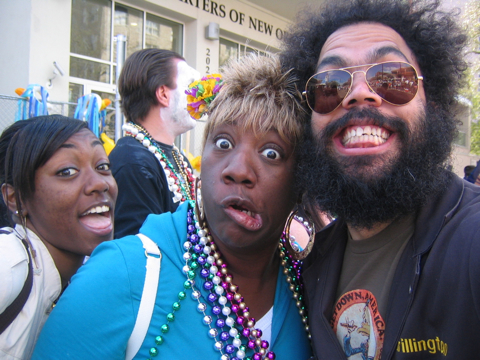
Our tipsy author, right, with fellow revelers at the Rex Parade, Mardi Gras morning.
Weird Shit’s Still Going Down: Notes From Mardi Gras in New Orleans, 2006 By Gabe Soria
I’ve been in love with New Orleans since the day in May, 1993 when I first set foot on its soil. Since then, I’ve been a resident of the city three times and have gone back over and over when I wasn’t. Mardi Gras, for all its faults and gross public image, is important to New Orleans residents and expatriates alike, so when the chance came to visit my city for the first time after Katrina during Carnival, I jumped at it, but not without some second-guessing trepidation. What follows are rough impressions of my experience being back in town from Saturday, February 25 through Mardi Gras to March 1, Ash Wednesday and the beginning of the season of Lent…
Touching Down Disembarking from the plane and already the Twilight Zone schisms from reality are apparent. This scene happens in the first couple minutes of the episode, the part right before the credits when the Rod Serling voice-over comes in and lets the viewing audience know that some crazy shit is about to go down. What’s Louis Armstrong International without its perpetually open souvenier stands and ersatz French Quarter bars? Too much like the Salt Lake City airport, that’s what. Outgoing passengers ain’t got nowhere to buy their last minute cans of Tony Chachere’s seasoning, authentic cookbooks or Hurricane mix. Incoming passengers don’t have anything, except for the baggage claim, and that is hardly a picnic. Everybody seems a bit hunted, a bit guilty.
Nothing makes you realize how much you’ve given up until someone’s taken away the lights, and the “Arriving Flights” underpass of Louis Armstrong International is a third world kick in the nuts: the absence of ambient light is palpable, and the illumination provided by taxis, shuttles and pick-up cars feels like interrogation by headlight. At the same time, though, it’s kinda eerily beautiful, as though everything is powered by steam and gaslight. We hear later that they’re still working to restore normal power. The airport of a major American city still doesn’t have full power six months after a disaster? What the fuck is going on here, I ask myself, resigning myself to joining the chorus of people asking that same question.
T-Shirt Slogans The town is aswarm with bootleg political shirts, jockeying for space in Decatur Street tourists shops with your typical novelty T-shirts about states of tequila intoxication. Most of these shirts feature embattled mayor Ray Nagin in Photoshopped Willy Wonka drag, making some sort of sport about his now infamous Martin Luther King Day “Chocolate City” speech, possibly the biggest effect a George Clinton song’s ever had on the political scene. React how you want to the speech—reading a transcript in retrospect, it’s obvious to this writer at least that Mr. Nagin’s frustration with his black contemporaries left him feeling a bit loose at the mouth, but I ain’t mad at him—you can’t help but realize that there’s a little bit of smug racism at the core of the these shirt’s makers, that they finally feel justified at putting the screws to a black mayor who, admittedly, said some dumb-ass shit. But then I realize an important fact: I don’t think I’d ever really want to hang out with someone who wears their politics, left or right or straight up centrist, on their literal shirt-sleeve. I mean, I’m all for band t-shirt propaganda, but this? Nah. One T-shirt maker has gone the extra satire mile, though: for sale at the Circle Bar are “Ernie K-Doe for Mayor” tees, featuring the smiling face of the late and lamented Emperor of the Universe. Bumper stickers can be had, too. One drunken night, I find myself fervently wishing that K-Doe wins in a write in. In the storied history of corrupt Louisiana politics, the election of a deceased and much loved R&B singer has got to be an improvement.
Chased on a Bike Weird shit’s still going down, though. On a perfectly fine afternoon, the wife and I mount bikes to ride down to a parade to meet a friend. Normally, yours truly is a bit more savvy about the safe routes to travel, but the hurricane-depleted lack of population has thrown me for a loop. Why not take a jaunt down a clear street a block closer to the river? The answer becomes clear when we make a left on Josephine Street towards St. Charles. A group of kids—12 to 14, black—are hanging out in front of a corner grocery/liquor store and begin shouting out warnings about how “Y’all don’t know where you ridin'”, etc., etc., and one kid’s bold enough to do a little mock run after the wife, who’s trailing behind on a too-small borrowed bike. The kid’s pursuit is half-assed, and he stops almost as soon as he starts, but it’s a neon-lights reminder that New Orleans is still a fucked-up place, race-wise.
In fact, this little incident is an anomaly. While statistics may not prove me right, the general impression one gets during Mardi Gras is of détente, peace. Sure, fratboys might get beaten down by cops along Bourbon Street after one Huge-Ass beer too many, but for the rank and file of the city, a “we’re all in this together and ain’t it fine” feeling pervades, usually. If you say “Happy Mardi Gras,” to anybody, they respond in kind, and mean it. But this little incident… well, they’re kids, so it doesn’t really mean much. It means that they’re acting like they think they’re supposed to act; it means that they actually think that their corner store is something to be protected; it means that they’ve learned that being young and black and aggressive can freak the fuck out of people going about their own business. Still, it’s days before I can stop picturing kicking the kid’s head in if he tried to touch the wife, and my subsequent murder at the hands of his numerous cronies. Yikes.
The 9th Ward Marching Band Not that it needed saving by anybody, but the wife’s and my Mardi Gras is definitely given a soul-rousing boost by seeing the Mr. Qunitron-led 9th Ward Marching Band parade with the Krewe of Proteus on Lundi Gras night. For the uninitiated, Quintron and his wife Ms. Pussycat were and remain the owners and operators of the Spellcaster Lodge, a house/venue located on St. Claude Avenue in the 9th Ward. They’re both musicians, as well as puppeteers. Long time fixtures of the weird underground of New Orleans, they’re more like good spirit elementals rather than impeccably dressed scenesters, which they are as well. The 9th Ward Marching Band started as a loose-knit, almost renegade marching assemblage, but over the years they’ve gotten their weird act together, and while sharp and somewhat professional, they still make the squares nervous. While watching them march in their smart red and white outfits, playing “Rock me Like a Hurricane,” I notice that the crowd lining the parade route is going BANANAS for them. Everybody can feel that this ain’t no sarcastic, ironic hipster bulllshit—it’s true American weirdness and beauty at its finest. But you can also tell that they make some folks delightfully nervous. This can probably be best attributed to the bands in-between, resting music. When there’s a lull in their routine and things calm down, the 9WMB’s glockenspiel players start tapping out the theme from the slasher film “Halloween,” with the tubas coming in every now and then to deliver an ominous “bruuummmmmm.” It’s the film score equivalent of the fabled brown sound—you can tell by the looks on people’s faces that they recognize the minor key tune, and they like it, but don’t like it at the same time. It’s a brilliant moment, and I want to buy whoever thought of it a beer or ten.
The Dead Zone The night of Lundi Gras finds the wife and I and our friends Judson and Courtney taking a shortcut on a drive downtown to hit a Quintron/Peaches show. The shortcut takes us through the area of town known and Mid-City, where Courtney lived previous to Katrina. Her new home features a handful of possessions salvaged from her house and cleaned of mold, but she’s basically begun anew. But driving through her old neighborhood… yikes. Once you get a few blocks off St. Charles, heading away from the river, a frightening change takes over the streets. They’re empty. They’re dark. Everything looks haunted and miserable. A few FEMA trailers are parked here and there, and on occasion someone seems to have managed to get a porch light working, but on the whole, it feels as if we’ve driven directly in a George Romero zombie flick. Any moment now I expect to see a shambling corpse slouch into the street, attempting to suck the brains out of our car’s passengers. No such thing happens, of course, but I am glad when we eventually make a right turn onto relatively populated, lighted Esplanade. The fact that a few moments earlier I was half-joking about wishing I was armed with a shotgun kinda makes me want to cry. I’ve NEVER wanted a gun in New Orleans, not even in my worse moments.
Mardi Gras Day (and on into the night) Mardi Gras morning rolls around and all seems to be aback to normal in the city, at least for a few hours. Working on a few hours of sleep, the wife and I roll out of bed and into our costumes (I’m going as a jerk dressed in a jumpsuit and furry cap; the wife’s going the classy route by masquerading as a magical French schoolgirl). Walking over to St. Charles, we begin to see a parade of friends walk by; everybody seems to be well on their way to drunk before noon, but nobody’s got a mean buzz on. It’s all hugs, everywhere. Families lining the filthy parade route in their chairs and ladders look bleary-eyed and happy. When Rex starts to roll, you see people catching beads… and handing them to little old ladies and kids next to them. Everybody’s saying, “Hey, darlin’,” and “Excuse me,” and you’d be hard-pressed to spot your usual line of sweaty guys being led plastic-cuffed into a paddywagon (though I’m sure it’s happening somewhere—you can’t buck tradition in one year). The hours melt away—at one point, the wife and I are eating hamburgers with friends, the next, we’re at our home base eating red beans and rice cooked with a nice hamhock, the next, we’re being dropped off downtown. But by the time the Morning 40 Federation hits the stage at Checkpoint Charlie’s for their annual Mardi Gras night show, as the festival comes to its natural inevitable end, the feeling in the air is undeniably powerful, completely ecstatic. You can feel the desperate urge in the club to let loose, to raise one’s arms high above and scream. And as the Federation lurches into their first amplified ode to boozing and 9th Ward living, everybody in the room does exactly that. I’m grinning from ear to ear—it’s the feedback and the beer, most definitely—but it’s also the hope and love I’m seeing right now, that I’ve seen all weekend. Sure, folks are cynical and tired, but they still believe, much more so than I think anybody else in any city would or could, for they know that’s there’s an ineffable something to New Orleans, something that just can’t and won’t quit, ever.
C and D: Two fellas reason together about some new records
D: We have some severe time and space restrictions today because there’s 25 records to examine and I only brought four beers. C: [disbelieving] I told you all week. D: Yes, well. We’ll have to be efficient and precise, like the German defense. C: Always with the soccer metaphors when he’s supposed to bring the beer. D: [looks at stack of CDs] Hmm, I like this pitch. [smiles broadly, uncaps a Foster’s] Come on man! It’s time for kickoff.
MARVIN GAYE The Real Thing: In Performance, 1964-1981 DVD (Hip-O/Motown/etc) D: Marvin Gaye, the sweetpeacelovevibetenormaster of all time. C: Sometimes things really are essential, and this nine-dollar DVD is one of those times. Or things. Anyways, the reason I’ve been watching this all week long is pretty obvious. There’s nobody like Marvin, no one even close; it’s a blessing just to watch him lip synch. D: [grabs DVD case] Give me that. Especially when it’s Marvin duetting with Tammi Terrell at something called “Swinging Sounds of Expo 67,” singing “Ain’t No Mountain High Enough” in a futuristic phone booth under a plastic dome with a people mover going by in the background. C: Look at those Dentyne smiles. It’s like a commerical for some future utopia where they are the fertility king and queen. D: [thoughtfully] A world where you’re not afraid to have a baby C: Hey, you’ll like this: the a capella option lets you hear Marvin singing in the shower. D: No it doesn’t. C: Okay it’s actually just isolated studio tracks. Beautiful. He really can make you swoon with just a voice and a snapped finger. That’s all he needed. D: Very efficient. C: “War is not the answer/for only love can conquer hate… we’ve go to find a way/to get some understanding here today”—man, if you sing that today, you’re called a master of the obvious, and yet maybe it’s only a lovesinger who can bring the super-commentary that lasts. He reminds us there’s better things to do with our time. D: [musing] Lovers and poets make the best peace advocates. C: This is footage from the film Save the Children— D: —which should be released on DVD immediately— C: —which includes live renditions of “What’s Going On/What’s Happening Brother” from a 1972 concert where they did the whole album, and you get Marvin at the piano and the legendary James Jamerson on bass guitar. D: [sipping beer] Unbelievable. Total butterland. C: Total ethnographic film of Black America in the early ‘70s: broken windowed skylines and gang grafitti, soul food joints and black pride bookstores, men in dashikis, women in flares and kids in corduroys with spaghetti on their faces, street basketball and barbecue, balloons and checker pants and sweaters. D: Excellent fashion! C: He sings like his voice is a horn—and his voice actually has the grain of one. So amazing. Plus there’s multiple appearances on the Dinah Shore show—[notices puzzled D]—that was an afternoon TV show for bored housewives back in the ‘70s. D: That was the time before they started making all the women work all the time too, in addition to the men. What happened? C: [ignoring] He talks about What’s Goin On: “I don’t recall much about making it. I feel it was very personal, very divine. I don’t hardly remember writing the songs, it was like I was in some sort of other dimension when we did it, so I know it was a very spiritual.” We could spend weeks talking about everything on here: the polyester jumpsuit future-Chic-soul-P-funk— D: Somewhere The Juan Maclean is crying. C: —about getting down on the moon with floor fog that is the promotional video for “A Funky Space Reincarnation”— “COME ON BABY, let’s go peace loving and check out this new smoke/Naw this thing I got, it ain’t classified as dope/Smoke I got from Venus/Have had it all week, it’s getting old/come on and try this new thing with me baby….” D: This song is my new national anthem. C: And your new wardrobe, if the world is lucky.
D: I’m looking at the stack of stuff we’re going to talk about and I am noticing an absence this time round of certain records, or styles, that I am particularly fond of. I am worried about the lack of brash super-volume riff-monster guitar and backbeat. C: Well D, the way I look at it is: We certainly can’t review everything that we come across—who has the energy for that? And we can’t even cover everything that’s obviously worthy—there’s just not enough space. So it’s a bit down to what most interests us at the moment. As Allen Ginsberg pointed out, “Mark Van Doren used to write book reviews for the Herald Tribune and almost every one of the reviews was intelligent and sympathetic; he was always talking about something absolutely marvelous. I said, ‘What do you do with a book you don’t like?’ and he said, ‘Why should I waste my time writing about something I’m not interested in?’” And anyways, don’t worry. There’s some riffs on the way.
Mountains Sewn (Apestaartje) D: [Listening to “Sewn One”] Hmm… Could it be the mighty Growing? C: Close, but no cigar. This is Mountains, a duo from New York who I only recently became aware of because Mr. Plastic Crimewave selected them to play at his 2 Million Tongues festival. Their second album. A nice electrical nature hum. I’ve also been hanging out recently in the mountains, so I feel a special affection for them automatically. D: An orchestral shower with the warm drone reminiscent of Herr Klaus Schulze on the synthesizer. C: And then, little acoustic guitar lines and horn tones, foregrounded, or deeply backgrounded. It’s pretty great isn’t it? Total mama nature kids in a low-wattage electronic garden. Reminds me of what Ginsberg’s “great peaceful lovebrain” would sound like, slowly comfortably spinning drifting slowly in eternal wombspace. An alternate soundtrack to Silent Running‘s opening sequence, or a lost instrumental Talk Talk aria… D: You’ve been on quite a Ginsberg kick lately. C: [smiles beatifically] Why bother to paraphrase already perfectly put words of wisdom? I say quotate away til we have something new to say… I like to listen to this at Arthur HQ with the windows and front door open, hoping birds will fly by or neighborhood animals will walk in, and we can all be at peace together, for once… Of course, it’s also useful to drown out the car alarms and sirens and lawnmowers and leafblowers and helicopters. It’s not sentimental flashy hot leftbrain human, not cold technical rightbrain robot: strictly ahuman, objective in a naturalist’s sense.
Citay Citay (Important) C: Continuing in the rural mode… D: Psychedelic canyon and meadow music such was made in ye olde ’70s! [starts air guitaring to closing ascending twin electric guitar line of “Seasons Don’t Fear the Year”] C: They’re really nailing that rich acoustic-electric rolling tabla honey harmony sound that all those heavy bands—Sabbath and Zeppelin, especially—used to do, back when all the best musicians were inspired by what the Incredible String Band were doing, and were still able (or willing) to express a feminine side to go with their preening barbarian or depressive wail aspects… D: [reminisces] When the maidens were fair and wore flowers in their hair instead of covering themselves in tattoos and piercings. I am awaiting Sandy Denny’s entrance at any moment. C: Total “Battle of Evermore” vibe, especially on “Nice Cuffs.” D: Nice title. I also like this one: “What Never Was and What Should Have Been.” C: More like “What Always Is and Will Ever Be.” This is an album without a sell-by date, with a song for every season. D: [listening to “Shalom of Safed”] Monumental. Like the best parts of Deep Purple and the Moody Blues and Pink Floyd. C: Making music for horse-drawn sledrides thru the driving snow to the lodge in the distance, where pale ale and a fireplace and friends are… D: [10 minutes later] Was that all one song?



 Arthur Magazine