Happy Birthday Kenneth Patchen

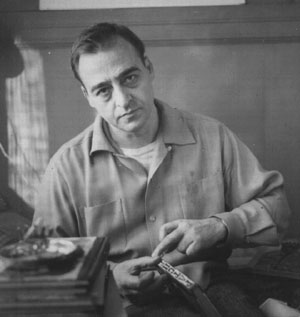
It’s the birthday of poet Kenneth Patchen, born in Niles, Ohio (1911). He came from a working-class family — coal mining on his mother’s side, farming on his father’s, and while he was growing up his father was a steel worker in Youngstown. His Scottish grandfather loved to read aloud Robert Burns poems. And Patchen said that in Burns’ poems and his grandpa’s stories, “there was what you would call magic.” He started keeping a diary when he was 12 years old, wrote poems throughout high school, went to a handful of colleges, and traveled around the country working as a migrant laborer.

Then he went to a friend’s Christmas party and met Miriam Oikemus, a college student at Smith and an anti-war activist. The daughter of Finnish socialist immigrants, she had joined the Communist Party at the age of seven. Kenneth and Miriam fell in love and exchanged letters for a while — Patchen wrote her love poems. They got married in 1934. A few years later, when Patchen was just 26 years old, he suffered a terrible spinal injury while he was helping a friend separate two collided cars. He spent the rest of his life in severe pain, and went through three surgeries. The first two surgeries were helpful, and increased his mobility, so he was able to tour the country and give poetry readings. He partnered with Charles Mingus and the Chamber Jazz Sextet, and he set his poetry to jazz music, for performances and recordings.

But during the last surgery, something went wrong and Patchen fell off the operating table and permanently ruined his back. He was bedridden for the rest of his life, but he continued to write and paint in bed. He said: “It happens that very often my writing with pen is interrupted by my writing with brush, but I think of both as writing. In other words, I don’t consider myself a painter. I think of myself as someone who has used the medium of painting in an attempt to extend.”

During his career, Patchen wrote more than 40 books of poetry and prose, much of it illustrated, including The Journal of Albion Moonlight (1941), The Memoirs of a Shy Pornographer (1945), The Love Poems of Kenneth Patchen (1960), and But Even So: Picture Poems (1968). He dedicated every book to Miriam.

In 1945, two journalists published an article called “The Most Mysterious People in the Village,” about the life of Kenneth and Miriam Patchen. Miriam told the journalists that her husband was “absolutely impossible until he’s had a whole pot of coffee in the morning.” They wrote about visiting Kenneth Patchen’s bedroom: “The bed was massive and so was the man. He wore a faded gray sweatshirt with washed-out blue cuffs and pocket. The shirt was tucked into the waistband of black woolen trousers that were frayed at the cuffs. Patchen wore blue, maroon and tan Argyle socks, but no shoes. His body seemed muscular and powerful; his face delicate and sensitive. His skin was white and his eyes were a deep blue-gray.”

Years later, Miriam described their daily routine: “I’d be up earliest, go for the paper, read it. He’d awaken later, having finally gotten to sleep, have breakfast and look at the news, then get to work. ‘Get to work’ meant writing in bed, lying down. The upright sitting position was painful for him, then. I’d read, wash clothes, house clean, take coffee to him frequently. When we had almost no money life was the same as when we had a little. At 12th Street we always had the rent and money for utilities. With an advance from Mr. Padell we bought a couple windsor-style chairs, one easy chair and a table. What elegance those pieces gave to the doll house.”

Kenneth Patchen died in 1972, at the age of 60. Miriam Patchen remained a champion of leftist causes as well as her late husband’s poetry, and collaborated on his biography Kenneth Patchen: Rebel Poet in America (2000), by Larry R. Smith. Miriam Patchen died in 2000 at the age of 85, sitting up in a chair, reading.

Kenneth Patchen said, “It’s always because we love that we are rebellious; it takes a great deal of love to give a damn one way or another what happens from now on: I still do.”

A Poem from Mark Perlberg

Once in a While
by Mark Perlberg

Mother was agitated all morning.
A call had come from her brother Harold,
who was spoken of only in whispers
and despised by those with a talent
for never changing their minds.
But Mother loved him.

Somehow I learned that my uncle
had forged checks and spent time in prison.
And I knew he played the saxophone
in small jazz bands.

In late afternoon the doorbell rang.

My uncle stood in the hall.
A tall man slightly stooped, he shook snow
from his long brown overcoat. He had a high
hooked nose and wavy brown hair
that fell across his forehead,
and he carried packages wrapped in Christmas paper.

My stepfather signaled: disappear.

In early evening Uncle Harold
knocked on my door with a gift for me:
jazz records, the first I’d seen.

Fats Waller beaming from the album cover
is clearer to me now than my uncle’s face.
“I can’t give you anything but love, baby.”

A mourning sax backing Lee Wiley:
“Once in a while, will you give just
one little thought to me…”

At first light my uncle was gone,
His footprints vanishing in a fresh fall of snow.

A Poem from Stephen Behrendt

For six nights now the cries have sounded in the pasture:
coyote voices fluting across the greening rise to the east
where the deer have almost ceased to pass
now that the developers have carved up yet another section,
filled another space with spars and studs, concrete, runoff.

Five years ago you saw two spotted fawns rise
for the first time from brome where brick mailboxes will stand;
only three years past came great horned owls
who raised two squeaking, downy owlets
that perished in the traffic, skimming too low across the road
behind some swift, more fortunate cottontail.

It was on an August afternoon that you drove in,
curling down our long gravel drive past pasture and creek,
that you saw, flickering at the edge of your sight,
three mounted Indians, motionless in the paused breeze,
who vanished when you turned your head.

We have felt the presence on this land of others,
of some who paused here, some who passed, who have left
in the thick clay shards and splinters of themselves that we dig up,
turn up with spade and tine when we garden or bury our animals;
their voices whisper on moonless nights in the back pasture hollow
where the horses snort and nicker, wary with alarm.

A Poem from Elizabeth Alexander

My mother loves butter more than I do,
more than anyone. She pulls chunks off
the stick and eats it plain, explaining
cream spun around into butter! Growing up
we ate turkey cutlets sauteed in lemon
and butter, butter and cheese on green noodles,
butter melting in small pools in the hearts
of Yorkshire puddings, butter better
than gravy staining white rice yellow,
butter glazing corn in slipping squares,
butter the lava in white volcanoes
of hominy grits, butter softening
in a white bowl to be creamed with white
sugar, butter disappearing into
whipped sweet potatoes, with pineapple,
butter melted and curdy to pour
over pancakes, butter licked off the plate
with warm Alaga syrup. When I picture
the good old days I am grinning greasy
with my brother, having watched the tiger
chase his tail and turn to butter. We are
Mumbo and Jumbo’s children despite
historical revision, despite
our parent’s efforts, glowing from the inside
out, one hundred megawatts of butter.

A Poem from Denise Duhamel

Buying Stock
by Denise Duhamel

“…The use of condoms offers substantial protection, but does not
guarantee total protection and that while
there is no evidence that deep kissing has resulted in
transfer of the virus, no one can say that such transmission
would be absolutely impossible.” –The Surgeon General, 1987

I know you won’t mind if I ask you to put this on.
It’s for your protection as well as mine–Wait.
Wait. Here, before we rush into anything
I’ve bought a condom for each one of your fingers. And here–
just a minute–Open up.
I’ll help you put this one on, over your tongue.
I was thinking:
If we leave these two rolled, you can wear them
as patches over your eyes. Partners have been known to cry,
shed tears, bodily fluids, at all this trust, at even the thought
of this closeness.

A Poem from Ruth Stone


WANTING
by Ruth Stone

Wanting and dissatisfaction
are the main ingredients
of happiness.
To want is to believe
there is something worth getting.
Whereas getting only shows
how worthless the thing is.
And this is why destruction
is so useful.
It gets rid of what was wanted
and so makes room
for more to be wanted.
How valueless is the orderly.
It cries out for disorder.
And life that thinks it fears death,
spends all of its time
courting death.
To violate beauty
is the essence of sexual desire.
To procreate is the essence of decay.

A Poem from Beth Woodcome

Hometown
by Beth Woodcome

The shame in the church crawls out of each human. A mild sin grows first behind the ears.

The wind: it comes without thought or any use of my hands. My hair grows the same color as the red scarf covering a lamp. I’ve heard of women who lead men into a chamber that is stained like the pit of a cherry. Place something upon the tongue. Go in peace.

Pretending there is no time to stop and look at the old gravestones that lean south, my father keeps driving. The common is cold and blown clear of leaves. This is near Chocksett School playground where a German shepherd tore up my soft back. My father took me to the dog that night to let it smell me. I held it in my arms. We’re all bound to something.

The strain of the body in trauma stresses the heart muscle. When I come up for air, the wind fills my throat before I realize I want it to.

When I think of what I am, I think of this small town. The dog, my back, the women, my dog.

A Poem from Grace Paley

The Poet’s Occasional Alternative
by Grace Paley

I was going to write a poem
I made a pie instead it took
about the same amount of time
of course the pie was a final
draft a poem would have had some
distance to go days and weeks and
much crumpled paper
the pie already had a talking
tumbling audience among small
trucks and a fire engine on
the kitchen floor
everybody will like this pie
it will have apples and cranberries
dried apricots in it many friends
will say why in the world did you
make only one

this does not happen with poems
because of unreportable
sadness I decided to
settle this morning for a re-
sponsive eatership I do not
want to wait a week a year a
generation for the right
consumer to come along

A Poem from Jennifer Boyden

Vandals
by Jennifer Boyden

They wrote it all down for me.
In the living room on the walls
they wrote who gave it up and who wanted it
most and a phone number. They told me
where to stick it, how to like it,
what the consistency was. There was a lot
I didn’t get, but they left more under the bridge
and against the back of Red Plank Records.
But I never met them. They came in the smoke
of my absence, during the hum
of appliances that needed to be wrapped
with stuffing and tape.
They made me the queen of their intent,
all the messages like stars
on the undersides of overpasses. I stay informed
about the people—what they do to each other,
how to take it, what number to call
for a piece of your own and what happens
if you’re not there to get it.
I watch for them to come back.
I watch for them from across the street
in my rented room with the walls painted red
and my little bit on and the curtains
more than slightly parted.

A Poem from Rae Armantrout

1

Anything cancels
everything out.

If each point
is a singularity,

thrusting all else
aside for good,

‘good’ takes the form
of a throng
of empty chairs.

Or it’s ants
swarming a bone.

2

I’m afraid
I don’t love
my mother
who’s dead

though I once –
what does ‘once’ mean? –
did love her .

So who’ll meet me over yonder?
I don’t recognize the place names.

Or I do, but they come
from televised wars.