“Fellowship of the Vine”: an interview with shamanic psychonaut-author Daniel Pinchbeck (Arthur, 2002)

Originally published in Arthur No. 1 (October, 2002)

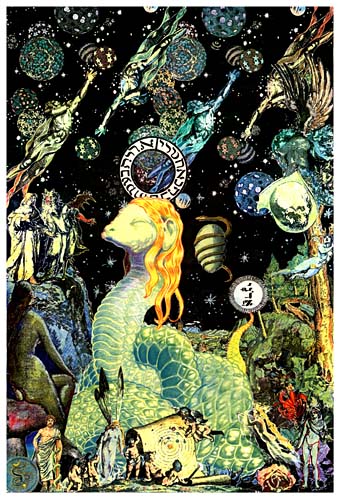
“The Garden of Magic; or, the Powers and Thrones Approach the Bridge” by Alan Moore (1994)

Fellowship of the Vine
An interview with shamanic psychonaut-author Daniel Pinchbeck

Daniel Pinchbeck is a New York-based writer and journalist who co-founded the literary magazine Open City in the early ‘90s. The son of the writer Joyce Johnson (a member of the Beat Generation and author of Minor Characters) and the painter Peter Pinchbeck, Pinchbeck has been on a passionate intellectual quest for the last years that has taken him across Nepal, India, Mexico, the Amazon and West Africa, writing pieces on art, psychedelics, and altered states of consciousness for Rolling Stone, The Village Voice, Wired, Salon, and The New York Times Magazine, among others. His new book, Breaking Open the Head: A Psychedelic Journey Into the Heart of Contemporary Shamanism (Broadway), is an account of that quest, blending cultural history, personal narrative, and metaphysical speculation. The original interview was conducted by Joseph Durwin on the eve of Breaking Open the Head’s publication; there’s been some slight futzing of the text by Arthur’s editor.

Arthur: In your book, you talk about exploring many of the same hallucinogenic drugs—LSD, magic mushrooms, ayahuasca—that postwar Westerm bohemians like the Beats and the Hippies were interested in. How does your quest compare to those of people like William Burroughs, Allen Ginsberg, Ken Kesey and Timothy Leary?
Daniel Pinchbeck: The Beats were working by instinct and intuition. They realized that modern society had become a horror show, and that their task was to begin to uncover, in Allen Ginsberg’s words, “a lost knowledge or a lost consciousness.” They took that process as far as they could in the context of their times and their individual personalities.

I believe that my approach—and my book—is more scientific and analytic, because that is the task of the “counterculture” in our time. Perhaps I am the only person who feels this way, but I see a clear goal ahead. This goal is a direct legacy of the counterculture —but it is actually hundreds, if not many thousands, of years older than that. In fact, it is the mission that we must somehow accomplish. Think of it as a secret raid to be carried out deep behind enemy lines, despite incredible odds, and with no possibility of failure.

The Beats and the Hippies saw through the abrasive insanity gnawing at the soul of America–this warmongering, money-mad, climate-destroying monstrosity, which is now casting a dreadful shadow across the planet. Where the Beats acted intuitively, from the heart, we now have the necessary knowledge to put together a new paradigm that is simultaneously political, ecological, spiritual, and far more scientifically accurate than the out-dated Newtonian-Darwinian model which is propping up the doom-spiraling status quo. The psychedelic experience supports the physicist David Bohm’s vision of a “holographic universe,” which is also identical to the alchemical perspective of “As above, so below.” We now have the tools to reinstate the archaic cosmological perspective on a firm scientific basis. Once that sinks in, it becomes obvious that the true goal of human existence is psychic and spiritual development, and the entire thrust of the capitalist system is a samsaric delusion that is keeping humanity from recovering its birthright.

Perhaps there is a reason that humanity has been frantically seeking to develop a “global brain” through the Internet, cell phones, and satellites: I suspect that a moment will come when complete social transformation becomes not only possible, but inevitable. That moment may be sooner than we think.

What were the circumstances that led to pursuing the experiences you relate in your book?
I first tried mushrooms and LSD in college–as many people do—and my experiences left me intrigued but puzzled. It seemed extraordinary that such vast alternative dimensions of consciousness could be revealed with such shocking immediacy. And it was equally extraordinary that the mainstream culture didn’t find this a worthy subject of discussion or thought. After college, I put psychedelics aside to enter the “real world.” When I hit my late twenties, I began to feel increasingly desolate and despairing. I was lucky enough to be connected to the New York media world, the art world, and the literary world, but all these scenes began to seem unbearably empty to me. I realized that I needed to know for myself if there was a spiritual dimension to existence–I really thought that I might literally go insane or prefer to die without access to some form of deeper knowledge. I didn’t think a bit of yoga was going to do the trick. At a bookstore, I heard about iboga, an African tribal psychedelic plant used in Gabon and the Congo that is said to show initiates the African spirit world. Most people just take it once in their lives–it lasts for thirty hours. I got an assignment to go to Africa and go through the initiation, and that was where my quest began.

Continue reading

FAMOUS ARTHUR: Arthur C. Clarke, profiled by Paul Moody (Arthur, 2002)

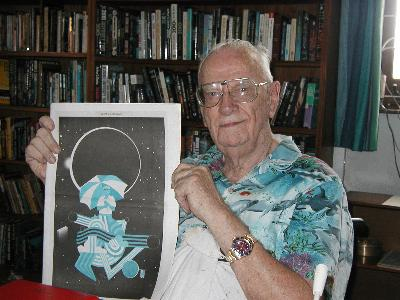
Originally published in Arthur No. 1 (Oct. 2002), with a full-page illustration by Geoff McFetridge. In the photo above, ACC holds his copy of Arthur No. 1, with that page showing.

FAMOUS ARTHUR: Arthur C. Clarke
Paul Moody enters the sci-fi court of King Arthur

Androgynous aliens searching the galaxy for the nine billion names of God; mysterious unmanned spaceships drifting Marie Celeste-like into the solar system; vast black monoliths discovered under the surface of the moon..it’s all in a day’s work for Arthur C. Clarke.

The author of more than seventy novels and the undisputed Godfather of science fiction, he’s also—to a generation brought up on his long-running UK TV series, The Mysterious World Of…—the monstrodomo of the unknown. Add the fact that’s he’s lived in self-imposed exile in Sri Lanka since 1956, became a guru to the entire US space program in the 1960s and has attracted visits from even the likes of ill-fated Rolling Stone Brian Jones in the search for answers to the reason why we’re here, and you’ve got a mystery wrapped in an enigma signed with a question mark. Religious cults have been born from less.

Yet meeting this good natured sci- fi Colonel Kurtz takes you into an even stranger world. Picture the scene as a Hollywood pitch: you’re standing in a quiet residential street in Cinnamon Gardens, the most exclusive district of Colombo, capital of Sri Lanka. Vast palm trees sway in the 90-degree heat haze. A cloud of bats flies overhead on its daily vigil toward the sunset. Suddenly a ten foot grille slides open and you’re walking into the private residence of one of the most reclusive figures on the planet.

Yet it’s all true. As you go up the stairs of his palatial headquarters you begin to realize you’ve entered a one-man orchestrated nerve-center. This is a far cry from the days when Clarke owned the first television set in Sri Lanka. Banks of computers drone harmoniously; fax machines buzz with communications from all corners of the globe (the telecommunications bills rarely drop below $1000 a month). Signed pictures of everyone from Neil Armstrong to Elizabeth Taylor to the Pope line the walls, amid vast blown-up NASA Moonscapes, whilst a vast floor to ceiling bookcase at one end of the room is filled entirely with hardback first editions of Clarke’s novels.

The overall effect is like entering the inner sanctum of a benign, hyper-active Bond villain. Prodigious isn’t the word for Clarke. He claims to have 102 projects on the go at any one time, and in this setting, aided by a host of assistants, it’s hard to disbelieve him. On top of all this, a wall-sized TV screen is beaming footage of Clarke appearing as a hologram at the Playboy Mansion last year. Standing on a dais addressing an invited crowd of NASA dignitaries, octogenarian swingers and luminescent blank-eyed Playboy bunnies, Clarke delivers a speech as a shimmering, golden, light projection. The effect is much like seeing Kirk and Spock mid-dematerialization on the USS Enterprise. Except Clarke really is going where no man has been before.

As you’d imagine, he’s pleased with it.

“You are watching history!” he booms by way of introduction, gesturing at the screen. Wheelchair bound due to the debilitating effects of post-polio syndrome, nonetheless he wheels himself forward at high speed wrapped in a batik sarong.

Continue reading

“Dizzying Heights”: Animal Collective interviewed by Trinie Dalton (Arthur, 2005)

Originally published in Arthur No. 19 (Nov. 2005)

Dizzying Heights
How do the four humble critters that are Animal Collective make such wildly beautiful and beguiling sounds?
By Trinie Dalton

Photography by Susanna Howe

As pathetic as this sounds, I originally started listening to Animal Collective because they were an “animal band,” and I make a point of hearing all new animal bands because I’m obsessed with animals. There are so many animal bands these days, especially lupine ones: Wolf Eyes, Wolf Parade, Wolfmother…I figure anyone who names their band after animals must like animals too, so we have something in common, and maybe they’re also into classic animal bands, like The Animals and The Turtles. So far, this theory for checking out new bands has worked, and I like most animal bands. But Animal Collective are by far the best. They’re King of the Jungle.

This is an especially lame confession because the members of Animal Collective barely even like having a name; they’d much prefer to be individuals who come together in various combos and in various locations to make intriguingly titled albums, like Danse Manatee, Campfire Songs, or Here Comes the Indian, sans band name. That’s one refreshing thing about Animal Collective: they aren’t glory hogs. In animal terms, they’re like prairie dogs, bees, or penguins—humble critters that understand the definition of teamwork. In the beginning, Animal Collective often wore masks and costumes hiding their individual identities, and they’ve always used nicknames to keep alive the secret society element of what they do: Dave Portner is Avey Tare, Brian Weitz is Geologist, Josh Dibbs is Deakin, and Noah Lennox is Panda Bear. Having a band name is too traditional, they say; they only have one because record labels have told them that listeners need to identify the group as a cohesive, named unit.

Which is important, because Animal Collective are one of those rare bands who sound completely different live and on record. Sung Tongs, their last full-length album, is infused with psychedelic wall-of-sound production, Brian Wilson-style. Sung Tongs is so classic it gives me chills. I imagine Sung Tongs on the cover of that Arthur issue 50 years from now featuring the best albums of the past century. The cool part is, I’ll recall how I nearly went deaf hearing tweaky live versions of harmonious tunes like “Leaf House” and “Kids On Holiday.” On headphones, certain Animal Collective songs sound sleepy and hypnotic, while live those same songs make the club’s floor vibrate from heavy bass and guitar distortion. Hearing Animal Collective live is nearly my favorite pastime. Recently, while living in Berlin, I was so dying to see them that I almost flew hundreds of miles to southern France to catch their gig. Getting a grip, I reminded myself that this was a little extreme, not to mention expensive. Each show is different, though: live versions of songs render them unrecognizable or mutate into new songs, so you can’t say, I’ll just stay home and listen to the album.

Feels, Animal Collective’s new release, is heavily injected with sentiment without being sappy. Dedicated to such lofty romantic themes as Love, Purple (the color of passion) and (they say) “synchronicity, or connections between people,” Feels is highly emotive. As opposed to Sung Tongs’ choral vocal layerings and druggy nods to Smiley Smile, Feels contains fewer vocal harmonies but compensates with an abundance of rock-out moments balanced by a “warm hum” of instruments. I can’t wait to see these songs performed live, since the instrumentation on Feels is so elusive. This new record also further distinguishes Animal Collective from the Freakfolk bands they’ve sometimes been lumped together with. I never thought they sounded even remotely folky; Feels instead sounds a lot more influenced by their early inspirations, My Bloody Valentine and Pavement.

Animal Collective are childhood friends. Noah and Josh met in second grade in their hometown, Baltimore. In 1996, Josh hooked up with Brian and Dave, who were also high school buddies from Maryland. They all hung out sporadically throughout college, and by 2000, they were all living in New York, where they recorded and released Spirit They’re Gone, Spirit They’ve Vanished, which gave them their first taste of success. Since then, they’ve made several albums and started a record label, Paw Tracks, home to artists like Ariel Pink and The Peppermints. Prospect Hummer, their last record, is testament to all the European touring they’ve done; they met and recruited Vashti Bunyan in England for vocals on it. Three of the band left New York years ago—Noah for Lisbon, Brian for D.C., and Dave for Europe—so Animal Collective functions via satellite, in a way, until they convene for recording sessions and tours. Even interviewing them was a feat—I received four separate phone calls from around the world—although I really enjoyed it because Animal Collective were so friendly. Each man spoke highly of the others, discussing how the group sound has evolved instead of geeking out on who plays what. They gave uncannily similar answers, and Brian confessed that Animal Collective may know each other “too well.” I had this feeling before, but I know it now—Animal Collective are four best friends committed to experimenting and having fun.

Arthur: What are your ideas about collectives? Animal Collective’s lineup is constantly changing, so your aesthetic is extremely dynamic. Live, for instance, you always play new songs instead of the songs from the album you’re touring for.
Josh (Deakin): The word “collective” is oddly touchy for us because it has a certain political air. The idea of calling ourselves a collective was for our own state of mind. We weren’t thinking of it in a broader sense. We’re a fairly exclusive collective. There are people are in our lives that we work with who we consider part of it, in a way, but we aren’t a collective in the big sense. We’ve known each other since we were kids, and really enjoy doing this together. We don’t want to just form a regular band where it’s like “he plays guitar, he plays bass, and I sing.” We came up with the idea in college, when we couldn’t always all work together. Originally, our records had their own titles without band names attached. It’s this idea of creating an environment where you’re not wed to specific habits. Habit contributes to complacency. We wanted to allow for as much change and development as possible. My perception of collectives is that there is some kind of collective consciousness that is an element for us, but mostly we’re strong individuals who have different ideas and like to share them with each other.

Continue reading

“So Righteous to Love”: Devendra Banhart, interviewed by Trinie Dalton (Arthur, 2004)

Originally published in Arthur No. 10 (May 2004)

So Righteous to Love
Devendra Banhart is here and he plays folk music. Trinie Dalton finds out where he’s coming from.
Photographs by Melanie Pullen.

A few months ago I hiked high on mushrooms in the Redwoods, and Devendra Banhart’s first album served as my bridge between fantasy and reality. His music isn’t about tripping out on drugs—I’m not belittling it that way—but its soothing quality makes one feel peaceful in any state of mind. As I interviewed him over the phone in late February about a myriad of topics, Devendra often returned to talking about folk music’s universality, about how one of its most noble purposes is to make listeners feel comfortable.

Hearing 23-year-old Devendra talk like this reminded me of how closely related late-1960s psychedelic rock bands were, in spirit and sense of idealism, to the folk singers Devendra loves so much from the same period: their considerations for listening to and hearing music were at the forefront of their playing. But Devendra’s tastes extend into the present, and there appears to be just as many neo-psychedelic musicians playing today as there are neo-folk rockers. Is it due to the current abominable political state? I don’t know. I didn’t care to discuss politics with Devendra because I was more fascinated by his reverence for nature—by his belief that music can bring one closer to not only self-understanding but also learning about one’s place in the environment, whether it be forested or urban.

Devendra’s new album Rejoicing in the Hands cultivates this respect for life under the auspices of yet another new hybrid-Banhart sound, this time combining old-time blues with the troubadour-ish balladry, psychedelic rock and acoustic guitar traditions of folk. The sound of this record is both familiar and absolutely unique, although Banhart’s singing does gets compared in the press to Marc Bolan’s and Billie Holiday’s to an unfortunate, almost annoying degree. Rejoicing in the Hands is perhaps his best work—it’s hard to say that, cuz they’re all so great—in that the guitar playing achieves more complexity, at times becoming as strong a force as the vocals. Not that his first two releases, 2002’s Oh Me Oh My album (Young God), and 2003’s The Black Babies EP (Young God), didn’t feature some fantastic guitar sounds, but until Rejoicing, I’d heard Devendra’s guitar as more a complement to his vocals than having its own individual drive.

I figured this increased guitar-playing skill must mean his shows are getting better and better, so I started our talk by asking him about performing live. His speaking voice became more melodic and animated when he talked of things he felt passionately about. When he began to talk about his favorite types of venues to play, things got interesting…

Arthur: You prefer to play galleries and churches…
Trinie Dalton: I try…I don’t entirely like playing rock clubs and bars because it doesn’t lend itself too well to the kind of music we’re playing. When I play a church, the acoustics are so wonderful. You have to play an environment that suits what you’re doing, and churches are built to have incredible acoustics. Some Aztec churches, the acoustics are built so wildly, they’re so psychedelically manipulative, that if you clap into a certain passageway, it responds like the sound of a sacred bird that the Aztecs worshipped. They really thought about it. It makes sense for people who play non-electric music, or quieter music to play in a place that augments that instead of in a place that drowns it completely out. Those people that are used to dealing with 8000 amps and four drum sets, the whole building [a rock club] is built to suck in the sound.

It gives your music a richer sound, or has a more spiritual atmosphere or something…or there’s more than just sound going on, with the other senses too.
There’s a vibe.

I think of your music as a mixture of folk and psychedelic. I read up on your big influences, but you didn’t mention psychedelic bands, more of the folky psychedelic rock, like Incredible String Band, Fairport Convention. Do you listen to that kind of music?
I really do. “Psychedelic,” to me, just means a sharp awareness of your surroundings, and a heightened aesthetic sense, and a sensitivity…it’s like this ultra-sensual state. Psychedelic words bring out that state in objects that might be considered mundane. Usually they’re in nature, because usually you’re not going to find psychedelic qualities in a stapler, you know? But a tree, you feel it. It’s like a magic spell, or alchemy, using certain words to bring out the psychedelic life and energy, the core, god’s vein, the blood of the gods.

Back to the music, I’m so easily influenced and affected by music. I love Incredible String Band. But I’m not as big a fan of them as I am Clive Palmer, the guy who started them. He played on the first record. The real song to me, on that one, is Clive’s song… “You know my ____ friends/ Singing baby…” [starts singing it] I like Robin Williamson’s solo records, they’re incredible, and I like Mike Heron’s solo records. It’s unbelievable to think that they’re both fucking Scientologists now. Some of these records are just getting re-released, so they won’t just be available on bootleg anymore. Like Clive’s Original Band, and Clive’s Famous Jug Band. As far as British psychedelic stuff, Fairport Convention has never been too psychedelic, they’re more like rock-folk. Then there’s Trader Horne…Currently, I’ve been getting into more current psychedelic stuff, via my friend, Steve Krakow, who goes by the name Plastic Crimewave. He has a magazine devoted to all things psychedelic, that he hand draws and hand writes, called Galactic Zoo Dossier. He also has a band called Plastic Crimewave…he’s a scholar of the psychedelic ways, he’s an incredible person. It’s a good road to go down. A band that I recently saw that was the awesomest epitome of bar psychedelia, is Comets on Fire, they get everybody grooving.

Continue reading

ASK NEIL HAMBURGER (Arthur, 2002)

Originally published in Arthur No. 1 (October 2002)

Ask Neil Hamburger

Each issue, comedian Neil Hamburger will answer Arthur readers’ queries about relationships, career, sexual intercourse, table manners and particle physics. Email your questions to editorial@arthurmag.com and we will pass them along to Neil at our next Cappuccino Blast party. For this special premiere issue of Arthur, we didn’t have any questions from our readers for Neil, mostly because we don’t have any readers yet. So we adapted the following questions from The Sun.

“HER CALLS AND TEXTS ARE SO EROTIC”
I am 22 and living with my 20-year-old girlfriend of two years and our baby son. Our relationship is routine and boring. I’ve never been in love with her and only stayed because of the baby and because it was somewhere to live. My life changed a few months ago when I met this beautiful, intelligent older woman. We met at the gym where she works out most days. She doesn’t look anywhere near her true age. I am younger than her children but I don’t care about the age difference between us, although she does. She asked me out for a drink and afterwards we went back to her house and ended up making love. She is the most fantastic lover a man could wish for. Her calls and texts are so erotic, I’m addicted. She asks what underwear I like, then buys it for me. She laughs at my jokes, listens to everything I say and she’s only interested in me. Even without sex, being with her is good fun. We recently sat on the beach for hours just talking – something I’ve never done with my partner. But my lover is married and says she will never leave her husband. They live in a fabulous house and I think it’s only the money that keeps them together. I’ve promised my lover that if ever I win the Lottery I will take her away with me. She agrees we could be blissfully happy together if we had money. She is going away on holiday soon and I worry she will meet another young guy who does have money and head off with him instead. I’m pretty sure my girlfriend knows something is going on because of the text messages. I feel bad but I can’t live without this woman. My partner is trying hard to please me but I just want my lover. Will she ever leave her husband so I can have her to myself? —Who’s Laughing Now

Dear Who’s, I can relate to your wish to win the Lottery. But the rest of your problem is somewhat foreign to me. I haven’t had this sort of situation, unfortunately. You say, “She laughs at my jokes.” I would love to meet a woman that would laugh at MY jokes. It seems that at far as that is concerned, sir, you HAVE won the Lottery! A lot of times I have done shows to huge crowds and received no laughs at all. Here you have a situation where this woman laughs at your jokes…and still you complain! I don’t understand what your problem is. Except where you say “I worry that she will meet another young guy who does have money, and head off with him instead.” Because I’ve had that happen to me, which ruined my marriage. Except that it wasn’t a young guy…it was a dentist! So my advice is, yes, keep playing the Lottery. And suggest to your lady-friend that she brushes her teeth three times a day, thus ensuring that she stays away from the dentist. A good, name-brand baking soda-based toothpaste should solve your problem, as it neutralizes the acids that cause cavities.

“IT WAS A BIT ROUGH BUT IT WAS THE BEST I’D EVER HAD.”
I’m a 17-year-old girl and this happened after I’d gone to a nightclub with some of my mates. After a few hours they were bored and decided to go on somewhere else but I wanted to stay as I’d seen a really cute guy standing at the bar. He’d been looking at me all evening and when they left he came over and bought me a drink. We got chatting and seemed to hit it off straight away. At the end of the evening he said he’d walk me home but as we started walking down an alleyway he suddenly pushed me against the wall and started kissing me. I was surprised at first but we ended up having sex. It was a bit rough but it was the best I’d ever had. Now I’m desperate to see him again. I’ve looked out for him in the club and around town but he’s nowhere to be found. I don’t know whether to tell my mates or keep it to myself. —Likes It Rough

Dear Likes, This happens to me all the time. People leaving nightclubs to have sex, thus missing my act. Oftentimes they leave shortly after my set starts, which doesn’t look good in the eyes of the club owner. These nightclubs are reluctant to book you a second time if people are walking out during your set, whether it’s to have “rough sex” or just to get some cigarettes across the street. It’s people like you who are ruining my career. Yes, I do have some advice to you! Next time you are out at one of these nightclubs, watch ALL the acts on the bill, particularly the comedy segments of the night. Be patient—and THEN go home and have your rough sex, however you want to have it. It’s just common courtesy.

“I COULD HARDLY BELIEVE MY EYES WHEN I DISCOVERED THE VIBRATOR.”
My girlfriend and I are both in our thirties and have been together for three years. Last weekend she went to her mum’s with our baby daughter so I could decorate our bedroom. As I tidied the wardrobe a bag fell out and curiosity made me peep inside. I could hardly believe my eyes when I discovered the vibrator. I haven’t mentioned it to her yet. I’m so confused and upset I don’t know how to deal with my feelings. Should I say anything? —Seeing Is Believing

Dear Seeing, This is a very modern age, so this is the sort of problem that comes up now and again. Unfortunately, we men have to accept the fact that we are now replaceable, because of the invention of the battery. You can say something to your girlfriend, but you’ll probably be told that you are impeding “progress”, that you are a fossil, a relic of a by-gone era. Nowadays they have computers that can do anything…including comedy routines! The old-style comedian, such as myself, must make do with bookings in smaller towns in which the computer age has not yet arrived. This is why I have so many bookings in Oklahoma. This is what I suggest you do: find one of these small-town girls who has not yet been exposed to the new technology, who still believes in the simple things, like the human touch.

“I LOVE HIM WHEN HE’S KIND BUT NOT WHEN HE’S BEING A SEXUAL DEVIANT.”
I am 29, my husband is 39 and we’ve been married just over a year. When we met he was everything I ever wanted in a man and–as a bonus–he accepted my son who absolutely idolizes him. But things started to go wrong within weeks of marrying. He likes to experiment sexually and his sexual demands are getting worse. I go along with his wishes to keep him happy but I don’t enjoy most of it. Stupidly, I agreed to a threesome. He found her through an advert. She was quite matter-of-fact but I had to drink a bottle of wine before I could go through with it. I feel totally worthless now and I can’t understand why he needs someone else if he loves me. I have refused to do it again but he won’t stop asking. What am I going to do? I love him when he’s kind and gentle, but not when he’s trying to be a sexual deviant. —Liquored Up

Dear Liquored Up, I see what you mean. I had a show booked recently in Denver, Colorado, at a little nightclub there. It was supposed to be just myself and my opening act, Pleaseeasaur, which is also a comedy-oriented act—we often travel as a package deal. Anyway, we both arrived in Denver early, prepared to do this show…but when we got there, we found that a “third party” had been added to the bill, making the night a “threesome,” as you call it. I felt totally worthless because I had believed that we were able to perform adequately for the Denver audience without needing another act on the bill to keep the evening going. And to make matters worse, this third party, a band called “The Fire Show,” sat in the back of the club all night saying bad things about my act, and about Pleaseeasaur. I had to drink a bottle of wine before I could sit through their set. But you know what: we were vindicated, in that no one bought any of this third party’s merchandise afterwards, not a single thing! Yet we sold quite a few Neil Hamburger souvenir CDs, fridge magnets, buttons, and T-shirts. So my advice is to hang in there, because, as the legendary entertainer Phil Harris used to say, “cream always rises to the top.”

Neil Hamburger says his next comedy album, Laugh Out Lord, is due soon on Drag City Records. For more information, say hello to http://neilhamburger.tvheaven.com

“ICE CREAM FOR CROW: In the Shadow of the Valley of the Bomb Pop” by Eddie Dean (Arthur, 2002)

Originally published in Arthur No. 1 (Oct. 2002)

ICE CREAM FOR CROW: In the Shadow of the Valley of the Bomb Pop
Last Notes from the Great Lost Big Lik Expedition
by Eddie Dean, with photography by Dave Brooks

I first discovered the power of a Fudge Bomb when I was surrounded by a family of Blue Ridge Mennonites who hadn’t seen the ice cream truck for a week. All their Fudge Bombs had run out days ago, and their Snow Cones and Chocolate Chump Bars, too. Their sturdy white frame house sat on a hill in Greene County, Virginia, and I was parked before it in my truck, both of us coughing up dust after the long climb up the winding gravel driveway. These people were hurting badly. We were here to help them.

For generations, locals have found this rocky region as poor as a snake. But it’s been a goldmine for interlopers—first the folk-song collectors and then the government men and the social workers and finally the movie stars here for peace of mind and land for their trotting horses. The movie stars didn’t buy ice cream, not off a truck anyway. Just about everybody else did, though. At least, they did back then. This was 20 years ago, before gourmet ice cream and the culture of instant gratification. If you lived in Greene County, the only way you could get a Fudge Bomb was from my truck.

A Fudge Bomb is a brown and yellow “quiescently frozen confection” impaled on a stick and molded in the shape of a Sputnik-era nuclear warhead. It is infused with an equatorial stripe of artificially flavored banana that beads with tropical sweat when unveiled in the July heat by a Mennonite housewife in a gingham dress. At the time I was selling them, a Fudge Bomb cost 60 cents, a crucial dime more than its red-white-and-blue cousin, the Superstar Bomb Pop, but well worth the extra investment. No mere popsicle, a Fudge Bomb is a bona fide meal.

The Mennonites are a strict denomination. For them, every day is a holy day, and they dress and try to behave as such. But there is nothing in their rules that forbids the indulgence of sweets. And no visiting preacher ever inspired more joy than did the driver of the truck with the BIG LIK license plates. I would often linger in the shade as the family members gathered on the green lawn, becalmed by the sacrament of ice cream. The rippling folds of the Blue Ridge mountains stretched to the horizon, as big white clouds drifted by like so many covered wagons. At such a moment of a bright Sunday many summers ago, I understood why their ancestors decided to nestle here instead of pushing west. This perch would do fine until the Battle of Armageddon.

Those were good customers, that family, one of several Mennonite families on the route. They even bought ice cream for their livestock. They had a goat named Curly leashed to a tombstone in the family graveyard, a stone-walled plot near the driveway. His reward for keeping the grass trim was an ice-cream sandwich. The Mennonites were businesspeople themselves. I’d often pass roadside stands where they sold homemade peanut-butter pies to the weekend tourists from Washington D.C. They were better off than most of my customers, who had little in worldly possessions other than the junk accumulated on their ramshackle properties. Yet even the most destitute were no less faithful when that ice-cream bell came ringing. For them, the unbidden arrival of the BIG LIK truck was proof that even if they weren’t among the affluent or the righteous, they would not be denied their just desserts–even if it meant scraping together a fistful of pennies for a 25-cent popsicle.

Behind the wheel of BIG LIK, in the shadow of the hazy, hallucinatory Blue Ridge, I believed I’d found my calling, though at 20 I would have never used such a word. All I knew was that it didn’t seem like work and it beat delivering pizza in a borrowed car. What began as a seasonal job during my time at the University of Virginia held me in Charlottesville well after graduation. It wasn’t driving the truck that hooked me: I fell for the geography. I’d grown up in the lowland Piedmont of Richmond, and there was something about this rugged landscape that moved me. Whatever the reason, the mountains cast a spell that I couldn’t shake.

Continue reading

“The Turntables Might Wobble But They Won’t Fall Down: A Jam Master Jay Fan Remembers” by Peter “Piper” Relic (Arthur, 2002)

Originally published in Arthur No. 2 (December 2002)


The Turntables Might Wobble But They Won’t Fall Down: A Jam Master Jay Fan Remembers
by Peter “Piper” Relic

A few minutes before four o’clock on Halloween afternoon 2002, I realized I’d better do the crosstown hustle in grandma’s Nissan if I was gonna bumrush rush hour to Beachwood Place Mall. Cooped up in the lab all day, I ran outside—foliage in full flame and wind whipcracking off Lake Erie—Cleveland represent!—and drove east past the granite gryphons lording over Carnegie-Lorain Bridge.

Fiddling the radio dial of the broken cassette deck, I struck immediate jackpot as the “blazin’ hip hop and R&B” station spun Missy Elliot’s new single, giving me my fix of elephant trunk calls, backmask raps, and well, that chubby cheeked happy feeling Missy’s voice always gives me. Thing is, my favorite bit in “Work It” is the part at the end when Missy shouts out “to muh lay-deez!” and Timbaland’s track flips into the beat from Run DMC’s “Peter Piper.” Woomp! Damn if radio plays anything anymore that hits as hard as Jam Master Jay’s cuts—you know that sound, like carpet needles cutting through a bituminous bite plate? Of course, that sheer fierceness may be the reason the ending is usually chopped and faded by some dumbo-eared radio bungler to make way for a Liberty Ford commercial.

Eff ‘em. Hearing that snatch of “Peter Piper” got me hyped. I snapped off the radio and busted the verse embedded in a shell-toed part of my memory bank:

“Doctor Seuss and Mother Goose both did their thing
but Jam Master’s getting loose and DMC’s the King,
Adult entertainer, child educator,
Jam Master Jay king of the cross fader,
He’s the better of the best
Best believe he’s the baddest
Perfect timing when I’m climbing on my rhyming apparatus
When he cuts girls move their butts
His name is Jay, here to play, he must be nuts
On the mix real quick and I’d like to say
He’s not last but he’s fast and his name is Jay!”

Maybe those aren’t the letter-perfect lyrics, but hey. I also doubt that my Run DMC experience was wildly different than that of many other kids lucky enough to tune in during the salad days of Hollis, Queens finest, but here goes:

It was the fall of 1985. I was a freshman at a suburban Connecticut public high school. Out of nowhere one day a way-beyond-me junior girl came up to my locker and without saying anything just handed me a tape. It was not Huey Lewis & the News. This 60 minute Memorex piece of black plastic included Beastie Boys’ “She’s On It,” Original Concept’s “Knowledge Me,” Skinny Boys’ “Jock Box” and Run DMC’s “Sucka MCs”—all songs that crunched. I listened to it on my Walkman while delivering the New Britain Herald (pumped me up to break my fastest time record on my route), on a D-battery powered Tandy tape recorder while playing driveway hockey against my brother (it made my slapshot nastier). I listened to it endlessly, and when Run DMC Raising Hell came out the following year, I bought the cassette at Strawberry’s. It took me forever to get through the entire album because I kept rewinding “It’s Tricky” and “My Adidas.” (I remember the look on my mom’s face when I told her “You be illin’.” The first time was the last.) But finally I made it to the awesome closing track, “Proud To Be Black.” Jam Master Jay’s slashing stab-scratches cut like brass tacks through a whitewashed history text as Run proclaimed “George Washington Carver made the peanut great, showed any man with a mind could create!” I loved peanut butter and I loved funky beats, just like Run DMC! They became the first heroes I ever had who weren’t pro athletes.

Thinking about it now, Jam Master Jay’s beats and cuts were essential for Run DMC to get their message across. Heck, Run and DMC knew it—they shouted Jay out all the time. Run DMC and Jam Master Jay exemplified synergy, syzygy and symbiosis—like Public Enemy and the Bomb Squad, their music hit as hard as their lyrics. It had to. I doubt today’s average teenage hip hop fan can appreciate how awesome Run DMC were, because I don’t hear anything that comes close to their power on commercial rap radio. I mean maybe I’m an ageist kook, but damn…

Back to Halloween ’02. As I pulled into the mall parking lot, an announcement came on the radio: “We will now have 60 seconds of silence for Jam Master Jay who was shot and killed this morning.” The words hit like a brick to the head. I parked and walked dumbstruck into Dillard’s. The first two brothers about my age I saw I went up to and said, “I just heard…Jay Master Jay….” One fellow lowered his eyes while his buddy shook his head slowly and whispered, “I know.” I drifted over to a 70% off reject rack and found a black t-shirt that said I’VE GONE TO FIND MYSELF—IF I GET BACK BEFORE I RETURN KEEP ME HERE.

At the video store, I did what I’d come to do: buy Donnie Darko on DVD. I asked the girl ringing it up, “Are you a hip hop fan?” She looked at me. I went on: “Can you believe…Jam Master Jay?” She gave me a sorrowful, sympathetic smile and said, “He brought a lot to the game.”

He brought a lot to the game.

I drove home, flipped the stereo on and got into the shower. The Chronic 2001 disc I’d left in the player started up and I heard Dr. Dre’s voice: “I moved out of the hood for good, you blame me? Niggas can’t hit niggas they can’t see, I’m out of they sight now I’m out of they dang reach. How would you feel if niggas wanted you killed? You’d probably move to a new house on a new hill and choose a new spot if niggas wanted you shot…I ain’t a thug—how much Tupac in ya you got?”

That’s when I cried. Bad meaning bad not bad meaning good. Jam Master Jay, not being a gangsta, must have felt safe staying in the hood with his wife and kids. When Tupac and Biggie died, it wasn’t a shock like this, and didn’t hurt the same. I guess because with Jam Master Jay, it hurt the fourteen year old inside me. And that 14 year old who fell in love with hip hop (and the girl who gave me that tape; thanks Mary) is still fundamentally me. I feel Run DMC’s records like I feel my younger self: dated but never played out.

Watching Donnie Darko that night, I noticed that at one point in the movie Donnie—a suburban kid living in the mid ‘80s—is rocking shell toes. I can only assume Donnie also agrees with the on-record unison appraisal of Jam Master Jay by Run and DMC: “Goddamn that DJ made my day!”

For my friend Jeff Seifert. Rest In Peace.

A tribute to Eagle Pennell by Paul Cullum (Arthur, 2002)

first published in Arthur No. 1 (October, 2002)

THE EAGLE HAS LANDED
By Paul Cullum

“Life has been your art. You have set yourself to music. Your days are your sonnets.”
—Oscar Wilde, The Picture of Dorian Gray

Like punk legends, indie film pioneers are going to start dying off soon. And in a microcosm defined by perpetual youth, dissolution and decay don’t have much room to ramp up, making it harder to get used to the idea. I guess it’s never pretty.

Eagle Pennell was politely called a regional filmmaker by those unaccustomed to his kind, and like many in his native Texas, he had an outsized impression of his own identity that ultimately destroyed him. In 1978, when A-list Hollywood was made up of veterans of Roger Corman’s shoestring epics, and everyone else in America with dreams to burn now worked for Corman to replace them, the first inklings of what we now think of as independent film came courtesy of people who were too clueless or inept to follow that simple protocol. One of them was Eagle, whose shaggy dog buddy comedy The Whole Shootin’ Match pioneered that Austin-specific sort of epic underachieverdom that Slacker later turned into an anthropological treatise. But Eagle’s laconic dreamers, drunk as a lord and impossibly balanced on the thin line that separates ambition from nostalgia, were more than just literary conceits. They were Eagle in a nutshell. Like we used to say about him, the man belonged in the Alcohol of Fame; he put pop alcoholics like us to shame.

The Whole Shootin’ Match, based on an earlier 16mm short called Hell of a Note, starred Lou Perry (nee Perryman) and Sonny Carl Davis as a couple of perpetual fuck-ups trying to work as insulation blowers or something equally improbable, and retiring to the comfort of cold beers and fevered dreams once the going gets tough. (In Hell of a Note, they laid asphalt, until they were fired for not realizing you weren’t supposed to pee on it until it had cooled off.) This woozy testament to the comically disenfranchised, made for twenty grand in borrowed money, was also historically significant in that it was the film that Robert Redford was famously watching at the 1978 inauguration of the U.S. Film Festival in Park City, Utah when he had the epiphany that it was strays like this who could best benefit from such a festival, or something like his soon-established Sundance Institute.

Continue reading

BULL TONGUE by Byron Coley & Thurston Moore from Arthur No. 2 (Dec. 2002)

first published in Arthur No. 2 (December, 2002)

BULL TONGUE
Exploring the Voids of All Known Undergrounds
by Byron Coley and Thurston Moore

We open this time with an essay by Thurston Moore entitled, “My Summer Beats My Winter.” If you didn’t catch the Metal Machine reference, look it up.

Touring around the USA, Europe, Japan, Oz etc. is like staying home: same dynamics of same-ism and same familial interaction complex. But there’s one thing that gives it ROCK distinction: seeing old n new chumsters and seeing old n new bands. With fam-man responsibilities these are things not readily available on the homefront scene (which, in case you think you’re groovy, I ain’t jonesing to trade for nut). So fuck this, dig the bands that were kicking my ROCK ass in the summer of 02:

dateline Lyon France 19 June:
MARTEAU ROUGE is a french band featuring legendary free-rock guitarist Jean-FranÁois Pauvros (along with Jean-Marc Foussat, Masahiko Sato and Yuko Kametani). We had Pauvros play once before with us in Paris as a solo artist where he came out and laid flat the room with howling amp buzz. It was not so much noise-violence but a more in-tune and curious new-birth wonder. Pauvros, a tall long-haired 40-something cat has an illustrious history. In the 70s, with formidable avant-garde legend Jac Berrocal, he was a member of Catalogue. And, with Gilbert Artman, he played in Lard Free and Urban Sax. Through the intervening years he has recorded with such disparate freaks as Blurt, Arto Lindsay and Keiji Haino. Marteau Rouge is his newest new-thing. Gone are the spiked edges of youthful blunder. What has evolved is the fascinating sounds of players moving into high-adult dimensions. This evokes a focused creative enterprise sweet to the collective soul of the listening audience. Pauvros and Marteau Rouge reportedly have a CD coming out on HatHut with American saxophonist Joe McPhee which could be excellent. But HatHut is mum on this news.

dateline Bristol, UK 24 June:
LIARS had the potential to annoy. Musical annoyance is one of the finer attitudes in rock, but it either takes a needlepoint intellect (Steve Albini) or a battering ram cementhead (GG Allin) to pull it off with any true swing. If it’s annoyance for the sake of annoyance (a la mid-period Bunnybrains, The Rachels) then it is naught but disingenuous time-death. Liars had one small label 12” available for one minute and then a deal with Blast First. They were part of the HOT new New York rock scene of 2002. They might even be the Stones to the Strokes’ Wildlife-period Wings. The singer cats it with Karen O, the panty-splitting snake charm spitter of Yeah Yeah Yeahs. Wild ass stuff but, like cheese, it’s a stink that can be either dick-thickening or no more fun than a phone call from Nedelkoff. I’ve seen some of the new new new new new new new New York City rockers and I must concur with Deborah Harry: What was once a surreal vision (1975 Johnny Thunders, Richard Hell) is now a MTV/Levis-sponsored giveaway. The songs are OK here and there, but here (in the Berkshire foothills) is as good as there (in the Williamsburg high-res rubble). But, fuck, everyone knows that anyway and the only reason to live and rock in NYC is for kicks–that much has not and will not, I suspect, ever change. LIARS are from California, Nebraska and Australia and maybe some other geogs, but the generally impressive reek they give off is of a fantastic spiced-earth stew. The best thing is they ain’t looking to pop, they’re looking to sizzle. The first hits will make any geek scream “Pop Group!” or “Birthday Party!” (Come to think of it, I remember screaming “Pop Group!” after first hearing Birthday Party(!)), but these buff young nice-niks are employing some fresh diaper liberation. Guitars seek fine slices of feedback sonance whilst the rhythm roots/toots like Nick Cave’s lips on acid nips. Sexy boy romp without the schmoe-pose even when the 10 foot tall Oz dream singer pelves the aghast UK sickheads into blankminded judgement lapse. All atonal skid mark flail and then the whomp and buttock kick of some weirdo Turbo-Rat setting. Pretty nice and wonderfully annoying to the point of cloying–the only B-Party comparison I’d deem to make. Cute as hell and, thankfully, the real deal. (www.liarsliarsliars.com)

dateline Turino, Italy 06 July:
MY CAT IS AN ALIEN do not jibe with the indie-rock establishment in Italy. At least that’s the impression I get when the twin brothers Maurizio and Roberto Opalio confront booking agents and gig promoters with the knowledge that My Cat Is An Alien exist to promote “alien love.” Maybe I’m missing something in the translation, but the professionals ain’t buying it; the only time these displaced wizards seem to get a decent gig is when we or Blonde Redhead blow through the boot. Which is a shame because MCIAA let loose a chance bafflement of free-rock ideas always set on upsetting conscious rock-realization. The first time I heard them was when they sent us CDRs entangled in wired cages. We saw they were from Italy, we were heading there soon enough, we loaded the CDR in and were caught off-guard by the voidoid cosmo pleasures in emittance. So we asked them to play. They rocked in the most non-rock way: guitars tuned to God-knows-what pubic tensity, drums possibly interacting with crashed electronic skittle and vocals calling all alien pets to keep watching the skies. Next time around the lads knelt with guitars raised to the electric maximus and delivered a mass of heatball fuzz. This evening they soundchecked for two hours in front of the incoming audience (outdoor gig), pissing off the already uptight promoters and crew with super-indeterminant blasts of synthi-shards and drum smacks to awaken the behemoth god Prometheus. It sounded nutso and awesome–“this should be their gig” we’d mutter every 15 minutes or so. Then they stopped and got ready to play. They returned to the stage and played one 12 minute rock n drop and then split. Huh? Go fig–when something like this happens I know the wannabe controllers of rock n roll surprise have a continuing uphill nightmare to contend with. Which of course makes it all a stone gas. I released a double-LP of MCIAA earlier this yr on Ecstatic Peace called Landscapes Of An Electric City/Hypnotic Spaces–available through our own mill outlet in Florence, Mass. if yr wanting to dig. (www.mycatisanalien.com; http://www.yod.com)

dateline Dresden, Germany 08 July:
COBRA KILLER are from Berlin. Two women: WILDEST GINA V. D’ORIO and KWIKEST ANNIKA TROST. They come out of the Digital Hardcore camp. And they come out swinging! Wine bottles, high heels, long leather pimp coats, glitter dust flaking off eyelashes to adhere to tear streaked cheeks. This ain’t no let’s destroy the scene vibe, this is destruction in all its celebrated collapse. Try pushing the right button on yr machine whilst yr red wine-in-paper-cup topples, maybe use yr nose or yr stockinged toe or yr ass which just happens to be slipping peekaboo out of yr ballet warmup–the one you wear anytime and all the time. Who created this noise hump? We were nailed by Cobra Killer. This is performance that only the full-blooded German lustlords n ladies can exhibit. Semi-drunken loop dancing and singing/chanting and hula-hoop mastery by a rather bountiful busted goddess of peace and deliverance. This is a right on band and they rock like absolutely no other. They have ingested the finest elements of Elvis, James Brown, Ari Up, Lydia Lunch, Sly Stone and Whitehouse and spend an amazing 35 minutes unleashing it in a personalized ritual of possession and exorcism. Theatrical concepts are utilized to keep it all on stage and within some sane atmosphere for the highly amused, if not aroused, audience. Any band that bids adieu to their audience by attempting to kiss them all and hold them to their sweet maiden breast is already better than the Beatles or Nirvana any day of the millennium. Dresden was flooded a week later to extraordinary levels. (www.cobra-killer.org)

Continue reading

BULL TONGUE by Byron Coley & Thurston Moore from Arthur No. 1 (Oct. 2002)

first published in Arthur No. 1 (October, 2002)

BULL TONGUE
Exploring the Voids of All Known Undergrounds
by Byron Coley and Thurston Moore

The concept of this column is simple: to cast light on scenes, music, words and images that are ignored by the handmaidens of capitalist culture. Living people seem to be tired of gagging on the brackish pablum of the known. We would like to offer them access to new nooks. That is all. To start this first installment, here is some bottled screed tossed from the Sonic Youth tour bus.

The 1970s punk rock scene in NYC never paid heed to L.A. And London did not have a clue. There was one record store in 1978/79 NYC on 1st Avenue around 3rd Street that actually had copies of the first West Coast punk rock 7”s. I remember seeing the Dangerhouse 7″‘s of X and Black Randy and wondering why they were even there. They seemed to be from a distant world as opposed to the spotlight punk scenes of NYC and London. I was curious about their weirdness and I bought the X one. I had read how they were the main L.A. punk group who played in a graffiti-drenched dungeon in Hollywood called the Masque. And I bought the Black Randy one cuz the cover was so completely inane, w/ comic book panels referencing a bizarro Hollywood sex-joke juvenilia. It was a repartee I have only just gleaned. And that gleaning is thanks to We Got the Neutron Bomb (Three River Press/Random House) an oral history of the early L.A. punk scene, edited by noted L.A. punk impresario/historian Brendan Mullen. Brendan, a founder of the Masque, also helped Germs drummer Don Bolles edit and prepare Lexicon Devil (Feral House Press ) an oral history of Darby Crash and the Germs. We Got The Neutron Bomb, gaping holes and all, acts as an almost necessary precursive read to Lexicon Devil.

The X single struck me as interesting if only because it was so different than the Ramones/Heartbreakers crunge I heard in the NYC clubs. Its obvious “poetic” sploo was also quite odd in comparison to the St. Marks Church visions of Patti Smith, Richard Hell and Tom Verlaine. And it certainly wasn’t the sex bop of Blondie or the artschool geekage of Talking Heads. And it didn’t have the ground zero allure of primo London punk–Sex Pistols, X Ray Spex et al. The Black Randy 7″ made no sense whatsoever, ‘though the barking retardo chorus of “trouble at the cup! trouble at the cup!” had a genuine other planet punk rock sensibility.

That other planet was L.A. and the only images available of L.A. punk in NYC were from imported issues of Slash and Flipside, magazines found only at Sohozat on West Broadway between Canal and Grand St. (or sometimes at Revenge on 3rd Avenue just south of St. Marks Place) (or at Manic Panic right on St. Marks Place just west of 2nd Avenue). I suppose Bleeker Bob’s, then on Macdougal Street just south of 8th Street, would carry them as well. Bleeker Bob was dependable for carrying any 7″ from the nascent punk rock scene upon its initial availability and had a large collection of ‘zines. Unfortunately, all of these items were behind the counter and you had to brave a request to check any of them out, which would invariably mean that Bob himself would humiliate you w/ assholistic douchebaggery. Plus, there were usually repellant Who-collector clientele farting about the place. These dups would be aggressively collecting “anything on Stiff Records” and wearing Gen X and Joe Jackson badges while still secretly believing that Steely Dan were valid. Bluggh.

The images in the punk ‘zines of L.A. showed bands and fans, all dressed up in ‘77-era leather, bondage and PUNK regalia. This was a style identified w/ the U.K. and no one in NYC bought into it, knowing that it was an extreme and manipulated reaction to Richard Hell, the Ramones, Blondie, Wayne County, Mink Deville et al. To see an American city like L.A., and to a slightly more obscure (yet more typically urban) extent S.F., adopt this identity seemed dopey. At this time, downtown NYC had a developing post-punk community of artists and musicians exhibiting a new radical style of nihilism and producing sex/danger noise/vision. This was “no wave” and it was committed to destroying any strain of rock n roll still alive in punk. To the no wave, the new wave of punk rock was corny. Seeing, hearing and playing atonal guitar monotony in a Broome Street gallery was formidable and it was a formulative experience for my 18-year-old psyche. I’m glad to have been there, all the while thinking that L.A. was nothing but a sea of goofy punk hairdos that weren’t even of their own creation.

I’d see Sid and Stiv Bators skinking around St. Marks and would follow them at a careful distance, wondering how to tell them I was the guitar player Sid should be playing with. The fact that Sid was a heroin dog never really registered to me at the nefarious level it should have. Even though I had near proximity to his thereabouts at the time (as he was always at the same CBGB gigs etc.), the reality of me ever hooking up or communicating w/ him was completely farfetched. Plus, I was conflicted by an incident involving him slashing Patti Smith’s brother’s face w/ a broken beer bottle. But when Sid died it was a landmark event for all of us, and punk CHANGED right then and there. The ideals went into transition: Patti moved to Detroit and married/disappeared. Richard Hell went even more subterranean. The Ramones began to be taken for granted in their perfection. Johnny Rotten made the genius move of experimenting w/ dub-radics and Sid Vicious remained dead. London went dipshit w/ new wave, new romantic and some kind of pirate bullshit, but also had an onslaught of cool Rough Trade inspired art-school punk (Raincoats, Pop Group). NYC went beyond no wave into Bush Tetras/ESG/Eight Eyed Spy grey-scale rhythm music and serious noise composition (Glen Branca, UT, Rhys Chatham, Information). And California continued being punk (but also w/ its own buy-in to dipshit new wave, the examples of which are too wretched to list here). But L.A., by documented proof, particularly The Germs’ (G.I.) LP, X’s Los Angeles LP, the first SST and Dangerhouse label 7″s, the Circle Jerks Group Sex LP and the wild issues of Slash magazine, was also evincing an exciting creative energy identity, unlike the intellectual toe-sniffing of NYC. L.A. was punk rock. But punk rock was over, wasn’t it? The new hardcore kids, romping around Avenue A w/ the Black Flag bars and the Germs’ blue circle on their leather jackets, certainly did not agree. Nor did they care if anyone thought otherwise.

L.A. punk in 1978 was not an affront to a culture-clashed society in a Thatcher-strangled depression. It was a reaction to a mellow Eagles/Jackson Brown “L.A. Sound” and the suburban mom n dad nowhere zone of SoCal. And it was decidedly anti-hippie. Hippie had been the dominant youth culture vanguard for too long. Glam/glitter-rock had never threatened hippie hegemony. If it was seen as anything, it was as a somewhat sex-wild cultural adjunct to hippiedom. But PUNK ROCK, which spun obliquely out of glam/glitter, was hardly foreseen by the potted royalty of the hippie elite. Punk set itself on a crash course to puncture the self-satisfied bloat of the longhair paunches. The punk rock revolution destroyed hippie. From its smoking ruins emerged the sentient force of real rock and roll fun.

Continue reading