NEWS FROM THE UPPER NINE: Henry Griffin goes back to New Orleans (Arthur, 2006)

Originally published in Arthur No. 20 (January 2006)


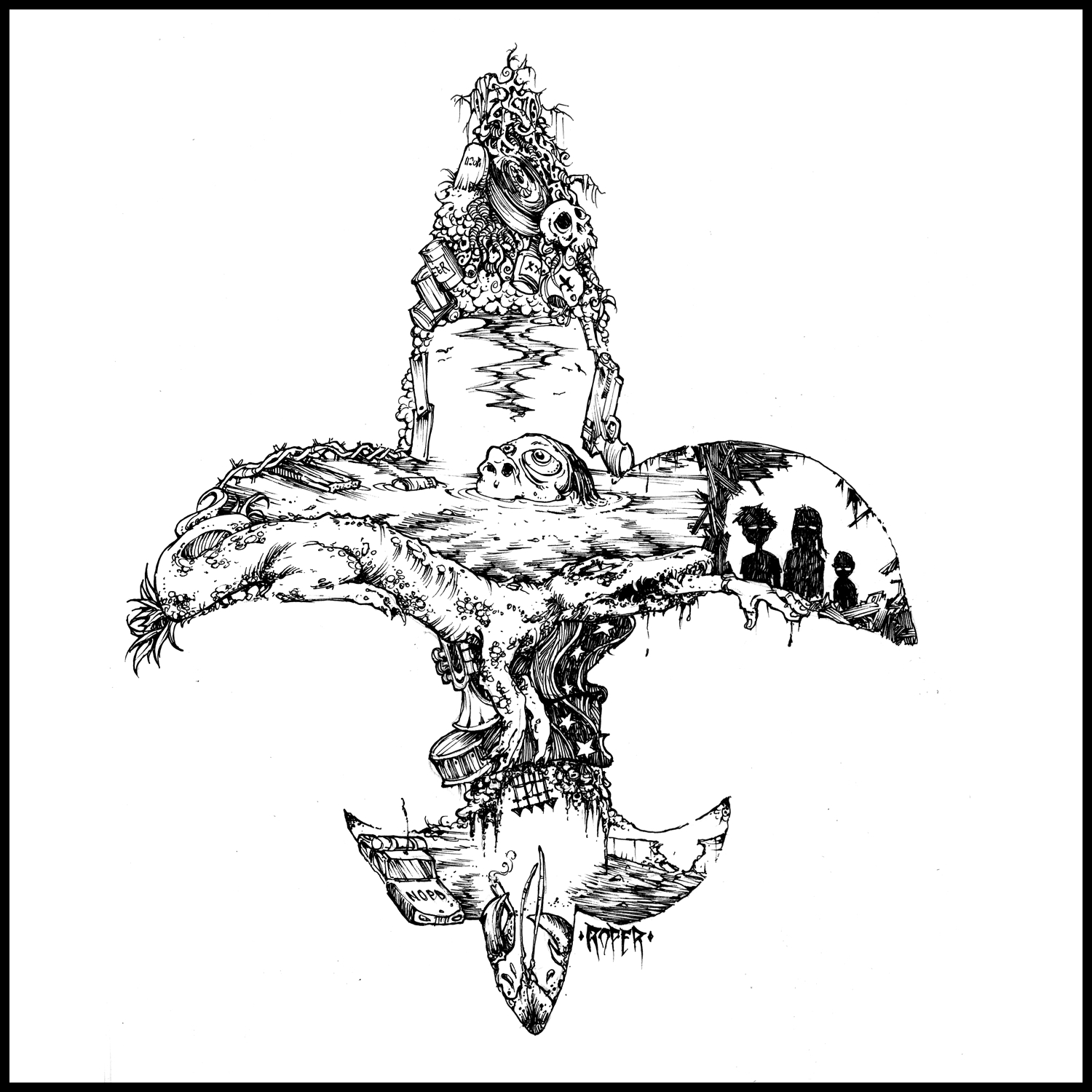
Illustration by Arik Roper

News From the Upper Nine
Henry Griffin goes back to New Orleans

“You are entering the city at your own risk. Police and fire services are limited. There is no 911 service. Traffic lights are out throughout the city. Observe a citywide speed limit of 35 mph, and proceed with extreme caution, especially around downed power lines. You are not permitted to go beyond your designated ZIP code area. Do not drink, bathe in or wash your hands in tap water. Standing water and soil may be seriously contaminated. Limit your exposure to airborne mold and use gloves, masks and other protective materials. Apply mosquito repellent and sunscreen. Bring sufficient food, water, gas and any medical supplies required to sustain you and your family, keeping in mind the curfew and store inventories may limit access to supplies. Gas stations are not fully operational. Fuel is limited.” —from a list of “tips” from the New Orleans Mayor’s office for dealing with the “urban hazards” of life in the 9th Ward in September, 2005

I’ve long used the introduction “I live in New Orleans” to break the ice at parties. This usually cheers people up, often sparking memories of a particularly debauched vacation. “How can you people live down there?” someone would inevitably ask, meaning “How do you keep from becoming an alcoholic?” Now the same question connotes differently, more of a “How could you live in that city knowing that you were doomed by its very design?” Of all the tragedies of Katrina, this hurts the most: our carefree lifestyle, our legendary tolerance, for alcohol, for iniquity and corruption, is now less a punchline than a cautionary tale.

You’d think from the apocalyptic prognostications of the national media that there wouldn’t be much of a city left to return to. Not so. Some areas are straight-up ravaged, that’s for sure. But your “average block” can be quite a mix, and even in the so-called “spared” neighborhoods, a hundred year oak may be splintered across some power lines.

My house is still there, a raised Creole cottage at the eastern-most tip of the upper Ninth ward, three blocks north of the river. I describe it this way, as that’s how I first re-located it, via a satellite photo posted on the web, after the cataclysm. I found my neighborhood from space, then my block and then my house. It was easy to pick out: there is an 80-foot pecan tree leaning against the roof. The good news is that it hasn’t fallen through and bisected the building. The bad news is that the tree has been there since July 5, a symptom of long forgotten Tropical Storm Cindy. In classic New Orleans fashion, it hadn’t been seen to by the proper authorities by the time Katrina hit eight weeks later.

Three weeks after Katrina, I returned to find my basement apartment had taken three feet or so of water. It had dried out by then but waterlines and a veneer of detritus told the story: my life had been coated with waste, human and otherwise. To keep the effect from being entirely humorless, the Almighty had thrown in a few frogs, who were now living in my office.

My urban salvage operation actually lightened my mood. Like most folks, I’d imagined losing everything I’d left behind. To get back even half of my stuff seemed almost unfair. I couldn’t breathe the spore-clogged air or touch anything with my bare skin, but rescuing keepsakes from the rising mold was as thrilling as the prize choosing finale of Wheel of Fortune. Things I’d owned and lost were now won back from oblivion. I was in such a good mood that first night that I almost brushed my teeth in tap water, mistaking this for any other major American city. Spill bottled water on the brush, I reminded myself. Like you’re in Haiti.

Some people suffered their share without losing a shingle. My friends Dave and Jennifer had to watch the whole storm from a vacation in Thailand (being late August, lots of folks were out of town). They returned to find their recent home purchase in fine condition. Then they noticed the stench out back. An unpleasant excavation followed, and a more unpleasant discovery: a visiting country’s National Guard, after having barracked in a nearby Catholic school, had used these civilians’ yard as a dump for their rotting garbage.

Things could have been far worse. They could have had a pile of trash dumped on their lawn by the enterprising earth mover, who was leaving his business card for the follow-up call to remove said pile (in order to dump it on his next intended customer). They could have been arrested for a curfew violation by the Wyoming National Guard or the NYPD, who’ve been patrolling New Orleans due to our cop shortage, and been put behind bars at the bus station, which is Orleans Parish’s prison since the real one was flooded. They could have been blindsided by a hit and run driver who speeds off, uninterested in trading insurance information without the rule of law (I witnessed such an incident). They could have had their house gutted by looters. They could have absentmindedly opened their refrigerator.

Those early weeks after Katrina, people were very well-behaved. Streets were empty and quite peaceful, passersby waved hopefully. The de-electrified environment and low population lulled us into a sense of temporary historical atavism. By which I mean, the neighborliness was positively Amish.

Imagine that all the things you loved about your home were taken away. Instead of food you get 24 varieties of MRE (avoid the Thai Chicken); drinking water comes in cans supplied by Anheuser Busch. Where your favorite vegetable truck used to park, now there’s an upside down Volkswagen that had caught fire. Long tree-lined avenues like St. Charles and Esplanade have been given arboreal crewcuts by the storms, leaving the shade compromised. Friends and neighbors aren’t around too much, but you do get daily visits from assorted rescue workers, most double-checking that each house’s spray-painted sigil is still accurate.

And, after a while, civilization returns, one service at a time. Electrical power! Gas! Cable! DSL! Sanitation! Could the mail, once the invincible standard of civil service, be far behind?

* * *

The anarchic spirit of a functional ghost town couldn’t last forever. As the population rose in September and October, the town got crankier. Four-way stops, once an opportunity to wave at a kindly stranger, now began to prompt the waving of just a single special finger. The long-awaited return of recognizable first world civilization tested the patience of many thousands.

And yet…Each restaurant or bar that reopened became an opportunity to rejoice. By Halloween, the city’s Dionysian personality was returning in force, and celebration was beginning to become a goal in and of itself, which seemed familiar. What festivities there were spilled into the streets, as they used to do. For Halloween, the most popular costume was a refrigerator wrapped in duct tape, spray-painted with the address of George W. Bush or Tom Benson, the reviled Saints owner who intends to move our hopeless but beloved football team to San Antonio.

There were a lot of smiles, a lot of back slapping and story trading, even among people who had just traded introductions. We all knew this one new thing about each other. That we would, and did, come back. Even redefined, this tainted city, one that wasn’t exactly in mint condition when we got it, would be ours again if we want it.

* * *

If everybody doesn’t return (and how could they all?), will New Orleans lose its most essential asset, its culture? It’s hard to say. But maybe it isn’t so tragic. Maybe it’s the case that every person who doesn’t get back is somehow happier somewhere else, where they have air conditioned schools, and a lower murder rate, and better jobs—jobs that aren’t in the tourist, service and gambling industries. Who can blame them? Who in their right mind would come back, to a city of corrupt politics, looting cops and dwindling protection from the elements?

The answer, of course, is those who can’t imagine living anywhere else.


Henry Griffin, a fifth generation New Orleanian, is a writer and director whose films include Mutiny and Tortured by Joy. He organizes his books by color, trading organization for the pleasing effect of his shelves viewed from a distance. Since the storm, he is fresh out of blue books.

“Weird Shit’s Still Going Down: Notes From Mardi Gras in New Orleans, 2006” by Gabe Soria (Arthur, 2006)

Originally published in Arthur No. 22 (May 2006)


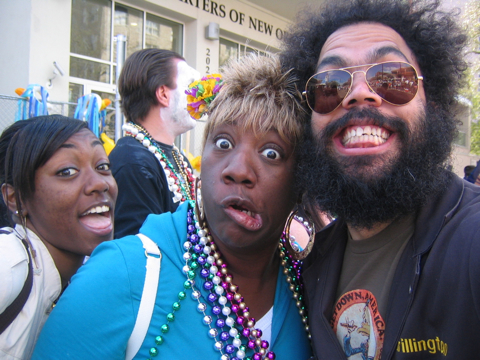
Our tipsy author, right, with fellow revelers at the Rex Parade, Mardi Gras morning.

Weird Shit’s Still Going Down: Notes From Mardi Gras in New Orleans, 2006
By Gabe Soria

I’ve been in love with New Orleans since the day in May, 1993 when I first set foot on its soil. Since then, I’ve been a resident of the city three times and have gone back over and over when I wasn’t. Mardi Gras, for all its faults and gross public image, is important to New Orleans residents and expatriates alike, so when the chance came to visit my city for the first time after Katrina during Carnival, I jumped at it, but not without some second-guessing trepidation. What follows are rough impressions of my experience being back in town from Saturday, February 25 through Mardi Gras to March 1, Ash Wednesday and the beginning of the season of Lent…

Touching Down
Disembarking from the plane and already the Twilight Zone schisms from reality are apparent. This scene happens in the first couple minutes of the episode, the part right before the credits when the Rod Serling voice-over comes in and lets the viewing audience know that some crazy shit is about to go down. What’s Louis Armstrong International without its perpetually open souvenier stands and ersatz French Quarter bars? Too much like the Salt Lake City airport, that’s what. Outgoing passengers ain’t got nowhere to buy their last minute cans of Tony Chachere’s seasoning, authentic cookbooks or Hurricane mix. Incoming passengers don’t have anything, except for the baggage claim, and that is hardly a picnic. Everybody seems a bit hunted, a bit guilty.

Nothing makes you realize how much you’ve given up until someone’s taken away the lights, and the “Arriving Flights” underpass of Louis Armstrong International is a third world kick in the nuts: the absence of ambient light is palpable, and the illumination provided by taxis, shuttles and pick-up cars feels like interrogation by headlight. At the same time, though, it’s kinda eerily beautiful, as though everything is powered by steam and gaslight. We hear later that they’re still working to restore normal power. The airport of a major American city still doesn’t have full power six months after a disaster? What the fuck is going on here, I ask myself, resigning myself to joining the chorus of people asking that same question.

T-Shirt Slogans
The town is aswarm with bootleg political shirts, jockeying for space in Decatur Street tourists shops with your typical novelty T-shirts about states of tequila intoxication. Most of these shirts feature embattled mayor Ray Nagin in Photoshopped Willy Wonka drag, making some sort of sport about his now infamous Martin Luther King Day “Chocolate City” speech, possibly the biggest effect a George Clinton song’s ever had on the political scene. React how you want to the speech—reading a transcript in retrospect, it’s obvious to this writer at least that Mr. Nagin’s frustration with his black contemporaries left him feeling a bit loose at the mouth, but I ain’t mad at him—you can’t help but realize that there’s a little bit of smug racism at the core of the these shirt’s makers, that they finally feel justified at putting the screws to a black mayor who, admittedly, said some dumb-ass shit. But then I realize an important fact: I don’t think I’d ever really want to hang out with someone who wears their politics, left or right or straight up centrist, on their literal shirt-sleeve. I mean, I’m all for band t-shirt propaganda, but this? Nah. One T-shirt maker has gone the extra satire mile, though: for sale at the Circle Bar are “Ernie K-Doe for Mayor” tees, featuring the smiling face of the late and lamented Emperor of the Universe. Bumper stickers can be had, too. One drunken night, I find myself fervently wishing that K-Doe wins in a write in. In the storied history of corrupt Louisiana politics, the election of a deceased and much loved R&B singer has got to be an improvement.

Chased on a Bike
Weird shit’s still going down, though. On a perfectly fine afternoon, the wife and I mount bikes to ride down to a parade to meet a friend. Normally, yours truly is a bit more savvy about the safe routes to travel, but the hurricane-depleted lack of population has thrown me for a loop. Why not take a jaunt down a clear street a block closer to the river? The answer becomes clear when we make a left on Josephine Street towards St. Charles. A group of kids—12 to 14, black—are hanging out in front of a corner grocery/liquor store and begin shouting out warnings about how “Y’all don’t know where you ridin'”, etc., etc., and one kid’s bold enough to do a little mock run after the wife, who’s trailing behind on a too-small borrowed bike. The kid’s pursuit is half-assed, and he stops almost as soon as he starts, but it’s a neon-lights reminder that New Orleans is still a fucked-up place, race-wise.

In fact, this little incident is an anomaly. While statistics may not prove me right, the general impression one gets during Mardi Gras is of détente, peace. Sure, fratboys might get beaten down by cops along Bourbon Street after one Huge-Ass beer too many, but for the rank and file of the city, a “we’re all in this together and ain’t it fine” feeling pervades, usually. If you say “Happy Mardi Gras,” to anybody, they respond in kind, and mean it. But this little incident… well, they’re kids, so it doesn’t really mean much. It means that they’re acting like they think they’re supposed to act; it means that they actually think that their corner store is something to be protected; it means that they’ve learned that being young and black and aggressive can freak the fuck out of people going about their own business. Still, it’s days before I can stop picturing kicking the kid’s head in if he tried to touch the wife, and my subsequent murder at the hands of his numerous cronies. Yikes.

The 9th Ward Marching Band
Not that it needed saving by anybody, but the wife’s and my Mardi Gras is definitely given a soul-rousing boost by seeing the Mr. Qunitron-led 9th Ward Marching Band parade with the Krewe of Proteus on Lundi Gras night. For the uninitiated, Quintron and his wife Ms. Pussycat were and remain the owners and operators of the Spellcaster Lodge, a house/venue located on St. Claude Avenue in the 9th Ward. They’re both musicians, as well as puppeteers. Long time fixtures of the weird underground of New Orleans, they’re more like good spirit elementals rather than impeccably dressed scenesters, which they are as well. The 9th Ward Marching Band started as a loose-knit, almost renegade marching assemblage, but over the years they’ve gotten their weird act together, and while sharp and somewhat professional, they still make the squares nervous. While watching them march in their smart red and white outfits, playing “Rock me Like a Hurricane,” I notice that the crowd lining the parade route is going BANANAS for them. Everybody can feel that this ain’t no sarcastic, ironic hipster bulllshit—it’s true American weirdness and beauty at its finest. But you can also tell that they make some folks delightfully nervous. This can probably be best attributed to the bands in-between, resting music. When there’s a lull in their routine and things calm down, the 9WMB’s glockenspiel players start tapping out the theme from the slasher film “Halloween,” with the tubas coming in every now and then to deliver an ominous “bruuummmmmm.” It’s the film score equivalent of the fabled brown sound—you can tell by the looks on people’s faces that they recognize the minor key tune, and they like it, but don’t like it at the same time. It’s a brilliant moment, and I want to buy whoever thought of it a beer or ten.

The Dead Zone
The night of Lundi Gras finds the wife and I and our friends Judson and Courtney taking a shortcut on a drive downtown to hit a Quintron/Peaches show. The shortcut takes us through the area of town known and Mid-City, where Courtney lived previous to Katrina. Her new home features a handful of possessions salvaged from her house and cleaned of mold, but she’s basically begun anew. But driving through her old neighborhood… yikes. Once you get a few blocks off St. Charles, heading away from the river, a frightening change takes over the streets. They’re empty. They’re dark. Everything looks haunted and miserable. A few FEMA trailers are parked here and there, and on occasion someone seems to have managed to get a porch light working, but on the whole, it feels as if we’ve driven directly in a George Romero zombie flick. Any moment now I expect to see a shambling corpse slouch into the street, attempting to suck the brains out of our car’s passengers. No such thing happens, of course, but I am glad when we eventually make a right turn onto relatively populated, lighted Esplanade. The fact that a few moments earlier I was half-joking about wishing I was armed with a shotgun kinda makes me want to cry. I’ve NEVER wanted a gun in New Orleans, not even in my worse moments.

Mardi Gras Day (and on into the night)
Mardi Gras morning rolls around and all seems to be aback to normal in the city, at least for a few hours. Working on a few hours of sleep, the wife and I roll out of bed and into our costumes (I’m going as a jerk dressed in a jumpsuit and furry cap; the wife’s going the classy route by masquerading as a magical French schoolgirl). Walking over to St. Charles, we begin to see a parade of friends walk by; everybody seems to be well on their way to drunk before noon, but nobody’s got a mean buzz on. It’s all hugs, everywhere. Families lining the filthy parade route in their chairs and ladders look bleary-eyed and happy. When Rex starts to roll, you see people catching beads… and handing them to little old ladies and kids next to them. Everybody’s saying, “Hey, darlin’,” and “Excuse me,” and you’d be hard-pressed to spot your usual line of sweaty guys being led plastic-cuffed into a paddywagon (though I’m sure it’s happening somewhere—you can’t buck tradition in one year). The hours melt away—at one point, the wife and I are eating hamburgers with friends, the next, we’re at our home base eating red beans and rice cooked with a nice hamhock, the next, we’re being dropped off downtown. But by the time the Morning 40 Federation hits the stage at Checkpoint Charlie’s for their annual Mardi Gras night show, as the festival comes to its natural inevitable end, the feeling in the air is undeniably powerful, completely ecstatic. You can feel the desperate urge in the club to let loose, to raise one’s arms high above and scream. And as the Federation lurches into their first amplified ode to boozing and 9th Ward living, everybody in the room does exactly that. I’m grinning from ear to ear—it’s the feedback and the beer, most definitely—but it’s also the hope and love I’m seeing right now, that I’ve seen all weekend. Sure, folks are cynical and tired, but they still believe, much more so than I think anybody else in any city would or could, for they know that’s there’s an ineffable something to New Orleans, something that just can’t and won’t quit, ever.

LIFE AGAINST DEMENTIA by Joe Carducci (Arthur, 2002)

Originally published in Arthur No. 1 (Oct. 2002)


LIFE AGAINST DEMENTIA
by Joe Carducci

Anyone familiar with the roiling currents and tidal motion of American popular culture knows that the film and music industries are delivering less interesting work than ever. Melodies, rhythms, songs, voices, characters, stories and genres seem colder, more processed and, in general, received rather than inspired. There’s nothing wrong with referencing or even stealing plots or melodies as long as the stealing’s done by an artist or madman who revives them too, in some new personal way. But with the explosion of University film departments and rock and roll courses in the last two decades the American arts are filling up with professional careerists who better belong in business college, or law school.

The action film fell of its own overblown weight; you’d hardly know that it grew from such lean, tightly-scripted productions as Dirty Harry (1971), Death Wish (1974), Rocky (1976), First Blood (1982), and Terminator (1984). And whereas Jaws (1975) remade film marketing, Titanic (1997) threatened to remake the action film itself: fusing the male action film with the woman’s film takes another hundred million dollars and an additional hour in running time. The resulting summer behemoths trod the marketplace with such strong-arming confidence that the studios practically demand they be made without costly stars so as to pack in more explosives and effects and advertising.

The music industry’s dilemma was clear at this year’s Grammies. In a normal year Michael Greene, president of the National Academy of Recording Arts & Sciences (NARAS), would have slammed Republicans on non-Industry social policy grounds, but Bush got off easy this year as the country ain’t in the mood and Greene’s house was not in order. Big recording stars are lobbying in Sacramento to void the record industry’s exemption from the seven-year personal contract limit, and they want to own their own master recordings. And over all the bogus proceedings on Grammy night loomed the specter of the computer-software-hardware-internet juggernaut’s paramount killer app—free music. (NARAS is no longer Greene’s playpen due to sexual harassment lawsuit—a real Clinton Democrat, apparently.)

So the questions become:

– Have the media, which now dominate content, so divided programming into blindered marketing niches that’s they’ve cut the cords to our rich musical and film traditions?

– Has the evolution of Pop—its computer generated virtual musics and films—superseded any organic folk motion within our music and film traditions?

– Has the Organization Man of International Entertainment corporate culture proved incapable of recognizing and delivering music and film of the level that sundry Sammy Glicks and juke-box mobsters did for decades in their sleep?

– Has the music underground rejected all tradition but either the line of nihilism diagrammed by Greil Marcus in Lipstick Traces, or a backstop of kitsch (such vicarious ex-pat pursuits as French chanson, Exotica, Canto-Pop, J-pop)?

Sorry I asked…

We can’t be sure whether the current thin gruel might not be the only possible art deduced from the slim pickings of the last nearly thirty years. The teenagers just starting their bands and the twenty-somethings still prepping their first film will be the artists shaping what American pop culture will become. But they have experienced pop culture of little depth or personality their entire lives. What humanity persists in the art tends to be negative, reactionary traits: cynicism, indifference, contempt….

Radio was formatted in the early seventies and so ambitious recording artists quickly began to format themselves. An entire generation of willful rock bands—Ramones through Flipper—refused to format themselves. These were the last bands to have grown up listening to the cultural mix of pre-1973 radio and TV variety shows (not to mention walked through the high grade “amateur” musical environment Americans of all ages once experienced at County Fairs, Corn-boils, church socials, and school dances). But unformatted, these Punk bands were then, not programmed. Those that attempted to format themselves for hits (Talking Heads, Devo, X, Replacements…) ensured they would not be the bands that carried the torch forward; perversely, it would be the unprogrammed misses (Ramones, Avengers, Black Flag, Minutemen, Descendents…) that would launch a million bands.

Since the music left the South in the late fifties the natural grace of that early rock and roll has gradually dimmed, leaving a more studied rock music in its place. The British bands of the decade between 1963 and 1973 had studied the music, though you couldn’t say they were grounded in it. The American punk bands that formed before 1980 were the last to be grounded in this folk tradition aspect of rock and roll (though they were warped as well by that new Brit influence). Thereafter, even the most important bands (Sonic Youth, Nirvana, Tool, Kyuss/Queens of the Stone Age, White Stripes…) are necessarily more conceptual in approach. It may be that our distance from the South of that day, and the input from today’s constricted media-driven musical environment might ultimately dry up the musicality of even bands that do not depend on the programmers of radio and MTV.

Hollywood today, courtesy of marketing science and Sammy Glick IV, offers CGI (computer-generated imaging) Potemkin villages and villagers for pulverizing in CGI thermidor for the boys, tearjerking emo-porn for girls, and nihilistic puzzle pictures for the sophistos. Generations of filmmakers have been destroyed by the Star Wars saga with nary a wobble in the force detected. (In my unrequited meetings with film producers in L.A. and N.Y. the life-size star-trooper models in the office corners never relax their guard.) More noxious influences on film narratives are tramping in from TV, music videos, advertising, videogames, pornography, and all the film deconstruction bonuses included on the typical DVD release.

Recently passing on through the obit pages have been American cultural figures such as Peggy Lee, Budd Boetticher, Joey and Dee Dee Ramone, Dave Van Ronk, Pop Staples, Katy Jurado, Ray Brown, Anthony Quinn, Waylon Jennings, Dorothy MacGuire, Harlan Howard, John Lee Hooker, Richard Farnsworth, Bernard Klatzko, Carl Perkins, Ed Roth, Hilous Butrum, Rod Steiger, Otis Blackwell, and John Fahey. Never mind the heftlessness of the obits in decades to come, Britney Spears may never die! The biotech nerds (not known for their ability to hear music) are forging new frontiers in unintended consequences.

Our meta-sentient pop culture has foreshadowed this immortality. The explosion of cultural choices via cable and satellite has reached critical mass via the web—it’s now become something different, a constant ambient hemorrhagic din. Kids watch Ozzie and Harriet and The Osbournes; the Randolph Scott rides again; Buster Keaton falls down and springs up again; and even the sword-and-sandal genre returns! We are either jacked by contemporary offerings (Survivor, Cops, Robot Wars, Dismissed…) or calmed by our immortal ghost culture (Lawrence Welk, Audie Murphy, Cheyenne, Father Knows Best…).

Continue reading

DIVERS DOWN: Animal Collective’s Geologist and Deacon share the scuba experience with Morgan V. Lebus (Arthur, 2005)

Originally published in Arthur No. 19 (Nov. 2005), as a sidebar to Trinie Dalton’s cover feature profile


Photo collage of (and by) Geologist and Deacon

DIVERS DOWN
Animal Collective’s Geologist and Deacon share the scuba experience with Morgan V. Lebus

Arthur: When and where were these photos taken?
Deacon: We went diving off the east side of Marathon Key in Herman’s Hole. The visibility underwater was crystal. Herman is a very large moray eel who no longer lives in his hole–he’s relocated to an aquarium in Miami.

Isn’t scuba diving expensive?
Deacon: The toughest part is getting certified, which costs about $500. I was lucky enough to have a dive master friend who certified me for free. The most expensive part of scuba diving is the travel. You can dive almost anywhere, but unless you’re pretty gung ho about it, diving in the local quarry is less than choice. You want to go somewhere that has a a tropical vibe, with lots of reef life and clear waters. Once you’re there, a full day of diving with boat and and gear rental will run less than $100.
Geologist: While this is true, if you are into cold water diving, there are some good lake spots in New England. I’ve never done any cold water dives because you need to buy a dry-suit.

Your most fascinating underwater find?
Deacon: It’s all fascinating: scuba diving is the best drug ever. My first open water dive (off a boat, away from the shore) was in South Carolina. The visibility was low and we didn’t see much more than a few barrucada and some flounder (a flat bottom feeder fish with both eyes on one side of its head). On the way up the surface I couldn’t see the bottom or the surface but off in front of me about fifteen feet away was a jellyfish. A very simple translucent specimen, but I could’ve watched sway it for hours.
Geologist: In the Gulf of California I went diving off the coast of an island that was home to a sea lion colony. The pups had just been born and they were extremely curious. I also saw a seahorse there—they’re pretty rare. My big dream though, is to see whale sharks, mantas, leafy sea dragons, and a school of hammerhead.

If you could dive anywhere on earth, where would it be?
Geologist: The arctic or antarctic. The way the light filters through the ice is supposed to be amazing. I´d also like to dive in the Andamen sea off the coast of Thailand, but further north, closer to Burma.
Deacon: I think for me it is more a matter of when. Coral is being damaged at an intense rate and a lot of marine life is gone. I imagine that diving 100 years ago would have been a dramatically different experience, regardless of where you did it.

Your deepest dive, ever?
Deacon: South Carolina at about 68 feet down.
Geologist: Deep dives are not necessarily the best because your bottom time is extremely limited. With a normal tank rig you get about 15 minutes of dive time at 90 feet before you have to to a shallower depth and decompress. However, a 30-foot dive can have amazing stuff as well and your dive can be an hour long. My deepest was just above 100. The limit was 90 feet but it was a wall dive—the sea floor was about 65 feet and it stretches out from the island and then you reach the edge and the wall drops 6,000 feet! We swam over the edge and dropped to 90 feet and viewed the wall along our side. It’s an amazing feeling to look down and see nothing but darkness and try to comprehend the bottom being 6,000 feet below you.

PERFECT SOUND FOREVER: Kevin Shields of My Bloody Valentine, interviewed by Hua Hsu (Arthur, 2003)

Originally published in Arthur No. 7 (Nov. 2003)

Perfect Sound Forever
My Bloody Valentine’s fluff-on-the-needle sound changed rock music forever. Then they disappeared. Ten years later, MBV’s Kevin Shields explains almost everything.
by Hua Hsu

The story is not uncommon: someone—too old to have done so accidentally, too young to have known any better—creates something truly great but panics at the burden of what that greatness means. As singer, guitarist and producer for My Bloody Valentine, Kevin Shields was instrumental in defining the sound of a generation. Breathy vocal washes clashed with brittle walls of noise on the band’s two classic albums, Isn’t Anything (1988) and Loveless (1991), and though MBV’s dense, otherworldly sound was described as “dreampop” or “shoegazer,” it was always meant to conjure up much more imaginative spaces. “When you hear something and you don’t know where it’s beginning or ending, suddenly your imagination is fifty percent of what’s happening,” Shields explains. “The person listening is playing a huge role in what they’re perceiving, cause they’re allowing that part of their mind to be open.”

Saddled with the enormous expectations that Loveless brought, the shy, nerdish Shields seemed to dissolve into thin air. Was he apprehended by his own legendary perfectionism, sitting alone behind a console of knobs and sounds, striving for something unimaginably pure and beautiful? Had he soured from music altogether, or were the rumors about his drum-n-bass obsession true? Or, had he lost himself in the logical end of his hyper-inward music and found retreat in his own mind? The rare moments he would appear as an onstage guest or as a remixer only added to his disheveled legend.

In 1997, Shields joined bratty Scottish rockers Primal Scream and though he still remained reclusive, he at least seemed alive and well. This year, Shields contributed several new tracks to the soundtrack of Sofia Coppola’s Lost in Translation and he’s in the midst of remastering and re-releasing two discs of My Bloody Valentine rarities. Disarmingly charming, Shields sat down with Arthur and a plate of fries to talk about all of it.

Arthur: Can you describe your childhood?
Kevin Shields: I was born in New York, in Queens. I grew up in Long Island (until I was ten) in this place called Commack, your typical suburb-y kind of whatever, and I went to this horrible school called Christ the King—an absolute nightmare, I’m still suffering the scars from that! Then we moved to Ireland—my parents were from there originally. They had immigrated when they were young, they were teenagers (and) they just wanted to come to America. Then they wound up with five kids in the early ’70s and they decided to go back to Ireland.

Were your folks pretty Americanized at that point?
My dad became an American citizen, he was quite Americanized because he’d spent thirteen years or something here. He spent his whole young adult life in America. I lived here ‘til I was ten, so I had the same upbringing as any American. You see the same TV shows and Godzilla movies and read Eerie and Creepy and worry about evil kids with B.B. guns.

Was there culture shock when you got to Ireland?
Mmm, yeah. That was in 1973 and America was truly about 20 years ahead of the rest of the world. In some ways, Europe had things that were more…like they had the glam rock movement. I remember that summer here (in America) it was Three Dog Night—they were the big popular bands with the kids…at school it was that or people were into Led Zeppelin or whatever. Then we got to England and it was Wizard and Slade and Sweet and all these guys in makeup. That was quite radical, that was a huge inspiration to me. In the first few weeks of being in the country, I was already obsessed with pop music. I was always into music—even in America we had our own little fake band, playing cushions and miming.

What inspired you about glam? The theatrics?
There was a whole style of producing that music that was really quite otherworldly at the time. They all used the double-tracking vocal effect and big slap-back on the drums and everything was slightly mutated-sounding. It was all very John Lennon-ized, nearly all the glam records had that double-tracked effect. Suzi Quatro had this song called “Cat on the Can” or something and there were bits where she was screaming with the double-tracked vocals and I remember as a kid believing that she was really doing that with her voice and just thinking, “These people are amazing!” and my brother going, “No it’s all studio trickery” and I was just going, “No it’s not, it’s all real they’re really doing it!”

And so you started playing music around this time?
I started playing guitar when I was 16. I was asked specifically to play guitar to be in this punk band. I hadn’t really thought about guitar so much; I was thinking of bass the summer before. I was basically told, “If you get a guitar you can join the band.” So I got a guitar for Christmas and joined the band. We did our first gig six months later doing Sex Pistols, Ramones, Motorhead…those kinds of songs. That band broke up by the end of that year and we were in this classic post-punky Joy Division-kind-of…actually quite like The Rapture. Weirdly enough, our ‘81 band was insanely similar [giggles] ‘cause that was the thing that was going on then, everyone playing sorta-funky bass, play the guitar with an echo unit—but use the echo unit in a percussive way—and you’ve got this singer who does this thing over the top… that was what was going on then. I spent all of that ‘81-‘82 period being in that world somewhere between Joy Division and…not Gang of Four, I wasn’t really that into them myself. And then from there we just went to doing this Birthday Party/Cramps thing in 1983. Einsturzende Neubauten were a big influence. I got a (Tascam) Portastudio and the first My Bloody Valentine was based around the Portastudio, making tapes at home and then playing them and then jamming over the top of them live.

So you would jam over your own rhythm tracks?
Not drums….we would just have drone-y sounds, weird sounds. Colm [O’Ciosoig, who is still in the band] would drum and I’d play guitar and Dave [Conway, who is not] would sing.

In The Story of Creation, the video about Creation Records [see Endnote 1] that came about ten years ago, Alan McGee jokes about seeing My Bloody Valentine for the first time in the mid-1980s and describing you as a “crap anorak band”—is this the period he was referencing?
Oh, that came a bit later. That came in ‘86. We moved from the Cramps to…I discovered the Byrds and a lot of the British bands that were into that light sort of thing. But all of them, whenever they would play live, it was always quite tough. It wasn’t quite that Talulah Gosh…what do you call it?

“C-86”? [2]
Yes, it was like a real twee thing came out. But around ‘85 and early-‘86 in London…I went to see Primal Scream and they were in their very Byrds-y kind of…but really loud and very aggressive version of it. Not noisy, but hard. Not angry, but a fuck-you attitude. That was kind of cool. Then we went through our shit anorak/indie phase. All our lyrics and live gigs at the time were always quite intense. We had a concept—we used to pick very harsh frequencies on the guitar and make them really loud and people would be like “Oooh,” but we had these haircuts and sparkly tops. It was too conceptual, basically, which is why it was kinda not very good. It wasn’t until Dave left that we relaxed a bit and stopped being so conceptual. We were still crap for another six months but then we suddenly got good. We just dropped the concepts and did music in a more generalized way.

Do you remember the moment when you finally thought you were good? Did you suddenly just think, “Wow, we’re good!”
Yeah. Literally yeah! [Smiles] It was literally one moment to the next. We were touring and Alan McGee had seen us the year before and didn’t really like us and then he saw us again and was really surprised at how we’d changed. He was like, “Would you guys be interested in making a record?” He gave us four or five days studio time, we recorded five tracks, mixed them and just went “Shit. This is good, actually, for a change!” We realized something. It was good because we were letting ourselves be more Sonic Youth-y, more of our influences in a way. And somehow out of that came an original quality. And I think it was just the relaxing quality of it.

Which five songs were these?
You Made Me Realise (originally issued in 1988 on Creation). That was the EP we made after doing the gig with Biff Bang Pow! [3]

You once said “Johnny Ramone’s playing on ‘Leave Home’ is somewhere between stupid and genius. Johnny Ramone was the first guitarist who blew me away—he showed me that maybe I could do something with the guitar…After getting into the Ramones, my attitude became one of using that guitar as simply a noise generator. I didn’t have any ambition to learn the guitar; I just wanted to generate noise like he did.”
Oh that “stupid/genius” thing! I’m so embarrassed by that… But yeah, the Ramones for me were THE revelation. I was into punk but in Britain punk wasn’t such a huge leap…even though it was invented in New York it couldn’t be absorbed culturally in the ‘70s in America. Whereas in Britain—since we’d had all the glam rock bands, which in a way was kind of punky—the punk bands were immediately on TV. The Buzzcocks were always on TV, every band you would read about you would see on TV every week. Punk rock was a mainstream event from the very beginning. It wasn’t an underground thing, even though if you were a punk rock kid you would risk being beaten up, but as a musical thing it was quite mainstream…So I was into all that but then I saw a video for two Ramones songs. And suddenly I understood. This was in 1978. Suddenly I realized he wasn’t playing guitar—he was generating the sound. He was doing what he had to do to make that, but there was no “playing guitar” involved. My ultimate hated image was the ‘70s rock guy just whittling away [strikes pose of consternated guitarist tapping fingerboard] with his too-tight trousers.

So the noise generator—did it influence how you practiced?
I actually consciously didn’t want to learn how to play anything other than the two basic bar chords, so I just learned the two positions Johnny Ramone used and that was it. I absolutely didn’t want to become a guitarist in the traditional sense. In ‘81 this bass player came on the scene and he was basically playing funky, strange bass-lines…melodically it was impossible to play a chord with it. So suddenly I couldn’t play. So I would find a note and then another note and I played a very fractured style. And then I did these percussive things and I suppose that’s when I left that attitude of generating a noise, and I only really came back to it around the time of the Isn’t Anything period because the way I played the tremolo arm…it only sounds good if you have quite a clear track. If you have a lot of overdubs it actually doesn’t sound good, so you can only do it with one main, good sound, and it has to be really loud to hear properly. So I came back to that stage of cranking sound like this. [Pretends to strum while gripping the tremolo arm]. As opposed to playing guitar I was just cranking the sound. And that’s what happened—that’s the Ramones connection. What I did that was any good in the end came from the mentality that Johnny wasn’t playing guitar. Even though now I’ve learned that he was playing a lot more than I thought.

You also said something in that video where you describe My Bloody Valentine as having this “fluff on the needle” sound where things are a bit dulled rather than bright. You described it as music you had to look into, as opposed to coming out at you. [4]
Well yeah. In the ‘80s the production values got to the point where every record was basically: really loud snare drum with a lot of reverb on it, the guitars were clear and separated. It was kind of…it was…your imagination didn’t play a big role in what you were hearing. When you hear something and you don’t know where it’s beginning or ending, suddenly your imagination is 50 percent of what’s happening. So the person listening is playing a huge role in what they’re perceiving, cause they’re allowing that part of their mind to be open. But if you give something to somebody in a way that says this is where it begins and this is where it ends, people go, “Okay, now what?” Whereas, if you don’t say anything people start to think…it’s like if you were to see the brain in a brain scan, it’s moving differently. So by blurring the edges—or not trying to make them clear, cause people go through an awful lot of effort to make that really clear sound—basically it just made the person listening to the music half the experience. I think what the ‘80s were about was killing that. What we were doing was reintroducing it. I think that mentality was very popular in the ‘60s—Phil Spector’s approach, a lot of the Stones’ records were quite grungy, a lot of the Beatles stuff…all the best popular music of that era, there was a lot of depth to it. It just disappeared into this horrible flat…bass exists here, snare drum is here, bass drum is very clicky there. It was, I suppose, a really right-wing way of making music in a way. It was very, this is right and that is wrong.

Do you keep tabs on My Bloody Valentine’s legacy?
I think the main thing is, in Britain and Europe because of dance music, a lot of things we did got discovered by themselves. People in the dance world discovered the pitch wheel and learned how to use it. There’s millions of dance records that, if they came out in ‘92 or ‘93, people would say they just ripped us off. And now people know they’re not ripping us off, it’s just that people have discovered the pitch wheel and they’re experimenting with it. There’s this great hit by Royksopp and it’s all “byuuuu” [makes high-pitched drop sound], it’s all twisted and melted. But it’s not from us, you know? It’s just because it had to get discovered—that’s human nature to go, “What does this do?” and then do it to every possible thing.

Continue reading

“Charles Bronson, Dark Buddha” by Joe Carducci (Arthur, 2003)

Originally published in Arthur No. 7 (November 2003). Adapted from the forthcoming book, Stone Male – Requiem for a Style.


Charles Bronson, Dark Buddha
1921-2003
by Joe Carducci

Charles Buchinsky was following his brothers and father down the coalmine when WWII drafted him out from under the company town of Ehrenfeld, Pennsylvania. After the war he drifted and found pickup work to avoid getting locked down into the life of his family, and to protect and pursue his interest in painting. A job painting sets for a theater led to acting and marriage to actress Harriet Tendler. By 1949 he’d done bit parts on New York stages, and they moved to L.A. where he trained at the Pasadena Playhouse, which led to his first bit part in a Gary Cooper film, You’re in the Navy Now (1951).

Buchinsky (often Buchinski), with his stocky ‘30s action-style body and toughguy face, was first just another uglyman character actor—not as mean as Neville Brand, not as nice as Ernest Borgnine. American film audiences after the war were no longer obsessed with pretty boy leads, but it was older actors who took advantage of this new appetite for realism—Robert Taylor, James Stewart, Gary Cooper, Henry Fonda—many of whom in fact had been those slim, unmarked romantic leads of twenty years earlier. Others who got the interesting B film leads were actors like Aldo Ray, Rod Steiger, Broderick Crawford; Buchinsky coveted these roles. He changed his name to Bronson in 1954 to sound less suspicious during the Hollywood red scare—his parents were both Lithuanian.

He was in the Hollywood system though not as a contract player with a studio. Still, he was soon getting third or fourth billed roles in westerns such as Apache (1954), Drum Beat (1954), Jubal (1956), and Run of the Arrow (1957). But he was ambitious and remained frustrated. He took lead roles in three great 1958 B-films, Showdown at Boot Hill, Machine Gun Kelly and Gang War, did dozens of television one-off roles from 1953 to 1967, and starred in a cheapjack series, Man with a Camera (1958-60). 1960s A-films for Bronson meant playing in the action ensembles of Never So Few (1959), The Magnificent Seven (1960), The Great Escape (1963), and The Dirty Dozen (1967). It was progress, a career, but he’d expected more. Bronson was the eleventh of 15 children of immigrants; his father was dead of black lung disease by the time Charles was 12. Several of his siblings died young. Once out of Ehrenfeld he’d been taken for an immigrant himself and he worked hard to leave his accent and naiveté behind. (Bronson used this accent for the character Velinski in The Great Escape.)

He bounced from agent to agent, divorced his wife, fell in love with his best friend’s wife and found himself ready for lightning to strike. Bronson turned down a script from Italy called “The Magnificent Stranger.” Richard Harrison, an American actor who had found work and fame in Europe, was busy and told Sergio Leone about Clint Eastwood. The idea was to have an American star in a German financed, Italian directed western based on a Japanese film (Yojimbo) inspired by a Budd Boetticher/Randolph Scott western (Buchanan Rides Alone); it would be shot in Spain. Eastwood was younger, and had less to lose; he was looking forward to the end of the TV series Rawhide wherein he’d played a character he’s referred to as ‘trail flunky.’ Eastwood simply threw out his character’s and most of the others’ dialogue and as luck had it Leone had an eye for the rest; the film became A Fistful of Dollars (1964). Bronson then rejected For a Few Dollars More (1965) and that part went to Lee Van Cleef, a marginal heavy in lots of westerns through the ‘50s. Van Cleef became an overseas star too; he looked great but never threw out enough of his dialogue. Bronson would have done The Good, the Bad and the Ugly because by then he’d seen Fistful, but he was committed to The Dirty Dozen (1967).

Meanwhile, Bronson was getting his own international action. He had married the English actress Jill Ireland after she’d divorced actor David McCallum. (It was apparently all very civilized and will someday make a nice little TV movie.) McCallum, who was quite a pop star due to his role in The Man from U.N.C.L.E., had turned his agent Paul Kohner onto Bronson, and Ireland pushed him to France to do Adieu L’Ami (a.k.a., Farewell Friend, or Honor Among Thieves, 1968) and Rider on the Rain (1970). These arty messes were huge hits throughout Europe and Asia but are most interesting for being the first to really frame and linger on Bronson’s potential for violence in its cool, calm potential phase. Following such stillness with his natural aptitude with guns and fists became his formula. Bronson made ten films in five years for European production companies. And Leone finally got Bronson for Once Upon a Time in the West (1969) where he played opposite Henry Fonda.

After five years dominating the overseas box office, Bronson returned to Hollywood, though by now the studios were mere distributors of the productions of smaller, hipper companies—companies who knew the value of Charles Bronson. Dino De Laurentiis Productions signed him for three pictures at a million dollars each. The third of these was Death Wish, a film that became the zeitgeist’s skyrocket in the summer of 1974. And so, as the ‘60s youth culture crested and curdled in 1974, a deeply scarred 52-year-old immigrant’s son found himself the number one box office attraction in America, and the world.

Producer-director Michael Winner who worked with Bronson in this period said, “He had a chance when he could have broken through, and I know the pictures he didn’t do and it’s a pity.” But when the personal and professional pressures finally let up on Bronson, film had become to him merely a professional means to personal ends. He always knew his lines and hit his marks on the set. More often in Hollywood, actors were contemptuous of their craft and so drank or whored or subverted characterizations as written with a kind of performance striptease often hinting at closeted homosexuality. Bronson instead respected the work, but from hereon he considered himself a family man first, a painter second, and only then an actor. Bronson, the Dark Buddha, had reached his personal-professional goal or dharma and it earned him the following or sangha that further freed him.

He loved Jill Ireland; they were a Beauty and the Beast couple. She loved children as he did; more so perhaps for enduring repeated miscarriages to have them. His and her children from both previous marriages as well as their daughter were often together in the rural Vermont Bronson household and after Death Wish’s success Bronson and Ireland made films together. He gladly forced her on producers, and snubbed Hollywood by working primarily with Brit directors (Michael Winner, J. Lee Thompson, Peter Hunt). The best of these films are Chato’s Land (1971), Stone Killer (1973), Death Wish (1974), Death Hunt (1981) and maybe even Murphy’s Law (1986).

Three fortunate exceptions to this Brit preference are among the best films of Bronson in his prime: Mr. Majestyk (1974) directed by Hollywood veteran Richard Fleischer from a script by Elmore Leonard, Breakout (1975) directed by Tom Gries, and Hard Times (1975), Walter Hill’s directorial debut. Telefon (1977), though directed by Don Siegel and written by Stirling Silliphant, is less than it ought to be (see Siegel’s chapter on the film in his autobiography for details).

Late Bronson deteriorates but remains interesting. The Death Wish series (five in all; the last direct-to-video), 10 to Midnight (1983), The Evil That Men Do (1984), and Kinjite: Forbidden Subjects (1989) are lurid collisions of an aging puritan-avenger Bronson with some of the sleaziest settings any box office champ ever got near. Here the sexual neuroses and Fleet Street cynicism of the Brits and Bronson’s professional detachment yielded strikingly perverse films. Bronson’s Beauty was dying of cancer through these years and when she succumbed in 1990 his career changed as well. He did one last great support role (fifth billed and without hairpiece) in Sean Penn’s The Indian Runner (1991) and then moved to network television where he did some good wholesome work that was likely closer to his true taste: Yes Virginia, There Is a Santa Claus (1991), The Sea Wolf (1993), Donato and Daughter (1993), and the three Family of Cops films (1995, 1997, 1999).

Today, Bronson’s catalog has drifted off of the shelves of videostores with the phasing out of videotape, and interest hasn’t yet demanded restocking in the DVD format. A failed career then, one might say, but surely a successful life—a complete kalpa. In Hollywood the reverse is more often true, though it’s generally work from failed careers that endures. A Buchinsky autobiography is to be published.

Margin quotes:

“The star, to me, is not an actor. He doesn’t do a scene. An actor in that kind of role just wanders through the action. He doesn’t impose himself on the action.” —Bronson to Curtis Lee Hanson, Cinema, Vol. 3, No. 1, December 1965

“The most frustrating element is to try to protect the performance you know you gave, to get it up on the screen. This is the most difficult thing when you are a supporting actor, because the leading credits get all of the consideration…. You’ve got to work, you’ve got to live. I’m in a supporting category right now. The only solution is to get the hell out of this category, and prove that you can draw the box office as well as anybody else.” —Bronson to Curtis Lee Hanson, Cinema, Vol. 3, No. 1, December 1965

“Brando’s walking around dressed like a bum and telling how tough life is. How does he know? It was never tough for him. And it wasn’t tough for most of those ‘angry’ guys. What have any of them got to be ‘angry’ about?” —Bronson!, W.A. Harbinson, Pinnacle Books, New York

“It was the biggest ‘plug’ show in the history of television. The sponsor was a manufacturer of cameras and photography products. I was the hero, a news cameraman, but the director had to keep stopping the action to make sure the label on the equipment was visible. By the tenth week I realized I was playing second banana to a flashbulb. In the twentieth week, our flashbulb became obsolete when another company marketed one that could be used over and over again. So we got canceled after the twenty-sixth week.”—Bronson!, W.A. Harbinson, Pinnacle Books, New York

C & D bicker about new records (Arthur No. 15/March 2005)

Originally published in Arthur No. 15/March 2005

Nina Simone
Baltimore
(CTI/Legacy/Epic/Sony)
D: [to tape recorder] Hello. We are back!
C: [very formally] It is time to exchange views once again, after our brief vacation from these pages. A vacation, I might add, that was not entirely voluntary—
D: But we will speak of that some other time.
C: Everything was going well until they caught you putting the potato in that Hummer’s exhaust pipe in front of the military recruitment center.
D: I told them I was removing the potato that I had just witnessed some crazy anarchist put there. I was actually de-vandalizing their truck—
C: But, strangely, they were not convinced. Especially after they found the grater in your jacket.
D: Yes, well…
C: [Yawns.] Please remind me to forget to call you next time something is going down, because I can’t afford any more of these “vacations.”
D: Soooo, Nina Simone’s 1974 album Baltimore has been reissued.
C: Apparently she didn’t want to make this record. She didn’t like making the record. She didn’t like the finished record. And it’s such a good record!
D: The title track is the greatest Randy Newman cover of all time. I mean, Randy Newman done in a loping funk mode? If you’ve ridden the Amtrak through Baltimore, the route it takes gives you an unobstructed view of a horribly blighted ghetto, and her voice here really captures that sadness.
C: I’m guessing she thought the more pop-orientated /songs were beneath her, that it was somehow undignified for her to sing Hall & Oates’ “Rich Girl,” and maybe she was right on that count. But this is really a unique Nina Simone album, and frequently magnificent.

Antony and the Johnsons
I Am a Bird Now
(Secretly Canadian)
D: Give me that. [looks at sleeve] I was happier when I didn’t know what he looks like.
C: Hey man, everyone looks like something.
D: It’s like if you heard Pavarotti singing and then turned out he looks like Pee-Wee Herman!
C: Well, how hard is it to just listen to the music? My goodness.
D: I’m just saying.
C: This guy’s voice is known to have moved Lou Reed to tears. I might be wrong, but I don’t think Lou Reed cries very often. The tracks of Lou’s tears…
D: …could not extinguish torch songs this strong. So very beautiful. [towards end of album] Yet here we have instance number eighty-seven-thousand-four-hundred-and-two of a greaseball, cheeseball Saturday Night Live style saxophone solo ruining another otherwise faultless song.
C: Clarence Clemmons, so much to answer for.

The Kills
No Wow
(Rough Trade)
D: They still don’t have a drummer? Another incomplete band…
C: That means that each get an entire half of the proverbial pie! Great opening salvo, it’s the drum beat equivalent of a strobe light in the face. They have a song about asking if you got the real good cigarettes from the store like I asked.
D: A frequently posed question around my house.
C: There’s that chugalug thing they do so well, on the chorus of “I Hate the Way You Love.” You can ride that into the sunset. By taking instruments away, rock’n’roll has reminded us that at it’s core it’s dance music. Fewer instruments means the sound has room to breathe. And breath plus beat equals boogie. Even if the beat is that of a machine. See? Drum machines do have soul.
D: I am more enamored with their human qualities. Speaking of which, I’d like to give a hearty salute to VV for being that rarest of regional species: the untanned Floridian.
D: [end of “Rodeo Town”] That is so Velvets! She is fearsome yet vulnerable, a potent combination.
C: The fella in the group goes by the nom de rock Hotel. I think Motel would be more appropriate. Someplace where rooms can be rented by the hour.
D: [Listening to the three note piano riff on “Ticket Man”] They should use piano on more songs. And they should use more of the piano, period. I think there’s 85 more keys to be precise. It’s like the music has been shaved to an inch of its life.
C: I’ve always said there’s two types of people: the shaves and the shave-nots.
D: Not as catchy as the first album, but The Kills aren’t dead yet.

M. Ward
Transistor Radio
(Merge)
D: [listening to “One Life Away”] He actually says, “I’m visiting my fraulein”! An inspired approach to breaking into the hofbrau circuit. How sweet is this…you could whistle or hum along to this entire album without feeling stupid once.
C: This guy seems unassuming. I’d like to hang out with him in an Airsteam trailer crossing the country. Easygoing, but clever. He’s making lyrical origami out of the sad history of rock on “Fuel For Fire”: “I’ve dug beneath the wall of sound/the song is always the same/I’ve got lonesome fuel for fire/And so my heart is always on the line.” This album is genius. For fans of Dylan, Red House Painters/Sun Kill Moon, even Chris Isaak aficianados feeling frisky.
D: I have seen M. Ward. He has curly hair. And if the hair is curly outside your head, it means there is something curly going on inside too.
C: This song “Big Boat” is the dis track of the year! All about how this guy who says he’s got a big boat really only has a tiny dinghy! HAHA!
D: “I’ll Be Yr Bird” – a bird reference, just like Antony. The whole lot are ornithology-crazed.
C: What do you think the M in M. Ward stands for?
D: Megamensch. Obviously.

Fiery Furnaces
EP
(Rough Trade)
D: Ween covering Kraftwerk?
C: It’s like they’re playing the zaniest parts possible. Zappa plus Sandy Shaw plus Miami bass plus Peter Frampton talkbox plus “Da Funk”-era Daft Punk. [as song builds] You can hear why this band has such a good live rep. And there’s the Disneyland Electrical Parade. Geniuses, pushing it forward: a band mashing itself up. And dig those fistfulls of piano notes!
D: Eleanor and Matthew Friedberger, I salute you. Or I would, except I am sitting on my hands in an effort to behave.
C: Somewhere, Neil Hagerty doesn’t feel so lonesome anymore.
D: Todd Rundgren looks up, with interest.
C: Friedberger & Frampton has a certain ring to it. The law firm that rocks!
D: That’s very similar to an Echo & Bunnymen song, “Killing Moon.” [tries singing along]
C: You can’t sing along with this record. How you going to do “fireman Frank friendly fed fee-free/daznk dusty doughnuts den da dribble drank”? Can you imagine Fiery Furnaces karaoke?
D: Only after multiple pitchers of margaritas.
C: Pace yourself, please.
D: You may call me Margarita Friedbergerhead from now on.
C: I may not.

Louis XIV
Illegal Tender EP
(Pineapple/Atlantic)
C: More complex melodic pop, lotsa cool elements. One song goes into a violin and horn shuffle! Uptempo, Fall-Stones swagger.
D: “Are you ready Steve?”
C: Especially the garage-glam stomp here. I love the theatricality of these guys. Brian May type clipped, melodic, strutting guitar. What a tone.
D: You know, it cannot be coincidence that Brian May and Louis XIV, I mean the historical figure Louis XIV, have the exact same hairdo.
C: There may be something to your curly hair theory after all.

Continue reading

"My Conversation With the Secret Service" by IAN SVENONIUS (Arthur No. 15/March 2005)

Originally published in Arthur No. 15 (March 2005)

A Conversation With the Secret Service
Was I being investigated as a threat to the president—or as a potential hire for a sinister job?

By Ian Svenonius

I have a suspicion that the current president might be assassinated. How do I know? I was interviewed for it.

About a year and a half ago, I took a call from people who identified themselves as the Secret Service. They expressed an urgent desire to see me, which in their highly considered psycho-babble, was made to sound like a choiceless inevitability.

On the demand for an explanation, the agent, a woman, told me that they had intercepted an email which seemed to implicate me in a plot to harm the POTUS: that is, the President Of The United States.

I immediately surmised that her concern was related to a mass mailing I’d written in beat-prose to attract attendees to a night of record playing at a local club, called “Spilt Milk.” Thinking that my audience would enjoy the same amusements as myself, I had perhaps contained some reference to a dispatched leader of the free world.

The Secret Service’s responsibility was to check out every instance of a threat, no matter how far-fetched.

“We need you to come down to the office. It’s extremely important,” the woman insisted.

To get the initial sale, through, they used a female agent, knowing via a psychological assessment based on telephone and computer surveillance, that this would seem less threatening to me. Like a talented telemarketer, she was gentle but firmly coercive. In fact, the two professions are related, as the FBI and CIA’s inquisition techniques are lifted straight from Nelson Rockefeller’s bible for salesmen, How to Win Friends and Influence People, and feature the exact same mind control tricks. Of course, telemarketers don’t have the weight of state security at their disposal.

“I can’t come down, I’m really busy,” I told her, though my inbred instinct was to obey.

“We’ll come to your house, then,” she insisted, another offer I evaded.

After much back and forth, I agreed to meet “them,” the Secret Service agents, at a French bistro not far from my house. It seemed less likely that they’d kill or abduct me in a public setting.
Before I left my home, I alerted a few people as to the nature of my rendezvous and they agreed to witness the interrogation from afar, unannounced.

When I arrived, the officers were sitting in the outside cafe section under a sun umbrella which said “CHIMAY.” One was the woman I had spoken with on the telephone and she was accompanied by a man in a lowslung baseball cap with some rugged facial growth.

They looked drab and angry, respectively.

As the woman agent clasped the evidence and sat businesslike, her partner assumed the “bad cop” persona, searching me like a berserker and then scowling fiercely through the duration of the meeting. The implication was clear; if he were let off his chain, he would make quick work of me for god and country.

The purpose of this choreographed psycho-ballet is of course to draw the detainee into the maternal arms of the good cop so as to escape the paternal bad cop figure’s wrath. This psy-op cliche was immediately transparent, but it still worked; psychological reflex is at least as dependable as the blood-and-guts kind.

Meanwhile, my own spy witnesses had taken their anonymous positions, taking snapshots innocuously in case I were later dangled from a helicopter by these freak thugs.

When the waiter came by, I ordered a latte.

The mama character drew the offending email from a folder dramatically, like it was a bad report card. She read it aloud, slowly and haltingly as if translating from hieroglyphs.

Continue reading

“The Fifth World and the Hopi Apocalypse” by Daniel Pinchbeck (Arthur, 2005)

Originally published in Arthur No. 14 (Jan. 2005)

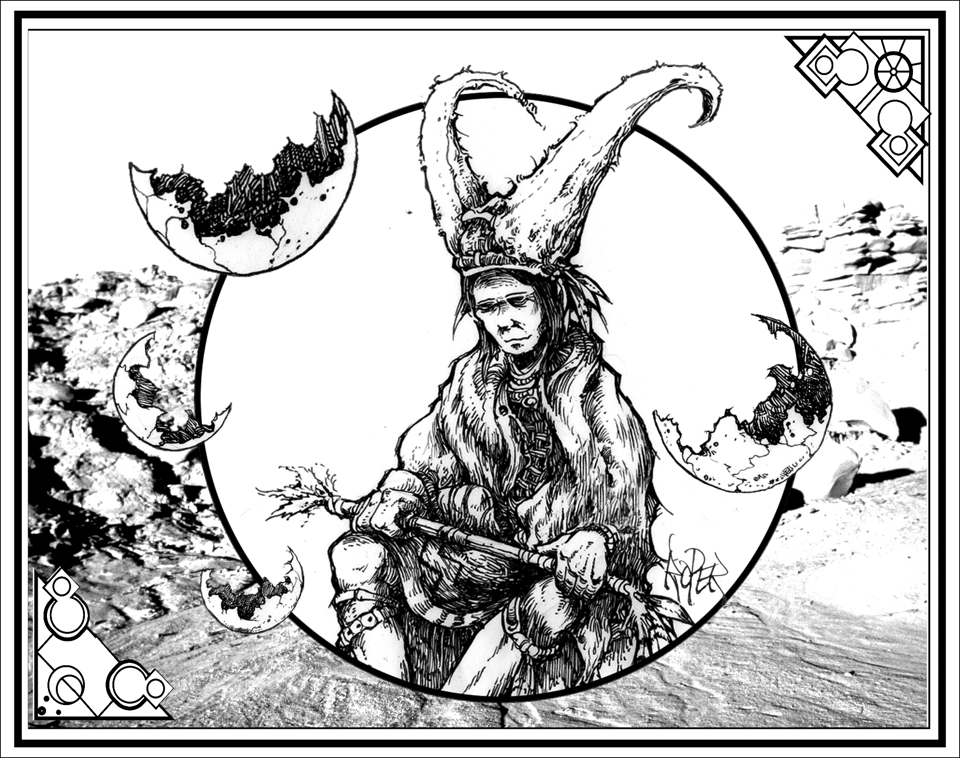
Illustration by Arik Roper

“Here and Now” column by Daniel Pinchbeck

“The Fifth World and the Hopi Apocalypse”

Last summer, I visited the Hopi on their tribal lands in Arizona. The Hopi are thought to be the original inhabitants of the North American continent–this is what their own legends tell us, and archaeologists agree. My initial interest in the Hopi came from reading about their oral prophecies and their “Emergence Myth.” According to the Hopi, we are currently living in the Fourth World, on the verge of transitioning, or emerging, into the Fifth World. In each of the three previous worlds, humanity eventually went berserk, tearing apart the fabric of the world through destructive practices, wars, and ruinous technologies. As the end of one world approaches a small tunnel or inter-dimensional passage —the sipapu—appears, leading the Hopi and other decent people into the next phase, or incarnation, of the Earth.

Of course, most modern people would consider this story to be an interesting folktale or fantasy with no particular relevance to our current lives. Even five years ago, I probably would have agreed with them. However, my personal experiences with indigenous cultures and shamanism convinced me, in the interim, that there is more to traditional wisdom than our modern mindset can easily accept. The Hopi themselves say that almost all of the signs have been fulfilled that precede our transition to the Fifth World. These include a “gourd of ashes falling from the sky,” destroying a city, enacted in the atomic blasts obliterating Hiroshima and Nagasaki, and a spider web across the Earth, which they associate with our power grid and telephone lines. According to Frank Waters, who compiled accounts from 30 Hopi elders in his Book of the Hopi (1963), the current Fourth World will end in a war that will be “a spiritual conflict” fought with material means, leading to the destruction of the United States through radiation. Those who survive this conflict will institute a new united world without racial or ideological divisions “under one power, that of the Creator.”

The 12,000 Hopi live in a dry and dramatic landscape strewn with enormous boulders, resembling the surface of an alien planet. Their towns are clustered on three mesas—high, flat cliffs overlooking vast swathes of desert. Traditionally, the Hopi are subsistence farmers; they work with ancient strains of corn and beans that are, almost miraculously, able to grow in that arid environment. For obvious reasons, water is sacred to their culture—many of their rituals are aimed at bringing rain. Each spring, each well, is precious to the Hopi. While I was visiting Hopiland I attended a raindance in the town of Walpi, on First Mesa. Perhaps 50 men of the town—wearing masks and costumes and feathered headdresses —participated in the dance, which was held in the town’s center. The dancers are dressed as katsinas, the spiritual beings that are thought to control elemental forces. The ceremony is a form of possession trance—the goal is to summon the katsinas to temporarily inhabit the bodies of the dancers. The Hopi believe that their culture can only prosper if they maintain direct contact with the supernatural powers that manifest directly through the natural world.

In his book Rethinking Hopi Anthropology, the Cambridge anthropologist Peter Whitely recalls, with an almost embarrassed reluctance, that during his time with the Hopi in the 1980s, he witnessed repeated demonstrations of their precognitive abilities and their ability to influence natural forces through ritual. He was transfixed by his first visit to a Snake Dance in 1980: “This was no commodified spectacle of the exotic … its profound religiosity was tangible, sensible. Within half an hour of the dance (which lasts about 45 minutes), a soft rain began to fall from a sky that had been burningly cloudless throughout the day.” When he went to see one of his informants, Harry Kewanimptewa, a septuagenarian member of the Spider clan, he would often find that the elder would answer the questions he had intended to ask before he could vocalize them: “I have no desire to fetishize or exoticize here, but this was something about him and some other, particularly older, Hopis that I have experienced repeatedly and am unable to explain rationally.”

I can sympathize with Whiteley’s plight. Since I started exploring shamanism almost a decade ago, I have found myself living in two worlds simultaneously—the world of Western rationalist discourse with its empirical and materialist emphasis, and the shamanic realm of magical correspondences, supernatural forces, dream messages, and synchronicities. The shamanic realm is one in which human consciousness is not an epiphenomenon or dualistic byproduct of a purely physical evolution, but an inseparable aspect of the world, intertwined with reality at every level. It seems that quantum physics has attained a perspective that is similar to the shamanic view, acknowledging a direct relation between the observer and observed.

Continue reading

AUTUMN OF THE PATRIARCHS: James Parker on Richard Meltzer and Mike Watt (Arthur 14/Jan. 2005)

Originally published in Arthur No. 14/January 2005

Autumn of the Patriarchs
By James Parker

Reviewed:

RICHARD MELTZER
Autumn Rhythm
(Da Capo/Perseus)

MIKE WATT
the secondman’s middle stand
(Columbia/RedEye)

It’s Autumn, by God, and I couldn’t be happier. If you’re a writer, it’s the only season: the peak, the prime. Summer flattens you, Winter cramps you, Spring is a mere sizzling of the sex-urge, but Autumn flings open the furnace door to real transformation. On a high November afternoon, with the leaves in a life-and-death whirl and that tossing, brassy light all around, the writer creeps from his/her carapace and partakes in the vortex of Possibility. Out come the old, allergen-loaded sweaters. Yes! On goes the woolly hat, that incubator of thought. Upward fly the—well, I could go on, but the point here is to address our latest bard of the Autumn, the great Richard Meltzer, whose Autumn Rhythm (now out in glorious paperback!), is not so much about crisp weather and fiery trees as it is about Mortality (or mortali-T, as the Meltz, in his demented flippancy, might put it)—age, defeat—the Autumn of our days—“the ‘topic’ at hand: your time… my time… all our times running low, running out, or in any case running.”

Meltzer, in case you’re not sure, is a father of what he calls ‘rockwriting’—Sixties, Seventies, he did it, he lived and typed it, was legendary, boozed with Bangs, tyro’d with Tosches etc etc. He figured in LA punk rock, a great stimulus to the minutemen, had his own terrible band. It’s all in his previous tome, A Whore Just Like the Rest. And now, finding himself “on the cusp of fucking dotage” (his late fifties), Meltzer is taking the long view and using the essay form. He considers his life, and the possible cessation thereof. Is there any more good art to be had from the fact that we’re all, sooner or later, going to be combusted or ploughed under? Certainly there is. Take this: “A couple years ago I started quantifying what a day actually felt like, what its duration as lived existentially was, and the unit day, I surmised, was only four hours long. It now feels about three and a half…. What can you get done in three and a half hours? (Better not piss—that’ll cut it to three.)” Or this, from a piece about Meltzer’s father, touchingly entitled “The Old Fuckeroo”: ‘Of course he LOVED me (and I loved him) and all such nonsense—but that part was maybe the worst of it. A sentimental slob, a ‘40s romantic in desperate need of a compliant LOVE OBJECT, he inflicted his ardor on me in direct proportion to what he wasn’t getting from his wife, assuring me (as often as not) that I was the the most important being in his life. A sensitive little prick, I grieved for the guy in his loneliness…” This is top-notch, ranking with the most exalted literature of fathers and sons. “(And I loved him)”—oh, the brackets say everything.

Like a number of greying punk rock dudes one knows, Meltzer is a cat person. It’s almost a type: the hoary radical, the ex-crazy, childless (Meltzer has declined to Impose “the full slimy wrath of [his] being” on any progeny), spurning most human allegiance but twistedly into his cat or cats, relishing and respecting the fuck-you-ness and complication of the feline. Meltzer writes, at any rate, with unguarded passion about his own aging—dying, in fact—pet-friend. The prose totters pretty close to the sentimental here—“It tears my guts out that I can’t tell him anything he’ll understand ‘bout how come he can’t go outside no more”—but it’s the real man speaking, no question, the same crank who elsewhere demands that we “unplug from the cyber lifeline… it’s a fucking deathline,” and that “Any bar, meantime, where the TV is never off should be NAPALMED.” (hear! hear!)

Meltzer can be an extraordinary comic writer, a real Joycean nutjob, but Autumn Rhythm is—as a rule— sombre, shaded, down. For a freelancer or “writeperson,” reading him in this mode is like having a skull on your desk—the hack’s death’s head, with failure caverned in its eyeholes. Unrich, unredeemed, still pissed at all the mags he ever wrote for, the Meltz will be your memento mori. “May this heap-o-pulp likewise serve as the ur-expression of YOUR vanity. A foretaste of your own aftertaste, of your own extinction.” No laughing matter. Only once does the author uncage the humorist, the Joycean nutter within, in a blinding series of anagrams (with explanations) for “Twentieth Century”: “W.C.T.E: ‘NUTHER ENTITY? (is the Women’s Christian Temperance Enfederation really diff’rent from their Union?)… WET TEN-INCH RYE TUT (medium-size Egyptian novelty bread, after the rain).” Personally, I can’t get enough of this stuff—“NEUTER THE WITTY N.C. (Noel Coward should be desexed, humorless critics contend)”—but I suppose I should stop quoting it. Besides, it’s not all gold dust between these covers. There are “poems”—or at least vertical strands of collapsed prose—in here, mere beermat jottings really. “His life was like a fart…” “if the flies want me/ let the flies have me,” “does my dick have scales?”—yeah, well, okay. Dead-end complacency. Keep typin’em up, Mr. M, if it helps you stay loose… Alright, just one more: “TUNNEY ET IT W/ ‘H’ CERT (Gene followed lobster with a heroin-flavor breath mint).” Ha!

MTV, the “wundaful world-o-videos,” is another of Meltzer’s apocalypses, like the TV bars and the Internet. “When the frigging MINUTEMEN did a vid,” he declares, “you knew it was completely over.” So speaking of the minutemen, and speaking of being completely over, let’s move on to the new Mike Watt CD, which details—really details—a more urgent autumnal event, a most drastic run-in with mortality. the secondman’s middle stand is about serious physical illness (and recovery), and like Watt’s previous contemplatin’ the engine room it takes the form of a punk rock opera, thematically unified, moving in suites. No guitar this time, no Nels Cline or flaming Joe Baiza—on top of the bass and drums is the B3 organ of Pete Mazich, summoning celestial overtones or carousel queasiness as required.

The sickness unto death, for Watt, began in the perineum, that dark notch between balls and asshole. A place of terror: less a place than a space—an eerie, sensate, biologically brooding nothing. Anyway, in 2000 Watt got some sort of explosive abscess right there on his perineum, on the black fulcrum of his being as it were, a boil or saddlesore that blossomed vilely upward and inward and swelled its canker until he quite literally burst, gushing infection through emergency blowholes. Imagine it if you dare, it was an authentic crisis—flashing lights, gurneys, surgery, “38 days of fever,” the mercury climbing in horror and indignation, Watt hovering in half-states, deeply drugged. He almost died. His health and strength were demolished. His recovery was inch-by-inch. “Many geisha boy steps to make the couple of blocks from my pad.” Geisha boy steps—that’s very good.

Fortunately, blessedly, Watt’s philosophy seems to have been a match for this. A proper materialist from his minuteman days, always wrestling with the actual, he was not dismayed to find himself splayed, helpless, reduced, a creature of “pissbags and tubing.” His interest in the conditions, his taste for the basics, prevailed. Adrift for a time in the the unlit precincts of his own body, CURIOSITY got him home. “Dicktube yanked out too/How I laughed when that golf ball bead came thru…” If you’ve ever encountered Watt in person you know that there’s a poetic totality to the man, a density of imagination in which everything—the mumble, the rumble, the word-hoard, the face-bristle, the bong-gurgle, the rumour and squelch of his bass—corresponds. It’s the whole Watt thing, and it feeds the art tremendously: in some respects it is the art. All experience is grist to Watt the mythifier and this here, this bodily drama, is his own “dark wood of error,” his existential pratfall. Can you dig a punk rock opera about a man whose ass exploded? I know you can. Three movements—Inferno; Purgatorio; Paradiso—hell-hot fever, convalescent limbo, the heaven of the healed return. Dante Alighieri hovers palely by, upper lip lengthened in slight disapproval: Watt has customised the Divine Comedy.

“Boilin’ Blazes” gets us rolling, as Watt does some big vomiting—“threw up mah guts”—and succumbs to fever. It’s the beginning of the “hellride,” a derangement of vile organ-blare and bombastic drumming. “Puked to High Heaven”—more vomiting, and the freakout becomes ontological: “In my head, a tightly packed flame…The moment has me seized!” “Burstedman” is the killer track: “Virgil! Beatrice!” cries the patient, as ungodly fluids splatter his “bulkhead.” “A life in the moment, is that what you’ve always wanted, Watt?” he taunts himself, his bass snicker-snacking. “Well here it is!” (Watt’s playing in general on secondman… is, if possible, more bulbous and ruminative than ever.)

Into hospital we go, and Watt gives us—joyously—the wadded dressings, the catheters, the incidental bladder infections, the nitty gritty: “yankin’ it out… and shovin’ it in!” The mood of “Tied a Reed Round My Waist” is… wonder, oddly enough, Pete Mazich’s B3 doing soft throbs of awe as Watt goes swooning under the knife of top surgeon “Doc Hopkins.” “Beltsandedman”—again with the blue-collar metaphors!—is a beautiful evocation of post-traumatic smoothness, clarity of perception, with fuzzed bass-notes lingering and Petra Haden’s harmonies leavening the Watt-growl. See Watt on the back of the CD, pounds lighter, purged and streamlined: the eyes are heavy-lidded but clear, afire, and there’s a sort of rinsed brilliance to the complexion. It all appears to have been quite good for him.