HAPPY MERRY HAPPY! 2010 painted card series. LOVE alia

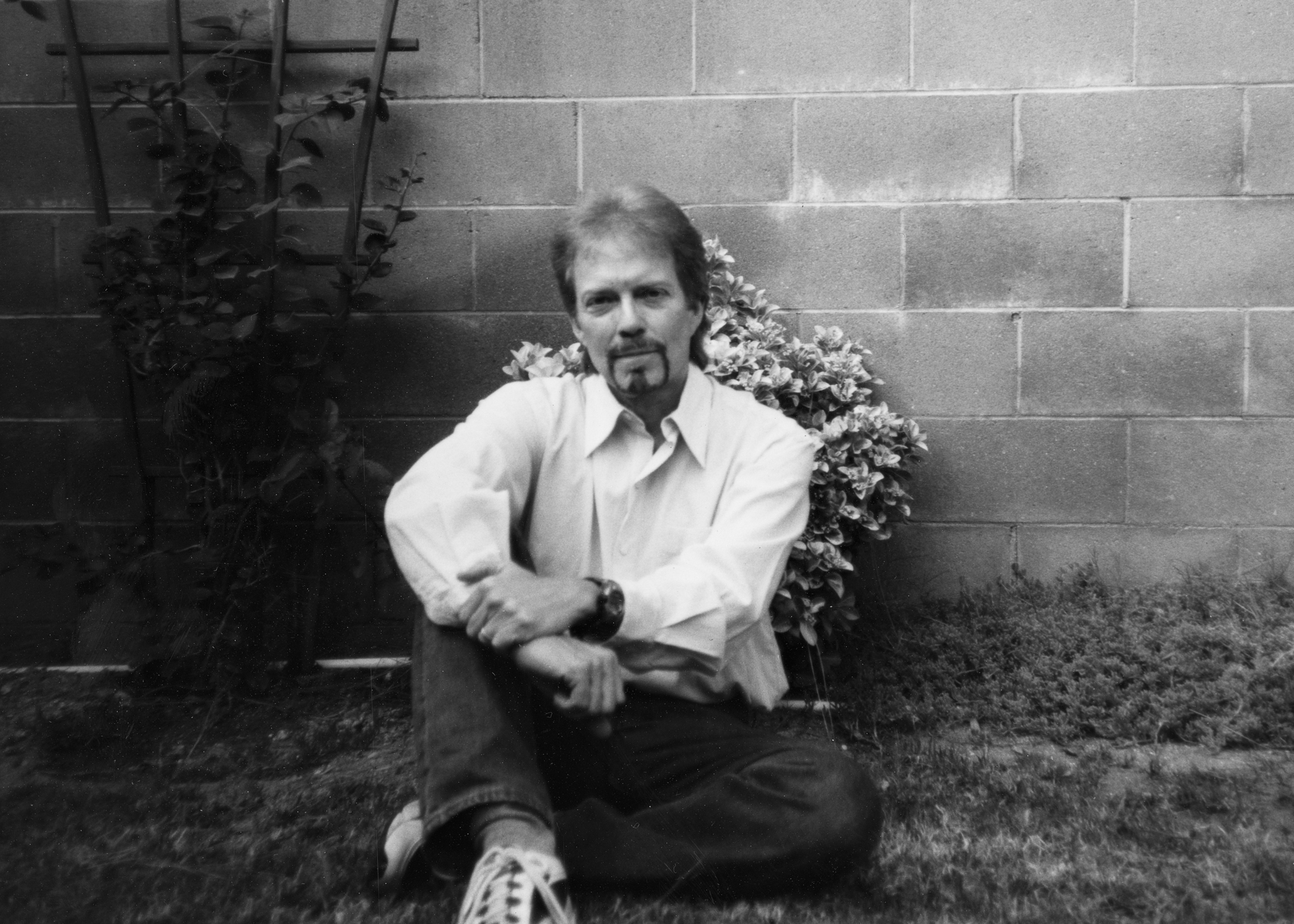
The Death Of Santa Claus
by Charles Harper Webb
He’s had the chest pains for weeks,
but doctors don’t make house
calls to the North Pole,
he’s let his Blue Cross lapse,
blood tests make him faint,
hospital gown always flap
open, waiting rooms upset
his stomach, and it’s only
indigestion anyway, he thinks,
until, feeding the reindeer,
he feels as if a monster fist
has grabbed his heart and won’t
stop squeezing. He can’t
breathe, and the beautiful white
world he loves goes black,
and he drops on his jelly belly
in the snow and Mrs. Claus
tears out of the toy factory
wailing, and the elves wring
their little hands, and Rudolph’s
nose blinks like a sad ambulance
light, and in a tract house
in Houston, Texas, I’m 8,
telling my mom that stupid
kids at school say Santa’s a big
fake, and she sits with me
on our purple-flowered couch,
and takes my hand, tears
in her throat, the terrible
news rising in her eyes.

While I was getting a drink at the bar
a half hour ago I saw you deciding,
she said, whether you should talk to me,
I tried making your decision easier
by smiling at you, but you started
talking to someone else. I’m
your second choice. Just like
Avis has to try harder than Hertz,
I have to try to outshine the other women.
Knowing you picked her over me
makes me want to tell you
to just go back to square one.

After We Saw What There Was to See
by Lawrence Raab
After we saw what there was to see
we went off to buy souvenirs, and my father
waited by the car and smoked. He didn’t need
a lot of things to remind him where he’d been.
Why do you want so much stuff?
he might have asked us. “Oh, Ed,” I can hear
my mother saying, as if that took care of it.
After she died I don’t think he felt any reason
to go back through all those postcards, not to mention
the glossy booklets about the Singing Tower
and the Alligator Farm, the painted ashtrays
and lucite paperweights, everything we carried home
and found a place for, then put away
in boxes, then shoved far back in our closets.
He’d always let my mother keep track of the past,
and when she was gone—why should that change?
Why did I want him to need what he’d never needed?
I can see him leaning against our yellow Chrysler
in some parking lot in Florida or Maine.
It’s a beautiful cloudless day. He glances at his watch,
lights another cigarette, looks up at the sky.

Once in a While
by Mark Perlberg
Mother was agitated all morning.
A call had come from her brother Harold,
who was spoken of only in whispers
and despised by those with a talent
for never changing their minds.
But Mother loved him.
Somehow I learned that my uncle
had forged checks and spent time in prison.
And I knew he played the saxophone
in small jazz bands.
In late afternoon the doorbell rang.
My uncle stood in the hall.
A tall man slightly stooped, he shook snow
from his long brown overcoat. He had a high
hooked nose and wavy brown hair
that fell across his forehead,
and he carried packages wrapped in Christmas paper.
My stepfather signaled: disappear.
In early evening Uncle Harold
knocked on my door with a gift for me:
jazz records, the first I’d seen.
Fats Waller beaming from the album cover
is clearer to me now than my uncle’s face.
“I can’t give you anything but love, baby.”
A mourning sax backing Lee Wiley:
“Once in a while, will you give just
one little thought to me…”
At first light my uncle was gone,
His footprints vanishing in a fresh fall of snow.
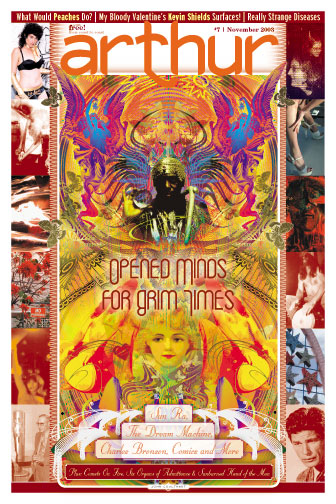
Above: the cover to Arthur No. 7 (Nov 2003)—artwork by John Coulthart, design by W.T. Nelson
Dark Funk, Gardenfolk and the Almighty Zaps
This summer, underground psych bands SUNBURNED HAND OF THE MAN, COMETS ON FIRE and SIX ORGANS OF ADMITTANCE ventured across the continent in a traveling caravan of mindblowers. Tony Rettman reports live from the scene.
Originally published in Arthur No. 7 (November 2003)
“Jazz doesn’t have to swing and rock doesn’t have to rock and religion has next to nothing to do with God.” —Richard Meltzer
Yes. Meltzer’s testimonial riff is the kind that can really get you going going gone. Strip music of any elements that seem banal, pretentious or overly cerebral. Twist the sound into something of your own. Create a primal celebration of boundary-less independence. Join the others who’ve walked through the door marked “Free”—and emerge with a blown mind full of free jazz, psychedelia, proto-metal, oddball folk, prog rock, blues, English country rock, funk, mind-numbing drones, electronic music, non-genre improvisation.
In the past few years, a seemingly ever-growing number of underground American artists have been making that trek Beyond, collecting elements from these sounds and shooting them through a post-punk perspective, laying the results down on self-pressed vinyl and home-burned CD-Rs, sold through homegrown distribution networks like Brooklyn’s Fusetron, Arizona’s Eclipse Records, and Massachusetts’ Forced Exposure and Ecstatic Yod.
But a funny thing is happening. Through next to no effort of their own, these freaks are now attracting the attention of curious folk from outside the esoteric, near-hermetic circles that their music was necessarily born from and sustained by. Indeed, the very definition of this genre-obscuring cult movin’ on up happened this July when three of the finest units out of this quote scene unquote descended on Pianos in NYC to strut their stuff: San Francisco’s’ loud-as-hell psychedelic four-piece Comets On Fire, Boston’s 15-member sound collective The Sunburned Hand of the Man and the author of the new chapter of gypsy folk meanings from Santa Cruz, Six Organs of Admittance. This show—the conclusion of a three-week tour—brought together three groups who are aesthetically linked in approach, intensity and a loosely limbed philosophy: Here’s how the whole enchilada—the show, the tour, the bands themselves—came together and got down to getting Free.
* * *
Ben Chasny is Six Organs of Admittance–he is the sole soul responsible for the unearthly and solemn sounds created under this moniker, with others occasionally sitting in on recordings and live sets. Tonight at Pianos in he first and he plays alone, acoustic guitar in his lap, head down and hair in face, with only his black jackbooted heel to keep the beat. “Transcendent” is the bang-on word to describe what Chasny lays out. His music conjures up foggy, half-remembered memories of drunken nights in overlit fluorescent rooms that pulse. Strange feelings that mix danger with joy. And then he busts out with a cover of Neil Young’s “A Man Needs a Maid.”
Visiting with Chasny later in the evening over a beer at the bar, I get some background. Chasny grew up in the woods bordering the northern California town of Eureka, 300 miles north of San Francisco. His musical upbringing was positive hardcore punk, until one day when his hippie father laid dark folk troubadour Nick Drake’s Fruit Tree box set on him. In it laid all the keys needed to open Chasny’s doors wide open. A second turning point came when a friend returned from a journey to San Francisco with a copy of the underground psych magazine Forced Exposure in hand. “That magazine was filled with exactly what I knew was out there but couldn’t find,” says Chasny. “I went crazy and started absorbing all the new sounds they were championing.”
Continue reading
For six nights now the cries have sounded in the pasture:
coyote voices fluting across the greening rise to the east
where the deer have almost ceased to pass
now that the developers have carved up yet another section,
filled another space with spars and studs, concrete, runoff.
Five years ago you saw two spotted fawns rise
for the first time from brome where brick mailboxes will stand;
only three years past came great horned owls
who raised two squeaking, downy owlets
that perished in the traffic, skimming too low across the road
behind some swift, more fortunate cottontail.
It was on an August afternoon that you drove in,
curling down our long gravel drive past pasture and creek,
that you saw, flickering at the edge of your sight,
three mounted Indians, motionless in the paused breeze,
who vanished when you turned your head.
We have felt the presence on this land of others,
of some who paused here, some who passed, who have left
in the thick clay shards and splinters of themselves that we dig up,
turn up with spade and tine when we garden or bury our animals;
their voices whisper on moonless nights in the back pasture hollow
where the horses snort and nicker, wary with alarm.

My mother loves butter more than I do,
more than anyone. She pulls chunks off
the stick and eats it plain, explaining
cream spun around into butter! Growing up
we ate turkey cutlets sauteed in lemon
and butter, butter and cheese on green noodles,
butter melting in small pools in the hearts
of Yorkshire puddings, butter better
than gravy staining white rice yellow,
butter glazing corn in slipping squares,
butter the lava in white volcanoes
of hominy grits, butter softening
in a white bowl to be creamed with white
sugar, butter disappearing into
whipped sweet potatoes, with pineapple,
butter melted and curdy to pour
over pancakes, butter licked off the plate
with warm Alaga syrup. When I picture
the good old days I am grinning greasy
with my brother, having watched the tiger
chase his tail and turn to butter. We are
Mumbo and Jumbo’s children despite
historical revision, despite
our parent’s efforts, glowing from the inside
out, one hundred megawatts of butter.

Buying Stock
by Denise Duhamel
“…The use of condoms offers substantial protection, but does not
guarantee total protection and that while
there is no evidence that deep kissing has resulted in
transfer of the virus, no one can say that such transmission
would be absolutely impossible.” –The Surgeon General, 1987
I know you won’t mind if I ask you to put this on.
It’s for your protection as well as mine–Wait.
Wait. Here, before we rush into anything
I’ve bought a condom for each one of your fingers. And here–
just a minute–Open up.
I’ll help you put this one on, over your tongue.
I was thinking:
If we leave these two rolled, you can wear them
as patches over your eyes. Partners have been known to cry,
shed tears, bodily fluids, at all this trust, at even the thought
of this closeness.

Published in Arthur No. 13 (Nov., 2004)
My Top Ten Favorite Psychedelic Folk Songs
by Genesis Breyer P-Orridge
I was invited to create a list of my personal FAVORITE music and so I did, for an English newspaper The Independent. I was happy to illustrate how different my taste is to the endless dark mediocrity of current so-called Industrial Music that people seem to assume I would like when I NEVER have!
A note about the number of Incredible String Band songs in the following list: In 1969, I was a member of The Exploding Galaxy kinetic performance troupe in London. Some members left to form Stone Monkey, who danced with the ISB for a while. I had been listening to the Incredible String Band since school. The surrealism and FREEDOM of the lyrics is what continually engages me: the subject matter of absurdity and spirituality combined. I feel the ISB are probably the lyrical geniuses of the ’60s and onwards, far more than the Beatles or Dylan, who become predictable and never really extended the form of the song as an open system in the same way. Once one gets the ISB all the other musics fall into place. These are the true troubadours of the last two centuries. They explore divinity and magick from a lyrical chivalric dimension. Combine this with the interdimensionality and you have works beyond compare. SUBLIME!
Go and explore, there are more stories in the drug mine of British folk than man hath dreamed of and Lewis Carroll hath penned to his own particular blend of paper.
Genesis Breyer P-Orridge
New York City, April 2004
=====
1. “Meet on the Ledge” by Fairport Convention
(from What We Did On Our Holidays, 1968)
When I was at Hull University this song was on the student-picked juke box. The in-joke amongst we flower children/soon-to-be-drop-outs was that when we wanted to score hash from the University dealer we’d put this record on as a buying signal and meet outside by the “hedge.”
2. “When I Get Home” by Pentangle
(from Light Flight compilation double CD, 1971)
This is amazing! Bert Jansch, John Renbourn, Richard Thompson and the crew evoke the most immersive sense of melancholy. I saw all the guitarists individually in the Hall of Residence cafeteria so this always makes me smell gravy and roast potatoes instead of think of alcoholism. A whiskydelic song as Lady Jaye would say.
3. “A Very Cellular Song” by the Incredible String Band
(from The Hangman’s Beautiful Daughter, 1968)
Probably my equal favorite song of all time. Full of whimsy, weirdness, surreal lyrics that insist they are profound when you know they are more likely just found. When it gets to a sequence which describes the feelings of an amoeba you know that you are, after all, in the presence of genius!
4. “Strangely Strange But Oddly Normal” by Dr. Strangely Strange
(from Kip of the Serenes, 1970)
I can’t imagine life without this band. They always bring joy to my heart. Rumor has it the main singer split to become a full-on Zen priest so they only made two albums. Both are total classics of British pre-Raphaelite fairytales. No other people can pull off this nonsense poetry so authentically. The genius Joe Boyd brought them from Eire to record their masterpiece. You do not love words if you cannot love this song which has the silliest chorus ever written.
5. “Sign On My Mind” by Dr. Strangely Strange
(from Heavy Petting, 1970)
I used to have this on vinyl and the cover unfolded as intricately and dadaistically as the music and lyrics. Gnomic hippies peer from insubstantial cut-out trees as we are led a merry frolic into the surprise of a guitar solo by Gary Moore of Thin Lizzy fame! I have seriously considered doing a cover version of this song with The Master Musicians of Jajouka playing the flute parts.
6. “Time Has Told Me” by Nick Drake
(from Five Leaves Left, 1969)
The myth says that Rizzla rolling papers had one paper that said “Five Leaves Left” to warn stoners of impending doom. Of course, I could have chosen ANY song by Nick Drake. The intensity of melancholia drenching the analog tape, the sheer PRESENCE of his voice is an honor to share, as is the raw intimacy with which he describes turmoil, creating confusion in us by delicately flecking every edge of his words with guilty beauty.
7. “My Father Was a Lighthouse Keeper” by the Incredible String Band
(from Earthspan, 1972)
Here I am duty bound to confess I have at least 20 ISB CDs and albums! Never, ever, on any day, in any mood do I feel less than joyous to hear their voices and humor, their grand metaphysics and acid-drenched morality plays. At first I wasn’t sure about this era. L. Ron Hubbard supposedly wanted to guide their parables. But there is something in the violin—as an electric violin player since 1966 myself, I am a sucker for them. Now, I bellow along and feel the sea spray soak my mediaeval hose as I witness a murderous foam.
8. “Translucent Carriages” by Pearls Before Swine
(from Balaklava, 1965)
Tom Rapp is one of the great undiscovered poet songwriters from Eastern USA. Originally on ESP Disc alongside the Fugs and other neo-Beat nutters he occasionally lets slip a seductive lisp. I have never figured out the meaning of this song (which was first played to me by Annie Ryan in Liverpool in a post-acid glow) even though I did record it for the Psychic TV Pagan Day album. Answers on a dog-tag please. He is a lawyer now. Sensible man saw too much of the larval nature of mankind for his own peace of heart.
9. “War in Peace” by Alexander “Skip” Spence
(from Oar, 1969)
Skip was a Canadian bass player who switched to drums for the Jefferson Airplane during the acid madness until he was dropped in 1966 for missing a rehearsal! He turned up like a mad penny in Moby Grape next, still erratic and enigmatic. There’s the touch of Syd Barrett tragedy in the implosion and incompleteness of many of his songs. His deranged inspiration sneaks him in as folksy acid.
10. “Ducks on a Pond” by the Incredible String Band
(from Wee Tam and the Big Huge, 1968)
Yes, I know, there are so many others and where DO you draw the psychedelic line? By its very natyre it meanders and has no beginning, edge or point. I wanted to include the Blossom Toes’ “We Are Ever So Clean”; Nirvana’s “All of Us”; anything quirky by Syd Barrett (which means everything he did). Why I even toyed with Kaleidoscope from the USA and Dantalian’s Chariot (whose guitarist went on to play in The Police!!! Oh Andy Summers, ouch!). But “Ducks” is the 1968 masterpiece. A total artwork. A monster that will not shut up or stop spiralling around and around as dumb as a duck and as crazy as a fox complete with “inky scratches everywhere.”
 Arthur Magazine