I remember raving. I remember Ecstasy. I remember chewing on a piece of gum until it broke—until it turned into something else, something weak and viscid, its gummy properties of twang and bounce quite exhausted. Symbolic? I thought so. I remember the mad foam of chemical brotherhood. I remember insisting, deep in some woofing, thumping London club, that two people I had just met stand next to me with their heads touching mine so that I could enjoy the warmth of their nude ears (we all had very short hair). And I did it in San Francisco too, where the loonies are—a man at a ‘smart drinks’ bar, wearing an Anarchic Adjustment t-shirt, told me that in the course of his psychedelic researches he had become invisible for nearly three weeks.
I know a little bit about it, is what I’m saying, but Julie Drazen’s Rise —a movie about New Orleans rave promoter Disco Donnie—still surprised me, because guess what the kids have done now? They’ve taken raving—the most godless, pharmaceutically programmed, pseudo-spectacular trip there is—and gone and made a religion out of it. And because their minds have been weakened by drugs and flashing lights, they have christened this religion with the anaemic acronym PLUR. PLUR, for Peace Love Unity Respect, which they pronounce as a single syllable to rhyme with “purr.” Oh dear. “Jesus preached PLUR!” declares a girl with awful Ecstatic earnestness, filmed against a colourless background. The bass frequencies of an offscreen rave shimmer around her, and her jaw is lunging about like something trapped. “And he probably smoked bud too!” Her boyfriend is even worse, a drug-electrified fanatic, unable to do anything more than twitch his head in agreement. Rave as spent cultural force? Just say that word PLUR and hear the energy leaking out of you, away from that promisingly plosive beginning—the pop! of newness—into entropy, wasted breath, the heat-death of the universe etc.
Not to bash the kids: they have an absolute right to their foolishness. And if they make it through, if they don’t entirely ransack their life’s ration of serotonin and good luck, who knows, they could end up as wearily wise as me. But there does seem to be some synchrony going on here between the powers of Ecstasy and the credulousness and positivity of the American national character. British ravers, though drugged like shamans, were by and large a pasty-faced, sardonic crew. They kept it—I won’t say real, but realistic. UK rave had its cranks and ideologues of course: one thinks for example of the magnificent shaven-headed Spiral Tribe, illegal party planners and white label artists, speculating on mystical vortices, intoxicated with the number 23, bouncing grimly in churned fields and in the corners of squats. But an essential British narrowness was always part of it. This was part the distinct pleasure of the whole trip: beneath the skin of the most blazingly loved-up raver, his open arms extended zombie-like towards you, you could always discern the sunken shrewd skull-face of the morning after, the colour of an empty milk bottle. The spidery ironist Jarvis Cocker made fun of us all: and you want to call your mother and say /”Mother, I can never come home again/’cos I seem to have left an important part of my brain/ somewhere, somewhere/ in a field, in Hampshire (“Sorted For E’s and Wizz”). In America there was Timothy Leary in his robes. There was twinkling Terence McKenna, that one-man rocket-ship leaving the Ego behind. It was in America that someone actually said to me, muffled deep in an embrace, “I don’t know who you are, but I fucking love you.”
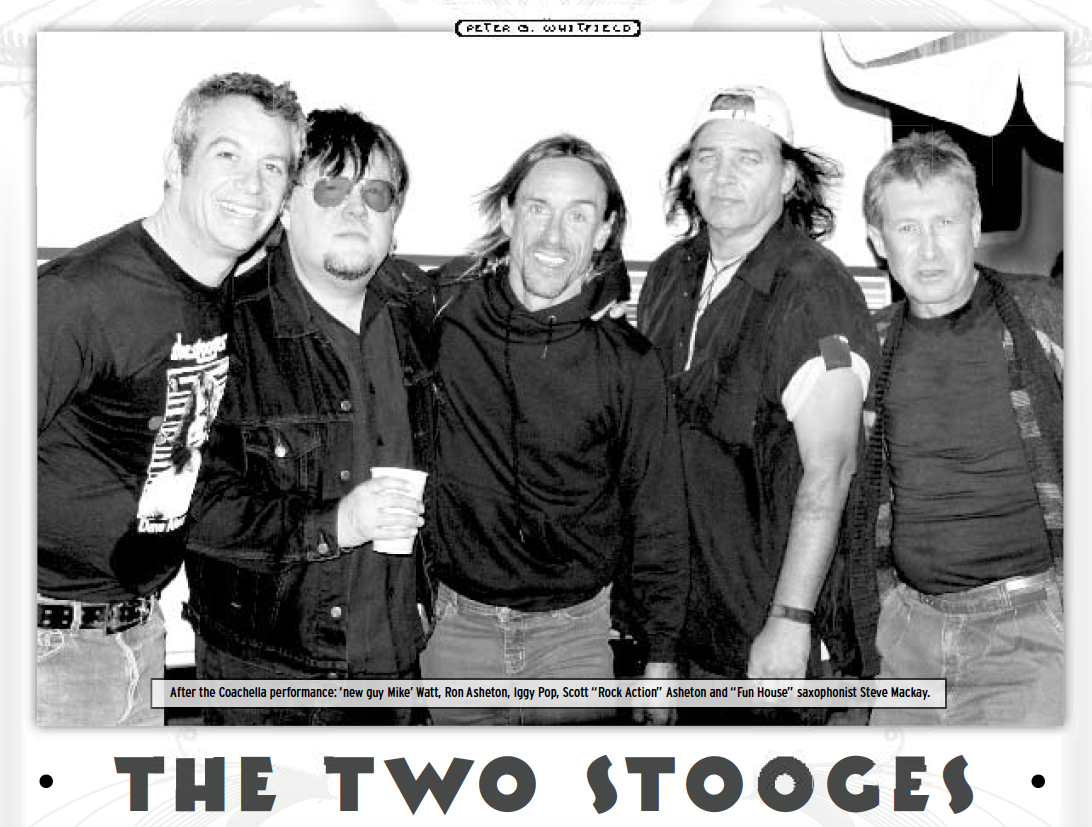
RON & SCOTT ASHETON on their past, present and future.
by Jay Babcock
Photo by Peter G. Whitfield, art direction by W. T. Nelson
Originally published in Arthur No. 6 (Sept. 2003)
Following the second (and final) split of the Stooges in 1974, Ron and Scott “Rock Action” Asheton’s next joint effort was to form New Order, who released a single eponymous LP that gained little critical or commercial notice. Scott did some work with ex-MC5 Fred “Sonic” Smith’s band, Sonic Rendezvous, while Ron went on to work briefly with the second, post-Mike Kelley/Jim Shaw version of Destroy All Monsters, a sort-of Detroit supergroup, before forming The New Race with Stooges acolytes Deniz Tek and Rob Younger of the Australian power rock group Radio Birdman. The New Race released a single quasi-live album, in 1981, and then was no more. In the ‘90s, between taking roles in his beloved low-budge horror films (his filmography includes Hellmaster [‘92], Legion of the Night [‘95], Mosquito [‘95] and, of course, Frostbiter: Wrath of the Wendigo [‘96]), Ron recorded with a group called the Empty Set, and performed and recorded with singer/Destroy All Monsters alum Niagara in a new group called Dark Carnival.
Ron’s participation in the Wylde Ratttz sessions in ‘98 [see sidebar] eventually led to an invitation by J Mascis & the Fog to play songs live dates with his band, then featuring ex-minuteman Mike Watt on bass. Watt, who had been playing the Stooges songs for years (see “From a minuteman to a Stooge”) was the singer on the Stooges songs the band performed each night for the numbers when the group wasn’t being joined by guest vocalists, which was often. These shows attracted enough heat for Sonic Youth, curators of the 2002 All Tomorrow’s Parties, to ask Asheton, Mascis and Watt to do an all-Stooges set at the UCLA festival, with secret guest vocalists.
At this point, Scott “Rock Action” Asheton was coaxed back into the spotlight. Working on a piece for the LAWeekly to coincide with that ATP show, I caught up with Scotty down in Florida to ask him what he‘d been up to. “I’ve been playing with various musicians and bands, did some touring, did some recording with Capt. Sensible from the Damned and Sonny Vincent,” he said. “But I’ve got a daughter now, and mostly I’m just busy being a dad.”
Although Scotty had kept in contact with Iggy, his dreams of some sort of reunion of the Stooges hadn’t come to pass. “I used to call up his management and kinda bug ‘em about if there’s a chance we could get together, him and myself and my brother and do an album. He used to tell me ‘Well he’s not opposed to the idea but he’s just really busy.’ I think the people would like it, I think it would be cool if me, my brother and Iggy do some things… You know, there’s a lot of good memories and a lot of bad memories. It’s too bad that the band had to fall apart when we did, but it was due to things that were out of our control. Me and James [Williamson, the band’s second guitarist] and Iggy were having some problems, and as a result the band fell apart. I always felt bad for my brother because he kinda got the raw end of the deal. It really wasn’t his fault that things went the way they did.”
Although he was aware that the Stooges’ records had continued to win the band fans three decades after their initial release, Scotty had obviously long lost interest in contemporary rock. As I read off the names of the people he’d soon be performing with, he said, “To tell you the truth, I don’t know anything about ‘em. I was asking other people, and they were saying Well [J Mascis] is from Dinosaur Jr. And I’m going Well, sorry again, then. Never heard of them. But if Ron likes them, they gotta be good.”
They were good—it was a lineup of singers that included Watt, Sonic Youth’s Kim Gordon and Thurston Moore, Eddie Vedder and Queens of the Stone Age’s Joshua Homme—but, in the end, none of them, of course, was Iggy. (By the same token, as good as his solo work has been, Iggy has never had a band that approached the utterly primordial, shamanic genius that was the Stooges, either.)
After several months of tantalizing rumors, in February 2003 the Ashetons reunited with Iggy Pop to record some new Stooges songs for Iggy’s new solo album. The sessions, produced by Iggy at a studio near his Miami home, yielded four songs and a tentative interest in performing live as the Stooges again. I caught up with Ron—Scotty remained elusive—to find out how this all went down. The following Q & A is culled from two phone conversations with Ron—one took place just prior to the 2002 ATP show, and the other, less than a week before this issue of Arthur went to press in late July. — Jay Babcock
Arthur: So, how did this happen?
RON ASHETON: Well, Iggy called up and he goes, ‘Well hey, what’s happening?’ We did small talk for about 20 minutes and then he goes, ‘Well the reason I called was I was wondering if you’d be innerested in a project. You can say yes, or you can say no, and I don’t care, I understand. And if you say yes, you can call me back in two weeks and tell me to go fuck myself.’ [laughs] But I said right away, Yes, sounds cool to me.
I went down to Florida. My brother, who lives there part of the year, was already there. Jim—most people know him by Iggy but we call him Jim, usually—came to the hotel and he goes, Well I know a fun place to eat. So we went. I was a little nervous, I hadn’t seen him up close, shake-hand close, since 1980. He’s a guy that was one of my best friends, that I haven’t really talked to, or seen, in many years—and I’m there to work, to do music! Whoa. So I go, [mock melodramatic voice] ‘God, please make it good.’ So we talked and had dinner. The next day we went to his house and we visited for about an hour and a half and then we went to the studio. And it was easy. From then on, it’s like there was no time in between… It was great. I think I appreciate it and enjoy it more now. I like the things we talk about. And I’m proud of what he’s done.
You guys weren’t just in a band—you all lived together in the old days. That stuff doesn’t really go away, does it?
We started out with our first band house, our little summer sublet, and then we moved on to a farmhouse and then another farmhouse and then out in L.A. Not to mention all the thousands of shows on the road through the years. So we’ve got a lot of time between us.
How were the new songs written?
I had some things and I got pieces and I started workin’ on stuff. So we talked as the time was approaching to go to Miami, I had a talk with him and he goes, You know, you can bring stuff down, or you can bring pieces, or you can bring down nothing at all. So I decided to bring nothing. [laughs] But the night before I left, I’m going, Well I gotta have an icebreaker. So I came up with that thing for “Skull Ring.” And we jammed on that. That got turned into a tune. And then I said, “Well Jim, why don’t you stay at home and give me about four or five hours before you come to the studio tomorrow, and let me see what I can come up with.” Before I went to bed that night at the hotel, I’m lyin’ in bed and I got a riff stuck in my head. I started out on that the next day and it just came quickly—I wrote “Little Electric Chair” in 15 minutes. I did three things. One of ‘em didn’t make it to the record cuz we didn’t have time. So I wrote ‘em, brought my brother in, taught him the song, recorded it and then I laid a bass track on it. One hour later, I brought him back in. He goes, “Ready already? You just taught me the other one!” And I go, “Yeah well I got this other one.” And we just did that. It just was flowing out of me, cuz I was excited about doing it and I liked that studio. I felt real comfortable there. I knew that it was important, and I knew that we didn’t have a lot of time. But luckily it just worked out. The stuff just flowed right out. Then Iggy came and he goes, Yeah this is cool.
You use the same little riff on the bridge for ‘Loser’ as there is at the beginning of ‘Dead Rock Star’…
Iggy had that basic piece, and I kinda toughened it up, played into that more. I used that descending riff on ‘Dead Rock Star’ just to show him it was good. I gave him a lot of options to choose from. And he wound up going, Well I like both of ‘em. I go, Just do it man. It’s great how they cut it up. He was a little hesitant to play ’Dead Rock Star’ for us. He goes, Well I got this idea for this song but I don’t know… I go, [mock impatience] Just play it for me! And I go, No man it’s cool. I really like that. He didn’t know what he thought about it. Then he started liking it. I go, No it fits it, I really like that, cuz you got different things on our stuff. You got Stooge voice, and…you’ve got your crooning and even on the other Stooges songs, the voices are a little different. And I get a kick out of the album—[mock DJ voice] ‘It’s Iggy playing with Green Day. It’s Iggy with Sum 41.’ On the record [as a whole] he does all kinds of stuff. It’s cool.
On a couple of the songs you do a sort of prelude riff before the ‘proper‘ riff comes in, like you did on ‘1968’ and ‘Loose’ —
Yeah, we talked about this also. He goes, People are gonna expect it to be kinda like the Stooges. Cuz I’d sent him a bunch of stuff I did with the Wylde Ratttz and that was not very Stooge-y. He liked the stuff, but he was also a little worried that I might be too good. [laughs] Which, you know, in all my other songwriting with other bands they’re always going, ‘It’s a great song but you wouldn’t think that was a Stooges song.’ Well you know, I got a little better! And I’m having fun experimenting and it’s boring [to play simple stuff] as I learn more. So [getting more technically proficient] has kinda been a blessing and a curse for me. And Iggy was concerned and I also was concerned, that I needed to think primitive for this. It wasn’t as hard as I thought it was, just to go back into that feeling.
What was really amazing for me was playing at Coachella, because I was figuring, I’m a little a bit better player so maybe I’ll rip off a couple slicky riffs or something for leads, but when I started doin’ it [at rehearsal], uh oh I’m kinda stuck all of a sudden. But once I was up there onstage and doing it, it was like I switched back to primitive mode. I just started playing simpler and a lot of those old riffs came back to me. I’m going ,Well goddamn I rehearsed this, but just being up there, it made some kind of magic that brought it all back to that kind of primitive stuff.
Has it been strange, the three of you doing Stooges again and Dave Alexander not being there with you?
No… because I’d been doin’ it a bunch with others. But Dave was there with me in spirit, because…I thought about that a lot, and I talked to my brother about it. He goes, Well Dave’s right here with me now, man. That’s how we all felt, and that’s why my brother gave Mike Watt the Dave Alexander t-shirt to wear, and Watt was so into it he wore it every day at practice too. We thought about Dave. When I took breaks I would say, You know thanks to you, Dave. You were part of this, and…you should be proud. Cuz I’m so proud that you were a part of it. He was a very inneresting bass player. Watt goes ‘Man just listen to him, he was a tripped out bass player, that thing he does on TV Eye that just kinda rubber bands around your thing, that’s brilliant.’ We always miss him—I think about him every day, I always have. There isn’t a day go by that I don’t think about him a bunch. I’ve had many other bands, so I didn’t miss him in that sense. But I wish he coulda been here.
I think listeners and the audience have always thought of Iggy as being fearless and spontaneous, but you’re talking about him being uncertain about songs…
Well, for me, I like that edge for playing. I like to know that everyone knows the song, and there is a format: you got your basic song. But I enjoy what might happen within the tune. With Jim what’s amazing is he is—and we talked about this—he’s really worked hard on his stage show. He’s perfected it. He’s a better showman. He doesn’t beat the hell out of himself like he used to. If something came into his head, bam, he’d do it. But now he paces himself better. I mean, if you coulda seen some of the shows way back when, it was like, man, the guy just went out and played a whole game of football in an hour. He’d always be battered up. He always hurt himself, almost all the time. Mostly at the beginning by accident: hitting the mike stand, take a tumble, do a swan dive off the stage and people got hip to it, here he comes, they thought it was funny, the parting of the crowd sea, and I’d go, Uh oh shit, they all moved! To see him just swan dive into a bunch of folding chairs and a fuckin’ floor.
At the time, did that recklessness seem stupid to you? As in, if he hurts himself, how are we gonna do the show tomorrow?
I knew he would never really hurt himself. I’m surprised he didn’t break any bones. But he got cuts and bruises and stitches. I would have so much fun watching him—even at Coachella I was going, Oh shit, I gotta get my head back in the ball game, I’m watching Iggy. I got this smile on my face and I’m just watching him. [laughs] I never smiled in the Stooges! That’s part of my THING. I’m just supposed to stand there, no smile on my face. Which I always did, it was kind of a natural thing for me back then. That was my schtick, kind of: I was holding down the fort. But it was fun just to have enough muscle memory with the tunes at Coachella where I could kinda step out of myself for a couple seconds and see what’s goin’ on. I had a good time. [laughs] I was going, Man he’s sure knocking himself around. I’m going, Uh oh he’s not gonna really go into the crowd. And there he goes. I go, Goddamn dude. For all the things, the battering he’s taken onstage, and all the abuse he’s done to himself, he’s fared very well.
It was an extraordinary performance. A lot of us were losing it—I don’t think anyone really ever expected to get to see the Stooges again. Could you tell from onstage how astounded the audience was?
You know what, I never thought it would happen either. I’d thought Jim was pretty happy with his solo career. He’s very proud of it, and he should be. He likes being…Iggy Pop. But, this will help him also. And yeah, I could tell, I could see the faces. You know [people are in shock] when mouths are open and eyes are wide and they’re really just trying to drink it all in. It was very cool. At first I was nervous, until we started the first song and then I was fine.
And what a trip to have Steve Mackey there for “Funhouse” and “L.A. Blues”!
Yeah! He goes, ‘It’s my same horn.’ I go, ‘No way, you didn’t throw it in the San Francsico Bay or something by now‘?!? Talk about somebody who hasn’t changed! He’s the same gregarious talkative guy. It was so much fun to see him. I had played with him with J Mascis in San Francisco. That was fun.
How did you got together with all those guys?
The Wylde Ratttz thing. Don Fleming invited Mascis along for the second set of Velvet Goldmine sessions. We were sitting around, Steve Shelley, Thurston Moore, Mike Watt and Mark Arm and Don Fleming the producer goes, Well let’s just jam every Stooges song that we know. And I’m going, Oh god, I don’t want to teach those songs to those guys. But they’re going, Oh no man, we know em all! So we just jammed. I didn’t have to teach them anything. Watt and J Mascis, they know the songs inside and out. Thurston and Watt said that’s how they learned to play guitar: playing along to Stooges songs. They’re really good songs to learn guitar on, because you can tell that you’re making progress. Watt’s such an eccentric perfectionist. [In mock outrage] What! You don’t even know your own song?! And I’d go, Mike I haven’t played in 10 years. It was ‘1970.’ I knew all the other ones. And then one time we were doing ‘Loose’ and then J just didn’t play, and he stood there with this look on his face, and he goes, You forgot the whole beginning. You haven’t been playing that beginning part! And I went, Oh that’s right, I completely forgot about that E chord intro. And so I go, Well you do it! So he played it, and I knew what time to do the riff, I just came in. So those guys remember stuff… It was fun playing with J because I was always telling everyone, [mock pretentious voice] Well yes, you know the Stooges songs, they lend themselves to sorta like free-form jazz. And J goes okay and he would just take it wherever he thought was fun to take it. That was very cool. But Watt was always saying, Gee you know I love J but it’d sure be neat just to play the songs with you sometime too. So it wound up that Mike got his wish.
If anyone in the Stooges story has anything to be bitter about, it would have to be you. I mean, those guys sold your guitar for drugs!
Yeah, that was in New York. I told this roadie, I’ll take the guitars. And this roadie was like, No I’ll grab that guitar, I’ll take it back to the hotel. I knew something was up. I found out later that what happened is it went right to Harlem, right into the hands of a black guy that was gonna get em heroin. And the black guy said I’ll be right back, lemme take the guitar and he went right up the stairs and right out the back door. No heroin—and no guitar. They didn’t even score! [laughs] They got ripped! And I didn’t find out til later. They did the same old bullshit, my brother wouldn’t even fess up. The roadie goes, Oh yeah, I put it down at the gig, man, and turned my back, and it’s gone, I looked everywhere. Even though I didn’t know that’s what had happened, I was going, This is bullshit, this has never happened before. But I did right, I fired him right then and there.
I didn’t go along with the heroin bullshit. It was really hard to see the guys you hung out with, and try to build a dream with, just going down the tubes, man. To wake up everyday and see possessions missing. Wait a minute, where’s the electric piano? 6-7-800-dollar electric piano went to get 40 dollars’ worth of heroin. Bullshit like that.
How did you stay straight amidst all that stuff?
It wasn’t easy. Probably what really helped me, when they really got badly into heroin, for a good period I had my first live-in girlfriend. And pretty much, they didn’t like that. ‘Hey you’re not one of the dudes anymore, man!’ We had an apartment in the Stooge house. It was a big house that the original owners had turned into separate apartments, and we had our own apartment. And those guys, we didn’t even see them. I just hung out with her. Then Bill Cheatham [who played piano and bass with the Stooges at different point], he got into doing some heroin for a while, but he realized it was bullshit. So he really did just cold turkey. He locked himself in his room for a week, and I would take him orange juice or whatever he wanted—chocolate milk!—and he did, he just kicked. So I had him to hang with now too. Even he stayed away because it was so bad.
After Dave Alexander was fired—Iggy had fired him, I knew there was no point in arguing—James came in and played [second] guitar. James and Iggy somehow hit it off, they formed that junkie relationship. Even though things were already really in bad shape, once James came aboard, it was the total swan song. I mean, it was some of the worst times of my life, just to see everything you had done fall apart, only because of drugs. It was fun when we were smoking marijuana and hash, and we had our little acid phase, for me that was about as far as it went, then…BA-BA-BA-BOOM… Our road manager, who had been clean for those couple of years, he got back into it, and he drug those guys in, and that was like… Oh man, it was a terrible ending. ‘Cause it didn’t have to end, but the drugs killed it.
Later, for Raw Power, Iggy asked you and Scott back. Only now you were the bassist and James Williamson was the guitarist. And Iggy and James were writing the songs on their own…
Iggy said he couldn’t find a bass player or a drummer—‘we’ve auditioned a hundred people, we can’t find anybody’—and how would we like to play. I said, Well you know, cool. I had a good time playing bass then because I started out playing bass in my high school rock band, so it was fun at least to go in and do it. I enjoyed it playing it myself, just [in pretentious voice] to show the world that I can play some bass guitar.
But you won’t play these songs now.
I enjoy some of those songs, but I never played ‘em on guitar. I don’t want to learn to play ‘em. What little input I did have, you know, writing little pieces or helping a song develop, they didn’t even give me credit. I came up with just little things here and there—nothing major—but still, my feeling is, I’m not gonna play something that I didn’t write or wasn’t given any credit for. But my problem with those times was that it wasn’t a band. Iggy was signed with MainMan, it was his record deal, his management deal, and basically, in reality, we were just signed as backup people. We didn’t even see him that much a lot of times when we weren’t working. He’d already had established his whole little group of friends and cronies that were into his kind of shit. The three of us—Williamson, my brother, myself—did tend to stay together a bit more.
MainMan finally wound up dumping Iggy, and we got new management and a booking agent, but they had it so we were constantly playing! Every day, just about, on the road. And when we did come back, it was just for a week or two before we’d go back out on the road for months again. It was like some bizarre Twilight Zone: you can never get out of being in the band, your stage clothes are so dirty you don’t really have time to wash them that often, and just living out of a suitcase, it was maddening. It was like Goddamn, this isn’t fun at all, this is like some sort of weird hell—a bad dream I can’t wake up from.
Do you ever talk with James Williamson? What’s he up to now?
He works with Sony, something to do with computers. He travels a lot, he goes to Europe and Japan all the time. He’s visited a couple times, to see me and my brother and our sister. It was cool. We had such great times when the Stooges were doing well and the only drugs anyone took was smoking marijuana, basically. There was LOTS of good times.
What happens with the Stooges after you do those September shows in Europe?
We probably won’t play again cuz Jim is interested in not going out too much now… Going with the material we have now would be fun but Jim’s gotta promote his record, he’s got a whole agenda of stuff he’s gotta do, and he’s excited about doing a Stooges record. I’ve gotta come up with a lot of stuff. One of my quirks, which I’ve done well with, is when I get a deadline is when I really start cranking. But that’s just too nerve-wracking to have to come up with a whole lot… I can come up with like 10 or 12 things, but not 30. You need that much cuz you’re gonna throw half of it away. So, basically for me, after September I’ll just be writing tunes. I’ll have enough time to do it so I don’t get all jammed up. I’m hoping next year we’ll go and do some stuff.
Now, what does all this mean for your horror film career?
My buddy Gary Jones who did The Mosquito picture, eh’s partnered up with Gunnar Hanson, who was Leatherface. They’ve written a screenplay, he’s got his little company together, Gary, and we’re gonna do an independent film called The Last Horror Picture Show. It’ll be starring Gunnar Hansen, Robert Englund, who was Freddy Krueger, and Kane Hodder who was Jason. They’re gonna play evil guys, but not those particular characters. So it’s kind of an inneresting premise, it’s a horror picture WITHIN a horror picture. I’m excited about it, it’s a good story. So we’re trying to raise dough now. The producers of the film asked if the Stooges might do the theme song, and also I will do other bits of music in the film, so besides my small acting part I’ll be doing some music.
What would your character be?
I would once again be what I always play: a goofy, wacky something-or-other. It’s a small principal part, because pretty much the focus of the movie is on the three main bad guys, and then the younger people that all get offed. [laughs] In this one, I’m the loser musician…who [in mock sentimental voice] turns out to be a hero in the end.
Originally published in Arthur No. 28 (March 2008)
1. Otto Hauser (musician) and Brandy Flower (visual artist)
Two really great men who’ve never met, but were my 2007 favorites for the same reasons: they are really talented and humble, and they both travel where they’re needed and just lay it down, making them pillars of their respective communities.
2. Persimmons
I was astonished to eat this thing for the first time… like a dessert bread… heard if you freeze them, it’s like ice cream.
3. Local media in Los Angeles
L.A. morning TV news, papers, and radio stations… I’ve really been enjoying tuning in to see what everybody’s watching and hearing.. never used to do that, but I like the immediacy of receiving something at the same time as millions of other people around you… I’d forgotten that feeling after spending so much time on more obscure books, news sources, music, and movies that you usually watch alone or with a couple of other people, tops… (Channel 9 News, News 980, LA Times, KPFK, KXLU, Dublab.com, Classical 91.5 fm, Latino96.3, Indie 103.1–Jones’s Jukebox and Rollins’s show).
4. NYC
I spent more time there this year than I ever have before, and really enjoyed it. Thanks to all my people over there for taking me under your wings, especially Miss Carol Sharks xox
5. Traveling
See the world, get around, gather no moss, get oxygen.
6. Symphonic software
Nowadays you can get really decent sound programs that run on your computer and turn you into a one-person orchestra…I’ve waited years for this technology to develop to the point where quality sampled sounds are affordable and accessible to people everywhere …. Faster computers have really helped out, as have the people behind some good new products like MOTU ( Mark of the Unicorn) Symphonic, and M-Tron…
7. Nocturnalism
I spent more of 2007 in the night than the day. This kind of living has its downsides, but between the hours of 1am and 5am, I was way too happy to care. If you’re out on the town, there’s plenty of excitement; if you’re at home, there’s a beautiful stillness and quiet to the world, and sounds float more easily…
8. Marvin Gaye
There’s a live DVD that came out recently called Real Thing: In Performance 1964-1981…. the footage and music video for “What’s Goin On?” is really moving and heavy.
9. Skateboarding again
Last year started riding a big ’80s deck, big Shogo Kubo wheels, rolling around like they never invented the Ollie and having a great time… I’ve stopped worrying about finding good parking spaces… thanks to Eric Shea in SF for getting me started again…
10. Surfing on moving buses/subway trains
Don’t hold on to any handrails, bend the knees and roll with the bumps and sudden jerks.. Place one hand in the air to act as a vibe antenna… It’s a fun practice, and lifts you up….
11. Megauploading
Lots of big information flying around really fast between good friends is awesome.
12. Pynchon’s Against the Day
This 1,000+ page book could be a real chore sometimes, but filled with plenty of enjoyments for the Arthurian reader; it deals with some really fun concepts from the world of the late 1800s through the First World War. You get aeronauts and aether, Robber Barons, Icelandic Spar and a lot of Tesla, amongst many other things.
13. Pandora
Spins a good thread based on your entered area of musical interest.
14. Anchovya the Cat
I’ve been very happy with this cat.
15. Left hand
Develop brains in both hands, try and switch even the most meaningless activities to the other hand… in my case, I want the left hand to be a good low-end piano player. Also switched mouse to left hand to avoid repetitive stress…
16. Heatwarps
Good musical source of information.
17. J.J. Hat Company in NYC
A fine shop with really classic hats. Thanks to Otto Hauser (see #1)
18. Mexico
A nearby faraway place you can still dream in, but staying aware when you’re there is a must….
19. Elliptical Machines
A good workout for the body without taxing any joints too badly or getting too ripped, muscle-wise.
20. Voice development
This life-changing practice involves producing sound via the different resonating chambers of your head and torso…. Really fun and rewarding, great at first in shower and car, then carries over into everyday social life, increasing energy and confidence, alleviating boredom, and boosting conversation skill… just start humming!
21. Aging
Getting on in years, more patience and tolerance, greater perspective… Also, inner depths become vaster, brighter/darker, and way more controlled/chaotic. I’ve really enjoyed marking these changes in myself, friends and relations…
Farmer Dave Scher resides in Highland Park, California, and feels pretty well lately.
We’ve been informed that Arthur’s supposed regular advice columnist, Fat Possum recording artist T-Model Ford of Greenville Mississippi, is too busy facilitating a 10-day workshop-retreat on “Transpersonal Enlightenment and Ancient Wisdom” in Peru to take any of our goddamn questions right now. He’ll be back next issue, no doubt.
Our advice columnist this issue is John Lurie, who needs no introduction. (pause) Right. For the more curious members of Arthur’s readership, here’s an update on Mr. Lurie’s current activities. John claims that he is on sabbatical from music, and is living in New York City while working on an autobiography entitled What Do You Know About Music, You’re Not a Lawyer. Also, he just fired his girlfriend.
None of this has been independently verified.
Onto the questions…
Q: I’m 25 and have two children from previous relationships. I met my boyfriend a year ago and we hit it off immediately. He’s 28, divorced with two sons. I find him funny, gorgeous, witty and charming and we are totally relaxed together.
When we first had sex, it was the best ever. He is a fantastic lover. We were planning to spend our lives together and I want this more than anything but for some reason I have gone out of my way to sabotage the relationship by sleeping with many other men. I go out with my friends and as soon as another man shows any interest, I’m there. I have met men in clubs and gone home with them. The sex is never up to much and I am disgusted with myself afterwards. I decided to stop going clubbing to avoid temptation and started just going to pubs in town with my mates.
My boyfriend found out about the flings and was devastated. I seem to go out of my way to hurt him but I felt brokenhearted when he told me recently he was seeing someone else. I thought I had lost him but he was back a week later to see how I was and we ended up sleeping together. He still comes round and we have sex but now I am the one who feels betrayed. He says he has feelings for me but he is still with the other woman. I am at my wits’ end about what to do.
John Lurie: You have no business feeling betrayed as you created this situation yourself. You may have to wait a while until he feels he can trust you again. In the meantime, please forward your phone number to our staff.
My daughter spends less and less time with the family since she met her boyfriend. She’s 16 and has just started dating a boy of 19 who we have known for years. He was such a nice boy once but now he is abusive and rude. He has a bad temper and we know he smokes pot. We used to have a good relationship, then he was rude to me. My husband was furious and told our daughter that her boyfriend was a lout who would never be allowed to come into our house again.
Because she can’t now bring him home, the only time we see our girl is at dinner and for a few minutes before she goes to bed. Do you think I’m being too possessive wanting her to spend some time away from this boy? Or should I just leave her alone and hope she comes to her senses?
You are not being too possessive wanting to see your daughter, but I don’t think that is what you really mean. Are you saying you could demand that she spend time with you and away from him? Because that would be a disaster. She is 16 and not supposed to come to her senses for at least another 13 years. One thing you might try is inviting the boy to your house. You must show him how uncomfortable loutish behavior can be. If he smokes a joint, you and your husband could take out your crack pipes and start smoking. Your husband should scream at you constantly, “Smash the pipe! Smash the pipe! We’ll just keep mine. Smash the pipe!” You could suggest that your husband smash his pipe, while you crawl around on the floor picking up pieces of the carpet to smoke. Make sure that you are both hyperventilating. This has been proven to work for many families with teenage daughters.
My boyfriend is perfect for me but he can’t last long when we make love. We are both 22 and have been together four months. I’m multi-orgasmic and self-satisfaction isn’t what I want but most days it is what I end up with. I never tell my boyfriend how I feel because I don’t want him beating himself up over this.
Change the “up” to “off” and have him try it an hour before visiting.
I am 32, my wife is 31 and we already have three girls. We always planned to have four children and would really love for our last child to be a boy. Is there any way we can make this happen?
I would suggest flushing the female kittens down the toilet.
My hubby is 35 and I’m 30. We’ve been married for 12 years and have two children, aged three and six. We have been happy, although things had become a bit dull. We hardly ever went out and only made love at weekends.
Last year two good friends of ours split up. She is 32 and he is 33. They also have two children, aged seven and nine. I should have given them my support but instead I went after the husband, even though I knew she wanted him back desperately. It was exciting at first, meeting in secret and having illicit sex while my husband was at work. We did things that my hubby and I would never do. He made me feel desirable and daring. I felt alive again for the first time in years. Eventually, it all came out and my husband left.
Worse still, I’ve told my lover lots of lies about his wife to keep them apart and he’s treated her terribly because of it. We’ve both neglected our children while we’ve been seeing each other.
This man thinks I’m totally in love with him and that I’ve given up everything for him. The truth is it started out as a bit of fun and a challenge and now I want out.
How do I do it without losing face and owning up to all of my lies? And how do I get my husband back? He has now found someone else but I want him back because I’ve realized what a bad mistake I’ve made.
You’ve already lost face. You have no face at all. If you are seeing a face when you look in the mirror it is the same psychological mechanism that causes phantom limb pain in amputees.
I am 21 and she is 20. We have been together for 18 months and I fancy her like mad. She’s beautiful, loving and sex was brilliant at first. I started having problems six months ago. I can’t satisfy her and she thinks I’ve lost interest. But when I’m alone with a magazine or video,everything works normally.
You aren’t explaining what doesn’t work normally when your girlfriend is there. Perhaps you could get a large cardboard box from outside the local refrigerator store. Cut a large rectangular hole on one side, glue knobs to that same side that say “POWER,” “VOLUME” and “CHANNEL.” Then ask your girlfriend to wear rabbit ears and step inside. Go around the house yelling “Honey! Honey I’m home.” But tell her not to respond.
I’ve been married for six years to the woman I thought was the perfect partner. She’s sexy, good-looking and has been a fantastic mum to our children aged three and 11 months. We’re in our early thirties. For several months my wife has said she is suffering from post-natal depression. Then two weeks ago she said she was was seeing someone else and had also slept with her lover’s friend on one occasion. Then she told me about the group sex video her new man wants to make. The idea horrifies me but she seems to be going along with it. She has changed totally. She ignores the children and won’t do anything for them while speaking to her lover on the phone for hours. She’s obsessed with this man. He’s in his forties and well off. Until the other day she didn’t even know his real name. He lies to her and has no respect for her.
I’m coming to the end of my tether. I know she uses me and walks all over me but she says she still loves me and he’ll never love her the way I do. I’d forgive anything because I can’t live without her.
I suggest an icicle. There is no murder weapon and no finger prints.
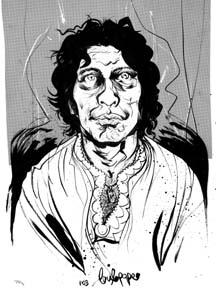
Tim DeLaughter is the cheerful mastermind behind THE POLYPHONIC SPREE, the world’s best happiest symphonic pop band. Ornate on record and staggering live, the grand tradition of Texas psychedelia has never sounded so ecstatic—or tasted so sweet. Text by Gabe Soria. Illustration by Paul Pope.
Originally published in Arthur No. 3 (March, 2003)
“This is going to be fun,” says the impish man with the curly black hair. He’s dressed in a flowing white robe, and he chuckles. The crowd titters in agreement. Then, like the thunderclap before a sudden and wonderful summer rainstorm, a firecracker burst of a drum roll breaks the anticipatory silence and the band behind and besides the man kicks in, and the choir behind them starts boogeying and the hairs on the back of your neck are standing up because for all intents and purposes you feel like you’re rocketing down the first drop of the world’s best wooden roller coaster, full of terror and elation, brimming with the beauty and potential of life, coupled with a stirring acknowledgment of its sadness and inevitable mortality.
“This is gonna be fun,” said the man in the white robe, and he wasn’t telling tales out of school. The band—the French horn player, the trombonist, the harpist, the flautist, the drummer, the ten person choir, and so on—are, like the singer, dressed in matching white robes, and although they’re only two songs into their set at the second anniversary of Dallas’ Good Records store, you can hear that they’re already working up an ecstatic sweat. The audience is besides themselves with excitement. And then the defiant simplicity of the song’s main refrain, almost like a school yard chant, comes in:
“You gotta be good!
“You gotta be strong!
“You gotta be two thousand places at once!”
And by the time the song winds down, the entire audience will be chanting along, singing with the band, hands in the air, beaming, beatific smiles on their faces. And the only people enjoying it more than the folks watching are the band themselves, all two dozen of them looking like they’re fit to burst from elation. That is what watching the Polyphonic Spree live is like. It’s the type of thing that makes you raise your hands up and say “Yeah!” while joyous tears of hope and fear brim at your eyes.
“So… how was your day?” I ask.
“Today was… wow,” laughs Polyphonic Spree ringmaster Tim DeLaughter, 37, over the phone from Dallas. He excuses himself from his dinner companions – he explains that the maelstrom of noise and chatter in the background is simply the sound of what seems to be his hometown’s busiest Tex-Mex restaurant – and walks outside to continue our conversation in relative silence. And this isn’t the first time he’s going to say that word, that “wow”. It peppers his speech liberally, and the way he wraps his soda-pop sweet Texas accent (it splits the difference aw-shucks good-ol’ boy and cosmic space cowboy) around it, it’s given its due as the English language’s best shorthand for awe and amazement. This fella (and his band) have got a lot of time for the wonder and the glory in this terrible and grim world and he wears it on his sleeve.
Originally published in Arthur No. 2 (December, 2002)
Pulp sci-fi author Jeff Lint has loomed large as an influence on my own work since I found a scarred copy of I Blame Ferns in a Charing Cross basement, an apparently baffled chef staring from the cover. After that I hunted down all the Lint stuff I could find and became a connoisseur of the subtly varying blank stares of booksellers throughout the world.
Born in Chicago in 1929, Jeff (or Jack) Lint submitted his first story to the pulps during a childhood spent in Santa Fe. His first published effort appeared in a wartime edition of Amazing Stories because Lint submitted it under the name “Isaac Asimov.” “And Your Point Is?” tells the story of an unpopularly calm tramp who is pelted every day with rocks, from which he slowly builds a fine house. The story already reflected the notion of ‘effortless incitement’ which Lint would practice as an adult. “Jack was fantastic,” says friend Tony Fleece. “Went around blessing people – knew it was the most annoying thing he could do. A dozen times, strangers just beat the hell out of him.” Lint perfected the technique when he stumbled upon the notion of praying for people.
Lint’s first novel was published by Dean Rodence’s Never company in New York. The relationship between Rodence and Lint was one of complete mistrust, rage and bloody violence. When submitting work in person, Lint insisted on appearing dressed as some kind of majorette. “He was a large man and clearly wasn’t happy at having to do this,” explains Fleece. “He blamed Rodence, was resentful. I still don’t know where he got the idea he had to dress that way when handing his stuff in.”
The first novel with Never was One Less Person Lying, in which Billy Stem must tell the truth or be transformed into the average man. Rodence persuaded Lint to change the title word ‘Person’ to ‘Bastard.’ On a night of pre-press jitters, Rodence then partially re-wrote the final sections of the book so that Stem puts on a spacesuit and goes berserk, killing an innocent stranger with a large rock. The book was published as simply One Less Bastard. In the 25 years of their association Lint never forgave Rodence for the incident, and often alluded to it by repeated use of the word “bastard” when speaking to him.
Around the time of his second published novel Cheerful When Blamed, Lint met his first wife Madeline, who was attracted to him by a knife scar which led from below his left eye to his mouth. This was in fact a sleep crease and Lint managed to maintain the mistake by napping through most of the marriage. But after five months a bout of insomnia put paid to the relationship and left Lint with nothing to occupy his time but his writing–luckily for the world of literature, as he produced some of his best work at this time, including Jelly Result, Nose Furnace, Slogan Love and I Eat Fog, all of which appeared on Rodence’s new Furtive Labors imprint. Turn Me Into a Parrot took issue with the fundamentalist notion that the world was only a few thousand years old and that dinosaur bones had been planted by god to test man¹s faith. Lint asserted that the world was only sixty years old and that the mischievous god had buried sewers, unexploded bombs and billions of people. In my own book Shamanspace I make it clear that humanity arrived eons ago but, like a man standing in front of an open fridge, has forgotten why.
She died on Thursday May 15. Complications from heart valve replacement surgery were the cause; that, and being without oxygen too long, whereby her loved ones were forced to take her off life support. My adopted hometown went into deep mourning. The following Sunday, I sat beside my new husband on our beat-up sofa in Nashville, watching Channel 5 broadcast the funeral of June Carter Cash from the First Baptist Church in Hendersonville, just up Gallatin Road and through two townships from where we sat holding hands at home.
The place was packed with fans, friends and the famous–from Sheryl Crow to Jane Seymour to Larry Gatlin, all of whom spoke or performed during the sometimes moving, sometimes bizarre open mic portions of the service. A mad crush of flowers dressed the altars, the backdrop to the speaker’s podium, and flanked the blue coffin wherein lay the 73-year-old body of June Carter Cash. After the funeral, I read that her children asked that flowers be sent in lieu of donations, for their mother had loved them so. I wondered if the coffin color was what the family knew as “June-blue,” self named for her favorite shade.
Johnny sat in the front row, in a wheelchair, not walking the line, but kinda broke-down, untethered; an American icon wholly human before us. Seeing him so made me squeeze my own husband’s hand harder. June and Johnny, married to one another for 35 years, found each in the other a soul mate in mid-life. Theirs is neither fable nor fiction, but fated love story for the ages. And that love first fettered then unfurled, became June’s greatest art, midwifing her most enduring and exponentially regenerative acts of faith; faith in God, faith in man, faith in big beautiful bittersweet Life, and in the salvation that comes from belonging.
Well practiced in the womanly art of community building, June Carter Cash was one of the faces of radical feminism in my book. Not unlike choices made by women the world over–from my mother to my best girlfriend, to Patti Smith post-Mapelthorpe and prior to her husband’s untimely departure from this world– June mindfully feathered her nest, made welcome what came, and enlarged the circle by choosing home and family, (both blood and chosen) as the focus for her spotlight. Not the choice for all, but a valid and deeply beautiful choice for her, June Carter Cash lived in a way that inspires women to follow their hearts, making choices that suit them and their get, rather than buying into received opinion of shoulds and should nots. June had the strength and the intelligence, the warmth and the gumption to go on ahead and embrace her greatest gift–that of being the glue, that of being the magic.
She was a female familial icon of continually shifting status: born into the First Family of Country Music as daughter of Maybelle, sister of Anita and Helen; married into Legend as wife of Johnny and mother to seven children, a family of both fame and of infamy. (That next generation is smattering of yours, mine and ours, including musicians Carlene Carter, John Carter Cash and Rosanne Cash, the latter of whom told all in her elegantly gracious eulogy for June, that while the elder Cash–who refused to preface daughter with “step”–hadn’t given her physical birth, she’d nonetheless helped to birth her future). None of these is the lead role; all are defined by their interrelationships. In this web of interdependence that revolved and spun near and around her, June played an integral supporting role. The sum of the parts she played are enough to populate that proverbial village we hear so much about–the one it takes to raise a child, or a rock star (same difference…), or anchor a Family Fold. She played each role with gusto, with grace, with joy.
None of which is to deny her individuality; it is in fact to her credit that she found her own voice and self at all–surrounded as she was, June could easily have gotten by standing on the shoulders of giants. She was always a unique figure, an attention-getter. If one Carter Sister had the looks and one had the voice, June had the personality. She was the fun one. She threw off enough sparks to catch the attention of Elvis–never at a loss for female attentions–in their tent-show days. She was a good actress, a protege of Elia Kazan; her talent flowed from her strong sense of self, her confidence. Latter day appearances in fare like Robert Duvall’s The Apostle more than testify to this. Her comic timing was flawless— from her first bit as a kid walking on stage with a plank (looking for her room; she had her board) to her send up of “Baby It’s Cold Outside” with Homer and Jethro, to her deliciously kooky warble and pointed delivery of “Tiffany Anastasia Lowe” on the Grammy-winning solo album Press On.
A critical success in 1999, Press On is the musical autobiography of a remarkable woman spanning a remarkable set of circumstances for the better part of the last century, a remarkable time in and of itself. Reissued only last month by Dualtone, setting the stage for a September follow-up, Press On bookends itself with Carter tunes and carries within its grooves June’s take on her very own “Ring Of Fire.” One of the most enduring and affecting country songs ever (even if it was most likely the afterthought conqueso horns that boosted it up the charts for the Man In Black), “Ring of Fire” is a nugget of gut-wrenching poetry on the allure of dangerous love. The fact that Johnny was its inspiration, and that the songwriter not only married him but saved him from himself in the process, is a twist of sweet justice.
As June always told it, and was oft recorded saying, for her there were only two kinds of people in the world: the ones she knew and loved, and the ones she didn’t know. And loved.
When at the funeral, Rosanne stood to read her beautiful words, she spoke what everyone had on their minds— that her father, Johnny Cash, had lost his anchor, his dearest companion. To my mind, had we never known June’s radio shows, films, records or books, we’d have known of the love she’d shared with this man, and that in and of itself would have been more than enough. It’d been salvation, in some small way, to all who witnessed it. What greater gift, than to be the glue, to be the magic?
Thank you, Valerie June Carter Cash. Thank you for giving us artful aspiration of kith and kin. We should all be so blessed, to be somebody’s glue, somebody’s magic.
You will be remembered fondly and often, as we all press on.
Paige La Grone Babcock lives in Nashville, Tennessee with her husband Eric.
“What God hates most is arrogance. And what I see in the United States is sheer arrogance.”
Mullah Anar M. Anif, Peshawar, Pakistan, April 2002
“Chap in a dishdash coming through.”
British officer in Iraq, March 2003
BLOOD RUNS DOWN the camera lens. The American plane has shot up a column of Kurds, US Special Forces and a BBC TV crew. “A scene from hell,” says journalist John Simpson, whose interpreter has just been killed. Some of the footage, sans the blood, is shown on American network TV for a few seconds. Most of these scenes from hell, of course, are not filmed. They are happening to people who don’t own video cameras.
Sitting here in Texas watching BBC TV on my computer reminds me that there is no film from Amritsar except the fictional reconstruction offered in Richard Attenborough’s Gandhi. That hypocritical piece of imperial self-serving posed as an authentic account. The massacre was portrayed as an aberration rather than the norm. I also start thinking of Lawrence of Arabia, David Lean’s powerful piece of romanticized imperial history. I recall how disgusted I was by Attenborough’s other essay into whitewashing middle-class liberal sensibilities, Cry, Freedom, about the murder of Steve Bitko in South Africa. The British are good at this kind of misleading sentimentality. They’re subtler than Americans who crudely rewrite history to show themselves or versions of themselves as simple heroes, whether it’s Errol Flynn single-handedly ‘liberating’ Burma in WW2, Mel Gibson defeating the British in The Patriot, Mel Gibson pretending to be a Norman baron gone native in Braveheart, the falsifications of Blackhawk Down, or Americans (rather than British) discovering how to beat the Germans with the Enigma machine. The British are ultimately more persuasive, I suspect. They’ve had more practice at this kind of patriotic propaganda than the Americans, by and large. Everyone’s learned from Goebbels, whether they know it or not, of course.
“Chap in a dishdash…”
Dishdash?
Those of us still alert to the language of Empire remember the teenage soldiers coming home to Britain to tell stories of the tricks they played on brown civilians across the globe in the 1940s and 50s as the British slowly gave ground to angry freedom fighters in, for instance, Burma, Malaya, Kenya, Palestine and Cyprus.
Dishdash.
I’d forgotten about dishdash, which in the language of British imperialism is used as a generic for almost any Middle Eastern garment, though I hadn’t forgotten about ‘imshi’, for instance. I’ve written a bit about British colonial occupations in, my book Breakfast in the Ruins (available free on the net at RevolutionSF off the SF Site, if you’re interested). My book A Nomad of the Time Streams also dealt with the idealism of Empire and how it gets decent people to do its dirty work (that isn’t free, but it’s pretty cheap, second hand). All my writing life, in fact, I’ve been addressing the matter of Empire and I’d rather hoped I was seeing the end of that particular aggressive folly…
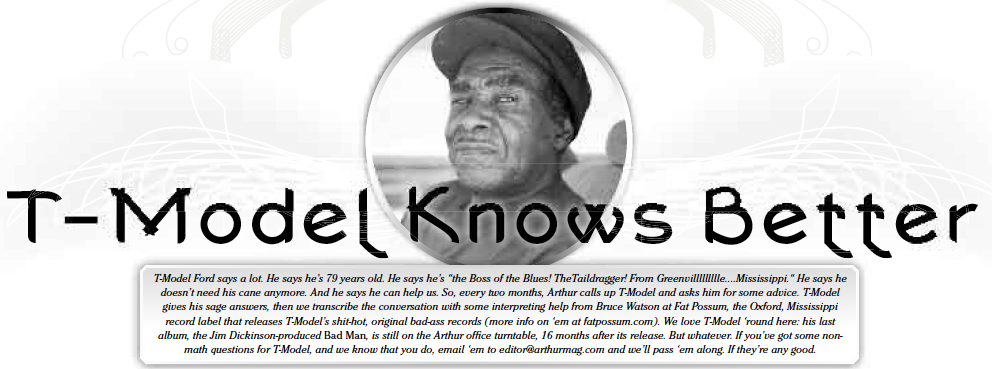
T-Model Ford says a lot. He says he’s 79 years old. He says he’s “the Boss of the Blues! The Taildragger! From Greenvillllllllle….Mississippi!“ He says he doesn’t need his cane anymore. And he says he can help us. So, every two months, an Arthur staffer calls T-Model and asks him about certain topics of the day. T-Model gives his answers over the phone, then we transcribe the conversation, with some help from Bruce Watson at Fat Possum, the Oxford, Mississippi record label that releases T-Model’s amazing albums. If you have any non-math questions for T-Model, and we suspect that you do, email them to editorial@arthurmag.com
Public school or private school? What about home schooling? Are the schools good enough for the kids these days?
Well, regular schools is good enough for ‘em. I wouldn’t put ’em in no private school. Nuh unh. It cause a whole lot of problems. But just regular school, that’d be the best, cuz it give ‘em a whole chance to meet one another and get trained with one another, get used to one another. You put ‘em in a private school, then when they get up a little higher, they don’t wanna act right.
You take me, I never been to school a day in my life. I ain’t never been to school. I had a mean daddy, he didn’t let me go to school. He started me to plowin’ a mule when I got to six years old. And I worked all of my life since then up until say somewhere about 10 years ago. I fell and hurt myself, knocked my hip out of place on a job I was workin’ for Greenville Head & Block… I didn’t tell nobody and I just kept on workin’. Finally though it overtook me.
You wanted to go to school?
He wouldn’t let me go to school. I had to do what he said to do or else get a beating. After he was so tough and mean to me, I just forgot about going to school. I didn’t think I’d ever learn anything, not in school. But he did learn me how to work and provide for myself. He learnt me that! But as far as readin’ and writin’, I can’t do it.
You’ve done pretty good for someone who didn’t go to school, don’t you think?
I don’t know. I can’t tell that cuz I never had a chance to read or be in nothin’ in the schools, or be around children going to school, so… I don’t know what I lost. But I lost something. So far, as far as I done, as old as I done got, I know a heap but I just can’t read and write.
Why wouldn’t you put a child in a private school?
Well when you get where you wouldn’t be around to carry them to private school, or for them to be in school…? I just think, really, the public school—he can go with anybody. He can visit anybody. With that private school, he can’t be with everybody cuz he don’t know if his parents are gonna have a ride for him to go, or if he’ll be where he can catch the bus to go. And he gon’ miss some. And he ain’t gonna get all what he needs to get.
What about these people who want to teach reading and writing themselves? Teach their kids at home?
Welllllll… I was at home but I didn’t have anybody teach me nothin’! So, it’s pretty hard for me to say about that, cuz’n I don’t know.
Okay. Here’s the other question. A lot of our readers are pretty unhappy with living in the United States. They don’t like the politics. The economy is bad. It’s hard to find a job. Some of them are thinking about leaving. Where should they go? If you had to live somewhere besides the United States, where would you live?
Well, I would like Switzerland. And I would like France. Over there it look like the people are more friendly to one another than they do here. They’re not friendly [here]. It’s done got really rough. Peoples live here, they’re not friendly with one another. I don’t know what’s the causin’ of it, but they really ain’t friendly. All they know is go to somebody’s house and talk about somebody, low-rate somebody, mis-use people’s who try to help you. You don’t want that! They wanna do’s it… You helping them, they wanna be against you, do you wrong and all like that. You’ve got to have a heart to stand up to all to that kind of mess. Now I’ve got a heart to stand up and…. They do me like they wanna! And I still try to help ‘em. I’m in a situation right now, I help the woman I’ve been with six years, and it’s the other way now. They’s stealing from one another… It’s rough.
But it seems different in Switzerland and France, they treat each other different?
There, everybody’s happy. As far as I can see, they friendly, they stick together. But here they don’t. Yeah, if I was gonna go somewhere to stay as long as I live, I’d go to either one of them places…or I would go to Sweden.
T-Model Ford says a lot. He says he’s 79 years old. He says he’s “the Boss of the Blues! The Taildragger! From Greenvillllllllle….Mississippi!“ He says he doesn’t need his cane anymore. And he says he can help us. So, every two months, an Arthur staffer calls T-Model and asks him about certain topics of the day. T-Model gives his answers over the phone, then we transcribe the conversation with some help from Bruce Watson at Fat Possum, the Oxford, Mississippi record label that releases T-Model’s one-of-a-kind blues albums (more info on ‘em at fatpossum.com). If you have any non-geography questions for T-Model, and we suspect that you do, email them to editorial@arthurmag.com
Arthur: T-Model one of our readers wrote in and said, “I’m worried about one of my longtime friends. He’s been hanging out with this woman who I know smokes crack. I’m afraid he’s going to start smoking crack too. What should I do?”
T-Model Ford: Well, be worried. If you like him, and he in it, best for you to stay away from him much as you can. Cuz you’ll get in trouble. You’ll be doin’ what he be doin’, or what the othern’ doin’. That crack helped cause a-many young people to mess up. I don’t know what it do, but some I hear say it mess the brains up. It must do somethin’ ‘cos they all want to fool with it. They wild, they don’t do right. They stay in trouble, meddlin’, breakin’ in, fightin’, do anything. I never seen none of it when [I was a young man], and I ain’t never smoked none of it. Now I done quit smokin’…quit about 20 years… I wouldn’t smoke another cigarette. Ain’t got no feeling for it. And I do good and I feeeel good. As old a man as I is, I’m still gettin’ up and goin’.
How can you tell when someone is on crack?
I seen some of ‘em since they done got way in it. Everywhere that smokin’ that crack got a good thing going, it breaks it up. Greenville looks like a ghost town now. You don’t see nothin’ hanging around. That crack? I hate to even see anybody smoking that mess. They don’t look right, they don’t act right. They look wild and stupid. If anybody smoke it, you can tell it. In the way they acts. Get on away from ‘em.
Is there anyway to get ‘em someone off of crack who‘s already in it?
Not hardly. Not ‘til they get in enough of a mess, then they have to get out of trouble.
Okay. Next question. One of our older readers writes in to say, “Dear T-Model, I thought I was a good father, my wife and I have been very loving, we have a beautiful daughter, she’s 15 years old, but we’re worried that she’s started to have sex.”
Uh-ohhhhh.
“She hasn’t admitted it to us, but we think it’s happening. We don’t know what to do. Should we leave her alone?”
Yes. Leave her alone. Cause next thing she’ll start sassin’ you, blessin’ YOU out, tellin’ you what you can’t do! What SHE can do! “I’m grown, I can do what I wanna do.” Blowin’ back. First thing you wanna hearin’. Seem you can’t raise your children now. You have to let ‘em go til they get their selves in trouble or mess up. Then they go to see anybody, but it be too late. They all do.
Is there a way for these parents to tell if their daughter is having sex? Can you tell?
Yeah, you can tell. Watch the breasts. They get sassy and nasty and … Once it get started, then let ‘em get their own place to stay. That’ll whoop ‘em quicker than anything! That’s right. They’ll find out they can’t. That a home’s where they at. It’s somethin’ else. You wanna go and get out like that, remember one thing gets turned over to the Good Lord. Ever where she head, let her go. She get into somethin’, don’t get her out, let her get out the hard way. Once she get out, she’ll make something out of herself.
A reader in his late teens writes, “Dear T-Model, I gotta buy a new car. I’m just drivin’ around town. I don’t need a truck. What should I look for? You got any suggestions on what kind of car I should get?”
If you gon’ do that, just to ride around in, find you an old model. The Lincoln, if it’s in good shape when you get it, take care of it, keep the oil changed and filter changed, and it’ll last a loooong time. Or a good Chevrolet or a good Ford or a good Buick.
You like those American cars.
Yes indeed. They all been good to me. They go longer. They last longer. And I had good safeties out of ‘em. I love ‘em. I got a ‘79 Lincoln here. It’s an antique, I want to buy an antique tag for it. It look good right now. Everybody’s trying to buy it. They want me to sell it. I told ‘em, It ain’t for sale. But still they want it. They like it.
Now, you know how to fix cars, right?
Well I can but I’m not able now, I done got broke up by that limb. Tree fell on me and I can’t get around. Before that tree fell on me, I’d work on and build motors and everything.
How did you learn how to do all that?
Go ‘round where people workin‘, and WATCH em. Watch em. I can’t read and write, can’t spell nothin’… but I never did carry my car to the shop.


 Arthur Magazine