ON DISPROVING A NEGATIVE…

FROM THE NEW YORK TIMES:

SADDAM’S SWAN SONG

Iraq Makes a Philosophically Flawed Effort to Disprove a Negative

By EMILY EAKIN

How many pages does it take to prove a negative? Iraq is hoping 12,000 might do the trick. That, roughly,
is the number of pages in the declaration it turned over to the United Nations in a last-ditch effort to convince the world that it has no weapons of mass destruction. For the moment, the United Nations and the United States are playing along, scouring the document page by page last week for signs that Iraq is lying or fudging the truth.

    But while the exercise may make for good politics, as a philosophical proposition
it is arguably deeply flawed. In fact, some scholars would say the task
the world has assigned Iraq ˜ to prove it has no weapons of mass destruction
˜ is logically impossible.


    The problem
is not, as is frequently assumed, that proving a negative simply can’t
be done.


    “If I
say I have no coins in my pocket, you can just search me,” said Colin McGinn,
a professor of philosophy at Rutgers University, pointing out that people
verify modest negative statements all the time with little difficulty.


    But philosophically
speaking, there’s a big difference between claiming there are no coins
in your pocket and claiming there are no coins in the pockets of New Yorkers,
or, more to the point, no weapons of mass destruction anywhere in the nearly
170,000 square miles that make up the state of Iraq.


    As the
scope of the claim grows, so do the number of philosophical objections
and practical obstacles to proving it. This is where the work of the 18th-century
Scottish philosopher David Hume comes in. In a dazzling insight that changed
the course of Western philosophy, Hume demonstrated that the common practice
of induction (inferring general rules from particular observations) is
inherently circular and unreliable.


    Philosophers
like to explain Hume’s argument using swans. Ronald J. Allen, a law professor
and evidence expert at Northwestern University, put it this way: “Suppose
somebody claims all the swans are white. He says, `I’ll prove it to you.’
He takes you to the zoo, and there are 20 swans there, all white. Well,
he’s merely showing you a finite set of swans. This can’t establish that
all swans are white.”

    Because
no one can ever observe all the swans in the world, but only particular
groups of swans, according to Hume it would be logically indefensible to
conclude that all swans are white no matter how reasonable such an inference
seems.


    This
same difficulty arises in trying to prove some large-scope negatives, Mr.
Allen points out. “Suppose you assert that there are no black swans,” he
said. “You’d have to produce all the swans in the world to show there are
no black ones” ˜ an impossible undertaking.


    This,
he said, is the situation faced by Iraq. “You can see the perversity of
it,” Mr. Allen said. “The Iraqis have to show that there’s no state of
the universe inconsistent with the statement that they have no weapons
of mass destruction.”

IF Mr. Allen is right, weapons
inspections that turn up nothing, and a 12,000-page declaration that discloses
no violations, are of extremely limited value. Like groups of white swans,
they might tell us something particular but nothing general. They certainly
don’t prove anything about Iraq’s claim that it possesses no weapons of
mass destruction.


    Of course,
it is possible to argue that Iraq’s situation more closely resembles Mr.
McGinn’s single pocket example (a small-scope, easily verified negative)
than it does Mr. Allen’s black swan example (a large-scope, unverifiable
negative).


    “Iraq
is big, but not that big,” said Simon Blackburn, a professor of philosophy
at Cambridge University and a leading authority on Hume. “There is no more
difficulty to prove there are no weapons of mass destruction than to prove
there’s no rhinoceros in my sitting room.”

    But other
scholars concede that the burden of proof placed on Iraq by the United
Nations is so great that no amount of evidence is likely to suffice. The
Bush administration has often spoken of Iraq’s intention to acquire weapons
of mass destruction, said Brian Leiter, a professor of law and philosophy
at the University of Texas at Austin. Once intention becomes a factor,
he said, Iraq’s situation begins to look more and more like the black swan
problem ˜ an unverifiable negative.


    “I’m
willing to venture it’s impossible for anyone to prove they don’t have
the intention to do something,” he said, adding that placing such a burden
on an American criminal defendant ˜ who, unlike Iraq, is guaranteed a presumption
of innocence ˜ would be unthinkable.


    If Iraq’s
task is demonstrably impossible, on what basis can it be justified? Ultimately,
the best defense may hinge not on logic or law but on more nebulous concepts
like experience and common sense.


    “The
thing we’re asking them to prove, whether you put it positively or negatively,
is so extremely hard to prove that we’re almost rigging the outcome by
the way we put the question,” said Laurence H. Tribe, the Harvard professor
of constitutional law. “But it doesn’t follow that we’re acting in a way
that’s contrary to all our conventional jurisprudential principles.”

CITING Iraq’s past use of
weapons of mass destruction and long record of duplicity on the issue,
Mr. Tribe argued that “we’re acting in a preventative mode where we’re
not prepared as an international community to take the risk that potential
mass destruction will go uncontrolled.”


    That’s
a statement that Hume might have found perfectly reasonable. A practical
man, he realized that in the absence of certain knowledge, experience and
common sense are often the best guides to judgment. The danger arises when
fallible human judgments are confused with truth.

    In the
end, Hume argued, the inevitable uncertainty of knowledge requires, in
response, a rigorous policy of “mitigated skepticism” ˜ the constant application
of “a degree of doubt, and caution, and modesty, which, in all kinds of
scrutiny and decision, ought for ever to accompany a just reasoner.”

“Researchers map brain areas that process tunes”

http://www.dartmouth.edu/~news/releases/dec02/melodies.shtml

MELODIES IN YOUR MIND

Researchers map brain areas that process tunes

HANOVER, N.H. ˆ Researchers
at Dartmouth are getting closer to understanding how some melodies have
a tendency to stick in your head or why hearing a particular song can bring
back a high school dance. They have found and mapped the area in your brain
that processes and tracks music. It‚s a place that‚s also active during
reasoning and memory retrieval.

The study by Petr Janata,
Research Assistant Professor at Dartmouth‚s Center for Cognitive Neuroscience,
and his colleagues is reported in the Dec. 13, 2002, issue of Science.
Their results indicate that knowledge about the harmonic relationships
of music is maintained in the rostromedial prefrontal cortex, which is
centrally located, right behind your forehead. This region is connected
to, but different from, the temporal lobe, which is involved in more basic
sound processing.

——————————————————————————–

The orange and red area indicates
where Janata and his collegues tracked and mapped musical processing in
the brain. The blue and purple areas are also processing music, but these
areas did not track the harmonic changes as consistently as the red and
orange areas.


——————————————————————————–

„This region in the front
of the brain where we mapped musical activity,‰ says Janata, „is important
for a number of functions, like assimilating information that is important
to one’s self, or mediating interactions between emotional and non-emotional
information. Our results provide a stronger foundation for explaining the
link between music, emotion and the brain.‰

Using functional magnetic
resonance imaging (fMRI) experiments, the researchers asked their eight
subjects, who all had some degree of musical experience, to listen to a
piece of original music. The eight-minute melody, composed by Jeffrey Birk,
Dartmouth class of ‚02, when he was a student, moves through all 24 major
and minor keys. The music was specifically crafted to shift in particular
ways between and around the different keys. These relationships between
the keys, representative of Western music, create a geometric pattern that
is donut shaped, which is called a torus.

„The piece of music moves
around on the surface of the torus, so we had to figure out a way to pick
out brain areas that were sensitive to the harmonic motion of the melody,‰
explains Janata. „We developed two different tasks for our subjects to
perform. We then constructed a statistical model that separated brain activation
due to performing the tasks from the activation that arose from the melody
moving around on the torus, independent of the tasks. It was a way to find
the pure representation of the underlying musical structure in the brain.‰

The two tasks involved 1.)
asking subjects to identify an embedded test tone that would pop out in
some keys but blend into other keys, and 2.) asking subjects to detect
sounds that were played by a flute-like instrument rather than the clarinet-like
instrument that prevailed in the music. As the subjects performed the tasks,
the fMRI scanner provided detailed pictures of brain activity. The researchers
compared where the activation was on the donut from moment to moment with
the fluctuations they recorded in all regions of the brain. Only the rostromedial
prefrontal area reliably tracked the fluctuations on the donut in all the
subjects, therefore, the researchers concluded, this area maintains a map
of the music.

„Music is such a sought-after
stimulus,‰ says Janata. „It‚s not necessary for human survival, yet something
inside us craves it. I think this research helps us understand that craving
a little bit more.‰

Not only did the researchers
find and map the areas in the brain that track melodies, they also found
that the exact mapping varies from session to session in each subject.
This suggests that the map is maintained as a changing or dynamic topography.
In other words, each time the subject hears the melody, the same neural
circuit tracks it slightly differently. This dynamic map may be the key
to understanding why a piece of music might elicit a certain behavior one
time, like dancing, and something different another time, like smiling
when remembering a dance.

Janata adds, „Distributed
and dynamic mapping representations have been proposed by other neuroscientists,
and, as far as we know, ours is the first paper to provide empirical evidence
for this type of organizational principle in humans.‰

Scott Timberg on Andrea Zittel

FROM LOS ANGELES TIMES:

All alone, creating a world

In the desert, Andrea Zittel lives her art: isolated existence as voyeuristic experience.

By Scott Timberg, Times Staff Writer

Andrea Zittel is a shy, private person whose art invites, even demands, an almost voyeuristic attention
to her life. As a young artist in New York in the early ’90s, she was surrounded by eccentrics with daring lifestyles, but the art they produced was often ordinary.


    “I just realized, over and over, that I was more interested in people’s lives than I was in their work,” says the tall, rail-thin Zittel, 37, naming several now-forgotten artists whose lives still compel her attention. “It’s all of those weird human idiosyncrasies.”

    Zittel has taken her own idiosyncrasies, and her angst over isolation and community, individualism and escape, and built a lively career in contemporary art. She lives her art to a nearly literal degree.

    Her latest chapter is outside Joshua Tree — a homesteader’s cabin from the 1930s remade into a kind of high-desert Case Study House, the post-World War II homes built for middle-class futuristic living. She’s surrounded it with metal plates, mounted on posts and filled with reconstituted paper she has pulped and dried in the sun. The refried paper, improbably, resembles travertine marble. Spilling in eerie geometric intervals down the desert floor outside the house, the drying racks look as if they were left by
a benign alien visitor. And she’s just completed the latest phase of her Uniforms project, in which she makes her own clothing from felt and, in an exaggerated back-to-the-land gesture, wears a single “uniform” for six months at a time.


    Zittel calls the whole setup a High Desert Test Site. There’s a lot of terminology to Zittel: The Joshua Tree house, which is down the street from one of the town’s many bail bonds shops, is called A-Z West, to distinguish it from her Brooklyn apartment-studio known as A-Z East. Even the initials have a hidden meaning: She broke up with a serious boyfriend, she says, because she couldn’t “A to Z,” or organize, this big, messy guy. In the late ’90s, she made everything she lived in, from her kitchen to her couch;
she called the project “Raugh,” which is pronounced “raw.” The 25 scorched acres Zittel lives on, and her clothes and desk and conflicted feelings, are her artwork. A new show at Regen Projects — which includes felt dresses and metal panels of pulped paper — illuminates some of it, as do the weekend
open houses she’s holding in the desert in lieu of an art opening.


    Although most desert art is about the beauty of nature, Zittel’s work is about the strangeness, and the possibilities, of culture. A utopian from the suburbs — Le Corbusier with a Valley Girl accent — she’s creating what the Swiss architect called a “machine for living” on the high desert. She’s like the lonely, dreamy kid who makes up an imaginary world. But this world is real.

Fear of growth

When Zittel was a child, the daughter of schoolteachers, her chaparral-lined street in Escondido
was empty except for one other house. By high school, she was surrounded
by tract housing, a supermarket and bulldozers. “Pretty weird,” she says,
looking back. “Growing up in a community that’s growing so rapidly really
instilled a fear of growth. You have no control over it at all. I think
I wanted a place small enough that I could have some control over the way
the entire community developed.”


    Even early on, she was fascinated by isolation, and some of her best childhood
memories involve being left alone, with food in the freezer, when her family
went away for weeks at a time on a 31-foot houseboat. She describes her
childhood as alienated, a situation made no better by four aimless, intellectually
barren years at San Diego State — one long frat party, she calls it, which
she had no interest in attending.


    Then one day a college field trip took her to MOCA’s Temporary Contemporary,
for a show by Al Ruppersberg. “He had these photographs of people sitting
on couches,” she says, her eyes widening as she remembers realizing that
something so commonplace could be art. Bitten by the art bug, she headed
after graduation to the prestigious Rhode Island School of Design, where
she majored in sculpture.


    Though it expanded her sense of possibility, art school also left her, upon graduation
in 1990, completely dazed. “I went to New York not knowing what art was,”
she says. Whatever it was, she wanted to stretch its boundaries.


    Her first major project was breeding animals. “I was trying to design my own breed
of chickens, after discovering that domestic breeds were invented over
the last 100 years; I just wanted to show what constructions they were,”
she says with a laugh. “I jokingly referred to it as the designer pet of
the ’90s — like pot-bellied pigs in the ’80s or miniature horses in the
’70s.”


    Her bantam
chickens, a less spectacular batch than she’d hoped because of recessive
genes, never caught on. But one of the breeding units she made, to give
the animals some privacy in a Manhattan gallery, ended up in the collection
of MOCA. “I gave another one to the bodega next door,” she says, “and they
used it as a microwave stand.”

    Her interest
in living things, and the way their lives can be shaped — through Darwinian
or utopian principals — fed into her later work with human environments.
The breeding units became living units.


    In the
mid-’90s, she used a grant from the Danish government to construct and
live on a 54-ton cement island in a Scandinavian sea. “It was like a prototype
for a way somebody could live in the future,” she says. “Your land, your
dwelling and your vehicle all in one unit.”


    During
the two years of construction, she looked forward to the isolation of island
living. “And then what happened was that every Danish guy who has access
to a boat bought a six-pack and circled the island — drank their beer
and waved. I felt like a circus freak.” Finally, the structure sprang a
leak that acted like a blowhole, spurting cold water high into the air.


    Zittel
also spent two yearlong stints on fellowship in Berlin, where she was fired
by the ideas of European Modernists such as Walter Gropius and Le Corbusier,
and the way they worked themselves out in suburban California culture.


    “Like
Price Club and tract housing,” Zittel says. “Bauhaus was about quality
goods available for all at an affordable price. Well, Price Club’s kind
of like that.” She began to build travel trailers as a statement about
the suburbanization of the Bauhaus vision, and then two years ago, she
rented out her Brooklyn apartment and moved to the desert edge of her suburban
past, a place, she says, where she could get away from it all.

Furniture as art

When Zittel walks through
A-Z West, she’s one part affectless homeowner — complete with a dog named
Poppy — and one part dead-serious art theorist. She’s proud of her place,
but each time she points out a desk, the kitchen, it launches her into
another whimsical idea. Much of her furniture “cycles through,” as she
puts it, starting as a concept, becoming a piece she lives with, and ending
up in a gallery or museum; this pays her bills and lets her make more work.
Walking outside through the kitchen, she pets Poppy and meanders through
a collision of boulders, yucca plants, creosote bushes and hard desert
floor parched by an 18-month drought.


    She chose Joshua Tree, not far from the home of longtime desert assemblage artist Noah Purifoy, in part because “I’m sort of inspired by his whole project,” she says of his open-air studio-cum-gallery nearby. “He said no museum would collect his work, so he made his own museum.”

    Here, in her frontyard, the rectangles of paper stare sunward. “No one would understand how much, like, drama went into making these,” she says with a laugh as she describes the combinations of cement, water and wheat paste she had to go through to make the panels look right.

    Surveying the rows, she riffs on her vision of farming for art: “Mulching my garbage every day, packing it in these huge trays; it would take about six weeks to dry and then I could just read lots of books and harvest it afterward.”

    “I think of Andrea as the quintessential Californian,” says New York artist Allan McCollum, who was born in L.A. “Andrea isn’t trying to deconstruct Hollywood or Disneyland, she’s actually capturing some of the truly wonderful things about California — the honest, historical optimism, the utopianism and the progressiveness of the state. Andrea embraces this California spirit so arduously, even as she laughs at it and caricatures its excesses.”

    Now she’s putting the ideas of the European avant-garde through their paces at her desert retreat, inviting the world to peek in. She’s becoming famous, oddly, for being private. But her open houses, the last of which is this weekend, are pretty conventional. “Just everybody comes in,” she laughs, “and hangs
out, and we drink beer.”

OH THE FURY…

YNGWIE MALMSTEEN [above, pregnant, with beer and spandex] threatened to kill a fellow passenger on a flight to Tokyo, Japan after the woman poured a glassful of water on the guitarist.

    The passenger, who had no prior contact with Yngwie, allegedly overheard Malmsteen making derogatory comments about homosexuals and decided to show her disapproval by emptying the contents of her glass on the hefty axeman.

    A member of Yngwie’s touring entourage, who was traveling with Malmsteen at the time, had a tape recorder running and managed to catch Yngwie’s reaction on tape immediately after the guitarist was “assaulted” by the offended passenger.

    To download an MP3 file containing Yngwie’s response to the “water attack”, including his now-legendary phrase “You’ve unleashed the fucking fury,” click here (file size: 1.7 MB).

http://www.blabbermouth.net/yngwie_tokyo_flight.mp3

THROUGH A CAT’S EYES.

from October 11, 1999 BBC ONLINE:


By BBC News Online Science
Editor Dr David Whitehouse

These are the first pictures from an extraordinary experiment which has probed what it is like to look
through the eyes of another creature. As reported on BBC News Online last week, a team of US scientists have wired a computer to a cat’s brain and created videos of what the animal was seeing.


    By recording the electrical activity of nerve cells in the thalamus, a region of the brain that receives signals from the eyes, researchers from the University of California at Berkeley were able to view these shapes.

    The team used what they describe as a “linear decoding technique” to convert the signals from the stimulated cells into visual images.

    Dr Yang Dan, Assistant Professor of Neurobiology at UC Berkeley, Fei Li and Garrett Stanley, now Assistant Professor of Biomedical Engineering at Harvard University conducted 11 experiments.

    They recorded the output from 177 brain cells that responded to light and dark in the cat’s field of view.

    In total, the 177 cells were sensitive to a field of view of 6.4 by 6.4 degrees. As the brain cells were stimulated, an image of what the cat saw was reconstructed.

    The first example is a face. Although the reconstructed image is rather fuzzy, it is clearly recognisable as a version of the original scene. It is possible that a clearer image could be obtained by sampling the electrical output of more cells.

    In the cat’s brain, as in ours, the signals from the thalamus cells undergo considerable signal processing in the higher regions of the brain that improve the quality of the image that is perceived.

    Taking an image from a region of the brain before this image enhancement has taken place will result in a poorer image than the cat is able to see.

    The other two examples show two woodland scenes, with tree trunks being the most prominent objects.

    By being able to tap directly into the brain and extract a visual image the researchers have produced a “brain interface” that may one day allow the control of artificial organs and indeed machines by thought alone.

It is also conceivable that, given time, it will be possible to record what one person sees and “play it back” to someone else either as it is happening or at a later date.

A clearer image could be obtained by sampling more cells

COURTESY OF ORI K.!

Jodorowsky:”Failure doesn’t exist.” (The Guardian)

http://film.guardian.co.uk/interview/interviewpages/0,6737,844764,00.html

‘I am not normal’

Alejandro Jodorowsky has made three cult films, writes esoteric sci-fi and claims he will live to
150. Steve
Rose met him

Friday November 22, 2002

The Guardian

Many film-makers have profited from the wild and vivid imagination of Alejandro Jodorowsky, but Jodorowsky himself is not one of them. He has made three classic cult movies – El Topo, The Holy
Mountain
and Santa Sangre – and he has had a significant influence on popular culture over the past 35 years, from Mexican cinema to the making of Alien, the imagery of Marilyn Manson and even the development of mime.

But he hasn’t made a penny out of it.

A Chilean-born Jewish Russian, Jodorowsky has described his films as the equivalent of psychedelic drugs. They mix surrealism, mysticism and warped violence, and have invariably been too esoteric, too pretentious or too graphic for popular consumption. They are, however, filled with unforgettable images: the conquest of Latin America re-enacted by costumed frogs; a circus elephant’s funeral, complete with giant coffin; a master duellist whose weapon is a butterfly net.

    His film-making techniques were similarly unorthodox. He regularly used non-actors he found
on location,
and there are tales of him putting them, and himself, through gruelling experiences for the camera. Rumour has it he would make them drink one another’s blood, film real violence rather than staged and dangle himself off rickety rope bridges in the desert. Allegedly, he even killed 300 rabbits with his bare hands for
one scene.

    Separating truth from fiction, or even the past from the present, has always been a problem with a figure like Jodorowsky. Today – silver-haired, smartly dressed and surrounded by cats in his book-lined
Paris
apartment – he looks every bit the senior artist. However, his contempt for linear thought is undiminished.

    “Listen,” he says. “I can make this interview like a normal person. I am not a normal person. I am living in a normal body, but my mind is not normal. When you speak about my past, I have no past. You see the
person I am now – I am 74. My wife is 37 years younger than me. I don’t feel the difference. My
consciousness is without limits more than when I was 40 or 50. I don’t regret any past. I am not there. I
am not sorry not to make pictures, because I know one day I will do it. I intend to live 150 years.
I am only
in the middle of my life. So when you say what do you think about the past? Nothing! It’s done!”

    This much we do know. Having directed theatre in Chile and studied mime in Paris with Marcel Marceau (for whom he claims to have invented the famous “I’m trapped inside a glass box” routine), Jodorowsky filmed his no-budget 1967 debut, Fando y Lis, from a half-remembered play by his surrealist associate Fernando Arrabal. The film generated censure and death threats in Mexico. But Jodorowsky didn’t come to international attention until two years later when he released El Topo, in which he plays a black-clad gunslinger in search of enlightenment.

    The film was seen by John Lennon, who advised Apple manager Allen Klein to buy the rights to it, and introduced the first screening of it in New York. El Topo became a permanent fixture of late-night hippie
cinema for the rest of the decade and a favourite of the emerging New Hollywood generation, particularly
the likes of Dennis Hopper and Jack Nicholson. Hopper’s ill-fated follow-up to Easy Rider, The Last
Movie,
was inspired by Jodorowsky’s spontaneous, free-ranging methods, as well as his mystical and anthropological concerns.

At one stage, Hopper invited Jodorowsky to his studio in Taos, New Mexico to help him finish the movie.

    “When I see the rushes – not very clear, but some beautiful scenes,” Jodorowsky remembers. “He had a lot of material and six editing machines, but he could not do it. In one or two days I cut it myself, but
I think
Dennis didn’t want another guy making his movie, so he rejected it and made his own. It was not so good. Later I asked him to be in Santa Sangre, and he said no, just like that.”

    Meanwhile, Lennon had persuaded Klein to put up $1m to help Jodorowsky make another film, The Holy Mountain. Like El Topo, it was a spiritual quest, this time following a Christ-like figure (Jodorowsky,
again)
seeking immortality. “El Topo was normal, The Holy Mountain was abnormal. My ambition was enormous. I wanted to make a picture like you would make a holy book, like the Bhagavad Gita or the Tao Te Ching. I went very far.”
    Jodorowsky hired a fashionable guru to prepare him, performing mystical exercises and experimenting with LSD and magic mushrooms (the only time he has taken drugs, he says). He put his cast through a
similar
process, keeping them in a house together for two months and allowing them only four hours’ sleep a night. The result was even more extravagant than El Topo, and although it was never shown in the US, it became an underground hit in Europe.

    Jodorowsky’s
next project was even more ambitious. Over-ambitious, as it turned out:
a $20m


French-financed adaptation
of Frank Herbert’s Dune. An impressive team was assembled. Orson Welles


agreed to take a role, as
did Salvador Dali, who recommended to Jodorowsky a Swiss painter called
HR


Giger for concept designs.
Also on the team were Pink Floyd, French graphic artist Moebius and writer
Dan


O’Bannon. After a year of
preparation, the project fell through. According to Jodorowsky, the Hollywood


producers realised they
could make a similar picture without a wild card like himself at the helm,
and pulled


the plug. Jodorowsky’s disregard
for the sanctity of Herbert’s novel could also have been a factor.


    A few
years later, Hollywood was working on its own version of Dune, with David
Lynch directing.

Meanwhile, Ridley Scott
made Alien with half the crew Jodorowsky had assembled, including Giger
as


creature designer and O’Bannon
as writer. Jodorowsky was left behind. His one triumphant return was


Santa Sangre, made in 1990:
a customarily freakish but more accessible circus horror with echoes of
Tod


Browning and Hitchcock’s
Psycho. There were two more failed projects: an Indian elephant film, Tusk,
and


an unreleased film, The
Rainbow Thief, starring Peter O’Toole (“I hated him; he was the worst person
I ever


met in my life”). [The Rainbow
Thief was in fact released. – Magpie Editor]


    “When
you don’t do something, you shouldn’t think of it as a failure,” says Jodorowsky.
“Failure doesn’t


exist. It’s only a change
of direction.” Now he has turned to the medium of comic books, where his

imagination can run riot
without budgetary constraints. He has several titles on the go, including
an epic


sci-fi series, Incal, with
Moebius, and its offshoot, Metabarons, a sort of delirious, space-age Greek
tragedy.


    There
are plans for a $15m sequel to El Topo, in which Jodorowsky’s friend and
fan, Marilyn Manson, is


expected to star. But raising
capital is difficult for Jodorowsky, and he has no expectations.


    Nor does
he have any bitterness, he says, towards those who have made money from
his ideas. “It’s not


important. What’s important
is to give your ideas to the world if you love the world. My pictures are
a gift. I


am an honest artist.

    “For
me, the goal of art is to heal. I see avant-garde art now – it is all destructive.
But I think to be

avant-garde, you need to
be a saint. That’s why I push my art into therapy. I help people. In the
last six


months, three young people
who were going to commit suicide have told me I saved their lives. That
is


better than making films.”

COURTESY: JOHN C.!

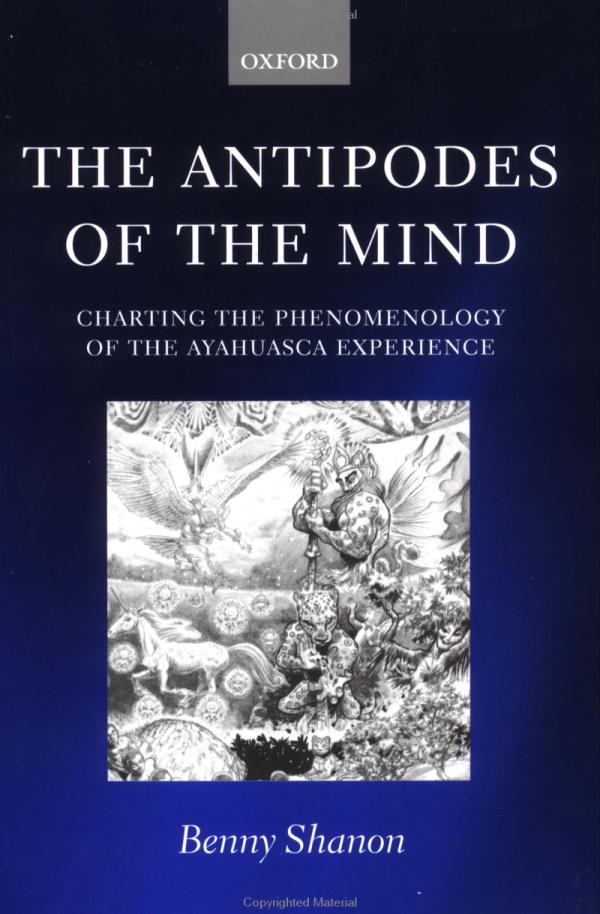
The Antipodes of the Mind – Charting the Phenomenology of the Ayahuasca Experience

from Oxford University Press website:


by Benny Shanon

Professor, Department of
Psychology of the Hebrew University of Jerusalem and holder of the Mandel
Chair in Cognition


Publisher: Oxford University
Press; ISBN: 0199252939; (December 2002)


488 pages, 7 tables and
4 halftones, 234mm x 156mm


order from Amazon.com

A pioneering study of the
phenomenology of the special state of mind induced by Ayahuasca, a plant-based
Amazonian psychotropic brew. The author’s research is based both on extensive
firsthand experiences with Ayahuasca, and on interviews conducted with
a large number of informants coming from different places and backgrounds.

Readership: Anthropologists,
psychologists, students of consciousness, neuropsychologists, psychiatrists
and other clinicians, philosophers and students of religion and of culture,
botanists and ethnobotanists, pharmacologists, physiologists, medical practitioners.

Contents/contributors

Prologue

Preliminaries:General background;
Theoretical foundations; Methodology and general structure


The Phenomenology of the
Ayahuasca Experience;Atmosphere and general effects; Open eye visualizations;
A structural typology of Ayahuasca visualizations; Interaction and narration;
The contents of visions; The themes of visions; Ideas, insights, and reflections;
Non-visual perceptions; Consciousness I; Transformations; Time; Meaning
and semantics; Consciousness II; Light


Theoretical issues:Stages
and order; Contextual considerations; Cognitive parameters; Dynamics; A
general theoretical perspective; Concluding philosophical reflections


Epilogue

Appendix (Quantitative Data)

Bibliography

“LA is a warmup for the apocalypse”

FROM http://www.seanbaby.com/e32001/index.htm:

Above: Beautiful Los Angeles. Inset: A closer look. Not pictured: Tina Turner

LA is a warmup for the apocalypse. There’s not enough water, it’s covered in a dome of toxic smoke, electricity doesn’t work, and a full tank of gas is worth enough to kill a man over.

Gas in LA costs about $98.45 a gallon. Their gas stations don’t even give receipts anymore. When you fill up, an electronic voice laughs at you and prints out a picture of a baby, indicating that you owe them one live human baby. This is different from the system in Brazil where you have to take home one of the attendants’ extra babies every time you fill your tank.

Slowly coming to a stop costs several thousand dollars in gas, so we had the idea to start jumping out of still-moving cabs. Erik broke his head, pelvis, and vagina, but we each saved enough money to get the new LA status symbol — a gas filled tooth.

The LA airport is where all the horrors of LA go after they’ve trained to be the best. But besides the general Mad Max dangers of it, they’ve started insulting people over the loudspeaker. Every four seconds a voice booms, “YOU ARE NOT REQUIRED TO GIVE MONEY TO SOLICITORS. THEIR ACTIONS ARE NOT SPONSORED BY THE AIRPORT.” Who is that announcement for? I know what a fucking solicitor is, airport. Your speaker might as well say, “SOLICITORS ARE NOT ICE CREAM. OR CHOO CHOO TRAINS.” And if somehow there really was someone that stupid in the airport, let the guy doing the announcement leave the microphone and drive behind them in a little cart so he can personally give them advice while they crawl around on their retarded mutant flippers. And while I’m on the subject of taking personal offense at public announcements, why do U2 songs keep telling me not to kill people because of their color? I don’t even do that, you stupid dicks. Sometimes when they come on I scream back at the radio, “Hey Bono, why don’t you stop lighting hitchhikers on fire?” and then change the station to someone who gives less insulting advice like, “You’ve got to Move it! Move it!”

The one thing that sets LA apart from other versions of the apocalypse is that none of their panhandlers
can form words.
Maybe I’m lucky to come from a city where government rats don’t eat the tongues out of sleeping hobos, but I couldn’t understand a thing those mole people were saying. One hari krishna came up to me and said word-for-word, “Smibble moofn moof.”

I pretended to look in a nonsense-to-English dictionary which was actually a novel based on the Super Mario Brothers, and then took a crap in his bucket, normally an eight dollar value. And if you’re reading this from LA, that means I “powdered my nose” in his bucket, pussy. I could tell from the mean look he gave his bucket that I’d broken some sort of airport taboo, or at least misunderstood what “Smibble moofn moof” meant. I’d still rather take shit on an angry hari krishna than in an evil robotic airport toilet, even if that hari krishna was a barrel of alligators….

SEEING EVIDENCE OF A MOTHER CULTURE…


News on Olmec comics from THE NEW YORK TIMES:

(Drawing by Ayax Moreno)
Researchers say symbols from an Olmec Indian site in Mexico, above, date back to 650 B. C., and are the Americas’ earliest forms of writing.

New Evidence of Early Form
of Writing in Mexico


By JOHN NOBLE WILFORD

Centuries before the famously literate Maya, even before the Zapotecs, the Olmecs of ancient Mexico were carving symbols on stone and ceramics 2,600 years ago in what a team of archaeologists thinks is the earliest form of writing ever found in the New World.

    In a report being published today, archaeologists led by Dr. Mary E. D. Pohl of Florida State University in Tallahassee say they discovered writing symbols, or glyphs, on a cylinder seal used to make imprints and on fragments of a greenstone plaque.

    The artifacts,
dated at about 650 B. C., were excavated near the prominent Olmec site
of La Venta, close to the Gulf of Mexico in Tabasco State, in southeastern
Mexico. The researchers said this was strong evidence that pre-Columbian
writing originated on the coastal plain there.


    Scholars
had previously traced the earliest American writing to about 300 B. C.
and to the Zapotec culture centered at Monte Albán, in Oaxaca State.
Mayan writing developed some 500 years later and farther south in Mexico
and Central America.


    The new
discovery has focused attention on the Olmec civilization, which flourished
from 1,300 to 300 B. C., as innovative and a wellspring of most subsequent
Mexican cultures. The Olmecs were best known until now only as the bold,
mysterious sculptors of colossal stone heads carved with huge lips.


    Writing
in the journal Science, Dr. Pohl’s group said the new artifacts “reveal
that the key aspects of the Mesoamerican scripts were present in Olmec
writing.” The Olmec writing has not been deciphered, but several glyphs,
the researchers said, shared several similarities with much later Mayan
words.

    The archaeologists
also said the excavations produced compelling evidence of a connection
between Olmec writing, the sacred 260-day calendar and kingship, all hallmarks
of later Mesoamerican cultures.


    “We’re seeing evidence of a mother culture,” Dr. Pohl said in a telephone interview.

    Such a role for the Olmecs made sense, she said, because they may have been the “first known peoples in Mesoamerica to have a state-level political structure, and writing is a way to communicate power and influence.”

    Other scholars reacted to the new findings with fascination and caution.

    As expected, several scholars raised questions about characterizing the glyphs as elements
of true writing ˜ whether they were simply pictures of objects or people,
or represented spoken language. A few said they suspected the dates for
the artifacts should be more recent.


    “It’s an interesting find, but we need to wait and see what it means,” said Dr.
Joyce Marcus, a University of Michigan archaeologist who is an authority
on the Zapotecs.

    Dr. Michael D. Coe of Yale, an authority on Mayan culture, said that until much more evidence of Olmec writing was uncovered, Dr. Pohl’s interpretation would remain speculative and the Olmec role in early writing would be an open question.

    “It’s controversial, but that’s all right,” Dr. Coe said of the report. “It’s worth publishing.”

    By a loose definition, Dr. Coe said, the glyphs on the artifacts are “certainly
writing.” In particular, he noted the drawing of a bird with symbols
coming out. “This bird is talking ˜ he’s saying something,” Dr. Coe explained.

“One of those symbols looks very much like one of the Maya calendar glyphs,
a day name.”


    Dr. Coe
was referring to a bird, perhaps representing a king dressed as a bird,
depicted on the excavated cylinder seal. Two glyphs emanate from the bird’s
beak, like words from modern-day cartoon figures. The image seems analogous
to speech scrolls that were common in later Mayan art.


    Dr. Pohl
interpreted the words as meaning “king” and “3 Ajaw.” The latter is the
name of a day in the sacred calendar that could have been used as a personal
name for a king.

    The cylinder,
the size of a human fist, was apparently used like a roller stamp. With
ink or paint applied, the roller was used to spread the imprint of a pictograph
or word symbol on cloth or over someone’s body.


    “Clothes
and jewelry were important items of display to show your rank and status,
so it would show you were part of the elite to be able to display your
connection to the ruler,” Dr. Pohl explained.


    In their
report, members of Dr. Pohl’s group said they identified other glyphs incised
on fragments of a greenstone plaque that was dug out of refuse deposits
at the site of San Andrés, three miles from La Venta.


    The evidence
for writing in a second medium, the archaeologists said, strengthened “the
argument that the writing system was indigenous” to that Olmec region.


    The authors
of the report, besides Dr. Pohl, were Dr. Kevin O. Pope of Geo Eco Arc
Research, a Maryland company that specializes in geological and archaeological
projects, and Dr. Christopher von Nagy of Tulane University, in New Orleans.


    “I know
this is very controversial,” Dr. Pohl said in the interview. “We feel we
have made a good case for writing in the Olmec culture, but we also recognize
that there’s more research to be done.”