15 MAY 02



15 MAY 02
Is Taking Psychedelics an Act of Sedition?
Charles Hayes, Tikkun Magazine
April 23, 2002
The disturbances of Sept. 11 have sent us reeling, driving many to seek relief from anxiety and depression through socially sanctioned psychotropics such as Prozac, Xanax, and alcohol.
But some of the so-called psychedelic drugs (cannabis, LSD, peyote, psilocybin, ayahuasca, and MDMA or Ecstasy), targets of America’s deeply misguided war on drugs, could have a more profound and healthful effect, if used responsibly.
The very
idea of going off on a psychedelic “head trip” in this hour of national
crisis might be seen as self-indulgent folly, or worse, an act of cerebral
sedition. Yet a cold and sober look through the smoldering smoke of Ground
Zero leads me to believe that, depending on individual circumstances, of
course, there are now even more compelling reasons to sanction the practice
of judicious psychedelic use.
If combat
readiness is an issue, if your function is to evacuate a building in a
hurry, screen airline passengers, detect the presence of microscopic pathogens,
analyze forensic evidence that could lead to the apprehension of culpable
or would-be terrorists, or execute a commando raid on an Afghan mountain,
this is probably not the season for psychedelics.
But if
you’re not sure who the real enemy is, if you’re inclined to ask more questions
about the nature of the reality that’s just swung out into a broad new
arc, or if you’re seeking solace and healing from trauma or debilitating
stress, it could well be the time to venture out into new psychical frontiers
by means of certain time-tested plants and chemicals. In fact, for some
especially scarred, it might even be foolish not to, given that there might
not be as much time to lose as we thought we had.
Perturbing the Brain
Granted, a state of war,
or any other condition in which physical security is under threat, is not
the ideal circumstance to explore inner realms. The removal of base concerns
for food, shelter, and bodily safety has been a key factor in the evolution
of human consciousness from such immediate distractions to plans for future
(inner and outer) space exploration.
To paraphrase
Terence McKenna, the late shamanologist and outspoken champion of psychedelic
consciousness, if you remove stress and threat, add a lot of alkaloids,
and perturb the brain, it will transcend three-dimensional space and unfold
into a four-dimensional matrix. In an era in which Terror and the War Against
It are being waged, the safe and supportive setting long advanced by psychedelic
gurus and pundits would seem harder to provide.
But let
us not suppose that psychedelics are only for the serene and that their
impact on the psyche is purely pacific and unobtrusive. Because they dissolve
boundaries to cognitive, emotional, and spiritual understanding, there
is, in fact, something uniquely destructive about them, particularly the
sort that effectively “kills” the ego through a symbolic death that blows
the hatch on one’s clinging obsessions and deconstructs one’s entire perception
of reality*a nuclear fission of the psychological world with impacts not
unlike some of the far-flung effects of Sept. 11. Aldous Huxley’s proposed
invocation for psychedelic sessions includes the admonition: “Your ego
and the [fill in your name] game are about to cease.”
Deployed
with ill intent, along psychotomimetic lines (the first use of LSD and
mescaline earmarked by the scientific community), such an assault could
wreak havoc on individuals and populations. The CIA tested LSD as a weapon
for immobilizing enemies and extracting secrets from them. Conversely,
hashish was allegedly used to induce visions of paradise and thereby stoke
the courage of a secret order of Muslim guerrillas called the People of
the Old Man of the Mountain, which terrorized Christians during the Crusades
by stealthily killing their leaders; hence the term “assassins” from the
Arabic Hashshashin for “hashish smokers.” Subject to the wrong input, the
vulnerability of the psychedelicized mind can be grossly abused. History
is rife with such examples of the perversion of technology or magic.
Still,
the CIA and the Saracen assassins were onto something, albeit in the most
unwholesome of ways. Psychedelics are a weapon of war, the war of perceptions,
priorities, and values. More readily than the reverse, they can be used
to erode the will to use military force, so long as survival isn’t at stake.
How many thousands of Americans in the Sixties, tripping out on acid, grass,
mushrooms, or mescaline, got a heightened sense of the utter absurdity
of killing Vietnamese in their own country? Anti-war activists declared
openly that LSD was a guerrilla weapon of pacifist resistance, and one
that ultimately helped to end that war.
For Paul
Krassner, a cofounder of the Yippies, taking acid was a political act,
something he did on the occasion of his testifying at the Chicago Conspiracy
trial. His new book, Psychedelic Trips for the Mind (High Times Books),
celebrates the synchronicity of the crystallizing counterculture, a profusion
of spontaneous acts of elation kindled by psychedelics that helped to consolidate
the unified mind of a generation.
“The
CIA originally envisioned LSD as a means of control,” says Krassner, “but
millions of young people became explorers of their own inner space with
it instead. Acid was serving as a vehicle to help deprogram themselves
from a civilization of inhumane priorities. Rand Corporation researchers
speculated that LSD might be an antidote to political activism, but the
CIA’s scenario backfired.”
The Great Beyond
If death is another name
for the process of undoing to which all of our doings must and do lead,
then the psychedelic experience is most certainly concerned with death,
with endings that, if we could only see, become beginnings in other forms.
McKenna once wrote that psychedelics anticipate the dying process, and
just four month’s from his own passage, he told a group at Esalen, “If
psychedelics don’t prepare you for the Great Beyond, I don’t know what
really does.”
In revealing
that the emperor wears no clothes, that things fall apart, psychedelics
decrypt the death bound into things and offer us a chance to capture —
or recover — the rapture of union, to snap out of the trance that sustains
the illusion of our separateness. There is a diaphanous quality to things
seen on the psychedelic, a sympathetic blurring of the lines, an overdrape
of molecular fabric that suggests that we are a part of everything.
Such
a vision proved to be the stuff of psychic liberation for the late Israeli
Holocaust survivor Yehiel De-Nur, who tells, in Shivitti (Gateways Books
and Tapes) of a miraculous breakthrough during a 1976 LSD-assisted psychotherapy
session in Leiden, Holland with Dr. Jan Bastiaans, the psychiatrist who
identified Concentration Camp Syndrome. During the session, De-Nur relived
the hell of Auschwitz and then saw his own face over that of his tormenter,
deducing that all of humanity — including himself — was complicit in
the Nazi horror, that it could have been him on the other side of the dynamic,
herding people into the ovens, that there was a collective burden of guilt
for all to share.
Far from
being a “bad trip” in which he recoiled at identifying with a fiendish
executioner, the epiphany catalyzed a redemptive rebirth for his stricken
soul, dissolving the victim/perpetrator dichotomy.
Israeli Raves
A 30-year belief in the
power of psychedelics to confer such transformations spurred Rick Doblin,
president of the Multidisciplinary Association for Psychedelic Studies
(MAPS; see http://www.maps.org) to submit an historic protocol for MDMA-assisted
psychotherapy in the treatment of patients afflicted with chronic post-traumatic
stress disorder (PTSD) brought on by criminal deeds. The protocol, approved
by the Food and Drug Administration (FDA) on November 2, 2001, surprisingly
with no snags over the issue of neurotoxicity, will be used for the first
U.S. study ever to evaluate if MDMA can have actual mental health benefits.
The FDA
ruling may clear the way for an Israeli study of the efficacy of MDMA-assisted
psychotherapy in the treatment of PTSD caused by terrorism or war. MDMA
manufactured by Israeli syndicates is used in raves and clubs there, as
well as by a growing colony of disaffected young army veterans and other
Israeli escapists settling in Goa, India. The Drug Enforcement Administration
(DEA) suspects the Israeli mafia of being, along with dealers in Holland,
behind the spike in worldwide MDMA production, some of it smuggled as “Ecstasy”
tablets — often by Hassidic couriers — into the United States, hence
the Israelis’ hesitation to proceed with MDMA research until the United
States approved a protocol for it first.
Now,
however, according to Jorge Gleser, Deputy Director of Mental Health Services
at the Israeli Ministry of Health, the Ministry will welcome the submission
of a slightly revised version of the MAPS protocol. If approved, the study
will probably be supervised by Dr. Moshe Kotler, former chief of psychiatry
for the Israeli Defense Forces.
Doblin
was in Tel Aviv fresh from meetings with Gleser and Kotler when he learned
of the Sept. 11 attacks. News of the disaster brought home his sense of
“Zionist duty to bring psychedelics to Israel,” a nation he sees as a traumatized
society where a succession of shocks over the last century has left many
of the people “frightened and unable to trust, even when trust should be
given.” Declares Doblin, “I honestly believe that psychedelics used sensibly
and therapeutically can help bring peace to the Middle East, by reducing
both personal and social conflicts.”
Those
in power who could take hemispheric strides toward peace and accommodation
if they surrendered their armor and reactionary impulses are not likely
to use MDMA, LSD, or other psychedelics, in therapy or otherwise. But Doblin
holds out the hope that they can learn by example, by seeing that more
and more people can go through the psychedelic ego death and rebirth without
losing touch with their cultures.
Dr. Charles
Grob, a child psychiatrist at UCLA, who in 1994 conducted the first FDA-approved
study of the effects of MDMA on human volunteers, asserts that MDMA’s capacity
to promote empathy could have a powerful impact on geopolitical affairs.
“Well, you’re not going to get Sharon and Arafat to take MDMA together,”
he grants, “but let their children get together one day to do it in a medical
setting and have a mutually empathetic experience, seeing the humanity
of the other side.” Grob thinks that MDMA could have a healing effect on
Americans rocked to varying degrees by the Sept. 11 attacks, by fostering
empathy for the families of victims, and, less directly, for the bereft
and disenfranchised anywhere in the world.
MDMA
has already proven to be a bonding agent on a vast scale, within the rave
movement, which is international in scope, and pacific, empathic, and celebratory
in nature. Just as LSD was a bedrock for the Yippie ethos nearly two generations
ago, Ecstasy could well become the social glue for a new activism, should
an urgent and well-articulated need arise. MDMA dissolves boundaries for
the individual’s immersion into a communal group mind, according to author
and media theorist Douglas Rushkoff in an essay entitled “Ecstasy: Prescription
for a Cultural Renaissance” (included in Ecstasy: The Complete Guide by
Dr. Julie Holland, Inner Traditions).
“On E,
lies are inefficient,” he writes, “and the peculiarities and weaknesses
they are meant to obscure no longer seem like offenses against nature.”
Hence the doors of perception are cleansed, but without blowing them off
their hinges. MDMA is unique among so-called psychedelics for leaving the
ego unthreatened by inducing a pervasive sense of peace and trust that
enables fruitful self-inventory, therapeutic healing, and a powerful feeling
of appreciation for one’s fellows.
Ironies of the Drug War
Prior to Sept. 11, the nation
was beginning to enjoy an increasingly rich dialogue about the role of
psychoactive drugs and the impact of the War on Drugs, led most notably
by Bill Maher of ABC’s “Politically Incorrect,” whose comic quips roasting
government drug policy complemented the dignified propriety of calls for
reform by the Republican Governor of New Mexico, Gary Johnson. Nick Bromell,
author of Tomorrow Never Knows: Rock and Psychedelics in the 1960s (University
of Chicago Press), observed, optimistically, in a June 2001 essay on the
“New Cultural Assent to Drug Use” in The Chronicle of Higher Education
that “more and more Americans are unwilling to take a hard line against
drugs if that means simplistically refusing to consider why people actually
take them.”
The ironies
of the drug war are everywhere today. “If [Sept. 11 hijacker] Mohammed
Atta had been a dope dealer,” Grob complains, “we would have been on him.
Since he was only suspected of terrorism, he eluded our watch. Our preoccupation
with illegal drugs has contributed to our head being in the sand. Last
spring we gave $43 million in food aid to the Taliban for suppressing poppy
production. It’s affected our value system, our ethics, our intelligence-gathering
ability. The government could tax drugs to subsidize its war on terrorism.”
Grob,
who objects to Ecstasy use at raves and clubs, says he does not advocate
an open market for all drugs, but notes, “Controlled drugs are completely
out of control! Anybody can do them under any circumstance, whereas trained
professionals can’t. Who’s being controlled?”
Recent
trends in medicine are redrawing the map of human consciousness as an interaction
of specific biochemical agents and processes. The new study of neurotheology
is examining the causal relationship between brain chemistry and spirituality.
Dr. Rick Strassman, author of the briskly selling DMT: The Spirit Molecule
(Inner Traditions; see http://www.rickstrassman.com) focuses the search for a
biochemical catalyst for spirituality on a single endogenous compound,
DMT, the most powerful hallucinogen known.
In the
early 90s, he conducted FDA-approved research on human subjects with the
material. In his book, he posits the theory that blasts of resident DMT
from the pineal gland at key moments of stress, including birth and death,
are responsible for spiritual awakenings. Contemplation of the grisly carnage
of September 11 has strengthened his belief that upon death, bodies should
not be disturbed, so that this process is able to play out and facilitate
the soul’s transfer to a noncorporeal state.
Funnily
enough, in a May 2001 cover story that examined “How We’re Wired for Spirituality”
(“This is your brain on God”) Newsweek managed to dance around the issue
of psychedelic drugs as mediators of mystic states. The magazine’s religion
editor, Kenneth Woodward, strained reason when he wrote that the emotions
of “losing oneself in prayer * have nothing to do with how well we communicate
with God.” Such a dismissal of peak experiences is tantamount to saying
that the flush of joy felt by a child in the realization of his parents’
love could never translate into a deepened understanding and appreciation
of life.
Recently,
no less an authority on religion than Huston Smith has said, “If religion
cannot be equated with religious experiences, neither can it long survive
their absence.” As he and others, including myself, have documented, extraordinary
changes in brain chemistry induced by psychotropic substances can, under
the proper circumstances, occasion such experiences.
The going
may be rough, of course, though that, says Smith, is no reason to discount
the results. In Cleansing the Doors of Perception (Council on Spiritual
Practices; see http://www.csp.org), he points out that religious experiences in
general have fearsome properties. Those brought on by psychedelics are
no different. “The drug experience,” he writes, “can be like having forty-foot
waves crash over you for several hours while you cling desperately to a
life raft which may be swept from under you at any moment.” Thus, he refutes
the claim that the expansive relief from ordeal that some psychedelic experients
feel is an invalid path to religion, because we do, after all, accept battlefield
conversions and those made in the throes of physical crises.
Peak Experiences
Nor should we discount drug-abetted
awakenings because they’re one-time affairs. Echoing the great religion
scholar William James, Smith notes that the ephemeral nature of peak experiences
sparked by psychedelics makes them no different from any other sort of
mystic encounter with the mysterium tremendum. Such soul-rocking events
are indelible in spite of their transient nature, whether you’re a born-again
Christian or an acid mystic turned Buddhist monk. But the degree to which
they will affect you over time, and the tenacity of your newfound conviction,
depend on how well you integrate the often alien or otherly vision into
your daily life.
So long
as such stormings of heaven are outlawed and dismissed, the greater the
likelihood for relapse from the cosmic consciousness they engender to the
coarse materialist outlook that is consensus reality. It takes a prolonged
commitment to mindfulness to prevent the sort of recidivism epitomized
by Yippie Jerry Rubin’s high-profile conversion to yuppiedom, just as it
will require high vigilance and honesty to ensure that profiteering doesn’t
befoul the surging waters of heart-felt patriotism, as has already begun
to occur just weeks after Sept. 11.
With
religion-inspired hatred on the loose, many see religion itself as a culprit
for the Sept. 11 troubles, and point to psychedelics — or entheogens,
divine-generating agents — as a means of bypassing religion to get to
the wellspring of spirituality. Because they produce the primary experience
on which faith is inspired, “entheogens prove that no intermediary is necessary,”
states Clark Heinrich, author of God Without Religion (yet unpublished)
and Strange Fruit (to be published in the US by Inner Traditions), a speculative
history about the role of the Amanita muscaria mushroom in several world
religions. After his own drug-induced awakening, the late British Ecstasy
advocate, Nicholas Saunders (see http://www.ecstasy.org), surmised that religions
may very well have been invented to explain entheogenic experiences.
Still
another nondenominational yet transcendental usage seen for psychedelics
is as a tool of hyper-ratiocinative perception, a means to deconstruct
media charades and help the intellect to cope with ambiguity and uncertainty,
according to Erik Davis, author of Techgnosis: Myth, Magic + Mysticism
in the Age of Information (Three Rivers Press).
“I wouldn’t
necessarily want to trip in the aftermath of Sept. 11,” concedes Davis,
“but I can now use my psychedelic training for coping with the epistemological
cyclone of a cataclysm such as this. I grew up in the cushiest reality
in the history of the planet. Now I see demons pouring over the lip of
my existence, but I’ve learned through psychedelics how to breathe through
it and not believe its story.”
Orchestrated Cataclysm
In a subtle sense, Sept.
11 has had the effect of a virtual psychedelic experience, breaking up
the world and reorganizing it. In this respect, says Krassner, the event
was “an instant ‘trip’ for many who are now face to face with what to do
with their lives, what their concept of God is.” In the wake of the attacks,
we have witnessed that a cataclysm can have a positive outcome. A tangible
new sense of tighter community has come into being, woven from the supplest
fibers of the human spirit rebounding from the obliteration of the old
order.
For those
with the courage to trust, the psychedelic experience can orchestrate a
sort of manageable in-house cataclysm — wreaking only epistemological
havoc, not mortal carnage — and one that can heal by enlivening these
same regenerative psychical tissues. Used wisely, psychedelics can thus
open the heart to compassion and enable the mind to decouple itself from
neurotic or burdensome patterns.
Because
of this potential for unsettling the already shakable self, if only temporarily,
the tool of psychedelic consciousness is certainly not an imperative, and
not for everyone; it must be utilized, managed, and regulated skillfully.
In order to fill the sensorium with as much preternatural light as can
be metabolized, and liberate the psychedelic experience from the underworld
darkness of proscription, the practice should be sacramentalized and institutionalized
under the administration of the scientists, doctors, psychologists, and
spiritual leaders most knowledgeable about its propensities and potentials.
Psychedelic
sessions would then be structured and guided by the collective wisdom generated
from centuries of shamanic ritual, as well as from modern clinical research
and lessons learned from more informal practices. Select, certifiably pure
psychedelics could then be placed once again in the service of private
therapy for individuals, couples counseling, and the treatment of drug
or alcohol dependency, depression, and other mental maladies.
And they
could also be shared in settings for congregational worship, as the Native
American Church uses peyote and the Santo Daime and Uniao de Vegetal churches
in Brazil use ayahuasca.
On a
more massive scale, I can envision devoting a single day in the near future
on which, say, five million people worldwide took a good healthful dose
of MDMA (or hashish, psilocybin) and opened up their hearts and minds to
each other and to the universe. Such a rite of pure Dionysian grace, involving
communal song, dance, and invocations of prayer, would strum the invisible
wires of the emergent global consciousness network, striking a harmonious
chord from Chicago to Bangkok, Sydney to Sao Paolo, London to Delhi, Durban
to Tehran.
What
immediate effect this would have on our disposition toward the war would
most certainly not be a tauter clench on lethal weaponry but rather a quickened
pulse in the bond of human kinship we’ve begun to feel more acutely in
the wake of Sept. 11. Such a communal connection, kicked home by a deep,
soul-tickling intoxication with the Breath of (all, nonpartisan) Life,
would strengthen the resolve to oppose terror in all of its guises, not
just those our respective governments don’t like. The weapon that psychedelic
consciousness brings to the War on Terrorism is as a perceptual laser that
dissolves the blind rage of which it is a symptom, dispelling the rumor
of our disparateness.
By deploying
psychedelics sensibly, not for jaunts of recreational escape but for mindful
meditations, more and more people would come to appreciate the treasure
of life here and now, in a time and place of war or not — and know, as
William Blake observed, that such “gratitude is heaven itself.” Humanity’s
failure to exploit such opportunities for life’s gratuitous graces will
only prolong the condition of war.
Charles Hayes is author of
Tripping: An Anthology of True-Life Psychedelic Adventures (Penguin); see
http://www.psychedelicadventures.com. His work has appeared in Shaman’s Drum,
Oxford American, High Times, and E Magazine.
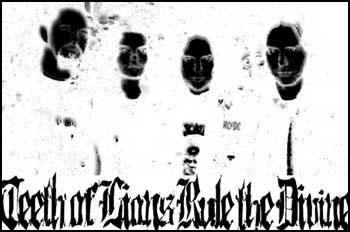
“AN UNHOLY INVOCATION OF CRIPPLING DOOM!!!!
The awaited birthing of doom architects’ morbid calling : Justin Greaves (IRON MONKEY/HARD TO SWALLOW) Greg Anderson (SUNN 0))), GOATSNAKE,THORR’S HAMMER), Lee Dorrian (CATHEDRAL, NAPALM DEATH) Stephen O’Malley (KHANATE, SUNN 0))), BURNING WITCH).
Black fumes non-verbal carnage spilled forth the unholy mines, minds and lanterns of Nottingham, UK January 2001. Souls cracked and burned, a fitting feast for low end wavetorment and high sound pressure hexing. Invocations of despair (vokills recorded) lain by Dorrian summer 2001. Six months rotting in the pits and graves to be unearthed and dissected by high necromancer Billy Anderson winter
2001. TEETH OF LIONS RULE THE DIVINE is the manifest of doomed mortality, divine suffering and flaggellation through trance and drone. In the memory of Jules Leach (R.I.P.) TOLRTD commanded forth a golem of leprosy, madness, and punishment. Prepare to be doomed.The album: “RAMPTON” by TOLRTD, will be unleased in North America by Southern Lord April 2nd 2002. It will be available in Europe through Rise Above Records 02/2002 “
The Machine
by Eduardo Galeano
Rebelion.org
April 27, 2002
[Translated by Francisco González]
Sigmund Freud had learned it from Jean-Martin Charcot: ideas can be implanted by hypnosis in the
human mind.
More than a century has gone by since then, and the technology of manipulation has made great strides.
This is a colossal machine, the size of the planet, that orders us to repeat the messages it puts inside our heads. Its a word-abusing machine.
The President of Venezuela, Hugo Chavez, had been elected, and reelected, by an overwhelming majority, in a much more transparent election than the one that put George W. Bush in power in the United States
The machine propelled the coup that tried to overthrow Chavez–not because of his messianic style,
or his tendency toward logorrhea, but because of the reforms he proposed and the heresies he committed. Chavez touched the untouchables. And the untouchables–the owners of the media and almost everything else–were outraged. With complete freedom they denounced the crushing of freedom.
Inside and outside his own country, the machine turned Chavez into a tyrant, a delirious autocrat and an enemy of democracy. Against him was the citizenry. Behind him were the mobs, which did not meet in rooms but in lairs.
The media campaign was decisive in the avalanche that lead to the coup, programmed from abroad against this ferocious dictatorship that did not have a single political prisoner. Then the Presidency was occupied by a businessman for whom nobody voted, and whose first democratic measure was to dissolve the Parliament. The stock market went up the following day, but a popular uprising returned
Chavez to his legitimate post. As Venezuelan writer Luis Britto Garcia put it, the media-engineered coup was able to generate only a virtual power, and it didnt last. Venezuelan television–a bastion of information freedom–did not get wind of the upsetting news.
Meanwhile, another voted-by-none figure who also took power by coup detat is displaying his successful
new look: General Pervez Musharraf, military dictator of Pakistan, has been transfigured by the magical kiss of the mass media. Musharraf says–and repeats–that the notion that his people could vote does not even enter his head, but he himself has given a vote of obedience to the so called “international community”, and that is the only vote that really matters in the end, at the time of reckoning.
He has come a long way indeed: only yesterday, Musharraf was the best friend of his neighbors, the Taliban. Today hes become the liberal brave leader of the modernization of Pakistan.”
And in the meantime, the slaughter of Palestinians continues. The worlds manufacturers of public
opinion call it a hunting down of terrorists. Palestinian is a synonym of “terrorist”, but this word is never used to refer to the Israeli army. The territories seized by continuous military invasions are called “disputed
territories.” And Palestinians–who are Semitic–turn out to be anti-Semitic.
For more than a century they have been condemned to atone for the sins
of European anti-Semitism, and to pay with their land and their blood for
a Holocaust they did not perpetrate.
There is a Gutlessness Competition
at the Human Rights Commission of the United Nations, which always aims
South, never North.
The commission specializes
in charging against Cuba, and this year Uruguay had the honor to lead the
pack. Nobody said: “I do it so that they buy what I sell”, or: “I do it
so they lend me what I need”, or: “I do it so they loosen the rope thats
tightening around my neck”. The art of good governing allows its practitioners
not to think what they say, but it forbids them from saying what they think.
And the media took advantage of the occasion to confirm, once again, that
the blockaded island is one of the baddies.
In the dictionary of the
machine, the bribes that politicians receive are called contributions,
and their betrayals are called pragmatism. The word security refers
not to notions of safety and protection, but to investments; and it is
in the stock exchange that these securities undergo all kinds of crises.
Where we see “the international community demands,” we should read: the
financial dictatorship imposes.
“International community”
is also the pseudonym that shelters the great powers in their military
campaigns of extermination, also called pacifying missions. The pacified
are the dead. The third war against Iraq is already in the works. As in
the two previous ones, the bombers will be called allied forces while
the bombed will be fanatic mobs serving the Butcher of Baghdad. And the
attackers will leave behind a trail of civilian corpses which will be called
collateral damages.
In order to explain this
next war, President Bush does not say: Big oil and big weapons need it
badly, and my government is a pipeline and an arsenal. Nor does he explain
his multibillion project for the militarization of space with words like:
We are going to annex the sky the way we annexed Texas. No, the explanation
is that the free world that must defend itself against the threat of terrorism,
both here on Earth and beyond, even though terrorism has demonstrated it
prefers kitchen knives to missiles, and despite the fact that the United
States is opposed–along with Iraq–to the International Criminal Court
that has been recently established to punish crimes against humanity.
In general, the words uttered
by power are not meant to express its actions, but to disguise them. More
than a century ago, at the glorious battle of Omdurman, in Sudan, where
Winston Churchill was both reporter and soldier, 48 Britons sacrificed
their lives. In addition, 27,000 savages died. The British were pushing
their colonial expansion by fire and the sword, and they justified it by
saying: We are civilizing Africa through commerce. They were not saying:
“We are commercializing Africa through civilization.” And nobody was asking
Africans their opinion on the matter.
But we are fortunate enough to live in the information age, and the giants of mass communications love
objectivity. They even allow for the point of view of the enemy to be expressed as well. During the Vietnam war, for example, the point of view of the enemy was 3% of the coverage given by ABC, CBS and NBC.
The Pentagon acknowledges that propaganda is part of the military budget, and the White House has
hired Charlotte Beers, a publicity expert who had pushed certain brands of rice and dog food in the local markets. She is now in charge of pushing the crusade against terrorism into the world market. Were selling a product, quipped Colin Powell.
Brazilian writer Millor Fernandes confirms that in order not to see reality, the ostrich sinks its head
in the television set.
The machine dictates orders, the machine stones you.
On September 11, the loudspeakers of the second twin tower in New York were also giving stunning orders, when the tower started to creak. As people ran down the stairs, the loudspeakers were ordering everyone to return to their workstations.
Those who survived, disobeyed.

Prolonged slump puts media in the mood to pander to buyers
By Matthew Rose and Suzanne Vranica
THE
WALL STREET JOURNAL
NEW YORK, May 9 On an early
March episode of her talk show, Rosie ODonnell chatted about her new diet
and the great different salads available at Wendys fast-food restaurants.
A sample sat on the table in front of her. Suddenly, Ms. ODonnell received
an urgent instruction from off stage: eat the salad. Any reason you want
me to taste the salad? Ms. ODonnell asked, on air. Just do it, came the
response. Shrugging, Ms. ODonnell shoveled a fork-full of lettuce into
her mouth, and declared, Mmmm, thats good. This is what it takes to
get advertising these days
WHEN WENDYS International Inc. committed to spend more than $23 million
on ads with AOL Time Warner Inc.s media outlets, the burger chain asked
for and received a host of extra goodies. The media giant, which produces
The Rosie ODonnell Show through its Warner Bros. unit, agreed to have
the host eat a Garden Sensations salad on air. The salad also made an
appearance on TBS Superstations Dinner & a Movie. And this month,
AOL Time Warner magazines such as Sports Illustrated and InStyle inserted
a Wendys promotion personalized with each subscribers name.
Media companies have long sold ads simply by touting the size of their
audiences or the quality of the product. Theyd herd advertisers into neatly
prescribed areas of real estate a 30-second TV spot, a half-page print
ad. Now, on the heels of the worst advertising slump since World War II,
advertisers
are getting a startling array of services that have turned publishers and
TV channels into full-service marketing companies. On behalf of their advertising
clients, media companies stage and pay for parties and corporate events,
develop elaborate promotions and mailings and agree to unusual product
placements.
Advertisers see the shift as long overdue. For years, they have been increasingly
concerned that their messages were getting lost in the clutter of new cable
channels and Internet sites. Theyve worried about dwindling network television
shares and declining magazine and newspaper sales, and fretted about the
looming era when consumers will be able to zap commercials with the help
of electronic recorders. Now, an 18-month-long advertising recession that
saw ad spending slump nearly 10% last year has shifted the balance of power
in favor of the advertisers. Even though there are signs that the recession
is lifting, many of the changes demanded by advertisers are likely to be
permanent.
The tables have turned, says Don Calhoon, Wendys executive vice president
of marketing. If media companies dont play ball, marketers will take
their ad dollars to other places. There are too many ways to reach consumers.
The shifting terrain puts media companies especially magazines and television
networks in a tough spot. They often pay for events and parties out of
their own pocket and write it off as a new cost of getting ads. This means
that the ads that do run these days arent as profitable. And the new product
placements are blurring the line between content and advertising in ways
that may be jarring to consumers.
For instance, in a move that gives new meaning to the term autoeroticism,
Playboy magazine will replace its June centerfold with a fold-out picture
of Bayerische Motoren Werke AGs new Mini car, bumping the real Miss June
to another section. BMW paid the equivalent of six ad pages to the Playboy
Enterprises Inc. publication. On the May 1 episode of soap opera Days
of our Lives, meanwhile, a box of Kleenex tissue got unusually prominent
display in a scene between two weepy characters forced to give up their
baby. Kimberly-Clark Corp. got the plug as part of an elaborate advertising
deal with General Electric Co.s NBC.
Some in the business lament the changes, especially the smaller players.
I am frustrated by how much the world has changed, says John Fox Sullivan,
president of the Atlantic Monthly and National Journal. Consumer magazines
have become such commodities, almost the last thing the advertiser seems
to care about is placing their ads amidst editorial the reader craves.
But many others shrug it off. Our world is changing, says Gary Burke,
vice president of prime-time sales at NBC, which has created several promos
tied to ad deals in recent months.
AD BOMBARDMENT
Traditional ads alone just dont cut it anymore because folks are bombarded
with advertising, agrees Joe Adney, director of marketing at Baskin-Robbins,
a unit of Allied Domecq PLC. There is a real desire to be integrated into
the program. Baskin-Robbinss media-buying firm, Interpublic Group of
Cos. Initiative Media, recently completed a media-buying deal that included
having the ice-cream brand incorporated into TV shows such as Top 20 Countdown,
a music-video program broadcast on Viacom Inc.s VH1. During a recent episode,
the host passed out Baskin-Robbins ice cream from a VH1 truck to passersby.
The clout large advertisers wield has grown with the consolidation of companies,
known as media buyers, that act as liaisons between advertisers and media
operations. About 80% of the ad spending in the U.S. is funneled through
only eight firms. WPP Group PLCs Mindshare, for example, represents more
than $20 billion in annual budgets with clients including Ford Motor Co.,
American Express Co., and International Business Machines Corp.
These firms start throwing their weight around early in the selection process.
Landing in publishers mailboxes recently was a document from Media Planning
Group, a unit of Havas Advertising SA, which represents Fords Volvo unit.
The firm wanted information to help it plan a coming advertising schedule.
Instead of asking standard questions about readership size, age and income
levels, MPG wanted publishers to describe readers typical day, their favorite
movie, author and TV program. I look at this stuff and ask, Is this creative
writing? complains one publisher.
To prepare its 2002 schedule, Volkswagen AGs U.S. media agency, Arnold
MPG, a Havas unit, asked publishers to make a video describing their readers.
Blender, a new music magazine owned by Dennis Publishing, rented a VW Beetle
and sent a production crew on a road trip around Manhattan, mixing nonalcoholic
drinks and confronting random pedestrians. The staffers videotaped interviews
with those who turned out to be Blender readers. When a policeman gave
them a ticket for making an illegal turn onto 42nd Street, they taped him,
too.
Blender eventually got a high single digit number of pages for 2002,
says publisher Malcolm Campbell, but not everyone was so lucky. Of the
120 publications that made a video, only 50 made the cut.
Because Volkswagen is a marquee advertiser, media companies are willing
to go the extra mile. But theyre doing the same for companies without
generous ad budgets. In March, MSNBC, the cable news channel jointly owned
by NBC and Microsoft Corp., signed a deal with financial-services company
Lending Tree Inc. In return for about $5 million, a tiny sum that will
cover all of 2002, MSNBC is creating a twice-weekly financial update which
will be sponsored by Lending Tree.
Last summer, Jeff Hicks, the president of Miami-based agency Crispin Porter
+ Bogusky, gathered more than 50 publishers into an auditorium in Manhattan
and asked for groundbreaking ideas to promote BMWs Mini. Even though
the account was valued at only an estimated $20 million as little as
a third of similar launches Mr. Hicks was inundated with proposals, including
Playboys centerfold idea. The New Yorker, owned by Condé Nast Publications
Inc., threw a party in a Soho gallery displaying Minis that had been decorated
by top artists. Wenner Media Inc.s Rolling Stone magazine ran ads in a
thin strip around the edge of the page showing Minis tearing along a road.
The tagline: Nothing Corners Like A Mini. Readers had to remove the strip
to read the article.
Television networks have gone the furthest in incorporating advertisers
messages into once-sacrosanct territory. When Verizon Wireless, a joint
venture between Verizon Communications Inc. and Britains Vodafone Group
PLC, dangled $50 million in the hope of integrating its Talk Man character
into network programming, eight different channels leaped at the opportunity.
Talk man is the Verizon pitchman who crisscrosses the country saying,
Can you hear me now? into his cellphone.
By January, Talk Man escaped from the confines of the traditional ad.
He popped up in a promo for NBCs Frasier and also appeared on a movie
set designed to mimic Indiana Jones and the Temple of Doom to tout a
rerun of the adventure flick on Walt Disney Co.s ABC. Following the opening
credits of the WBs Dawsons Creek, a teen drama, Talk Man appears
on the shows set and repeats his catchphrase as part of the ad deal.
The networks have been more willing to pursue things like product placement
while two years ago when the market was tighter they were less willing,
said Rich Hamilton, chief executive of Zenith Optimedia, which is jointly
owned by Publicis Groupe SA and Cordiant Communications Group PLC and which
represents Verizon Wireless.
Suzanne Kold, executive vice president of marketing at WB, doesnt see
a problem with this. I dont think most audiences are shocked that there
are advertising relationships with shows or that advertisers fund things,
she says. ABC declined to comment on the Verizon deal.
To accommodate the new demands, media companies have started to change
the way they do business. Hearst Corp.s magazine division, for example,
awards a $1,000 prize each month to the salesperson who comes up with the
best idea to be used by an advertiser. Chief Marketing Officer Michael
Clinton says the company has around 40 proposals floating around at any
one time.
One of those proposals led to Hearsts announcement last year that it had
teamed up with Brookstone Inc., a Nashua, N.H., gift retailer, to promote
DaimlerChrysler AGs Chrysler in Hearst publications and Brookstones catalog
business and 240 gift-store outlets. After six months of planning, the
November issues of 7.8 million Hearst magazines ran a section highlighting
design elements of Chrysler vehicles and Brookstone merchandise. Hearst
says the section enticed 13,600 readers to test-drive a Chrysler.
Julie McGowan, the publisher of Food & Wine, reckons the magazine now
throws anywhere from two to five events a week, compared with two a month
in the late 1990s. These range from parties to store openings to wine tastings,
all arranged to leverage the magazines contacts and give more publicity
to advertisers. Advertisers demand it, she says. Food & Wine is owned
by American Express Publishing Corp., a venture of AOL Time Warners Time
Inc. and American Express.
ELABORATE EVENTS
The events are becoming increasingly elaborate. Fortune magazine, published
by Time, holds roughly one mammoth event a month either tied to an ad-page
deal or to schmooze important advertising clients. In March, Fortune and
its sister publications took over the Road Atlanta Racetrack in Braselton,
Ga., on behalf of Merrill Lynch & Co., a key advertiser. The financial-services
company invited some of its own wealthy customers and corporate clients.
Participants were given a chance to drive a race car at 120 miles per hour.
Publishers fervently hope that a recovery in the advertising market will
bring some respite. Stocks of major newspaper and advertising companies
are up substantially so far this year. Steven Florio, chief executive of
Condé Nast, says 12 of his 15 magazines, which include Vogue and
Vanity Fair, posted gains in their June issues.
But few executives are certain when the turnaround may come. First-quarter
results were generally inconclusive. Ive seen some swallows, but Im
not ready to call it summer, says Richard M. Smith, chairman of Washington
Post Co.s Newsweek magazine.
As far as exhausted media executives are concerned, it might not matter
when the ads return. Arnold, the media-buying agency that put magazines
through their paces for VW, is considering kooky ideas for 2003 pitches.
Publishers are already calling asking, What is our assignment this year?
says Steve Moynihan, senior vice president media director at Arnold MPG.
This time around, Mr. Moynihan says he is looking for bigger and better
ideas from publishers. I anticipate that they will respond to whatever
we request of them, he says.

From 13 May BUSINESS WEEK:
Lawrence Lessig: The “Dinosaurs” Are Taking Over
If the media giants have
their way, the Net freedom fighter says, content will be rigidly controlled
and innovation stifled
Who should control the Internet?
If Stanford University law professor Lawrence Lessig is right, the Internet
will soon belong to Hollywood studios, record labels, and cable operators
— corporate giants that he says are trying to cordon off chunks of the
once-open data network. Lessig’s mission is to stop them. At age 40, he’s
already the Net’s most famous freedom fighter. Since 1995, he has been
a seminal thinker on many of the Digital Age’s most important battles —
the AOL-Time Warner merger, Napster, and the Microsoft antitrust case.
In his latest book, The Future
of Ideas: The Fate of the Commons in a Connected World, Lessig argues that
imminent changes to Internet architecture plus court decisions that restrict
the use of intellectual property will co-opt the Net on behalf of Establishment
players — and stifle innovation. On Apr. 29, Lessig spoke with BusinessWeek
Online Technology reporter Jane Black about what he sees as some disturbing
trends. Here are edited excerpts of that conversation:
Q: You argue that the Internet’s
popularity as a new medium is a result of its open architecture. How do
you see this changing? And are the changes a threat to e-business?
A: There are two places
where it’s changing. One is at the physical level of the network. As we
move from narrowband to broadband [access to the Net], broadband operators
are developing technology that gives them control over applications and
content on the network.
Cable
companies, for example, have a view of what the network should be used
for. And they’re beginning to pick and choose what kinds of content will
flow quickly as a way of favoring — or not favoring — content providers.
For instance, perhaps cable companies can make it more difficult [for Web
sites] to use streaming video if that interferes with their video business.
It’s your father’s AT&T all over again: They, not the user, decide
what the network should be.
Q: What’s the result of a
controlled network?
A: The cost of innovation
goes up significantly. Before, you just had to worry about complying with
basic network protocol. Now you have to worry about making your program
run on the full range of proprietary systems and devices connected to the
network. Before, the network would serve whoever and whatever people wanted
it to. Soon, you will need the permission of network owners.
Think
about other platforms in our lives, like the highway system. Imagine if
General Motors could build the highway system such that GM trucks ran better
on it than Ford trucks. Or think about the electrical grid. Imagine if
a Sony TV worked better on it than a Panasonic TV. The highway and electricity
grids are all neutral platforms — a common standard that everyone builds
on top of. That’s an extraordinarily important feature for networks to
have.
Q: And the second change
that threatens e-business?
A: Dominant media is a huge
threat. [Record labels and Hollywood studios] make their money because
of the control they assert over the production and distribution of artists’
work. In the music business, a handful of companies control more than 80%
of the music in the world. These companies control not just distribution
but a market where artists have to sell their souls to a record label just
to have a right to develop music that can be distributed.
That’s
the model for the last century. The economic reasons that might have justified
that tightly controlled structure have disappeared. The Internet can support
much greater competition in production and distribution than [is possible
with] the dominant five companies. The record labels have launched lawsuits
against every company that has a model for distributing [music and entertainment]
content they can’t control. That has sent a clear message to venture capitalists:
Don’t deploy a technology that we don’t approve of, or we will sue you
into the Dark Ages.
The result
is that the field has been left to dinosaurs. There would have been more
chips, computers, and devices to deliver content if Congress had been more
keen to allow innovation to occur. We’ve given
control over the future to exactly the wrong people. And before
we know it, the possibility for innovation will have disappeared.
Q: Why is it so difficult
to head off these moves?
A: One reason is that Washington
surrounds itself with the same people all the time — [Motion Picture Association
of America President] Jack Valenti and [Recording Industry Association
of America President] Hillary Rosen. They’ve succeeded in making Washington
believe this is a binary choice — between perfect protection or no protection.
No one is seriously arguing for no protection. They are arguing for a balance
that avoids the phenomenon we are seeing now — one where the last generation
of technology controls the next generation of industry.
In fact,
there are lots of solutions that would promote innovation. For example,
Congress could do what it has always done — establish a flat compulsory
licensing fee [such as the one radio stations pay to music publishers for
playing their songs] so that any company can compete in the marketplace.
That’s what Napster [the free-music sharing Web site the recording industry
sued out of existence] asked Washington for all along — a compulsory license.
That could deal with 80% of the problem of existing content.
But these
solutions are never recognized because, while the future under perfect
competition would produce an industry with much greater income to artists
and greater opportunities to consumers, the fact is that the concentrated
players are going to lose.
The
problem is, we’ve given control of the future to the people who will lose
even under the best possible plan. It’s like giving the communists
control over the future of the new Russia. Congress continues to have them
come down and testify. And they step forward and say they want communism
to be protected for the next 100 years.
Q: The current debate over
Web radio is a good example. New fees that the U.S. copyright office has
mandated threaten to put small Webcasters out of business.
A: Web radio is a perfect
example. In the course of its testimony before the CARP hearings [the Copyright
Arbitration Royalty Panel, the government group responsible for setting
compulsory license fee for Webcasters] the RIAA argued that higher rates
would reduce the number of competitors to four or five big players. That’s
their model: To wipe out diversity and get back to a place where only a
few people control delivery.
I understand
why they want that. But I don’t understand why Congress is giving it to
them. And it’s not just the fees that are ridiculously high — it’s the
data collection that has been mandated [by CARP and is awaiting approval].
If the RIAA has its way, Webcasters would have to report every song that
every listener heard. In essence, it asks to create a national police state
of music listening by forcing Webcasters to collect data and turn it over
to copyright holders. My question is: Why? It kills competition and the
development of niche markets. This is a classic example where the legal
process is being used to destroy creativity and innovation.
Q: What should Washington
do?
A: First in context of copyright,
Congress should pass low fixed compulsory license fees for distribution
of [music and entertainment] content on the Web. Those fees should not
be tied to reporting every usage on the Web. They should be determined
the same way they are now for radio — according to a sampling that gives
some idea of what music is being played.
Second,
Congress should repeal the 1998 DMCA [Digital Millennium Copyright Act,
which, among other things makes it a crime to circumvent copyright-protection
technology]. We have no reason to believe that the market won’t work well
enough to prevent abuse. We don’t need the federal government threatening
prosecution.
Finally,
Congress needs to not pass new legislation, like the [recently introduced]
Hollings’ bill that would mandate a police state in every computer [by
requiring that copyright-protection mechanisms be embedded in PCs, CD players,
and anything else that can play, record, or manipulate data]. (See BW Online,
3/27/02, “Guard Copyright, Don’t Jail Innovation.”)
Q: Do we need a new definition
or vision of copyright and intellectual property in order for e-business
to move forward?
A: We don’t need a new vision.
We just need to recognize what the traditional vision has been. The traditional
vision protects copyright owners from unfair competition. It has never
been a way to give copyright holders perfect control over how consumers
use content. We need to make sure that pirates don’t set up CD pressing
plants or competing entities that sell identical products. We need to stop
worrying about whether you or I use a song on your PC and then transfer
it your MP3 player.
COURTESY I. ROGERS!
From the Globe & Mail, Saturday, May 4, 2002 Page A1:
Suspicious deaths
The sudden and suspicious deaths of 11 of the world’s leading
microbiologists. Who they were:
1. Nov. 12, 2001:
Benito Que was said to have been beaten in a Miami parking lot and died later.
2. Nov. 16, 2001:
Don C. Wiley went missing. Was found Dec. 20. Investigators said he got dizzy on a Memphis bridge
and fell to his death in a river.
3. Nov. 21, 2001:
Vladimir Pasechnik, former high-level Russian microbiologist who defected in
1989 to the U.K. apparently died from a stroke.
4. Dec. 10, 2001:
Robert M. Schwartz was stabbed to death in Leesberg, Va. Three Satanists
have been arrested.
5. Dec. 14, 2001:
Nguyen Van Set died in an airlock filled with nitrogen in his lab in Geelong, Australia.
6. Feb. 9, 2002:
Victor Korshunov had his head bashed in near his home in Moscow.
7. Feb. 14, 2002:
Ian Langford was found partially naked and wedged under a chair in Norwich,
England.
8. 9. Feb. 28, 2002:
San Francisco resident Tanya Holzmayer was killed by a microbiologist colleague, Guyang Huang, who shot her as she took delivery of a pizza and then apparently shot himself.
10. March 24, 2002:
David Wynn-Williams died in a road accident near his home in Cambridge,
England.
11. March 25, 2002:
Steven Mostow of the Colorado Health Sciences Centre, killed in a plane he
was flying near Denver.
COMPILED BY ALANNA MITCHELL
It’s a tale only the best conspiracy theorist could dream up.
Eleven microbiologists mysteriously dead over the span of just five months.
Some of them world leaders in developing weapons-grade biological plagues.
Others the best in figuring out how to stop millions from dying because of biological weapons. Still others, experts in the theory of bioterrorism.
Throw in a few Russian defectors, a few nervy U.S. biotech companies, a deranged assassin or two, a bit of Elvis, a couple of Satanists, a subtle hint of espionage, a big whack of imagination, and the plot is complete, if a bit reminiscent of James Bond.
The first three died in the space of just over a week in November. Benito
Que, 52, was an expert in infectious diseases and cellular biology at the
Miami Medical School. Police originally suspected that he had been beaten on
Nov. 12 in a carjacking in the medical school’s parking lot. Strangely
enough, though, his body showed no signs of a beating. Doctors then began to
suspect a stroke.
Just
four days after Dr. Que fell unconscious came the mysterious
disappearance of Don Wiley,
57, one of the foremost microbiologists in the
United States. Dr. Wiley,
of the Howard Hughes Medical Institute at Harvard
University, was an expert
on how the immune system responds to viral attacks
such as the classic doomsday
plagues of HIV, ebola and influenza.
He had
just bought tickets to take his son to Graceland the following day.
Police found his rental
car on a bridge outside Memphis, Tenn. His body was
later found in the Mississippi
River. Forensic experts said he may have had
a dizzy spell and have fallen
off the bridge.
Just
five days after that, the world-class microbiologist and high-profile
Russian defector Valdimir
Pasechnik, 64, fell dead. The pathologist who did
the autopsy, and who also
happened to be associated with Britain’s spy
agency, concluded he died
of a stroke.
Dr. Pasechnik,
who defected to the United Kingdom in 1989, played a huge
role in Russian biowarfare
and helped to figure out how to modify cruise
missiles to deliver the
agents of mass biological destruction.
The next
two deaths came four days apart in December. Robert Schwartz, 57,
was stabbed and slashed
with what police believe was a sword in his
farmhouse in Leesberg, Va.
His daughter, who identifies herself as a pagan
high priestess, and several
of her fellow pagans have been charged.
Dr. Schwartz
was an expert in DNA sequencing and pathogenic micro-organisms,
who worked at the Center
for Innovative Technology in Herndon, Va.
Four
days later, Nguyen Van Set, 44, died at work in Geelong, Australia, in
a laboratory accident. He
entered an airlocked storage lab and died from
exposure to nitrogen. Other
scientists at the animal diseases facility of
the Commonwealth Scientific
and Industrial Research Organization had just
come to fame for discovering
a virulent strain of mousepox, which could be
modified to affect smallpox.
Then
in February, the Russian microbiologist Victor Korshunov, 56, an expert
in intestinal bacteria of
children around the world, was bashed over the
head near his home in Moscow.
Five days later the British microbiologist Ian
Langford, 40, was found
dead in his home near Norwich, England, naked from
the waist down and wedged
under a chair. He was an expert in environmental
risks and disease.
Two weeks
later, two prominent microbiologists died in San Francisco. Tanya
Holzmayer, 46, a Russian
who moved to the U.S. in 1989, focused on the part
of the human molecular structure
that could be affected best by medicine.
She was
killed by fellow microbiologist Guyang (Matthew) Huang, 38, who shot
her seven times when she
opened the door to a pizza delivery. Then he shot
himself.
The final
two deaths came one day after the other in March. David
Wynn-Williams, 55, a respected
astrobiologist with the British Antarctic
Survey, who studied the
habits of microbes that might survive in outer
space, died in a freak road
accident near his home in Cambridge, England. He
was hit by a car while he
was jogging.
The following
day, Steven Mostow, 63, known as Dr. Flu for his expertise in
treating influenza, and
a noted expert in bioterrorism, died when the
airplane he was piloting
crashed near Denver.
So what
does any of it mean?
“Statistically,
what are the chances?” wondered a prominent North American
microbiologist reached last
night at an international meeting of
infectious-disease specialists
in Chicago.
Janet
Shoemaker, director of public and scientific affairs of the American
Society for Microbiology
in Washington, D.C., pointed out yesterday that
there are about 20,000 academic
researchers in microbiology in the U.S.
Still, not all of these
are of the elevated calibre of those recently
deceased.
She had
a chilling, final thought. When microbiologists die in a lab,
there’s a way of taking
note of the deaths and adding them up. When they die
in freakish accidents outside
the lab, nobody keeps track.
THANKS: O. KOWARSKY!
 Arthur Magazine