OF REX THE WONDER DOG AND DETECTIVE CHIMP: JOHN BROOME SPEAKS AT SDCC, 1998

http://povonline.com/COL233.htm

BY MARK EVANIER

ORIGINALLY PUBLISHED 4/16/99

Let me set the scene. It’s Day Three of last year’s Comic Con International in San Diego…August
14, 1998, 4:00 in the afternoon.  The room is packed.  An amazing percentage of those present are professional comic book writers, most of them the right age to have read comics in the sixties or before: Marv Wolfman, Kurt Busiek, Roy Thomas, Mark Waid, Dan Raspler, Mike Friedrich and many others.


    So you know right there, this is something special.  Folks who do comics almost never go to convention panels ˜ not unless they’re up there behind the table, answering questions.  Still, they’ve all turned out for this one.

    One of those on this panel is Murphy Anderson, one of our best artists. Another is Julius Schwartz, one of our best editors.  They are fine gents, well worth hearing…but they are — this is not a criticism — convention regulars.  Everyone in the room knows them.  In fact, a high percentage of those present has actually worked for Julie.  Important though they are, Anderson and Schwartz are not the reason all these writers are here.

    No, the reason is John Broome.

    John Broome wrote for DC from 1946 until 1970.  Most of his work was done for Julie, who was also his best pal.  But it was not friendship that caused the man they call B.O. Schwartz (for “Be Original”) to have Broome writing Flash and Green Lantern and Batman and The Atomic Knights and so many more.  It was because John Broome was a terrific writer ˜ arguably among the three-or-so best among many fine writers who worked for DC over the years.  Many in the room might say he was the best, but I don’t want to go there.

    Few of them have met Broome before this convention.  He did his last script for DC before most of them were in the field.  He has always been a world traveller, so even when he was working at DC, he was often away from the office for months at a time.  He has been away from comics altogether since ’70 and has never been to a comic convention before this one.

    And though he’s a Guest of Honor at this convention, the con didn’t arrange for him to be here, didn’t pay his way over from Tokyo, where he now resides.  An ad hoc group of Broome fans, headed by Rich Morrissey, arranged it and put up the bucks.  That’s how important it is to them to have him here, to meet him, to hear him.  All would be pleased to find him a charming, self-effacing gentleman.  He blushed every time someone said to him, “You were a major influence on me,” which meant that he did a lot of blushing at the con.

    Now comes the panel, which I get to moderate, along with Mike Barr — another writer who lists Broome as a major influence.  Here is some of what was said in a room thick with love and respect…

M.E.: You have an enormous number of fans out here.  We have all loved your work for many years
and I can’t tell you how much I have stolen from you. I want to go back to the earliest part of your career.  I believe the first comics you wrote were for Fawcett. What was the first?


JOHN BROOME: I remember the very first one.  I don’t remember much after that (laughs). If I’m correct ˜ and I might not be entirely correct because that was a long, long time ago ˜ the first one wasn’t a super-hero at all.  It was an ordinary guy in the South Seas named Lance O’Casey.  It was just an adventure story.  Just like you might read in the South Seas magazine.

JULIUS SCHWARTZ: Edited by Ray Palmer…who was the real Atom.

M.E.: At that time, you wanted to write professionally ˜?

BROOME: I think I realized that I wasn’t good enough to be a real top notch science-fiction writer. You know, these things happen.  You just want to be something and you don’t get to be it.  Your wishes are completely disregarded by somebody who regulates these things.  (Audience laughs).  And so, when I found out that I could make money in comics, I became a comics writer.

SCHWARTZ: I must interrupt Mr. Broome.  I was your agent for a while and I sold at least 12 science-fiction stories.  That’s not too bad.

BROOME: Not too bad. But they weren’t very good.
SCHWARTZ: I sold them — they must have been great.  (Audience laughs).

BROOME: You were one salesman.

M.E.: What were your influences as a writer?  What did you read that excited you?

BROOME: I read everything. I was a reader.  I wasn’t a writer, I was a reader!  I loved them all ˜ all the great writers…H.G. Wells, Bernard Shaw, Tolstoy, Dostoevsky…I read them all.  That had nothing to do with my comics career. Comics is a very special field and, somehow, it suited me.  That was what
made me realize that somehow. I was being cared over by something, somebody, somewhere.  Somebody was taking care of me! 
I realized that, all of a sudden.  Later on, it became more obvious but, at that time, it was the first inkling that I wasn’t going to have to go out and hold out a tin cup in order to make my dinner.  I could make my money writing comics.  That was the big event of my life!

M.E.: What was your first page rate?

BROOME: A dollar a page. (Audience laughs).  Julie, is that right?

SCHWARTZ: Not at DC, I beg your pardon! (laughs)

M.E.: How did you get into Fawcett?

BROOME: That’s a good question. I think I heard that Fawcett was publishing comic books.  There was
someone named Wendell Crowley who was editor at Fawcett and somehow, I got the chance to try-out…to write a story and have it looked at. 
From there on, it went like that.

M.E.: Was this before or after you sold the science-fiction stories?

BROOME: I think it was right in the middle of it.  Julie and I were trying to figure out when we
first met…


SCHWARTZ: Not just when but who first introduced us.  We came to the conclusion that it was
a good friend of John’s ˜ I think he went to Brooklyn College with you ˜ named David Levine at that time.  Then he changed his name to David Vern and wrote science-fiction and many comics under the name of David V. Reed.  Also, David knew Mort Weisinger and he came up and did some comics and he brought John along.  This is about as close as we can get.

M.E.: Did you do any super-hero stuff at Fawcett?

BROOME: Yeah, I did Captain Marvel.  He was a good character.  He wasn’t up to Superman or Batman, but he was a good character.

M.E.: How did you get from Fawcett to DC?

BROOME: Through Julie, whom I was getting to know fairly well…then the Army intervened.  I was
in the Army for two-and-a-half years.  After I got out, Julie was already established as an editor at DC.  So all I did was to go up to Julie’s office and start writing.

SCHWARTZ: That’s not quite right. (Audience laughs)  Alfred Bester got me my job at DC — or All-American, in that case.  When Alfred left, he had been writing Green Lantern.  I persuaded a science-fiction writer named Henry Kuttner to do some, which he did for a while, then he decided to move on. 
I was doing fairly well with John on science-fiction.  I said, “How about trying some comics?”  That is about the most reasonable explanation I can think of.


BROOME: Do you remember the editor of Amazing Stories, I think, or Astounding?  When he read
one of my stories, he said, “This guy’s science is terrible.”  Remember that?  Well, I never claimed to be a great scientist! (Audience laughs)

SCHWARTZ: But I’ll bet I sold the story, anyway.  So I think I immediately put John on Green Lantern because I needed someone, and eventually, he did some Flashes.  But the main thing he did, as far as I was concerned, was to take over the stories that were appearing in All-Star Comics that dealt with the
Justice Society of America.  He wrote many of the latter stories before the magazine was discontinued.  I hope there is an expert in here.  I said to John, I think you did a backup story in All-Star Comics about
a girl in the future called Astra.  Does anyone know anything about that?  Oh, Mark Waid!


MARK WAID: That was actually in Sensation Comics.

(This is M.E. here in italics. Sure enough, down in the front row, Mark Waid not only knows about Astra,
he happens to have a copy of her first appearance ˜ Sensation Comics #99, Sept.-Oct. 1950 ˜ which he shares with the panel.  It’s a treasure which, he later tells me by e-mail, “by dumb luck I’d bought in the dealers’ room about an hour beforehand with no notion it might connect with Mr. Broome in any way.”)


SCHWARTZ: That was a forgotten gem.  I always forget ˜ whenever I have questions about anything,
Mark Waid knows the answer.


M.E.: Now, after you started working for DC, did you work for any other comic book companies?

BROOME: I don’t think so.  Julie?

SCHWARTZ: You may have done an occasional story for Mort Weisinger or Jack Schiff.  Once he got
started at DC, he was treated very well.  He got a fairly good rate, as high as any in the field.

AUDIENCE MEMBER: Were you familiar with Batman before you wrote him in 1964?

BROOME: Sure.  I wrote Batman for Mort Weisinger before Julie took over.

SCHWARTZ: How well John knew Batman and how well I didn’t know Batman became apparent in the first story that appeared [when I took over as editor].  The first error was that Batman was on the hunt for the villain during the daytime.  The second was when Batman caught up with the villain, pulled a gun on
him and held him at bay.  Neither one of us realized that Batman didn’t use a gun, but we learned quickly.


M.E.: All right now…you wrote westerns, science-fiction, super-heroes…Did you have a favorite
genre?  Rex the Wonder Dog?

BROOME: Detective Chimp.  Rex the Wonder Dog was an important character.  I remember being in St. Tropez, writing Rex the Wonder Dog or Detective Chimp and it seemed a little odd that I should be writing things like that in such a setting.

M.E.: No preference for any type of story?

BROOME: I think I preferred Hopalong Cassidy.  I liked it because I could work in a more human
kind of story into these.  I can remember giving someone advice about breaking into comic books.  “Start with the character,” I told him. 
“Start with the character.”  So when I was writing Hopalong Cassidy,
I would think of some doctor who has a problem, some lawyer who has a problem ˜ something simple ˜ and work from there.

M.E.: Did you like the way your scripts were illustrated?

BROOME: Yes, I think so. I found that DC had good artists and they did a good job of illustrating
the story.


SCHWARTZ: I never thought to ask.  After the story appeared in print, did you look at it?

BROOME: Sometimes, I would reread it.  I would admire my own work! (Audience laughs).  I
worked on a kind of philosophy of comics.  I said that, “The essential of comics is a gimmick that works!”  And Shelly Mayer, who was my editor somehow before Julie, said this about me.  I’m boasting a little now, because I don’t have much chance to boast, but this is my one chance.
(Audience laughs)  He said he never came across a writer who, when he hit it — that is, when the gimmick was operating, hit it as hard as I did.  (Audience applause).  I would work up a kind of a curve of an idea.  It would start off low and finally, all of a sudden — POW! 
That’s what I prided myself on when writing the story.

M.E.: Now, John, in the 1950s you wrote the Nero Wolfe comic strip, right?

BROOME: That’s right. Is anyone going to ask me about the first union that ever existed?

M.E.: We’ll get to that. (Audience laughs).  Let’s discuss the way you worked with Julie. How many pages did you write a week?

JOHN BROOME: I think I did enough to make a living.  As I said, I wrote for money.  I don’t want to disguise it.  I wasn’t working to try and make a lot of friends. 

I seem to have a lot of friends but I didn’t work for that.  I went for the money. I did the best I could, and Julie and I turned out to be a good team.  We complimented each other, we supplemented each other
and I could always rely on him to have a good reaction to any ideas that I would bring up.  People would often ask me, “Where do you get the ideas?” Well, I don’t think any comic writer can ever tell you where ideas come from.  If you are a comics writer, you get ideas. That’s your business — to get ideas.  I remember, I got an idea…”The Guardians of the Universe!”  That was an idea.  As far as I know, they didn’t exist.  (Audience laughs)  That didn’t keep me from writing about it.  That’s what the stories were based on — ideas.

JULIUS SCHWARTZ: That originated in a science-fiction story, I believe, that appeared in either Strange
Adventures or Mystery in Space.  It was called “Guardians of the Clockwork Universe.”  That eventually lead into the Guardians that appeared in the Green Lantern series.  Incidentally, why do aliens have to
look different from the way we do?  Maybe in this particular universe, all the aliens look alike.  The Guardians of the Universe were all based on the prime minister of Israel, Abin Sur.


MARK WAID: No, not Abin Sur —  Ben-Gurion.

SCHWARTZ: Oh, right! (Audience laughs)

M.E.: Abin Sur was the first Green Lantern.  Would you describe for us what it was like to work with Julie in the typical session?  You would come in the morning and he would tell you what he needed?

SCHWARTZ: He would probably say, “What are you going to have for lunch?” (Audience laughs)

BROOME: He would say what he needed.  For example, he would say, “I need a 12-page Flash story.” 
We always knew the number of pages ahead of time.  That was very important. An idea for a story had to be bigger for twelve pages than for six or eight. 

You had to get the right kind of idea for the length of the story, and that came with practice.

SCHWARTZ: Well, of course, we came up with the idea of having the cover first.  We had a provocative
cover and it was a challenge to us to look at the cover and figure out how a thing like that happened.  A typical example was the Flash cover in which he was holding up a big hand toward the reader and the copy read, “Stop!  Don’t pass up this magazine!  My life depends on it!”  (Audience laughs).  We worked it out and it became a beautiful story.There was another reason, incidentally, why we had the cover done first.  After the artwork was done, there might not be a decent cover scene in it, so it was much better to get the cover beforehand. 

Poor Murphy, poor Gil Kane, poor Carmine Infantino, poor Mike Sekowsky would pace up and down, trying to think up an original cover idea. Sometimes, nothing came out but some days, you’d get three or four.  I’d present the cover to John and say, “OK, let’s solve it!”  We had a great time doing it.

BROOME: That’s right. The cover sometimes provided the story in a sketchy kind of way. Then I’d work out some kind of understanding or explanation of the cover. The cover usually presented some kind of mystery.  Something was happening, someone was getting poisoned, or frozen or killed or something like that.

M.E.: You would come up with ideas and he would come up with ideas…

BROOME: I would usually have a day or two because he would contact me by telephone and, a day or
two later, I would come in with some ideas for a story.  I might have several ideas and he would pick one of them.  He knew what was good and what wasn’t.  Then we began the most intricate and interesting part of our meeting, which was the plot.


SCHWARTZ: No, it was discussing where we were going to have lunch.  (Audience laughs)

M.E.: After you settled on lunch, you’d talk through the plot, you’d take notes?

SCHWARTZ: John never took any notes.

M.E.: You would go home and write the script in a couple of days ˜?

BROOME: Maybe two or three, maybe a week.

SCHWARTZ: No, let me interrupt again.  John would say, “When do you want the story?”  I’d say,
“Wednesday,” for example.  He’d come in Wednesday and have the story done and the beautiful part was I had the check ready for him.  In Mort Weisinger’s case and Jack Schiff’s, the editor made you wait a few
days to a week.  But my writers knew they the check was waiting in my drawer, and that’s why most preferred to work for me.  (Audience laughs and claps)

MURPHY ANDERSON: Not true. (Audience laughs) That was a factor but that was not the big thing.

M.E.: Julie, how often did you want rewrites on these scripts?

SCHWARTZ: When the rewriting had to be done, I did it.  Yes, I would say, “John, I didn’t like this,” but I would rewrite it myself.  With John, there was very little rewriting.  Gardner Fox, quite a bit.  It would be easier for me to do it than to try to explain where again and bring it in.  A terrible example of that was Fox.  He bought in a story we had plotted and I said, “Oh my God, there’s a hole in the story,” and Gardner said, “I know.” I said, “Why did you write it that way?”  And he said, “That’s the way we plotted it!”  (Audience laughs)  John always brought it in on time and with very little rewriting.

ANDERSON: I can attest to that.  I’d get John’s scripts and there would hardly be any editing at all.  But with Gardner, it sometimes took quite a bit of figuring out.

M.E.: Let’s talk about the Atomic Knights.  What do you remember about how that strip came to be?

BROOME: I remember, in the beginning, we both got the feeling that it had something to do with King
Arthur and the Knights of the Round Table.  We thought if we could make a modern version of that spirit and the feeling, that would be a new kind of comic that hadn’t been done and we would enjoy doing it. So
we worked out a third World War where life was almost destroyed and crime was all over.  And the Atomic Knights stand for justice and faith and all that. 
So that is the way the story began.

M.E.: Murphy, do you remember starting on the Atomic Knights?  Was it one of you favorite assignments?

ANDERSON: Oh, yes, I remember.  Yes, that is something I really enjoyed doing.  Except it was a back-breaker and I was thankful it only appeared every three months.

AUDIENCE MEMBER: While we are on the topic of the Atomic Knights, I just have to know this. 
What did you get the idea for the giant dalmatians?
  (Audience laughs)

BROOME: That was one of the stories?  (Audience laughs)  That’s been long ago! Sorry.

M.E.: Towards the end of your career at DC, there was an attempt to form a writer’s union…

BROOME: Oh, yeah. I developed a fixed idea that DC should pay us for reprint material. When they reprinted a whole story without paying us, that was a stealing of our abilities.  It was stealing something away from us.  I knew that, in movies and television and ASCAP [the composers’ union], they paid royalties…so I thought comics should pay royalties and I talked to the other writers.  I didn’t talk to the artists…they were above me, anyway. There were five or six writers ˜ Eddie Herron, Bob Haney, Otto
Binder, Gardner Fox, a few others.  I think it took six or eight months but one day, I got them all together ˜ all in the same room, ready to do what we had to do, which was to march into Liebowitz’s office.  Liebowitz was the millionaire boss.  We marched in and demanded reprint rights. 

And Liebowitz, who I understand is still alive…he’s about 95 or something

SCHWARTZ: Or more!

BROOME: He didn’t waste any time.  He said, “Boys, I’ll give you a two dollar raise,” and immediately, my union collapsed!  (Audience laughs)  That was the end of the first union at DC.

M.E.: Can you give us a year on that?  About ’68 or so?

BROOME: By ’68, I was already cashing out of the picture.  It would be earlier.  Maybe ’65 would be about right.

M.E.: Now were there other grievances besides the reprints?  Didn’t some of the guys want health insurance?

BROOME: Maybe.  I think maybe they had other demands, but that’s the only part I recall. Liebowitz was afraid of me.  He knew I was a danger to him. I was going to cost him money! (Audience laughs).  So he didn’t like me but he really couldn’t get rid of me too easily.

M.E.: Now, one day, years later, they started sending you reprint checks.  How’d you feel the first time you got one?

BROOME: I loved it!! (Audience laughs and applause)  I felt that I had it coming to me.  The new management, Jenette [Kahn] and a couple of others seem to me to be a new breed, different from the old breed hanging on to their money.

SCHWARTZ: To show you an instance…when the Flash went on television, I received a check, Robert
Kanigher received a check, Carmine received a check…John, they sent you a check for how much?


BROOME: It was $5000.  (Audience applause)

SCHWARTZ: They didn’t have to do it.

M.E.: So that was sometime in the sixties.  You didn’t work for DC much longer after that.

BROOME: Not much longer.  I wasn’t fired or anything like that.  I just lost momentum. I lost steam.  I just couldn’t keep going.  And so I went into the business of teaching English, and that was the end of it.

AUDIENCE MEMBER: John, I was wondering if there was any sense of competition between you and Gardner Fox?  I always feel that you guys were the two giants of DC writers. Did you ever feel competitive with him?

BROOME: I’m afraid when it came to comics writing I never recognized that I had any competition. 
(Audience laughs and applause)  We were good friends.  He was an honest man. I had a very enviable position.  I remember Eddie Herron ˜ some of you may remember ˜ a giant of a man. He said to me, “Your stories are cold.  Mine are warm.”  He was trying to make up for the fact that I had this great ‘in’ with Julie.  I could travel around the world, so he was jealous of me, as I’m afraid other people have been.


Marv Wolfman: Julie’s books and comics back in the fifties and sixties for a long time never had credits. However, there were always stories that all of us would say somehow resonated a lot more than the others.  Later on, when I became a professional and had access to DC office files, I checked out all the stories from my childhood that I liked.  There were so many that you wrote that I want thank you for my childhood, as everyone else here does, too.  (Audience applause)

M.E.: He’s basically saying we all stole all our ideas from you.  (Audience laughs)

AUDIENCE MEMBER: Mr. Broome, I had a question regarding the current direction of Green Lantern. 
How do you feel about DC taking your baby and turning Hal Jordan into a mass murderer?


SCHWARTZ: He knows nothing about that.

M.E.: DC has done a storyline in which Hal Jordan has become a mass murderer and gone crazy…

BROOME: I would never write that story! (Audience applause and shouts of approval)

DAN RASPLER: Mr. Broome, I’m an editor at DC Comics.  I would just like to cordially offer you the opportunity to, if you have any interest in writing a story for DC Comics, we would always be interest in talking with you.  (Audience applause)

AUDIENCE MEMBER: I wonder if you recall any of your favorite gimmicks that you came up with?

BROOME: That’s a good question! As I’ve said, I think that is the key to a good, successful comic. It’s
very hard to say what a successful gimmick is.  A gimmick could be something like a banana peel.  A typical example from newspaper comics ˜ in  the old days, they used to show a guy walking along and he would slip on a banana peel and land on his head and that was considered very funny. But if you put a banana peel down on a villain who is running away from Green Lantern or Flash, you want him caught because he  is an evil person.  Well, he slips on that banana at the right moment and the reader feels great.  The reader feels fate overtook him. 

It’s what you used to say, Julie ˜ “tragedy struck and fate intervened!” That was the slogan.  We would joke and say. “At this point, tragedy struck and fate intervened!”  (Audience laughs)

M.E. again.  This has been an edited transcript of maybe the best panel I’ve ever seen at any convention.  Admittedly, what made it great cannot be reproduced here.  It was the massive amount of respect and affection that filled the room, emanating from the audience to John Broome (and also between Broome and his collaborators, Julie Schwartz and Murphy Anderson). At the end, Mr.
Broome received a standing ovation that rocked the convention center. 
I hope, back in Tokyo where he now lives, he’s still hearing its echoes. It was loud enough that he should.

NOBODY ESCAPES THE EMPIRE.

From the New York Times:

October 1, 2002

A New Intrusion Threatens a Tribe in Amazon: Soldiers

By LARRY ROHTER

SURUCUCU, Brazil ˜ The Yanomami
Indians have lived precariously in the most remote reaches of the jungle
here for thousands of years, hunting with bows and arrows, and warring
among themselves and with the few white intruders who have appeared in
recent years.


    But now
they are facing a threat to their very existence as a people: the Brazilian
Army.


    As part
of a program to strengthen the military’s presence along Brazil’s vast
and largely undefended northern Amazon border, the Brazilian Armed Forces
are building new bases and expanding old ones in territories set aside
for the Yanomami and other tribes. As their numbers expand, soldiers are
increasingly getting Yanomami women pregnant, spreading venereal disease
and disrupting patterns of village life that have endured largely unchanged
since the Stone Age.

    “The
destruction has already begun,” Roberto Angametery, the village chief here,
lamented in an interview in the lodge where members of his community live
together. “The soldiers say they are here to protect us, but they have
brought diseases and taken our land without asking us. Soon there will
be more, and then what will we do? Where will we go?”


    Initiated
in the mid-1980’s, the military’s Northern Channel program was shelved
during a budget crisis more than a decade ago. But with the United States’
decision two years ago to provide more than $1.5 billion in military and
other assistance to neighboring Colombia, Brazilians fear that the conflict
there will spill over into their territory.


    Indian
advocates, however, argue that the logic of the military expansion is dubious
here in Roraima State, which borders instead on Venezuela and Guyana.


    “The
armed forces are just seizing an opportunity to revive a program that has
long been desired but long lain dormant,” Egon Heck, executive secretary
of the Indigenous Missionary Council, a Roman Catholic church group, said
in an interview in Brasília, the capital. “There is nothing to justify
the construction of military bases in Roraima, because no concrete guerrilla
threat exists there.”


    Military
officials in the border region, at the headquarters of the Amazon Military
Command in Manaus and at the Army Chief of Staff office in Brasília
declined to discuss the issues that Yanomami leaders have raised, failing
to respond to two weeks of telephone calls, faxes and e-mail messages seeking
comment.

    In a
letter, however, the minister of defense, Geraldo Quintão, blamed
the tense situation here on what he called “a systematic and reiterated
campaign” on the part of Indians and advocacy groups “against the army,
which historically has always conferred a cordial treatment on the Indians.”


    He acknowledged
the existence of sexual relationships between soldiers and Indian women
but said he saw no need to intervene because they were “consenting relations”
between adults.


    “A relationship
that lasts two or three years is not sexual abuse,” Mr. Quintão
maintained. “It is natural that these relationships occur,” and “to block
them is to impede the fruit of human nature.”


    As perhaps
the most primitive of the indigenous peoples of the Amazon, the Yanomami,
who number about 15,000 in Brazil and another 12,000 just across the border
in Venezuela, are especially vulnerable to the military effort. In his
recent book, “Darkness in El Dorado,” Patrick Tierney describes the Yanomami
as having been victimized repeatedly by miners, missionaries and anthropologists
since sustained contact with the outside world began in the 1960’s.


    The impact
of the increased military presence in Yanomami territory appears to have
been similar. According to Davi Kopenawa, a Yanomami shaman who serves
as a tribal spokesman, at least 18 children have already been born of sexual
liaisons between soldiers and Yanomami women: 5 here and 13 in Maturacá,
a Yanomami village about 250 miles southwest of here.

    “The
soldiers have women of their own, so why don’t they bring them along?”
he asked. “They should stop messing with our wives and daughters, and respect
our rights instead of abusing us.”


    Tribal
leaders here refused to allow interviews with the women involved, to avoid
further humiliation, they said. But in a videotaped deposition to the Human
Rights Commission of the Brazilian Congress last year, one woman about
18 years old said she had agreed to have sexual relations with a soldier
after he gave her thread and food as gifts.


    The couple
had sex in the barracks at the base here, the woman testified. “The sergeant
knew what was going on, but he did nothing,” she said through an interpreter.


    “It is
illegal under federal law for government employees to have sex at their
workplace, but that is what these soldiers are doing,” said Martinho Alves
da Silva, regional delegate for the National Indian Foundation, the government
agency in charge of indigenous affairs. “They are having sex with Yanomami
girls in the barracks, on top of cars, in the jungle, at waterfalls.”


    Mr. Alves
da Silva said he had complained to the army about such incidents, with
few results. “They tell us they have taken measures to stop that behavior
and opened an internal investigation,” he said. “We would like for federal
prosecutors to supervise that process, but they have been unable to do
so.”


    A four-day
visit here revealed few if any restrictions on fraternization between troops
and Indians. Yanomamis were observed playing soccer on the army base, and
soldiers would occasionally swim at a nearby waterfall that is also frequented
by the Yanomamis, including young women wearing only loincloths.

    For the
Yanomami, the sudden appearance of mixed-race children in their midst has
created a cultural quandary. The village here consists of only 143 people,
and has until now been racially homogenous, which is one of the requirements
for an Indian tribe to maintain its status under Brazilian law.


    If tribe
members intermarry with whites and the group becomes excessively acculturated,
its members run the risk of being reclassified as caboclos, as persons
of mixed white and Indian blood are called in Portuguese, and losing the
benefits and protections provided to indigenous peoples. For that reason,
the mixed-race children here are regarded not just as a source of shame
but also as a threat.


    “When
these children grow up, no one knows where their loyalties will lie,” explained
Ivanildo Wawanawetery, a Yanomami who works for the National Indian Foundation
as an interpreter. “They may want to follow the path of their fathers and
live with the whites, and then they will no longer be Indians.”


    In at
least one other case, near Maturacá, a soldier has announced his
intention to settle down with the mother of his child and move into the
village and live as a Yanomami. This, too, has caused consternation among
the Yanomami who, while not hostile to occasional visits from strangers,
clearly delineate between themselves and outsiders.


    Mr. Kopenawa
said that one particularly alarming result of sexual contact between soldiers
and Yanomami women was the introduction of venereal diseases, which had
not previously been reported in the tribe. “The soldiers have already brought
gonorrhea and syphilis with them, and we fear that if they continue to
have sex with Yanomami women, they will transmit AIDS,” he said.


    Claudio
Esteves de Oliveira, director of Urihi, a nonprofit group that provides
health care to the Yanomami under a government contract, acknowledged that
doctors have recently treated cases of gonorrhea in Yanomami villages here
and elsewhere.

    But he
said he lacked proof that the disease originated with soldiers, because
the Yanomami may have also had sexual contact with miners and employees
of the government’s Indian affairs agency.


    At the
same time, tribal leaders complain, the army is stepping up efforts to
recruit young Yanomami men as soldiers. Because the Brazilian military
has intensified its presence along the border, guides and scouts who know
the their way through the dense, trackless jungle are in greater demand,
and the Yanomami are clearly the best qualified to fill that crucial role.


    Tribal
elders worry, though, that the young men will return from their one-year
enlistments with the white man’s materialistic values and a sense of cultural
inferiority that will make it difficult for them to fit back into village
life. The few Yanomami who have come back from military service have already
become disruptive forces in their communities, leaders say.


    Alarmed
by what they see as the threat the military poses to their identity and
culture, the Yanomami and other Indian groups are now seeking to block
the construction of new bases along the border. The focus of that effort
is Ericó, a Yanomami village north of here where virtually none
of the residents speak Portuguese or have had extended contact with whites.


    The Indians
have also filed a suit seeking the dismantling of a new base at Uiramutã
on the border with Guyana and another older base at Pacaraíma, on
the Venezuelan border. They argue that the military bases are unconstitutional
because they violate provisions granting Indians “exclusive use” of lands
designated for them.

    “The
military argues that national security is above Indian rights, but we don’t
think the Supreme Court will agree,” said Joenia Batista de Carvalho, a
Wapixana Indian who is a lawyer for the Roraima Indigenous Council. “But
we are prepared to go all the way to international courts if Brazil does
not respect rights of indigenous peoples that it has already recognized.”


    In the
meantime, the situation here is growing increasingly complicated. Fleeing
a conflict with a group of villages further north that has denied them
access to their traditional hunting grounds, one Yanomami community recently
moved to a site that is about 200 yards from the military base here.


    “Now
the Yanomami look forward to the whites’ giving them food instead of going
hunting and tilling their fields,” Mr. Kopenawa said. “This is bad, like
a dog you feed every day. Everything is being ruined.”

“Only three brothers know the names of the 130 plants and how to blend and to distill them.”

“Chartreuse

 Monk Liqueur

“Chartreuse is made according to extremely complex secret formulae and contains about 130 different herbs. The monks control distillation, while bottling and sales are conducted
by a secular company. The considerable royalties accruing to the order finance much charitable work. It is the green Chartreuse that is the strong one; the yellow is slightly weaker and marginally sweeter. There is also the rare élixir végétal, nearly eighty per cent alcohol, which is probably very close to the original medicinal compound. The GREEN CHARTREUSE is the only green liqueur in the world with a completely natural color. It is powerful and different.

“Only three brothers know the names of the 130 plants and how to blend and to distill them. They
are also the only ones who know which plants they have to macerate to produce the green and yellow colors. And they alone supervise the low ageing in oak casks.


Price:  $45.83. To
order…”

From http://www.nycgoth.com/more/chartreuse/

“Chartreuse is an herbal
liqueur made by the Carthusian Monks near Grenoble, France. According to
the tale, the formula for chartruese was invented by a 16th century alchemist
as an attempt to create aqua vitae (the waters of life.) Aqua vitae was
believed to restore youth to the aged, endow animation to the dead, and
be a key ingredient in the creation of the philosophers stone. Though this
attempt at its creation seems to fall somewhat short of the legendary effects,
it was promoted as a heal-all tonic by the descendant of the alchemist,
and was bequeathed to the Carthusian Order upon his death. This formula
of 130 herbs has been secret for nearly 400 years. Today, only three brothers
of that monestary know how to make chartreuse.


    Charteuse
is made in three varieties; yellow chartreuse, green chartreuse, and VEP
elixir chartreuse. Yellow chartreuse is a pale golden color, extremely
sweet, and tastes roughly like plum wine with a touch of honey, or perhaps
a delicate version of Benedictine (which is probably related.) Green chartreuse
is fiery; the shade of green actually named for this liquor denotes an
intense herbal taste vaguely reminiscent of absinthe. Also like absinthe,
it has an extremely high alcohol content. VEP elixir chartreuse, the rarest
and most expensive kind, sacrifices a small amount of green’s intensity
for all of the sweetness of the yellow. Only 100 bottles of VEP elixir
are produced each year, and it is the variant closest to the original alchemical
formula. It is also, supposedly, the most difficult to create.


    Though
the precise herbs in chartreuse are not publically known, there is a
small quantity of thujone, the active chemical in wormwood (and consequently,
absinthe.) This considered, it is no surprise that the intoxication caused
by chartruese is both stronger than it’s alcohol content (110 proof) would
otherwise indicate, and slightly different because of thujone’s psychoactive
qualities.


    Green
chartreuse is particularly loved in the goth scene because of it’s efficiency;
a very small quantity can maintain a buzz for most of an evening, and a
larger quantity can take the sharp edges off of everything. For many, it
is the poor man’s absinthe; it has a smidgen of its psychotropic effects
because of the thujone, and it has an herbal taste and a sharp kick reminiscent
of absinthe experience. A few shots of green chartreuse, and you’re completely
wasted.


    VEP chartreuse
is loved for these reasons and more; its rarity, its remarkable taste,
and its fascinating and mysterious lineage.


    Yellow
chartreuse is not as popular in the goth scene as its sister liquors; there
is nothing particularly wrong with it, but the others outshine it in every
way.

    Nevertheless,
the popularization of Chartreuse within the goth scene can be attributed
to an additional source; Poppy Z. Brite. In her debut novel, Lost Souls,
she mentions (Green) Chartreuse eight times within the prologue alone,
and is the alcoholic drink of choice among the undead throughout the novel.
Bela Lugosi’s “I never drink… wine” be damned; the zing of Chartreuse
seems potent enough to get a rise out of the dead and the living. Well,
at least Poppy thinks so.

Commentary by Clifford Hartleigh
Low, Thursday, April 30, 1998.

“ABSOLUTE SOBRIETY IS NOT A NATURAL OR PRIMARY HUMAN STATE.”

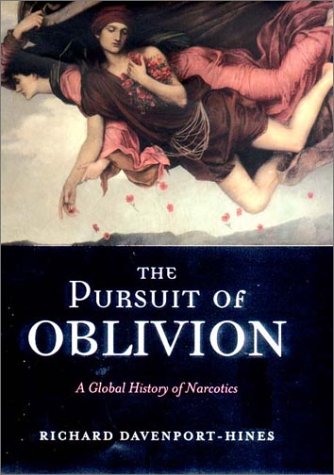
THE PURSUIT OF OBLIVION
A Global History of Narcotics
By Richard Davenport-Hines.
Illustrated. 576 pp. New
York: W. W. Norton & Company. $29.95.

From the New York Times Sunday Book Review:

September 29, 2002

‘The Pursuit of Oblivion’: Drug Taking as Part of Human Nature

By CHRISTINE KENNEALLY

In a sunless room in Bengal
in the 1670’s, a group of English sailors enacted a scene that would, in
spirit, be repeated in basements, bedrooms and alleys of the Western world
for centuries. First, they each swallowed a pint of bhang, a local drink.
One of the sailors then sat and sobbed all afternoon, another began a fistfight
with a wooden pillar, yet another inserted his head inside a large jar.
The rest sat about or lolled upon the floor. They were completely stoned.


    Psychotic,
depressed or mirthful, the sailors’ behavior was induced by bhang’s crucial
ingredient — cannabis, also known as ganja, charas, grifa, anascha, liamba,
bust, dagga, hashish, hemp and marijuana. Their drug-addled afternoon,
reported firsthand by the merchant Thomas Bowrey, who sat sweating throughout
it, is the earliest account by an Englishman of recreational cannabis use.
With this report, the English writer Richard Davenport-Hines begins ”The
Pursuit of Oblivion,” a history of drug taking that is dense with scholarship
and, because it is a ”history of emotional extremes,” highly absorbing.


    Early on, Davenport-Hines presents with appealing plainness a radical idea: ”Intoxication
is not unnatural or deviant.” This small statement shapes his book. In
refusing to view drug use through the lens of the modern criminal justice
system, Davenport-Hines extends his focus beyond the ”drug problem” or
the miseries we bring upon ourselves (though it includes many examples
of that). Instead, he sees it as part of the repertoire of normal human
activities.


    He also states that ”absolute sobriety is not a natural or primary human state.”
Humans have always used drugs, a fact that underpins ”The Pursuit of Oblivion,”
a history of the controlled and uncontrolled use of substances that alter
consciousness, shift feeling and meet an immense range of human wants and
needs. Davenport-Hines, whose books include studies of Auden and the gothic
genre, notes that his view conflicts with a prohibitionist view of drugs.
He briefly categorizes the major drug groups (opium is a narcotic, cannabis
and LSD are hallucinogens, amphetamines and coffee are stimulants) and
points out that their physiological effects have been truly understood
only in the last 30 years. He presents a multitude of capsule biographies,
official reports, literary excerpts, government inquiries and medical histories
that provide overwhelming support for the idea that drug use is not deviant
and, moreover, that it often reflects the ideal of ”human perfectibility,
the yearning for a perfect moment, the peace that comes from oblivion.”


    The documentation of specific drugs and desires is dazzling. Opium is one of the oldest known
drugs. An Egyptian papyrus describing 700 different opium mixtures (including
one for calming bothersome children) dates to 1552 B.C. Cocaine is one
of the most recent. It was first extracted in 1860 by a chemistry student,
Albert Niemann, for his doctoral thesis. In between are betel, qat, pituri,
alcohol, chloroform, mescaline and tea, among others.

    History’s drug users have been rich and poor, despairing and lighthearted, educated,
unemployed and holders of political office. They have imbibed, inhaled
and injected to allay physical discomfort, increase sexual stamina, feed
addiction, soften coughs, take a mental holiday or just feel normal. Marcel
Proust was fond of the stimulant amyl nitrate before bedtime (it helped
his asthma). Arsenic-eaters in 19th-century Austria were in search of clear
skin and a good aphrodisiac. Civil War soldiers took opium to prevent malaria
and diarrhea.


    Crawford Long, a young doctor in Jefferson, Ga., was motivated by fun. In 1842,
he staged ”ether frolics,” riotous parties where the chemical was dispensed.

When Long noticed that his guests sustained wounds while stumbling about
drunk but did not seem to feel them, he began to experiment with the drug
as a medical anesthetic, thus shaping the course of modern surgery.


    Inevitably, the story of narcotics is closely intertwined with the story of the Western
medical establishment. Yet this connection has rarely been as uncomplicated
or benevolent as Long’s ether experiment. For hundreds of years, doctors
have been users and often addicts. In the late 1800’s, most of the male
morphine addicts in the United States were physicians. Through ignorance
or therapeutic intent, they also made addicts out of many of their patients.


    Similarly, no account of drug use is complete without a thorough analysis of commerce,
global trade, politics and antidrug legislation. Dozens of perfectly legal
drug products were once available, like morphine and heroin pastilles (available
through department store catalogs in England). In the 1930’s, according
to F. Scott Fitzgerald, airline stewardesses would regularly offer barbiturates,
asking, ”Dear, do you want an aspirin? . . . or Nembutal?”


    Davenport-Hines assembles strong evidence to support his belief that criminalization has
created the modern drug problem. Indeed, history offers few examples of
punitive legislation curing addiction or ending trafficking. He contends
that because risk is closely tied to profit, enforcing laws against drug
trafficking actually increases the economic reward for those willing to
run an illegal business. The facts he cites bear him out: world coca production
doubled between 1985 and 1996. Opium production tripled.

    Because the book spans continents, millenniums and subjects, from the opium habit
of Emperor Marcus Aurelius to the invention of hypodermic needles, the
sheer volume of detail in ”The Pursuit of Oblivion” makes it demanding
to read. But it is an extremely impressive work, not just for its common-sense
argumentation and encyclopedic breadth, but also because of Davenport-Hines’s
sharp eye for a good story. He skillfully weaves anecdotes into his analyses,
like that of the Derbyshire schoolteacher in 1911 who demanded that a pupil
tell him why the geography class was so sleepy. The reply: ”Percy Toplis
brought in a bottle of laudanum, Sir, and passed it round the class, Sir.”


    ”The Pursuit of Oblivion” follows a long trail of desire, despair and bad decisions,
and it is impossible not to feel a sense of connection with many of its
case studies. Whether or not the book’s readers are personally familiar
with the effects of narcotics, they will understand at least some of the
emotions that surround their use. After all, who hasn’t longed for oblivion
or dreamed of ecstasy? Who hasn’t wished for something, anything, to take
the edge off daily life?

Christine Kenneally is writing a book about the evolution of language.

WIRE, RE-ACTIVATED

From posteverything.com:

The legendary “art” combo
Wire was formed in 1976 in the midst of the first flush of punk’s youth
but immediately diverged from the “pogo” standard thrash with a combination
of a sparse aesthetic, obtuse lyrics and a much vaunted (but never charted!)
“pop sensibility”. Through the Seventies they released three classic albums
on EMI‚s Harvest label building a formidable reputation based on a rapid
evolution of style until one band could no longer contain the prodigious
output of it’s members and Wire went into one of it’s periodic hibernations.
During the eighties the band returned embracing a more electronic sound
and a series of albums for Mute records followed, the sound became even
more diverse as they became embraced by the indie generation. By 1990 phase
2 was complete and after one drummer-less album a second more protracted
hibernation ensued.


    It was not until the 2nd Millennium was almost complete that Wire were again curious
enough to venture abroad again. Physical temptation took the form of an
invitation to headline & curate a night at the prestigious Royal Festival
Hall. Wire now have their own imprint pinkflag through which they are
starting to release a series of increasingly adventurous items currently
taking the form of the “read & burn” series. Do not expect every read
& burn to appear in the shops.
Always expect read & burns to
be available through posteverything!!


    Wire are Colin Newman, Graham Lewis, Bruce Gilbert & Robert Gotobed.

READ
& BURN – 02


WIRE 1 Oct 2002

PF5 [CD]

01  ‘Read & Burn (2:35)’
02  ‘Spent (4:43)’

03  ‘Trash/ Treasure
(5:07)’


04  ‘Nice Streets Above (2:50)’

05  ‘Raft Ants (2:05)’
06  ‘99.9 (7:38)’

Pinkflag proudly present the much anticipated follow up to WIRE‚s „Read & Burn 01‰ in the shape
of „Read & Burn 02‰.

Unlike „01‰ Read & Burn
02 will be available exclusively to posteverything customers (from 2nd
September 2002) and attendees of Wire‚s forthcoming shows in North America
& Europe this Autumn. This item will not be available in shops or via
any other mailorder service.


All posteverything mail
order customers will have the added bonus of an included special item.
This time this will be a sample of a WIRE designed fragrance „The smell
of YOU‰.

READ
& BURN – 01


WIRE 17 Jun 2002

PF4 [CD]

01  ‘In the Art of
Stopping’

02  ‘I Don’t Understand’

03  ‘Comet’

04  ‘Germ Ship’

05  ‘First Fast’

06  ‘The Agfers of
Kodack’

Pinkflag proudly unveil the
first wholly new wire release for over 10 years. This landmark release
marks the 1st shot in the „Read and Burn‰ series of sixpacks. In an offer
exclusive to mail order customers only, the CD will be dispatched with
a signed, limited edition print, featuring the band, excerpted from the
forthcoming video. Those unfamilar with Wire’s recent doings read on..

SEMINAL (ADJECTIVE) -CONTAINING
OR CONTRIBUTING THE SEEDS OF LATER DEVELOPMENT : CREATIVE, ORIGINAL.


REGROUPING FOR LIVE PERFORMANCE
IN 1999, THE HUGELY INFLUENTIAL WIRE HAVE ABLY DEMONSTRATED, VIA SELL-OUT
SHOWS EVERYWHERE FROM THE ROYAL FESTIVAL HALL TO THE GARAGE, THAT THEIR
FIRE STILL BURNS SOME 20 YEARS ON FROM THEIR FIRST ANGULAR BROADCASTS,
WOWING AUDIENCES MADE UP EQUALLY OF DEVOTED DISCIPLES AND CURIOUS YOUTH,
WINNING RESOUNDING CRITICAL APPROVAL OF THE “ELDER STATESMEN STILL ROCK
LIKE ANGRY YOUNG MEN” VARIETY.


READ & BURN 01 ? IS
THE FIRST PHASE OF A SERIES OF NEW WORKS AND STAGE APPEARANCES PLANNED
FOR THIS YEAR AND ON INTO 2003, MARKING A FIERCE RETURN TO RECORDING FOR
THE BAND, SETTING A STANDARD THAT MANY OF TODAY’S NEW CHASERS OF ART-ROCK’S
GOLDEN FLEECE WILL BE HARD PRESSED TO EMULATE (AND HOW THEY’VE TRIED IN
THE PAST!), AND SERVING EMPHATIC NOTICE THAT THE GAUNTLET IS DOWN.

COMMITTED FOLLOWERS WILL
NOD IN APPROVAL AT THE SLY REFERENCING OF ELEMENTS OF EARLIER MATERIAL.
THE KIDS WILL BE TOO BUSY RESPONDING TO THE DEMANDS OF THEIR ADRENAL GLANDS
AS THEY BOUNCE THEIR HEADS OFF WALLS IN UNISON WITH THE CARCRASHING DYNAMISM
AND DOGGED, UNYIELDING TEMPOS. THE SIX TRACKS OF READ & BURN 01 EACH
HITTING THE 3 MINUTE MARK WITH DEADEYE ACCURACY, RIDE THE LINE FROM PUNK
TO ROCK AND BACK AGAIN WITH NERVE-JARRING IMMEDIACY, DRESSED AND STYLISHLY
ACCESSORISED WITH STATE OF THE ART PRODUCTION VALUES. WHICH MEANS, IN SHORT,
LOUD AND CLEAR LIKE THE SOUND OF SHOUTING INSIDE YOUR OWN SKULL. (Capitalised
propaganda courtesy Bill Dolen)

WIRE will be taking part
in an evening of performances to launch Iain Sinclair‚s “M25 London
Orbital” which has a soundtrack composed by WIRE’s Bruce Gilbert at the
Barbican on Friday 25th October @ 7.30 pm. The Barbican’s website says
: “Based on and inspired by Iain Sinclair‚s ŒLondon Orbital‚, this extraordinary
performance brings together readings by Iain Sinclair, J.G.Ballard, Bill
Drummond and Ken Campbell; Chris Petit‚s specially shot and manipulated
M25 film and new music performed live by WIRE, Scanner and Jimmy Cauty.”

HOW CORPORATE GLOBALIZATION DESTROYS AND THEN ‘GREENWASHES’ ITS ACTIVITIES.

The Lacandon Jungle’s Last Stand Against Corporate Globalization

Plan Puebla Panama and the fight to preserve biodiversity and indigenous rights in Chiapas

By Ryan Zinn

Special to CorpWatch

September 26, 2002

Montes Azules, Mexico —
A battle is raging in Chiapas’ Montes Azules Integral Biosphere, Mexico’s
Garden of Eden. The last stand against corporate resource exploitation
is taking place in this remote, lush tropical jungle, home to Mayan communities.
Best known for ancient pyramids and endangered species like the toucan
and jaguar, this modern day “El Dorado” is now threatened by the search
for black and green gold: oil and biodiversity.


    Caught in the cross-fire are indigenous communities, many of them Zapatista supporters,
who are resisting the devastating effects of corporate globalization. The
zone has recently been marred by violence and plagued by paramilitary attacks
against these communities. Local residents believe the attacks to be the
latest stage in the Mexican government’s efforts to oust indigenous people
from the Biosphere.

Continue reading

BUT WILL THEY TOUR?

“An elephant orchestra plays drums, wind instruments and a foot-operated gong at Thailand’s Elephant
Conservation Centre in Lampang, 600 km north of Bangkok, on September 8, 2002.


“Buoyed by the success of their first compact disc, Californian-born resident conservationist Richard
Lair and compatriot musician Dave Soldier are putting together a second CD featuring an ensemble orchestra of 11 elephants, some rescued from a brutal life on the streets of Bangkok, who play everything from xylophones to drums and wind instruments.”

Zen and axial-symmetry skeletons of stimulus shapes

from msnbc:

Scientists unlock Zen garden’s secret
Analysis reveals a hidden tree among rocks

Sept. 25 ˜  For centuries, visitors to the renowned Ryoanji Temple garden in Kyoto, Japan, have been
entranced by the simple arrangement of rocks. The five sparse clusters on a rectangle of raked gravel are said to be pleasing to the eyes of the hundreds of thousands of tourists who visit the garden each year. Scientists now believe they have discovered its mysterious appeal.

       
“WE HAVE UNCOVERED the implicit structure of the Ryoanji garden’s visual ground and have shown that it includes an abstract, minimalist depiction of natural scenery,” said Gert Van Tonder of Kyoto University.

      
The researchers discovered that the empty space of the Zen Buddhist temple’s garden evokes a hidden image of a branching tree that is sensed by the unconscious mind.


 “We believe that the unconscious perception of this pattern contributes to the enigmatic appeal of the garden,” Van Tonder added.

He and his colleagues believe that whoever created the garden during the Muromachi era between 1333-1573 knew exactly what they were doing, and that the placement of the rocks was “not accidental.

      
Through the centuries, various meanings have been read into the rock placement — one view holds that the rocks symbolize a tigress crossing the sea with her cubs, while another contends that the pattern represents the strokes of a Chinese character meaning “heart” or “mind.”

      
However, such interpretations don’t explain the attraction the garden holds even for the uninitiated, the researchers reported in Thursday’s issue of the journal Nature.

To look for deeper patterns, the scientists used a concept called medial-axis transformation, a scheme for analyzing shapes that is widely used in image processing and studies of visual perception.
    
To understand the concept of medial-axis transformation, imagine drawing the outline of a shape in a field of dry grass and then setting it alight: The medial axis is the set of points where the inwardly propagating fires meet, the researchers explained. It has been shown that humans have an unconscious visual sensitivity to the axial-symmetry skeletons of stimulus shapes.

      
The analysis revealed what appeared to be a tree with branches that separated the elements of the rock arrangement. A widening trunk leads to a point in the garden’s main hall that is considered the prime viewing spot — as well as to an alcove containing a Buddhist statue.

       
Random changes in the location of the five rock clusters would destroy the image, the researchers said.

      
They said abstract art may have an impact similar to that of the Ryoanji Temple’s garden, which has helped earn Kyoto’s monuments the status of a UNESCO World Heritage Site.

   
“There is a growing realization that scientific analysis can reveal unexpected structural features hidden in controversial abstract paintings,” Van Tonder and his colleagues observed.

“PATIENCE HAS ITS LIMITS.”

AMMAN, Jordan (AP) Witnesses say a Jordanian woman ripped off her enveloping black cloak and veil ˜
to reveal a traditional long dress that was nearly as enveloping and punched and kicked into submission three young men who had been verbally harassing her.


    The official Petra News Agency reported Sunday that shopkeepers and passers-by believe the unidentified woman must have had martial arts training. In Friday’s incident on the main street in Zarqa 13 miles north Amman, the three men were too shocked to react at first and ended up knocked to the ground, screaming in pain. They then scrambled up and fled.

    The woman quoted the title of a song made famous by the late Egyptian star Umm Kalthoum
— “patience has its limits” — before continuing on her way as a crowd cheered her.


    Petra quoted witnesses as saying the three men had regularly directed obscenities at the woman as she walked in the area. It was not clear if they harassed other women as well.

THANKS: JB.