PROMETHEA'S FINAL ISSUE.

PROMETHEA #32
Written by Alan Moore
Art and cover by J.H. Williams III
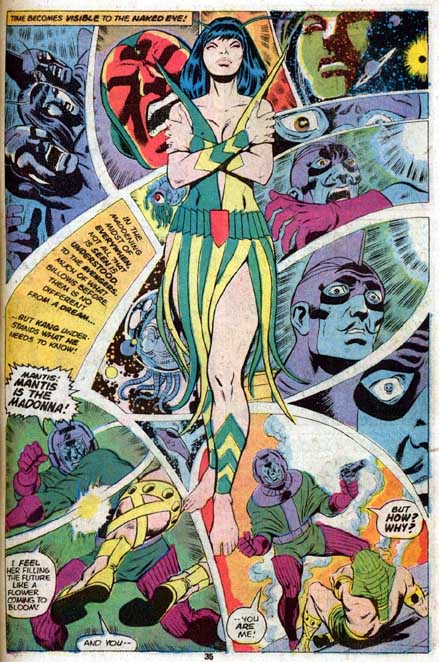
ABC. In a series that pushed the boundaries of mainstream comics to the edge, this unbelievable final issue goes a little bit further! Alan Moore and J.H. Williams III deliver the most gloriously experimental issue of PROMETHEA yet, in which the reader takes an incredible trip through the magical cosmos with Promethea as a guide.
But there’s more! While other comics allow the reader only one way to read a book, this issue gives you several options – one of which is assembling its 32 pages into a giant double-sided poster. Once the poster has been assembled, the pages form two lovely images (one on each side) that are only discernible as a complete entity! Final issue.
On sale Feb 9 o 32 pg (no ads), FC, $3.95 US

PROMETHEA #32 VARIANT EDITION
Written by Alan Moore
Art and cover by J.H. Williams III
ABC. In celebration of the final issue of PROMETHEA, America’s Best Comics is pleased to offer something truly unique: a variant version of issue #32 printed completely on two 27″ x 40″ posters! Each page of this groundbreaking issue comes together to form these two posters in which the entire story can be read in multiple ways. Just as important, the posters reveal two hidden images from the book that are only visible in poster format – something completely new to comics!
In addition, the PROMETHEA #32 VARIANT EDITION comes with a lovely saddle-stitched, 48-page companion book that collects each and every PROMETHEA cover illustrated by J.H. Williams. And as a bonus, each book will be signed by Moore and Williams! Retailers please note: This edition is limited to 1,000 units; orders may be allocated. A limited number of unsigned copies of the PROMETHEA COVER COLLECTION will be offered for sale at a later date.
On sale Feb 9 o Two 27″ x 40″ full-color posters
and 48-pg. comic, FC, $49.95 US

"The psychedelic sense of self may actually be truer than the common dualist view."

“A Window on the Mind” by Susan Blackmore
New Scientist, 13 November 2004 p 36: box within cover story “The Intoxication Instinct”

Note: This is the original version, and was slightly edited for publication.

Psychedelic drugs provide some of the best evidence we have that the mind is the brain; that our thoughts, beliefs, and perceptions are created by chemistry. Take a drug, particularly a hallucinogen, and any of these can change, and even our innermost selves can be quite transformed. This means these drugs can be scary, and need to be taken with great care and respect, for they can potentially reveal some of the deepest secrets about our minds and consciousness.

A century ago, long before prohibition, the groundwork of a science of intoxication was already being laid down, and the American psychologist, William James, experimented with the anaesthetic, nitrous oxide or “laughing gas.” Our normal rational consciousness, he said, is just one special type of consciousness, while all around it, “parted from it by the filmiest of screens” are other entirely different forms of consciousness, always available if only the requisite stimulus is applied.

Other experimenters meticulously described the effects of inhaling ether, chloroform or cannabis, and the strange distortions of time, perception, and sense of humour this induced. More curiously, they also described changes in belief, and even in philosophy. For example, nitrous oxide has the curious capacity to change materialist scientists into idealists. Its discoverer, Sir Humphrey Davy, bravely took the drug himself as an experiment in 1799 and ended up exclaiming that “Nothing exists but thoughts.” Others made similar observations and found their views profoundly shifted by even brief encounters with the other side of that filmy screen.

This raises the peculiar question of whether what James’s called “our normal rational consciousness” is necessarily the best for understanding the world. After all, if one’s view of the world can change so dramatically with the aid of a simple molecule like nitrous oxide, how can we be sure that our normal brain chemistry is the one most suited to doing science and philosophy? What if evolution had taken a slightly different turn and we had ended up with brain chemistry less inclined to make us believe in God or the afterlife. Or what if our actual brain chemistry evolved to help us survive and reproduce at the cost of giving us false beliefs about the world? If so, it is possible that mind-altering drugs might in fact give us a better, not worse, insight than we have in our so-called normal state.

Take the common experience of losing our separate self, or becoming one with the universe. This may seem, to some, like mystical nonsense, but in fact it fits far better with a scientific understanding of the world than our normal dualist view. Most of us feel, most of the time, that we are some kind of separate self who inhabits our body like a driver in a car or a pilot in a plane. We speak about “my body” and even “my brain” as though “I” were something separate from them both. Throughout history many people have believed in a soul or spirit that can leave the body and even survive after death. Yet science has long known that this cannot be so. There is no observer inside the brain who has our experiences, and no space in the brain from where an inner self can control it. There is just a brain that is made of exactly the same kind of stuff as the world around it. In other words, we really are one with the universe.

This means that the psychedelic sense of self may actually be truer than the common dualist view. So although our normal state is better for surviving and reproducing, it may not always be best for understanding who and what we are. Perhaps we could even have sciences carried out in some of these intoxicated states. This was just what psychologist, Charles Tart, suggested in 1972, in the prestigious journal Science. He likened different states of consciousness to different paradigms in science and proposed the creation of “state specific sciences”; new sciences which would be done by scientists working in altered states and communicating their findings to others in those states. These new sciences might only have limited application but this makes the point that our normal state, constrained as it is by the particular chemistry evolution has given us, may not be the only way to try to understand the universe.

Since Tart’s pioneering work on mapping altered states, most of the psychedelic drugs have become prohibited and research has largely been stifled. While the cultures that have used these drugs for millennia treat them with great respect, and control them with elaborate rituals and traditions, our culture gives over their control to criminals and tries to deny their amazing mind-revealing capacities. Perhaps one day, when prohibition is finally abandoned, scientists may once again take up the promise offered by those tiny little chemicals that can tell us who and what we are.

"I wish I had just freaking died over there."

From the Los Angeles Times

These Unseen Wounds Cut Deep

A mental health crisis is emerging, with one in six returning soldiers afflicted, experts say.
By Esther Schrader
Times Staff Writer

November 14, 2004

WASHINGTON–Matt LaBranche got the tattoos at a seedy place down the street from the Army hospital here where he was a patient in the psychiatric ward.

The pain of the needle felt good to the 40-year-old former Army sergeant, whose memories of his nine months as a machine-gunner in Iraq had left him, he said, “feeling dead inside.” LaBranche’s back is now covered in images, the largest the dark outline of a sword. Drawn from his neck to the small of his back, it is emblazoned with the words LaBranche says encapsulate the war’s effect on him: “I’ve come to bring you hell.”

In soldiers like LaBranche–their bodies whole but their psyches deeply wounded–a crisis is unfolding, mental health experts say. One out of six soldiers returning from Iraq is suffering the effects of post-traumatic stress–and as more come home, that number is widely expected to grow.

The Pentagon, which did not anticipate the extent of the problem, is scrambling to find resources to address it.

A study by the Walter Reed Army Institute of Research found that 15.6% of Marines and 17.1% of soldiers surveyed after they returned from Iraq suffered major depression, generalized anxiety or post-traumatic stress disorder — a debilitating, sometimes lifelong change in the brain’s chemistry that can include flashbacks, sleep disorders, panic attacks, violent outbursts, acute anxiety and emotional numbness.

Army and Veterans Administration mental health experts say there is reason to believe the war’s ultimate psychological fallout will worsen. The Army survey of 6,200 soldiers and Marines included only troops willing to report their problems. The study did not look at reservists, who tend to suffer a higher rate of psychological injury than career Marines and soldiers. And the soldiers in the study served in the early months of the war, when tours were shorter and before the Iraqi insurgency took shape.

“The bad news is that the study underestimated the prevalence of what we are going to see down the road,” said Dr. Matthew J. Friedman, a professor of psychiatry and pharmacology at Dartmouth Medical School who is executive director of the VA’s National Center for Post Traumatic Stress Disorder.

Since the study was completed, Friedman said: “The complexion of the war has changed into a grueling counterinsurgency. And that may be very important in terms of the potential toxicity of this combat experience.”

Mental health professionals say they fear the system is not moving fast enough to treat the trauma. They say slowness to recognize what was happening to Vietnam veterans contributed to the psychological devastation from that war.

More than 30% of Vietnam veterans eventually suffered from the condition that more than a decade later was given the name post-traumatic stress disorder. But since their distress was not clinically understood until long after the war ended, most went for years without meaningful treatment.

“When we missed the boat with the Vietnam vets, we didn’t get another chance,” said Jerry Clark, director of the veterans clinic in Alexandria, Va. “When they left the service, they went away not for a month or two but for 10 years. And they came back addicted, incarcerated and all these things. We can’t miss the boat again. It is imperative.”

Experts on post-traumatic stress disorder say it should come as no surprise that some of the soldiers in Iraq are fighting mental illness.

Combat stress disorders– named and renamed but strikingly alike — have ruined lives following every war in history. Homer’s Achilles may have suffered from some form of it. Combat stress was documented in the late 19th century after the Franco-Prussian War. After the Civil War, doctors called the condition “nostalgia,” or “soldiers heart.” In World War I, soldiers were said to suffer shell shock; in World War II and Korea, combat fatigue or battle fatigue.

But it wasn’t until 1985 that the American Psychiatric Assn. finally gave a name to the condition that had sent tens of thousands of Vietnam veterans into lives of homelessness, crime or despair.

A war like the one in Iraq — in which a child is as likely to die as a soldier and unseen enemies detonate bombs — presents ideal conditions for its rise.

Yet the Army initially sent far too few psychiatrists, psychologists and social workers to combat areas, an Army study released in the summer of 2003 found. Until this year, Congress had allocated no new funds to deal with the mental health effects of the war in Iraq. And when it did earmark money, the sum was minimal: $5 million in each of the next three years.

“We’re gearing ourselves up now and preparing ourselves to meet whatever the need is, but clearly this is something that could not be planned for,” said Dr. Alfonso Batres, a psychologist who heads the VA’s national office of readjustment counseling services.

Last year, 1,100 troops who had fought in Iraq or Afghanistan came to VA clinics seeking help for symptoms of depression or post-traumatic stress; this year, the number grew tenfold. In all, 23% of Iraq veterans treated at VA facilities have been diagnosed with post-traumatic stress disorder.

“And this is first-year data,” Batres said. “Our experience is that over time that will increase.”

In the red brick buildings of Walter Reed Army Medical Center, the “psych patients,” as they are known, mingle, sometimes uncomfortably, with those who have lost limbs and organs.

One soldier being treated at Walter Reed, who spoke on condition of anonymity, walks the hospital campus in the bloodied combat boots of a friend he watched bleed to death.

Another Iraq veteran in treatment at Walter Reed, Army 1st Lt. Jullian Philip Goodrum, drives most mornings to nearby Silver Spring, Md., seeking the solitude of movies and the solace of friends.

He leaves early to avoid traffic — the crush of cars makes him jumpy. On more than one occasion, he has imagined snipers with their sights on him in the streets. Diesel fumes cause flashbacks. He keeps a vial of medication in his pocket and pops a pill when he gets nervous.

“You question — outside of dealing with your psych injury, which will affect you from one degree or another throughout your life — you also question yourself,” Goodrum said. “I trained. I was an excellent soldier, a strong character. How could my mind dysfunction?”

When it began to become clear that what the Pentagon initially believed would be a rapid, clear-cut war had transmuted into a drawn-out counterinsurgency, the Army began pushing to reach and treat distressed soldiers sooner.

The number of mental health professionals deployed near frontline positions in Iraq has been increased. Suicide prevention programs are given to soldiers in the field. According to the Pentagon, 31 U.S. troops have killed themselves in Iraq.

At more than 200 storefront clinics known as Vet Centers — created in 1979 to reach out to Vietnam veterans — the VA has increased the number of group therapy sessions and staff. Three months ago, the VA hired 50 Iraq war veterans to help serve as advocates at the clinics.

Officials acknowledge that is only a start. The Government Accountability Office found in a study released in September that the VA lacked the information it needed to determine whether it could meet an increased demand for services.

“Predicting which veterans will seek VA care and at which facilities is inherently uncertain,” the report concluded, “particularly given that the symptoms of PTSD may not appear for years.”

The Army and the VA are also trying to catalog and research the mental health effects of this war better than they have in the past. In addition to the Walter Reed study, several more are tracking soldiers from before their deployment to Iraq through their combat experiences and into the future.

If Iraq veterans can be helped sooner, they may fare better than those who fought in Vietnam, mental health experts say. And they note that the nation, although divided on the Iraq war, is more united in caring for the needs of returning soldiers than it was in the Vietnam era. And in the last decade, new techniques have proved effective in treating stress disorders, among them cognitive-behavioral therapy and drugs like Zoloft and Paxil.

Whether people like Matt LaBranche seek and receive treatment will determine how deep an effect the stress of the war in Iraq ultimately has on U.S. society.

Before the war, LaBranche was living in Saco, Maine, with his wife and children and had no history of mental illness.

He deployed to Iraq with a National Guard transportation company based in Bangor. He came home a different person.

Just three days after he was discharged from Walter Reed, he was arrested for threatening his former wife. When he goes to court Dec. 9, he could be looking at jail time.

He lies on a couch at his brother’s house most days now, struggling with the image of the Iraqi woman who died in his arms after he shot her, and the children he says caught some of his bullets. His speech is pocked with obscenities.

On a recent outing with friends, he became so enraged when he saw a Muslim family that he had to take medication to calm down.

He is seeing a therapist, but only once every two weeks.

“I’m taking enough drugs to sedate an elephant, and I still wake up dreaming about it,” LaBranche said. “I wish I had just freaking died over there.”

MAGICK BY ZORN.

John Zorn: “Magick”


Cat. #8006
Released Oct 2004
cd time – 30:08
US Price: $15.00

Further explorations into the worlds of Magick and Alchemy, here featuring the long awaited premiere recording of Zorn’s new string quartet. Necronomicon is a transcendent five movement work of unparalleled ensemble virtuosity and formal beauty, brilliantly played by the Crowley Quartet. Also included is an astounding piece of witchcraft and sorcery for two bass clarinets, one of the most difficult yet written for the instrument, performed with passion and precision by two of the greatest players in the world.

Personnel:
Tim Smith: Bass Clarinet
Mike Lowenstern: Bass Clarinet

Crowley Quartet
Jennifer Choi: Violin
Fred Sherry: Cello
Jesse Mills: Violin
Richard O’Neill: Viola

HEY RED STATERS!

from http://www.theregister.co.uk/2004/11/07/blue_state_to_reds/”

The defeated Kerry may have called for unity last week, but already radical elements inside and outside of the Democrat party are arguing for the abandonment of the old ways of cosy consensus. One such organisation, formed even as the last queues for the ballots ebbed away, styles itself “The New Democrat Outreach Program.” The Register has been contacted by one NDOP activist, styling himself Commandante Camembert, with an early draft of the organisation’s first communique to the nation. “

An open letter to the Red-State victors:

With hard work and superb organization, you have triumphed over John Kerry and the forces of Blue-state paternalism. Congratulations. The multinational corporations that hold you in bondage remain free to profit off your sweat nearly tax free, while their overpaid senior execs continue to pay a pittance in personal income tax.

Your primary and secondary schools will continue to turn out third-rate pupils with limited opportunities, while you enjoy the satisfaction of making it on your own without health care when a catastrophic illness bankrupts your family.

Your agricultural universities will continue issuing Ph.D.s in football, and bogus Protestant Evangelical and Fundamentalist theology, and how to jerk off a bull safely. Your children will learn to borrow enough money to erect chicken houses so that they, like you, can take custody — not possession, but custody — of Tyson’s chicks, feed them, rear them, assume losses from those that fail to thrive, and in the end earn just enough money to service their endless debt, and realize a profit of perhaps $12K a year. Your bank thanks you; Tyson thanks you; George W. Bush thanks you; and I thank you.

You can continue sending your sons to die in Iraq on a fool’s errand. When you bury them, you can console yourselves with Bush’s platitudes about their heroic mission to defend America from weapons of mass destruction.

You can savor the deficit spending that stimulates commerce today, but will cripple the US economy in ten or fifteen years’ time when the bills come due with interest. Perhaps a Democrat will be in office at that time, who can be blamed for W’s delayed economic fiasco.

You can continue believing, as Republican Party brainwashing has persuaded you, that we, your neighbors, are your enemies. You can believe that we have no morals; that we pimp out our teenage daughters for Internet porn; that we eat babies; that we are all gay; that we are cowards on the battlefield; and that we want to run your lives and give you AIDS.

Here’s a clue: we are not your enemies; we are your countrymen. Your enemies are the greedy multinationals that the Republican Party bends over backwards to accommodate. Incidentally, most of them are based in Blue states, as are their Republican owners and major shareholders.

Here in the Blue States, Democrats and Republicans alike generate the lion’s share of America’s wealth, although it is you Reds who provide the lion’s share of the stoop labor. You are our Mexicans, so to speak. We could not have accomplished the economic miracle that is America without your willing capitulation to a system that lies to you and fucks you over at every turn.

Look at economic output and educational achievement on a state-by-state basis: it’s painfully evident that we Blues are immensely more productive and better educated than you Reds. We have lots more money. We live longer. We eat better. We work less. We fuck more. We do cocaine and smoke fine Canadian buds, not the homebrew crank and cheap Mexican headache reefer you guys are stuck with. We drink French wine and Stoli martinis, not Budweiser. Our children rarely bother us: we’ve got them on Ritalin and Prozac. Our teeth are straighter and whiter, our necks longer, and our fingernails cleaner. And many of us are the Republican elite who have just punked you.

It’s good to be a Blue, regardless of which party you join.

Understandably, you resent us, so you’ve fabricated an imaginary measure of superiority: Christian “values.” Yet you talk about values the way a pre-teen girl talks about “love” in fan letters to Ashton Kutcher. You recycle quasi-religious platitudes and received slogans. You know nothing of moral theology, a rigorous philosophical pursuit that hardly exists outside the Catholic Church and its elite universities. You make of the Bible what you will; you attend prayer meetings with other semi-literates, where you reinforce each other’s sloppy understandings of the text, and combine them with half-digested bits of old-timey Hallmark-card “wisdom.” And when you spout gibberish, you call it “speaking in tongues.” You actually fancy that you’re saints, you silly, narcissistic creatures.

Nevertheless, you are fellow Americans. The Blue Republican elite encouraged you to vote for George W Bush, because they quite simply own him, and they know that his administration will make policies that help them, even if hurt you. We Blue Democrats voted for John Kerry because we believed he would minister to your needs better than Bush. A President Kerry would have shared some of our wealth with you, assured your health care, raised the minimum wage, and checked the rapacious greed of the multinationals that hold you in thrall.

President Kerry would have helped us to help you, which is all that we ask. It pains us to see you in wage slavery. It pains us to see you so ignorant and uneducated, and so eager to place yourselves in bondage. Yes, we live better; but we wish you to live better too, even if it means sacrifice on our part.

What we wanted for you would have been far better than that which you, in your ignorant pride, demanded for yourselves. Oh, you defeated us all right, but only to your detriment.

We Blues will come out of the Bush era no worse for wear, although you Reds will come out very much diminished, deeper in debt, and less able to improve your circumstances by your own powers. But because you wish to be flattered more than helped, you will be grateful for your ass fucking from the Blue-state Republican elite that is laughing behind your backs today.

We did not wish it so. We honestly did want to help.

On 2 November, you thanked us by electing a shrewd, manipulative handmaiden to corporate America who panders to you while ruthlessly exploiting your ignorance and weakness for the benefit of his patrons in the national plutocracy. There is nothing we can do about that. You won fair and square.

We should let you rot. We should secede and leave you to fend for yourselves. Then you will see firsthand just how dependent you are. We are sick of fighting for you by fighting against you. Perhaps, when you see how dreary your lives have become without us, you will finally develop the spine to fight for your basic, human rights. And then we will gladly confront the plutocracy alongside you. We need your help to defeat the Blue Republicans, who, I assure you, are just as decadent as we are, though often richer.

But until you finally learn to respect yourselves, we can’t respect you, and we therefore can’t be bothered to give a rat’s ass about you.

So let us secede, Blue America and Red America. We can handle the Blue state Republicans, so long as we don’t have a lot of ignorant Red state lemmings frustrating our efforts and screwing themselves in the bargain. Secession will enable us both to live as we have chosen without the other’s interference. We will prosper, and you will get a clue.

But do stay in touch after the borders slam shut. When you finally tire of living on the modern, corporate plantations of Cargill, Tyson, ConAgra and Smithfield; when you tire of shopping at Wal-Mart and sending your daughters to sling hash at Denny’s in hopes that they’ll meet the nicer sort of truck driver; when you tire of sneaking into Blue America as illegal white-trash wetbacks eager for casual work dusting our parlors; and when, like men, you finally rise up in rebellion against this immoral usury — then, and only then, let us talk.

We’ll gladly get your backs. But first you must grow the brains and the balls needed to profit from our help.

COURTESY J. COULTHART!