Traumatized soldiers on Ecstasy.

Ecstasy trials for combat stress

David Adam, science correspondent
Thursday February 17, 2005
The Guardian:

American soldiers traumatised by fighting in Iraq and Afghanistan are to be offered the drug ecstasy to help free them of flashbacks and recurring nightmares.

The US food and drug administration has given the go-ahead for the soldiers to be included in an experiment to see if MDMA, the active ingredient in ecstasy, can treat post-traumatic stress disorder.

Scientists behind the trial in South Carolina think the feelings of emotional closeness reported by those taking the drug could help the soldiers talk about their experiences to therapists. Several victims of rape and sexual abuse with post-traumatic stress disorder, for whom existing treatments are ineffective, have been given MDMA since the research began last year.

Michael Mithoefer, the psychiatrist leading the trial, said: “It’s looking very promising. It’s too early to draw any conclusions but in these treatment-resistant people so far the results are encouraging.

“People are able to connect more deeply on an emotional level with the fact they are safe now.”

He is about to advertise for war veterans who fought in the last five years to join the study.

According to the US national centre for post-traumatic stress disorder, up to 30% of combat veterans suffer from the condition at some point in their lives.

Known as shell shock during the first world war and combat fatigue in the second, the condition is characterised by intrusive memories, panic attacks and the avoidance of situations which might force sufferers to relive their wartime experiences.

Dr Mithoefer said the MDMA helped people discuss traumatic situations without triggering anxiety.

“It appears to act as a catalyst to help people move through whatever’s been blocking their success in therapy.”

Continue reading

Starting in the Middle of the Day, We Can Drink Our Politics Away

Matching Mole
Little Red Record
Columbia (COL 471488-2)
UK 1972

Dave McRae, Grahnd Piahno, electric piano, Hammond Organ; Robert Wyatt, drums, mouth; Phil Miller, guitars; Bill MaCormick, bass; with Brian Eno, synthesizer

Tracklist:
1. Starting in the Middle of the Day, We Can Drink Our Politics Away – 2:31
2. Marchides – 8:25
3. Nan True’s Hole – 3:36
4. Righteous Rhumba – 2:50
5. Brandy as in Benj – 4:24
6. Gloria Gloom – 8:06
7. God Song – 2:59
8. Flora Fidgit – 3:26
9. Smoke Signal – 6:37

From http://www.progreviews.com/reviews/display.php?rev=mm-lrr
Joe:
“The second Matching Mole studio album is generally considered to be the more consistent of the two they released. Also of interest, it was the album that introduced Robert Fripp (producer) to Brian Eno (guest synth player). The first song, “Starting in the Middle of the Day…” shows the craftier moments of the band, with frenetic piano lines from McRae bouncing off of Wyatt’s disguised vocals. “God Song” is a bit of socialist angst from Wyatt, played against a delicate acoustic guitar backdrop from Miller. Although a bit overdone in the lyrics department, at least it doesn’t take itself too seriously and truth be told, it does contain some witty lines. “Nan True’s Hole,” features the catchiest riff on the album (indeed, that’s pretty much all the song is) and a hilarious cameo from Alfreda Benge (Wyatt’s wife), who provides dual voices for a bewildered prostitute and her sheepish, 40-year old customer. “Marchides,” powered by Wyatt’s forceful drumming, seems taken straight from the Soft Machine engine, and will please those fans uncertain of exploring Wyatt’s post-Softs waters. Much of the rest of the album, however, doesn’t particularly stick with me, and mileage will vary for how much you can take of Wyatt’s lyrics. But besides that: da Komrade, da!”

Gary N:
“I’d only had the faint notion that Matching Mole was some kind of Soft Machine spinoff (the name being taken from the French for “Soft Machine”: Machine Molle), but didn’t realize the rest of the impressive genealogy until I stumbled upon this album (and also noticed it was produced by Robert Fripp). I was certainly not disappointed. As has been stated repeatedly elsewhere, this album was a marked change from their debut in that it was more of a band effort than their first release, which was commandeered almost entirely by Wyatt. The difference is… well, less Wyatt, and more instrumental input from everyone, resulting in a nice combination of spacey jazz and groovy jams, with Wyatt sticking to the skins more so than on their first. I actually gained quite an appreciation for his lyrics and voice, which hadn’t made as much an impression on me in Soft Machine, thanks to “God Song”, on which he lends his humorous philosophy to a quiet and somber tune by Phil Miller. For the most part, though, all members of the band shine brightly on this album, and the whole thing has a comfortable loose concept feel to it, applying wit and experimentation throughout with some great composition coupled with jamming by seasoned musicians.

Seance in the sixth fret…

From Perfect Sound Forever:
“It is difficult to describe the music of Exuma. Many times, there is not much in the way of instrumentation; most of the songs are anchored around his singing and acoustic guitar playing. It is undeniably African-influenced, with much exotic percussion, but it is also grounded in Voodoo beliefs found in the West Indies. His guitar playing is solid, but not flashy. He once said in an
interview, “I only know a few chords, but I can stretch them out!” His greatest instrument was his voice. It was a thing of ragged beauty. Neither too high nor low, it compelled and beckoned, sounding as if he had experienced many things in many planes.

On the first album of Exuma (called Exuma, but subtitled “Fire”) you hear a wolf’s howl, acoustic guitar, bongos and bells. Then a gravelly voice sings:

“I came down on a lightning bolt
Nine months in my Mama’s belly.
When I was born, the midwife scream and shout,
I had fire crystals coming out of my mouth
I’m Exuma, I’m the Obeah Man!”

The lyrics get even more colorful after this, if you can believe it. He makes mention of walking with Charon (the ferryman at the River Styx) and Hector Hippolyte (artist and Voodoo priest). The backing vocals are dolorous and chant-like; there are bird calls and the whole affair ends with a sonic boom.

Then, the SECOND song starts up!

This was 1970. The Guess Who were angering certain people with their song, “American Woman”, which some took to be anti-patriotic, so one can only gather what the reaction to this album would have engendered among the same factions.

One track, “Seance in the Sixth Fret,” is exactly that; a seance. While “Black Mass” by Lucifer (Mort Garson) has a simulation of a seance on it, the listener can become detached, as the album is played entirely on synthesizer. This doesn’t feel simulated (there is musical backing, but the words are prose, not poetry), even if no dead people spoke to anyone involved with the record. He calls out the names of three deceased people and there are sound effects; not quite a field recording, nor does it have the feel of an Andy Hardy musical in which Mickey Rooney turns to Judy Garland, and says “Hey, let’s put on a seance!”

The illustrations on the album are also rather odd. An anguished face on the cover, the foldout picture features two white, silhouetted profiles looking in opposite directions, reminiscent of the Greek God Janus, with two wings behind it. The back cover features a butterfly, whose wings feature two sets of eyes, one set eerily reminiscent of the eyes of the anguished face on the front cover!

COURTESY JOSEPH M.!

NO ONE PREDICTED A SOFA RIOT AT IKEA.

‘Slowly but steadily, madness descended’

by Mark Oliver
The Guardian Thursday February 10, 2005

At one minute past midnight last night, Ikea’s new flagship store opened in north London, and managers expected that around 2,000 bargain-hunters would quietly file in. The British, after all, have a reputation for being decorous queuers.

But Ikea had not predicted that up to 6,000 people would descend on the new store, in Edmonton, with a stampede to get in resulting in a frightening crush.

Thousands had been lured by bargains – some of which were only available until 3am even though a 24-hour opening was planned – such as 500 leather sofas for only ¬£45. Cars were abandoned on the roadside as shoppers attempted to reach the store in time to secure the best offers.

Six people were taken to hospital, including a man in his 20s who was stabbed nearby at around 1.30am. He was said to be in a stable condition, and it was not clear whether the incident was related to the opening.

Continue reading

War as a perversion of sex.

“War is a perversion of sex. You only have to look at things like the language of war, any of these excitable young American pilots coming back from bombing Libya, and they’re saying: ‘Yeah, we shot our missiles right up their back door.’ Homoerotic. They will also, just before they attack somewhere, generally launch a sort of propaganda campaign saying the enemy is a homosexual… They have to make him into a woman. The Ayatollah Khomeini: ‘Oh yeah, he likes little boys,’ that’s what we were saying just before we bombed the shit out of Iran, or were going to, or that Colonel Gadaffi: ‘He dresses up as a woman,’ this was the CIA rumor put around just before we bombed Tripoli…there’s a lot of connections between war and eroticism.” — Alan Moore interview, 2002

Friday, February 4, 2005 Posted: 11:02 AM EST (1602 GMT)

WASHINGTON (CNN) — A three-star Marine general who said it was “fun to shoot some people” should have chosen his words more carefully, the Marine Corps commandant said Thursday.
Lt. Gen. James Mattis, who commanded Marine expeditions in Afghanistan and Iraq, made the comments Tuesday during a panel discussion in San Diego, California.
“Actually it’s quite fun to fight them, you know. It’s a hell of a hoot,” Mattis said, prompting laughter from some military members in the audience. “It’s fun to shoot some people…You go into Afghanistan, you got guys who slap women around for five years because they didn’t wear a veil. You know, guys like that ain’t got no manhood left anyway. So it’s a hell of a lot of fun to shoot them.

Mattis’ press office has not yet responded to a request to answer questions about his comments.

However, the Marine commandant, Gen. Michael Hagee, defended Mattis, calling him “one of this country’s bravest and most experienced military leaders.”

Penance for his Pentagon work…

“Located in the Cathedral, the Great Stalacpipe Organ is the world’s largest musical instrument.
Stalactites covering 3 1/2 acres of the surrounding caverns produce tones of symphonic quality when electronically tapped by rubber-tipped mallets. This most unique, one-of-a-kind instrument was invented in 1954 by Mr. Leland W. Sprinkle of Springfield, Virginia, a mathematician and electronic scientist at the Pentagon. He began his monumental 3 year project by searching the vast chambers of the caverns selecting stalactites to precisely match a musical scale. Electronic mallets were wired throughout the caverns and connected to a large four-manual console. When a key is depressed, a tone occurs as the rubber-tipped plunger strikes the stalactite tuned to concert pitch.
“Today, the organ is played by activating an automated system which works in a manner similar to a child’s music box. The organ is also fully capable of being played manually from the console, as Leland Sprinkle did for many years.”

COURTESY PETER R.!

Spiritualism and art…

The Spiritual in Art: Abstract Painting, 1890-1985
Edited by Maurice Tuchman

Around 1910, groups of artists moved away from representational art toward abstraction, preferring symbolism. They made an effort to draw upon deeper and more varied levels of meaning, the most pervasive being spiritualism. This book demonstrates that the genesis and development of abstract art were inextricably tied to spiritual ideas current in Europe in the late 19th and early 20th centuries. Sixteen essays explore such topics as music, romanticism, mysticism, and the occult and their relationship to abstract art. Among the many artists discussed are Kandinsky, Munch, Redon, Arp, Klee, O’Keeffe, Mondrian, and Marsden Hartley.

1986, 436 pages, 523 illustrations (122 in full color), 10 1/2 x 10 1/2 inches.
Paper, ISBN: 0875871305

Paradise on earth.

From Robert Fripp’s online diary:

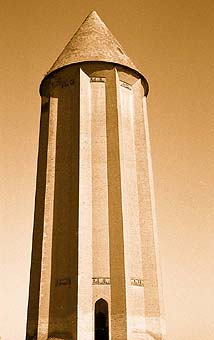
In this morning’s e-box, a letter from Jason Elliot. Jason is the author of An Unexpected Light, on his journeying in Afghanistan. We [recently] discussed a building Jason has discovered in Persia (ie Iran) while researching his current book.

“A note on the theme of the monument I mentioned.

“This ‘discovery’, along with one or two others, fills me with a private kind of excitement, but I am not at all sure who I may be able to usefully share it with, or to what purpose.

“But in brief: in northern Iran stands a celebrated tower, built entirely from brick and dating from the twelfth century, which commemorates the rule of a local monarch. It is generally thought of as a sort of folly, and indeed rather resembles an English one, though it is far more ancient and generally held up as an architectural marvel and something of an anomaly, if not a work of genius. I attach a photo I took. But that is about all, conventionally. It is publicly accessible but, being empty inside, is not used for anything at present.

“However… even from the exterior, the configuration of the structure reveals an advanced understanding of acoustics. At a distinct point about twenty metres from the entrance, one’s voice is unmistakably reflected to one’s ears, as though amplified, in a most disturbing (to me!) fashion; and inside – well, yes, it’s empty, but what an emptiness! I’d often wondered, from a distance as it were, what the place might have been for. And last year, when I was visiting for the second time, out of curiosity I sang the lines from La Boheme when Rodolfo seizes Mimi’s freezing hand in the darkness… and it knocked my socks off.

“The sound generated was truly extraordinary. I might have been Pavarotti. My voice was taken upwards, swirled around, and returned, resonant and purified. I was with two friends; we froze on the spot. I had never heard such sound. It is very hard to describe; a real voice would have sounded heavenly. It really went into our bones, and left us stunned. Nothing I have heard came close to it. The latest digital mixer couldn’t have done a more sublime job. It dawned on me then that such acoustic genius could not have been accidentally created, and I am convinced that the building was used for musical sessions long ago. There is nothing inside but a circular stone platform at the base, where people used to sit; and suddenly it took on new meaning.

“So, my experience there confirms what I have encountered in writing about Iran and aspects of Persian culture; namely that in essence Persian music is all connected with the idea of Paradise and its intimations here on Earth; and they knew how to make you feel you’ve died and gone to Heaven. Until recently there was no such thing as ‘popular’ Persian music as this was confined to the (formerly) royal and intellectual elite. But to mention the very word ‘music’ is problematic in the sense of what music is designed to achieve, since we are mostly trained to think of music as a sort of recreation.

“Iranian music and poetry are closely allied; purely instrumental music is very specific, and, traditionally at least, all melodies are associated with the different seasons, human temperaments, and times of day or night. A kind of mathematical correspondence links these genres. You could say that in traditional music there are three fundamental variations: orderly melodic progressions; single note-centred music that orbits as it were around a single source and eventually returns to it; and astonishingly complex rythmic or arhythmic compositions designed to overwhelm the mind by their intensity. If I had another lifetime I would investigate the geometry of these tonal systems. Until virtually yesterday I believed there was only one: ie european diatonic…

“But the goal is all the same: to coax the soul into a state of longing for the Real.

“And it strikes me as likely that the building in question was used as a musical forum. The only comparable site I know personally is Thoronet Abbey near Provence, which demonstrates exceptional resonance. Such things are seldom accidental; but the European dimension has been competently investigated already.

“There is another structure in Isfahan where the elaborate, hollowed out spaces in the walls have been put forward as resonating chambers, again for royal musical sessions. The point is that the people of the era knew what they were doing.

“I am sure one day the tower’s acoustic/harmonic properties will be rediscovered, and people will flock there. But not quite yet. Meantime, everyone from Caruso to Sting can eat their hearts out because for a moment I sounded better than all of them………”

THE ARTHUR MAILING LIST BULLETIN No. 0013

“COMMAND PERFORMANCE” -THE ARTHUR MAILING LIST BULLETIN

No. 0013

MONDAY FEBRUARY 7, 2005

title: Money isn’t an issue.

Hello friends and future-friends,

From an AP piece… Did you know that last summer, Ricky Williams, 27, who led the NFL in 2002 with 1,853 yards rushing and broke nine team records, abruptly retired from the Miami Dolphins prior to the 2004 season?

Money wasn’t an issue. Williams, who is single but has three young children, was to make at least $3.6 million this season, with incentives possibly pushing that as high as $6 million.

After winning the Heisman Trophy at Texas in 1998, Williams joined the New Orleans Saints when coach Mike Ditka used all of his draft picks to acquire the standout running back. Ditka said after Williams’ announcement that he hasn’t spoken with Williams in about six months and was taken aback by the retirement news.

“I’d love to talk to him and try to talk him out of it,” Ditka said from Chicago. “It seems kind of foolish to me, but I don’t know what’s on his mind. You’re just destroying a great career. He’s a talent. To let that all go to waste doesn’t make a lot of sense.”

Williams dropped out of sight after his retirement in July. He has resurfaced recently in Nevada County as a student of the ancient Indian medical system system known as Ayurveda.

“I realized a while back that I have an innate ability to be compassionate,” he told the San Francisco Chronicle after Thanksgiving 2004, “and I saw that the strength of compassion is something that healers have and healers use.”

Williams is now about a month into a 17-month course at the California College of Ayurveda in Grass Valley, about 45 miles northeast of Sacramento.

“Ayurveda deals with using your environment to put yourself in balance,” he said. “I’ve realized, both on a psychological and physical level, that the things we do in football don’t bring more harmony to your life. They just bring more disharmony.”

Although he wouldn’t rule out a return to football (“I’m not a fortune- teller”), he indicated the game was far from his mind.

The 5-foot-10 Williams weighs 210 pounds, about 25 fewer than his playing weight. He looks healthy and happy. As part of his Ayurveda studies, he said, “I try to give foods and herbs attributes and find out which ones balance me out.”

He wore sandals, black trousers and a light blue T-shirt silk-screened with the message: “My home is in my head.” His beard is somewhat scraggly. His distinctive dreadlocks have given way to a short haircut.

“I loved playing football, but the reasons I loved football were just to feed my ego,” Williams said. “And any time you feed your ego, it’s a one-way street. … There were so many things I had to deal with that erased the positives I got from playing the game that it wasn’t worth it. It’s like eating a Big Mac and drinking a Diet Coke.”

He’s renting a one-bedroom cottage in nearby Nevada City. A couple of months earlier, he was planning to buy a 165-acre farm in Australia. Those plans have been shelved.

“As human beings we have a tendency when we like something to tie it up and make sure it’s there for a long time. I’ve been working on being able to let things go. I don’t think I ever want to buy property again.”

He seems to have overcome his social anxiety disorder. “I don’t know what it was,” he said. “I definitely have come out of my shell a lot more. When you question who you are, you can’t be proud of who you are. Now that I’m trying to peel off those layers and really understand who I am, I don’t have anything to be shy about.”

He was evasive on the question of his drug use. A recent article in Esquire magazine by a writer who found him in Australia described him as sharing a joint that was “sturdy enough to prop open a door.” Shortly after retiring, he told the Miami Herald that one of the many reasons he quit was that he wanted to smoke marijuana without incurring the wrath of the NFL. The Herald said he faced a four-game suspension and a $876,000 fine by the league for a third violation of its substance abuse policy. He said at the time that he used a masking agent called Extra Clean for two years in Miami to conceal his marijuana use.

As for the idea that he quit because he wanted to be free to smoke dope, he laughed.

“I think it’s funny,” he said.

We’re laughing here too, Ricky, as we imagine how many football fans’ minds you have blown with your courageous public re-setting of priorities. Wonderful!

Here’s some other things that make us feel good:

Arthur No. 15, starring Six Organs of Admittance, J.G. Ballard, Douglas Rushkoff, Jessica Yu (director of the Henry Darger documentary), a piece on meditation as a subversive activity, James Parker on the spawn of Godflesh and Sleep and more more more, is due out on February 15. It’s FREE as always. It’s also the first issue in Arthur’s exciting new format, with a 25%-increased printrun of 50,000 copies. Details about the issue are available now at

http://www.arthurmag.com

The RZA’s book is finally out.

Arik Moonhawk Roper has designed the new Arthur t-shirt, starring a two-fisted tough wizard for our times. We’ll have ’em available soon for as cheap as we can from the arthurmag.com website.

Listening to Alan Moore’s half-hour interview with Brian Eno on BBC4:

http://www.bbc.co.uk/radio/aod/genres/comedy/aod.shtml?radio4/chainreaction

What a hoot and a half it was to hear the confusing labyrinth that is “The Air Itself” by Sunburned Hand of the Man from their recent album (on Arthur’s Bastet label) on WFMU last week. Less form, more matter, sez he? We agree. The all-new, all-life album, “No Magic Man,” is now shipping from us for the low-as-we-can-do-it price of $12 US/$14 Can/$17 world, postpaid. Find out what all the fuzz is about at

http://www.arthurmag.com/store/bastet_cds.php

A special FREE screening of filmmaker MAYA DEREN’s seminal 1948 16mm movement study “Meditation on Violence” will be held Sunday, February 20, 2005, 18.00 – 18.30pm, in Los Angeles as part of a program called “Films with music from China Haiti Jamaica North America.” Directors Guild of America / Theater 2, 7920 West Sunset Boulevar, Los Angeles, CA 90046. RSVP, information and directions. tel +323.965.5578, tellesfineart@earthlink.net

And so on, strolling on….

We’ll see you there,

Arthur Wellness Center Staff Director

Los Angeles, California