
Sorry ladies, I'm busy

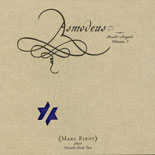
MARC RIBOT
“Asmodeus: Book of Angels Volume 7”
Tzadik
Cat. # 7362
Released Jun 2007
cd time – 38:30
US Price $16.00
1. Kalmiya
2. Yezriel
3. Kezef
4. Mufgar
5. Armaros
6. Cabriel
7. Zakun
8. Raziel
9. Dagiel
10. Sensenya
Personnel:
John Zorn: Composer, Conductor
Trevor Dunn: Bass
Marc Ribot: Guitar
G. Calvin Weston: Drums
“Three of the most intense musicians on the planet come together in one of the most explosive and rockin’ ensembles around. An original member of the Masada family since its inception, no one is more keenly equipped to handle a rock trio interpretation of the Book of Angels than Marc Ribot. Joined here by the versatile Trevor Dunn (Fantomas, Moonchild) on bass and the legendary G.Calvin Weston (Ornette Coleman, James Blood Ulmer) on drums, Marc plays like never before, referencing Hendrix, Sharrock, McLaughlin, Ulmer and more. Masada music takes on a whole new dimension. Passionate and powerful, this is one of the most compelling installments in the entire Masada series and contains some of Ribot’s wildest and best playing ever. This CD will blow your mind.”

from the Stefan Brecht’s Article: Revolution at the Brooklyn Academy.
The Living Theater’s four splendid spectacles were a great event. Like an astonishing portion of the country’s popular music, they proved to be in content and form outside the social system, not structured by it nor, except as outlet, implementing it: liberated territory.
Below is a script for the anti-theater masterpiece(?) Paradise Now.

“This chart is the map. The essentail trip is the voyage from the many to the one. The plot is revolution.”
In the film Paradise Now documenting a performance of the piece in Brussels and Berlin, the “actors” after haranguing the audience for hours, with naked calisthenics and existential questions like “why can’t I smoke marijuana”, yell something like, “leave the theater, the real theater is in the streets”. People tumble toward the door, presumably heading for some kind of barricade.

The Military Industrial Complex Is Sucking The Living Blood Of This Nation:
A Psychedelic Lightshow
or
Dynacorp of El Segunda, CA is a War Profiteer Pretty Light Party.
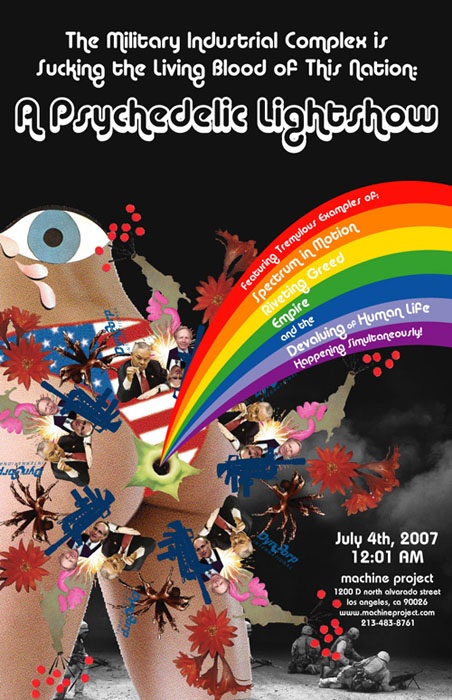
12:01 AM July 4th, aka late night July 3rd

(above: The Brig cast protest in Times Square)
“Join us to demonstrate our refusal to be complicit in this unjust war.
Two free street theatre performances of THE BRIG
Ground Zero: Church Street (at entrance to PATH train)
Sunday July 1 4pm
Wednesday July 4 2pm
Dear friends,
The Living Theatre has a long history of political street theatre: from the slums of Brazil (where the company was imprisoned for 2 months) to the steel factories in Pittsburg our political theater work against violence in all its forms continues with plays like Not In My Name (1994) against the death penalty and more recently No Sir! which we play in front of the Armed Forces recruiting station in Times Square.
We also have chosen to open our new theatre here on Clinton Street (LES) with the revival of The Brig: a play written by a Marine in the late fifties and presented by the Living in 1963. It not only won many awards but Howard Taubman and other critics called for a congressional investigation which led to policy changes in the treatment of Marines in their own brigs. It has again received an Obie as well a many incredible reviews, many writing about its pertinence to today’s war climate and specifically about Guantanamo and Abu Grav.
But this is not enough! Not enough to simply work for a paying public. Thus in these last weeks we have been presenting The Brig in the street: in Union Square and also Columbus Circle. Now we are going to Ground Zero where this new cycle of violence and war has started.
I don’t have to tell you guys about the worsening situation in Iraq, or Afghanistan. Our banners say: Support the troops AND Stop the war. If in your busy schedules you would like to collaborate with us we would be more than happy. We could do a benefit performance here on Clinton Street for your group but, to the point, we invite you to join us at Ground Zero for two showings of The Brig.
We are inviting lots of friends and reaching out to other groups. We believe also that some press will be there, and some “friends” from the other side.
See you there!
Gary Brackett
The Living Theatre
garyliving@yahoo.com
info
The Living Theatre
212 792 8050
www.livingtheatre.org“
located via John Coulthart post
Green Hermeticism: Alchemy and Ecology
Peter Lamborn Wilson, Christopher Bamford, Kevin Townley
Introduction by Pir Zia Inayat-Khan
ISBN: 9781584200499
Book (Paperback)
Lindisfarne Books
$25.00
6 x 9 inches
224 pages
September 2007
“In Alchemy, there is an injunction to quicken, or revive, the dead, which is illustrated by a dead tree growing verdant again. That is exactly what this wonderful and rare work does in awakening human consciousness to its Divine potential and Ultimate Destiny. Art thus helps Nature to achieve its ideal Perfection. The authors must be congratulated for their insightful words. I wholeheartedly recommend reading it again and again, and again.” —Stanislas Klossowski de Rola, author Alchemy: The Secret Art and The Golden Game: Alchemical Engravings of the Seventeenth Century
“Environmental solutions today are largely technical, but the planetary crisis is also a crisis of soul—or better yet, of the Imagination. Too tricky for religion, too poetic for reductionist science, Green Hermeticism reheats a prophetic imagination still in love with the material world—a new alchemy of ancient nature.” —Erik Davis, author, The Visionary State: A Journey through California’s Spiritual Landscape
“Just when you felt numb and disenfranchised, thinking the world had become bleak and dead, along comes this rare, much needed book to remind us that there is still some sanity, depth, and creative energy percolating up from the heart of Reality. Thank God (and the Goddess Nature) for this smart and inspiring breath of fresh air! Green Hermeticism is where the wasteland ends—and where the world becomes re-enchanted with genuine living thought that goes beyond superficialities. It’s a rare pleasure to be in the presence of living minds who actually know something wonderful and have not been deadened by the opiates of capital or the tenure track. Very highly recommended.” —David Fideler,publisher (Phanes Press) editor (Alexandria), author of Jesus Christ, Sun of God and translator of Love’s Alchemy: Poems from the Sufi Tradition (with Sabrineh Fideler)
“The publication of Green Hermeticism has the sense we so rarely get, of a genuine moment in cultural history. It is not just the eloquence of its authors’ knowledge and arguments or that they are showing us, once again, the depth and range and beauty of alchemy, and the Hermetic tradition, and what Peter Lamborn Wilson calls Romantic Science. Nor is it even the links they establish between the Hermetic tradition and ecology, and the value of a science that perceives the world as alive rather than a machine. What makes this work significant is the sense that it shows us how we can use these ideas and knowledge to create a genuine counter to destruction and despair, an alchemy of our politics as well as of our spirit.” —Rachel Pollack, author of 78 Degrees of Wisdom: A Book of Tarot
“Green Hermeticism reminds us that the art of the Great Work is to enter more deeply into the dynamic and practical wisdom of the universe, which is our laboratory, where work and prayer combine. When we engage with the All, we know ourselves to be one kindred with all in the viriditas—God’s greening power—where body, soul, and spirit honor each other.” —Caitlín & John Matthews, authors of Walkers Between the Worlds: The Western Mysteries from Shaman to Magus
Hermeticism, or alchemy, is the ancient, primordial mystery science of nature through which people in all times and places have, for the sake of world evolution, sought to unite Heaven and Earth—divinity, cosmos, earth, and humanity, as a single whole. Selfless, intimate, dedicated to healing and harmony, Hermeticism has accompanied and sustained every religious epoch and revelation. It may be found in all historical cultures, from the traditions of India and China in the East to the Judeo-Christian West. It could even be said that Hermeticism is the primal cosmological revelation and the common ground of all spiritual traditions.
Nevertheless, in the great revival of mystical, esoteric traditions and practices during the last century, Hermetic tradition—in fact, Nature herself—has been largely ignored. Today, when the Earth seems most under attack, Green Hermeticism is especially appropriate. The book explores not only the ancient Masters’ inner science, but also their science of Nature.
During spring and summer 2006, Pir Zia Khan convened a series of gatherings to begin to unfold the contemporary meaning of ancient, sacred science for our time. Green Hermeticism is a partial record of that meeting. Peter Lamborn Wilson, explores the many ramifications of the alternative worldview offered by Hermeticism; Christopher Bamford provides a broad historical overview of the tradition from the Ancient Mysteries to contemporary manifestations of the alchemical tradition; while Kevin Townley brings a practical dimension to the gathering teaching the preparation of herbal elixirs and demonstrating that cosmology and philosophy can become a truly healing path for the Earth.
Green Hermeticism is necessary reading for anyone seeking a spiritual and cultural path for the healing of the current ecological and cultural crisis.
Peter Lamborn Wilson (b.1945) is a scholar of Sufism and Western Hermeticism and (under the pseudonym “Hakim Bey”) a well-known radical-anarchist social thinker. His books include Sacred Drift: Essays on the Margins of Islam (City Lights, 1993) and Escape from the Nineteenth Century and Other Essays (Autonomedia, 1998).
Christopher Bamford is the editor in chief of SteinerBooks and its imprints. A Fellow of the Lindisfarne Association, he has lectured, taught, and written widely on Western spiritual and esoteric traditions and is the author of The Voice of the Eagle: The Heart of Celtic Christianity and An Endless Trace: The Passionate Pursuit of Wisdom in the West. He has also translated and edited numerous books, including Celtic Christianity, Homage to Pythagoras, and The Noble Traveller (all published by Lindisfarne Books). HarperSanFrancisco included an essay by Mr. Bamford in its anthology Best Spiritual Writing 2000.
Kevin Townley has been a lifelong student of Western Hermeticism. Early on in his studies, he was drawn to the writings of Dr. Paul Foster Case and has been a member of the Builders of the Adytum (B.O.T.A.) for eleven years. Kevin is currently the Vice President of LPN- USA, an esoteric organization dedicated to the study and practice of Qabalah and Laboratory Alchemy. His studies have led him around the world seeking original Rosicrucian and alchemical texts, as well as individuals who practice this royal art. He is the author of The Cube of Space: Container of Creation (Archive Press, 1993) and Meditations on the Cube of Space (Archer Books, 2002).
Pir Zia Inayat-Khan is the spiritual leader of the Sufi Order International (established by Hazrat Inayat Khan in London, 1917) and founding director of the Suluk Academy, an esoteric school in upstate New York. His initiatory heritage integrates the sacred transmissions of the Chishti, Suhrawardi, Qadiri, and Naqshbandi lineages within a post-denominational, inter-spiritual goal. Pir Zia holds a master’s degree in religion from Duke University.
ARTHUR BENEFIT PARTY
Wednesday, June 27, 2007 * 8pm
Silent Movie Theater
611 N. Fairfax Avenue
Los Angeles
featuring
Six Organs of Admittance
sepcial one-time-only performance with Joseph Mattson, Steve Ruecker and and Elisa Ambrogio
Ruthann Friedman
songs from legendary “astral folk goddess” (cf. galactic zoo dossier)
Entrance
full band performance!
Elisa Ambrogio (Magik Markers)
reading
Lewis MacAdams (poet)
reading
Paloma Parfrey (ex-Sharp Ease)
reading with sounds by Tamala Poljak
MC: Oliver Hall (E.S.P.S.)
Admission: $15
Advance tickets available via Ticketweb — click here to order
poster by Alia Penner
event produced by Small Town Talk
NO ALCOHOL SERVED * BRING YOUR OWN FLASK
Erased and Invisible History About Gentrification In and Around Echo Park
Got this note from the Pocho Research Society
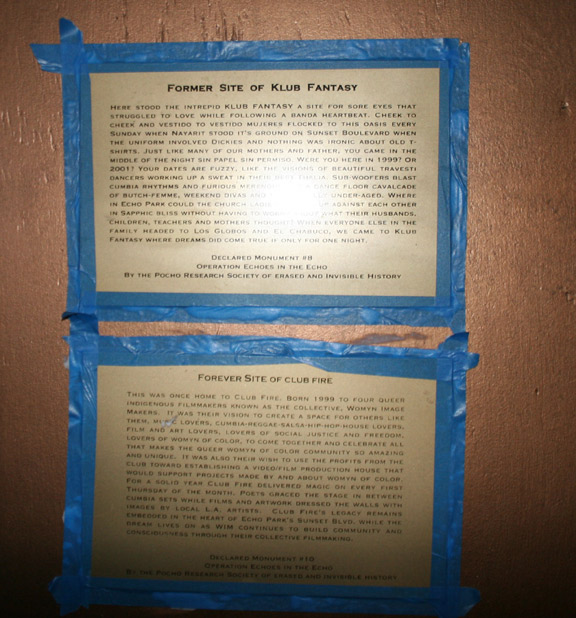
The Pocho Research Society (PRS) has installed “unofficial” plaques in public spaces to commemorate formerly queer Latina/o bars in the Echo Park, Silverlake and the Downtown area on June , 2007. The group operates in a clandestine fashion.
Since the longevity of the plaques at the sites is unknown, visit the following locations ASAP in order to view before they are taken down.
Site Locations:
Le Barcito, currently the Cha Cha 2375 Glendale Blvd Los Angeles, CA 90039
Klub Fantasy at the Nayarit aka The Echo 1822 W Sunset Blvd Los Angeles, CA 90026
Club Fire at the Nayariit currently The Echo 1822 W Sunset Blvd, LA , CA90026
The Score 107 W. 4th St, Downtown Los Angeles, currently Bar 107Echoes in the Echo is a series of public interventions that will explore History and memory in and around Echo Park. This phase of the project commemorates a few of many queer Latina/o spaces that were a ‘home’ to many for periods of up to a couple of decades and have since changed ownership and now cater to a new, straighter, younger and whiter clientele. This project takes place while the city, itself, is at a crossroads in its own history. Dramatic increases in real estate prices coupled with commercially driven development projects facilitated by elected officials are two of a multitude of forces that push many working class communities out of the city “core”. Waves of new ‘immigrants’ (albeit from the Midwest) have in the process displaced longstanding cultural spaces created over several decades. Within this massive “land grab” questions like ‘where do drag queens, closeted quebradita dancers and gay cholos go once they been pushed out?’ arise. How and who defines a space? Is a space defined by its present incarnations or does its past ruthlessly resurface like dust in unswept corners?
June 17, 2007
An Earth Without People
A new way to examine humanity’s impact on the environment is to consider how the world would fare if all the people disappeared
By Steve Mirsky
It’s a common fantasy to imagine that you’re the last person left alive on earth. But what if all human beings were suddenly whisked off the planet? That premise is the starting point for The World Without Us
According to Weisman, large parts of our physical infrastructure would begin to crumble almost immediately. Without street cleaners and road crews, our grand boulevards and superhighways would start to crack and buckle in a matter of months. Over the following decades many houses and office buildings would collapse, but some ordinary items would resist decay for an extraordinarily long time. Stainless-steel pots, for example, could last for millennia, especially if they were buried in the weed-covered mounds that used to be our kitchens. And certain common plastics might remain intact for hundreds of thousands of years; they would not break down until microbes evolved the ability to consume them.
Scientific American editor Steve Mirsky recently interviewed Weisman to find out why he wrote the book and what lessons can be drawn from his research. Some excerpts from that interview appear on the following pages.
The Interviewee
Alan Weisman is author of five books, including the forthcoming The World Without Us
Q&A With Alan Weisman
If human beings were to disappear tomorrow, the magnificent skyline of Manhattan would not long survive them. Weisman describes how the concrete jungle of New York City would revert to a real forest.
“What would happen to all of our stuff if we weren’t here anymore? Could nature wipe out all of our traces? Are there some things that we’ve made that are indestructible or indelible? Could nature, for example, take New York City back to the forest that was there when Henry Hudson first saw it in 1609?
“I had a fascinating time talking to engineers and maintenance people in New York City about what it takes to hold off nature. I discovered that our huge, imposing, overwhelming infrastructures that seem so monumental and indestructible are actually these fairly fragile concepts that continue to function and exist thanks to a few human beings on whom all of us really depend. The name ‘Manhattan’ comes from an Indian term referring to hills. It used to be a very hilly island. Of course, the region was eventually flattened to have a grid of streets imposed on it. Around those hills there used to flow about 40 different streams, and there were numerous springs all over Manhattan island. What happened to all that water? There’s still just as much rainfall as ever on Manhattan, but the water has now been suppressed. It’s underground. Some of it runs through the sewage system, but a sewage system is never as efficient as nature in wicking away water. So there is a lot of groundwater rushing around underneath, trying to get out. Even on a clear, sunny day, the people who keep the subway going have to pump 13 million gallons of water away. Otherwise the tunnels will start to flood.
“There are places in Manhattan where they’re constantly fighting rising underground rivers that are corroding the tracks. You stand in these pump rooms, and you see an enormous amount of water gushing in. And down there in a little box are these pumps, pumping it away. So, say human beings disappeared tomorrow. One of the first things that would happen is that the power would go off. A lot of our power comes out of nuclear or coal-fired plants that have automatic fail-safe switches to make sure that they don’t go out of control if no humans are monitoring their systems. Once the power goes off, the pumps stop working. Once the pumps stop working, the subways start filling with water. Within 48 hours you’re going to have a lot of flooding in New York City. Some of this would be visible on the surface. You might have some sewers overflowing. Those sewers would very quickly become clogged with debris—in the beginning the innumerable plastic bags that are blowing around the city and later, if nobody is trimming the hedges in the parks, you’re going to have leaf litter clogging up the sewers.
“But what would be happening underground? Corrosion. Just think of the subway lines below Lexington Avenue. You stand there waiting for the train, and there are all these steel columns that are holding up the roof, which is really the street. These things would start to corrode and, eventually, to collapse. After a while the streets would begin cratering, which could happen within just a couple of decades. And pretty soon, some of the streets would revert to the surface rivers that we used to have in Manhattan before we built all of this stuff.
“Many of the buildings in Manhattan are anchored to bedrock. But even if they have steel beam foundations, these structures were not designed to be waterlogged all the time. So eventually buildings would start to topple and fall. And we’re bound to have some more hurricanes hitting the East Coast as climate change gives us more extreme weather. When a building would fall, it would take down a couple of others as it went, creating a clearing. Into those clearings would blow seeds from plants, and those seeds would establish themselves in the cracks in the pavement. They would already be rooting in leaf litter anyhow, but the addition of lime from powdered concrete would create a less acidic environment for various species. A city would start to develop its own little ecosystem. Every spring when the temperature would be hovering on one side or the other of freezing, new cracks would appear. Water would go down into the cracks and freeze. The cracks would widen, and seeds would blow in there. It would happen very quickly.”
How would the earth’s ecosystems change if human beings were out of the picture? Weisman says we can get a glimpse of this hypothetical world by looking at primeval pockets where humanity’s footprint has been lightest.
“To see how the world would look if humans were gone, I began going to abandoned places, places that people had left for different reasons. One of them is the last fragment of primeval forest in Europe. It’s like what you see in your mind’s eye when you’re a kid and someone is reading Grimm’s fairy tales to you: a dark, brooding forest with wolves howling and tons of moss hanging off the trees. And there is such a place. It still exists on the border between Poland and Belarus. It was a game reserve that was set aside in the 1300s by a Lithuanian duke who later became king of Poland. A series of Polish kings and then Russian czars kept it as their own private hunting ground. There was very little human impact. After World War II it became a national park. You go in there and you see these enormous trees. It doesn’t feel strange. It almost feels right. Like something feels complete in there. You see oaks and ashes nearly 150 feet tall and 10 feet in diameter, with bark furrows so deep that woodpeckers stuff pinecones in them. Besides wolves and elk, the forest is home to the last remaining wild herd of Bison bonasus, the native European buffalo.
“I also went to the Korean DMZ, the demilitarized zone. Here you have this little stretch of land—it’s about 150 miles long and 2.5 miles wide—that has two of the world’s biggest armies facing off against each other. And in between the armies is an inadvertent wildlife preserve. You see species that might be extinct if it weren’t for this one little piece of land. Sometimes you’ll hear the soldiers screaming at one another through loudspeakers or flashing their propaganda back and forth, and in the middle of all this tension you’ll see the flocks of cranes that winter there.
“But to really understand a world without humans, I realized I would have to learn what the world was like before humans evolved. So I went to Africa, the place where humans arose and the only continent where there are still huge animals roaming around. We used to have huge animals on all the other continents and on many of the islands. We had enormous creatures in North and South America—giant sloths that were even bigger than the mammoths; beavers the size of bears. It’s controversial as to what actually wiped them out, but a lot of indications point the finger at us. The extinctions on each landmass seemed to coincide with the arrival of humans. But Africa is the place where human beings and animals evolved together, and the animals there learned strategies to avoid our predation. Without humans, North America would probably become a giant deer habitat in the near term. As forests would become reestablished across the continent, eventually—in evolutionary time—larger herbivores would evolve to take advantage of all the nutrients locked up in woody species. Larger predators would evolve accordingly.”
Thinking about an earth without humans can have practical benefits. Weisman explains that his approach can shed new light on environmental problems.
“I’m not suggesting that we have to worry about human beings suddenly disappearing tomorrow, some alien death ray taking us all away. On the contrary, what I’m finding is that this way of looking at our planet—by theoretically just removing us—turns out to be so fascinating that it kind of disarms people’s fears or the terrible wave of depression that can engulf us when we read about the environmental problems that we have created and the possible disasters we may be facing in the future. Because frankly, whenever we read about those things, our concern is: Oh, my God, are we going to die? Is this going to be the end? My book eliminates that concern right at the beginning by saying the end has already taken place. For whatever reason, human beings are gone, and now we get to sit back and see what happens in our absence. It’s a delicious little way of reducing all the fear and anxiety. And looking at what would happen in our absence is another way of looking at, well, what goes on in our presence.
“For example, think about how long it would take to wipe out some of the things we have created. Some of our more formidable inventions have a longevity that we can’t even predict yet, like some of the persistent organic pollutants that began as pesticides or industrial chemicals. Or some of our plastics, which have an enormous role in our lives and an enormous presence in the environment. And nearly all of these things weren’t even here until after World War II. You begin to think there’s probably no way that we are going to have any kind of positive outcome, that we are looking at an overwhelming tide of geologic proportions that the human race has loosed on the earth. I raise one possibility toward the end of the book that humans can continue to be part of the ecosystem in a way that is much more in balance with the rest of the planet.
“It’s something that I approach by first looking at not just the horrible things that we have created that are so frightening—such as our radioactivity and pollutants, some of which may be around until the end of the planet—but also some of the beautiful things that we have done. I raise the question, Wouldn’t it be a sad loss if humanity was extirpated from the planet? What about our greatest acts of art and expression? Our most beautiful sculpture? Our finest architecture? Will there be any signs of us at all that would indicate that we were here at one point? This is the second reaction that I always get from people. At first they think, This world would be beautiful without us. But then they think, Wouldn’t it be sad not to have us here? And I don’t think it’s necessary for us to all disappear for the earth to come back to a healthier state.”
Courtesy Mark Pilkington
 Arthur Magazine