
Guatemala
Recently I got mailed this book of paintings by elin o’Hara Slavik called, Bomb After Bomb. I figured that I’d be looking at either a series of calculated flow charts of casualties or a grotesquery as it comes with a forward by Howard Zinn and the conceptual hook of the book, subtitled “A Violent Cartography”, is that it’s made up of paintings of maps of places the United States has bombed. I was surprised to see a book full of fairly abstracted and fairly “decorative” paintings. Though slavick’s paintings rely on a kind of information graphics approach, portraying clearly and exactly countries, towns, regions that the US has blown up, all of these paintings take a much more formal approach. Quite often they are dominated by a game of color, line, pattern, and abstraction. If it weren’t for the title, at times we wouldn’t know the deaths and crimes being masked here.
These paintings reminded me of the work of LA painter Jill Newman, who equally chooses to paint politically charged sites. Instead of working in a social realist form, both painters use their representations as a place for formal departure. Early this year, at the recently closed Park Projects (now resurrected as Sea and Space), Newman exhibited a lush painting of the South Central Farm called Endless Numbered Days.
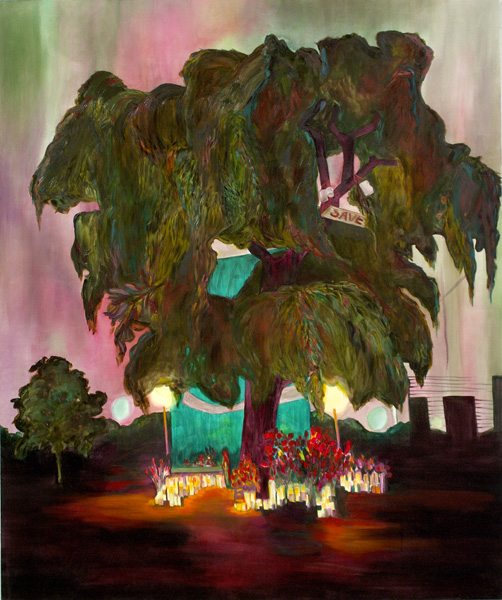
Endless Numbered Days
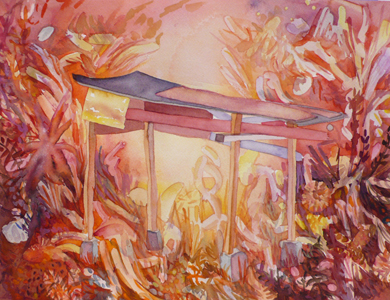
Luminescent in oil, the large painting depicts the tree at the center of the struggle. This is the walnut tree that activists camped in to defend the garden. The significance of the tree within the conflict is visible only by a faint banner and the tree-sit platform painted with the word “SAVE” on it. Otherwise it’s a color and lightfest. At a recent show at Taylor De Cordoba, Jill continued her South Central Farm trilogy with a series of watercolor paintings of improvised architectural forms constructed by the farmers. Like the oil of the walnut tree, these paintings use the political context of the farm as an invitation for aesthetic play with color. Rather than a retelling of the tragedy that has befallen LA, it is as if saved in Newman’s painting is a little bit of the spirit, biodiversity and creativity lost when the place was plowed under.
Chatting with my friends Kimberly and Melissa about these paintings, we came to a quote by artist Andrea Bowers regarding Vija Celmins, an artists who spent hours drawing meticulous, formally perfect photo-realistic. Bower’s said:
When you work this way, imagery is not chosen lightly; it is considered for a very long time. The dedication of her labor is an act of generosity toward the viewer. Her work shares a record of time in relation to production and to imagery. Whereas cynicism is prevalent in the art world today, she instead chooses to believe in human motives, so obviously displayed in Untitled #9 (For Felix) (1994–95), a drawing of a comet dedicated to the memory of Felix Gonzalez-Torres, whose own work focused on generosity despite his dealing with the horror of AIDS.
In an age of intellectual coolness and emotional distancing, Celmins’ work reminds me that the artist’s personal position in relation to her subject matter has value.

untitled, #10
Howard Zinn writes in o’hara’s book “if the drawings of slavick and the words that accompany them cause us to think about war, perhaps in ways we never did before, they will have made a powerful contribution towards a peaceful world”. If Zinn is refering to a kind of conscioussness raising frequently performed by political art, I find this unlikely to occur. Slavick’s is an art that doesn’t seem to circulate in the appropriate environments, and its postion seems to be more about painting than convincing. I don’t however think this makes her kind of political art useless. Though representational and political in subject, it takes a differen’t approach than someone like Leon Golub, who is political becuase he can bludgeon. By taking scenes and places, battle zones which we think we know so well, and transforming them for creative fodder for trips into other realms, Newman’s and slavick’s paintings do a bit to reclaim wonder and imagination from the death machine. And here is the peace.
 Arthur Magazine