Old Ways News

Western Shoshone leader dies at 87
Associated Press 10:23 a.m. July 11, 2007

RENO, Nev. – Corbin Harney, a spiritual leader of the Western Shoshone who challenged the federal government – and once his own tribe – to oppose nuclear weapons on aboriginal land has died at the age of 87. Harney, a fixture at anti-nuclear rallies, died Tuesday of complications from cancer near Santa Rosa, Calif., where he had hoped to finish a book, according to his family.

“We have truly lost a lot,” said his nephew, Santiago Lozada, who was with him when he died. “

Corbin was a World War II veteran and was known around the world for his activism against radioactivity and nuclear weapons,” said Robert Hager, Reno-based lawyer for the Western Shoshone tribe. “He’s irreplaceable to the Western Shoshone nation.”

“He was someone who just had this gentle spirit but a steely resolve that people should do the right thing,” Hager said. “He thought people would eventually come around and realize the harm people were doing to Mother Earth.”

Hager recalled that Harney bucked his own tribe when the federal government in the 1950s unearthed remains of Western Shoshone ancestors during digging for nuclear testing at the Nevada Test Site north of Las Vegas.

“He picked up the remains and gave them a decent burial,” Hager said. “He took a lot of flack from Western Shoshone leaders who said he should have nothing to do with the U.S. government. But I always respected Corbin for doing what, to the Western Shoshone, was not politically correct but in his mind was the right thing to do.”
Ian Zabarte, secretary of state for the Western Shoshone National Council, said Harney “was always steadfast in trying to prevent the proliferation of nuclear weapons and guard the people against the threats and hazards that nuclear technology poses.”

Harney traveled around the world as a speaker and environmentalist. He received national and international awards and spoke before the United Nations in Geneva.

Public Statement by Corbin’s Immediate Family

July 10, 2007 (TurtleIsland). Corbin Harney Spiritual Leader of the Western Shoshone Nation crossed over at 11:00 a.m. this morning in a house on a sacred mountain near Santa Rosa, CA (Turtle Island). He had dedicated his life to fighting the nuclear testing and dumping.

That battle claimed his life through cancer.

Before he passed, he said to remember:

“We are one people. We cannot separate ourselves now.

There are many good things to be done for our people and for the world.

It is important to let things be good. And it is important to teach the younger generation so that things are not lost.”

According to witnesses present, in the morning fog, the spirits of four Shoshoni dog soldiers were outside on horseback before Corbin’s passing. But then one of the Shoshone present, Santiago Lozada, yelled “Tosawi Tosawi!” (White Knife). And then the fog shifted and there were thousands of spirits waiting.

Corbin passed peacefully at the end. He was only worried that he still had more to do. When he finally let go and went with the dog soldiers, Red Wolf Pope, grandson of Rolling Thunder, was present and sang him the Tosawi death song to call the dog soldiers to come take him home. Golden eagles continue to circle the house hours after his crossing.”

True to form Corbin joked around several days ago that he was going to go at 11:00, and kept his promise.

Over his lifetime, Corbin traveled around the world as a speaker, healer and spiritual leader with a profound spiritual and environmental message for all. He received numerous national and international awards and spoke before the United Nations in Geneva, Switzerland. Corbin also authored two books: “The Way It Is: One Water, One Air, One Earth” (Blue Dolphin Publishing, 1995) and a forthcoming book, “The Nature Way”. Numerous documentaries have been made about his work and message. In 1994, Corbin established the Shundahai Network to work with people and organizations to respond to spiritual and environmental concerns on nuclear issues. He also established Poo Ha Bah, a native healing center located in Tecopa Springs, California. He will be missed but always honored for his work and dedication to traditional ways.

Corbin Harney is descended from generations of Newe (Shoshone) traditional healers and was always grateful for the many extraordinary teachers who shared their knowledge in his lifetime. Corbin is survived by his daughter Reynaulda Taylor; granddaughters Ann Taylor and Nada Leno; grandsons Keith, Jon and Joel Leno and William Henry Taylor; seven great-grandchildren; two great-great grandchildren; and his sister Rosie Blossom’s family and many cousins and other family members as well as many, many friends around the world. Corbin was preceded in death by his mother, father, sister, grandparents, uncle, great granddaughter, cousins, and friends. A very special thanks to Patricia Davidson, Corbin’s caregiver in his final months; Dominic Daileda, Corbin’s friend and companion for his support and compassion in hard times, and the family of Dixie and Martin van der Kamp for opening up their home and their hearts to Corbin and his family and friends during his time of need.

Dates and times for services are being made with official announcement to follow. Three day services are planned at the home of Larson R. Bill, So Ho Bee – Newe Sogobe (Lee, Nevada –Western Shoshone Territory) with burial services at Battle Mountain Indian Community, Battle Mountain Nevada.

Donations may be made either to the immediate family through:

Reynaulda Taylor
P.O. Box 397
Owyhee, Nevada 89832

775-757-2610 or 775-757-2064

annietaytay@yahoo.com

Or, to:

The Corbin Harney Way
6360 Sonoma Mtn. Rd.
Santa Rosa, CA 95404

No other individual, organization or entity is authorized to receive donations on behalf of Corbin’s immediate family or Corbin Harney.


R.I.P. LADY BIRD JOHNSON

“As first lady, she was perhaps best known as the determined environmentalist who wanted roadside billboards and junkyards replaced with trees and wildflowers. She raised hundreds of thousands of dollars to beautify Washington. The $320 million Highway Beautification Bill, passed in 1965, was known as ‘The Lady Bird Bill,’ and she made speeches and lobbied Congress to win its passage.

“‘Had it not been for her, I think that the whole subject of the environment might not have been introduced to the public stage in just the way it was and just the time it was. So she figures mightily, I think, in the history of the country if for no other reason than that alone,’ Harry Middleton, retired director of the LBJ Library and Museum, once said.”

from the Human Flower Project:

Poppies and cornflowers in South Carolina

Lady Bird’s Wild Highways

Lady Bird Johnson went up against the outdoor advertising lobby to build a new federal highway program, flower by flower by flower.

The U.S. federal highway system was a legacy of the Eisenhower administration. And the U.S. billboard industry was instantly hip. Instead of muscling up to customers, why not let a captive audience of consumers roll right past your pitch? “Take a Puff, It’s Springtime!”

“In 1958, Congress had passed a highway bill that gave states an extra half percent in funding if they controlled billboards, but the incentive appeared ineffectual in stopping highways from being blanketed” with signs.

Enter Lady Bird Johnson, wife of President Lyndon Baines Johnson. After making the drive from Central Texas to D.C. one too many times, Lady Bird pressured her husband to push through a Highway Beautification bill in 1965, “improving landscaping, removing billboards, and screening roadside junkyards.”

You don’t hear the word “beautification” anymore. There aren’t any more idle groups of white ladies in white gloves. But in fact, Mrs. Johnson’s efforts—whatever they were once called—streamed into present-day environmentalism and conservation.

“After President Johnson left office, Mrs. Johnson continued to be a champion of environmental initiatives. In 1982, she founded the National Wildflower Research Center (now the Lady Bird Johnson Wildflower Center), and in 1987, she helped add the native wildflower requirement as an amendment to the Surface Transportation Urban Relocation Authorization Act.”

Now, native wildflower seeds or seedlings must be planted in landscaping all federal highways projects.
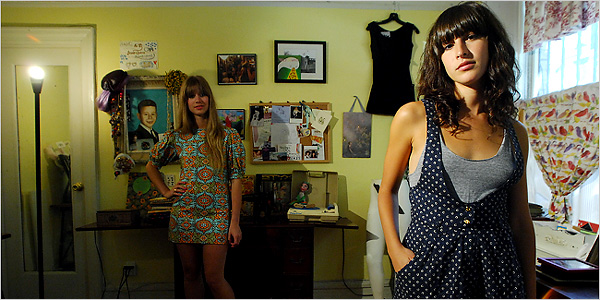


Alison Lewis, left, and Rachel Antonoff of the indie label Mooka Kinney.


A design from the book, “KnitKnit.”

The Knitting Circle Shows Its Chic
By RUTH LA FERLA
The New York Times – July 12, 2007

TEVA DURHAM is an unlikely idol, a soberly outfitted, plain-talking mother with a passion for quirky yarns. But to her fans, who snap up her how-to-knit books by the tens of thousands, Ms. Durham is the undisputed mistress of stitchery.

Those admirers, often young and aesthetically inclined, follow her patterns — casting on, increasing, decreasing — with unwavering fidelity. As well they might. Ms. Durham’s artfully crafted stockings and skirts, open-work dresses and cardigans vie in style and intricacy with many of their counterparts on the fashion runways.

Just a few years ago, the assertion that hand-stitched garments could compete with designer wares would have raised derisive hoots from the fashion set, which viewed the needle crafts as the domain of ladies in buns and harlequin glasses. As Ms. Durham acknowledged mildly, “People still think of knitting as, you know, a homey hobby.”

Well, no. Formerly neglected domestic arts like knitting, quilting, sewing and embroidery are being eagerly embraced, especially by the young. Their passion kindled by the abundance of handcrafted looks on the runways, they are blowing the dust off these folksy skills and lending them the bright sheen of style.

“It wasn’t that long ago that people would cringe at the word ‘craft,’ ” said Melanie Falick, who developed a crafts imprint at Stewart, Tabori & Chang. “Ten or 20 years ago, there were far fewer crafters and knitters, certainly fewer who ‘outed’ themselves. Now it has become a badge of honor.”

And an insignia of chic. The new generation of needle hobbyists, nimble-fingered women in their 20s and 30s, is growing ever more sophisticated, seeking out novel yarns imbued with bamboo or fur, working confidently with elaborate patterns, swapping tips online and emulating styles by fashion designers like Marc Jacobs, Nicolas Ghesquiere of Balenciaga and Michael Kors.

If needlework has been transformed from a homely pastime into a legitimate fashion pursuit, is it any wonder that some artisans are marketing their handwork online and at cutting-edge boutiques? And influencing designers in turn.

“I do think the runways were inspired by people doing crafty things at home and by how inventive this generation is,” said Ruth Sullivan, an editor at Workman Publishing, which publishes large numbers of crafts books. She added that designers may also be looking at the Internet, where rafts of people are designing their own patterns and posting them on blogs.

Visiting an exhibition of quilts from Gee’s Bend, Ala., at the Whitney Museum, Marc Jacobs was sufficiently impressed to introduce whimsical patchwork skirts and dresses into his secondary line for spring 2007. Fashion titans like Fendi are offering bags that might have been stitched by your Great-Aunt Fanny, albeit with a tribal twist. Fendi’s coveted Voodoo bag is a bestseller at Bergdorf Goodman, as are open-work cashmere wraps from Loro Piana and hand-embroidered flats from Emma Hope. Even at the luxury level, shoppers are craving a handcrafted look, said Ed Burstell, senior vice president for beauty, accessories and footwear at Bergdorf.

The revival of these arts also owes a debt to a clutch of needle-wielding superstars: Ms. Durham, whose first book, “Loop-d-Loop,” was a best seller on Amazon; Wenlan Chia, a knitwear designer with an avid following; Diana Rupp, a youthful doyenne of home sewing; and Debbie Stoller, the founder of the popular Stitch ’n Bitch knitting circles across the country, who has been credited with jumpstarting the knitting rage with her popular series of Stitch ’n Bitch books. (Some four million people in the United States have taken up knitting since 2003, Ms. Sullivan said.)

The women — and a few men — who are buying these books march into crafts shops, eager to follow their patterns or to improvise. They also arrive with magazine tear sheets in hand, hoping to copy the styles of their favorite designers.

Ms. Rupp, who teaches a popular sewing class at Make Workshop, her studio on the Lower East Side, cheers them on by displaying fashion magazines and Barneys New York catalogs on cutting tables throughout her workshop.

Needlework hobbyists have become more savvy, said Joelle Hoverson, an owner of Purl and Purl Patchwork, neighboring yarn and fabric boutiques in SoHo. “A lot of that is driven by fashion,” she said. Ms. Hoverson has noticed that designers like Mr. Jacobs inspire her customers. “But they’re also looking at clothes from the ’40s, ’50s and ’60s,” she said. “And they’re looking at each other. It’s very cool.”

The ardent pursuit of the needle arts has fueled a $1.07 billion industry, according to the National Needlework Association. That figure does not take into account mass merchants and chains. “This is no mom and pop retail phenomenon,” said Sherry Mulne, a marketing consultant for the association. “This is big business.”

Sewing is the latest of the domestic arts to be touted as a hipster passion, the rock ’n’ roll of the crafts world. Inspired by television hits like “Project Runway,” aspiring designers have re-energized the industry. The Home Sewing Association says that there are about 35 million sewing amateurs in the United States, compared with 30 million in 2000. And Singer reports that annual sales of its machines have doubled to three million since 1999.

The mushrooming of the needle crafts, which extends even to arcane pursuits like shoemaking and hat design, is also driven by a growing aversion to cookie-cutter mall fashions, by a desire to connect with like-minded sisters and reinforce a sense of community, and by a wish to handle solid, tactile materials in an increasingly virtual world.

“There is a natural need to do something low tech, to get your hands involved,” said Ms. Falick, the crafts editor. Ms. Stoller, an advocate of pleasure for pleasure’s sake, added: “It’s so nice to have something in your life that’s not just about self-improvement — that is, losing weight or advancing your career.”

Needle arts have also received a boost from hobbyists determined to market their one-offs and few-of-a-kind designs. Rachel Antonoff and Alison Lewis, the designers behind the indie label Mooka Kinney, comb flea markets and estate sales for vintage clothing and fabrics.

“We couldn’t get over the wealth of amazing fabrics we found,” Ms. Antonoff said, “so we just started making these dresses.” Today they sell their brightly patterned pieces at stores like Barneys and Satine in Los Angeles.

Sydney Albertini, a painter and ceramicist, sells her whimsically patterned tunics and wrap skirts from her studio in East Hampton, N.Y. “I think to myself, ‘Maybe one of the little girls whose portrait I’m painting would wear this skirt,’ ” she said of the designs she hopes one day to place in progressive boutiques.

Etsy, a two-year-old online marketplace for craftspeople, has 50,000 sellers, many of whom are independent artisans trying a hand at fashion. The online crafts market, initially built on sales of toys and dolls, has shifted to clothing in the last year or two, said Robert Kalin, Etsy’s founder, growing from 2 or 3 percent six years ago to as much as 30 percent.

Online marketers showcase handiwork that can be surprisingly refined, surpassing the cable-stitch sweaters, wrap skirts and tote bags that are the bread and butter of older crafts primers. The wares include items like fishnet funnel-neck tunics, ruched camisoles, intricate cocoon wraps, cobwebby disco dresses and even tulle-edged corsets.

Designers and mass apparel makers keep an eye on the independent craftspeople, Mr. Kalin said. “This is where fashion comes from. The big companies tend to be a couple of years behind in poaching ideas from these little guys, who will always be on the cutting edge.”

Vashti Valentine has yet to explore the opportunities of Etsy, but Ms. Valentine, who attends Make Workshop, has dreams of her own. She inherited a desire to sew from her mother, who died last fall. “In August she was supposed to make my wedding dress,” she said, “but she was so sick that she couldn’t.”

To honor her mother’s legacy, she is learning to use a machine and hopes eventually to design a line with a friend.

Vivian Pan, her classmate and a graduate student in psychology, plans only to acquire enough tailoring skills to whip up decorative pieces for her home.

“I have expensive tastes and a grad school budget,” she said. “But that’s not going to get in my way.”


“Tim Dundon

– called the ‘King of Compost’ by Organic Gardening Magazine – has cultivated the mammoth compost pile in the backyard of his Altadena home, carefully blending household garbage, animal droppings and mulch into an organic tower of supercharged soil!

“Tim has demonstrated that the management of organic material is not only fun, but also takes those who are involved into a whole new dimension of enlightenment.

“Dedicating his entire life to proving the marvel of mulch, this man has accomplished wonders towards the education of schools, children, their families and the community at large.”


(Corbin courtesy N. Shinewater; knitware courtesy M. Frances)

Arthur in the media.

“Arthur: The Little Magazine That Could” by Kevin McCarthy at The Nation‘s website.

“Tracks,” a French-German TV program, is featuring a segment on Arthur in its 12 July 02007 broadcast. Arik Roper, Vashti Bunyan, Brightblack Morning Light and Priestbird are also featured.

Print Fetish interviews Arthur editor/owner Jay Babcock.

Arthur was featured in the 29 June 02007 edition of Spanish daily El Pais. (No link yet, sorry!)

For Your Formal Consideration; art review.

Guatemala

Recently I got mailed this book of paintings by elin o’Hara Slavik called, Bomb After Bomb. I figured that I’d be looking at either a series of calculated flow charts of casualties or a grotesquery as it comes with a forward by Howard Zinn and the conceptual hook of the book, subtitled “A Violent Cartography”, is that it’s made up of paintings of maps of places the United States has bombed. I was surprised to see a book full of fairly abstracted and fairly “decorative” paintings. Though slavick’s paintings rely on a kind of information graphics approach, portraying clearly and exactly countries, towns, regions that the US has blown up, all of these paintings take a much more formal approach. Quite often they are dominated by a game of color, line, pattern, and abstraction. If it weren’t for the title, at times we wouldn’t know the deaths and crimes being masked here.

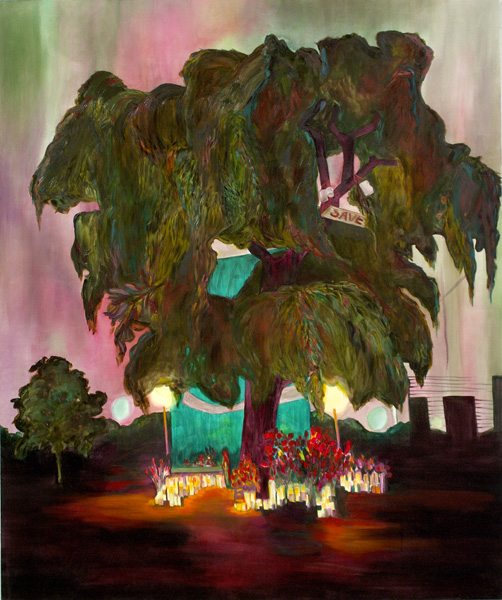
These paintings reminded me of the work of LA painter Jill Newman, who equally chooses to paint politically charged sites. Instead of working in a social realist form, both painters use their representations as a place for formal departure. Early this year, at the recently closed Park Projects (now resurrected as Sea and Space), Newman exhibited a lush painting of the South Central Farm called Endless Numbered Days.

endlessnumbereddayssave.jpg

Endless Numbered Days

Luminescent in oil, the large painting depicts the tree at the center of the struggle. This is the walnut tree that activists camped in to defend the garden. The significance of the tree within the conflict is visible only by a faint banner and the tree-sit platform painted with the word “SAVE” on it. Otherwise it’s a color and lightfest. At a recent show at Taylor De Cordoba, Jill continued her South Central Farm trilogy with a series of watercolor paintings of improvised architectural forms constructed by the farmers. Like the oil of the walnut tree, these paintings use the political context of the farm as an invitation for aesthetic play with color. Rather than a retelling of the tragedy that has befallen LA, it is as if saved in Newman’s painting is a little bit of the spirit, biodiversity and creativity lost when the place was plowed under.

41standalamedaglorydays.jpg

Chatting with my friends Kimberly and Melissa about these paintings, we came to a quote by artist Andrea Bowers regarding Vija Celmins, an artists who spent hours drawing meticulous, formally perfect photo-realistic. Bower’s said:

When you work this way, imagery is not chosen lightly; it is considered for a very long time. The dedication of her labor is an act of generosity toward the viewer. Her work shares a record of time in relation to production and to imagery. Whereas cynicism is prevalent in the art world today, she instead chooses to believe in human motives, so obviously displayed in Untitled #9 (For Felix) (1994–95), a drawing of a comet dedicated to the memory of Felix Gonzalez-Torres, whose own work focused on generosity despite his dealing with the horror of AIDS.

In an age of intellectual coolness and emotional distancing, Celmins’ work reminds me that the artist’s personal position in relation to her subject matter has value.


untitled, #10

Howard Zinn writes in o’hara’s book “if the drawings of slavick and the words that accompany them cause us to think about war, perhaps in ways we never did before, they will have made a powerful contribution towards a peaceful world”. If Zinn is refering to a kind of conscioussness raising frequently performed by political art, I find this unlikely to occur. Slavick’s is an art that doesn’t seem to circulate in the appropriate environments, and its postion seems to be more about painting than convincing. I don’t however think this makes her kind of political art useless. Though representational and political in subject, it takes a differen’t approach than someone like Leon Golub, who is political becuase he can bludgeon. By taking scenes and places, battle zones which we think we know so well, and transforming them for creative fodder for trips into other realms, Newman’s and slavick’s paintings do a bit to reclaim wonder and imagination from the death machine. And here is the peace.

"A Wal-Mart crushed by a great green storm, a new town rising from the logos to be born."


From the 10 July 02007 Los Angeles Times

Preaching the anti-shopping gospel

Under the guise of the Rev. Billy, activist, actor and writer Bill Talen targets consumerism and big corporations.

By Erika Hayasaki, Times Staff Writer

NEW YORK — Familiar in his clerical collar, cream-colored suit and dyed-blond pompadour, the Rev. Billy has spent much of the last decade parading through the streets of Manhattan, shouting through a megaphone messages such as: “Mickey Mouse is the anti-Christ!”

Accompanied by a robed choir belting out gospel songs, the Rev. Billy condemns the “Disneyfication” of Times Square and warns that Wal-Mart is part of the “consumer axis of evil.”

To passersby, the preacher who shouts: “Can I get a change-a-lujah?” might seem like just another colorful character in New York’s backdrop. But the Rev. Billy does not promote religion and he is not actually a reverend. He is the alter ego of Bill Talen, an activist, actor and writer who has become nationally known as Rev. Billy, a character inspired by televangelists, for his fight against consumerism and big corporations.

At the end of June, police arrested the Rev. Billy in Manhattan’s Union Square on suspicion of harassment after he repeatedly recited the 1st Amendment through a megaphone during a bicycling rally. His arrest sparked outcries from supporters who said his free-speech rights had been violated.

“Rev. Billy has a 1st Amendment right to recite the 1st Amendment,” said Norman Siegel, former head of the New York American Civil Liberties Union and attorney for Talen, who has called for the charges to be dismissed.

Video of Talen being handcuffed was posted on YouTube. After his release from jail, he criticized police for violating his rights and took his moment in the spotlight to bring new attention to his crusade against megastores, consumerism and gentrification.

“We’re addicted to shopping,” said Talen, in an interview at an independently owned East Village cafe. It’s near St. Mark’s Church in-the-Bowery, where his congregation, the Church of Stop Shopping, holds services.

“Don’t go shopping in a big-box store if you can help it,” he said. “Don’t go to a chain store if you can help it. Those are sweatshop products. Those are union-busting companies.”

Big businesses targeted

Talen used to live in the East Village, paying about $400 a month for rent. But he said he was forced to move to Brooklyn as rent in the neighborhood climbed to $2,000 a month. He pointed to a Chase Manhattan Bank across the street from the church.

“That used to be the Second Avenue Deli, with the Yiddish Walk of Fame in front of it,” he said, noting there was another Chase branch around the corner. “I’m embarrassed that’s there.”

Though many admire Talen’s passion, his critics — including corporations that he targets and customers who shop there — say it is unrealistic to ask the public to stop shopping at their favorite stores. Others complain that the Rev. Billy’s dramatic protests, which sometimes include barging into stores with his bullhorn, are disruptive and don’t contribute to meaningful discussion or debate about the issues.

Talen’s mission to curb consumerism began in 1997, when he felt that megastores and corporations were overrunning Manhattan streets where family-owned shops and restaurants used to be. Meanwhile, he said, “poor people, eccentric people, vendors, people of color” were being priced out of the neighborhoods they had lived in for years to make room for wealthier people and businesses where they shopped.

Talen bought a pulpit from a thrift store and planted himself in front of the Disney store in Times Square, just as the area was beginning to transform into the glitzy commercial center of the city that it is now. He delivered sermons in a Southern accent denouncing big businesses.

“At first it may have been a parody,” said Talen, “and you probably could have taken it right out of ‘Saturday Night Live.’ “

But Talen said he believed in his message and it resonated with people. As his following grew, he met Savitri Durkee — now his wife. She also came from a theater and arts background and had grown up in a utopian commune. He was raised a Dutch Calvinist in the Midwest, a faith he rejected as a teenager.

He and Durkee partnered in writing political theater featuring the Rev. Billy, which he performs with his choir and band.

“It resembles religion in certain ways,” she said. “We have a regular group of people who come to our shows. They are exactly like a congregation and our relationship to them is very much like a congregation. The expectation in the room is a prayerful one, a hopeful one.”

In his book, “What Would Jesus Buy?” the Rev. Billy offers prayers and songs: “We believe in making more than money. Beyond big debts there’s a super value. A Wal-Mart crushed by a great green storm, a new town rising from the logos to be born.”

Coffeehouse banishment

Talen’s work has been captured by producer Morgan Spurlock (of “Super Size Me”) who followed the Rev. Billy and his entourage — including a 35-member choir and band — as they traveled on two biodiesel-fueled buses across the country in late 2005 for a soon-to-be-released film. Among the stops: Disneyland’s Main Street U.S.A., where Talen was arrested on Christmas Day.

Another frequent target of the Rev. Billy’s is Starbucks — a judge has barred him from coming within 250 yards of the businesses in California.

In a statement, Starbucks spokeswoman Bridget Baker said the company was aware of the Rev. Billy and his criticisms. “We understand that activists use many vehicles to express their opinions,” she said, adding that Starbucks has a record of social responsibility.

Talen, who often takes his performance on the road, remains undeterred. He keeps financially afloat with donations and the sale of his book and CDs.

He traveled to Iceland last week to take his message to a conference on saving the country’s landscape from heavy industry. When he returns to New York, he is scheduled to perform his anti-consumerism production, the Rev. Billy’s Hot and Holy Highline Revival.

“We have humor inside our prayers, inside our hymns,” he said last week, his voice shifting into his sermon style as he recited a line he has told tourists at Times Square:

“I want you to take your little family away from this den of iniquity!”

erika.hayasaki@latimes.com

Moorcock on Ballard

mm_jgb_brighton.jpg

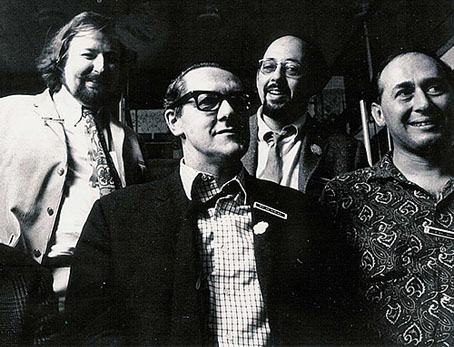
This photo is believed to have been taken in 1968 at the Brighton Arts Festival. From the left, Michael Moorcock, Brian Aldiss, Mike Kustow (director of the Institute of Contemporary Arts in London), JG Ballard (photo courtesy Michael Moorcock).

“He inspired his contemporaries, like Aldiss and Brunner, for instance, to concentrate increasingly on contemporary imagery and issues. He was so far removed from even the best genre writers, such as Dick or Pohl and Kornbluth, that he was our finest model in showing new writers how to develop their own vocabularies. I didn’t want to write like Jimmy any more than the rest of our best writers, but he showed that it was possible to write idiosyncratically about what we saw as the urgent issues of the day, that genre conventions need only be employed where they were useful to the individual. Previous to that I think Jimmy would argue only Bradbury had managed that transformation. Bradbury was Jimmy’s inspiration before Burroughs. I had seen Bester and the Americans who influenced him as a similar inspiration. Neither of us could read what is generally called ‘Golden Age’ SF.”

(…)

“I think we were all part of a broad movement which was rejecting, as I said, the played out conventions of Modernism. We were looking for methods which worked for us. Some were eventually abandoned. Some were modified. We now live in a world where many of our innovations, techniques and subjects we considered our own, have become so commonly used nobody even knows where they originally came from. We’ve probably, therefore, achieved what we set out to do, to establish fresh conventions better able to deal with contemporary life.”

One great contemporary writer discussing another at Ballardian.

Skills-enhancing public beach safaris in Malibu…

The Los Angeles Urban Rangers announce

‘MALIBU PUBLIC BEACHES’ SAFARIS
August 4-5 & 11-12, 2007

“Tired of Zuma and Surfrider? Want to find and use the other beaches in Malibu? The twenty miles that are lined with private development? The ‘Malibu Public Beaches’ safaris will show you how to find, park, walk, picnic, and sunbathe on a Malibu beach. Each 3 1/2-hour safari visits two or three beaches and explores natural history, jurisdiction, and the identification of public and private property. Skills-enhancing activities include a public-private boundary hike, an accessway hunt, sign watching, and a public easement potluck.

“We will offer two safaris in west Malibu and two in east Malibu:

** West Malibu beaches – SAT Aug 4 (9:30am-1pm), SUN Aug 12 (1:30-5pm)
** East Malibu beaches – SUN Aug 5 (9:30am-1pm), SAT Aug 11 (1:30-5pm)

“Safaris are free, but space is limited. To sign up, please email info@laurbanrangers.org with tour date, name, and number of people. For further information on the safaris and the Los Angeles Urban Rangers, visit http://laurbanrangers.org/.

“A ‘Malibu Public Beaches’ guide will be downloadable from our website in
early August.

“The Los Angeles Urban Rangers is a collective of artists, writers, architects, and urban designers. We adopt the park ranger persona – friendly, knowledgeable, direct, and a tad gee-whiz- to explore the workings of our home megalopolis, and to give people the interpretive tools to do the same.”

A REVIEW OF THE TRIBUTE TO MORT SAHL by Paul Krassner

When my wife Nancy was 16, she listened over and over to Mort Sahl’s first album until she memorized it, just as she had done with the score of My Fair Lady. Last week, we sat behind Sahl, watching him enjoy and appreciate a tribute to him by a gaggle of comedians at the Wadsworth Theater in Brentwood.

There were the original gang members: Jonathan Winters (in character as an aging baseball star); Norm Crosby (master of malapropism); and Shelley Berman (doing his classic rotary-phone call, still dialing a number rather than pressing buttons).

And there was the newer breed: a surprise appearance by George Carlin (his set piece on contemporary schizophrenic man followed by a film clip of his 1962 impression of Sahl); Jay Leno (fat jokes); Richard Lewis (dick jokes); Drew Carey (referring to the bus driver who told Rosa Parks to move to the back of the bus as “the father of the civil rights movement”); Harry Shearer introducing Kevin Nealon; and Bill Maher re-introducing political incorrectness.

Woody Allen and Don Rickles sent their good wishes via video. The program mentioned that “Comedians scheduled to appear are subject to personal availability.” Thus, David Steinberg and David Brenner were no-shows, and Larry King was replaced as host by Jack Riley, one of the patients in Bob Newhart’s TV group-therapy ensemble.

Paula Poundstone, the only female comic, resorted to her forte, asking an audience member, “What do you do for a living?” He was an attorney–giving her the opportunity to talk about her own problems with the law–and he turned out to have started the first Mort Sahl fan club in 1956. She asked if all the members of his fan club wore those cute red pullover sweaters like Mort did.

Although all the performers topped off their regular schtick with praise for Sahl’s comedic breakthrough, Albert Brooks was the most original and unique to the context of this occasion.

“I’m embarrassed tonight,” he began. “And angry. And I’m confused. I don’t know the people that produced this show at all. But I would strongly suggest that when they do an event like this again, they spend a little extra money and hire a real publicity firm to disseminate the information correctly. I was told that Mort Sahl passed away. So you can imagine my shock, my dismay, and quite frankly my disappointment, when I arrived here this evening and saw him standing there.

“I worked very, very hard on this eulogy–and unlike other comedians tonight, I don’t have a current act, I just can’t pull ten minutes off the top of my head–so I do this, or I have nothing. I asked myself, ‘What would the late Mort Sahl say?’ I think he would have said, ‘You do it.’ Nobody appreciated a turn of a phrase, a beautifully-written sentence, as much as he did. But then again I say, to the people that produced the show, ‘If you don’t wanna spring for full-blown publicity, please get someone who will talk to the talent.”

And he started to read aloud:

“Mort Sahl–1927 to 2007. Mort? We hardly knew you. I remember the last time I saw Mort alive. It was at a Starbucks near where I live. And now I wish I’d said the things that I really felt. I wish I’d said how much he influenced all of us here. How brave he was. I wish I’d have told him how much of an innovator he was. I wish I’d have told him how much I loved listening to his records. While he was here. But I didn’t. All that I think I said that day was, ‘Are you gonna finish that latte?’

“This should be a lesson to all of us. If you see someone that you love, don’t ask for their food. Tell them how much they mean to you. Do you know what? On a night like this, I think we need to look on the positive side. From what was told to me, Mort didn’t suffer. He died as he lived. In his sleep. It’s at times like these that I think of what the great Alexander the Great said to his brother in the middle of a fierce fight. He said, ‘I’m going home. I don’t wanna fight anymore. You can take over. And try not to die.’

“If only I’d said that to Mort Sahl! That day in Starbucks. But I didn’t. Actually I think, along with the latte comment, I also asked him if he were going to eat the scone. But you know what? I’m sure he knew what I meant. I’m sure he read into that freeloading comment, the fact that I loved him….”

Finally, Sahl himself took the stage–wearing, of course, his signature red pullover sweater.

“I’ve been very moved by everybody tonight,” he said. “And I had a good time laughing. I want you to know it really did knock me out. And I also want you to know that I’ll do it as long as they let me. I didn’t want this to be a retirement party, you know. I’m still in business. And to reference that business–when Bill Maher came down to so graciously keep us company, was talking about the Bush administration–you know, I know the president, and he told me that he doesn’t drink. And he said, ‘I don’t need it, because I’ve been born again. And what occurred to me in the moment was: If you had the rare opportunity to be born again, why would you come back as George Bush?…Cheney went to the hospital. Got an aneuryism in the right knee. You know, the one that replaced the left knee. Also he’s had four heart attacks and also a pacemaker. They’re reconstructing Cheney, a Halliburton corporation. And they’re overcharging him.”

At one point, someone shouted, “Hey, Mort! You avoid 9/11 in your act. You always talked about the Warren Commission. You were all over it!”

“You hear that?” Sahl asked the audience. “It was something to do with the Warren Commission. Well, you know that’s how I went out of business for about twelve years. But I stuck to my guns, because I remember something [Bobby] Kennedy said: ‘To all you with the guns out there. You may be able to slay the dreamer, but you haven’t slain the dream.’ I came to this because I really thought I was an American and really had the capacity to dream. You all know that if you watch Turner Classic Movies. That’s what the movies were about–it was a dark place where people could fall in love and moral issues could be resolved. My grandfather came from Lithuania, although Lou Dobbs tried to stop him….I dreamed that dream.

“When I started this act,” he concluded, “although I was just lonesome and looking for a family, in a larger sense I saw it as a rescue mission for America…but I believe it more than ever, in spite of the odds. That the good guys’ll win….I tried to get to your funny bone and get into your head, but apparently I also got into your heart.”

———

Satirist Paul Krassner will perform at M Bar in Hollywood on July 20.
More info: paulkrassner.com

The Hidden People of Iceland…

2023 UPDATE: Stream the entire film here.

“Huldufólk 102”
Nisha Inalsingh, 2006, 74 min., doc
Iceland
NEW YORK PREMIERE! – July 22 at Anthology Film Archives

“Set against the backdrop of Iceland’s breathtaking rural landscapes, Huldufolk 102 explores the country’s incredible attitude towards a supernatural phenomenon most of us associate with Walt Disney, JRR Tolkien and five-year-olds. Entitled, quite literally, ‘Hidden People 102’, Nisha Inalsingh’s film debut tackles parallel universes, fairies, elves and all things three feet tall. Interviews with farmers and academics, politicians and priests, the young, the old, the superstitious and the rational, bear testament to the survival of ancient folkloric traditions in all segments of Icelandic society. Men in suits talk very seriously about the huldufolk’s invisible houses inside rocks and stones. The matter is taken so seriously, in fact, that parliamentarians agree to divert roads around potentially ‘inhabited’ rocks! It’s not, the interviewed invariably stress, that everybody believes in these invisible beings (though 10% of the population do admit to it), but rather that most refuse to deny the possibility (80% to be sure).”

More info: www.huldufolk102.com

(click here to see trailer)