Instead of spending a fortune getting rid of graffiti, why don't we just give it marks out of 10?

vandal.jpg

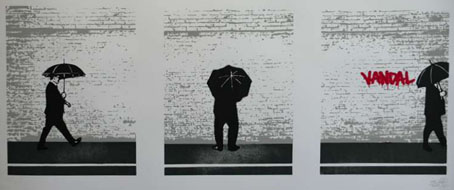
Vandal by Nick Walker.

Germaine Greer
Monday September 24, 2007
The Guardian

Thirty-five years ago I bought a dilapidated house in North Kensington, London. One of the reasons I bought it was that it sported a magnificent graffito. In those days, graffiti were usually texts, some of them, it was said, written by the poet Christopher Logue. This one spelt out, in foot-high block capitals, the undeniable truth that “Boredom is counter-revolutionary”. When the house was done up, the graffito disappeared. Over the years, the neighbourhood lost all its graffiti one by one, as the pestiferous warren of flats and bedsits was regentrified. The wall that had the one word “Scream” written its full length was repainted, and the grim prediction “This too will burn” was removed from a pillar under the Westway.

Aerosol art is not the same thing at all. Although Banksy is as likely to be arrested as the defacers of those days, what he does is jokey, wry, fundamentally civilised. In a message that’s been sloshed up by a couple of four-inch brushes loaded with red and black gloss paint rather than sprayed through a stencil, you see not good humour and self-deprecation, but honest-to-goodness grief and rage.

For months I thought about restoring my graffito, maybe cleaning the new cream stone-textured paint from off the letters or even painting them again; but eventually I realised that for the owner of a house to scribble on it is just pathetic and downright disrespectful, like Foxtons the estate agent having the name Foxtons painted on the side of its fleet of Minis in graffito script. You’ve got to be working full-tilt, hanging head downward off a motorway bridge with your mates holding you by the feet, writing . . . what? Probably your tag in blocky letters outlined in contrasting trim. Nearly all graffiti are just annoying, but you have to put up with the millions of naff ones if you want the occasional brilliant one. A great graffito is not simply an arresting design; it is a once-in-a-lifetime coincidence of work, place and space. Would anyone now dare to sandblast the murals of loyalists and republicans from the walls of Belfast? Now old IRA wall paintings are being touched up and recycled with messages in Arabic signifying solidarity for the Palestinians. And Banksy has done his best work on the West Bank Barrier.

Most aerosol art, like most other art, is feeble and bad. If bad art was a crime, some of our most respected citizens would have been banged up years ago. Wall art, whether brilliant or ordinary, is a crime so serious that it is to be treated with zero tolerance: fortunes are spent in tackling the graffiti scourge; in Berlin low-flying aircraft are used to scan the streets with infra-red cameras to catch the spray painters at work. Oceans of highly toxic solvents are being sluiced over walls and hoardings to wash the paint into the sewers and eventually into the water table. Wildly illiberal proposals are coming from all quarters: possession of spray paint and selling of spray paint will become crimes; taggers will have their driving licences withdrawn and be fined huge amounts on the spot. In England two young men known in art as Krek and Mers, who haven’t done a graffito in two years, have been sent to prison for 12 months and 15 months respectively – though one of them was due to start an art course at university, his mother had offered to pay for the damage, and 500 people signed a Facebook petition. Needless to say, making an example of them will be the opposite of a deterrent; tagging is now heroic protest. Expect to see the names Krek and Mers on every railway bridge.

Graffiti cost Londoners £100m a year, and the country as a whole more than a billion, we are told; what is actually costing is not the art, which is free, but its destruction. The engine driving this colossal expenditure is Encams, mastermind of the Keep Britain Tidy Campaign, which implores us not to drop litter or chewing gum, dump cars or rubbish, make lots of noise, or leave our dogs’ shit on the pavement. Major mess-makers they leave well alone. Apparently graffiti and fly-posting can fill people with a feeling of unease or fear, because they associate both with crime. As fear of crime is already way out of proportion to the actual incidence of crime, loathing of graffiti must be equally, if not more irrational. We should not pander to it.

Walls don’t look much better after their graffiti have been washed off than they did before, so we might as well stop doing it. In environmental terms, the washing-off makes a worse mess than the painting ever did. The wall-painters themselves will paint over each other’s work, especially if they consider it feeble. A far less costly option is for us all to make our own stencils giving the defacers marks out of 10, to remind the artists that there are people out there who have eyes to see, and as much right to say what they think as the artists. The work then becomes a palimpsest, a dialogue between artists and public. Most tags deserve the single-word comment “prat”.

Whether at Lascaux 17,000 years ago or in Western Arnhem Land 50,000 years ago, art began on a wall. If the sandblasters had been around in either place, we would have lost a precious inheritance.

For a regular dose of great street art, check Wooster Collective.

"Hollywood Effects Prepare Sailors for Deployment"

Because death and crippling wounds are not exciting enough….

from Navy News 9/12/07

NORFOLK (NNS) — Navy Expeditionary Combat Command (NECC) introduced a new aspect of combat life-saving training to many predeploying Sailors during the two-week NECC-centric exercise Comet ’07, which ended Sept. 13.

NECC hired special effects company, Strategic Operations (StratOps), to conduct “hyper-realistic” medical training and to simulate a tactical combat environment.

According to NECC Force Medical Master Chief (DSW/SS) Dennis Polli, the primary goal of “hyper-realistic” training is to mentally prepare Sailors for situations that could over-stress them.

“Most Navy training is didactic; classrooms, text books and then maybe you buddy up with someone and practice putting on bandages or a tourniquet. During Comet, non-medically trained Sailors will have to treat people with major trauma injuries, while under fire.”

Using Hollywood-trained special effects, make-up artists and actors, many of whom are amputees, StratOps is able to present Sailors with one-of-a-kind training scenarios.

During the first week of Comet ’07, Sailors attended a basic combat life-saving class. After they discussed theory for several hours, two Sailors at a time were led from the classroom and taken outside.

They were then prepped for their practical exercise, according to Constructionman Jonathan Lewis of Riverine Squadron (RIVRON) 2.

“They had us sprint 100 meters and then crank out a bunch of pushups to get our heart rates up,” said Lewis. “Then they told us to enter a building and take a right. As soon as we got in, we saw a Sailor on the ground with both his legs blown off in a huge pool of blood. Apart from telling us to help him, they didn’t give us any instruction. It was the most realistic training we’ve been through.”

“When you actually have a guy who’s missing limbs covered in blood and acting as though he was in shock, it’s amazing,” said Gunner’s Mate 3rd Class James Soden, RIVRON 2.

One of the objectives of this course is to force the Sailor to calm down and assess the situation.

“In a way, it’s just like any other training, you want to build mental and muscle memory,” said Polli. “Once someone has seen something for the first time, they have a chance to get used to it, and the next time they’re in a similar situation they won’t hesitate to act.”

StratOps Special Effects Artist Alisha Saunders, said she’s had a lot of positive feedback from Marines who’ve gone through the training and returned from deployments in theater.

“A lot of people tend to freeze up when they see the wounds we create. From what we’ve been told, this is really helping prevent shock when out in the field,” said Saunders. “Plus, they learn to wrap wounds that are covered in blood, which is a lot harder than wrapping clean skin during regular medical training.”

Carie Helm, a makeup artist with StratOps, said there’s a lot of job satisfaction turning someone into a blood-spewing medical nightmare.

This is the best job in the world. We get to create our favorite things, horrible bloody wounds and work with Sailors and Marines. But seriously, if we can help prepare someone that’s getting deployed, that means a lot to us.”

Comet ’07 was conducted in three locations – Fort Pickett, Naval Weapons Station Yorktown Cheatham Annex and Naval Amphibious Base Little Creek, all in Virginia. The exercise involves nearly 1,000 active-duty and reserve Sailors from various NECC commands including Maritime Expeditionary Security Force, Explosive Ordnance Disposal, Seabees, Maritime Civil Affairs and Riverine.

Additionally from the San Diego Union Tribune regarding the founding of San Diego Based Strategic Operations

After the Sept. 11 terrorist attack in 2001, Segall’s studio experienced a slowdown, but he soon found a way to put the excess studio capacity to good use, said Kit Lavell, executive vice president of Segall’s Strategic Operations Inc. ….

Around the same time, Lavell said, agents with the Drug Enforcement Agency, which is headquartered nearby, showed up at the studio because they’d heard shooting. A tour of the grounds led to that agency training there, and, as word spread, other agencies as well.

In September 2002, Segall incorporated Strategic Operations, which provides tactical training to the military, complete with “hyper-realistic” special effects, pyrotechnics, medical makeup and actors to stage attacks, sucking chest wounds and traumatic amputations.

The company, which offers a range of programs, can charge up to “a couple hundred thousand dollars” to train 1,000 marines for 10 days at the studio, Lavell said.


For further reading check out Paul Virilio’s War and Cinema

Par(king) Day is today

Plop your monies in a meter and build a park

The first annual Park[ing] Day LA, which will be on Friday, September 21st will bring together a diverse constituency of community groups, neighborhood councils, design & architecture firms, professional organizations, non-profits, cyclists & pedestrian advocates as they work together to transform numerous parking spaces & parking lots located throughout LA into ephemeral parks for the day. By occupying a parking spot and feeding the meter, volunteers will enhance the street with a sustainably designed pocket-park.

m_bdd7d43007c8ad46e6abfa27b571e80e.jpg

Events planned in LA and across the United and Overpaved States!.
Original concept (and photo) courtesy of Rebar.

RUSHKOFF on 9/11 conspiracy theorists

CONSPIRACIES OF DUNCES
by Douglas Rushkoff
(from Arthur No. 26)

I have to admit that I do this with some trepidation. I can already feel the assault on my inbox. But after a good long think about potential time and energy being lost by our entire community to senseless and ultimately inconsequential musings, I have to come out and say it: the alternative theories about 9-11 are wrong. Worse, the endless theorizing and speculation about trajectories, explosives, military tests, fake airplane parts and remote control navigation actually distracts some of our best potential activists from addressing the more substantive matters at hand.

Yes, I believe that 9-11 theorizing debilitates the counterculture. It robs us of some potentially creative thinkers. It replaces truly important questions with trivial ones. It marginalizes more constructive investigation of American participation in the development of Al Qaeda as well as its subsequent aggravation. And perhaps worst of all, it is precisely the sort of activity that government disinformation specialists would want us to be involved with.

9-11 theorists are unwittingly performing as the unpaid minions of the administration’s propaganda wing. (At least most of them are unpaid; no doubt, some of the loudest are working as contractors for the same agencies whose activities they pretend to deconstruct.) That’s why, instead of nodding along with their long-winded, preposterous yarns under the false belief that any critique is better than no critique, we—the informed, intelligent, and reasonable members of the war resistance—must instead disassociate ourselves from this drivel. In other words, we must draw the line between the kind of analysis done by Greg Palast and that done by Pilots for Truth. If we don’t apply discipline to our thinking, we risk falling into the trap that even some of our best intellectuals have—like Harper’s editor Lewis Lapham, who on reading a bit too much 9-11 conspiracy, has concluded that it all has some merit.

I’m all for supposing. It’s how the best science fiction gets written, the best science gets speculated, the best innovations get developed, and the wildest thoughts get hatched. But forensics is a different beast. As any detective will tell you, the most straightforward solution is usually the right one. As one NYPD detective explained to me, “Nineteen hijackers took four planes and crashed them at different places: WTC 1, 2, the Pentagon and a field in PA. These accounts broadly correspond to all that was observed and heard that day, who was on the flight manifests, where they came from and what they claimed to want to do, and yet do not involve vast US government conspiracies and do not need the coordinated, perfect lying of tens of thousands of people about the mass murder of their fellow citizens and those they gave their oath to spend their careers protecting.”

True enough, these huge incidents have produced many unexpected details. The plane in Pennsylvania scattered its parts differently than we might have expected it to. Lamp posts near the Pentagon got knocked over when we wouldn’t have thought were vulnerable given the altitude of the approaching plane. Building number 7 fell hours later, even though it was never directly hit by a plane. Video photography of the collapses show the towers falling quite neatly, as if in a planned detonation.

But strange and unexpected details don’t necessarily point to the fallacy of the central premise—especially when the alternative involves the active coordination of thousands, if not tens of thousands of citizens in a conspiracy to attack the United States. We must look at what each intriguing detail or inconsistency actually says about how the crime took place. Again, in the words of my favorite member of the NYPD, “These explanations are principally based on the fatally flawed idea that any confusion or misinterpretation or differing accounts in times of crisis must be the product of purposeful lies. They neglect the idea that in crises, and when there is mass confusion, people do not have specific recollections, only general ones that are highly subjective, such as what direction a plane sounded like it was coming from. Their stories seek to poke holes in prevailing truth, yet offer no alternative that could be seen as remotely plausible.”

For example, the Pilots for 911 Truth website explains: “Why was Capt. Burlingame, a retired Military Officer with training in anti-terrorism, reported to have given up his airplane to 5 foot nothing. 100 and nothing Hani Hanjour holding a “boxcutter”. (Exaggeration added for size of Hani, he was tiny, lets just put it that way). We at pilotsfor911truth.org feel the same as his family in that Capt. Burlingame would not have given up his airplane unlike what is reported in this linked article from CNN.”

What, exactly, is this supposed to mean? Was Captain Burlingame murdered? Or was he the willing participant in the government’s effort to sell the invasion of Iraq to America—so much so that he chose to enter into a suicidal pact? Or was the hijacker bigger than his passport suggests? Or is it implausible that a small dark man from an undeveloped country was able to overpower a big, trained, white man from a Superpower?

And that’s where I suspect all this theorizing really takes us: to the heart of a racist jingoism worse even than the triumphalism justifying our foreign policy to begin with. They can’t bring themselves to accept that our big bad government can really be so swiftly outfoxed by a dozen relatively untrained Arab guys. And rather than go there, they’d prefer to maintain the myth of American hegemony. On a certain level, it feels better to believe that we are only vulnerable by our leaders’ sick choice—not by our adversarsies’ increasing strength and prowess.

But maintaining this comforting illusion comes at a price. It paralyzes our ability to do the real work necessary to parse what is going on. I mean, on a certain level, what does it matter whether Osama Bin Laden, a CIA-trained former ally is currently acting on his own or as an operative of some covert semi-governmental organization or corporation? We can’t even begin to ask these questions when the people who might be most qualified to look into them are instead crippled by their own ethnocentrism.

The cultivation of a critically aware public is too important right now for us to entertain this silliness any longer. When a full 40 percent of the American public believes that Saddam Hussein was responsible for 9-11, we can’t afford the luxury of this delusional behavior. We are the alternative to the FoxNews version of events, and we must strive to present a more responsible alternative to Karl Rove’s disinformation.

The war profiteers are absolutely delighted that so many of us are still distracted by this phantom menace. And they delight in our belief that the central government is really powerful enough to pull something like this off. I’ve been interacting with intelligence people for the past three years, going to conferences and writing articles promoting an open-source approach to national security. After these encounters, I can assure you—anyone who knows anything about our government knows that a conspiracy on this order is well beyond their capabilities. Hell, the administration couldn’t even “find” weapons of mass destruction in Iraq. They can’t even reveal a Valerie Plame or fire the few remaining honest US attorneys without a complete backfire. Conspiracy is not what these folks are good at.

Our government excels at doing its really bad stuff out in the open. They break laws in order to spy on citizens, and refuse to acknowledge objections from lawmakers or justice. They take taxpayers money and give it to the companies they run. They acknowledge the many billions of dollars that go missing, and offer not even a shrug. They put the people who formerly lobbied on behalf of industries in positions running the agencies that are supposed to be regulating them.

By looking under the rug for what isn’t even there, we neglect the horror show that is in plain view. In the process, we make it even easier for the criminals running our government to perpetuate their illegal, unethical and un-American activities.

In fact, the most logical conclusion I can draw from the existing evidence is that 9-11 theorists are themselves covert government operatives, dedicated to confusing the public, distracting activists from their tasks, equating all dissent with the lunatic fringe, and provoking the counterculture’s misplaced belief in the competency of its foes.
That’s the real conspiracy.

"Like Omigoshh! After I do my hair, I'll Kill some Iraqis!"

FUCK YOU MTV for Selling the OC’s Precious Children to the Meat-Machine.


Infinite justice will rain down like peroxide blondes and little jerks- future service members in uncle sams shit pile.

From Navy Newstand

SANTA ANA, Calif. (NNS) — Navy Recruiting Station Santa Ana got a little bit of the Hollywood treatment June 8 when a film crew from MTV was on site to film an episode of its reality TV show “Laguna Beach.”

This rare opportunity gave the station a chance to help spread the Navy message to the Navy’s target recruitment audience on a national level when one of the show’s participants, Grant Newman, expresses an interest in the SEAL program.

Newman, joined by show mate Allie Stockton, was greeted by Navy recruiter Yeoman 1st Class (SW/AW) Thomas Jackson as the cameras rolled. After an exchange of friendly handshakes, Jackson gave Newman a rundown of some of the opportunities and benefits the Navy has to offer. Benefits such as educational opportunities, travel and job security, which would appeal to many young adults in the same age group as Newman.

“This is the perfect opportunity for us to spread Navy awareness to a wide range of people nationwide,” said Jackson. “It’s a chance for us to take away any misconceptions some people may have about the U.S. Navy in a positive light on MTV, a nationally televised network.”

“It’s a great chance for us to tell the story about the Navy,” said Lt. Erik Reynolds, of Navy Office of Information.

Laguna Beach is a show that a lot of young people watch and this gives us a chance to put out information about the Navy they may not have been aware of.”

Laguna Beach is a reality TV show which documents the lives of several teenagers living in Laguna Beach, a community located in Orange County, Calif.

for a different reality on military and college service check this out..

John Sinclair on Cary Loren's BOOKBEAT in Oak Park, Michigan

OUT OF CONTROL: Cary Loren & BookBeat
By John Sinclair

“Our bookstore’s like a screaming little kid that’s out of control,” BookBeat proprietor Cary Loren confesses, looking sort of sheepishly around his overstuffed shop at the outer corner of a strip mall at 10-1/2 Mile and Greenfield in Oak Park, Michigan.

He’s got that right: “out of control” is the proper name for this perfect mess of a place crammed with books and visual curiosities of unseemly descriptions. True, the store presents a penetrable opening space sporting popular literary products from the present, and there’s a recognizable counter with cash register and other expected signs of business activity, but past this navigable vestibule the books come stacked up thicker and higher with each step toward the rear.

BookBeat isn’t some dusty relic of the days of bookshop glory, although the shop is clearly the creation of serious modern intellectuals of the humanitarian persuasion. It’s a bright, colorful, warm and welcoming place for intellectual stimulation, art and politics, with a parallel reality as a comprehensive source for state-of-the-art children’s books, classic literature and progressive texts.

Like all successful shops BookBeat pays close attention to the contemporary marketplace and takes great pains with its art and literary specialties and its treasured legion of readers. The store’s regular reading series features the usual traveling authors and more idiosyncratic guests like Nikki Giovanni, Ira Cohen, Stanley Mouse, Faith Ringgold, Darlene Love, Anne Rice, Sonic Youth, Billy Name, Ultra Violet, Mike Kelley and Jim Shaw. They also host in-person writer events at nearby libraries and cultural centers and sponsor book clubs and book-related community events of many kinds.

These crucial outreach activities have combined with the shop’s extensive and eclectic inventory to anchor BookBeat firmly in the center of the local literary and arts community. “I think you can have a good bookstore with a lot of different things,” Loren says, “but you still need literature, and experimental literature, so that’s been a core part, and the photography’s been a core part.

“But we’re missing the auto repair section, and the computer books…. There’s just whole wads of books that we just said, ‘Fuck It,’ you know. I wanna have certain books on my shelf and I don’t care if it’s there a year or ten years, it’s still a viable thing.”

Loren’s sensitivity to the needs of his clientele has paid off in the best possible way. “Our customers are very loyal,” Cary says, “and they’re voting with their feet when they come here instead of going to one of the chain stores. Those places are becoming more dominant and more controlling of the whole environment.

“What worries me,” he says, “is that I don’t think there’s another generation coming up that understands the value of independent bookstores and of independent culture in general, as opposed to the chainstore reality.”

He has every right to be worried, because without new seekers of wisdom and truth the independent bookstore as we know it is doomed to extinction. The converse is also true: Absent the classic independent bookstores like BookBeat, how will young readers ever understand the value of these places or be able to measure the hole left in our cultural life by their disappearance?

So much of the world represented by places like BookBeat has passed on that their continued survival is a critical issue for the future. The great thing about them is that the mental world where I live and prosper still exists here. It’s an environment specifically designed for those of us who have the mental patience to investigate and discover new realms of intelligence and creativity, and you can tell at once it’s not run by someone who got an MBA in management and trained at Borders or Waldenbooks.

In fact, BookBeat was created by a pair of young intellectuals from suburban Detroit as “something they could do” after college. “And, you know,” Cary says, “I was not capable of doing anything else. When I was going to school I was working for other bookstores, so I knew I could do this. I wanted to go into arts, but I also knew that I needed to, like, make money. And I didn’t want to stay in school and teach, and I thought, maybe I could do art and things on the side, and be supported by the store, eventually.”

Cary and his wife Colleen opened BookBeat in a former pregnancy boutique called the Purple Pickle in the summer of 1982. “I moved back into my parents’ house when we first opened the store,” Cary recalls, “to save money. Colleen and I both lived with our parents to save money.

“But that was good to be able to put everything into the business for those two years, so we were able to expand. There was a Detroit Edison outlet next door, and three years after we opened we took that space.”

Why the strip mall in Oak Park? “We knew the area, because we had grown up around here,” Cary says. “We started with really nothing—my own collection of books, beat literature and stuff, and we wanted to also relate to the community too, so we were stocking Danielle Steele and Stephen King and whatever people were buying, you know, at the time.

“But our emphasis was on the arts, and children’s books—those are the two areas where we wanted to start off, and we’ve stuck with that.”

The arts make a lot of sense, and popular releases, but what about the children’s books? “There’s a couple reasons for carrying the children’s books,” Cary says. “One, a lot of really great illustrated books started to happen at that time, and we also saw that future readers are children, you know? So we need to indoctrinate children early, because those are your future readers of adult material.

“Colleen’s input has been really important,” Cary adds, “because she’s put so much into the children’s side of the store, and it’s been the money-maker part of the business, certainly of late. She works closely with parents and teachers—she reads a phenomenal amount of material, I mean thousands of books every year, probably three or four thousand books a year.

“And so she has this vast warehouse of, you know, first-hand information from reading so much, and she can tell each teacher what to use for the class being offered, and she can come up with programs and books that not only affect the teacher but all the kids in each classroom. She’s become a great resource for this area.”

How did a couple of nice suburban kids get into all this strangeness? “I was going to Eastern Michigan University, and I got through school by working in pizza places. But I was thinking of the bookstores in Ann Arbor. Borders had just started when we got to Ann Arbor, and there was Centicore, that was one of my favorite bookstores, and there was David’s Books, a large store on Liberty, it had a lot of hip poetry.

“We met Andy Warhol at the Centicore one time,” Cary laughs. “I was a real Warholite, following his films and stuff, and I used to write to him when I was a high school student, like, ‘If you’ve got any job openings or anything,’ you know, and he’d send back, like, a signed postcard or something.

“But the guy I corresponded with was Jack Smith, who wrote back and said, ‘Come visit me. If you’re ever in New York, I’d like to meet you.’ So I did, and that’s when, like—that’s just before Destroy All Monsters was formed, and so my esthetic really came out of my time in New York with Jack Smith. He was my mentoring experience, and so I brought that back to Ann Arbor, and that became a part of the Destroy All Monsters thing. I was doing films, photography and collages that were in his vein of… camp and strange exotica, you know?”

The lasting effect of Jack Smith’s cultural tutelage persists in Loren’s personal artistic output: Not just his long-standing participation in the pioneering out-rock ensemble Destroy All Monsters, but in films like Shake a Lizard Tail or Rust Belt Rump, Grow Live Monsters, Strange Frut: A History of Detroit Culture (Part One), Letters from the Dead House and Fantomash, and CDs like the seminal DAM: 1974-1976, Backyard Monster Tube & Pig, Music is Revolution and Monster Island albums like From the Michigan Floor, Dream Tiger, Swamp Gas and Killing Me Softly. This is some pretty weird stuff.

But Cary goes even farther back: “I’d also like to mention the influence of the [early ’60s arts collectives] Once Group of Ann Arbor and the Detroit Artists Workshop on what our bookstore became, and also anti-art movements like Fluxus and Dadaism.

“We also try to publish and try to get a few things out. We’ve done books with Lisa Spindler (Perfume), a Homage to Hans Bellmer, the Destroy All Monsters package Geisha This, and the projects we did with you.” [Full disclosure: Cary Loren and this writer have collaborated on several projects at BookBeat, including the books This Is Our Music and PeyoteMind and the CDs of PeyoteMind and Music Is Revolution.]

“We started our little backroom gallery soon after we opened, and we’ve had exhibitions by James Van Der Zee, Weegee, Billy Name, Day of the Dead Mail Art, Bruce of Los Angeles, Jim Shaw Dream Drawings, Gordon Newton, Leni Sinclair, Haitian Voudou flags and objects, Alfred Steiglitz & Cameraworks, Nina Glaser, and the group show titled Women Photograph Mythology.

“Artist and curator Jon Hendricks is currently helping me with a project with one of our gallery photographers, Jeffrey Silverthorne. We published a little book of his photographs of Goth kids, you know, shot in Detroit, with little hand-tipped-in black-and-white contact plates. I related to the Goth kids because they were, to me, like the sub-culture of now, of the ’90s, at that time. So we put this little book called GOTH together and Jon sent a copy to the director, Lars Schwander in Denmark who became interested and is now publishing a catalog and traveling exhibition of Jeffrey’s work.

“Some of the bizarrities we carry? A lot of experimental music, Sun Ra CDs and Sun Ra videos, Harry Bertoia LPs, miniature books, hand made artist books, original photographs, tarot cards and other odd sidelines some might consider ‘out’.”

Finally, looking into the future after 25 years in the same bizarre location: “I don’t know. Nobody’s gonna offer me ten cents for this store. Economics could squeeze us out of it. I mean, it’s gotten tougher—every year it’s tougher—so the economics could really squeeze us out.

“I’m know I’m not gonna get a buyout, but I gotta think of this in terms of my retirement, you know, and the thing is, I’ll never get out of it! There’s no leaving it. It’s impossible….”

© 2006 John Sinclair. All Rights Reserved.