It's Time to Stop Messing Around- Why I Am Not Going to the Protest

The rise of the new ultra-radicals?(-RH)
By JEFF GIBBS
from counterpunch.org

I am not going to the protest. I am tired of protests: they don’t stop wars. Not protests that are mostly about sign waving and hooking up with friends and strangers and feeling the solidarity and then going back to work or school on Monday. They say the definition of insanity is doing the same thing over and over again expecting a different result.

Sure it FEELS rebellious, these government-permitted, media-ignored, totally predictable rituals-but come on, going to an anti-war protest hasn’t been rebellious since Abbie Hoffman coughed up a fur ball at one in 1968. And in the context of the war on our civil liberties envisioned by Clinton/Reno and executed by your nemesis George W. Bush, they are very, very happy to have you protest and take your name and number. Or force you into a field, or a waiting pen to be locked away until they decide to let you out.

Personally I am tired of marching alongside people wearing masks and carrying signs about stupid Bush when we and everyone we know put together have not been smart enough to stop him. And the Bush bashing only makes the whole parade, err, protest look juvenile to the rest of the world.

Here is what I propose: let’s stop messing around. No more anti-war. Let’s stop the war. No more protest, unless it is part of some huge thing that doesn’t involve business as usual the next day. How do you stop the war? Shut ‘er down. No more business as usual. The target audience: the Democrats, and the presidential candidates who can’t fall over each other fast enough rattling their little Democrat saberettes. (“Bomb Iran? I can top that, let’s bomb PAKISTAN! Take THAT, cowboy!”)

Being anti-war is a fashion statement, a political position, not a movement. I talked to a fellow yesterday who was anti-poison but still used them on HIS lake to fight HIS weeds-weeds outta control because he and his neighbors dump tons of fertilizer on their beach hugging lawns. I personally am anti-junk food but I still eat it, anti-logging but I still use wood products, anti-fossil fuels but my work and fun still depend on them. I am anti-aging but I still age. I am against, rape, animal cruelty, torture, genetically modified food, child abuse but what am I doing to stop it? Well, being against it. In other words, nothing.

“Anti-” is easy-stopping is hard.

Continue reading

MAGNIFICENT BASTARDS | THE ART OF WAR

New works by Karl Erickson and Andrew Falkowski
September 8 – October 13, 2007
High Energy Constructs, Chinatown LA

Not your typical anti-authority, anti-war perspective, this exhibition is a considered response, reflecting arbitrary and insufficient answers to the untenable power struggles that envelope us all. The absurdity of our historical moment cries out for a reaction. But when has art ever produced an appropriate response to war? Guernica, a hallmark of cultural resistance, didn’t stop a civil war, it didn’t stop Franco and it didn’t stop fascism’s ascendancy in Spain and beyond. Leon Golub didn’t do a goddamn thing to change the torture in South America. Perhaps the complaint is misplaced….So what if art is limited? The Magnificent Bastards describe a mood: the angst and hapless bewilderment of an entire generation. Arrogant? Accurate? Okay! The Art of War is that expression: If you can’t stop’em, describe’em.

Say “No” to 2257

Did I say that gay Americans won’t have to sneak around in the future thanks to the internet? Maybe I spoke too soon. Via Manhunt.

The federal government is proposing regulations that would effectively kill adult social-networking sites. This is being done under the guise of fighting child pornography. You have until September 10 to object to these regulations. It’s easy to do and essential. A sample e-mail comment is at the bottom of this page. Please forward this information to your friends!

What’s the Deal?

The Department of Justice is proposing regulations to implement a federal law designed to combat child pornography, known as Section 2257. The law was first enacted in 1998 and was amended in 2006 and significantly expanded to include regulation of the Internet.

While many of the regulations pertain to companies that produce adult entertainment magazines and videos (and are extremely burdensome), they would also affect anyone who uses an adult social-networking site. Here’s how:

The regulations would require the people running a site to get and maintain personal information from every user (that means you) who posts a “sexually explicit” photo, including your photo ID (driver’s license, passport, or military ID).

• The regulations would allow the Attorney General to conduct warrantless searches at will on the sites’ records, including your personal information.

• There are few safeguards over what the FBI can do with the information it obtains.

• If a site operator fails to comply with the regulations, he or she would face a prison sentence of up to 5 years.

• Obviously, none of this has anything to do with child pornography. Instead, it is a blatant attempt to end the ability of consenting adults to use adult social-networking sites to meet other people for sex. Obviously, if these regulations go into effect, they will kill this industry.

What You Can Do

The Department of Justice has published these proposed regulations and the public has until September 10 to comment on them.

We need to generate thousands of comments objecting to the proposed regulations – and it’s easy to do via e-mail. Just follow the instructions below.

Why We’re Involved

The National Gay and Lesbian Task Force, Inc. is involved in this fight because we believe sexual freedom is a fundamental human right and we don’t think the government has any place in relations between consenting adults. These regulations are part of our government’s hypocritical and punitive views about sex, sexuality, and reproductive rights. All of this – from abstinence-only sex education programs to the elimination of funding for accurate and explicit HIV prevention programs – fall hardest on gay, lesbian, bisexual and transgender people.

Take Action Now

Here is a sample letter with the e-mail address you need to send it to (Admin.ceos@usdoj.gov) and the subject you must include in the subject line of your e-mail (Section 2257 Docket No. CRM 104).

Sample Letter

To: Admin.ceos@usdoj.gov
Re: Section 2257 Docket No. CRM 104

To the U.S. Department of Justice:

I am writing to object to the proposed “Section 2257” regulations.

These regulations are complicated and burdensome on legitimate businesses, and have very little to do with protecting children and minors from pornography. Their reach — particularly into adult social-networking internet services — is overbroad, unnecessary, and would allow the federal government to search and seize personal records of adult consumers without a warrant; a clear violation privacy and constitutional rights.

Specifically, I object to the following provisions:

1. The regulations (18 § 2257(b)(1) and (c)) would force adult social-networking services to obtain and maintain personal information about their users, including the user’s photo ID (driver’s license, passport, or military ID). (I must note that the sites already require users to affirm that they are over 18 years of age.) Many sites have tens of thousands of users and it is simply not possible for them to do this. Moreover, many people who use these sites want to maintain their privacy, for any number of reasons, including the sad fact that they might face discrimination and/or violence if others found out they were using these sites. It is still legal in 31 states to discriminate against someone who is gay or bisexual, and in 41 states if the person is transgender. The combination of the recordkeeping requirements and many users’ fears about providing such information will kill the entire industry.

All of this is overkill given that adult social networking sites were not identified as a problem in the production, distribution and downloading of child pornography in the Department of Justice’s own report on “Child Pornography on the Internet” (May 2006).

2. The regulations (18 § 2257(g) and under 28 C.F.R. § 75.5) would allow the Attorney General to conduct unannounced warrantless searches at will on the sites’ records, including reviewing and presumably seizing the personal information on site users. This is an egregious abuse of government authority, an unwarranted invasion of privacy and, in my opinion, a violation of the Fourth Amendment of the U.S. Constitution.

3. The regulations (28 C.F.R. § 75.5(4)) provide insufficient safeguards over what the government can do with the information it obtains through its searches. This, by itself, has a chilling effect on the ability of people to engage in constitutionally protected activities. As noted above, this is particularly dangerous for gay, lesbian, bisexual and transgender people.

Let me be clear: I believe children need to be protected from coercion into pornography and it is important for the federal government to do all that it can to insure those protections. Sadly, many of the provisions of the proposed 2257 regulations do nothing to address child pornography, but instead are clearly aiming at destroying an industry and ending a legal and valuable way for adults to meet one another.

Sincerely,

(your name)

Opening Reception of Ira Cohen Photoworks at CerealArt Philadelphia

CEREALART Project Room presents

Ira Cohen Photoworks
An exhibition of back-lit transparency works “From The Mylar Chamber” series
and “The Naga” Photographs.

September 7 - November 10, 2007

Opening Reception: Friday September 7th, 6 - 9pm.
149 North 3rd Street, Philadelphia PA


Cereal Art


The Cerealart Project Room presents an exhibition of photoworks by poet, photographer, and filmmaker, Ira Cohen.

The exhibition includes five 20 x 30 inch backlit transparencies, from his legendary series "From the Mylar Chamber" which have been celebrated internationally for more than 38 years, displayed in lightboxes, and twenty-two 11 x 14 inch pigment prints from Cohen’s two trips to the Kumhb Mela in India in 1977 and 1986.

Mr. Cohen’s began working in the 1960’s when he built a room in his New York loft lined with large panels of Mylar plastic, a sort of bendable mirror that causes images to crackle and swirl in hypnotic, sometimes beautiful patterns. After a few years experimenting with the technique in photographs, he invited his friends from the downtown scene — like Beverly Grant, Vali Myers, Jim Hendrix, William Burroughs, Angus MacLise and Tony Conrad to have their photos taken. This body of work is known as “Works from the Mylar Chamber”. Two examples of these works are currently included in the Whitney Museum’s “Summer of Love” exhibition. “It’s like going on an ecstatic journey to another planet, full of magical beings, animals and plants,” Cohen said. “It’s a hallucinatory, almost trance-inducing experience.”

For more images and a complete press release please visit www.cerealart.com.

For more infomation please contact Shiya Mangel, 215-627-5060 or shiya@cerealart.com

Exhibition presented with the support of The Ira Cohen Akashic Project (www.iracohen.org) and Saturnalia NYC (www.saturnalianyc.com).


CEREAL
ART 149 North 3rd Street, Philadelphia PA 19106 T. 215.627.5060 / E. info@cerealart.com / www.cerealart.com

Sharon Rudahl's comic strip biography of EMMA GOLDMAN

“‘You are a terrible child and will grow into a worse woman! You have no respect for your elders or for authority! You will surely end on the gallows as a public menace!’ —EMMA GOLDMAN’S CHILDHOOD RELIGION TEACHER

“A wonderful retelling of the famous anarchist and radical icon Emma Goldman’s extraordinary life, this biography embodies the richness and drama of Goldman’s story in a wholly original way.

“A Dangerous Woman depicts the full sweep of a life lived to the hilt in the struggle for equality and justice. Emma Goldman was at the forefront of the radical causes of the twentieth century, from leading hunger demonstrations during the Great Depression—’Ask for work! If they do not give you work, ask for bread! If they do not give you work or bread, take the bread!’—to organizing a cloakmakers’ strike, from lecturing on how to use birth control to fighting conscription for World War I, while her soulmate, Alexander Berkman, spent fourteen years in jail for his failed attentat against industrialist Henry Clay Frick.

“Sharon Rudahl’s lovely, energetic illustrations bring Goldman’s many facets and passions to new life; her work belongs with the critically acclaimed graphic nonfiction of Alison Bechdel’s Fun Home and Marjane Satrapi’s Persepolis. Featuring a foreword by Alice Wexler, A Dangerous Woman is a marvelously compelling presentation of a woman devoted to revolutionizing her age.

“Sharon Rudahl’s work has appeared in underground newspapers and magazines, Marvel Comics, and Wobblies!: A Graphic History; her art has been widely exhibited. She lives in Hollywood. Paul Buhle is a senior lecturer at Brown University. He has written, edited, or co-edited thirty-two books, including the Encyclopedia of the American Left, Wobblies!, and the recent Jews and American Popular Culture trilogy. Alice Wexler is the author of a two-volume biography of Emma Goldman. She is a research scholar at UCLA.”

"For seven months we will be travelling through Europe in search of Utopian ways of living despite capitalism. Our trip will take us from low-impact permaculture communities in Devon to an occupied factory in Serbia, from a squatted hamlet in France to a German ecovillage practicing free love."

“The briefing begins. ‘Welcome to operation Roaring Monkey.’ Everyone laughs, the nervous tension releases a bit. ‘The police’s operation has been codenamed Hargood, we are already winning on the imagination front. Tonight we are going to make something we have been imagining a reality…'” (more)

Erik Bluhm on Pat Kilroy's band The New Age

“Some of you may have already picked up the latest Ugly Things magazine in which our pal David Biasotti uncovers the amazing journey of guitar raga-pioneer Pat Kilroy and his short-lived group, The New Age. After Kilroy’s 1966 Light of Day album flew right over the heads of most heads, he re-teamed up with flautist/etc. Susan Graubard as The New Age—palling around with the Fish and performing at S.F.’s Human Be-In and The Jabberwock in Berkeley. RD Records has just released the sessions they did for Warner Brothers in the summer of 1967, “a true groundbreaking adventure of the highest order” replete with “incredible raga-esque acoustic guitar, electric bass, Spanish cowbells, bell tree, silver flute, bamboo flutes, viola, tamboura, conga drums, tables, acoustic and electric bass and tambourine.” Sadly, Kilroy died a few months later of Hodgkin’s disease. Graubard went on to play with Robbie Basho, The Floating Lotus Opera Company, and ex-Mighty Babyers The Habibiya, who word has it, will be the subject of Biasotti’s next musical exploration—Sufi outfits, trips to the Middle East and all. Exciting stuff, people, exciting stuff.”

Distress Signals

Some notes on a scandal by John Coulthart.
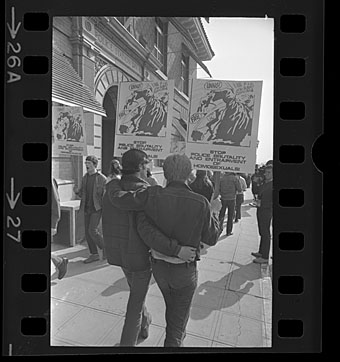
protestors.jpg

Members of the Gay Liberation Front picketing a
police station in Hollywood, California, 1971.

One of the more notable things about the fallout from Senator Larry Craig’s tap-dancing antics has been the way the affair put a spotlight on a world of clandestine liaisons which a small but often vocal portion of the American populace doesn’t want to know about and wishes would go away forever. What many news reports managed to miss amid the wailing and rending of garments was the significant point that the only societies whose members feel a persistent need for furtive sexual encounters are those that proscribe those encounters and make gay people feel ashamed–or afraid of the repercussions–of their actions.

A number of reports felt the need to explain for readers or viewers unskilled in cultural anthropology how men seeking sex communicate with each other in the restrooms of the nation. ABC News ran a story last week with the title, “Secret Signals: How Gay Men Cruise For Sex“, as though all gay men are the same and we’re all just counting the seconds until our next toilet encounter. (And I see today they’ve finally changed the title to “How Some Men Cruise For Sex”.) What this and other reports lacked in their elaboration of secret signals was any question as to why men would be compelled to go to these lengths in the first place.

Historically, all persecuted groups have sought a way to identify their members without drawing undue attention to themselves, and the lexicon of ambivalent loitering–toe-tapping or otherwise–was evolved by gay men out of necessity, not choice. When you’re part of a minority that outwardly resembles the majority, finding others like yourself presents a problem. When that majority wants to imprison you for loving the wrong gender, as was the case in Europe and the US until very recently–and is still the case in much of the Middle East, Africa and Asia–you can’t exactly walk around in a t-shirt saying “I’m not gay but my boyfriend is.” Hence the need for secret signals, sly glances and out-of-the-way trysts. In this at least, gay men have been no different to early Christians, or to the Catholics in Protestant England who were persecuted to such an extent that “priest holes” were built into many Catholic houses to give local priests a hiding place when fleeing angry Protestant mobs. (The irony of the persecuted becoming future persecutors needs no undue elaboration here.)

Marginal groups of any stripe bond through shared slang and identifying signals. Criminal gangs in 19th century London used “cant” and backslang so they could talk among themselves without fear of their schemes being revealed through eavesdropping. Tradespeople used similar cant expressions of their own and, sure enough, gay men in the capital evolved their own version of cant, partly so as to be able to gossip about other men in public but mostly as a means of extending mutual solidarity. Polari, as the slang was called, spread from gay haunts into the world of backstage theatre and eventually found its way into the wider culture, giving us terms such as “drag” (which originally meant any kind of clothing) and “rough trade”, trade in Polari being a term for sex. The word “naff” is now a commonly-used piece of English slang meaning “crap” or “useless”, common enough even for Princess Anne who once told photographers to “naff off”. I wonder if anyone informed her that “naff” was a Polari acronym for someone you wouldn’t want to have sex with: Not Available For Fucking.

Public toilets in Polari were known as tearooms or cottages, and the word “cottaging” is still a common one among British gay men. Senator Craig’s alleged tearoom encounter with a NAFF police officer lifted the lid for many appalled Republicans on a world which their own attitudes had helped create. In the days when gay sex was a crime or could have severe repercussions, anyone loitering in a public toilet was obviously there to do more than wash their hands, hence the popularity of such places for random encounters. So too with other all-male places such as saunas or bathhouses. As long as society made it difficult for men to have sex with men, gay men had to find their own spaces to meet. Senator Craig continues to protest his innocence but has he stopped to consider during the past few days that maybe–just maybe–the reason restrooms are policed has some connection with attitudes that push gay people to the margins of society, attitudes that his voting record has helped sustain?

Whether they know it or not, closeted men of Senator Craig’s generation who look for sex in toilets are living out an anachronism, acting as though it’s still the 1950s and they have to sneak around out of sight of wives or workmates or voters. This has never been a safe or convenient way of finding sex. John Rechy’s The Sexual Outlaw, a 1977 study of cruising in Los Angeles in the early Seventies, recounts in detail a period within recent memory when police persecution of gay Americans was persistent and often violent. There was more cruising in those days because there were fewer bars and what bars there were often sustained harassing police raids. Away from the big cities, furtive and desperate loitering was all that many men would have known.

None of the young gay men I know today would dream of looking for sex in a public toilet; they meet new guys through MySpace or Facebook, on dating sites like Gay.com or via gay groups at university. If they’re old enough they can go to bars or clubs. Suggesting to a gay guy below a certain age that they ought to go looking for sex in a park or toilet would inspire the same bewildered reaction as you’d receive from a straight guy if you suggested he should go kerb-crawling for hookers at the weekend.

Some gay men do still enjoy cottaging, of course–ask George Michael–not least for the thrill of possibly being caught. The Spartacus International Gay Guide lists cruising sites for travellers and is updated every year; there are many online equivalents of this. For guys with a fetish for married bisexual men (more common than you might think) random sex in public places is a good way to meet the object of your desire. But that’s all it is today, a fetish, just like dressing in rubber or being peed on in a bathtub. Men of Senator Craig’s generation who were unable to fully acknowledge their sexuality find themselves repeating the impulses of a conflicted and miserable youth, often filled with shame and guilt but unable to prevent their actions all the same. It’s quite probable that in twenty years time this kind of activity in Europe and America will be increasingly rare, passing into history just as Polari has passed from use as the need for a secret slang diminished. There’ll still be guys wanting a quick random encounter but why do that in the uncomfortable confines of a toilet stall with a risk of arrest when you can relax in somebody’s home or hotel room?

The other striking feature of the Craig business has been the way it fits a pattern in which Republicans make all the mistakes that plagued the decadent later years of the last Conservative administration in Britain. Thatcher’s regime in the Eighties was just as intolerant as the current GOP (lesbian daughters or no) so the Conservatives looked equally foolish during the outing of Harvey Proctor, Tory MP for Basildon and a man happy to pander to racists and homophobes in his public pronouncements until he was revealed to enjoy spanking sessions with black rent boys.

When John Major was handed Thatcher’s poisoned chalice following her sacking as PM in 1990, he announced a half-baked “Back to Basics” morality campaign for the UK. His moral drive was undermined immediately by a series of scandals involving Conservative MPs who were either having adulterous affairs, siring illegitimate children or taking bribes from lobbyists. Worst of all was the case of Stephen Milligan MP, found dead from auto-erotic asphyxia while tied to his kitchen table dressed in woman’s stockings. The spectacle of the party of morality trying to dictate to the nation while its MPs were behaving like characters in a bed-hopping farce was too much; “Back to Basics” collapsed and the whole sorry episode did much to further reduce the government’s already seriously eroded credibility.

The Blair administration has suffered far less from this kind of sexual damage. Blair’s Labour Party was the first to have openly gay MPs and it was their example, and the consequent indifference of the public to their sexual orientation, which led the way for other MPs–Conservatives included–to declare themselves. It’s often said that where America leads, Britain follows, but this once-homophobic nation has managed to shed its public intolerance far quicker and with considerably less fuss than the United States.

The lesson for Republicans–if they’re capable of learning any lessons by this point–is that lawmakers who don’t have to live a lie are less likely to bring the party into disrepute in airport toilets. But the intractable problem is that it’s impossible to have a party with openly gay members who are then required to vote against the interests of people like themselves, assuming anyone in a Republican state would vote for an openly gay candidate in the first place. Conservatives in Britain recognise now that the homophobic debates of the past are over, the country has moved on and there are more pressing matters to attend to. Much of America is stuck at the place Britain was circa 1982, with those on the right in thrall to the tiny percentage of the population who find their moral precepts by cherry-picking Leviticus.

Senator Larry Craig exemplifies the dilemma: repeatedly accused of gay activity but unable to ever admit anything, especially after his anti-gay voting record. He claims his tearoom signals were misinterpreted and seems now to have changed his mind about his resignation. Maybe the quantum superposition he exists in–gay or not? resigned or not?–isn’t the dithering of a man in a state of panic, maybe he’s simply large, like Walt Whitman, and contains multitudes.

And speaking of America’s greatest gay poet, Whitman himself struggled with his sexuality for many years until he was able to write in Starting from Paumanok:

I will sing the song of companionship,
I will show what alone must finally compact these,
I believe these are to found their own ideal of manly love,
indicating it in me,
I will therefore let flame from me the burning fires that were
threatening to consume me,
I will lift what has too long kept down those smouldering fires,
I will give them complete abandonment,
I will write the evangel-poem of comrades and of love,
For who but I should understand love with all its sorrow and joy?
And who but I should be the poet of comrades?

Not for the first time, politicians might learn something from poets.

Dots.

Levi van Veluw just received the IPA 2007 Award for Nonprofessional Photographer of the Year in the Fine Art section with his Ballpoints Series. (Image is “Dots,” from the Ballpoint series, 60×50 cm, Lambda print, ed. 10, 2007.)”