Try and stick with it because it all ties back in to BUFFALO, NY.

In the Belly of the Beast

Norman Mailer & wife

Powered by ScribeFire.
Try and stick with it because it all ties back in to BUFFALO, NY.

In the Belly of the Beast

Norman Mailer & wife

Powered by ScribeFire.
The debt I owe to Jon Hassell
Brian Eno
Friday November 9, 2007
The Guardian
I arrived in New York on a beautiful spring day in April 1978. I’d intended to stay for a week but the visit stretched on and on and I ended up staying for about five years.
Those first few months in the city were a formative time for me. I didn’t know many people, and I had time on my hands, so I was open to things in a way that I might not have been in a more familiar landscape. I listened to a lot of live music and bought a heap of records. One of the most important was by a musician I’d never heard of – a trumpeter called Jon Hassell. It was called Vernal Equinox.
This record fascinated me. It was a dreamy, strange, meditative music that was inflected by Indian, African and South American music, but also seemed located in the lineage of tonal minimalism. It was a music I felt I’d been waiting for.
I discovered later, after I met and became friends with Jon, that he referred to his invention as Fourth World Music (which became the subtitle of the first album we made together: Possible Musics). I learned subsequently that Jon had studied at Darmstadt with Stockhausen (as indeed had Holger Czukay from Can, another occasional colleague), that he’d played on the first recording of Terry Riley’s seminal In C, and that he’d studied with the great Indian singer Pran Nath.
We had a lot to talk about. We had both come through experimental music traditions – the European one, as exemplified by Stockhausen and Cornelius Cardew, and the American one of Cage and Terry Riley and LaMonte Young. At the same time, we were aware of the beauty and sophistication of all the music being made outside our culture – what is now called “world music”. And we were both intrigued by the possibilities of new musical technology.
But beyond these issues, there was a deeper idea: that music was a place where you conducted and displayed new social experiments. Jon’s experiment was to imagine a “coffee coloured” world – a globalised world constantly integrating and hybridising, where differences were celebrated and dignified – and to try to realise it in music.
His unusual articulacy – and the unexpected scope of his references – inspired me. In general, artists don’t talk much about how or why they make their work, especially “why”. Jon does. He is a theorist and a practitioner, and his theories are as elegant and as attractive as his music: because in fact his music is the embodiment of those theories.
We spent a lot of time together, time that changed my mind in many ways. We talked about music as embodied philosophy, for every music implies a philosophical position even when its creators aren’t conscious of it. And we talked about sex and sensuality, about trying to make a music that embraced the whole being and not just the bit above the neck (or just the bit below it).
It was in these conversations that, among other things, My Life in the Bush of Ghosts, which I made with David Byrne in 1981, was nurtured. All of us were interested in collage, in making musical particle colliders where we could crash different cultural forms with all their emotional baggage and see what came out of the collisions, what new worlds they suggested.
If I had to name one over-riding principle in Jon’s work it would be that of respect. He looks at the world in all its momentary and evanescent moods with respect, and this shows in his music. He sees dignity and beauty in all forms of the dance of life.
I owe a lot to Jon. Actually, a lot of people owe a lot to Jon. He has planted a strong and fertile seed whose fruits are still being gathered.
• Jon Hassell performs at the Queen Elizabeth Hall on November 17 as part of the London Jazz festival.
• Brian Eno was interviewed in Arthur #17; Jon Hassell was interviewed in Arthur #18.
NEW FROM ARTHUR: PARADISE NOW: THE LIVING THEATRE IN AMERIKA DVD
LIMITED EDITION OF 1,000
UPDATE MARCH 26, 2013: Remaining stock of this dvd available from Secretly Canadian distribution. Click here for ordering info.
Film Still by Marty Topp
Life, revolution and theater are three words for the same thing:
an unconditional NO to the present society.” – Julian Beck
“Paradise Now … more relevant now because we’re closer
to now than we ever have been.” – Hanon Reznikov
In collaboration with The Living Theatre, The Ira Cohen Akashic Project and Saturnalia Media Rites of the Dreamweapon, Arthur Magazine proudly presents “PARADISE NOW: The Living Theatre in Amerika,” a DVD featuring rare, never-before-distributed films and a plethora of revolutionary multimedia documents from The Living Theatre’s historic and influential ’68-’69 American tour. An edition of 1,000 copies of this DVD will be available from December 1, 2007. This staggering package, which retails for $29.95, features:
NEVER BEFORE RELEASED FILMS
– “PARADISE NOW: THE LIVING THEATRE IN AMERIKA” (1969) a harrowing, gorgeous, in-your-face-and-mind 45-minute black-and-white film by Marty Topp, produced by Ira Cohen for Universal Mutant. “Marty Topp’s beautiful film of ‘Paradise Now’ reveals how the theories of revolutionary change and the experience of sexual liberation are not separate paths to the beautiful nonviolent anarchist revolution. Practiced together they are a single thrust, encompassing both political action and sensual joy, leading to the dreamed-of terrestrial paradise.” — Judith Malina (The Living Theatre) 
– “EMERGENCY: THE LIVING THEATRE” (1968) a 32-minute color film by Gwen Brown, featuring precious footage of Living Theatre productions “Mysteries” and smaller pieces, “Paradise Now” and “Frankenstein.” “The fusion of Brown’s freewheeling direct cinema and the Living Theatre’s performance for revolutionary change (amidst the heydays of both) unite as a dynamic concoction of the era, yielding for the viewer a shifting terrain of both critical insight and ecstatic zeal, not as a vacant nostalgia for a pre-commodified radicality, but as tactical inspiration for future days.” – Andrew Wilson (Artist’s Access Television) 
– “PARADISE NOW: THE PERMANENT REVOLUTION” (2007) a new 18-minute film by Will Swofford and Georg Gatsas. On August 23, 2007, The Living Theatre restaged “Paradise Now” in New York’s Union Square to mark the 80th anniversary of the 500,000-strong street protest over the deaths of Nicola Sacco and Bartolomeo Vanzetti–Italian immigrants unjustly executed for their anarchist political convictions. COMMEMORATIVE PRINTED MATTER
– DOUBLE SIDED 14 x 19 POSTER featuring THE MAP OF PARADISE as drawn by Julian Beck and BAM ODYSESSY a stunning montage of photographs by Don Snyder from Paradise Now at Brooklyn Academy of Music- MAGAZINE BOOKLET including texts by Antonin Artaud, Allan Graubard, Julian Beck, Judith Malina, Hanon Reznikov, Ira Cohen, Don Snyder, photographs, stills from the films, ephemera and much more
ADDITIONAL SPECIAL FEATURES
– INTERVIEWS with directors Julian Beck*, Judith Malina, Hanon Reznikov, company member Steve Ben Israel, and producer Ira Cohen
*(courtesy of Mark Ari)– THE SPINNING WHEEL by Steve Ben Israel, soundtrack to EMERGENCY sourced from agit-prop radio broadcasts
– LOVE & POLITICS, an introduction to the themes and personalities at the heart of the work of The Living Theatre, including scenes from The Living Theatre repertory and poems and texts by Malina, Reznikov, Julian Beck. Filmed at The Pink Pony NYC and LaMama ETC with an introduction by Ira Cohen
– FULL THEATRICAL SCRIPT SLIDESHOW of Paradise Now, A Collective Creation of The Living Theatre, as written down by Julian Beck and Judith Malina documenting more than 100 performances of the event
– MYSTIC FIRE GALLERY of excerpts from Living Theatre films including Sheldon Rochlin’s watershed documentary, Signal Through the Flames
– AKASHIC VIDEO GALLERY of excerpts from current and forthcoming Arthur DVD releases
WHAT IS PARADISE NOW?
In 1968 The Living Theatre, led by Julian Beck and Judith Malina, triumphantly returned to America from years of self-imposed exile in Europe with their theatrical breakthrough Paradise Now. The play introduces the practice of collective creation, dissolving the boundaries of human interactions and forging a harmony between the actors and audience. Of this process, Julian Beck writes, “Collective creation is the secret weapon of the people… This play is a voyage from the many to the one and from the one to the many. It’s a spiritual voyage and a political voyage, a voyage for the actors and the spectators. The play is a vertical ascent toward permanent revolution, leading to revolutionary action here and now. The revolution of which the play speaks is the beautiful, non-violent, anarchist revolution. The purpose of the play is to lead to a state of being in which non-violent revolutionary action is possible.The result of this shared voyage is the spontaneous creation of a temporary anarchist collective- free from the enslavements of war, violence, the State, money and the self.
CRITICAL PRAISE FOR MARTY TOPP’S PARADISE NOW
“Paradise Now is possibly The Living Theatre’s greatest achievement … unsurpassable!” — Ira Cohen”This past spring, in a group art show at New York’s Swiss Institute, an old black-and-white television played a grainy print of bodies writhing to the tune of distant drumming. ‘As long as you have people working for money and not love, there will be violence,’ intoned a tall, angular man on the screen. The bodies- women in scant bikinis and men in what looked like loincloths-piled together in an orgiastic tribal dance, some simulating (or perhaps actually having) sex as the voice continued: ‘Psycho-sexual repression is impeding the revolution.’ What looked like an underworld-of the 1960’s counter-cultural variety, in this case- is the Living Theatre’s Paradise Now, as documented in the 1969 Ira Cohen-produced film Paradise Now: The Living Theatre in Amerika … soon to be released on DVD from Arthur Magazine.” — CAN THEATER STAGE A REVOLUTION? – Traci Parks, Fall ’07 Preview, V MAGAZINE
“Joyous, brutal, exploding with the kinetic energies of psychic catharsis… Marty Topp’s PARADISE NOW: The Living Theatre in Amerika has captured the essence of this extraordinary theatrical experiment. It is unquestionably one of the finest artistic documentaries to come out of the United States cinema. It’s heartfelt sincerity should be sheer inspiration to the many young people throughout the country who are struggling to make meaningful and influential work. It is the reverberation of a crucially important message that must not be neglected, for the consequences are too terrible to endure. Marty Topp’s achievement is not just in the making of a great film, but in making us remember again, Paradise as a reality.” – PARADISE ON FILM – Don Snyder, July 1970, East Village Other
“Like an astonishing portion of the country’s popular music, the spectacles of The Living Theater proved to be in content and form outside the social system- not structured by it nor, except as outlet, implementing it: liberated territory.” — Revolution at the Brooklyn Academy – Stefan Brecht, The Drama Review number 43: Spring 1969, The Living Theater Issue
MORE ABOUT THE LIVING THEATRE
Founded in 1947, The Living Theatre has staged more than 80 productions performed in eight languages in 25 countries on four continents – a unique body of work. Visit their new space on Clinton St. in NYC – more info: www.livingtheatre.org
WHAT IT IS
The Briarpatch is a system of self-reliance and mutual support, based on the ideas that you are a Briar if:
1. You have an insatiable curiosity about how the world works.
2. You seek to do the work you love and to make a living at it.
3. It is more important to you to provide the highest quality product or service than to get rich, but you recognize that you must make a profit to stay in business.
4. You prefer cooperation to isolation.
5. You prefer honesty and openness to deceit and secretiveness.
6. You believe in independence and personal responsibility.
7. You believe in simple living and environmental preservation.
8. Your financial records are open to your community.
9. It is important to you to have fun in everything you do.
HOW TO FIND A BRIARPATCH
The best way to find a Briarpatch where you live, is to just start one.
1. What’s your purpose? Every business support network is different. Most combine both emotional support and practical business counsel in various mixes. A clear purpose will make it easier for you to attract others.
2. Recruit at least one buddy. If you already meet regularly with a support buddy, the two of you will make the perfect kernal of an organizing team. Each of you can invite another person and you’ll have a support group. As each new person invites their friends and associates, you’ll become a network.
3. Avoid homogeneity. Many groups form around the similarities we see in each other, and that’s ok. But for longevity and innovation and the opportunity to change and grow, make a focused effort to invite people who are different. Of course you will want to invite experts in accounting, law, marketing, and so forth. That’s just good business sense. But also invite all genders and multiple ethnicities, and make a special place for the creative, the strange, and the wonderful.
4. Choose the right meeting place. Bay Area Briars have met in the posh San Francisco Tennis Club, member business board rooms, the meeting rooms in local restaurants, right in the middle of bustling cafes, in school classrooms, at different member homes and just about any place you can think of. Our longest continuously running meeting took place once a month for 6 years in an art gallery where we stored tables and chairs that we brought out each time we met. Mutual support was the main attraction, but members also looked forward to the continuously changing exhibits.
The place you choose will have a profound effect on the “look and feel” of the meeting. Make sure it’s in alignment with what you’re trying to accomplish.
5. Meet regularly and continuously. If members know the regular time and place and that the meeting will always be held, you’ll save on the time it takes to keep everybody informed about the meeting and folks will incorporate the rhythm of the meeting into their routines. Experiment has shown us that support buddies (2 people) should meet once a week, but support groups work best if they meet once a month.
6. Use meeting facilitation techniques. Agree on an agenda, appoint a time keeper, work together to keep the meeting moving. The Bay Area Briarpatch usually spends the first hour giving each attendee 2 minutes to introduce themselves and describe their business. If there are more people than there is time for introductions, the coordinator helps attendees move quickly through their 7 to 20 word “elevator” speeches. Then the floor is opened for brainstorming about individual attendees business needs. These can range from simple resource referrals of suppliers or professionals to shared words of wisdom from hard won experience. The coordinator keeps people to the time limit and at the end, time is made for announcements and networking.
7. Eat Lunch. Meeting over lunch draws more attendees because no matter how busy you are, you have to eat and lunch is a time that no one is expecting you to be at your desk to answer the phone. Many groups are successful at organizing potlucks, but it’s a lot of extra effort. Bay Area Briars held a monthly bring your own “brown bag” lunch successfully for more than 12 years. Participants often brought food to share, but it wasn’t a requirement.
BRIARPATCH HISTORY
The Briarpatch was founded in Menlo Park in 1974. Fathered by Dick Raymond of the Portola Institute and mothered by Gurney Norman, author of “Divine Rights Trip” in The Last Whole Earth Catalogue, the phenomenon of mutual support for right livelihood and simple living was an idea whose time had come.
Folks involved in the extended family/community that grew up around the Whole Earth Catalogue formed various businesses including a coop food market, a woman-owned auto repair store, and several others. Gurney Norman put together the first Briarpatch Review using Whole Earth’s layout studio. In it he described this new form of socially conscious, mutual self-support for businesses.
Former banker Michael Phillips was a key organizer of the Briarpatch and his efforts were principally responsible for the extended life of the community during the first decade following its founding. He introduced Dick Raymond to CPA Elliot Buchdrucker, insurance broker Werner Hebenstreit, and lawyer Tom Silk and the five of them together raised enough money to hire the first Briarpatch coordinator Andy (Bahauddin) Alpine, who later became the publisher of Common Ground and Specialty Travel Index. Phillips continued to recruit consultants and coordinators until his withdrawal from active involvement in the late 1980s. Up until that time, he traveled to many communities to assist them in starting their own Briarpatches and even got the Briarpatch principles introduced into the World Bank.
In the beginning, Phillips and Alpine started out using the old C.O.Y.O.T.E offices (Call Off Your Old Tired Ethics — Margo St. James’ organization that was working for the decriminalization of prostitution) on San Francisco’s Pier 40 to hold free consulting session every Wednesday. Very soon, so many people were coming for advice that they asked Dick, Elliot, Werner and Tom to help out.
From 1974 to the present day the Briarpatch has seen more than 1,000 people pass through it’s membership roles. There were always about 200-300 names on the current mailing list and 100-200 active members at any given time. Hold a lecture by a Briarpatch celebrity and several hundred people might show up. Throw a party and 50 to a hundred people would attend. Hold a workshop on business skills and you could always get a couple of dozen members to sign up.
In the Bay Area there were also several satellite networks in Marin and Sonoma counties, in the East Bay and on the Peninsula.
In San Francisco there were three coordinators: Andy (Baha’uddin) Alpine, Charles (Shali) Albert Parsons, and Claude Whitmyer. Marin Coordinators included Peter Oldfield, Sylvia Gorman, and Michael Stein. East Bay coordinators included Roger Pritchard, Elissa Brown and Portia Sinnot. Sonoma coordinators included Jim Bucheister, Tom Hargadon, Salli Rasberry, and Joan Leslie Taylor. In 1988, on the Bay Area Peninsula, a branch Briarpatch Network was started by Dave Smith and Paul Hawken. It met weekly at the Late For The Train restaurant in Menlo Park for about a year. Smith & Hawken then decided they should start their own business by importing garden tools from England.
In 1974 Gurney Norman published the first issue of The Briarpatch Review. Over the next few years eleven more issues were published with Annie Styron as editor and Tom Hargadon as publisher of the first eight. Numerous volunteers brought out the final three issues. The first eight issues were published as a book compilation by New Glide/Reed in 1978 and entitled The Briarpatch Book : Experiences in Right Livelihood and Simple Living from the Briarpatch Community.
In addtion to the San Francisco, East Bay, Marin, Sonoma, and Peninsula groups, we know about networks offering similar support structures to those offered by the Briarpatch that appeared in the U.S. in Tennessee and Washingtion and internationally in Australia, Denmark, England, France, Japan, New Zealand, Norway, and Sweden.
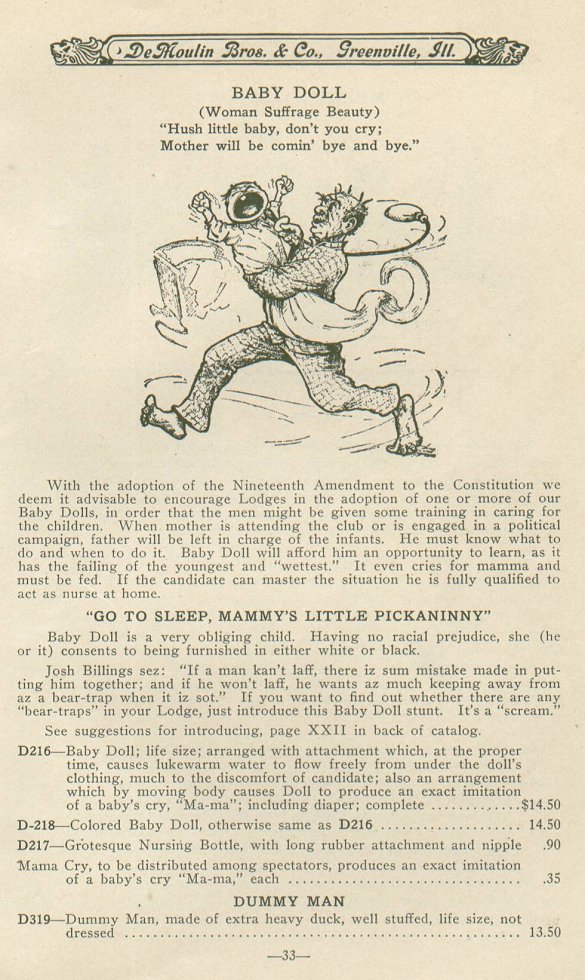
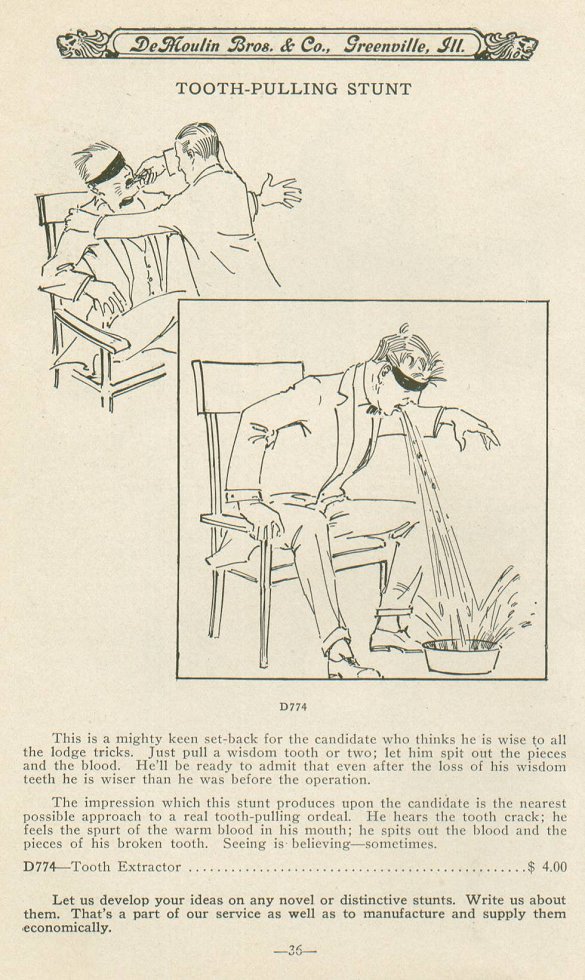
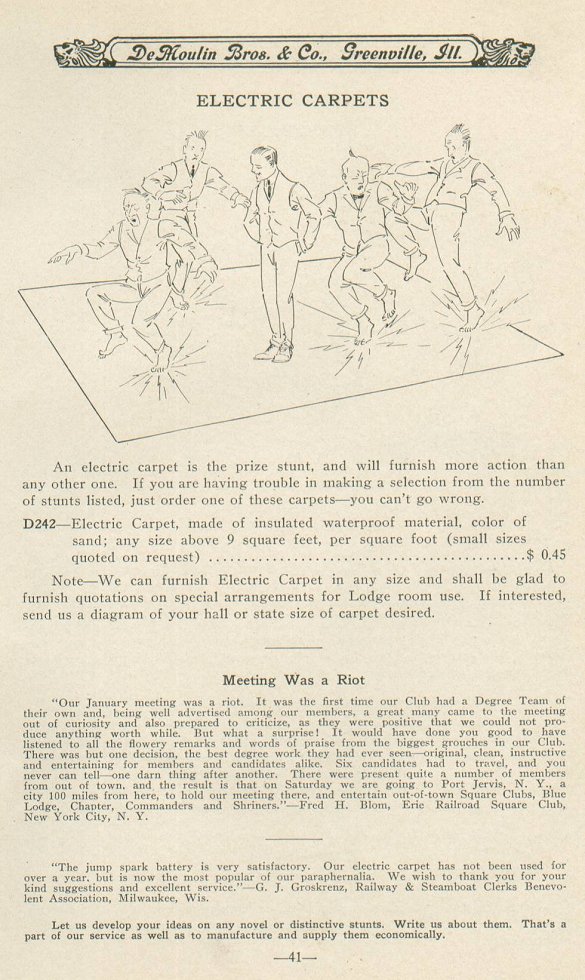
Items from an early 20th century fraternalism catalog, stuff you could order for the next lodge meeting…
Powered by ScribeFire.
—————-
Now playing: DJ Premier – 1 Count Down
via FoxyTunes
—————-
Now playing: DJ Premier – 1 Count Down
via FoxyTunes
Waterboarding is Torture… Period
by Malcolm Nance, Small Wars Journal
October 31, 2007
I’d like to digress from my usual analysis of insurgent strategy and tactics to speak out on an issue of grave importance to Small Wars Journal readers. We, as a nation, are having a crisis of honor.
Last week the Attorney General nominee Judge Michael Mukasey refused to define waterboarding terror suspects as torture. On the same day MSNBC television pundit and former Republican Congressman Joe Scarborough quickly spoke out in its favor. On his morning television broadcast, he asserted, without any basis in fact, that the efficacy of the waterboard a viable tool to be used on Al Qaeda suspects.
Scarborough said, “For those who don’t know, waterboarding is what we did to Khalid Sheikh Mohammed, who is the Al Qaeda number two guy that planned 9/11. And he talked …” He then speculated that “If you ask Americans whether they think it’s okay for us to waterboard in a controlled environment … 90% of Americans will say ‘yes.’” Sensing that what he was saying sounded extreme, he then claimed he did not support torture but that waterboarding was debatable as a technique: “You know, that’s the debate. Is waterboarding torture? … I don’t want the United States to engage in the type of torture that [Senator] John McCain had to endure.”
In fact, waterboarding is just the type of torture then Lt. Commander John McCain had to endure at the hands of the North Vietnamese. As a former Master Instructor and Chief of Training at the US Navy Survival, Evasion, Resistance and Escape School (SERE) in San Diego, California I know the waterboard personally and intimately. SERE staff were required undergo the waterboard at its fullest. I was no exception. I have personally led, witnessed and supervised waterboarding of hundreds of people. It has been reported that both the Army and Navy SERE school’s interrogation manuals were used to form the interrogation techniques used by the US army and the CIA for its terror suspects. What was not mentioned in most articles was that SERE was designed to show how an evil totalitarian, enemy would use torture at the slightest whim. If this is the case, then waterboarding is unquestionably being used as torture technique.
The carnival-like he-said, she-said of the legality of Enhanced Interrogation Techniques has become a form of doublespeak worthy of Catch-22. Having been subjected to them all, I know these techniques, if in fact they are actually being used, are not dangerous when applied in training for short periods. However, when performed with even moderate intensity over an extended time on an unsuspecting prisoner – it is torture, without doubt. Couple that with waterboarding and the entire medley not only “shock the conscience” as the statute forbids -it would terrify you. Most people can not stand to watch a high intensity kinetic interrogation. One has to overcome basic human decency to endure watching or causing the effects. The brutality would force you into a personal moral dilemma between humanity and hatred. It would leave you to question the meaning of what it is to be an American.
We live at a time where Americans, completely uninformed by an incurious media and enthralled by vengeance-based fantasy television shows like “24”, are actually cheering and encouraging such torture as justifiable revenge for the September 11 attacks. Having been a rescuer in one of those incidents and personally affected by both attacks, I am bewildered at how casually we have thrown off the mantle of world-leader in justice and honor. Who we have become? Because at this juncture, after Abu Ghraieb and other undignified exposed incidents of murder and torture, we appear to have become no better than our opponents.
With regards to the waterboard, I want to set the record straight so the apologists can finally embrace the fact that they condone and encourage torture.
History’s Lessons Ignored
Before arriving for my assignment at SERE, I traveled to Cambodia to visit the torture camps of the Khmer Rouge. The country had just opened for tourism and the effect of the genocide was still heavy in the air. I wanted to know how real torturers and terror camp guards would behave and learn how to resist them from survivors of such horrors. I had previously visited the Nazi death camps Dachau and Bergen-Belsen. I had met and interviewed survivors of Buchenwald, Auschwitz and Magdeburg when I visited Yad Vashem in Jerusalem. However, it was in the S-21 death camp known as Tuol Sleng, in downtown Phnom Penh, where I found a perfectly intact inclined waterboard. Next to it was the painting on how it was used. It was cruder than ours mainly because they used metal shackles to strap the victim down, and a tin flower pot sprinkler to regulate the water flow rate, but it was the same device I would be subjected to a few weeks later.
On a Mekong River trip, I met a 60-year-old man, happy to be alive and a cheerful travel companion, who survived the genocide and torture … he spoke openly about it and gave me a valuable lesson: “If you want to survive, you must learn that ‘walking through a low door means you have to be able to bow.’” He told his interrogators everything they wanted to know including the truth. They rarely stopped. In torture, he confessed to being a hermaphrodite, a CIA spy, a Buddhist Monk, a Catholic Bishop and the son of the king of Cambodia. He was actually just a school teacher whose crime was that he once spoke French. He remembered “the Barrel” version of waterboarding quite well. Head first until the water filled the lungs, then you talk.
Once at SERE and tasked to rewrite the Navy SERE program for the first time since the Vietnam War, we incorporated interrogation and torture techniques from the Middle East, Latin America and South Asia into the curriculum. In the process, I studied hundreds of classified written reports, dozens of personal memoirs of American captives from the French-Indian Wars and the American Revolution to the Argentinean ‘Dirty War’ and Bosnia. There were endless hours of videotaped debriefings from World War Two, Korea, Vietnam and Gulf War POWs and interrogators. I devoured the hundreds of pages of debriefs and video reports including those of then Commander John McCain, Colonel Nick Rowe, Lt. Dieter Dengler and Admiral James Stockdale, the former Senior Ranking Officer of the Hanoi Hilton. All of them had been tortured by the Vietnamese, Pathet Lao or Cambodians. The minutiae of North Vietnamese torture techniques was discussed with our staff advisor and former Hanoi Hilton POW Doug Hegdahl as well as discussions with Admiral Stockdale himself. The waterboard was clearly one of the tools dictators and totalitarian regimes preferred.
There is No Debate Except for Torture Apologists
1. Waterboarding is a torture technique. Period. There is no way to gloss over it or sugarcoat it. It has no justification outside of its limited role as a training demonstrator. Our service members have to learn that the will to survive requires them accept and understand that they may be subjected to torture, but that America is better than its enemies and it is one’s duty to trust in your nation and God, endure the hardships and return home with honor.
2. Waterboarding is not a simulation. Unless you have been strapped down to the board, have endured the agonizing feeling of the water overpowering your gag reflex, and then feel your throat open and allow pint after pint of water to involuntarily fill your lungs, you will not know the meaning of the word.
Waterboarding is a controlled drowning that, in the American model, occurs under the watch of a doctor, a psychologist, an interrogator and a trained strap-in/strap-out team. It does not simulate drowning, as the lungs are actually filling with water. There is no way to simulate that. The victim is drowning. How much the victim is to drown depends on the desired result (in the form of answers to questions shouted into the victim’s face) and the obstinacy of the subject. A team doctor watches the quantity of water that is ingested and for the physiological signs which show when the drowning effect goes from painful psychological experience, to horrific suffocating punishment to the final death spiral.
Waterboarding is slow motion suffocation with enough time to contemplate the inevitability of black out and expiration –usually the person goes into hysterics on the board. For the uninitiated, it is horrifying to watch and if it goes wrong, it can lead straight to terminal hypoxia. When done right it is controlled death. Its lack of physical scarring allows the victim to recover and be threaten with its use again and again.
Call it “Chinese Water Torture,” “the Barrel,” or “the Waterfall,” it is all the same. Whether the victim is allowed to comply or not is usually left up to the interrogator. Many waterboard team members, even in training, enjoy the sadistic power of making the victim suffer and often ask questions as an after thought. These people are dangerous and predictable and when left unshackled, unsupervised or undetected they bring us the murderous abuses seen at Abu Ghraieb, Baghram and Guantanamo. No doubt, to avoid human factors like fear and guilt someone has created a one-button version that probably looks like an MRI machine with high intensity waterjets.
3. If you support the use of waterboarding on enemy captives, you support the use of that torture on any future American captives. The Small Wars Council had a spirited discussion about this earlier in the year, especially when former Marine Generals Krulak and Hoar rejected all arguments for torture.
Evan Wallach wrote a brilliant history of the use of waterboarding as a war crime and the open acceptance of it by the administration in an article for Columbia Journal for Transnational Law. In it he describes how the ideological Justice Department lawyer, John Yoo validated the current dilemma we find ourselves in by asserting that the President had powers above and beyond the Constitution and the Congress:
“Congress doesn’t have the power to tie the President’s hands in regard to torture as an interrogation technique….It’s the core of the Commander-in-Chief function. They can’t prevent the President from ordering torture.”
That is an astounding assertion. It reflects a basic disregard for the law of the United States, the Constitution and basic moral decency.
Another MSNBC commentator defended the administration and stated that waterboarding is “not a new phenomenon” and that it had “been pinned on President Bush … but this has been part of interrogation for years and years and years.” He is correct, but only partially. The Washington Post reported in 2006 that it was mainly America’s enemies that used it as a principal interrogation method. After World War 2, Japanese waterboard team members were tried for war crimes. In Vietnam, service members were placed under investigation when a photo of a field-expedient waterboarding became publicly known.
Torture in captivity simulation training reveals there are ways an enemy can inflict punishment which will render the subject wholly helpless and which will generally overcome his willpower. The torturer will trigger within the subject a survival instinct, in this case the ability to breathe, which makes the victim instantly pliable and ready to comply. It is purely and simply a tool by which to deprive a human being of his ability to resist through physical humiliation. The very concept of an American Torturer is an anathema to our values.
I concur strongly with the opinions of professional interrogators like Colonel Stewart Herrington, and victims of torture like Senator John McCain. If you want consistent, accurate and reliable intelligence, be inquisitive, analytical, patient but most of all professional, amiable and compassionate.
Who will complain about the new world-wide embrace of torture? America has justified it legally at the highest levels of government. Even worse, the administration has selectively leaked supposed successes of the water board such as the alleged Khalid Sheik Mohammed confessions. However, in the same breath the CIA sources for the Washington Post noted that in Mohammed’s case they got information but “not all of it reliable.” Of course, when you waterboard you get all the magic answers you want -because remember, the subject will talk. They all talk! Anyone strapped down will say anything, absolutely anything to get the torture to stop. Torture. Does. Not. Work.
According to the President, this is not a torture, so future torturers in other countries now have an American legal basis to perform the acts. Every hostile intelligence agency and terrorist in the world will consider it a viable tool, which can be used with impunity. It has been turned into perfectly acceptable behavior for information finding.
A torture victim can be made to say anything by an evil nation that does not abide by humanity, morality, treaties or rule of law. Today we are on the verge of becoming that nation. Is it possible that September 11 hurt us so much that we have decided to gladly adopt the tools of KGB, the Khmer Rouge, the Nazi Gestapo, the North Vietnamese, the North Koreans and the Burmese Junta?
What next if the waterboarding on a critical the captive doesn’t work and you have a timetable to stop the “ticking bomb” scenario? Electric shock to the genitals? Taking a pregnant woman and electrocuting the fetus inside her? Executing a captive’s children in front of him? Dropping live people from an airplane over the ocean? It has all been done by governments seeking information. All claimed the same need to stop the ticking bomb. It is not a far leap from torture to murder, especially if the subject is defiant. Are we willing to trade our nation’s soul for tactical intelligence?
Is There a Place for the Waterboard?
Yes. The waterboard must go back to the realm of SERE training our operators, soldiers, sailors, airmen and Marines. We must now double our efforts to prepare for its inevitable and uncontrolled use of by our future enemies.
Until recently, only a few countries considered it effective. Now American use of the waterboard as an interrogation tool has assuredly guaranteed that our service members and agents who are captured or detained by future enemies will be subject to it as part of the most routine interrogations. Forget threats, poor food, the occasional face slap and sexual assaults. This was not a dignified ‘taking off the gloves’; this was descending to the level of our opposition in an equally brutish and ugly way. Waterboarding will be one our future enemy’s go-to techniques because we took the gloves off to brutal interrogation. Now our enemies will take the gloves off and thank us for it.
There may never again be a chance that Americans will benefit from the shield of outrage and public opinion when our future enemy uses of torture. Brutal interrogation, flash murder and extreme humiliation of American citizens, agents and members of the armed forces may now be guaranteed because we have mindlessly, but happily, broken the seal on the Pandora’s box of indignity, cruelty and hatred in the name of protecting America. To defeat Bin Laden many in this administration have openly embraced the methods of by Hitler, Pinochet, Pol Pot, Galtieri and Saddam Hussein.
Not A Fair Trade for America’s Honor
I have stated publicly and repeatedly that I would personally cut Bin Laden’s heart out with a plastic MRE spoon if we per chance meet on the battlefield. Yet, once captive I believe that the better angels of our nature and our nation’s core values would eventually convince any terrorist that they indeed have erred in their murderous ways. Once convicted in a fair, public tribunal, they would have the rest of their lives, however short the law makes it, to come to terms with their God and their acts.
This is not enough for our President. He apparently secretly ordered the core American values of fairness and justice to be thrown away in the name of security from terrorists. He somehow determined that the honor the military, the CIA and the nation itself was an acceptable trade for the superficial knowledge of the machinations of approximately 2,000 terrorists, most of whom are being decimated in Iraq or martyring themselves in Afghanistan. It is a short sighted and politically motivated trade that is simply disgraceful. There is no honor here.
It is outrageous that American officials, including the Attorney General and a legion of minions of lower rank have not only embraced this torture but have actually justified it, redefined it to a misdemeanor, brought it down to the level of a college prank and then bragged about it. The echo chamber that is the American media now views torture as a heroic and macho.
Torture advocates hide behind the argument that an open discussion about specific American interrogation techniques will aid the enemy. Yet, convicted Al Qaeda members and innocent captives who were released to their host nations have already debriefed the world through hundreds of interviews, movies and documentaries on exactly what methods they were subjected to and how they endured. In essence, our own missteps have created a cadre of highly experienced lecturers for Al Qaeda’s own virtual SERE school for terrorists.
Congressional leaders from both sides of the aisle need to stand up for American values and clearly specify that coercive interrogation using the waterboard is torture and, except for limited examples of training our service members and intelligence officers, it should be stopped completely and finally –oh, and this time without a Presidential signing statement reinterpreting the law.
Malcolm W. Nance is a counter-terrorism and terrorism intelligence consultant for the U.S. government’s Special Operations, Homeland Security and Intelligence agencies.

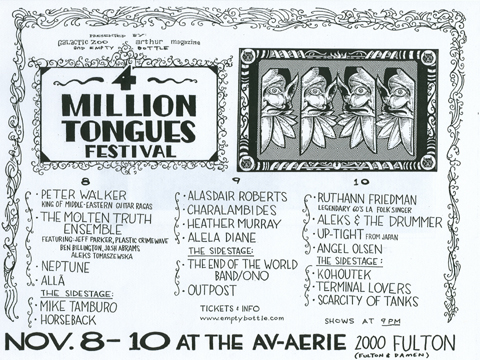
thu nov. 8th
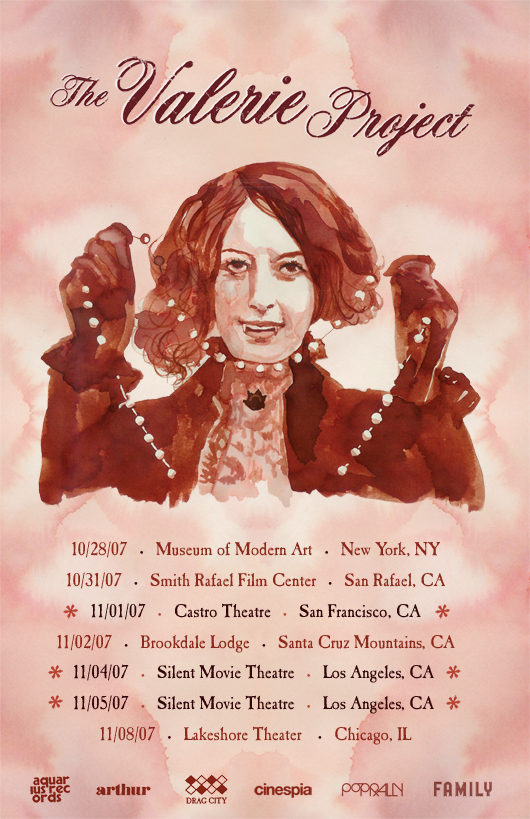
the valerie project at the lakeshore theater–8pm
all other shows at the av-aerie: (9pm, 2000 w.fulton at damen,
formerly ‘open end gallery’)
thu nov.8th (con’t)
peter walker (eastern-style raga guitar god who had two amazing 60’s
Lps on vanguard, and was timothy leary’s music advisor!!)
molten truth ensemble (debut performance, featuring jeff parker, josh
abrams, plastic crimewave, aleks tomaszewska and ben billington)
neptune
alla
sidestage-
mike tamburo
horseback
fri 9th
alasdair roberts
charalambides
heather murray
alela diane
sidestage-
end of the world band
outpost
sat 10th
ruthann friedman (first chicago appearance by famed LA 60’s acid folk singer/songwriter, who wrote ‘windy’ for the association!)
aleks and the drummer
up-tight
angel olsen
sidestage:
kahoutek
scarcity of tanks
terminal lovers
TICKETS AVAILABLE FROM THE EMPTY BOTTLE
poster artwork by Tracy Nakayama
THE VALERIE PROJECT is a rarely-screened film from the Czech New Wave presented with live music by some of the heroes of the new folk/psychedelic movement.
Jaromil Jires’ Valerie and Her Week of Wonders (1970) is a haunting, psychedelic vision which plunges the beautiful heroine Valerie into a phantasmagoric world of vampires, the dark arts and dreamy free love. At once terrifying and beautiful, this feast for the eyes is accompanied by a lush, orchestral and acid-charged new live score performed by a nine-piece ensemble including members of Espers, Fursaxa and Fern Knight. The sound goes off and the amps get cranked (do harps need amps?) [Yes—Editor]
Presented by Drag City, Arthur Magazine and Cinespia in Los Angeles:
Monday November 5 at 8pm at Silent Movie Theatre (followed by reception with DJs Tracy Nakayama and Jeremy Yoder)
Don’t miss this rare opportunity to see The Valerie Project in LA on the last leg of their one-time-only West Coast tour with this gorgeous, newly struck 35mm print.
A recording of THE VALERIE PROJECT‘s original composition soundtrack to “Valerie and Her Week of Wonders” will be available on CD/2LP from Nov. 20 through Drag City.
November 4, 2007 New York Times
Weed It and Reap
By MICHAEL POLLAN
Berkeley, Calif.
For Americans who have been looking to Congress to reform the food system, these past few weeks have been, well, the best of times and the worst of times. A new politics has sprouted up around the farm bill, traditionally a parochial piece of legislation thrashed out in private between the various agricultural interests (wheat growers versus corn growers; meatpackers versus ranchers) without a whole lot of input or attention from mere eaters.
Not this year. The eaters have spoken, much to the consternation of farm-state legislators who have fought hard — and at least so far with success — to preserve the status quo.
Americans have begun to ask why the farm bill is subsidizing high-fructose corn syrup and hydrogenated oils at a time when rates of diabetes and obesity among children are soaring, or why the farm bill is underwriting factory farming (with subsidized grain) when feedlot wastes are polluting the countryside and, all too often, the meat supply. For the first time, the public health community has raised its voice in support of overturning farm policies that subsidize precisely the wrong kind of calories (added fat and added sugar), helping to make Twinkies cheaper than carrots and Coca-Cola competitive with water. Also for the first time, the international development community has weighed in on the debate, arguing that subsidized American exports are hobbling cotton farmers in Nigeria and corn farmers in Mexico.
On Capitol Hill, hearings on the farm bill have been packed, and newspapers like The San Francisco Chronicle are covering the legislation as closely as The Des Moines Register, bringing an unprecedented level of attention to what has long been one of the most obscure and least sexy pieces of legislation in Congress. Sensing the winds of reform at his back, Senator Tom Harkin of Iowa, chairman of the Senate Agriculture Committee, told a reporter in July: “This is not just a farm bill. It’s a food bill, and Americans who eat want a stake in it.”
Right now, that stake is looking more like a toothpick. Americans who eat have little to celebrate in the bill that Mr. Harkin is expected to bring to the floor this week. Like the House bill passed in July, the Senate product is very much a farm bill in the traditional let-them-eat-high-fructose-corn-syrup mold.
For starters, the Old Guard on both agriculture committees has managed to preserve the entire hoary contraption of direct payments, countercyclical payments and loan deficiency payments that subsidize the five big commodity crops — corn, wheat, rice, soybeans and cotton — to the tune of $42 billion over five years.
The Old Guard has also managed to add a $5 billion “permanent disaster” program (excuse me, but isn’t a permanent disaster a contradiction in terms?) to help farmers in the High Plains struggling to grow crops in a drought-prone region that, as the chronic need for disaster aid suggests, might not be the best place to grow crops.
When you consider that farm income is at record levels (thanks to the ethanol boom, itself fueled by another set of federal subsidies); that the World Trade Organization has ruled that several of these subsidies are illegal; that the federal government is broke and the president is threatening a veto, bringing forth a $288 billion farm bill that guarantees billions in payments to commodity farmers seems impressively defiant.
How could this have happened? For starters, farm bill critics did a far better job demonizing subsidies, and depicting commodity farmers as welfare queens, than they did proposing alternative — and politically appealing — forms of farm support. And then the farm lobby did what it has always done: bought off its critics with “programs.” For that reason “Americans who eat” can expect some nutritious crumbs from the farm bill, just enough to ensure that reform-minded legislators will hold their noses and support it.
It’s an old story: the “hunger lobby” gets its food stamps so long as the farm lobby can have its subsidies. Similar, if less lavish, terms are now being offered to the public health and environmental “interests” to get them on board. That’s why there’s more money in this farm bill for nutrition programs and, for the first time, about $2 billion to support “specialty crops” — farm-bill-speak for the kind of food people actually eat. (Since California grows most of the nation’s specialty crops, this was the price for the state delegation’s support. Cheap indeed!)
There’s also money for the environment: an additional $4 billion in the Senate bill to protect wetlands and grasslands and reward farmers for environmental stewardship, and billions in the House bill for environmental cleanup. There’s an important provision in both bills that will make it easier for schools to buy food from local farmers. And there’s money to promote farmers’ markets and otherwise support the local food movement.
But as important as these programs are, they are just programs — mere fleas on the elephant in the room. The name of that elephant is the commodity title, the all-important subsidy section of the bill. It dictates the rules of the entire food system. As long as the commodity title remains untouched, the way we eat will remain unchanged.
The explanation for this is straightforward. We would not need all these nutrition programs if the commodity title didn’t do such a good job making junk food and fast food so ubiquitous and cheap. Food stamps are crucial, surely, but they will be spent on processed rather than real food as long as the commodity title makes calories of fat and sugar the best deal in the supermarket. We would not need all these conservation programs if the commodity title, by paying farmers by the bushel, didn’t encourage them to maximize production with agrochemicals and plant their farms with just one crop fence row to fence row.
And the government would not need to pay feedlots to clean up the water or upgrade their manure pits if subsidized grain didn’t make rearing animals on feedlots more economical than keeping them on farms. Why does the farm bill pay feedlots to install waste treatment systems rather than simply pay ranchers to keep their animals on grass, where the soil would be only too happy to treat their waste at no cost?
However many worthwhile programs get tacked onto the farm bill to buy off its critics, they won’t bring meaningful reform to the American food system until the subsidies are addressed — until the underlying rules of the food game are rewritten. This is a conversation that the Old Guard on the agriculture committees simply does not want to have, at least not with us.
But its defiance on the subsidy question may actually be a sign of weakness, for one detects a note of defensiveness creeping into the rhetoric. “I know people on the outside can sit and complain about this,” Representative Collin Peterson of Minnesota, chairman of the House Agriculture Committee, told The San Francisco Chronicle last summer. “But frankly most of those people have no clue what they’re talking about. Most people in the city have no concept of what’s going on here.”
It seems more likely that, this time around, people in the city and all across the country know exactly what’s going on — they just don’t like it.
Mr. Peterson’s farm bill passed the House by the smallest margin in years, and might have been picked apart on the floor if Representative Nancy Pelosi, the speaker of the House, hadn’t leapt to its defense.
(She claimed to be helping freshmen Democrats from rural districts.)
But Senate rules are different, and Mr. Harkin’s bill will be challenged on the floor and very possibly improved. One sensible amendment that Senator Byron Dorgan, Democrat of North Dakota, and Senator Chuck Grassley, Republican of Iowa, are expected to introduce would put a $250,000 cap on the payments any one farmer can receive in a year. This would free roughly $1 billion for other purposes (like food stamps and conservation) and slow the consolidation of farms in the Midwest.
A more radical alternative proposed by Senator Richard Lugar, Republican of Indiana, and Senator Frank Lautenberg, Democrat of New Jersey, would scrap the current subsidy system and replace it with a form of free government revenue insurance for all American farmers and ranchers, including the ones who grow actual food. Commodity farmers would receive a payment only when their income dropped more than 15 percent as the result of bad weather or price collapse. The $20 billion saved under this plan, called the Fresh Act, would go to conservation and nutrition programs, as well as to deficit reduction.
What finally emerges from Congress depends on exactly who is paying closest attention next week on the Senate floor and then later in the conference committee. We know the American Farm Bureau will be on the case, defending the commodity title on behalf of those who benefit from it most: the biggest commodity farmers, the corporations who sell them chemicals and equipment and, most of all, the buyers of cheap agricultural commodities — companies like Archer Daniels Midland, Cargill, Coca-Cola and McDonald’s.
In the past that alliance could have passed a farm bill like this one without breaking a sweat. But the politics of food have changed, and probably for good. If the eaters and all the other “people on the outside” make themselves heard, we just might end up with something that looks less like a farm bill and more like the food bill a poorly fed America so badly needs.
Michael Pollan, a contributing writer at The Times Magazine and a professor of journalism at the University of California at Berkeley, is the author of “The Omnivore’s Dilemma” and the forthcoming “In Defense of Food: An Eater’s Manifesto.”