The polyadvantage of polytheism.

Bring back the Greek gods
Mere mortals had a better life when more than one ruler presided from on high.

By Mary Lefkowitz

October 23, 2007 Los Angeles Times

Prominent secular and atheist commentators have argued lately that religion “poisons” human life and causes endless violence and suffering. But the poison isn’t religion; it’s monotheism. The polytheistic Greeks didn’t advocate killing those who worshiped different gods, and they did not pretend that their religion provided the right answers. Their religion made the ancient Greeks aware of their ignorance and weakness, letting them recognize multiple points of view.

There is much we still can learn from these ancient notions of divinity, even if we can agree that the practices of animal sacrifice, deification of leaders and divining the future through animal entrails and bird flights are well lost.

My Hindu students could always see something many scholars miss: The Greek gods weren’t mere representations of forces in nature but independent beings with transcendent powers who controlled the world and everything in it. Some of the gods were strictly local, such as the deities of rivers and forests. Others were universal, such as Zeus, his siblings and his children.

Zeus did not communicate directly with humankind. But his children — Athena, Apollo and Dionysus — played active roles in human life. Athena was the closest to Zeus of all the gods; without her aid, none of the great heroes could accomplish anything extraordinary. Apollo could tell mortals what the future had in store for them. Dionysus could alter human perception to make people see what’s not really there. He was worshiped in antiquity as the god of the theater and of wine. Today, he would be the god of psychology.

Zeus, the ruler of the gods, retained his power by using his intelligence along with superior force. Unlike his father (whom he deposed), he did not keep all the power for himself but granted rights and privileges to other gods. He was not an autocratic ruler but listened to, and was often persuaded by, the other gods.

Openness to discussion and inquiry is a distinguishing feature of Greek theology. It suggests that collective decisions often lead to a better outcome. Respect for a diversity of viewpoints informs the cooperative system of government the Athenians called democracy.

Unlike the monotheistic traditions, Greco-Roman polytheism was multicultural. The Greeks and Romans did not share the narrow view of the ancient Hebrews that a divinity could only be masculine. Like many other ancient peoples in the eastern Mediterranean, the Greeks recognized female divinities, and they attributed to goddesses almost all of the powers held by the male gods.

The world, as the Greek philosopher Thales wrote, is full of gods, and all deserve respect and honor. Such a generous understanding of the nature of divinity allowed the ancient Greeks and Romans to accept and respect other people’s gods and to admire (rather than despise) other nations for their own notions of piety. If the Greeks were in close contact with a particular nation, they gave the foreign gods names of their own gods: the Egyptian goddess Isis was Demeter, Horus was Apollo, and so on. Thus they incorporated other people’s gods into their pantheon.

What they did not approve of was atheism, by which they meant refusal to believe in the existence of any gods at all. One reason many Athenians resented Socrates was that he claimed a divinity spoke with him privately, but he could not name it. Similarly, when Christians denied the existence of any gods other than their own, the Romans suspected political or seditious motives and persecuted them as enemies of the state.

The existence of many different gods also offers a more plausible account than monotheism of the presence of evil and confusion in the world. A mortal may have had the support of one god but incur the enmity of another, who could attack when the patron god was away. The goddess Hera hated the hero Heracles and sent the goddess Madness to make him kill his wife and children. Heracles’ father, Zeus, did nothing to stop her, although he did in the end make Heracles immortal.

But in the monotheistic traditions, in which God is omnipresent and always good, mortals must take the blame for whatever goes wrong, even though God permits evil to exist in the world he created. In the Old Testament, God takes away Job’s family and his wealth but restores him to prosperity after Job acknowledges God’s power.

The god of the Hebrews created the Earth for the benefit of humankind. But as the Greeks saw it, the gods made life hard for humans, didn’t seek to improve the human condition and allowed people to suffer and die. As a palliative, the gods could offer only to see that great achievement was memorialized. There was no hope of redemption, no promise of a happy life or rewards after death. If things did go wrong, as they inevitably did, humans had to seek comfort not from the gods but from other humans.

The separation between humankind and the gods made it possible for humans to complain to the gods without the guilt or fear of reprisal the deity of the Old Testament inspired. Mortals were free to speculate about the character and intentions of the gods. By allowing mortals to ask hard questions, Greek theology encouraged them to learn, to seek all the possible causes of events. Philosophy — that characteristically Greek invention — had its roots in such theological inquiry. As did science.

Paradoxically, the main advantage of ancient Greek religion lies in this ability to recognize and accept human fallibility. Mortals cannot suppose that they have all the answers. The people most likely to know what to do are prophets directly inspired by a god. Yet prophets inevitably meet resistance, because people hear only what they wish to hear, whether or not it is true. Mortals are particularly prone to error at the moments when they think they know what they are doing. The gods are fully aware of this human weakness. If they choose to communicate with mortals, they tend to do so only indirectly, by signs and portents, which mortals often misinterpret.

Ancient Greek religion gives an account of the world that in many respects is more plausible than that offered by the monotheistic traditions. Greek theology openly discourages blind confidence based on unrealistic hopes that everything will work out in the end. Such healthy skepticism about human intelligence and achievements has never been needed more than it is today.

Mary Lefkowitz is professor emerita at Wellesley College and the author of Greek Gods, Human Lives: What We Can Learn from Myths and the forthcoming History Lesson: A Race Odyssey.

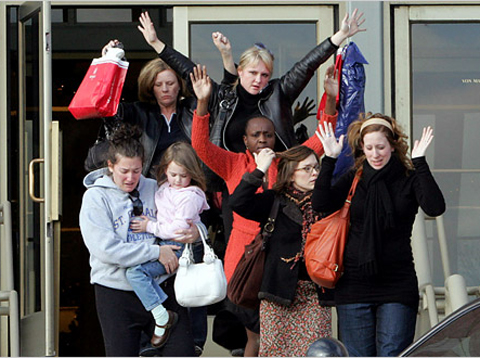
"WE WERE STEPPING OVER BLOOD ALL OVER VON MAUR.” / J.G. BALLARD LATEST

unhappyshoppers.jpg

From the Los Angeles Times:

“A suicidal 19-year-old who killed eight people at a mall packed with holiday shoppers had turned his gun on himself by the time police got to the scene, authorities said today. …

“Hawkins apparently stole from his stepfather the AK-47 he used to kill two shoppers and six employees of the Von Maur department store. Five other people were injured, and two remained in critical condition. …

“The slayings were a stark reminder that crowded American malls are potential targets for violence. In February, five people were slain at the Trolley Square Mall in Salt Lake City by a gunman who was then killed by police.

From The New York Times:

“[The police] chief said, ‘Obviously we’re in the midst of a very busy shopping season. If you were looking to engage in mass casualty type of incident, you would choose a public place.’ The governor said that Mr. Hawkins had been a ward of the state from 2002 to 2006 and had previous run-ins with the law, but had not been associated with violence.

“Later in the day, Todd Landry, director of the state’s department of Children and Family Services, said that the state provided Mr. Hawkins with stays at residential centers and in-patient facilities and also at a hospital. The facilities provided him with addiction counseling, mental-health counseling and behavioral counseling, among other services, but he said federal and state privacy laws prevented him from being more specific about Mr. Hawkins’ problems.”

Ballardian.com‘s synopsis of J.G. Ballard’s 2006 novel, Kingdom Come:

“Richard Pearson, a 42-year-old advertising executive is driving from central London to Brooklands, a town near the M25 on the western edge of the city. A few weeks earlier Richard’s father, a retired airline pilot, was fatally wounded during a shooting incident in the Metro-Centre – a vast shopping mall and sports complex, in the centre of Brooklands – when a deranged mental patient opened fire on a crowd of shoppers.

From wikipedia:

“Radiohead frontman Thom Yorke posted extracts from Ballard’s anti-consumerist novel Kingdom Come on the band’s blog, Dead Air Space, in the months leading up to the release of their 2007 album, In Rainbows.” Here’s one, from 6 Feb 2007. Here’s another, from 11 March 2007..


Author J.G. BALLARD was featured in Arthur No. 15 (March 2005): “Controversial novelist and visionary J.G. BALLARD wonders if something fundamental has gone awry in America. Interview by RE/Search’s V. Vale, with an introduction by author Michael Moorcock.”


Best books J.G. Ballard read during 2007, from The Observer:

“The most enjoyable book was St Peter’s by Keith Miller (Profile), a witty and entertaining account of the most famous church in the world, still standing firm against the tides of tourism that swirl around it. As Miller makes clear, St Peter’s has always been far more than a church. The most disturbing book of the year was Black Mass: Apocalyptic Religion and the Death of Utopia by John Gray (Allen Lane). This is Gray’s most powerful argument yet against the scientific idealists who think they can blueprint a benevolent end-state utopia. Their attempt, Gray argues, has led to the ruined utopias we see around us, and the return of repressed religious belief in its most frightening form. A brilliant polemic, probably best read on the steps of St Peter’s.”

And in The Guardian, Ballard on Christmas reading…

London: City of Disappearances, edited by Iain Sinclair (Penguin), was last year’s Christmas treat in hardback, a wonderful compendium put together by our psychogeographer-in-chief, and now out in paperback. Strange dreams of a vanishing London die and are reborn on every page. Ghosts haunt the alleys of Sinclair’s maze-like mind, and I couldn’t help thinking of the Warsaw ghetto as he paced Whitechapel and Spitalfields.

“This Christmas I will read The Hubris Syndrome: Bush, Blair and the Intoxication of Power by David Owen (Politico’s). Our former foreign secretary launches a scathing attack on the organ-grinder and his eager monkey for their conduct of the Iraq war, a combination of arrogance and incompetence.

“For next Christmas, God willing, I have already reserved The Architecture of Parking by Simon Henley (Thames & Hudson), a hymn to the true temples of the automobile age, multistorey car parks. Those canted decks are trying to lead us to another dimension . . .”


Sole and The Skyrider Band – "Stupid Things Implode On Themselves"

“In the future after a societal collapse, America is reduced to a feudal dystopia. The story focuses on a group of people clinging to life in a small outpost in the desert.

“This video was produced & directed by Ravi Zupa in Two Guns & Rim Rock Arizona. The track, “Stupid Things Implode On Themselves” is from the self-titled album from Sole and The Skyrider Band on Anticon.”

"Demanding the Impossible: Third Utopias Conference" starts today in Melbourne

“In December 2001 the University of Tasmania hosted a successful conference around the theme of Antipodean Utopias.

“In December 2005, Monash University hosted a second conference, around the theme of Imagining the Future, to mark the long-awaited publication of Archaeologies of the Future, Fredric Jameson’s full-length monograph on utopia and science fiction. In all, there were something like 90 papers presented to this conference, including one by Jameson himself.

“This third conference will return to the question of how we imagine the future and whether such imaginings remain open to the unforeseeable. Jameson famously concludes that utopia is ‘a meditation on the impossible, on the unrealizable in its own right’. Hopefully, the conference will play some small part in prompting similar such meditations on the impossible. Its keynote speakers will be: Terry Eagleton, whose recent publications include After Theory, Sweet Violence and Holy Terror; Tom Moylan, author of Demand the Impossible and Scraps of the Untainted Sky; Lyman Tower Sargent, founding editor of Utopian Studies and co-editor of The Utopia Reader; and Lucy Sussex, author of A Tour Guide to Utopia.”

Conference programme includes:

Opening by Prof. Rae Francis, Dean of Arts, Monash University

Tom Moylan– Making the Present Impossible: On the Vocation of Utopian Science Fiction

Verity Burgmann – Utopian Socialism: the Australian Experience

A. B. Carretero & Carmen Morales– Dialogic Philosophy, Participative Communication and Utopia

R.J. Imre & B. Patterson– Interstellar Relations: The Westphalian Planet-State

Paul Cheung – Of Cats, Coincidence and Continuity: Utopias with Chinese Characteristics?

Kong Xinren – A Belief Lies in Future: Recent Chinese History Science Fiction

Louise Katz– No Man’s Land and Everyman’s Land: The Ideal Meets the Real in Israel/Palestine

Craig Johnson – Cities from Scratch

Roberto González-Casanovas – Aztec Sacrifice as Dystopia in Colonial vs. Postcolonial Discourse: Cultural Politics in Competing Mythologies of Conquest

Hester Joyce– Lost hope: Pakeha (white settler) anxieties in The Quiet Earth and The Navigator

Peter Marks– Screening the Future: Surveillance and Utopian Projections

Jaroslav Kušnír– Game, Fantasy and Sci-Fiction in Damian Broderick´s novel Godplayers

Mahrokh Hosseini– Elements of Fantasy in Margareth Atwood’s The Handmaid’s Tale vs. Science Fiction

Chris Palmer– Ambiguous, Unsettled and Unconvincing Dystopias in Recent Fiction

Simon Sellars– Zones of Transit: J.G. Ballard’s Pacific Utopias

Lucian Chaffey– Chaodyssey and annihilation: Farscape’s wormholes and black holes

Chien-fu Hsueh– A Route in-between: The Functions of Travel in Thomas More’s Utopia

Evie Kendal– How the Author is alive and kicking in Utopian “social-science-fiction”

David Jack– Scared Old World: Allegories of Catastrophe in Huxley’s Brave New World

Thomas Ford– Demands and Impossibility: Bureaucracy and Utopia

Christopher Yorke– Utopia and the Death of Virtue

Matthew Chrulew– Heterotopian Science Fiction: Nature and Technology

R. Cunneen– Difficulties with Reading Utopias: The Case of M.B. Eldershaw’s Tomorrow

Kalinda Ashton– History and Amnesia in Amanda Lohrey’s The Reading Group

Lyman Tower Sargent – What would a truly comparative utopian scholarship require?

Jacqueline Dutton– Comparative Mythology

Roberto González-Casanovas – Utopian and Dystopian Typologies of Arawaks vs. Caribs: Relativising Cannibals in Colonial Myth and Postcolonial Critique

Terry Eagleton– Utopia and the New Testament

Will Douglas – The Discontinuity of Possibility and our Hopes for the Future in Last and First Men

Matthew Ryan– The Dystopian rendering of Ideology and Utopia in Cormac McCarthy’s The Road

Chris Palagy– Circumventing Dystopia: The Grand Inquisitor Fails

Michael Kulbicki– Iain M Banks, Utopia, and Critical Hope

David Farnell– The Morality of Preemptive Regime Change in Iain M. Banks’ The Player of Games

Dougal McNeill– James Kelman: Utopias of Form

Claire Henry – Madame X and Girl King on the High Seas of Lesbian Separatist Utopia

Linda Wight – Feminist Utopia or Masculinist Dystopia?

Helen Merrick – Doing science differently? Visions of feminist scientists

Raymond A Younis– The Wheel of Time/Places of Refuge / (Utopian Imaginaries East and West)

Krishna Barua– “The oceanic circle”: Mahatma Gandhi’s and his Ram rajya

Geoffrey Berry – Ecocentric mythopoeia and the absolute aegis of adaptation

Leonard Wilcox– Don DeLillo’s Dystopia: Postmodern Capitalism in Cosmopolis

Wei-Yun Yang– Re-imagination of Galactic Empires: Doris Lessing’s Shikasta and The Sirian Experiments

Zachary Kendal – The Dystopia of Urth: The Myth of Pandora in Gene Wolfe’s Book of the New Sun

Thomas Reuter– Arriving in the Future: The Utopia of Here and Now

Stefan R. Siebel– Basic Income: An Economic Utopia and its Reality Around the World

Ben Hoh– “What if the World was Made of Wood?”: The apocalyptic utopianism of blogging geopolitical trauma

Luke Howie– Images and the Monster Within

Alec Charles– The flight from history: British television’s most enduring fantasy

H. Gardner & S. Schmidt– Autopias

Hyijin Lee– Pythagorian utopianism and numerology

Joan Roelofs– The Considerant Manifesto

Dimitris Vardoulakis – Utopia and Suicide in Aris Alexandrou The Mission Box

Rob Baum– Gender dystopia in the Far/Middle East: An Artful Experimen

Angela Yiu – Utopian Schemes in Japan from the 1910s to 1930s

Christopher Yorke – Utopia ex nihilo: Ando Shoeki and the Heresy of Physiocracy in Edo-Era Japan

Lucy Sussex– A Tour Guide in Utopia

Julia Vassilieva – On Imagination, Energy and Excess:The Lasting Legacy of Eisenstein’s Utopias

Rachel Torbett – The Silence Afterwards: Lyotard with Haneke’s “Le Temps du Loup”

Claire Perkins – Your Friends and Neighbours: Recent Suburban Utopias

Kate Rigby– Apocalypse Now: Whither Utopianism in the Midst of Catastrophe?

David Fonteyn– Tourmaline : A meditation on Thanatos, Eros and Fertility

Chris Coughran– Ecology, Eutopia, and the Everted Sphere of the Future

Darren Jorgensen– Utopia as Failed Revolution: Ursula Le Guin and Louis Marin after 1968

Jacqueline Dutton– The Worst Place in the World: French Women’s Writing on Australia in 2007

Bill Metcalf – The Encyclopedia of Australian Utopian Communalism

Julie Kelso– ‘Radical Heterosexuality’ in the Song of Songs: Meditating on the Impossibility of the Love that Cannot Speak Its Name

Sarah Curtis – Evangelical Utopianism as a Hysteric Symptom

Blair McDonald– Finitude’s War: Returning to the Question

Simon Robb– ‘What do you think, children are psychics?’

Pip Stokes – Care of Place

Robyn Walton – Wyndham Lewis, Frank Lloyd Wright: Re-imagining Baghdad and London

Rudolphus Teeuwen– Losing the War, Winning Utopia: Christian Friedrich Weiser and Germany, 1918

A. Milner & R. Savage– Pulped Dreams: Utopia and American Pulp Science Fiction

Oleksandr Golozubov – From Abbey Telem to Animal Farm: spectrum of the comic forms in the European Utopia

Darren Jorgensen– The Dreamtime as a Modern Utopia

Hester Joyce – New Zealand Cinema and Expressions of Utopia

Keynote Address – Chair: Andrew Milner

Lyman Tower Sargent – Australia as Dystopia and Eutopia

Refereed proceedings of the conference will be published electronically in the on-line journal Colloquy.