Cast King passed away at his Old Sand Mountain home in Alabama On December 13th. He will be missed.
Cast taught himself to play guitar when he was a 10-year-old boy on Sand Mountain. In 1955 King recorded fewer than a dozen songs with his Honky-Tonk band, The Country Drifters, at the legendary Sun studios in Memphis. Five decades later, he recorded his debut for locust music with local producer & musician Matt Downer at the age of 79.
To many of you, this single album release – Saw Mill Man – became a household favorite, a taste of something raw & unadulterated from a musician few had heard of but whose rough and ready confidence & knack for song garnered praise in Rolling Stone, No Depression, Arthur, Mojo, Harp, Spin, Playboy, The Wall Street Journal and numerous other publications. Filmmakers started emerging out of the woodwork from all over wanting to tell Cast’s story. No documentary was ever made but Cast’s music graces the closing credits of Gus Van Sant’s Paranoid Park which is expected for theatrical release in the U.S. in 2008. Promoters far and wide tried their best to bring Cast to New York, Los Angeles, Chicago and a number of European Cities throughout 2005 & 2006 but, having never flown in an airplane, he didn’t see reason to begin now.
As many of you know, Cast was working on new material for a second record. Cast had talked often about wanting to make a gospel record, not the kind you’d see on television, he’d say, but the kind that really gets to a man’s soul. “Saved” is one of those songs. Please download the song & enjoy it. If you can, consider making a donation below. 100% of the proceeds will go to Cast’s family to help cover medical and funeral expenses. Thanks to all who wish to show their support.
From Cast King producer Matt Downer…
“On December 11th, we learned that 81 year old country singer Cast King is terminally ill with cancer and won’t likely make it to the new year. Earlier this Fall, Cast had some back trouble which he thought was from chopping wood out back behind his Alabama home. It was the day of he and his wife Helen’s 59th anniversary that doctors found cancer in his body from head to toe. After some time in the hospital, Cast was brought home this week where he is expected to live out his final days. To many of you, his single album release – Saw Mill Man – became a household favorite, a taste of something raw & unadulterated from a then 79 year old musician no one had heard of but whose rough-and-ready confidence awakened a taste for the real & immediately captivated the attention of fans worldwide. As many of you know, Cast was working on new material for a second record. Cast had talked often about wanting to make a gospel record, not the kind you’d see on television, he’d say, but the kind that really gets to a man’s soul. “Saved” is one of those songs. Please download it and enjoy the song. If you can. please consider making a donation below. 100% of the proceeds will go to Cast’s family. His wife Helen is deep in mounting debt due to hospital bills and impending expenses for his burial. If you would like to include a message for Cast, we will be passing along daily emails to his family to be read to him. Thanks to all who wish to show their support.” More…
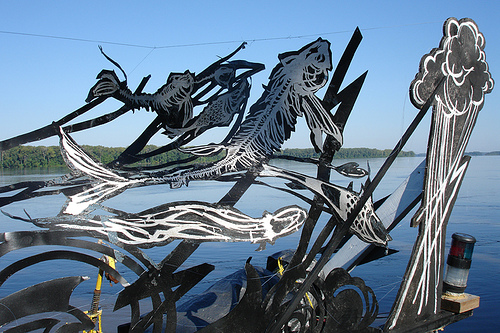
The Miss Rockaway Armada is both a collection of individuals and an idea. At its most basic, the idea is this: we’re going to float down the Mississippi River from Minneapolis to New Orleans on rafts that we built ourselves. The crew can be called many things: artists, musicians, builders, travelers, organizers, dreamers. Ask one of the people who help build and move these crafts for the purpose, though, and you’ll get many answers. But there are some things that we all agree on. We want to create: to invent a new sustainable way to travel, to demonstrate different ways of living and moving that are friendlier to the environment and to each other, to indulge in that essential urge to make something out of nothing. We want to meet people: to learn from new folks along the way, to teach what we know, to share our art, our music and our performance, and to make new friends. Finally, for adventure: to reclaim and reinvent the old American urge to strike out and discover the vast, mysterious land we inhabit and see it for ourselves.
We are floating down the Mississippi River on a raft we built from trash. The catch is that we don’t know much about boats or rivers, and we don’t have any money. We know we are blowing crazy hot air, but if the idea makes your eyes glow like coals then you understand what we’re doing. For the last year we’ve been meeting, making phone calls, holding benefits, drawing blueprints and building like crazy. We collected scrap wood from all over the city and hammered it together piece by piece. We had benefit parties and socked away brown rice and dented cans. We organized mostly out of New York and New Orleans because that’s where we live, but we have folks from the West coast as well as the Midwest.
Here’s the plan: Last year we met in Minneapolis in late July with sections of our raft in tow. We pieced together our pontoons and filled them with salvaged blocks of foam. We made it beautiful and tied on anything that would float, adding it to our junk armada, our anarchist county fair, our fools ark. Our precious cargo is everything we hold dear: pieces and parts of the culture we are already creating. Our zines and puppets, sewing projects and poster campaigns, mutant bicycles and punk rock marching bands. Plus our thoughts and dreams and irrepressible energy.
In the winter of 2007 a nice bar called Ducky’s Lagoon in Illinois took Miss Rockaway in and dry docked our giant raft. We love them for that. Recently, we plopped Miss Rockaway back in the water with a crane and we’re getting back on the river soon with a bigger and better show, more rafts & boats, more workshops and a good helping of face painting or the kids.
Together we’re floating down the Mississippi river, as far as we can, anchoring here and there to perform, give workshops, and create the big huge stinking spectacle we wished would have stopped in our hometowns. And at each place we’re inviting anyone to contribute performances or workshops of their own.
Our flotilla is built green with precycled materials, rainwater collection, wind and solar power, biodiesel, and dumpstered dinners. If we make it right, everything will run on sunshine and french fry grease. However, we are NOT hippies.
We are a small group of people with extensive experience making big insane projects. In the past we have taken 20-person bands to Mexico, pulled off town square-sized guerrilla theater in Berlin, and fed hundreds of people with garbage and love. We know this idea is ridiculous and impossible. That’s why we’re obsessed with it.
Last Friday, the city of Chicago agreed to pay out $20 million to settle lawsuits filed by four former death-row inmates who said they had been tortured by police officers and subsequently wrongly convicted. The four men were among dozens of black men who said they were tortured, beaten with phone books and suffocated with plastic typewriter covers while in police custody in the 1970s and 1980s, according to special prosecutors.
The stories of three of those four men, who were pardoned by former Gov. George Ryan in 2003, were first told by John Conroy, a veteran reporter for The Chicago Reader, an alternative weekly. On Friday, Mr. Conroy received a note from Jo Ann Patterson, whose son had been nearly suffocated in police custody in the process of obtaining a confession that proved to be false.
“My son, Aaron Patterson, tortured by the Chicago Police Department, would not be alive today, I believe, without your articles about police torture in the City of Chicago. You documented and wrote the realization of police torture, of which we will never forget. You help save my son’s life for which I thank you.”
Mr. Conroy was busy dealing with a flurry of e-mail messages that day because on Thursday, he had been laid off. The Chicago Reader, which had published his work for over 20 years, decided it could no longer afford to support his reporting. Citing declining revenue and a need to trim costs, Alison True, the editor of the paper, laid off four of its most experienced reporters, including Mr. Conroy. The Washington City Paper, another newsweekly owned by the same company, announced five newsroom layoffs as well.
In a week of media retrenchment — rumors of further cutbacks in network news, continuing layoffs at regional dailies and a “temporary” pay cut at an Illinois daily that became permanent — nine newsroom layoffs don’t seem significant. But of course, that all depends on whose ox is being gored, and in this instance, I felt a bit of the splatter.
At the end of the 1990s, I was editor of The Washington City Paper, a weekly with a history of excellence built by Jack Shafer (now the press critic for Slate), and owned by a group of college friends turned businessmen who also owned The Chicago Reader. In the time I worked for them, I was impressed by their constancy and their willingness to support good work in the belief that if you produced quality journalism, the business would look after itself.
In the case of The Reader, it seems like that turned out not to be true. The owners in Chicago sold out last summer to an unfortunately named outfit, Creative Loafing from Atlanta, which has mandated cuts across the organization. It is as if Creative Loafing executives bought a shiny new doll and then once they got their hands on it, felt compelled to tear its head off.
Ben Eason, chief executive of Creative Loafing, said, “We are not trying to make any other statement here other than it is a competitive world out there and we are doing what we can to make sure we are putting out an excellent paper in the communities we serve.”
Investigative reporting can expose corruption, create accountability and occasionally save lives, but it will never be a business unto itself. Reporters frequently spend months on various lines of inquiry, some of which do not pan out, and even when one does, it is not the kind of coverage that draws advertisers.
Serious reporting used to be baked into the business, but under pressure from the public markets or their private equity owners, newsrooms have been cutting foreign bureaus, Washington reporters and investigative capacity. Under this model, the newsroom is no longer the core purpose of media, it’s just overhead.
At the same time, the consumer is feeling more empowered, with Google, Digg and all manner of RSS feeds pushing current data to their desktops. But Google and Digg never made a phone call, never asked hard questions of public officials, never got an innocent man out of jail.
The smartest Web robot in the world is going to come back dumb if there is nothing out there to crawl across. Thousands of bloggers could type for a millennium and not come up with the kind of deeply reported story that freed innocent men — an effort that takes years of inquiry, deep sources and a touch for making unholy secrets knowable.
There have been attempts to fill in the gaps in investigative journalism, most notably in ProPublica, an independent, nonprofit newsroom led by Paul Steiger, the former managing editor of The Wall Street Journal. Another nonprofit, Mother Jones, which has a history of both aggressive reporting and left-leaning politics, recently opened a seven-person Washington bureau dedicated to investigative journalism to fill what its editors see as a vacuum in political and government reporting.
But enterprises like these will never be a substitute for a vital newspaper industry, which has historically used a distributed model of reporting to hold government, business and the broader culture to account.
There is a chance that historians will examine this period in American history and wonder if journalism left the field. With a lack of real-time annotation, wholesale business swindles and rogue actions by sitting governments will go uncovered.
In part, it is the triumph of the spinners, top to bottom. Since the media reached the height of its powers in the 1970s, there has been a pervasive effort to gain custody of public information in both the public and private sector. A working reporter cannot walk into a Gap store in a mall, let alone a police station, and ask a question without being swarmed by bureaucracy.
If the watchdog role is threatened by immediate financial pressures, I’m beginning to think that in the long run it can still flourish. Last week, this paper reported that the Central Intelligence Agency destroyed videotapes documenting the harsh interrogation of detainees that some believe constitutes torture.
The New York Times and other New York newspapers reported that a New York detective might have perjured himself when he said he had not interrogated a murder suspect, a suspect who was recording him all the while on an MP3 player in his pocket. And readers also learned that any bailout of the consumers caught in the subprime mess will be largely dictated by the industry that created it.
And lest you think that I’m just waving around the pompoms to keep my team in the game, keep in mind that later this week, Rupert Murdoch, the most successful of the modern media titans, is taking over The Wall Street Journal. He has made it clear that he will invest in the business newspaper to turn it into a source of general news. If the future of news were really so grim, would Mr. Murdoch be interested?
If Mr. Murdoch’s opinion of news (or that of The Times) isn’t to your liking, consider the view of Ms. Patterson, whose son was freed due in part to Mr. Conroy’s reporting.
“Without John Conroy’s stories, the public would have never believed what happened to my son,” she said in a phone call. “It is so important to have a reporter who knew the whole story, who did the reporting, and told people, over and over, what was really going on.”
This is a Spring 2005 conversation between Hakim Bey (pseudonym for scholar/poet Peter Lamborn Wilson) and Sasha Miltsov posted online…
======
Hakim Bey:…automobiles used to look quite beautiful, some of them. Now, even the cars of the very rich – you can hardly tell them from the cars of the bourgeoisie. They’re all the same boring, puffy-looking cars: No flare, no aerodynamics, no daring art deco. What is a modern “Bugatti”? It’s nothing. Even the Arab sheiks don’t dare to have beautiful cars like before. Why? Nobody knows how to make them? What’s the big deal?
Of course, it’s all just cars. It’s all just disgusting shit, but within that bad technology, which started so nice…
Alexandre Miltsov:It’s just getting worse and worse.
HB:Yeah.
AM:Nowadays, they do “retromobiles”. They take a “Chrysler” like it used to be 50-60 years ago and rebuild it with all the modern gadgets. It looks even more repulsive.
HB:It’s just post-modernism. It’s not good or new design.
AM:What still amazes me in America, even though I’ve lived in Canada for five years, is this tremendous amount of cars everywhere. Public transportation is basically dead. And, as we know, it has been maliciously removed.
HB: It is true. It’sabsolutely true. I don’t own a car – it’s not because I am so virtuous but rather because of circumstances. But I’m glad I don’t own a car – many times when I think about that – it’s horrible. At least I’m not adding to that particular misery. But if I didn’t go into other people’s cars – I would never get anywhere, except on a few rare bus stops.
AM:Since we’re talking about cars, what do you think about the projected “World Oil Peak”? It’s not a big secret that there is no real substitute for oil to run the existing gigantic world-industry. There’s a countless list of things running on and demanding oil; cars, of course, are on the top. So what do you think about oil depletion and all that?
HB:What a lot of people would say, primarily the “techno-optimists”, is that when the oil runs out – the other technologies will become economically feasible. So, they will have to run all the cars on hydrogen, or salad oil, or sunshine. But we will still have cars. It’s a horrible thought but they may be right. They may solve the problem.
AM: But most probably it’s not going to happen that way. There are no real alternatives. There’s not enough sunshine to power all these cars,there’s not enough salad oil – I mean you need to grow crops to get it – a lot of it! And almost all the good land is already in use. It has been paved over by these gigantic roads – you have Eisenhower Interstate Highway system here. And the so-called “hydrogen economy” is a myth, of course.
HB: That’s right. I’m just saying that we ought to think about all this from the “techno-fix” point of view. So far, they’ve always come up with something. History leads us to believe that they’ll figure something out. At least, we have to take it into consideration. After all, they have all the money in the world to spend on the most brilliant scientists and technologists.
But it seems that they’re not preparing. And that’s the interesting part. They’re acting as if there’s no tomorrow: they don’t think like American Indians or the Chinese for seven generations – they think for seven minutes. If you’re lucky – 15 minutes! That makes you think that there won’t be any smooth transition, brokered by the usual technological and capitalistic bla-bla. And maybe some crisis will occur, some fracture in this happy story. Should we hope for that or should we be incredibly afraid because of that? It’s hard to say. Anything short of the complete breakdown of civilization – nothing is working anymore – it’s going to be war, plague, horrible. Or can you still believe in a situation where the proponents of “the alternatives” have seized power in time to prevent it from happening? Can we really talk about “seizing power” in a context like that?
AM: Well, yes and no. “Power” is so obscure these days. I mean, “seizing” what? A TV or a radio-station?
HB: Yes, and you can have 2 billion dollars and think that you can change the world, and there’s nothing, no effect at all. Nothing seems to work.
AM: There is a popular and rather naïve belief that when the whole system, the Spectacle, will start to run out of energy – oil, gas and other resources – it will gradually loosen its grip on people’s minds and throats. The Media may still be there, the Capital will be there but they will be weak and disintegrated, and so society will inevitably break down into small autonomous collectives, not controlledby the outside world.
HB: Well, the attitudes are changing but the problem is – and now I can speak about the situation here locally – since I have been living here for 6-7 years, I have some insights – and that is that these attitudes are informed by reformism. They are not informed by a critique of capitalism or even of technology. The Green Party is a good example; basically, it’s a hobby group for losers. Here, by strange circumstances, we have a Green Party village government. I am still glad for that, I guess, but so far they haven’t accomplished anything here, except for some symbolic stuff. And the reason for this, I think, is that people of this reformist tendency are not really interested in building real alternative institutions.
For example, this movement is not taking place through labor unions, or food-cooperatives, or producers-cooperatives; it’s not taking place through free schools or alternative schools. It’s not taking place through autonomous action!
Look at the organic food situation: the big companies have already discovered that the organic food is a market and they’re in it, they’re marketing it. And for most of the consumers of organic food this is not a political issue. It’s a health issue. So they don’t care; if Monsanto is going to sell them health food – they’ll buy it from Monsanto. In other words, these nice impulses, these changing attitudes – some of which are forced on people by economic difficulties, as you pointed out, and some of which are voluntary, assumed out of a lifestyle or even out of consumerist attitude towards the “authentic” and the “organic” and the “alternative”, which after all is a market – it all runs into the sand, all the energy runs into the sand.
People with wonderful attitudes and desires that are good desires; but since there is no comprehensive movement, there’s nothing other than these “positive attitudes” and there’s no way to focus them.
I went to a Peace March yesterday – it was the anniversary of the beginning of the war in Iraq. I swear it was like being back in the 60s again: same clothes, same slogans:
“- What do we want? – Peace! – When do we want it? – Now!”
We’ve been saying this for 40 years and we still haven’t realized that symbolic action and symbolic discourse is NOT Action!
And this is even better: there was a counter-demonstration, and the anti-demonstrators were yelling at us that we were communists! This is like a civil war reenactment; it’s like people in medieval costumes pretending to be knights and ladies. Totally bizarre. I haven’t been going to demonstrations lately, so I thought maybe a few things have changed. But no! It’s just “a blast from the past” – for everybody, including the fascists who thought that they were still living in 1979. Very strange.
And this is it! You go, you have a march, you say: “Not in my name!” And then you go home and watch TV. You don’t then go out and start an alternative institution: a church, a farm, a commune…
AM: A pleasure club.
HB: Or even a pleasure club! Instead, they just go home and watch TV.
AM: And then they go to work and get their salaries from the same people who are waging the war. And the taxes go to war, of course.
HB: Exactly! And of course, you NEED your SUV; you NEED your cellular phone. These are real needs. So all these so-called “green people” around here are sucking up gasoline and cement… Just “not in my backyard” – that’s what they say. They are not going to swear off using cement. They will say: “Move the cement plant to Mexico”. I can’t participate in this pseudo-politics; there is no entry-point for me here.
AM:Back to the “Peace March”: the Iraq war looks like it is going to last long. We don’t really know what’s happening there; there are all sorts of media, mainstream and alternative, producing all sorts of “news” and speculations. But who in his or her sane mind will trust them? They are the media after all. The notion I have is that it’s going to be a big, long and ugly war for the last remnants of oil and for the control of the Gulf region. What do you think?
HB: I think you’re right or you might as well be right. We might as well plan on what you’ve just said; because it would be foolish to think that they’re going to stop just because we don’t like it. They’ve already proved that it’s not going to happen.
Let me try to be an “anti-pessimist” here and point out that if you are right, and I think you are, this will also involve a continuation of this unbelievable deficit spending and going into debt that we are practicing here in the US, both on the personal and the national level. And it must eventually lead to an economic collapse, as far as I can see. For one thing, Europe is going to be driven a little bit further to the left by anti-Americanism, so you will get more things like the mayor of Paris or the Spanish government happening -kind of nostalgic social-democratic, but still no longer interested in playing the global game with America as the sole superpower.
In fact, the whole ten years of globalism and neo-liberalism are already over. We are at a new stage now. That is why the anti-globalist movement suddenly seems so dead and irrelevant.
Going further with the scenario: A couple of other major things can happen, like China shifting its economic activities from the dollar to the euro and OPEC is, of course, practically out, and so forth.
So America is isolated economically: we don’t produce anything here anymore – we can’t be self-sufficient in terms of industry. We don’t make shoes here; we don’t make umbrellas, pencils. We make entertainment and information. We don’t even make the fucking computers! We produce the ideas that occupy the computers. That’s why artists are so important right now – it’s one of the few things that we actually produce. So the arts are hot, some artists are successful – this whole area around here is full of artists, and they drove the real estate prices up. So, now you can’t move into this county for less then 250,000 dollars. Thanks to the artists! You wonder why people get angry at artists – it’s not our fault – we’re just looking for low rent but the real-estate developers are following us, sniffing our butts wherever we go to find out where the next beautiful cheap real-estate is going to be…
So on with the scenario: in 1984 if somebody had asked “would the Soviet Union break up”, everybody would go “ha-ha-ha” – nonsense; it will never happen! In 1984, if people asked whether the United Kingdom would break up, if Scotland would be independent again – “Oho-ho-ho! – This would be a joke!” Just 20 years ago, it would be a total joke. Well, it happened – and to Yugoslavia too. So, it could happen here. Things move so quickly. It’s possible that with the neo-liberal period already over, we’re now into something new – the American Empire, and maybe that will only last for 8 years -10 years.
That’s why recently I have taken an interest in the idea of separatism and secession. Because, I think that the only optimistic or anti-pessimistic way of reading the American future is to see the breakup of the American Empire, meaning a political breakup, just like in the USSR. And, as you know very well, this is a mixed blessing – to put it mildly. But there is one advantage to it, and that is that you get a small social unit that you can deal with – maybe, if you’re lucky.
It can very well happen in America, and people have already started to talk about it. I’m writing articles trying to push that idea. If I’m wrong – I’ll be wrong. To me it’s just a tactic, because from an anarchist point of view, secession is good because you get a smaller unit to deal with and eventually – this is straight Proudhon – you will break it down into autonomous regions, and then you confederate them in an anarcho-federalist union, completely voluntarily and based on popular democracy with revocable delegates. And as he put, it is necessary to organize for production and if necessary defense. This is an anarchist ideal, and secession could be a step towards it. As we know, it can also end up in a fascist nightmare. This is a dangerous idea, I admit, but I don’t see any other interesting political possibility for America.
Charlottesville, VA December 12
Lighthouse Gallery (Fine Arts Building)
121 E. Water St.
Baltimore, MD December 13
H&H Building 6th Floor
405 W. Franklin St.
Philadelphia, PA December 14
Big Jar Books
55 N. 2nd St.
PALACE OF THE WINDS
A Film by Hisham Mayet
(45 minutes/color)
“An entrancing look at the culture and music of the Saharawis from the
Western Sahara and Mauritania. This film explores the rich heritage
of a culture that is cloaked in mystery and mired in struggle.
Journey from the northern fringes of the Western Sahara to the
Mauritanian capital of Nouakchott. Explore the intoxicating tapestry
of sight and sound that this obscure region has to offer from some of
its most legendary musicians.”
Trailer:
MUSICAL BROTHERHOODS FROM THE TRANS-SAHARAN HIGHWAY
A Film by Hisham Mayet (60 Minutes)
“This film showcases an assortment of spectacular musical dramas
presented live and unfiltered on the home turf of the world’s most
dynamic string/drum specialists performing and manifesting the
ecstatic truth! Ancient mystical brotherhoods have been flourishing
for centuries in and around the cities of Marrakesh and Essaouira in
Morocco where the trade caravans have gathered from their long
journeys across the Trans-Saharan Highway. This is some of the last
great street music on Earth.”
Trailer:







 Arthur Magazine