Making a Home: Japanese Contemporary Artists in New York


ON megumi Akiyoshi’s FLOWER gallery (2007).
Photo: Richard P. Goodbody. Image courtesy of Japan Society.

Making a Home: Japanese Contemporary Artists in New York

To celebrate the strong and historic cultural links between Japan and New York, Japan Society presents this large-scale group exhibition featuring the work of 33 contemporary Japanese artists who call New York City home, including Yoko Ono, Ushio Shinohara, Kunie Sugiura, Yuken Teruya, and Aya Uekawa.

The show comprises a broad range of media—from painting and sculpture to video and photography—and covers diverse age groups, identities, experiences, and styles that will show the breadth and depth of contemporary Japanese art as developed, practiced, and presented in New York. Visitors will go on a conceptual journey through multifaceted “homes” installed throughout the Society, illuminating the ways in which Japanese artists have made their homes and careers here since the 1950s, often bringing with them and maintaining aesthetic vocabularies that reveal their Japanese roots. Making a Home is curated by Eric C. Shiner, an independent curator specializing in contemporary Japanese art.

Artists featured in Making a Home are: ON megumi Akiyoshi, Noriko Ambe, Ei Arakawa, Satoru Eguchi, Ayakoh Furukawa, Toru Hayashi, Noritoshi Hirakawa, Yoshiaki Kaihatsu, Takahiro Kaneyama, Emiko Kasahara, Misaki Kawai, Miwa Koizumi, Yumi Kori, Nobuho Nagasawa, Hiroyuki Nakamura, Yoko Ono, Hiroki Otsuka, Katsuhiro Saiki, Kyoko Sera, Noriko Shinohara, Ushio Shinohara, Go Sugimoto, Kunie Sugiura, Hiroshi Sunairi, Mayumi Terada, Yuken Teruya, Yasunao Tone, Momoyo Torimitsu, United Bamboo, Aya Uekawa, Junko Yoda, Toshihisa Yoda and Yoichiro Yoda.


On megumi Akiyoshi, On gallery-at the Statue of Liberty, 2002. Photo © Oliver Irwin. Courtesy of the artist.


Momoyo Torimitsu, Miyata Jiro Performance in NY, 1996. Polyester resin, motor, business suits, nurse costume; 2 x 5.6 x 2.3′ (60 x 170 x 70 cm). Dikeou Collection, Peter Norton Family Foundation. Photo © Michael Dames.

Powered by ScribeFire.

"Greensulate"

Mushrooms Become Source for Eco-Building

By JESSICA M. PASKO Associated Press Writer

June 25,2007 | TROY, N.Y. — Eben Bayer grew up on a farm in Vermont learning the intricacies of mushroom harvesting with his father. Now the Rensselaer Polytechnic Institute graduate is using that experience to create an organic insulation made from mushrooms.

More at home on a pizza, mushrooms certainly aren’t a typical building material, but Bayer thought they just might work when given the assignment two years to create a sustainable insulation.

Combining his agricultural knowledge with colleague Gavin McIntyre’s interest in sustainable technology, the two created their patented “Greensulate” formula, an organic, fire-retardant board made of water, flour, oyster mushroom spores and perlite, a mineral blend found in potting soil. They’re hoping the invention will soon be part of the growing market for eco-friendly products.

Bringing the insulation to market is still at least a year away though, said McIntyre, and will require much more research and work, not to mention more sophisticated equipment and a better work space.

“We’ve been growing the material under our beds,” said McIntyre, adding that they’ve applied for a grant from the National Collegiate Inventors and Innovators Alliance.

The two young developers — Bayer is 21, McIntyre 22 — graduated in May from RPI with dual majors in mechanical engineering and product design and innovation.

“I think it has a lot of potential, and it could make a big difference in people’s lives,” said RPI Professor Burt Swersy, whose Inventor’s Studio course inspired the product’s creation. “It’s sustainable, and enviro-friendly, it’s not based on petrochemicals and doesn’t require much energy or cost to make it.”
Continue reading

Love Workshop: Put On a Happy Face (courtesy WFMU)

WFMU’s Beware of the Blog: Love Workshop: Put On a Happy Face

Shooting out of Phoenix in 1976, The Love Workshop was a 15 minute radio comedy show on rock station KDKB. In it’s heyday, the station was a daring album-rock station that acquired a rabid fan base. Two station employees, Russ Shaw and Tod Carroll, created alter egos Vern and Craig, and then happily pushed the boundaries of good taste in the name of fun.

Derrick Bostrom’s Bostworld blog recently uncovered this lost radio gem, and he describes it thusly:

n one segment, they microwave then eat a small boy surrounded by an accompaniment of jawbreakers and new potatoes. In another, they seduce the recently widowed wife of a Vietnam vet with bourbon and Quaalude. In another, they punch out the subject of a public television “empowerment” program after calling her a stupid lesbian. In still another, they force a guest to try out an I.U.D made of pop tops and bottle caps attached to a dead scorpion.

The writing on the show was brilliant. Their sense of comic timing and attention to detail was impeccable. And in the climate of the mid-seventies, the scorched-earth nature of material didn’t raise as many eyebrows as it would now. But not everyone admired it, apparently. Just as the show was poised to expand into other markets, it was suddenly cancelled as part of a controversial housecleaning of KDKB management.

Russ, the voice talent, went on to real estate (and occasional voice over work, like the classic Discount Tire Company ad), while Vern, who produced and wrote the show, went on to National Lampoon and later wrote screenplays. Check out all the details at Bostworld’s intense Love Workshop page, including this interview with 1/2 of the Love Workship, Russ Shaw.

And thanks to Derrick also for allowing us to repost many of the Love Workshop shows. Unfortunately, there are no airdates available, so these aren’t in any real order. But still, here is a chance for you to check out their show for yourself:

Powered by ScribeFire.

14% of American adults are now on antidepressants

From the Oct 8, 02007 L.A. Times:

At therapy’s end
As depression eases, patients often want to stop treatment. But are they better? Will they relapse?

By Josh Fischman, Special to The Times

PEOPLE come into Andrew Leuchter’s office, saying they’re better, saying they want to stop. “Oh, gosh, it happens all the time,” says Leuchter, a psychiatrist at UCLA’s Semel Institute for Neuroscience and Human Behavior. “They say they feel OK, that they don’t need drugs or any other help, and that they’ve recovered. On one hand that’s very encouraging, but on the other hand we have to be very careful, because the cost of being wrong — if they are not ready — can be very high.”

These are not drug addicts saying they want to go cold turkey. They are not alcoholics. These are people with depression who want to stop treatment.

Nearly 20 million Americans suffer from some form of depression, according to the National Institute of Mental Health. About 14% of adults now take antidepressants — triple the percentage during the late 1980s — and most stay on them for at least six months.

A study published in this month’s issue of the Archives of General Psychiatry estimated that mental disorders, largely depression, cost Americans 1.3 billion days of normal activity each year. Many people with such illnesses say they feel hopeless, helpless, unable to face life, unable to find solutions to their problems, and at times think of killing themselves. Some of them do.

Depression treatment, such as antidepressant drugs Prozac or some version of talk therapy, can help about two-thirds of sufferers. But as it does, patients start to ask: Am I better? Am I cured? Can I stop my therapy?

The answers are not simple. Measuring depression is hampered because there’s no physical marker that indicates whether a patient has it or does not. Information about that comes from behavior, thoughts and feelings, which can’t be assessed as easily as, say, blood pressure.

Rating scales can show how far symptoms, such as trouble sleeping, have receded, but psychiatrists say they put even more stock in a patient’s overall mood: whether he or she takes joy from life again and whether the person thinks he or she is back to a pre-depression emotional state. That too can be difficult to determine.

Now results from large, long-term studies are beginning to paint a clearer picture of the course of depression and are sharpening decisions about stopping treatment. If a person has had just one episode of depression, the chances of a long-lasting recovery are fairly good. But those chances go down with every subsequent episode.

Once people reach their third episode, Leuchter says, “then we need to discuss ongoing maintenance therapy, even if they are feeling better. I don’t like to use the phrase ‘lifetime treatment’ with patients. But, essentially, that’s what we’re talking about.”

Continue reading

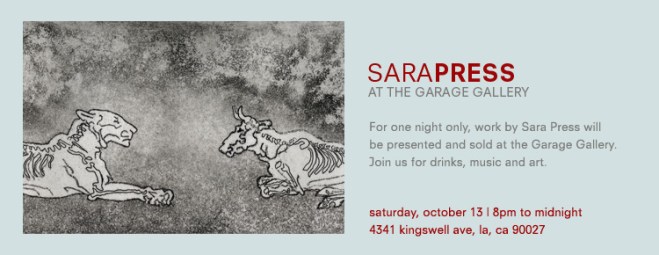
This Saturday in L.A.

sarapressinvite.jpg

from Sara Press:

“Dear L.A. area friends (and those who might be here visiting or in spirit) —

“I would love to see you next Saturday night at the Garage Gallery for
a one-night showing of my printmaking and book arts work!

“Join us for drinks, music, and animal-themed art.”

Saturday, October 13th
8 pm to midnight
4341 Kingswell Ave
LA, CA 90027