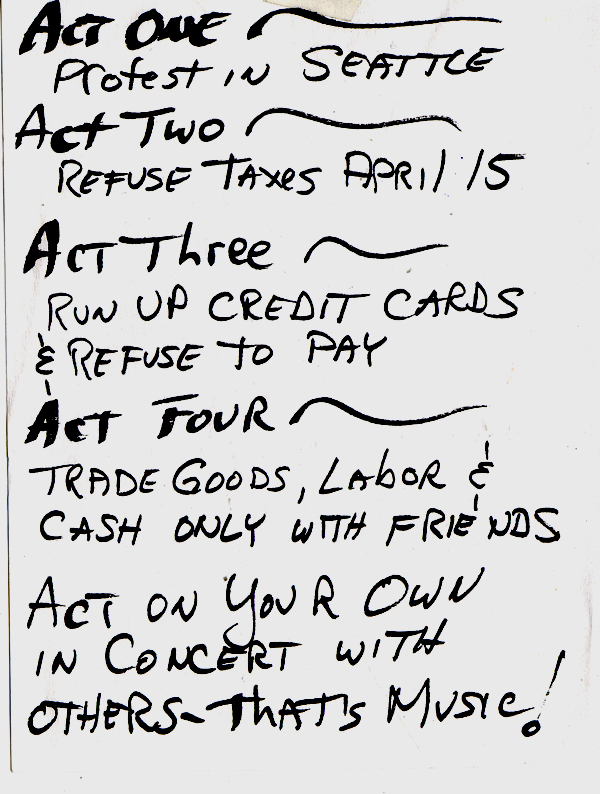
Happy 8 Year Anniversary Of Anti-Corporate-Globalization Week.

seattle.jpg

Hands down the funnest march I ever marched happened 8 years ago today. It was a polyamorous procession of the entire “Seattle Coalliton” (busty steel men, enviros, indigenous folks, dreamers and korean unionists) down some broad shoppers avenue on Capital Hill. Some where along the way the whole sh’bang (at least a thousand of us) fueled by the weight of our innevitablity, wandered off the street, onto the sidewalk and straight through the doors of one of those urban malls into a navy blue Gap. Through the atrium we brought our rummble of chants and slogans and drums, transformed it to an echo chamber- the mannequins in the store bopping to the drone of something louder than the big Taiko drums of the Koreans.

Later that evening my brother, this playful dude from Katuah Earth First! and I cruised Seattle in my ’89 Civic, playing rewinding and then playing again Garry Glitter’s stadium anthem Rock and Roll: Parts One & Two, all the while trying to top it with our own broadcasts of “General Strike Tommorow, Don’t Go To Work”, screamed out the window to any one we drove by. Next day was the blockade that closed down the city for the rest of the week.

Times have changed in the past but we won’t forget
Though the age has passed they’ll be rockin’ yet

Rock and ro-o-oll, rock and roll

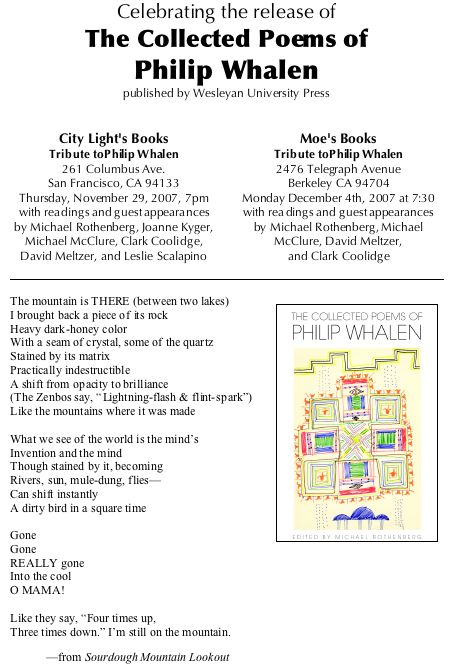
webuilt1.jpg

(flyer and arm band scavenged from the Denny St. convergence center 11/99)

Fungus Fair in Oakland this weekend (Dec 1-2), featuring Paul Stamets

“A Celebration of Wild Mushrooms

* 1-2 December 2007
* Saturday: 10 am to 6 pm — Sunday: 12 pm to 5 pm
* Oakland Museum of California, 10th and Oak Streets, Oakland

“In the San Francisco Bay Area, when the first rains tease up the chanterelles and porcini, fungus lovers head to the “Fungus Fair: A Celebration of Wild Mushrooms” at the Oakland Museum of California. The Fair, hosted by the museum and the Mycological Society of San Francisco (MSSF), provides information on the uses and abuses of fungi, with displays and exhibits on ecology, toxicology, and cultivation. Arrays of identification tables display locally collected mushrooms. Campsite gourmands learn how to serve up the safe and scrumptious species through identification tutorials, cooking demonstrations, and sales of recipe books, soups, snacks, and fresh edibles. Watch renowned Bay Area chefs prepare dishes like matsutakes & roasted cauliflower in coriander cream or sautéed caramel candy cap pears and dentelles.

“The Oakland Museum of California, 10 & Oak Streets in Oakland, is one block from the Lake Merritt BART and a few blocks from Highway 880.

“Admission is $8 general, $5 seniors/students with ID, and free for members, kids five and under, and Oakland City employees. A special two-day pass is available for $12 at
www.museumca.org/tickets

“The weekend event is a rare chance to pore over displays of remarkable
native mushrooms and see how they can be used to dye paper and
clothing, treat cancer and HIV, and add flavor to many foods. Attend a
slide talk or use a microscope. Highly recommended for curious kids!
Mycologists will be on hand both days to answer questions and identify
unknown specimens for visitors.

“Mushroom munchers can learn to recognize and prepare edible fungi from
cookbook and food vendors and the Fair’s popular cooking
demonstrations. Local chefs will prepare dishes with fresh fungi in an
outdoor kitchen on Saturday and Sunday.

“During the Fair, the MSSF presents slide shows on mushroom hunting and
identification. Paul Stamets, an advocate of the medicinal properties
of mushrooms, will give talks on the role of mushrooms in ecological
restoration (Saturday, 4 p.m.) and the mind-altering psychotropic
species (Sunday, 3:30 p.m).

“Fungus-Filled Family Fun! Mushroom crafts and Fair tours for kids take
place on Saturday from 10 a.m. to 4 p.m. and on Sunday from noon to 4
p.m.

“Fair vendors will have fresh wild mushrooms, cultivation kits, books,
clothing, posters, and other mushroom-centric items available all
weekend.

“The Mycological Society of San Francisco is an all-volunteer, nonprofit
organization dedicated to the promotion of educational and scientific
activities involving mushrooms. Founded in 1950, the MSSF is the
largest regional mushroom society in the U.S. The Society awards annual
scholarships, tracks local mycological species, and assists Bay Area
poison control centers. It also leads mushroom identification walks and
works to preserve cultural traditions of mushroom collecting. Visit
http://www.mssf.org for details.”

The new American militarism.

“We do not deserve these people”
by Anatol Lieven

Published in the London Review of Books, 20 October 2005

reviewed: The New American Militarism: How Americans Are Seduced by War by Andrew Bacevich

A key justification of the Bush administration’s purported strategy of ‘democratising’ the Middle East is the argument that democracies are pacific, and that Muslim democracies will therefore eventually settle down peacefully under the benign hegemony of the US. Yet, as Andrew Bacevich points out in one of the most acute analyses of America to have appeared in recent years, the United States itself is in many ways a militaristic country, and becoming more so:

“At the end of the Cold War, Americans said yes to military power. The scepticism about arms and armies that informed the original Wilsonian vision, indeed, that pervaded the American experiment from its founding, vanished. Political leaders, liberals and conservatives alike, became enamoured with military might.

“The ensuing affair had, and continues to have, a heedless, Gatsby-like aspect, a passion pursued in utter disregard of any consequences that might ensue.”

The president’s title of ‘commander-in-chief’ is used by administration propagandists to suggest, in a way reminiscent of German militarists before 1914 attempting to defend their half-witted kaiser, that any criticism of his record in external affairs comes close to a betrayal of the military and the country. Compared to German and other past militarisms, however, the contemporary American variant is extremely complex, and the forces that have generated it have very diverse origins and widely differing motives:

“The new American militarism is the handiwork of several disparate groups that shared little in common apart from being intent on undoing the purportedly nefarious effects of the 1960s. Military officers intent on rehabilitating their profession; intellectuals fearing that the loss of confidence at home was paving the way for the triumph of totalitarianism abroad; religious leaders dismayed by the collapse of traditional moral standards; strategists wrestling with the implications of a humiliating defeat that had undermined their credibility; politicians on the make; purveyors of pop culture looking to make a buck: as early as 1980, each saw military power as the apparent answer to any number of problems.”

Two other factors have also been critical: the dependence on imported oil is seen as requiring American hegemony over the Middle East; and the Israel lobby has worked assiduously and with extraordinary success to make sure that Israel’s enemies are seen by Americans as also being those of the US. And let’s not forget the role played by the entrenched interests of the military itself and what Dwight Eisenhower once denounced as the ‘military-industrial-academic complex’.

The security elites are obviously interested in the maintenance and expansion of US global military power, if only because their own jobs and profits depend on it. Jobs and patronage also ensure the support of much of the Congress, which often authorises defence spending on weapons systems the Pentagon doesn’t want and hasn’t asked for, in order to help some group of senators and congressmen in whose home states these systems are manufactured. To achieve wider support in the media and among the public, it is also necessary to keep up the illusion that certain foreign nations constitute a threat to the US, and to maintain a permanent level of international tension.

Continue reading

TONIGHT – HARRY SMITH films at REDCAT in L.A.

November 26, 2007 8:00 pm
($9, $7, $4)
REDCAT
box office at 213-237-2800.

Film/Video, Jack H. Skirball Series

ALCHEMICAL DREAMS: THE SHORT FILMS OF HARRY SMITH

“The hand-painted films with which [Smith] began his career are the most remarkable ever achieved in that technique; and his subsequent stature as one of the central filmmakers of the avant-garde tradition.” films, both animated and photographed from actuality, sustain his.” P. Adams Sitney

“You shouldn’t be looking at this as a continuity. Film frames are hieroglyphs, even when they look like actuality. You should think of the individual frame, always, as a glyph, and then you’ll understand what cinema is about.” – Harry Smith

Harry Smith (1923–91) was a unique visionary whose art and interests moved freely between music (most notably, with the seminal Anthology of American Folk Music), film, painting and the occult. Smith’s ground-breaking experimental films are rarely shown, and this screening includes several of his hand-painted Early Abstractions (1941–57, assembled ca. 1964, 23 mins., b/w and color, 16mm)), featuring live musical accompaniment; Film No. 17: Mirror Animations (Extended Version) (1979, 11 min., 16mm), collage-animation laden with Smith’s symbology and mythic imagination; Film No. 14: Late Superimpositions (1964, 28 min., 16mm), a quasi-autobiographical account of Anadarko, Oklahoma; Film No. 15 (1965–66, 10 min., silent, 16mm), Smith’s animation of Seminole patchwork; and Film No. 16: Oz, The Tin Woodman’s Dream (1967, 15 min., silent, 35mm CinemaScope).

Curated by Rani Singh, director of the Harry Smith Archives and senior research associate at the Getty Research Institute.

Early Abstractions (1941–57, assembled ca. 1964, 23 min., b/w and color, 16mm) is a set of seven films between two and six minutes in length produced between 1946 and 1957. Each film is numbered (1, 2, 3, 4, 5, 7, and 10) in the order they were made (a system animation pioneer Oskar Fischinger and Austrian experimental filmmaker Kurt Kren also employed). This numbering imposed an order and axis on these works from the beginning and suggests a commitment to a sustained “arc” that Smith undertook and achieved in his film-work. – Senses of Cinema
Featuring live musical accompaniment

Film No. 17: Mirror Animations (Extended Version) (1979, 11 min., 16mm). “If, (as many suppose), the unseen world is the real world and the world of our senses but the transient symbols of the eternal unseen… we could logically propose that any one projection of a film is variant from any other. This is particularly true of Mirror Animations. Although studies for this film were made in the early 1960s, the non-existence of suitable printing equipment until recently, my inability to locate the original camera footage until 1979, and particularly, the lack of an audience ready to evaluate L. Wittgenstein’s ‘Ethics and Aesthetics Are One and the Same,’ in the light of H.C. Agrippa’s earlier, ‘there is no form of madness more dangerous than that arrived at by rational means’ – have all contributed to delaying until now the availability of a print in the full mirror-reverse form originally envisioned.” – Harry Smith

Film No. 14: Late Superimpositions (1964, 28 min., 16mm) “Superimposed photographs of Mr. Fleischman’s butcher shop in New York, and the Kiowa around Anadarko, Oklahoma–with Cognate Material. The strip is dark at the beginning and end, light in the middle, and is structured 122333221. I honor it the most of my films, otherwise a not very popular one before 1972. If the exciter lamp blows, play Bert Brecht’s Mahogany.”– Harry Smith

Film No. 15 (1965–66, 10 min., silent, 16mm)

Film No. 16: Oz, The Tin Woodman’s Dream (1967, 15 min., silent, 35mm CinemaScope). One of the three surviving fragments of Smith’s aborted major project of reworking Wizard of Oz (the others being Oz/No. 13, ca. 1962 and Fragments of a Faith Forgotten/No. 20, ca. 1981). “Smith’s Wizard of Oz film (co-animated with Joanne Ziprin) would have chronologically followed his Heaven and Earth Magic. The project was begun in the early 1960s and received major financial backing from a consortium (which included Elizabeth Taylor). This was to be a widescreen film, using a number of colored glass plates in front of the lens at varying distances in order to create strange effects. Smith drew on a number of sources in order to produce a cabalistic environment within which the Oz story would unfold: these included the drawings of Hieronymous Bosch, Tibetan mandalas and sketchings of microscopic life by biologist Ernst Haeckel. Unfortunately, the major backer of the film, Arthur Young, died and the project was abandoned.” – Senses of Cinema

About Harry Smith

Although best known as a filmmaker and musicologist, Harry Smith (1923-1991) frequently described himself as a painter, and his varied projects called on his skills as an anthropologist, linguist, and translator. Born May 29, 1923, in Portland, Oregon, he spent his early childhood in the Pacific Northwest. His parents were Theosophists, and exposed him to a variety of pantheistic ideas, which persisted in his fascination with unorthodox spirituality and comparative religion and philosophy. By the age of 15, Smith had spent time recording many songs and rituals of the Lummi and Samish peoples and was compiling a dictionary of several Puget Sound dialects. He later became proficient in Kiowa sign-language and Kwakiutl.

Smith studied anthropology at the University of Washington between 1943 and 1944. After a weekend visit to Berkeley, during which he attended a Woody Guthrie concert, met members of San Francisco’s bohemian community of artists and intellectuals, and experimented with marijuana, he decided that the type of intellectual stimulation he was seeking was unavailable in his student life. In San Francisco he began to build a reputation as one of the leading American experimental filmmakers. He became close with other avant-garde filmmakers in the Bay Area, such as Jordan Belson and Hy Hirsh, and traveled frequently to Los Angeles to see the films of Oskar Fischinger, Kenneth Anger, and other Southern Californians experimentalists. He developed his own methods of animation, using both stop motion collage techniques and hand-painting directly on film. Often a single film required years of painstakingly precise labor.

Smith’s films have been interpreted as investigations of conscious and unconscious mental processes, while his fusion of color and sound are acknowledged as precursors of 1960s psychedelia. He also spoke of his films in terms of synaethesia, the search for correspondences between color and sound and sound and movement. Smith’s paintings and films were influenced by Kandinsky, Marc, and others who formed the foundation of the collection of the Museum of Non-Objective Painting (later the Guggenheim Museum). He developed a relationship with Hilla Rebay, the museum’s director, and she arranged for him to receive a Solomon Guggenheim grant. He moved to New York permanently in the early 1950s.

In 1952 Folkways issued Smith’s multi-volume Anthology of American Folk Music. It was comprised entirely of recordings issued between 1927 and 1932. Released in three volumes of two discs each, the 84 tracks of the anthology are recognized as having been a seminal inspiration for the folk music revival of the 1950s and 1960.

From the late 1940s, Smith was also a passionate jazz enthusiast, and created paintings that are note-by-note transcriptions of particular tunes. He spent much of the 1950s in the company of jazz pioneers like Charlie Parker, Dizzy Gillespie, and Thelonious Monk. His involvement with recording continued into the 1960s and 1970s as he produced and recorded the first album by the Fugs in 1965. His long term friendships with many of the Beat writers led to the release of Allen Ginsberg’s First Blues in 1976 as well as unreleased recordings of Gregory Corso’s poetry and Peter Orlovsky’s songs. Smith spent part of this era living with groups of Native Americans, and this resulted in his recording the peyote songs of the Kiowa Indians.

Smith donated the largest known paper airplane collection in the world to the Smithsonian Institution’s National Air and Space Museum. He was a collector of Seminole textiles and Ukrainian Easter Eggs. He also considered himself the world’s leading authority on string figures, having mastered hundreds of forms from around the world. Smith spent his last years 1988-1991) as “shaman in residence” at Naropa Institute, where he offered a series of lectures, worked on sound projects, and continued collecting and researching. In 1991 he received a Chairman’s Merit Award at the Grammy Awards ceremony for his contribution to American Folk Music.

For more information on Harry Smith please visit the Harry Smith Archives website: www.harrysmitharchives.com


An appreciation of Jean-Francois Bizot, by David Byrne

“10.24.2007: Long Live Jean-François Bizot

“Jean-François Bizot passed away recently. He was a friend though I didn’t see him often. In the late 70s or early 80s, when Talking Heads first played in France, I picked up a copy of his magazine Actuel. While its format was similar to Paris Match (an earlier incarnation was funkier and more psychedelic), it seemed to convey an alternative view of the whole world. Even with my limited French I could suss that this mag was something special. It was a glossy that reported on global culture — Fela Kuti, China, science, local oddballs, politics, art — and exhibited a curiosity and enthusiasm that I both shared and envied. Then and now, nothing like it exists in the US — its lack of specialization renders it unique.

“I wrote to the magazine out of the blue saying I loved what they were doing. I was not a well-known musician at the time, but Bizot got back in touch. Eventually he put Brian Eno, Jon Hassell and myself on the cover when the Bush of Ghosts record came out, with the affectionate but ironic headline, “The Whites Think Too Much.”

“We became friends. In the 80s, as my interest in music outside the rock mainstream deepened, he encouraged my curiosity. When I was in Paris we went to see Orchestra Aragon, the classic Cuban charanga band, at New Morning (I think) and I was transported. They would never play in the US due to the embargo, so this was a rare, funky, yet lyrical experience. He passed me tapes of African and old Cuban music — stuff I still listen to that has yet to be released in the US — and we would have late night talks that ranged widely. It was exactly what one hoped life could be for those curious about all manner of things going on out there.

“Later, in the 80s, he and some others started Radio Nova. At various periods, it might have been the best radio station in the world. No joke. They played alt-rock before there was such a thing, Raï, African pop music, Chanson, Latin American music, hip hop, and experimental music. We all wanted to hear it, and this was where we could. Finally. READ MORE…


Jean-François Bizot: Champion of counter-culture
By Pierre Perrone
The Independent
19 September 2007

Jean-François Bizot, publisher, editor, novelist: born Paris 19 August 1944; died Paris 8 September 2007.

Jean-François Bizot had an enormous influence on the cultural life of France over the past 40 years. Between 1970 and 1975, and again between 1979 and 1994, he was at the helm of the counter-culture monthly Actuel. This started out as a French take on the underground press, not too far removed from the Village Voice and the Los Angeles Free Press in the US, or Oz and the International Times in the UK, but eventually evolved into required reading not so much for the hippies as for the hip crowd.

In 1981, as François Mitterrand ascended to the French presidency and freed the airwaves from state control, Bizot launched Radio Nova, the pioneering station which championed world music before it was even called that, and various forms of hip hop and electronica. Indeed, Nova provided the springboard for acts like Mory Kanté, Rachid Taha, Tinariwen and Camille to reach a national and international audience. Bizot was a talent-spotter extraordinaire and gave slots and early exposure at the station to several presenters – Edouard Baer, Ariel Wizman and most notably the comedian Jamel Debbouze of Amélie fame – who have become mainstream names in France as actors, writers, producers and directors.

Bizot’s trajectory as a free-thinking, libertarian figure was all the more surprising since he came from a well-established family with a considerable fortune, and had the benefit of a solid bourgeois education. Born in 1944, he was the youngest of five children and attended a school run by Jesuit priests in Versailles, and then the School of Chemical Industries in Nancy where he gained several diplomas.

“First you do what’s expected of you, and then you do what you want,” he said, putting that principle into effect by quitting his job as an economist forecaster after just a year to become a journalist at the news weekly L’Express in 1967. Galvanized by the events of May 1968 which nearly toppled the de Gaulle government, and inspired by a trip to California where he discovered the alternative press, Bizot put his inheritance money where his mouth was, quit his job at L’Express and launched Actuel in May 1970 as the bible of the counter-culture in France.

Bizot didn’t pay himself a salary and ran a typically hippie-ish, commune-like operation, with everyone else getting 2,000 francs per month. His publication didn’t always reach the printers or the distributors on time, but he gave a voice to ecologists, feminists, gay-rights activists, squatters and anti-racism campaigners in what was still, in the early Seventies, a pretty conservative country.

He also joined the dots between the poetry of Rimbaud, Baudelaire and Verlaine, and existentialism, surrealism and Dadaism, and the music of Bob Dylan, Frank Zappa, Captain Beefheart or Soft Machine and the subversive cartoons of Robert Crumb and Gilbert Shelton. He surrounded himself with excellent collaborators too, most notably Bernard Kouchner, who went on to found Médecins Sans Frontières, and is currently Minister of Foreign Affairs in François Fillon’s government. The fact that Nicolas Sarkozy called on Kouchner is indicative of how far-thinking and influential Bizot and Actuel were in France.

A maverick, irreverent, at times autocratic editor, Bizot stopped publishing Actuel between 1975 – the first time it had turned a profit – and 1979, though two bumper annuals appeared during the intervening years. In 1979 he relaunched the magazine with a greater emphasis on reportage, travel and photography, and its circulation reached a peak of 400,000 in 1981. The publication of Actuel was “suspended” in 1994, when Bizot started the monthly Nova magazine which lasted for 10 years. In 1999, in parallel with running Radio Nova, its record label and its associated website, he also took over TSF with Frank Ténot, turning the troubled station into a successful outlet for jazz in the French capital.

Generous and always full of ideas, Bizot hated Sundays and holidays but travelled extensively, especially to Africa. He translated Charles Bukowski into French, and wrote two overviews of the alternative press phenomenon entitled Underground: L’Histoire (“Underground: the history”, 2001) and Free Press: Underground and Alternative Publications 1965-75 (2006), as well as several other books including the autobiographical novel Les Déclassés (1976) and Un Moment de Faiblesse (“A Moment of Weakness”, 2003) in which he tackled his cancer battle with typical humour, giving the tumour a nickname: Jack Le Squatter.

Asked what underground culture meant, Bizot said: “You have to know when to take a sideways step, when to take a chance, when to do what no one else seems to be doing at the time. Like asking your grandparents to come and live with you. No one does that. That really sets the cat amongst the pigeons. The taxman never believes you can share a home with your grandparents. That is a truly alternative lifestyle!”


Scenes from last weekend's Festival Ecstatique

All photos by and courtesy Matthew J. Despres

Festival Ecstatique organizer (and Arthur magazine “Bull Tongue” columnist) Byron Coley, 16 November 2007, Yod Space in Florence, MA.

Valerie Webber @ Festival Ecstatique, 16 November 2007, Yod Space in Florence, MA.

Charlie Potts @ Festival Ecstatique, 17 November 2007, Hampshire College Red Barn in Amherst, MA.

Mike Watt @ Festival Ecstatique, 16 November 2007, Yod Space in Florence, MA.


John Oliver Simon @ Festival Ecstatique, 16 November 2007, Yod Space in Florence, MA.

ANN SUMMA '70s L.A. punk photos now at Track 16 in L.A.

Eye of the Storm: Ann Summa’s punk variety show

By KRISTINE MCKENNA

Wednesday, November 7, 2007 – 10:00 pm – LAWeekly

Prior to arriving in Los Angeles in 1978, photographer Ann Summa hitchhiked across the African continent. By herself. Obviously, challenging situations don’t faze Summa, so when she stumbled into L.A.’s newly born punk scene, she simply grabbed her camera and dove into the fray.

Mind you, L.A.’s ’70s punk scene was a far cry from the testosterone fest we’re stuck with today. That first wave, born in 1977, was something altogether different. It had ripened to perfection by 1980, and lay rotting on the ground by 1984, but for seven years it was amazing. The stereotypes hadn’t solidified yet, so creative diversity flourished, and the variety of entertainment one could see on a single night, in the same club, was astonishing. Weird art bands (Nervous Gender, the Screamers), savagely funny musical satire (Black Randy & the Metro Squad), lugubrious delta blues (the Cramps), classic punk with a feminist twist (the Bags), full-on, indefinable genius (X) — the list of young bands was long and very wonderful.

During those years, punk bands played in tiny clubs, where Summa had no trouble positioning herself at the lip of the stage, and the pictures she took are remarkable. The L.A. punk community was small then, and it really was a community — everyone knew everyone, and people helped and supported one another. The handful of photographers on the scene — Summa, Frank Gargani, Jenny Lens and Melanie Nissen, among others — were part of the community too, and photographs from that time and place are infused with an intimacy that you won’t find in most “rock photography.”

Summa filed her punk photographs away long ago, but when a mercurial landlord prompted her to move her photo archive, she happened to look at the pictures and was surprised by how affecting she found them. Track 16 Gallery agreed that the photographs constitute a powerful document, and a selection of 35 of them opens November 17.

LOS ANGELES: PHOTOS BY ANN SUMMA | Track 16 Gallery, 2525 Michigan Ave., C1, Bergamot Station, Santa Monica | (310) 264-4678 or www.track16.com | Through December 15

CLOSING EVENT FOR “LOS ANGELES: PHOTOGRAPHS BY ANN SUMMA”
Saturday, December 15 at 7 P.M.
Featuring PUNK BANDS:
HUMAN HANDS
CHAIRS OF PERCEPTION (Formerly the URINALS)
DEADBEATS
more bands to be announced