
Yearly Archives for 2007
Olympia Washinton, Direct Action Against War.
The growing port militarization resistance movement in Olympia, WA. This footage is only from Saturday, Nov.10th. Actions at the Port of Olympia have been taking place all week.
39 women blockaded the port of olympia, a soldier from ft. lewis approached the gate and asked the protesters if one of them could give him a ride home since he was refusing to drive the military vehicles out of the port. He said “fuck this, I’m not going to kill anybody anymore.” and got a ride back to the Fort. Check http://www.tacomasds.org for updates.
Arthur presents Citay TONIGHT in all-ages L.A. gig
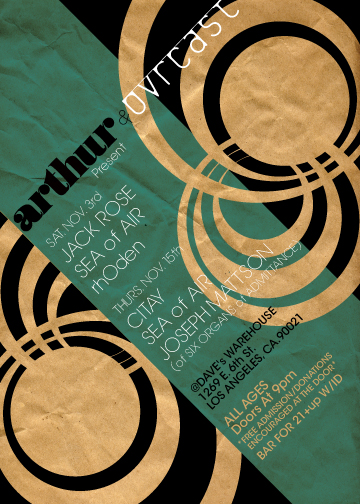
ARTHUR & OVRCAST PRESENT
Thurs. Nov 15
The Moon Upstairs
Citay
Sea of Air
Joseph Mattson
@DAVE’s WAREHOUSE
1269 E. 6th St.
Los Angeles, Ca.
90021
ALL AGES
Doors at 9:00pm
Full bar for those over 21
Free Admission/Donations Encouraged
My Name Is Albert Ayler (documentary)

My Name Is Albert Ayler is playing several times this weekend and early next week in NYC at the Anthology Film Archives.
Click here for the schedule and information.
“if people don’t like it now, they will”
A few tracks from the Holy Ghost box set (Revenant)
ca. late August, 1968 in New York area
6. untitled blues
7. untitled sermon
Powered by ScribeFire.
Anne Elizabeth Moore on the new corporate patronage system

Unmarketable: Brandalism, Copyfighting, Mocketing, and the Erosion of Integrity
Anne Elizabeth Moore
paperback
$15.95 / £9.99 / $19.95 CAN
PAPERBACK ORIGINAL
promotional copy:
A writer and activist investigates corporate America’s inroads into—and alliances with—the cultural underground
There’s an industry around you that works, whether you agree with it or not.
—ALEC BOURGEOIS, DISCHORD RECORDS LABEL MANAGER
For years the do-it-yourself (DIY)/punk underground has worked against the logic of mass production and creative uniformity, disseminating radical ideas and directly making and trading goods and services. But what happens when the underground becomes just another market? What happens when the very tools that the artists and activists have used to build word of mouth are coopted by corporate America? What happens to cultural resistance when it becomes just another marketing platform?
Unmarketable examines the corrosive effects of corporate infiltration of the underground. Activist and author Anne Elizabeth Moore takes a critical look at the savvy advertising agencies, corporate marketing teams, and branding experts who use DIY techniques to reach a youth market—and at members of the underground who have helped forward corporate agendas through their own artistic, and occasionally activist, projects.
Covering everything from Adbusters to Tylenol’s indie-star-studded Ouch! campaign, Unmarketable is a lively, funny, and much-needed look at what’s happening to the underground and what it means for activism, commerce, and integrity in a world dominated by corporations.
Anne Elizabeth Moore is the co-editor of Punk Planet, the Best American Comics series editor, and the author of Hey Kidz! Buy This Book: A Radical Primer on Corporate and Governmental Propaganda and Artistic Activism for Short People. She has written for Bitch, the Chicago Reader, In These Times, The Onion, The Progressive, and Chicago Public Radio WBEZ’s radio program 848. She lives in Chicago.
Pub Date: Fall 2007
Format: paperback
Trim: 5 1/4 x 7 1/2, 272 pages
ISBN: 978-1-59558-168-6
ASSHOLE OF THE YEAR by Paul Krassner
It’s Tim Russert. The moment he said to Dennis Kucinich at a “debate” among Democratic presidential candidates, “This is a serious question,” you knew it wouldn’t be. A responsible journalist might have asked, “Why do think that Dick Cheney should be impeached rather than George Bush?” But Russert wanted to further marginalize Kucinich–to ridicule him in a flying saucer kind of way–and, like a trial lawyer who already knows what a defendant’s answer will be–his “serious question” was “Did you see a UFO?”
Kucinich tried to explain that the U in UFO means “unidentified” flying object. He joked, “I’m moving my campaign office to Roswell, New Mexico and Exeter, New Hampshire.” He pointed out that Jimmy Carter had seen a UFO, and “More people–” Russert interrupted him with a statistic: 14% of Americans had seen UFOs. Kucinich asked him to repeat that number, as if to thank him for inadvertently providing him with the UFO sighters vote. Russert repeated the number and, with the smug satisfaction of having generated a guaranteed sound bite, he said, “I want to ask Senator Obama…”
There was a predictable trickle-down effect. Even Bill Maher mocked Kucinich, though Maher’s real target should’ve been Russert. A few days later, I met a woman who asked me who my ideal candidate is. “Dennis Kucinich,” I said. She responded, “Isn’t he the one who said he saw some Martians?” Of course, there’s a video of that encounter in the secret government implied-blackmail lock-box, along with the video of a threesome–Charles Schumer, Dianne Feinstein and a billy goat–and the video of Rudy Guliani performing an abortion on Pat Robertson’s mistress.
Ironically, Russert’s co-moderator, Brian Williams–in his capacity as host of Saturday Night Live–referred to the mainstream media’s proactive assumption that Hillary Clinton will win in the primaries and then in the general election. Fundraising is the name of that particular political game, because the candidates with the most money will buy the most TV commercials and print ads. Tim Russert gives a claymation face to that open conspiracy. And in the process, that old saying and song, “There’s no business like show business,” lands in the outdated metaphors graveyard. There is indeed a business like show business. It’s the news.
More Paul Krassner at paulkrassner.com
"Culture is worth a little risk" – Norman Mailer
This post is a follow up to my post from April 24, 2007 which details my quest to find the quintessential live version of Warren Zevon’s “Werewolves of London”. After hearing of Norman Mailer’s passing this weekend, I came across a story detailing the relationship between Norman Mailer, Gary Gilmore and Jack Abbott. Worth reading through to see how oily things got back in the late 70s and early 80s with NY high snobiety.
Try and stick with it because it all ties back in to BUFFALO, NY.

In the Belly of the Beast

Norman Mailer & wife

Powered by ScribeFire.
Eno on Hassell
The debt I owe to Jon Hassell
Brian Eno
Friday November 9, 2007
The Guardian
I arrived in New York on a beautiful spring day in April 1978. I’d intended to stay for a week but the visit stretched on and on and I ended up staying for about five years.
Those first few months in the city were a formative time for me. I didn’t know many people, and I had time on my hands, so I was open to things in a way that I might not have been in a more familiar landscape. I listened to a lot of live music and bought a heap of records. One of the most important was by a musician I’d never heard of – a trumpeter called Jon Hassell. It was called Vernal Equinox.
This record fascinated me. It was a dreamy, strange, meditative music that was inflected by Indian, African and South American music, but also seemed located in the lineage of tonal minimalism. It was a music I felt I’d been waiting for.
I discovered later, after I met and became friends with Jon, that he referred to his invention as Fourth World Music (which became the subtitle of the first album we made together: Possible Musics). I learned subsequently that Jon had studied at Darmstadt with Stockhausen (as indeed had Holger Czukay from Can, another occasional colleague), that he’d played on the first recording of Terry Riley’s seminal In C, and that he’d studied with the great Indian singer Pran Nath.
We had a lot to talk about. We had both come through experimental music traditions – the European one, as exemplified by Stockhausen and Cornelius Cardew, and the American one of Cage and Terry Riley and LaMonte Young. At the same time, we were aware of the beauty and sophistication of all the music being made outside our culture – what is now called “world music”. And we were both intrigued by the possibilities of new musical technology.
But beyond these issues, there was a deeper idea: that music was a place where you conducted and displayed new social experiments. Jon’s experiment was to imagine a “coffee coloured” world – a globalised world constantly integrating and hybridising, where differences were celebrated and dignified – and to try to realise it in music.
His unusual articulacy – and the unexpected scope of his references – inspired me. In general, artists don’t talk much about how or why they make their work, especially “why”. Jon does. He is a theorist and a practitioner, and his theories are as elegant and as attractive as his music: because in fact his music is the embodiment of those theories.
We spent a lot of time together, time that changed my mind in many ways. We talked about music as embodied philosophy, for every music implies a philosophical position even when its creators aren’t conscious of it. And we talked about sex and sensuality, about trying to make a music that embraced the whole being and not just the bit above the neck (or just the bit below it).
It was in these conversations that, among other things, My Life in the Bush of Ghosts, which I made with David Byrne in 1981, was nurtured. All of us were interested in collage, in making musical particle colliders where we could crash different cultural forms with all their emotional baggage and see what came out of the collisions, what new worlds they suggested.
If I had to name one over-riding principle in Jon’s work it would be that of respect. He looks at the world in all its momentary and evanescent moods with respect, and this shows in his music. He sees dignity and beauty in all forms of the dance of life.
I owe a lot to Jon. Actually, a lot of people owe a lot to Jon. He has planted a strong and fertile seed whose fruits are still being gathered.
• Jon Hassell performs at the Queen Elizabeth Hall on November 17 as part of the London Jazz festival.
• Brian Eno was interviewed in Arthur #17; Jon Hassell was interviewed in Arthur #18.
NEW FROM ARTHUR: PARADISE NOW: THE LIVING THEATRE IN AMERIKA DVD ANTHOLOGY – PRE-ORDER NOW – SHIPS DEC 1ST!
NEW FROM ARTHUR: PARADISE NOW: THE LIVING THEATRE IN AMERIKA DVD
LIMITED EDITION OF 1,000
UPDATE MARCH 26, 2013: Remaining stock of this dvd available from Secretly Canadian distribution. Click here for ordering info.
Film Still by Marty Topp
Life, revolution and theater are three words for the same thing:
an unconditional NO to the present society.” – Julian Beck
“Paradise Now … more relevant now because we’re closer
to now than we ever have been.” – Hanon Reznikov
In collaboration with The Living Theatre, The Ira Cohen Akashic Project and Saturnalia Media Rites of the Dreamweapon, Arthur Magazine proudly presents “PARADISE NOW: The Living Theatre in Amerika,” a DVD featuring rare, never-before-distributed films and a plethora of revolutionary multimedia documents from The Living Theatre’s historic and influential ’68-’69 American tour. An edition of 1,000 copies of this DVD will be available from December 1, 2007. This staggering package, which retails for $29.95, features:
NEVER BEFORE RELEASED FILMS
– “PARADISE NOW: THE LIVING THEATRE IN AMERIKA” (1969) a harrowing, gorgeous, in-your-face-and-mind 45-minute black-and-white film by Marty Topp, produced by Ira Cohen for Universal Mutant. “Marty Topp’s beautiful film of ‘Paradise Now’ reveals how the theories of revolutionary change and the experience of sexual liberation are not separate paths to the beautiful nonviolent anarchist revolution. Practiced together they are a single thrust, encompassing both political action and sensual joy, leading to the dreamed-of terrestrial paradise.” — Judith Malina (The Living Theatre) 
– “EMERGENCY: THE LIVING THEATRE” (1968) a 32-minute color film by Gwen Brown, featuring precious footage of Living Theatre productions “Mysteries” and smaller pieces, “Paradise Now” and “Frankenstein.” “The fusion of Brown’s freewheeling direct cinema and the Living Theatre’s performance for revolutionary change (amidst the heydays of both) unite as a dynamic concoction of the era, yielding for the viewer a shifting terrain of both critical insight and ecstatic zeal, not as a vacant nostalgia for a pre-commodified radicality, but as tactical inspiration for future days.” – Andrew Wilson (Artist’s Access Television) 
– “PARADISE NOW: THE PERMANENT REVOLUTION” (2007) a new 18-minute film by Will Swofford and Georg Gatsas. On August 23, 2007, The Living Theatre restaged “Paradise Now” in New York’s Union Square to mark the 80th anniversary of the 500,000-strong street protest over the deaths of Nicola Sacco and Bartolomeo Vanzetti–Italian immigrants unjustly executed for their anarchist political convictions. COMMEMORATIVE PRINTED MATTER

– DOUBLE SIDED 14 x 19 POSTER featuring THE MAP OF PARADISE as drawn by Julian Beck and BAM ODYSESSY a stunning montage of photographs by Don Snyder from Paradise Now at Brooklyn Academy of Music- MAGAZINE BOOKLET including texts by Antonin Artaud, Allan Graubard, Julian Beck, Judith Malina, Hanon Reznikov, Ira Cohen, Don Snyder, photographs, stills from the films, ephemera and much more
ADDITIONAL SPECIAL FEATURES
– INTERVIEWS with directors Julian Beck*, Judith Malina, Hanon Reznikov, company member Steve Ben Israel, and producer Ira Cohen
*(courtesy of Mark Ari)– THE SPINNING WHEEL by Steve Ben Israel, soundtrack to EMERGENCY sourced from agit-prop radio broadcasts
– LOVE & POLITICS, an introduction to the themes and personalities at the heart of the work of The Living Theatre, including scenes from The Living Theatre repertory and poems and texts by Malina, Reznikov, Julian Beck. Filmed at The Pink Pony NYC and LaMama ETC with an introduction by Ira Cohen
– FULL THEATRICAL SCRIPT SLIDESHOW of Paradise Now, A Collective Creation of The Living Theatre, as written down by Julian Beck and Judith Malina documenting more than 100 performances of the event
– MYSTIC FIRE GALLERY of excerpts from Living Theatre films including Sheldon Rochlin’s watershed documentary, Signal Through the Flames
– AKASHIC VIDEO GALLERY of excerpts from current and forthcoming Arthur DVD releases
WHAT IS PARADISE NOW?
In 1968 The Living Theatre, led by Julian Beck and Judith Malina, triumphantly returned to America from years of self-imposed exile in Europe with their theatrical breakthrough Paradise Now. The play introduces the practice of collective creation, dissolving the boundaries of human interactions and forging a harmony between the actors and audience. Of this process, Julian Beck writes, “Collective creation is the secret weapon of the people… This play is a voyage from the many to the one and from the one to the many. It’s a spiritual voyage and a political voyage, a voyage for the actors and the spectators. The play is a vertical ascent toward permanent revolution, leading to revolutionary action here and now. The revolution of which the play speaks is the beautiful, non-violent, anarchist revolution. The purpose of the play is to lead to a state of being in which non-violent revolutionary action is possible.The result of this shared voyage is the spontaneous creation of a temporary anarchist collective- free from the enslavements of war, violence, the State, money and the self.
CRITICAL PRAISE FOR MARTY TOPP’S PARADISE NOW
“Paradise Now is possibly The Living Theatre’s greatest achievement … unsurpassable!” — Ira Cohen”This past spring, in a group art show at New York’s Swiss Institute, an old black-and-white television played a grainy print of bodies writhing to the tune of distant drumming. ‘As long as you have people working for money and not love, there will be violence,’ intoned a tall, angular man on the screen. The bodies- women in scant bikinis and men in what looked like loincloths-piled together in an orgiastic tribal dance, some simulating (or perhaps actually having) sex as the voice continued: ‘Psycho-sexual repression is impeding the revolution.’ What looked like an underworld-of the 1960’s counter-cultural variety, in this case- is the Living Theatre’s Paradise Now, as documented in the 1969 Ira Cohen-produced film Paradise Now: The Living Theatre in Amerika … soon to be released on DVD from Arthur Magazine.” — CAN THEATER STAGE A REVOLUTION? – Traci Parks, Fall ’07 Preview, V MAGAZINE
“Joyous, brutal, exploding with the kinetic energies of psychic catharsis… Marty Topp’s PARADISE NOW: The Living Theatre in Amerika has captured the essence of this extraordinary theatrical experiment. It is unquestionably one of the finest artistic documentaries to come out of the United States cinema. It’s heartfelt sincerity should be sheer inspiration to the many young people throughout the country who are struggling to make meaningful and influential work. It is the reverberation of a crucially important message that must not be neglected, for the consequences are too terrible to endure. Marty Topp’s achievement is not just in the making of a great film, but in making us remember again, Paradise as a reality.” – PARADISE ON FILM – Don Snyder, July 1970, East Village Other
“Like an astonishing portion of the country’s popular music, the spectacles of The Living Theater proved to be in content and form outside the social system- not structured by it nor, except as outlet, implementing it: liberated territory.” — Revolution at the Brooklyn Academy – Stefan Brecht, The Drama Review number 43: Spring 1969, The Living Theater Issue
MORE ABOUT THE LIVING THEATRE
Founded in 1947, The Living Theatre has staged more than 80 productions performed in eight languages in 25 countries on four continents – a unique body of work. Visit their new space on Clinton St. in NYC – more info: www.livingtheatre.org
FINDING THE OTHERS: Let's make a new Briarpatch

WHAT IT IS
The Briarpatch is a system of self-reliance and mutual support, based on the ideas that you are a Briar if:
1. You have an insatiable curiosity about how the world works.
2. You seek to do the work you love and to make a living at it.
3. It is more important to you to provide the highest quality product or service than to get rich, but you recognize that you must make a profit to stay in business.
4. You prefer cooperation to isolation.
5. You prefer honesty and openness to deceit and secretiveness.
6. You believe in independence and personal responsibility.
7. You believe in simple living and environmental preservation.
8. Your financial records are open to your community.
9. It is important to you to have fun in everything you do.
HOW TO FIND A BRIARPATCH
The best way to find a Briarpatch where you live, is to just start one.
1. What’s your purpose? Every business support network is different. Most combine both emotional support and practical business counsel in various mixes. A clear purpose will make it easier for you to attract others.
2. Recruit at least one buddy. If you already meet regularly with a support buddy, the two of you will make the perfect kernal of an organizing team. Each of you can invite another person and you’ll have a support group. As each new person invites their friends and associates, you’ll become a network.
3. Avoid homogeneity. Many groups form around the similarities we see in each other, and that’s ok. But for longevity and innovation and the opportunity to change and grow, make a focused effort to invite people who are different. Of course you will want to invite experts in accounting, law, marketing, and so forth. That’s just good business sense. But also invite all genders and multiple ethnicities, and make a special place for the creative, the strange, and the wonderful.
4. Choose the right meeting place. Bay Area Briars have met in the posh San Francisco Tennis Club, member business board rooms, the meeting rooms in local restaurants, right in the middle of bustling cafes, in school classrooms, at different member homes and just about any place you can think of. Our longest continuously running meeting took place once a month for 6 years in an art gallery where we stored tables and chairs that we brought out each time we met. Mutual support was the main attraction, but members also looked forward to the continuously changing exhibits.
The place you choose will have a profound effect on the “look and feel” of the meeting. Make sure it’s in alignment with what you’re trying to accomplish.
5. Meet regularly and continuously. If members know the regular time and place and that the meeting will always be held, you’ll save on the time it takes to keep everybody informed about the meeting and folks will incorporate the rhythm of the meeting into their routines. Experiment has shown us that support buddies (2 people) should meet once a week, but support groups work best if they meet once a month.
6. Use meeting facilitation techniques. Agree on an agenda, appoint a time keeper, work together to keep the meeting moving. The Bay Area Briarpatch usually spends the first hour giving each attendee 2 minutes to introduce themselves and describe their business. If there are more people than there is time for introductions, the coordinator helps attendees move quickly through their 7 to 20 word “elevator” speeches. Then the floor is opened for brainstorming about individual attendees business needs. These can range from simple resource referrals of suppliers or professionals to shared words of wisdom from hard won experience. The coordinator keeps people to the time limit and at the end, time is made for announcements and networking.
7. Eat Lunch. Meeting over lunch draws more attendees because no matter how busy you are, you have to eat and lunch is a time that no one is expecting you to be at your desk to answer the phone. Many groups are successful at organizing potlucks, but it’s a lot of extra effort. Bay Area Briars held a monthly bring your own “brown bag” lunch successfully for more than 12 years. Participants often brought food to share, but it wasn’t a requirement.
BRIARPATCH HISTORY
The Briarpatch was founded in Menlo Park in 1974. Fathered by Dick Raymond of the Portola Institute and mothered by Gurney Norman, author of “Divine Rights Trip” in The Last Whole Earth Catalogue, the phenomenon of mutual support for right livelihood and simple living was an idea whose time had come.
Folks involved in the extended family/community that grew up around the Whole Earth Catalogue formed various businesses including a coop food market, a woman-owned auto repair store, and several others. Gurney Norman put together the first Briarpatch Review using Whole Earth’s layout studio. In it he described this new form of socially conscious, mutual self-support for businesses.
Former banker Michael Phillips was a key organizer of the Briarpatch and his efforts were principally responsible for the extended life of the community during the first decade following its founding. He introduced Dick Raymond to CPA Elliot Buchdrucker, insurance broker Werner Hebenstreit, and lawyer Tom Silk and the five of them together raised enough money to hire the first Briarpatch coordinator Andy (Bahauddin) Alpine, who later became the publisher of Common Ground and Specialty Travel Index. Phillips continued to recruit consultants and coordinators until his withdrawal from active involvement in the late 1980s. Up until that time, he traveled to many communities to assist them in starting their own Briarpatches and even got the Briarpatch principles introduced into the World Bank.
In the beginning, Phillips and Alpine started out using the old C.O.Y.O.T.E offices (Call Off Your Old Tired Ethics — Margo St. James’ organization that was working for the decriminalization of prostitution) on San Francisco’s Pier 40 to hold free consulting session every Wednesday. Very soon, so many people were coming for advice that they asked Dick, Elliot, Werner and Tom to help out.
From 1974 to the present day the Briarpatch has seen more than 1,000 people pass through it’s membership roles. There were always about 200-300 names on the current mailing list and 100-200 active members at any given time. Hold a lecture by a Briarpatch celebrity and several hundred people might show up. Throw a party and 50 to a hundred people would attend. Hold a workshop on business skills and you could always get a couple of dozen members to sign up.
In the Bay Area there were also several satellite networks in Marin and Sonoma counties, in the East Bay and on the Peninsula.
In San Francisco there were three coordinators: Andy (Baha’uddin) Alpine, Charles (Shali) Albert Parsons, and Claude Whitmyer. Marin Coordinators included Peter Oldfield, Sylvia Gorman, and Michael Stein. East Bay coordinators included Roger Pritchard, Elissa Brown and Portia Sinnot. Sonoma coordinators included Jim Bucheister, Tom Hargadon, Salli Rasberry, and Joan Leslie Taylor. In 1988, on the Bay Area Peninsula, a branch Briarpatch Network was started by Dave Smith and Paul Hawken. It met weekly at the Late For The Train restaurant in Menlo Park for about a year. Smith & Hawken then decided they should start their own business by importing garden tools from England.
In 1974 Gurney Norman published the first issue of The Briarpatch Review. Over the next few years eleven more issues were published with Annie Styron as editor and Tom Hargadon as publisher of the first eight. Numerous volunteers brought out the final three issues. The first eight issues were published as a book compilation by New Glide/Reed in 1978 and entitled The Briarpatch Book : Experiences in Right Livelihood and Simple Living from the Briarpatch Community.
In addtion to the San Francisco, East Bay, Marin, Sonoma, and Peninsula groups, we know about networks offering similar support structures to those offered by the Briarpatch that appeared in the U.S. in Tennessee and Washingtion and internationally in Australia, Denmark, England, France, Japan, New Zealand, Norway, and Sweden.
 Arthur Magazine