From Peter Alberts: “These are the crazy mushrooms that grew in my front yard. I’m still watering them to try to get them as big as a tree…”


Anyone know what these are?

From Peter Alberts: “These are the crazy mushrooms that grew in my front yard. I’m still watering them to try to get them as big as a tree…”
Anyone know what these are?
JOE PRESTON — “No particular order, and not specifically 2007. Just what’s been good since I moved back to the NW.”
1. Having a Grizzly lick cereal off my fingers.
2. Kids, getting to work with and hang out with them.
3. Volver
4. Annette Peacock live.
5. Rediscovering my record collection by getting to DJ every week.
6. All the old folks who stopped to see if I was OK after the Californians ran me off the road, especially the guy who loaned me his truck for the day to make repairs.
7. Marty’s still kicking it live.
8. Marnie Stern
9. Finally got to hear that other Burning Witch song.
10. Biff Lindstrom with Growing, Wolf Eyes, Reis, Carlo and Tyfus.
11. Elephant seals fighting by Hearst Castle
Joe Preston is a musician. He has participated in Earth, Melvins, Sunno))) and High on Fire, amongst others. He also does a solo project called Thrones. Some people claim Joe is the heaviest person alive.

From Andy Cabic of Vetiver: “A clump of Pine Spikes in my backyard…haven’t picked them yet. supposedly they aren’t very tasty unless dried.”
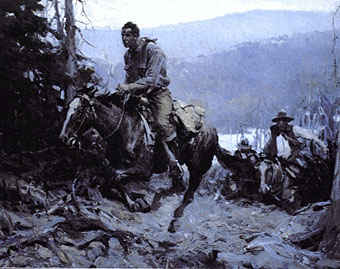
“A Charge to Keep” by W.H.D. Koerner (1916).
The Illustrated President
by Scott Horton
George W. Bush is famous for his attachment to a painting which he acquired after becoming a “born again Christian.” It’s by W.H.D. Koerner and is entitled “A Charge to Keep.” Bush was so taken by it, that he took the painting’s name for his own official autobiography. And here’s what he says about it:
I thought I would share with you a recent bit of Texas history which epitomizes our mission. When you come into my office, please take a look at the beautiful painting of a horseman determinedly charging up what appears to be a steep and rough trail. This is us. What adds complete life to the painting for me is the message of Charles Wesley that we serve One greater than ourselves.
So in Bush’s view (or perhaps I should say, faith) the key figure, with whom he personally identifies, is a missionary spreading the word of the Methodist Christianity in the American West in the late nineteenth century.
Wilhelm Heinrich Dethlef Körner (you see why he used initials, though he later Anglicized this as William Henry Dethlef Koerner) was born in Germany and immigrated to a small town in Iowa as a young tot. He made his way over time to Chicago and worked as an illustrator for the Chicago Tribune. He married Lillian Lusk, a well-know graphic artist in her own right, and moved to Battle Creek, Michigan, where he worked for Pilgrim Magazine. He and his wife scrimped and saved to finance a move to New York City. They were after more formal art training and to establish a position as artists in the heart of the publishing industry. They made it to New York in 1907, and they were very successful.
In fact, Koerner’s principal employer through the core of his career was Harper’s Magazine. Koerner published 43 feature illustrations in Harper’s, the first in 1910 and the last in 1925. You can view them here. Koerner was not exclusive to Harper’s, however, he also did important works for the Saturday Evening Post, McCall’s and Collier’s among other publications, and he did a brisk business for the book trade, again very heavily for Harpers Brothers, and he pioneered commercial illustration (Koerner did the first box artwork for C.W. Post’s Grapenuts, for instance). His serious work after 1907 focused heavily on the American West, and he clearly was one of the key “Golden Age” illustrators. His work is famous for dramatic images which for me are consonant with the age of Teddy Roosevelt—they suggest ruggedness, love for the outdoors, a strong sense of adventure and risk-taking. His paintings are packed with motion, and at times rather dramatic motion. I was not able to find much about Koerner and his sense of religion, through it is very clear that he did not engage in public displays of religious fervor and religious themes are absent entirely from his work.
So Bush’s description of “A Charge to Keep” struck me as very strange. In fact, I’d say highly improbable. Now, however, Jacob Weisberg has solved the mystery. He invested the time to track down the commission behind the art work and he gives us the full story in his forthcoming book on Bush, The Bush Tragedy:
[Bush] came to believe that the picture depicted the circuit-riders who spread Methodism across the Alleghenies in the nineteenth century. In other words, the cowboy who looked like Bush was a missionary of his own denomination.
Only that is not the title, message, or meaning of the painting. The artist, W.H.D. Koerner, executed it to illustrate a Western short story entitled “The Slipper Tongue,” published in The Saturday Evening Post in 1916. The story is about a smooth-talking horse thief who is caught, and then escapes a lynch mob in the Sand Hills of Nebraska. The illustration depicts the thief fleeing his captors. In the magazine, the illustration bears the caption: “Had His Start Been Fifteen Minutes Longer He Would Not Have Been Caught.”
So Bush’s inspiring, prosyletizing Methodist is in fact a silver-tongued horse thief fleeing from a lynch mob. It seems a fitting marker for the Bush presidency. Bush has consistently exhibited what psychologists call the “Tolstoy syndrome.” That is, he is completely convinced he knows what things are, so he shuts down all avenues of inquiry about them and disregards the information that is offered to him. This is the hallmark of a tragically bad executive. But in this case, it couldn’t be more precious. The president of the United States has identified closely with a man he sees as a mythic, heroic figure. But in fact he’s a wily criminal one step out in front of justice. It perfectly reflects Bush the man . . . and Bush the president.

From TomDispatch.com:
Revolution of the Snails
Encounters with the Zapatistas
By Rebecca Solnit
I grew up listening to vinyl records, dense spirals of information that we played at 33-1/3 revolutions per minute. The original use of the word revolution was in this sense — of something coming round or turning round, the revolution of the heavenly bodies, for example. It’s interesting to think that just as the word radical comes from the Latin word for “roots” and meant going to the root of a problem, so revolution originally means to rotate, to return, or to cycle, something those who live according to the agricultural cycles of the year know well.
Only in 1450, says my old Oxford Etymological Dictionary, does it come to mean “an instance of a great change in affairs or in some particular thing.” 1450: 42 years before Columbus sailed on his first voyage to the not-so-new world, not long after Gutenberg invented moveable type in Europe, where time itself was coming to seem less cyclical and more linear — as in the second definition of this new sense of revolution in my dictionary, “a complete overthrow of the established government in any country or state by those who were previously subject to it.”
We live in revolutionary times, but the revolution we are living through is a slow turning around from one set of beliefs and practices toward another, a turn so slow that most people fail to observe our society revolving — or rebelling. The true revolutionary needs to be as patient as a snail.
The revolution is not some sudden change that has yet to come, but the very transformative and questioning atmosphere in which all of us have lived for the past half century, since perhaps the Montgomery Bus Boycott in 1955, or the publication of Rachel Carson’s attack on the corporate-industrial-chemical complex, Silent Spring, in 1962; certainly, since the amazing events of 1989, when the peoples of Eastern Europe nonviolently liberated themselves from their Soviet-totalitarian governments; the people of South Africa undermined the white apartheid regime of that country and cleared the way for Nelson Mandela to get out of jail; or, since 1992, when the Native peoples of the Americas upended the celebration of the 500th anniversary of Columbus’s arrival in this hemisphere with a radical rewriting of history and an assertion that they are still here; or even 1994, when this radical rewriting wrote a new chapter in southern Mexico called Zapatismo.
Five years ago, the Zapatista revolution took as one of its principal symbols the snail and its spiral shell. Their revolution spirals outward and backward, away from some of the colossal mistakes of capitalism’s savage alienation, industrialism’s regimentation, and toward old ways and small things; it also spirals inward via new words and new thoughts. The astonishing force of the Zapatistas has come from their being deeply rooted in the ancient past — “we teach our children our language to keep alive our grandmothers” said one Zapatista woman — and prophetic of the half-born other world in which, as they say, many worlds are possible. They travel both ways on their spiral.
Revolutionary Landscapes
At the end of 2007, I arrived on their territory for a remarkable meeting between the Zapatista women and the world, the third of their encuentros since the 1994 launch of their revolution. Somehow, among the miracles of Zapatista words and ideas I read at a distance, I lost sight of what a revolution might look like, must look like, on the ground — until late last year when I arrived on that pale, dusty ground after a long ride in a van on winding, deeply rutted dirt roads through the forested highlands and agricultural clearings of Chiapas, Mexico. The five hours of travel from the big town of San Cristobal de las Casas through that intricate landscape took us past countless small cornfields on slopes, wooden houses, thatched pigsties and henhouses, gaunt horses, a town or two, more forest, and then more forest, even a waterfall.
Everything was green except the dry cornstalks, a lush green in which December flowers grew. There were tree-sized versions of what looked like the common, roadside, yellow black-eyed susans of the American west and a palm-sized, lavender-pink flower on equally tall, airily branching stalks whose breathtaking beauty seemed to come from equal parts vitality, vulnerability, and bravura — a little like the women I listened to for the next few days.
The van stopped at the junction that led to the center of the community of La Garrucha. There, we checked in with men with bandannas covering the lower halves of their faces, who sent us on to a field of tents further uphill. The big sign behind them read, “You are in Territory of Zapatistas in Rebellion. Here the People Govern and the Government Obeys.” Next to it, another sign addressed the political prisoners from last year’s remarkable uprising in Oaxaca in which, for four months, the inhabitants held the city and airwaves and kept the government out. It concluded, “You are not alone. You are with us. EZLN.”

The New York Times January 24, 2008
THEATER REVIEW | ‘DEEP TRANCE BEHAVIOR IN POTATOLAND’
No Map Needed for Reality-Altering Trip
By BEN BRANTLEY
Looking for the travel agent of your dreams, someone to fly you out of the muddy rut of midwinter monotony? Allow me to suggest Richard Foreman, a man whose slogan, spelled out in a ravishing new show called “Deep Trance Behavior in Potatoland,” gets right to the point: “Go to other places.” And, boy, does he make sure that you do.
Mr. Foreman is celebrating his 40th anniversary this year as the creative force that is the Ontological-Hysteric Theater, one of the most enduringly fertile bastions of the New York avant-garde. As befits a man who came of artistic age in the 1960s, his goal has always been to take people on mind trips, the kind hymned by the Beatles in “Magical Mystery Tour” and the Who in “Amazing Journey.”
Yet there’s nothing quaint or retrodecadent about Mr. Foreman’s phantasmagorical work, which is as disciplined as a Balanchine ballet. As is made clear by “Deep Trance Behavior,” which runs through April 13 at the tiny theater at St. Mark’s Church in the East Village, Mr. Foreman has distilled what’s noblest in the impulse that four decades ago propelled a generation to turn on, tune in and drop out.
While Mr. Foreman, 70, still shares that youthful urge to open new doors of perception — both philosophical and sensory — he has devised a purely nonpharmaceutical and increasingly sophisticated means for achieving his goal. “Deep Trance Behavior” portrays vaguely vampirish people regularly placing pills on their tongues with medical precision. But the true reality-altering tool here is nothing more nor less than the show itself.
Some of Mr. Foreman’s methods of disorientation have changed in recent years. He continues to create his singular fun-house sets, a metaphysical pack rat’s rooms of words and images that can never be taken in with a single glance. (“Deep Trance” motifs include pianos, funeral urns and Victorian photographs of mediums summoning ectoplasmic spirits.)
As always there is a core of robotic young performers in clothes that appear to be plucked from an era-scrambling time machine. And, oh yes, Potatoland? That’s been part of Mr. Foreman’s imaginary geography at least since the 1970s.
But in the past several years he has added digital film sequences to the mix, projecting flat, luminous scenes of actors in moody tableaus that both echo and contradict what’s happening onstage. For “Deep Trance” he has visited two locations, in Japan and England, and shaped the play as a sort of travelogue, filled with gnomic advice and dicta. These are either spoken — by the filmed or live performers, or by a sepulchral, amplified voice that belongs to Mr. Foreman — or projected in titles on-screen.
Here are a few of the more memorable tips: “Only being a tourist can one experience a place.” And conversely: “The visitor is always dead amidst the excitement of the experience.” And: “Do not forget those who travel to a place from which there is no return.”
Interpret these aphorisms and admonitions as you like; their meanings seem to change each time they’re repeated anyway. But there’s one declaration that is unconditionally clear, at least by Foreman standards, “No relationship exists between what happens onstage and what is happening on the illuminated screen, except — suddenly — click — and a profound relationship does now exist.”
He’s right, you know. That is what happens, as the lights — on the stage — behind the screen and even in the audience — keep shifting to force you to readjust your focus. The process is matched aurally by the melting collage of songs and speech in an assortment of languages that plays throughout.
Mr. Foreman’s goal is to make boundaries bleed, to “erase the frame,” as the voice instructs the audience. And not just among different cultures, but also between different periods and different levels of thought — even, as those séance photographs suggest, between the living and the dead. “Deep Trance” is, like most Foreman productions, just more than an hour long, and seems to occur out of time.
The five members of the live ensemble — all sultry young women except for Joel Israel, who sports a pinstriped suit and blood-sucking fangs — could have been summoned from the past or the future. The same might be said of the somnambulistic English and Japanese people on screen, who have been arranged into poses in stark corridors and sometimes bring to mind the elegant, cryptic souls of the vintage-voguish French film “Last Year at Marienbad.”
The filmed performers are given to ending their utterances (phrases like “mental activity, plus nobody home”) with the words, “knock, knock.” And the implicit plea in repeated words most often heard as the beginning of a joke sums up what Mr. Foreman has always asked of his audiences: to open up their senses to admit a change-stirring wind.
At one point Mr. Foreman’s voice is heard saying, “Do not dismiss, please, the possibility that very soon one evening in this series of evenings, it may happen that a single individual present at this very performance may, he or she, lock into the evening’s fluctuations.”
That hope is what has kept Mr. Foreman’s art so vital, and it is not misplaced. Even the most stolid theatergoers are unlikely to visit Potatoland without being transported, at least fleetingly, to a place that was always within them, even if they never knew it was on the map.
DEEP TRANCE BEHAVIOR IN POTATOLAND
Written, directed and designed by Richard Foreman; sound by Mr. Foreman; technical director, Peter Ksander; stage manager, Brendan Regimbal. Presented by the Richard Foreman Theater Machine and the Ontological-Hysteric Theater, Mr. Foreman, artistic director; Shannon Sindelar, managing director. At the Ontological-Hysteric Theater at St. Mark’s Church, 131 East 10th Street, East Village; (212) 420-1916. Through April 13. Running time: 1 hour 10 minutes.
WITH: Joel Israel (Man in Striped Suit), Caitlin McDonough-Thayer (Girl in Sailor Hat), Fulya Peker (Girl With Black Hair), Caitlin Rucker (Girl With the Golden Dress) and Sarah Dahlen (Girl With the Tiara); and the taped voices of Richard Foreman, Kate Manheim and André Malraux.
Brothers in Need: An update on the campaign to aid the Kenyan members of EXTRA GOLDEN
by Extra Golden’s Alex Minoff and Ian Eagleson
It’s Medicinal!: The Hand-Sewn Power Of Little Wings
by TRINIE DALTON
 Arthur Magazine