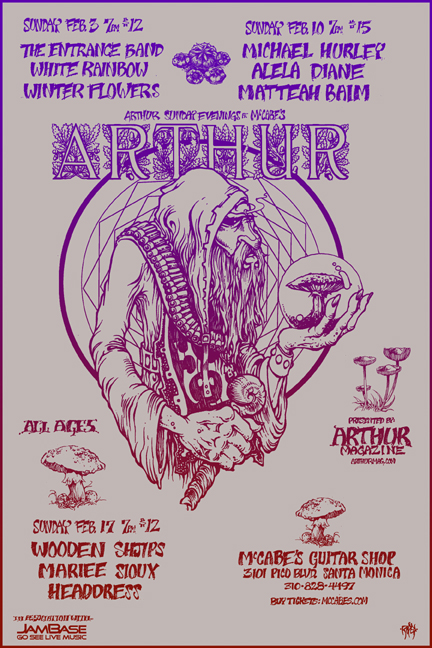
WOODEN SHJIPS, MARIEE SIOUX and HEADDRESS at Arthur Sunday Evenings at McCabe's tonight (Feb 17)

arthursundayevenings.jpg

Please join Arthur Magazine tonight as we conclude our Arthur Sunday Evenings series of music at the 50-years-old-and-growing-strong McCabe’s Guitar Shop in Santa Monica.

McCabe’s is all-ages, and doesn’t sell adult-designated beverages, so bring the whole family, bring your own flask and so on. Coffee, tea, bottled water, soft drinks and home-baked cookies will be available for reasonable prices. There will be two intermissions, and there are ins and outs all night so you can go outside to use your cel, or perhaps have an invigorating smoke.

McCabe’s holds 150; we’ll have 75 seats out for those who prefer to sit rather than dance or sway or lay down. Here’s the info:

Sunday, Feb 17, 7pm – $12 – call McCabe’s at 310-828-4497 to buy a ticket

WOODEN SHJIPS
Blissed longhairs from the Bay Area working the eternal vein that runs from “Electric Music for the Mind and Body”/”Section 43”-era Country Joe and the Fish to Butterfield Blues Band’s “East-West” to Jefferson Airplane to Quicksilver Messenger Service to the Doors to Suicide to Les Rallizes Denudes to Spacemen 3. As guitarist-vocalist Ripley Johnson acknowledges, “It’s been done already, by the Velvets most famously. This is just our take on it. It just feels so right: repetition, drone, simplicity — that is life, the sound of the nervous system, the sound of the universe.”

MARIEE SIOUX
Cascading river-of-consciousness folksongs from the young Nevada City nature-songstress

HEADDRESS
Texan nomad fellas on a dark, lonesome, reverb-soaked high — think the Stones’ “Wild Horses” in super-slow-mo and you’re getting there

Hot tips from McCabe’s on how to park for free near the shop:
http://www.mccabes.com/parking.html

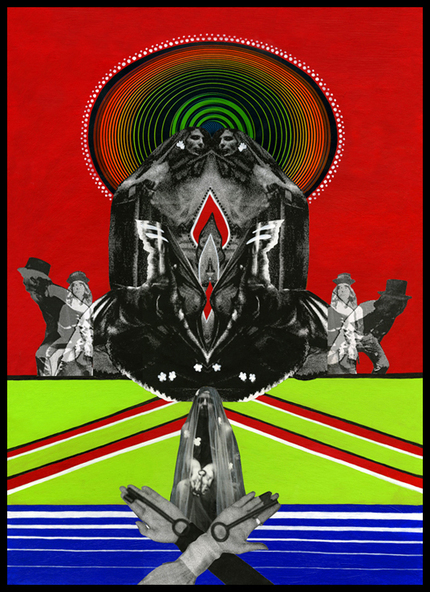
Arthur Sunday Evenings poster by ARIK ROPER


Albert Ayler visitation report

posted February 12, 2008 – The Nation (web only)

An Ayler in My House
Nick Stillman

On October 28, 2007, I ate my first pot brownie. A friend and I had huddled around a television set awaiting Game Four of the World Series, which would end up being the final contest of our hometown team’s romp through the playoffs. Having attended a college where fraternities are banned, we touted the evening as a kind of intentionally underwhelming, last-chance frat party. Both of us were heavily into free-jazz saxophonist Albert Ayler at the time; while waiting in suspense for the notoriously gradual effect of the brownies to kick in, we cranked Live in Greenwich Village, Ayler at his imperious best. Anyone who’s sampled a “special brownie” knows the rest of the story. As for the game, I remember almost nothing, except this: I was visited by the ghost of Albert Ayler.

About ten minutes before the first pitch my friend and I were in the clutches of the brownie–digging Ayler’s violent squawks and celebratory cadences, oblivious to Fox’s pregame histrionics on the muted TV screen. As a country singer approached a microphone near home plate to sing the national anthem, our jaws slackened as Ayler’s sax purred the plaintive opening notes of “Spirits Rejoice,” which quickly becomes a tight, triumphant military-style march before disintegrating into crushing trumpet bleats by Albert’s brother Don. On the silent screen gigantic flags were unfurled, pyrotechnics exploded, a military flyover happened and Americans rejoiced while Ayler’s band evoked twin towers of war–pageantry and battle–masterfully, if psychotically. The highly constructed, frankly vulgar pregame spectacle we were seeing was so incommensurable with the disarming, empowering and terrifying music we were hearing that it was as if the late Ayler himself had graced my civilization, determined to show me something.

My interest in Ayler was stoked by listening to an even more obscure group of free-jazz players: the Art Ensemble of Chicago. Contemporaries of Ayler, the Ensemble protested both America’s war in Vietnam and ignorance of a legitimate free-jazz revolution within its borders. (On their great album A Jackson in Your House, they openly mock the American military and white America’s fear of blacks.) In 1969 the group embarked on an extended residency in Paris with a team of players (including Ayler’s frequent drummer, Sunny Murray), who would record a torrent of now-legendary obscurities for the French label Actuel. The European subculture the musicians found themselves in embraced their new brand of music–one made with gongs, toys, noise guitar, non-instruments, silence, grunting, preaching, singing and chanting, as well as the more conventional saxophone, trumpet, bass and drums.

Initially, I assumed Ayler’s enigmatic music, like the firebrand Art Ensemble’s, could be interpreted as political satire. By 1966 Ayler had begun to weave simple melodies through the hard-core modal chaos that had become his trademark. Trying to explain the new direction in his brother’s composition, Don said at the time, “The thing about New Orleans jazz is the feeling it communicated; that something was about to happen, and it was going to be good.” These sing-songy passages echo the celebratory marches of early New Orleans jazz and grandiose patriotic standards. Ayler’s music from this period is a conflation of celebration and punishment. The difference between exultation and torture dissolves. Paranoia is part of the listening experience. Ayler’s celebratory moments–and many of them are achingly beautiful–become a tease, a false respite from an impending onslaught of horn, string and drum wrangling. Despite comments made by Ayler during his lifetime that his music was “not a protest,” I assumed that the stylistic schizophrenia of this period was a powerfully satirical metaphor for America at a loss, a nation enmeshed in a miserable war abroad and failing to deal with different stages of domestic status quo upheaval in regard to race and gender equity, sexuality and drug use.

After seeing the new film My Name Is Albert Ayler, by Swedish director Kasper Collin–which features the only known footage of Ayler–I found myself checking all these assumptions, and I’ve since come to realize it’s impossible to consider Ayler’s music to be even the slightest bit sarcastic or insincere. Audio from interviews with Ayler between 1963 and his death in 1970 is the backbone of the film–and why not, since Ayler is eminently quotable, uttering such pronouncements as “My imagination is beyond the civilization in which we live; I believe that I’m the prophet.” (Murray insists Ayler’s cosmic philosopher-speak accounted for his success with women.) But he also talks easily, freely and without a trace of negativity while the film documents his grinding poverty. Born into a working-class family in Cleveland, Ayler was forced to drop out of college and join the Army because, as he puts it, “funds weren’t strong enough.” Michael Sampson, the violinist in Ayler’s band, describes the conditions in New York as “dire poverty.” Ayler’s friend and staunch champion John Coltrane lent him and his brother cash so they could eat. The majority of the band being black, they were forced to stay in what Sampson called “ratholes” on the road. Don had become mentally unstable by 1966 and eventually suffered a nervous breakdown. In other words, while Ayler was revolutionizing music (and his commentary in the film demonstrates that he knew it, or at least felt it to be true), there was plenty to be negative about.

Ayler was prodigiously, if cultishly, spiritual. According to his commentary–and it’s hard to disbelieve it when you hear it–his music had one grand theme: universal harmony. And yet for such a message to be effectual people had to hear it, feel it and–ideally–like it. In the film he says, “The people must listen to this because they will be hearing it all the time.” The people weren’t ready. In 1967 Ayler published a dense, difficult, mystical-religious essay in Amiri Baraka’s magazine The Cricket. Photos of Ayler in 1968 show him pointing his horn skyward in Brooklyn’s Prospect Park, gazing at the sun. It was rumored that he had become involved in a mystical Egyptian ritual of staring at the sun; he reportedly told the photographer that he was prepared to go blind. In 1970 Ayler’s body was found floating in the East River. The circumstances of his death remain cloudy. What is clear, though, is that Ayler played music that exuded desire. Exactly what that desire entailed is probably incommunicable through language (and possibly a factor in his early death). It’s obvious in his tone: its glossy raggedness and disarming shifts in timing, volume and intensity. Ayler’s best music takes that iconic phrase of the civil rights movement, “I am a man,” and flips it into “I am human.” For Ayler, spiritual unity meant eschewing ugliness and negativity. Is this what Ayler’s ghost tried to show me on October 28? I’ll never know, but this I’m certain of–it’s plainly obvious what Sunny Murray means in My Name Is Albert Ayler when he cites the difference between Ayler and everyone else: “Albert played it with love.”


LAist's February, 2008 interview with Arthur editor Jay Babcock

From LAist.com:

LAist Interview: Jay Babcock from Arthur Magazine
by Nikki Bazar

Whether it’s free bands by the river, obscure films at the Silent Movie Theatre or music festivals featuring great non-mainstream bands, Arthur magazine has improved L.A.’s sullied corporate reputation by organizing eclectic, margin-friendly events that embody the magazine’s mission to represent “transgenerational counterculture.” Case in point: Arthur’s Sunday Evenings series at McCabe’s Guitar Shop in Santa Monica, which continues this weekend with eccentric songwriter Michael Hurley and next Sunday evening with psych-rock band Wooden Shjips. On Feb. 13, the magazine also presents a launch of Abby Banks’ new book Punk House at Family on Fairfax. The book features photos of punk houses from across the country ⎯ a few of which are reprinted in this month’s issue of Arthur. We asked Jay Babcock, guru of Arthur magazine, a few questions about the upcoming shows. Continue on to read more about the dire state of L.A.’s all-ages scene, the mysterious absence of our rock ‘n’ roll elders, and the fall and rise of Arthur magazine.

Q: Tell me about the bands you’ve chosen for this series.

Michael Hurley is a legendary folk nomad, one of America’s great weird individuals, who’s been around the block many times. His newest record is on Devendra Banhart’s record label. Alela Diane is another one of these amazing musicians coming out of Nevada City. The Rough Trade record shop in Europe said her album was the best of the year, and they had a point. Matteah Baim put out a really good record last year, a dark folk sound, ice-ghost sort of thing, headed toward Nico’s stuff. On the 17th is Wooden Shjips, a psychedelic raga band from San Francisco; Mariee Sioux from Nevada City; and Headdress ⎯ also wandering nomads who sound like an even darker, slightly more country Brightblack Morning Light. But with several of these artists, I’ve never seen ’em, so there’s a bit of mystery there for me just as there probably will be for most of the audience. Which is part of the fun.

Q: It’s good to see some decent bands on the Westside. How did you land on McCabe’s as the venue?

Jared Flamm at Everloving encouraged me to get in touch with Lincoln Myerson at McCabe’s, who’d told me a while back that McCabe’s and Arthur might be a good match. McCabe’s have been around for 50 years and haven’t used an outside booker/curator since the early mid-‘90s. Lincoln let us book whoever we wanted to do whatever they wanted musically ⎯ within reason, of course. So, the size of the venue dictates a lot of things, like how much money you can offer your talent, and we had to think about who we could afford to put in there and keep the door price low, and also who was available. Given those parameters, the goal was to put individual line-ups together who would form an interesting evening and also attract a mixed-generation audience. I really wanted to work with McCabe’s because it’s very simple ⎯ it’s about music, it’s not about alcohol sales. Also, it’s an all-ages venue. Ever since we did Arthur Ball at the Echoplex, which was 18 and over, I’ve been insistent that we only do all-ages shows, because I don’t think anyone should be excluded from good music. Also, I wanted a transgenerational group of artists. We call Arthur a “transgenerational counterculture magazine,” and we mean it. There is a coherent counterculture that runs from the beats to the hippies to the punks, forward. They have more in common with each other than they do with the mainstream culture. In any of our festivals we do, we try to include older artists as well as younger ones. It’s truly “all ages” onstage, and we’d like to see that more in the audience. There’s so many great artists that live here in Los Angeles ⎯ Tom Petty, Joni Mitchell, John Fogerty, Ray Manzarek, Dylan lives here sometimes ⎯ and you never, ever see them at shows. I assume they don’t participate in the local culture because they got burned one too many times with overhyped crap, or it’s just too much of a hassle to be out in public. Or maybe they just don’t have any interest and they’d rather roll one more at home and listen to Jim Ladd rhapsodize about the past rather than get out there and do something. But they should. ‘Think cosmically, act locally’ is a great credo, you know? You live here? Then BE here. A lot of cool stuff becomes possible when you mix the energy of the youth and the wisdom of the older folks: think of Allen Ginsberg’s continuing, lifelong interest in the best young artists ⎯ his advocacy for them ⎯ whether it was the blues guys or jazz players or the hippies or the punks, it was all the same to him. McCabe’s has such a great history, and is a venue a lot of those people have played at, and it’s so pure in its only interest being music (as opposed to alcohol sales) that I’m hoping some people older than 50 see what’s going on, something that may have more of a spiritual, political or aesthetic resonance with them than they may at first think.

Q: Arthur shut down for a spell in early 2007, then resurfaced with a redesign. Do you care to talk about what happened?

My partner for many years was looking to not be the publisher anymore and eventually, he didn’t want to own it either, so he wanted me to buy him out which I couldn’t afford to do. That’s when the magazine died. Then we made an arrangement that allowed me to gain 100 percent of the magazine. We’d already planned the transition to Mark Frohman and Molly Frances as the new art directors before the whole thing went down, so that’s just a coincidence. After I got full control of the magazine, we decided to go all color and go for it. We’re just continuing to do what we’ve been doing for five years. And there’s always new blood coming in. Next issue, [author] Erik Davis is going to start doing a column for us and there will be a lot of other surprises. So basically, I just took on more credit card debt and a lot of people loaned me money and we were able to go forward.

Q: What sort of things do you hope to do with the magazine that you just aren’t able to right now?

Well, it’d be nice for everyone to get paid what they deserve. We work from our homes in Atwater, we have tea at India Sweets & Spices or lunch at Tacos Villa Corona or Viet’s new noodle place, we sit by the river for inspiration and excitement … It’s not the toughest life. But as a business? We’re making a go of it, but we do want to be monthly and we want to have more pages. There’s so much good stuff to cover. The rest of the media is collapsing and there’s a lot of really good writers, photographers and cartoonists who deserve a wider audience and no one’s giving it to them for some reason. So the main pressure on us is to jam as much stuff into the magazine as possible without making it an aesthetic mess. If we had more pages, it could breathe a little bit more and we could cover a lot more of the good stuff that’s going on.

Q: And you obviously have a love for print.

The free magazine model is a really solid one, and it’s working, and it’s gonna work better in 2008 for us. Print is near-perfect. It’s portable, it doesn’t require batteries, you don’t have to squint, it’s a bigger window, you can do more design things than you can on a computer screen and it gets out there in front of people who aren’t looking for it necessarily. With the web, mostly what you get are people who are already looking for you. And of course, you can read a magazine by the river. Try looking at a website there.

Q: Is it your mission to book a lot of smaller acts that you don’t see as much in some of the bigger 21-and-over venues?

For a city this big, it’s absurd there aren’t more places where people of all ages can get together and hear something other than mainstream arena pop and rock with good quality sound in a comfortable setting. The only real venue in this city where people of all ages can gather together to hear music at a low price with good sound in a comfortable setting at a reasonable hour is Amoeba. You’re in a bad situation as a culture when you’re dependent on a store ⎯ a place of commerce ⎯ for the presentation of music to the public. We’ve written about this in Arthur in our all-ages series. You know, if you’re into music, bars are not the ideal venues. You don’t want to hear other people talking or the cash register ringing or bottles being dropped in a garbage pail. You don’t want to be hanging out with a bunch of amateur drunks. That has a place, but not all music is right for that. There just should be a greater range of venues. It’s also bad for the bands. You can’t build a career by getting one chance to intrigue the hipsters. And if we can help raise the profile of some of these artists by putting our brand name on it, then good. It’s very hard for artists to break in because everything is so calcified on radio and in venues.

Q: Arthur is developing a real presence in the L.A. music scene.

We’re working with people at a very local level who are in it for the right reasons ⎯ the folks at Family and at McCabe’s and The Cinefamily, it’s all labor of love stuff. We like labor of lovers, basically. Doesn’t really matter what it is they love. It’s the loving that is important. Those are our people, those are the people we want to hang out with in such grim times. We’re just trying to use whatever profile or heft we may have to hopefully help other people do what they love too.

Arthur presents PUNK HOUSE with ethnographic photographer Abby Banks and Foot Village at FAMILY this Wednesday

February 13, Wednesday 7:30pm. Free.

“In Punk House. Abby Banks photographs anarchist warehouses, tree houses, workshops, artists’ studios, self-sufficient farms, hobo squats, community centers, basement bike shops, speakeasies, and all varieties of communal living spaces. Over 300 images of fifty houses in twenty-five cities in the US. With an introduction by Thurston Moore.

“Abby will be giving a DVD presentation and Foot Village will perform live.”

FAMILY
www.familylosangeles.com
436 N. Fairfax Ave. Los Angeles, CA 90036 USA
323.782.9221 / Open Noon to 9pm Daily


First 2008 nomination for 60s-70s folk hero revival. Carl Ogelsby has the best tunes and most relevant/vital dialogue…

https://i0.wp.com/www.simonsays.com/assets/isbn/1416547363/BC_1416547363.jpg

The Time of Their Lives
– Elsa Dixler, NY Times 2-10-08

Campaigning against a president who refused to respond to the growing opposition to a cruel, dishonest war, the charismatic young candidate insisted: “What we need in the United States is not division.  What we need in the United States is not hatred. What we need in the United States is … love and wisdom and compassion toward one another.” That wasn’t last week — it was April 1968, and two months later Robert Kennedy was dead. Opposition to the war continued and
broadened after the election of Richard Nixon that fall, but one of the engines of the antiwar movement, Students for
a Democratic Society, largely disbanded after a split in 1969; the next year its leaders, gripped by revolutionary fantasies, went underground.

Among the casualties of S.D.S.’s implosion was a former president, Carl Oglesby, who was pushed out of the organization in 1969, accused of being a “hopeless bourgeois liberal” and possibly a government agent. In “Ravens in the Storm,”
Oglesby not only tells his own amazing story, but also provides an interesting angle on the contested history of S.D.S.

When he became president of the organization in June 1965, Oglesby (whom I knew slightly some years after the period covered in his book) was neither a student nor especially young. Born in 1935, he was the first in his family to hold a white-collar job. His father and mother had fled to Akron, Ohio, from Southern rural poverty, and Oglesby left his parents’ life far behind. He dropped out of Kent State to try his luck as an actor in New York but returned to school determined to become a playwright. Oglesby’s theatrical training served him well; in his memoir he says several times that it prepared him to be a public speaker.

Oglesby hung out with Kent State’s beatniks and immersed himself in poetry and jazz. After he married and became a father, he needed more money than he could make working part time at a pizzeria. He became a technical editor in Akron and later was hired by the Bendix Corporation’s Systems Division. By 1963 he was the supervisor of a 90-person technical editing section, while the company allowed him time to finish his B.A. at the University of Michigan. Oglesby and his wife, Beth, who by then had three children, settled on Ann Arbor’s appropriately named Sunnyside Street.

But Oglesby did not keep on the Sunnyside. Invited to write a research paper about the expanding American commitment in Vietnam for a Democratic candidate for Congress in 1964, Oglesby concluded that immediate disengagement was the only solution; the candidate was horrified. The publication of the position paper in the university’s literary magazine alongside one of Oglesby’s plays led to a visit from a graduate student who thought Oglesby belonged in S.D.S.

The organization, which by 1965 had 2,000 members, seems to have made a major effort to recruit Oglesby; he met its current president, Paul Potter, and its past presidents Tom Hayden and Todd Gitlin. Eventually he left Bendix and became S.D.S.’s director of research,information and publications. Then in June 1965, Oglesby was elected president. Pretty wild for a nearly 30-year-old father of three who only a few months earlier had worked for a defense contractor and held an F.B.I. secret clearance.

Oglesby presided over S.D.S. at a time of incredibly rapid expansion. He traveled around the country speaking against the war, and to South Vietnam. At an antiwar march on Washington in November 1965, he denounced what was coming to be known as corporate liberalism. Appealing to “humanist liberals,” he urged: “Help us build. Help us shape the future in the name of plain human hope.” Oglesby was an inspiring speaker, appealing to a broad audience in the name of “democracy and the vision that wise and brave men saw in the time of our own Revolution.”

But that was not the direction in which S.D.S., which by 1968 had approximately 100,000 members (and many more sympathetic nonmembers), was moving. More and more there was pressure not to end the war but to “bring the war home.” Oglesby’s belief that S.D.S. “could become a builder of the radical center” and “a serious force on the political scene” came into conflict with the organization’s increasingly confrontational style. Oglesby reproduces a series of conversations — based, he says, on his recollections and contemporary notes — with Bernardine Dohrn, who became an S.D.S. national secretary in 1968 and later a leader of the Weathermen. These dialogues are presumably meant to show the difference between Oglesby’s realism and decency and Dohrn’s melodramatic arrogance, but in them she often seems to get the better of Oglesby. Her main point is that she is a revolutionary and he is a mere liberal. Her politics were deluded and self-indulgent, but it is hard not to conclude that she had a point. As a “centrist libertarian,” Oglesby seemed determined to embark on causes — like a relationship with the director of an international consulting firm that may well have been a C.I.A.front — that seem odd and diversionary. His continual circling back to his arguments with Dohrn gives the book something of the stuck feel of a complaint from a still-bitter former spouse.

“Ravens in the Storm” is most interesting as the story of a life transformed. The author insists that it is memoir, not history, and he is right. The book ends in 1970 with Oglesby driven out of S.D.S. and demoralized, and he does not push beyond his point of view at that time to present his current thinking about S.D.S. (does he still see things the way he
did in 1969?) or the new student organization that has revived its name. Nor does he discuss current politics or let us know what he has been doing in the intervening decades.


It might be argued that the movements of the 1960s were far more successful culturally than they were politically… Shortly before he was forced out of S.D.S., Oglesby’s wife urged him to leave the organization. “You could go back to school, try to get another teaching job,” she suggests. “You could write another play … hang out with our kids.” But Oglesby continues to try to convince his comrades that it is possible to maintain a nonviolent opposition to the war and remain “a significant force in American education.” Unfortunately — for Carl Oglesby and for the American left — it wasn’t.


Another take on this period comes from “Students for a Democratic Society: A Graphic History” (Hill & Wang, $22). Written by Harvey Pekar, drawn by Gary Dumm and edited by Paul Buhle,who was the founding editor of the journal Radical America (and whom I also knew slightly), the book contains a history of S.D.S. by Pekar and illustrated recollections by a range of former S.D.S. members. I found the personal stories frustratingly brief and uneven, and wasn’t sure what the graphics added to most of them, but I’m not the target audience. The book should serve as an introduction to S.D.S. for curious students who aren’t committed enough for Kirkpatrick Sale’s 750-page version.

After leaving Pete Seeger’s Weavermen, singer/guitar player Carl Oglesby embarked on his own solo career, recording two albums for Vanguard (1969-1971), both works, here available on this single CD, are characterized by a psychedelic folk rock sound. Features some of the era’s most talented sidemen – Vinnie Bell, David Spinozza, Joe Meck, and John Frangipane. Both albums are considered lost jewels of the Vanguard collection. Cardboard gatefold sleeve. Universe. 2003.

(Note:  Nat Hentoff suggested Carl Ogelsby to Vanguard!!!  – SK)

Powered by ScribeFire.

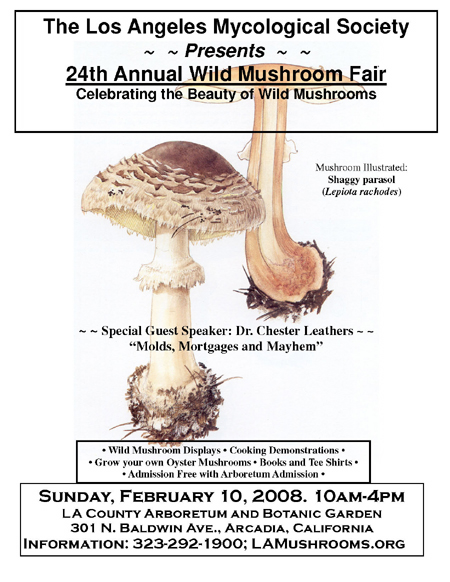
TODAY: 24th Annual Los Angeles Wild Mushroom Fair

lams_fairposter_2008.jpg

24th Annual Wild Mushroom Fair
Celebrating the Beauty of Wild Mushrooms

Keynote Speaker: Dr. Chester R. Leathers on “Mold, Mortgages and Mayhem”

Mushroom Cooking demonstration

Mushroom Cultivation demonstration

We will have experts on hand to identify any mushrooms you bring in.

Sunday, February 10, 2008. 10AM-4PM
Los Angeles County Arboretum and Botanic Garden
301 N. Baldwin Ave.
Arcadia, CA 91007

More info: http://www.lamushrooms.org/fair-2008.html