
poster by JOSEPH REMNANT

Hey dudes,
Last week, I talked by telephone to an LATimes journalist named August Brown about why Arthur Magazine had left L.A. for New York.
This was a long conversation. I now regret that I did not set a pre-condition for this interview: I should have insisted on seeing the quotations he was planning to run in his story, to check their accuracy, especially as he was not audiotape recording the conversation — an interview situation, I’ve learned from being a journalist and editor, that virtually ensures significant errors of omission and misrepresentation.
Next time, I will be much more careful. I am now readying a formal demand to the Times for a retraction of the article and a public apology. In the meantime, I want to try to clear the air, as best I can.
Arthur is not a hipster lifestyle publication. It’s an all ages counterculture mag about ideas, and manifestations of those ideas. And counterculture isn’t just in a single place or city or scene or neighborhood anymore — it’s all over the country, all over the world. It’s distributed, a beautiful constellation of enclaves and loners.
Arthur-as-a-magazine aims to serve those folks, wherever they are.
But Arthur-as-a-magazine is made possible by Arthur-as-a-business. Since, somewhat unfortunately, I own 100 percent of Arthur, and I carry all of its debt, I have to do what’s best for the business, and what seems best for me, personally.
At the most basic level, that means that I have to locate myself in the best possible place I can find for Arthur-as-a-business to grow so that Arthur-as-a-magazine can continue to publish.
For better or worse, the fact is that if you’re doing national magazine publishing, you’ve got a far higher chance of making it work as-a-business if you are based in NYC, where you can do the highest number of significant business meetings in the shortest amount of time. It’s not the ONLY place you can do this, of course, but it’s certainly the cheapest — I can get anywhere I need to go for $2 in NYC. And I gotta do that, cuz Arthur has never been big enough for the businesspeople-with-money to come to us–we have to go to them! And almost all of them are in NYC, or travel through it regularly.
So, I figured I would have a better chance of getting Arthur-as-a-business to be self-sustaining, as well as the magazine remaining autonomous and independent and on-target, if I were to be in NYC. The environment here is more hospitable for Arthur-as-a-business. And it has other things that I enjoy, on a personal level, like great pizza and lotsa creative folks and so on. So, here I am, and here we are.
That said!!!! Lemme just say I’m really gonna miss A LOT that is going on in L.A. So I wanna SALUTE organizations, nay INSTITUTIONS, like BEYOND BAROQUE in Venice, the LA CONSERVANCY people who are trying to save the good stuff, the wonderful FAMILY store on Fairfax, the absolutely world-class CINEFAMILY operation on Fairfax, MCCABE’S GUITAR SHOP in Santa Monica (50 years old!), the ELF CAFE in Echo Park, the ZIGGURAT THEATer people, all the wonderful vendors at the local farmers’ markets, FRIENDS OF THE L.A. RIVER, the weekly DUBCLUB (a real accomplishment!), the DUBLAB crew of sweethearts, Chris Ziegler and the L.A. RECORD gang, the valiant folks of SOUTH CENTRAL FARMERS (still going!), the FARMLAB organization, Flea’s SILVERLAKE MUSIC CONSERVANCY, Calarts and REDCAT, the UCLA Live people, whoever’s booking those great shows at the Hollywood Bowl and the Disney Hall, FRITZ HAEG and his visionary projects (although I’m not sure Fritz is really around much anymore), Machine Project (most exciting art space in L.A.), TIM DUNDON (the guru of doo-doo!) in Pasadena, NEW IMAGE ART, Wendy and OOGA BOOGA, VAMP SHOES, MATRUSHKA, the NEW ENERGY folks, ECHO PARK FILM CENTER, John Wyatt’s CINESPIA project, HOPE GALLERY, the nice people at ANTI/Epitaph, SOUTHERN LORD and EVERLOVING and BOMP/ALIVE and IN THE RED independent record labels, great independently owned and operated shops like the PULL MY DAISY (R.I.P. Bingo!) boutique in Silver Lake, PANTY RAID and FLOUNCE in Echo Park, the eternal CAFE TROPICAL in Silver Lake, the upstart INTELLIGENTSIA in Silver Lake, AMOEBA Music, MELTDOWN in Hollywood, DON’S RECORDS in Eagle Rock…
And then there’s Mr. T’s Bowl, THE NUART and NEW BEVERLY and the AMERICAN CINEMATHEQUE and films at MOMA, the Herbst brothers’ projects, whatever Kristine McKenna is up to, THE SMELL of course, SELF-HELP GRAPHICS in East L.A., the L.A. FREE CLINIC folks, the LEGAL AID people, the way-ahead-of-the-game BIKE KITCHEN and BIKE OVEN groups, the gigantic dutch oven apple pancakes at DINAH’S on Sepulveda, TITO’S TACOS, the $1 masala chai tea at INDIA SWEETS AND SPICES in Atwater, TACOS VILLA CORONA, the people of the canyons, all the ATWATER PAGANS and experimental chefs, CINEFILE and VIDEO JOURNEYS, Joe McGraw’s wild bar and wilder hair, the courageous people at SPACELAND PRODUCTIONS who produced three adventurous festivals with Arthur, whatever mischief Don Bolles and Nora Keyes are cooking up somewhere, Scott Sterling at the Fold who took so many risks, the overburdened and underpaid TEACHERS of L.A. Unified, the volunteers who keep AMIR’S GARDEN going in Griffith Park, all the lawyers doing PRO BONO work, the possibly revolutionary ECHO PARK TIME BANK, the independent merchants going for it on their own all over town…
I am TOTALLY gonna miss IN-N-OUT, esp the weird one in Glendale. And the GLENDALE NARROWS area of the L.A. RIVER. And Chuck Taggart’s GUMBO show on KCSN. (Thanks too to Chuck P. on Indie and Barry Smolin at KPFK for always looking our for local artists.) And MAN ONE’s crew of beautiful, inspiring graffiti artists. And PHILIPS BBQ off Crenshaw. Doing C-shots at VIET SOY. The pizza at FLORE. And all the great THAI FOOD… the amazing scene that is TOMMY’S on Temple, the Farmers Market downtown, the CARACOL herbal garden in East L.A. ELYSIAN PARK. The 2 FREEWAY. Jerome and the gang at BRAND BOOKS. The good folks of SKYLIGHT. And so many more!!!! All the great underheard bands and ignored poets and out-of-work journalists and artists and scholars and photographers and filmmakers and cartoonists and playwrights and actors and editors and gardeners and designers and botanists and scientists and teachers and historians and clothes designers, and union organizers, and all the life-lovers, all the amazing craftspeople, autonomous/independent individuals all, faced (like all such folks on this planet) with ever-worsening survival odds because of encroaching corporatization/homogenization…
So much good stuff survives, in spite of everything else that’s horrible about L.A.: the drive-you-nuts traffic and the increasing atomization that results, the fucked up health care system (MLK hospital, full-up ER rooms everywhere, etc), the closing of bookstores everywhere (ACRES OF BOOKS, RIP; DUTTON’S, RIP; etc), the dumbing down of schools (yes I know it’s national), the tasteless and foolish overdevelopment (RICK CARUSO’s Grove and Americana malls are abominations), soul-killing ads and billboards for endless crap that this city’s mind-destroying ‘entertainment industry’ churns out, lack of GOOD parks for everyone, oblivious rich people, petty Councilpeople and Supervisors (esp Gloria Molina for going after muralists and taco trucks!), cruel bureaucrats, dumb celebrities and people who care about them, bonehead street gangs killing people over stupid shit, bad policing, the unwillingness to deal with the inevitability of the next earthquake and/or Hollywood Hills fire [check out Dave Gardetta’s Nov 2007 Los Angeles Magazine article, “In the Line of Fire”], Sam Zell’s ongoing destruction of the LATimes, L.A.’s absolutely disgraceful prison system, the awful stuff on the public airwaves of tv and radio — I could go on for a long time.
My hat’s off to all of you who carry on doing your thing in the L.A. area DESPITE ALL OF THIS CRAP (which I refer to as the “psychic death hole”).
I’m really going to miss you, your spirit and your work. And I look forward to seeing you again soon.
Thanks for your interest in Arthur. If you have any questions, you know where to reach me.
All love,
Jay Babcock
Many miles inside the Arctic Circle, scientists have found elusive
vents of scalding liquid rising out of the seafloor at temperatures
that are more than twice the boiling point of water.
The cluster of five hydrothermal vents, also called black smokers, were
discovered farther north than any others previously identified.
The vents, one of which towers four stories high, are located on the Mid-Atlantic Ridge between Greenland
and Norway, more than 120 miles farther north than other known vents.
Remotely operated vehicles photographed the scene as part of an expedition led by Rolf Pedersen, a geologist at the University of Bergen in Norway.
Black smokers have been found in many deep-sea locations, including on the Juan de Fuca Ridge off Washington and British Columbia. Despite the lack of sunlight to power life in the abyss, the vents often support unique communities of creatures that live off their warmth and chemicals. Some scientists think the vents would have been great locales for the origin of life on Earth.

The Fabulous Freak Brothers Return
This story originally appeared in PW Comics Week on July 22, 2008
by Steve Bunche — Publishers Weekly, 7/21/2008 4:54:00 PM
This August, the U.K. comics publisher, Knockabout Comics will answer the prayers of classic underground comics aficionados with the publication of a massive 40th anniversary Freak Brothers Omnibus, a 624-page leviathan of laughs, straight from the mind of creator Gilbert Shelton. The book collects every adventure of the hirsute trio since their inception in 1968, as well as previously unpublished material.
The book’s first printing of 10,000 copies will feature an extra dust jacket and an insert detailing how the interested fan can donate funds and invest in Grass Roots, an upcoming animated film featuring the characters, and even get their names inserted into the corner of one of the film’s frames in a promotion called “Name That Frame.” (The investor purchases a frame and their name will be visible only when the film is slowed down on a DVD player). American distribution of the book will be handled by Diamond, Last Gasp, and Rip Off Press for the comics shop specialty market and by Atlas books for Barnes & Noble, Amazon, Borders and independent general book retailers.
But exactly what is the Freak Brothers series and why does it warrant such red carpet treatment? Simply put, The Fabulous Furry Freak Brothers is the Rosetta Stone (no pun intended) of “stoner” humor as we now understand the genre, predating Cheech & Chong’s THC-based antics by a few years and offering narratives that are often hilarious without the aid of various illegal “party favors.” The series revolves around the eponymous characters, a trio related not by blood, but by a common interest—the need for weed—and loony adventures in a rollicking counter-culture universe. The trio includes Phineas (the leftist intellectual), Freewheelin’ Franklin (the baked cowboy), and Fat Freddy (the “Curly” of the bunch). Their lives are driven by marijuana and they spend virtually all of their time trying to get stoned while avoiding the police or getting ripped off by unscrupulous dealers.
But unlike many of its underground contemporaries that wallowed in explicit sex, ultra-violence, and sometimes outright misogyny, the Freak Brothers strips concentrated on solid laughs and earned them and their creator an enduring following among the underground comix cogniscenti and beyond. When asked about how he settled upon his approach to the material Shelton reminisced, “I used to sell strips to weekly leftist newspapers. I was in sympathy with them but they were deadly dull, so I felt they could use a comic strip modeled on old comics.”
Shelton said at the time that he was “more into traditional comic strips like Chester Gould’s Dick Tracy, which seemed outrageously weird when seen from a grownup perspective. Other strips I enjoyed included Bob Montana’s Archie, Peanuts, B.C., The Wizard of Id, Miss Peach, and the old E.C. stuff, especially the original run of Mad when it was still a comic book.” That last influence must have been particularly strong since Shelton’s work on the Freak Brothers seemed like the next logical step from its 1950’s antecedent. The Freak Brothers comics were infused with the same anarchic energy and endearing silliness, only now unleashed in an era of free love and psychedelic mind-expansion. As for the inspiration behind the trio’s comedic adventures, Shelton said, “I took the ambience from real life and used gags that used to be based around alcohol and substituted marijuana for the booze. Take the one about the hippy getting busted on a possession charge and being told by the arresting officer that he had one phone call. The guy uses that call to get a pizza delivery.” And when not focusing on the Brothers themselves, Shelton turns his humorous eye to the antics of Fat Freddy’s Cat, a side-strip also featured in the omnibus that’s every bit as entertaining as the book’s main event.
The enduring popularity of the Freak Brothers has led to the production of Grass Roots, a stop-motion animated feature, but the project has not had smooth sailing; according to Shelton. “Grass Roots has been in progress for five years and Bolex Brothers, a hugely talented studio in Bristol, England, is handling it while actively raising money to fund it,” Shelton explained. He said this was the “6th or 8th time” the rights to a Freak Brothers film have been sold, “including once having been in the hands of Universal some thirty years ago. Obviously nothing came of that.”
Hopefully the combined efforts of the Bolex Brothers and the series’ rabid fan base will result in a happy ending for Shelton and Freak Brothers enthusiasts everywhere and the trio will finally make their bong-hitting way onto the silver screen alongside such stoner descendants as Cheech & Chong and Harold and Kumar. But until then, there are always Shelton’s stories to get us through these Freak-less times. In fact, the book serves as an echo of Shelton’s timeless credo: “Dope will get you through times of no money better than money will get you through times of no dope.” Words to live by, especially in the waning days of Dubya’s America.
The New York Times – July 23, 2008
Slow Food Savors Its Big Moment
By KIM SEVERSON
AT the end of the summer, the gastronomic organization called Slow Food USA will host a little party for more than 50,000 people in San Francisco.
To get things ready, the mayor let the group dig up the lawn in front of City Hall and plant a quarter-acre garden. It will be the centerpiece of the festival, ambitiously named Slow Food Nation.
Events will pop up all around the city over Labor Day weekend. Fifteen architects have volunteered to build elaborate pavilions dedicated to things like pickles, coffee and salami. Lecture halls have been booked, politicians invited and dinner parties planned. Nearly $2 million has been raised.
And for the first time in its 10-year history, the notoriously finicky organization has embraced corporate partners like Whole Foods, Anolon cookware and the Food Network.
The Slow Food faithful say they want the festival to be the Woodstock of food, a profound event where a broad band of people will see that delicious, sustainably produced food can be a prism for social, ecological and political change.
They also realize that it may be their best chance to prove that Slow Food, as a movement, is not just one big wine tasting with really hard to find cheeses that you weren’t invited to.
The American wing of the Slow Food movement, which began in Italy in 1986, has a tendency to polarize people. When it first took root here in 1998, some people were drawn to its philosophy, while others were put off by what they saw as elitism and an inflated sense of importance.
Slow Food’s leaders, the chef Alice Waters chief among them, bristle at the criticism. But most acknowledge that the organization did not translate well to an American audience. As a result, it has never had as much cultural or political impact as its parent group in Europe.
Now, they say, the organization is getting a makeover. And the festival in San Francisco will be the perfect place to show off a more inclusive and more politically attuned Slow Food USA.
“I don’t know if it’s going to be the youthful, happening Woodstock they want it to be, but it certainly has the potential,” said Corby Kummer, a food columnist, book author and Slow Food board member. “It will be a failure if it is only well-dressed people over 35 from the Bay Area treating it as if it’s another Ferry Plaza Farmers Market” — a reference to the place where well-fed San Franciscans and celebrity farmers chat over perfect peaches and soft, ripe cheese.
Carlo Petrini, a charismatic Italian who writes about food and wine, started Slow Food with friends who shared his notion that left wing politics and gastronomic pleasure could be happily married. The international organization has grown to 86,000 members and become an industry in Mr. Petrini’s hometown, Bra, Italy. There are Slow Food restaurants, a university and a hotel. You can buy a cashmere truffle-hunting vest embroidered with the Slow Food snail logo at the main office in Bra.
The group’s budget is about $39 million, and subsidized by the Italian government. Much of the organization’s work involves identifying traditional foods, like Ethiopian white honey or Amalfi sfusato lemons, and designing ways to help the people who produce them.
Its philosophy — that food is about much more than cooking and eating — is often hammered home by Mr. Petrini on his frequent trips around the world.
“I always say a gastronome who isn’t an environmentalist is just stupid, and I say an environmentalist who isn’t a gastronome is just sad,” he said through an interpreter in an interview last year.
In the late 1990s, Mr. Petrini’s ideas were quickly embraced by people on America’s coasts who were fans of farmers’ markets, local food and a slower, more reflective way of life. Ms. Waters, who had spent more than two decades advocating delicious organic food and the small farms that grew it, was among them.
“I heard him for the first time and I just fell for him,” she said. “I thought, oh, my God. We are soul mates.”
Most of Slow Food’s achievements in its first years in the United States were intellectual. It easily won new converts like the authors Eric Schlosser and Michael Pollan to its critique of the status quo in American food.
“Slow Food came on as a way to influence the system through small, enlightened groups,” said Bill Niman, the California rancher. “For me, any effort or movement that helps motivate people to ask where does this come from and where is it raised is very important.”
Slow Food gathered critics quickly, too. Those who embraced the Eurocentric Slow Food model struck some as cliquish and snobby.
“I do slow food. Why should I join it?” said John Scharffenberger, who made his name producing sparkling wine and chocolate in Northern California. “But I think it is a really good way to promote Italian food.”
Outside of the tight culinary circles of San Francisco and New York, people seemed to have a hard time figuring out exactly what Slow Food did. Some farmers and producers perceived its members as dilettantes who traveled the countryside “discovering” Berkshire pigs and heirloom tomatoes and old apple orchards.
Steven Shaw, a food writer and a founder of the food Web site eGullet, said Slow Food succeeded early on because it mixed hedonism with a leftist political agenda. But, he contends, its strong antitechnology, antiglobalization views are lost on the average member.
“Most people I know who go to Slow Food events are the culinary equivalents of the guys in college who go to protests to meet girls,” he said. “They couldn’t care less about the ideology.”
In the spring, several bloggers faced off over charges that the international organization was nothing but a collection of jet-setting food theorists. Brahm Ahmadi, the executive director of the People’s Grocery, a community organization that works to get healthy food into poor parts of Oakland, Calif., wrote in his blog that Slow Food lacked “economic and racial diversity.”
Katrina Heron, the chairwoman of the board that is running the Slow Food Nation festival, said Slow Food USA is trying to become more inclusive and develop an identity distinct from the parent group. “It had an awkward landing from the beginning,” she said. “There was kind of this problem in translation.”
Ms. Heron believes Slow Food Nation will be a turning point. Festival leaders have courted Mr. Ahmadi and others to lead panels on hunger, race and poverty. The group has also hired a “justice director” to make the conference more diverse.
She and other Slow Food leaders say that many of the 200 United States convivia — the term the organization uses instead of chapters — are doing important work in places where like-minded people might not otherwise have found one another. There are five chapters in Iowa, for example, including one in Des Moines started by Neil Hamilton, a gentleman farmer and director of the Agricultural Law Center at Drake University Law School.
“Farmers’ market vendors and farmers are not always the most organized,” he said. “Slow Food has provided an organizational place for all these folks to come together and support each other.”
Slow Food has helped build gardens in schoolyards, and it came to the rescue in post-Katrina Louisiana, raising about $50,000 to help restaurants reopen, farmers replant and shrimpers buy new equipment, among other things. New Orleans’s premier farmers’ market reopened a couple of months after the storm, largely through the sheer will of Slow Food members.
Slow Food also helped popularize the word “heritage,” now commonly used to describe certain breeds of pigs and even fruit. The group’s effort in 2001 to help a breeder sell his rare, old-fashioned turkeys — he called them heritage turkeys — became a cause célèbre that Thanksgiving.
But leaders realize Slow Food USA must do more if it is going to grow much beyond the 16,000 members it has now and build enough political muscle to help reform the food system.
“To change consumer buying habits and to get people to think differently about where their food comes from is one thing,” Ms. Heron said. “But that’s not the main event. The success of Slow Food Nation depends on political leaders taking up this issue.”
Meanwhile, Slow Food USA itself is trying to change, said Erika Lesser, the executive director of the national organization, which is based in Brooklyn.
“This is really a coming-of-age moment for us where we are trying to define who we are in the United States,” she said.
To that end, Slow Food USA is adding college chapters, reorganizing its internal structure and dropping the term convivium in favor of the more American-sounding chapter.
Even Ms. Waters, who is a vice president of Slow Food’s international board, realizes that her beloved cause has to invite some new guests to the table.
And it appears many of them will be showing up on Labor Day weekend.
“All I can say is, there are enough really beautiful people coming for it to be bigger than the sum of its parts,” Ms. Waters said. “If 60,000 people do come, and we’re all in front of City Hall, and it’s a beautiful night, well, who knows what could happen.”
Bad Days for Newsrooms—and Democracy
Posted on Jul 21, 2008 at TruthDig
By Chris Hedges
The decline of newspapers is not about the replacement of the antiquated technology of news print with the lightning speed of the Internet. It does not signal an inevitable and salutary change. It is not a form of progress. The decline of newspapers is about the rise of the corporate state, the loss of civic and public responsibility on the part of much of our entrepreneurial class and the intellectual poverty of our post-literate world, a world where information is conveyed primarily through rapidly moving images rather than print.
All these forces have combined to strangle newspapers. And the blood on the floor, this year alone, is disheartening. Some 6,000 journalists nationwide have lost their jobs, news pages are being radically cut back and newspaper stocks have tumbled. Advertising revenues are dramatically falling off with many papers seeing double-digit drops. McClatchy Co., publisher of the Miami Herald, has seen its shares fall by 77 percent this year. Lee Enterprises Inc., which owns the St. Louis Post-Dispatch, is down 84 percent. Gannett Co., which publishes USA Today, is trading at nearly a 17-year low. The San Francisco Chronicle is now losing $1 million a week.
The Internet will not save newspapers. Although all major newspapers, and most smaller ones, have Web sites, and have had for a while, newspaper Web sites make up less than 10 percent of newspaper ad revenue. Analysts say that although Net advertising amounts to $21 billion a year, that amount is actually relatively small. So far, the really big advertisers have stayed away, either unsure of how to use the Internet or suspicious that it can’t match the viewer attention of older media.
Newspapers, when well run, are a public trust. They provide, at their best, the means for citizens to examine themselves, to ferret out lies and the abuse of power by elected officials and corrupt businesses, to give a voice to those who would, without the press, have no voice, and to follow, in ways a private citizen cannot, the daily workings of local, state and federal government. Newspapers hire people to write about city hall, the state capital, political campaigns, sports, music, art and theater. They keep citizens engaged with their cultural, civic and political life. When I began as a foreign correspondent 25 years ago, most major city papers had bureaus in Latin America, the Middle East, Europe, Asia and Moscow. Reporters and photographers showed Americans how the world beyond our borders looked, thought and believed. Most of this is vanishing or has vanished.
We live under the happy illusion that we can transfer news-gathering to the Internet. News-gathering will continue to exist, as it does on this Web site and sites such as ProPublica and Slate, but these traditions now have to contend with a new, widespread and ideologically driven partisanship that dominates the dissemination of views and information, from Fox News to blogger screeds. The majority of bloggers and Internet addicts, like the endless rows of talking heads on television, do not report. They are largely parasites who cling to traditional news outlets. They can produce stinging and insightful commentary, which has happily seen the monopoly on opinion pieces by large papers shattered, but they rarely pick up the phone, much less go out and find a story. Nearly all reporting—I would guess at least 80 percent—is done by newspapers and the wire services. Take that away and we have a huge black hole.
Those who rely on the Internet gravitate to sites that reinforce their beliefs. The filtering of information through an ideological lens, which is destroying television journalism, defies the purpose of reporting. Journalism is about transmitting information that doesn’t care what you think. Reporting challenges, countermands or destabilizes established beliefs. Reporting, which is time-consuming and often expensive, begins from the premise that there are things we need to know and understand, even if these things make us uncomfortable. If we lose this ethic we are left with pandering, packaging and partisanship. We are left awash in a sea of competing propaganda. Bloggers, unlike most established reporters, rarely admit errors. They cannot get fired. Facts, for many bloggers, are interchangeable with opinions. Take a look at The Drudge Report. This may be the new face of what we call news.
When the traditional news organizations go belly up we will lose a vast well of expertise and information. Our democracy will suffer a body blow. Not that many will notice. The average time a reader of The New York Times spends with the printed paper is about 45 minutes. The average time a viewer spends on The New York Times Web site is about seven minutes. There is a difference between browsing and reading. And the Web is built for browsing rather than for reading. When there is a long piece on the Internet, most of us have to print it out to get through it.
The rise of our corporate state has done the most, however, to decimate traditional news-gathering. Time Warner, Disney, Rupert Murdoch’s News Corp., General Electric and Viacom control nearly everything we read, watch, hear and ultimately think. And news that does not make a profit, as well as divert viewers from civic participation and challenging the status quo, is not worth pursuing. This is why the networks have shut down their foreign bureaus. This is why cable newscasts, with their chatty anchors, all look and sound like the “Today” show. This is why the FCC, in an example of how far our standards have fallen, defines shows like Fox’s celebrity gossip program “TMZ” and the Christian Broadcast Network’s “700 Club” as “bona fide newscasts.” This is why television news personalities, people like Katie Couric, have become celebrities earning, in her case, $15 million a year. This is why newspapers like the Los Angeles Times and Chicago Tribune are being ruthlessly cannibalized by corporate trolls like Sam Zell, turned into empty husks that focus increasingly on boutique journalism. Corporations are not in the business of news. They hate news, real news. Real news is not convenient to their rape of the nation. Real news makes people ask questions. They prefer to close the prying eyes of reporters. They prefer to transform news into another form of mindless amusement and entertainment.
A democracy survives when its citizens have access to trustworthy and impartial sources of information, when it can discern lies from truth. Take this away and a democracy dies. The fusion of news and entertainment, the rise of a class of celebrity journalists on television who define reporting by their access to the famous and the powerful, the retreat by many readers into the ideological ghettos of the Internet and the ruthless drive by corporations to destroy the traditional news business are leaving us deaf, dumb and blind.
We are cleverly entertained during our descent. We have our own version of ancient Rome’s bread and circuses with our ubiquitous and elaborate spectacles, sporting events, celebrity gossip and television reality shows. Societies in decline, as the Roman philosopher Cicero wrote, see their civic and political discourse contaminated by the excitement and emotional life of the arena. And the citizens in these degraded societies, he warned, always end up ruled by a despot, a Nero or a George W. Bush.
Note: Chris Hedges was interviewed by Jonathan Shainin in the anti-war/anti-Empire Arthur No. 5 (2003)
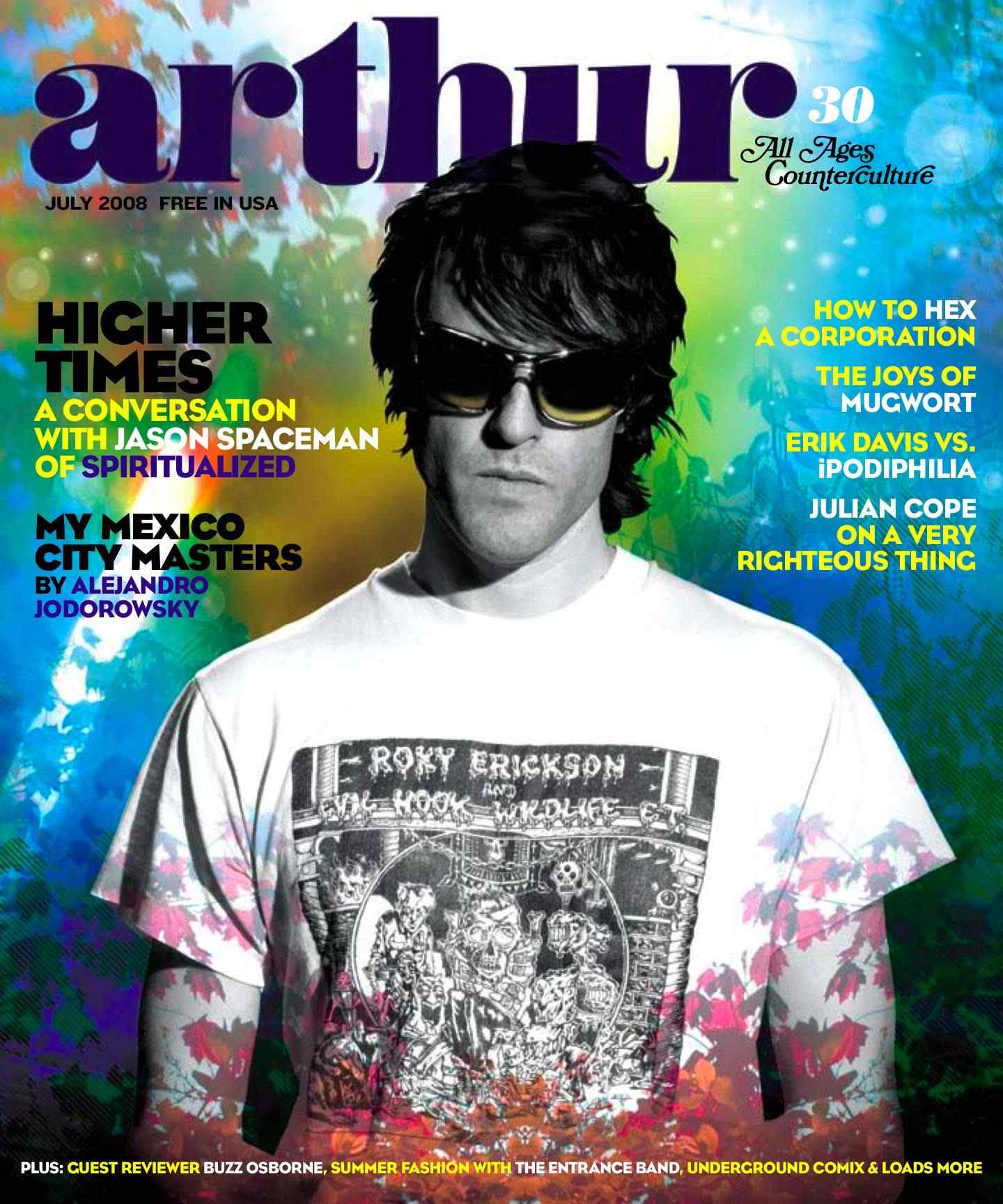
How a brush with death, a haunted guitar and filmmaker Harmony Korine helped Spiritualized’s JASON (SPACEMAN) PIERCE wrestle a new album of narcotic gospel music into being. By Jay Babcock, with photography by Stacy Kranitz.
In an exclusive excerpt from his new book, legendary film director/author/poet ALEJANDRO JODOROWSKY (El Topo, Holy Mountain) reflects on his encounters with Zen teacher EJO TAKATA and Surrealist master LEONORA CARRINGTON in late-Sixties Mexico City.
NANCE KLEHM salutes weeds—in particular, Artemesia vulgaris, aka mugwort.
The Center for Tactical Magic tells us HOW TO THROW A HEX—and why.
GREG SHEWCHUK on how the continuous prospect of eating shit on a skateboard can keep you humble—and awake.
ERIK DAVIS takes a stand against Cory Doctorow-style iPodiphilia and other data processing-marketed-as-pleasure.
A howl for America’s long-gone liberal media, by DAVE REEVES.
New work by poet MICHAEL BROWNSTEIN.
Psychonaut lookers Guy Blakeslee, Paz Lenchantin and Derek James are THE ENTRANCE BAND. Salubriously styled by the singular ALIA PENNER.
Writer-scholar EDDIE DEAN waxes lovingly about Argentinian bandoneon master Chango
Spasiuk, American rock n roll band Howlin Rain, the Maryland Redbud Tree, the Olympic Hi-Fi Stereo Console and other stuff rubbing him right lately.
Comics artist Joseph Remnant on author Patrick Rosenkrantz’s gorgeous book of underground comix history.
Bull Tongue columnists BYRON COLEY & THURSTON MOORE review choice finds from the deep underground.
JULIAN COPE on an extraordinary art statement of cavernous Detroit Psychedelic soul.
The Melvins’ BUZZ “KING BUZZO” OSBORNE joins C & D as they examine stuff by Endless Boogie, Al Green, Dennis Wilson, King Darves, Buffalo Killers, Hercules and Love Affair, Free Kitten, Arp, Awesome Color, Seun Kuti and Jex Thoth.
HEY BO DIDDLEY!: In Memorium by Plastic Crimewave.
Arthur No. 30 is at the printer, but you can download the entire 72-page magazine as two PDFs now:
Arthur No. 30 Part 1 of 2 (7.2mb)
Arthur No. 30 Part 2 of 2 (4.3mb)
Click here to subscribe to Arthur now via PayPal and receive Arthur for a year, starting with this issue.
Or, order only Arthur No. 30, via PayPal (credit cards ok!):
USA – $6 postpaid
Canada – $8 postpaid
World – $11 airmail
AIDS activists put a giant condom on the home of anti-gay Senator Jesse Helms in 1991…
courtesy John Coulthart!
 Arthur Magazine
