WILLING DUPES: Douglas Rushkoff on the credit crisis

“Riding Out the Credit Crisis” by Douglas Rushkoff

from Arthur Magazine No. 29/May 2008

There’s two kinds of people asking me about the economy lately: people with money wanting to know how to keep it “safe,” and people without money, wanting to know how to keep safe, themselves.

Maybe it’s the difference between those two concerns that best explains the underlying nature of today’s fiscal crisis.

Is what’s going on in the economy right now really worse than anything that’s happened in the past few decades? Are we heading towards a bank collapse like what happened in 1929? Or something even worse?

On a certain level, none of these questions really matter. Not as they’re being phrased, anyway. What we think of as “the economy” today isn’t real, it’s virtual. It’s a speculative marketplace that has very little to do with getting real things to the people who need them, and much more to do with providing ways for passive investors to grow their capital.

This economy of markets was created to give the rising merchant class in the late middle ages a way to invest their winnings. Instead of actually working, or even injecting capital into new enterprises, they learned to “make markets” in things that were scarce. Or, rather, in things that could be made scarce, like land.

That’s how speculation was born. Speculation in land, gold, coal, food…pretty much anything. Because the wealthy had such so much excess capital to invest, they made markets in stuff that the rest of us actually used. The problem is that when coal or corn isn’t just fuel or food but also an asset class, the laws of supply and demand cease to be the principal forces determining their price. When there’s a lot of money and few places to invest it, anything considered a speculative asset becomes overpriced. And then real people can’t afford the stuff they need.

The speculative economy is related to the real economy, but more as a parasite than a positive force. It is detached from the real needs of people, and even detached from the real commerce that goes on between humans. It is a form of meta-commerce, like a Las Vegas casino betting on the outcome of a political election. Only the bets, in this case, change the real costs of the things being bet on.

That’s what happened in the housing market and the credit market—which, these days, are actually the same thing. Here’s the story, in the simplest terms:

Bush’s tax cuts and other measures favoring the rich led to the biggest redistribution of wealth from poor to rich in American history. The result was that the wealthy—the investment class—had more money to invest, or lend, than there were people and businesses looking to borrow.

The easiest way to bring more borrowers into the system—and to create more of a market for money—was to promote homeownership in America. This is precisely what the Bush administration did, touting home ownership as an American right. Of course, they weren’t talking about home ownership at all, but rather pushing people to borrow money tied to the value of a house. If people could be persuaded to take mortgages on homes, real estate values would go up for those already invested (like land trusts and real estate funds) and banks would have a market for the excess money they had accumulated.

In short, there was a surplus of credit in the system. Americans were encouraged to borrow in the form of mortgages, which created demand for the credit banks wanted to sell. In many cases the credit itself wasn’t even real, but leveraged off some other inflated commodity that the bank or investor may have owned.

Banks and mortgage companies invented some really shady and difficult-to-understand mortgage contracts, designed to get people to borrow more money than they could. Banks didn’t care so much about lending money to people who wouldn’t be able to pay it back, because that’s not how they were going to earn their money, anyway. They provided the money for mortgage companies to lend, and in return won the rights to underwrite the loans when they were packaged and sold to other people and institutions.

So a bank might provide the cash for a bunch of loans, but then get it back, plus a huge commission, when those loans were packaged and sold to someone else.

Lots of people take out mortgages, and housing prices rise. This is used as evidence to convince more people that real estate is a great investment, and more people buy into the housing bubble. Lots of these people put little or no money down, and buy mortgages whose interests rates are going to change for the worse. But they believe the price of their home is inevitably going to go up, and pin their futures on the idea that they can refinance their mortgage before their rate changes. Since the house will be worth more, the mortgage for what they owe should be easier to get; it will represent a smaller percentage of the new total cost of the house.

Of course, this was dumb. Banks didn’t really care (because they weren’t holding the bad paper) but the people investing in those “mortgage-backed securities” were slowly getting wise to the fact that many of the borrowers were in over their heads. What to do? The credit industry went ahead and lobbied Washington to change the bankruptcy laws. While corporations could claim bankruptcy and stop paying for their retirees’ health coverage, individuals would no longer be able to claim bankruptcy, and even if they did, they would still owe their creditors the money they borrowed, forever. The credit industry spent over $100 million lobbying lawmakers for the new provisions.

Then, just like the credit industry predicted, loans start going bad. (The industry labels these loans “sub prime” because they want to make it look like the borrowers were somehow less-than-respectable people. But the term really just refers to a less-than-respectable loan.) As homeowners default on their mortgages, housing prices start to go down. This, in turn, makes it impossible for people to refinance their mortgages when they thought they would; in fact, now many homeowners actually owe more on their home than the home is worth. How can you refinance a million-dollar loan on a house that is only worth half that? You can’t, so instead you have to hold onto the variable-rate loan that you foolishly bought from the predatory lender. The rate rises higher and faster than you can pay it.

Lenders go ahead and start foreclosing on properties, kicking out the mortgage holders who can’t pay. But this creates another problem: what to do with the house? It’s not even worth the outstanding portion of the loan, in many cases. And even if they can sell it, how to distribute the money? No one even really knows whose mortgages belong to whom, as they’ve been sold as parts of packages, again and again, to different lenders, pension funds, money markets…you name it.

This leads to what became known as the “credit crunch” or “liquidity crisis.” No one feels good about lending money anymore because so much of it was tied in one way or another to these bad mortgages. The creditors don’t want to take possession of all these foreclosed homes, and they turn to the government for help.

Under the guise of helping homeowners “stay in their homes,” the government starts bandying about various “relief packages.” The Treasury department and the Fed are actually taking a two-pronged strategy towards fixing the problem. One prong is cynical PR, and the other is just plain stupid.

First, they want to create the illusion that something is being done, so they talk about “superfunds” to bail out homeowners, freezes on rate hikes, checks mailed to every taxpayer, and other useless gestures. They do all this to appease angry consumers and consumer advocates because they won’t want real lending industry regulation (like what Barney Frank and other progressives are pushing for) to gain any traction.

Second, they want to make more money available to the creditors (banks), so they can keep lending money—because this is their business. So the Fed lowers interest rates again and again. Banks get more money, and guess what? We’re back where we started: with tons of money and nowhere to invest it! By lowering the “prime lending rate,” they simply add to the surplus cash that created the problem in the first place.

Of course, both measures serve to stave off panic selling, because it seems as though something real is being done. Homeowners may get a slight delay in the paralyzing rate increases on their mortgages, giving banks and creditors the chance to make a more orderly exit. They will bail from these mortgages while selling the artificially secured credit to the likes of you and me through money market accounts and other retail products. They just need time to make sure the real losses trickle down to someone else.

And remember: this whole mortgage fiasco is just a little preview of what happens next year when the credit card industry faces the very same self-imposed “crunch.” In the case of mortgage lenders, at least the terms of the loans were disclosed. Credit card companies—which are some of the very same banks that are in the mortgage mess today—are busy rewriting their policies, increasing rates, and adding fees to the policies of people already in debt to them.

You know those little ‘inserts’ in your credit card bill? Read them, and you’ll find out, like I did, that some credit card companies have begun charging interest on your purchases from the moment you make the purchase. You pay finance charges even if you pay your whole bill every month. Most people carry big balances, so they won’t notice the additional charges, or at least that’s what the credit card companies are—quite literally—banking on.

* * *

After a certain point, consumers just won’t be able to pay their bills. Even though they’ve paid the cost of their purchases several times over, they’re simply buried in interest and interest on the interest, sometimes compounding at a rate of 30 or 40 percent per year. The creditors know this, which is why they’ve sold a lot of this debt to other banks, pension plans, money market funds…you get the picture: the kinds of places where we invest our retirement money. The banks invested in us; we were the assets. Now that we’re about to go broke, they’re busy selling us to other financial institutions in a game of musical chairs that will cost the last debtholder a lot of money. Of course, unless we can convince some foreign sheiks to buy some lousy US assets with their oil money, that last debt holder will end up being you and me.

Over the past few months I’ve spoken to top strategists at some of the biggest banks in the world, and they share my perception of the scenario. Most of them are “holding cash” as their main investment strategy, spread out over a few of the major currencies. Those making money are doing so by short-selling shares of other companies in the same finance industry that they supposedly work for.

The bigger picture, of course, is that speculation just worked too well for too long. The disparity between the market values and real values (rich people and poor people) got too large. Every asset class, even money itself, got too expensive. We became more valuable for our borrowing power than our labor—which also meant there was no way to work off our debt. Meanwhile, the people using reality as an investment vehicle have overwhelmed the real economy on which their “structured investments” are based.

Sure, this has happened before. It’s just that, traditionally, when wealth disparity got too great and there wasn’t enough money in the right places, the wealthiest bankers temporarily suspended their greed to bail out the system. Or progressive tax policies opened corporate coffers, permitting a “New Deal” that employed people while rebuilding the infrastructure required to make real things and provide real services to citizens.

Today, however, such temporary restraints on greed are systematically untenable and philosophically unthinkable. Conservatives are still so angry about New Deal reforms of the 1930s that that they have infused politics and banking with an economic ideology that sees any regulation of worker exploitation or predatory investment as anti-capitalist, anti-American, and even anti-God.

So instead we are the beneficiaries of “wink” reform: stuff that’s supposed to make us feel good while reassuring the speculators that their interests will remain paramount. A few hundred dollars mailed to every American family creates the illusion that government is lending a helping hand, but this money is not redistributing anything. It’s being taken from the same people who are receiving it, in the hope that they’ll just pump it back into the system at Wal-Mart or the Exxon station.

Whether the coming economic crisis will be deep or shallow is left to be seen. We may be at the start of the kind of depression our grandparents lived through in the ’30s, or we may simply experience what our parents lived through back in the ’70s. Foreign investment trusts may come in and buy our biggest banks and turn us into global citizens through the very World Bank policies we were hoping would turn all of them into US vassals.

Whatever the case, the best thing you can do to protect yourself and your interests is to make friends. The more we are willing to do for each other on our own terms and for compensation that doesn’t necessarily involve the until-recently-almighty dollar, the less vulnerable we are to the movements of markets that, quite frankly, have nothing to do with us.

If you’re sourcing your garlic from your neighbor over the hill instead of the Big Ag conglomerate over the ocean, then shifts in the exchange rate won’t matter much. If you’re using a local currency to pay your mechanic to adjust your brakes, or your chiropractor to adjust your back, then a global liquidity crisis won’t affect your ability to pay for either. If you move to a place because you’re looking for smart people instead of a smart real estate investment, you’re less likely to be suckered by high costs of a “hot” city or neighborhood, and more likely to find the kinds of people willing to serve as a social network, if for no other reason than they’re less busy servicing their mortgages.

The more connected you are to the real world, and the more consciously you reject the lure of the speculative ladder, the less of a willing dupe you’ll be in the pyramid scheme that’s in the process of collapsing all around us at this moment.

Think small. Buy local. Make friends. Print money. Grow food. Teach children. Learn nutrition. And if you do have money to invest, put it into whatever lets you and your friends do those things.

Douglas Rushkoff writes books about media, technology, and values. He’s currently working on a project called “Corporatized,” which will explore how chartered corporations disconnected us from reality. rushkoff.com

Beekeeper builds churches for bees

bees

Some bees,repenting

A spiritual beekeeper in Serbia has built hives in
the shape of monasteries and churches for his insects ‘because bees
have a soul too’.

Slobodan Jeftic is creating his ‘holy honey’ in the northern town of Stari Kostolac.

The 58-year-old said: ‘By doing this, I am bringing together the two great loves of my life – beekeeping and my religion.’

Metro.co.uk

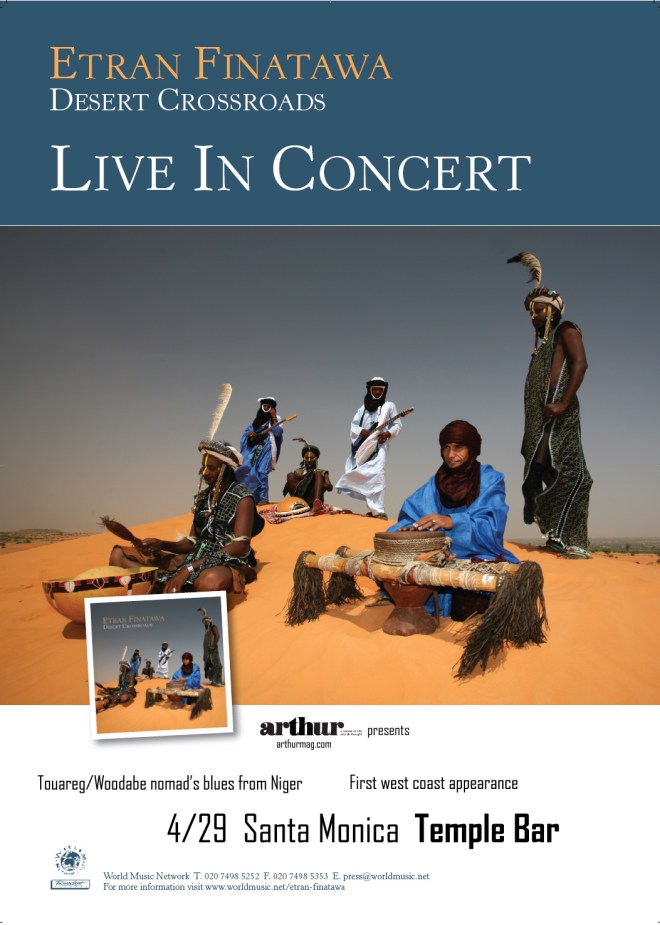
Arthur presents ETRAN FINATAWA in Santa Monica, April 29

templebar4.jpg

Tuesday, April 29: Arthur presents ETRAN FINATAWA at the Temple Bar in Santa Monica – first ever West Coast appearance – over 21 only, sorry….

Jon Pareles in New York Times: “Two groups of desert nomads meld their music in the sparse, spellbinding songs of Etran Finatawa, a band from Niger. Etran Finatawa, which means ‘stars of tradition,’ played its mesmerizing United States debut at Symphony Space on Friday in a World Music Institute concert. It was easy to tell who was who. Three Wodaabe musicians wore long, almost rectangular robes, hats with a single feather pointing skyward and white stripes of face paint down their foreheads and noses. Three Tuareg musicians wore ornately embroidered burnooses and robes.

“For centuries Tuareg and Wodaabe nomads have traversed the Sahel grasslands and Sahara in northern Africa, herding cows, camels and goats, and sometimes feuding over water and pastures. They now face the erosion of their age-old cultures and the desertification of their lands. Etran Finatawa responds in its songs while it symbolically reconciles the two groups. “A man is nothing when he is alone/People need other people,” they sang in “Jama’aare,” from their second album, “Desert Crossroads” (Riverboat/World Music Network).

“Many of Etran Finatawa’s lyrics insist on the value of heritage. Meanwhile, the music looks forward, altering that heritage by bringing together Wodaabe and Tuareg musicians and by using instruments that were introduced to Tuareg music in the 1970s: electric guitar and bass.

“From stoner rock in California to African nomad songs, the desert fosters drones. Most of Etran Finatawa’s songs revolve around one of Alhousseini Mohamed Anivolla’s repeating guitar lines: not chords, but picked, syncopated notes and trills. While the guitar lines probably derive from regional fiddle music, Americans might also hear a kinship with the oldest Delta blues.

“The other instruments are portable and unplugged: calabashes, clapping hands and the jingling, metallic percussion that Bammo Angonla, a Wodaabe, held in his hands and had strapped to his leg. Their instruments use the environment. A Tuareg drum is stabilized by sand; the Wodaabe float a calabash in a larger calabash basin of water, for a steady, deep-toned pulse. The songs ride multilayered six-beat and four-beat rhythms that seemed easy and natural until clapping audience members tried, and failed, to keep up.

“While the rhythm section was merged, the vocal styles were distinct. The Tuaregs sang in open, equable voices while the Wodaabes sang in high, pinched tones that must carry a long way across sand and savanna. In the Tuareg songs, in the Tamashek language, the vocal melody usually ran parallel to the guitar line. The Wodaabe songs, in Fulfulde, were more contrapuntal, with voice and guitar diverging and multiple singers in call and response. There were also Wodaabe songs that began with a lone, unaccompanied singer sustaining a note in a long crescendo until the other voices converged to join him: the sound of a community forging itself in a wilderness.”

More info at ETRAN FINATAWA


Paul Stamets’ mushroom-based bioremediation techniques to the rescue again… (NYT, 2008)

April 27, 2008 New York Times

Saddled With Legacy of Dioxin, Town Considers an Odd Ally: The Mushroom

By ANNIE CORREAL

FORT BRAGG, Calif. — On a warm April evening, 90 people crowded into the cafeteria of Redwood Elementary School here to meet with representatives of the State Department of Toxic Substances Control.

The substance at issue was dioxin, a pollutant that infests the site of a former lumber mill in this town 130 miles north of San Francisco. And the method of cleanup being proposed was a novel one: mushrooms.

Mushrooms have been used in the cleaning up of oil spills, a process called bioremediation, but they have not been used to treat dioxin.

“I am going to make a heretical suggestion,” said Debra Scott, who works at a health food collective and has lived in the area for more than two decades, to whoops and cheers. “We could be the pilot study.”

Fort Bragg is in Mendocino County, a stretch of coast known for its grand seascapes, organic wineries and trailblazing politics: the county was the first in the nation to legalize medical marijuana and to ban genetically modified crops and animals.

Fort Bragg, population 7,000, never fit in here. Home to the country’s second-largest redwood mill for over a century, it was a working man’s town where the only wine tasting was at a row of smoky taverns. But change has come since the mill closed in 2002.

The town already has a Fair Trade coffee company and a raw food cooking school. The City Council is considering a ban on plastic grocery bags. And with the push for mushrooms, the town seems to have officially exchanged its grit for green.

The mill, owned by Georgia-Pacific, took up 420 acres, a space roughly half the size of Central Park, between downtown Fort Bragg and the Pacific Ocean. Among several toxic hot spots discovered here were five plots of soil with high levels of dioxin that Georgia-Pacific says were ash piles from 2001-2, when the mill burned wood from Bay Area landfills to create power and sell it to Pacific Gas & Electric.

Debate remains about how toxic dioxin is to humans, but the Department of Toxic Substances Control says there is no safe level of exposure.

Kimi Klein, a human health toxicologist with the department, said that although the dioxin on the mill site was not the most toxic dioxin out there, there was “very good evidence” that chronic exposure to dioxin caused cancer and “it is our policy to say if any chemical causes cancer there is no safe level.”

Fort Bragg must clean the dioxin-contaminated coastline this year or risk losing a $4.2 million grant from the California Coastal Conservancy for a coastal trail. Its options: haul the soil in a thousand truckloads to a landfill about 200 miles away, or bury it on site in a plastic-lined, 1.3-acre landfill.

Alarmed by the ultimatum, residents called in Paul E. Stamets, author of “Mycelium Running: How Mushrooms Can Help Save the World.”

Typically, contaminated soil is hauled off, buried or burned. Using the mushroom method, Mr. Stamets said, it is put in plots, strewn with straw and left alone with mushroom spawn. The spawn release a fine, threadlike web called mycelium that secretes enzymes “like little Pac-Mans that break down molecular bonds,” Mr. Stamets said. And presto: toxins fall apart.

In January, Mr. Stamets came down from Fungi Perfecti, his mushroom farm in Olympia, Wash. He walked the three-mile coastline at the site, winding around rocky coves on wind-swept bluffs where grass has grown over an airstrip but barely conceals the ash piles. It was “one of the most beautiful places in the world, hands down,” he said.

Quick to caution against easy remedies — “I am not a panacea for all their problems” — he said he had hope for cleaning up dioxin and other hazardous substances on the site. “The less recalcitrant toxins could be broken down within 10 years.”

At least two dioxin-degrading species of mushroom indigenous to the Northern California coast could work, he said: turkey tail and oyster mushrooms. Turkey tails have ruffled edges and are made into medicinal tea. Oyster mushrooms have domed tops and are frequently found in Asian food.

Local mushroom enthusiasts envision the site as a global center for the study of bioremediation that could even export fungi to other polluted communities.

“Eventually, it could be covered in mushrooms,” said Antonio Wuttke, who lives in neighboring Mendocino and describes his occupation as environmental landscape designer, over a cup of organic Sumatra at the Headlands Coffeehouse.

The proposal is not without critics, however.

“There still needs to be further testing on whether it works on dioxin,” said Edgardo R. Gillera, a hazardous substances scientist for the State Department of Toxic Substances Control. “There has only been a handful of tests, in labs and field studies on a much smaller scale. I need to see more studies on a larger scale to consider it a viable option.”

On April 14, at a packed City Council meeting, an environmental consultant hired by the city voiced skepticism, citing a study finding that mushrooms reduced dioxins by only 50 percent. Jonathan Shepard, a soccer coach, stood up and asked: “Why ‘only’? I think we should rephrase that. I think we should give thanks and praise to a merciful God that provided a mushroom that eats the worst possible toxin that man can create.

Jim Tarbell, an author and something of a sociologist of the Mendocino Coast, said the enthusiasm for bioremediation showed a change in the culture at large.

We are trying to move from the extraction economy to the restoration economy,” Mr. Tarbell said. “I think that’s a choice that a broad cross-section of the country is going to have to look at.”

At the April 14 meeting, Georgia-Pacific promised to finance a pilot project. Roger J. Hilarides, who manages cleanups for the company, offered the city at least one 10-cubic-yard bin of dioxin-laced soil and a 5-year lease on the site’s greenhouse and drying sheds for mushroom testing. And the City Council said it would approve the landfill but only if it came with bioremediation experiments.

So, sometime later this year, Mr. Stamets is scheduled to begin testing a dump truck’s load of dioxin-laced dirt in Fort Bragg.

“One bin. Ten cubic yards. That’s a beginning,” said Dave Turner, a Council member. “I have hope — I wouldn’t bet my house on it — but I have a hope we can bioremediate this.”

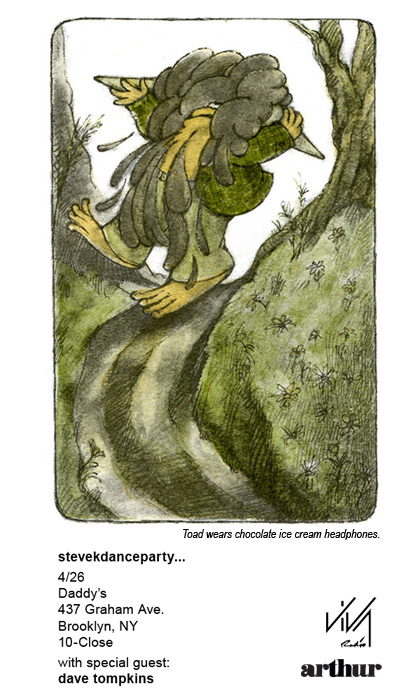
TONIGHT – Arthur presents Steve K Dance Party at Daddy's in Brooklyn

toad2_smaller.jpg

This Saturday, April 26th

Daddy’s
437 Graham Ave
Brooklyn, NY
3rd stop on the L
10-Close

Special Guest: Dave Tompkins

LOOK OUT FOR: Toadcoders, Das Boot bass, 4-part harmony soul mostly about relationships haunted by the shadow of a jilted string section, classy electronic handclaps, don’t stuff my ears with busted ice cream, robot woodpeckers headbutting telephone polls, a song called “Cold Wind Madness,” more handclaps.


That Ubu that you do

From Soft Machine to Pere Ubu, bands have been drawn to surrealist writer Alfred Jarry and the bizarre ‘science’ he invented. Mike Barnes on what happens when music meets absurdism.

Mike Barnes
Friday April 25, 2008
The Guardian

When Firmin Gémier, the actor playing Père Ubu, uttered the opening line of Alfred Jarry’s play Ubu Roi at its Paris premiere in 1896, its author gained instant notoriety. Although consisting of just one made-up word, “merdre” – for which one English translation is “shittr” – it was enough to cause 15 minutes of uproar in the audience. When the play continued, its mix of absurd humour and obscenity provoked heckling, and scuffles broke out. in the auditorium. Nobody had seen anything like it. A perplexed WB Yeats, who attended the performance, famously said: “What more is possible? After us, the Savage God.”

The Savage God sounds suspiciously like a rock band, and Jarry managed, in fact, to create one of music’s odder distributaries, thanks to the concept of ‘pataphysics. Jarry’s school physics teacher – nicknamed Père Hébé by his pupils – managed to influence his charge in ways he never intended. As well as providing the seed of Père Ubu’s name, Hébé’s bungling manner, disastrous experiments and inability to control a class led Jarry to the creation of the spoof science of ‘pataphysics, in which contradictions are embraced, with all possible viewpoints having equal validity. (The apostrophe was apparently necessary to “avoid a simple pun”, although what that pun was has never been explained.)

To the extent that people are familiar in any way with ‘pataphysics, it would probably be through the Beatles. Paul McCartney heard a radio production of Jarry’s play Ubu Coco (Ubu Cuckolded) and was inspired to mention ‘pataphysics in song. Unfortunately, he dropped it into Maxwell’s Silver Hammer, one of his very worst. But, that disaster notwithstanding, ‘pataphysics has a curious place in music, a place that will be marked tonight at the Queen Elizabeth Hall in London, with a musical production, Bring Me the Head of Ubu Roi, featuring the veteran US avant-rock band Pere Ubu, which will be preceded by a free ‘Pataphysics in Sound concert in the venue’s foyer.

Put into a brief idiot’s guide – which, one assumes, would be as ‘pataphysically valid as any other guide – ‘pataphysics is, in Jarry’s words, “the science of imaginary solutions” and “the law governing exceptions”. In it, science’s apparently immutable laws are scoffed at. To Jarry, they are merely “the correlation of exceptions, albeit more frequent ones … which reduced to the status of unexceptional exceptions, possess no longer even the virtue of originality”. ‘Pataphysics was, he said, “the greatest of all sciences”.

Jarry claimed that “talking about things that are understandable only weighs down the mind and falsifies the memory, but the absurd exercises the mind and makes the memory work”. He was a singular artist who aimed to live life as a total hallucination. To this end, he drank formidable quantities of wine and absinthe, which precipitated his demise at the age of 34 in 1907.

Jarry’s legacy was formalised posthumously in 1948 by the founding of the Collège de ‘Pataphysique in Paris. Its constitution asserts that all people are ‘pataphysicians whether they know it or not, but paid-up Collège members have included artists Asger Jorn, Marcel Duchamp, Max Ernst, Jean Dubuffet, Eugene Ionesco, Jean Baudrillard, Umberto Eco, and the Marx Brothers. And its precepts have produced music more interesting and challenging than Maxwell’s Silver Hammer.

Duchamp created a number of musical compositions, many purely conceptual. But when Stephane Ginsburgh recorded Duchamp’s 1913 opus Erratum Musical a few years back, he took into account Duchamp’s observation that ‘pataphysics involved “canned chance” and ensured all the piece’s 88 piano notes were picked out in a random order with no emphasis on any one in particular. In 1960, Jean Dubuffet, who originated the term Art Brut, taped a series of improvisations with Asger Jorn, choosing from his collection of more than 50 instruments, few of which he could play to any recognised standard. These energetic, chaotic recordings were released as Expériences Musicales in 1961. And in 1975, the English composer Gavin Bryars – a member of the Collège de ‘Pataphysique – wrote Ponukélian Melody, a slow piece for wheezing organ, parping tuba, cello and bells. It was his musical response to Raymond Roussel’s novel Impressions d’Afrique, which was set in an imaginary African country.

But ‘pataphysics first truly overlapped with rock music in 1967, when Soft Machine – a psychedelic pop group with a penchant for improvisation – performed a live soundtrack to Jarry’s play Ubu Enchainé (Ubu Enchained) at the Traverse theatre in Edinburgh during that year’s Fringe festival. Early in the band’s career, drummer and vocalist Robert Wyatt’s whimsical, absurdist lyrics were often described as Dadaist. But were they, more accurately, ‘pataphysical?

“I wasn’t drawn to Jarry and ‘pataphysics from reading about it,” Wyatt explains. “I think we were chosen to be ‘pataphysicians before I knew what it was. Later, we were playing in Paris, and some representatives of the College of ‘Pataphysics came to the concert. A venerable old member of their group heard it for about five minutes, thought we played the most incomprehensible and appalling music he had ever heard, gave us his blessing and gave us certificates. So we are officially Petits Fils Ubu – Ubu’s grandchildren – and in our case it gives us the right to lead the marching band at the front of the victory parade of the ‘pataphysical movement. But nobody who gave it to us thought to explain it any more than you would explain a football match to a teddy bear mascot.”

For Soft Machine Volume Two, recorded in 1968, Wyatt wrote A ‘Pataphysical Introduction and A Concise British Alphabet. The latter is in two parts: he sings the alphabet forwards in the first, backwards in the second. This followed in the footsteps of Luc Etienne’s 1957 composition L’Apres-Midi d’Un Magnétophone: Palindromes Phonétiques, which has a similarly palindromic form – a recording of speech played normally, then with the tape running backwards . This emphasised that, ‘pataphyscially speaking, it meant as much, or as little, either way around, and ‘pataphysicians would describe the relationship of Etienne’s composition to Wyatt’s as an example of “plagiarism by anticipation”.

Was Wyatt guided by any of these concepts? “I don’t think I was guided by any thought at all,” he admits. “But I just decided that singing the alphabet backwards was a ‘pataphysical activity. Some people get upset by art that doesn’t make sense to them – I never had that problem. I never saw what was the sense that modern art wasn’t making. I was always at home with the science of imaginary solutions.”

Tonight’s performance of Bring Me the Head of Ubu Roi is just the latest in a long line of different treatments of Ubu Roi, from Jan Lenica’s 1977 cartoon version to a 1991 opera by Polish composer Krzysztof Penderecki. Jarry had an interest in the notion of “horrible beauty” in which an aesthetic appreciation of the monstrous was allowable and discordant elements could be counterbalanced by humour. Pere Ubu’s singer, David Thomas, agrees that this is a pretty good description of the band’s music, which is surmounted by squalling, untempered synthesiser and his own squawking vocals. But apart from their name and the fact that the title track of their 1977 debut album, The Modern Dance, includes the refrain “Merdre, merdre”, was Jarry an influence on Pere Ubu’s music?

‘The thing that impressed me over the time of immersing myself in Jarry in high school and the point at which I formed Pere Ubu, was Jarry’s theatrical production ideas,” Thomas explains. “It seemed to me that his method called for the engaging of the audience’s imaginations in the creative process, with his use of placards, ‘pataphysical notions, and anti-naturalism. As synthesised, concrète and abstract sound techniques and technology developed, and were integrated into rock music, then pure sound as a powerful narrative voice in its own right came into play.

“The object was the same as Jarry’s seemed to be, to engage the imagination of the audience in the creative process. To confound, illuminate, generate chaos for its own sake, to overlay intentions with counter-intentions, self-doubt, fear and hope, to create an art that, as accurately as possible in a three-minute song, mimics the human condition.”

Thomas has edited the play to concentrate on the two main characters. He has also added elements that he feels are in “the spirit of the original, particularly in the area that originally interested me in this project – the notion that the Politico-Media-Industrial Complex is filled with characters far more grotesque than Jarry’s characters could have ever been.”

Jarry wrote The Song of Disembraining for Ubu Roi, but Thomas has decided not to use it. “It’s not really a very good song,” he says. “The title is great but it meanders on and on forever.” He has instead translated parts of the plot into original song structures “where elegant to do so”, for which he is unabashed. “We are a rock band. We are Americans. We’re not going to pretend to be something we’re not,” he says. “The justification is that we’re the only band in the world which has for more than 30 years followed a Jarry-esque, or even ‘pataphysical course in rock music. We got a right to do what we want. The play is about ideas. The clothes you put on ideas are fashions that come and go. The ideas are what count and what survive.”


INTERNSHIP OPENING AT ARTHUR WORLD SERVICE

Uber dot com — an artist-run, independent web publishing platform — is in need
of interns to work on Arthur World Service, Arthur Magazine’s Uber-powered
online video channel, among other projects.

Responsibilities include:
* Online research
* Writing commentary and headlines
* Posting content

The ideal candidate will have a passion for media, the news, and the online
world. Previous online experience, a familiarity with Arthur Magazine and
strong computer skills, a plus. Candidate should have strong writing skills
and be a regular consumer of online media as well.

Hours: M-F, 3-4 hours each day
Location: Uber’s office in Beverly Hills
Compensation: unpaid or school-credit

Please send writing sample and resume to: dan at uber dot com


ENDARKENMENT MANIFESTO by Peter Lamborn Wilson aka Hakim Bey (Arthur, 2008)

From ARTHUR MAGAZINE No. 29 (May 2008): Peter Lamborn Wilson’s half-serious proposal for a political movement to uphold and propagate the ideals of Green Hermeticism. Wilson sometimes uses the pen name ‘Hakim Bey.’ He is the author of the Temporary Autonomous Zone concept and manifesto, which, for better or worse, was the original inspiration for the Burning Man festival..

THE ENDARKENMENT MANIFESTO

At least half the year belongs to Endarkenment. Enlightenment is only a special case of Endarkenment—and it has nights of its own.

**

During the day democracy waxes, indiscriminately illuminating all and sundry. But shadowless noon belongs to Pan. And night imposes a “radical aristocracy” in which things shine solely by their own luminescence, or not at all.

**

Obfuscatory, reactionary and superstitious, Endarkenment offers jobs for trolls and sylphs, witches and warlocks. Perhaps only superstition can re-enchant Nature. People who fear and desire nymphs and fauns will think twice before polluting streams or clear-cutting forests.

**

Electricity banished shadows—but shadows are “shades,” souls, the souls of light itself. Even divine light, when it loses its organic and secret darkness, becomes a form of pollution. In prison cells electric lights are never doused; light becomes oppression and source of disease.

**

Superstitions may be untrue but based on deeper truth—that earth is a living being. Science may be true, i.e. effective, while based on a deeper untruth—that matter is dead.

**

The peasants attacking Dr. Frankenstein’s tower with their torches and scythes were the shock troops of Endarkenment, our luddite militia. The original historical Luddites smashed mechanical looms, ancestors of the computer.

**

“Neolithic conservatism” (Paul Goodman’s definition of anarchism) positions itself outside the ponderous inevitability of separation and sameness. Every caveman a Prince Kropotkin, every cavewoman Mrs. Nietzsche. Our Phalanstery would be lit by candles and our Passions avowed via messenger pigeons and hot-air balloons.

**

Imagine what science might be like to day if the State and Kapital had never emerged. Romantic Science proposes an empiricism devoid of disastrous splits between consciousness and Nature; thus it prolongates Neolithic alchemy as if separation and alienation had never occurred: science for life not money, health not war, pleasure not efficiency; Novalis’s “poeticization of science.”

**

Of course technology itself is haunted—a ghost for every machine. The myth of Progress stars its own cast of ghouls and efreets. Consciously or unconsciously (what difference would it make?) we all know we live in techno-dystopia, but we accept it with the deterministic fatalism of beaten serfs, as if it were virtual Natural Law.

**

Technology mimics and thus belittles the miracles of magic. Rationalism has its own Popes and droning litanies, but the spell they cast is one of disenchantment. Or rather: all magic has migrated into money, all power into a technology of titanic totality, a violence against life that stuns and disheartens.

**

Hence the universal fear/desire for the End of the World (or for some world anyway). For the poor Christian Moslem Jewish saps duped by fundamentalist nihilism the Last Day is both horrorshow and Rapture, just as for secular Yuppies global warming is a symbol of terror and meaninglessness and simultaneously a rapturous vision of post-Catastrophe Hobbit-like local-sustainable solar-powered gemutlichkeit. Thus the technopathocracy comes equipped with its own built-in escape-valve fantasy: the Ragnarok of technology itself and the sudden catastrophic restoration of meaning. In fact Capital can capitalize on its own huge unpopularity by commoditizing hope for its End. That’s what the smug shits call a win/win situation.

**

Winter Solstice (Chaos Day in Chinese folklore) is one of Endarkenment’s official holidays, along with Samhain or Halloween, Winter’s first day.

**

Endarkenment stands socially for the Cro-Magnon or “Atlantaean” complex—anarchist because prior to the State—for horticulture and gathering against agriculture and industry—for the right to hunt as against the usurpation of commons by lord or State. Electricity and internal combustion should be turned off along with all States and corporations and their cult of Mammon and Moloch.

**

Despite our ultimate aim we’re willing to step back bit by bit. We might be willing to accept steam power or hydraulics. The last agreeable year for us was 1941, the ideal is about 10,000 BC, but we’re not purists. Endarkenment is a form of impurism, of mixture and shadow.

**

Endarkenment envisages a medicine advanced as it might have been if money and the State had never appeared, medicine for earth, animals and humans, based on Nature, not on promethean technology. Endarkenment is not impressed by medicine that prolongs “life span” by adding several years in a hospital bed hooked up to tubes and glued to daytime TV, all at the expense of every penny ever saved by the patient (lit. “sufferer”) plus huge debts for children and heirs. We’re not impressed by gene therapy and plastic surgery for obscene superrich post humans. We prefer an empirical extension of “medieval superstitions” of Old Wives and herbalists, a rectified Paracelsan peoples’ medicine as proposed by Ivan Illich in his book on demedicalization of society. (Illich as Catholic anarchist we consider an Endarkenment saint of some sort.) (Endarkenment is somewhat like “Tory anarchism,” a phrase I’ve seen used earliest in Max Beehbohm and most lately by John Mitchell.) (Other saints: William Blake, William Morris, A.K. Coomaraswamy, John Cowper Powys, Marie Laveau, King Farouk…)

**

Politically Endarkenment proposes anarcho-monarchism, in effect somewhat like Scandinavian monarcho-socialism but more radical, with highly symbolic but powerless monarchs and lots of good ritual, combined with Proudhonian anarcho-federalism and Mutualism. Georges Sorel (author of Reflections on Violence) had some anarcho-monarchist disciples in the Cercle Proudhon (1910-1914) with whom we feel a certain affinity. Endarkenment favors most separatisms and secessions; many small states are better than a few big ones. We’re especially interested in the break-up of the American Empire.

**

Endarkenment also feels some critical admiration for Col. Qadhaffi’s Green Book, and for the Bonnot Gang (Stirnerite Nietzschean bank robbers). In Islamdom it favors “medieval accretions” like sufism and Ismailism against all crypto-modernist hyperorthodoxy and politics of resentment. We also admire the martyred Iranian Shiite/Sufi socialist Ali Shariati, who was praised by Massignon and Foucault.

**

Culturally Endarkenment aims at extreme neo-Romanticism and will therefore be accused of fascism by its enemies on the Left. The answer to this is that (1) we’re anarchists and federalists adamantly opposed to all authoritarian centralisms whether Left or Right. (2) We favor all races, we love both difference and solidarity, not sameness and separation. (3) We reject the myth of Progress and technology—all cultural Futurism—all plans no matter their ideological origin—all uniformity—all conformity whether to organized religion or secular rationalism with its market democracy and endless war.

**

Endarkenists “believe in magic” and so must wage their guerrilla through magic rather than compete with the State’s monopoly of techno-violence. Giordano Bruno’s Image Magic is our secret weapon. Projective hieroglyphic hermeneutics. Action at a distance through manipulation of symbols carried out dramaturgically via acts of Poetic Terrorism, surrealist sabotage, Bakunin’s “creative destruction”—but also destructive creativity, invention of hermetico-critical objects, heiroglyphic projections of word/image “spells”—by which more is meant (always) than mere “political art”—rather a magical art with actual dire or beneficial results. Our enemies on the Right might call this political pornography and they’d be (as usual) right. Porn has a measurable physiopsychological effect. We’re looking for something like it, definitely, only bigger, and more like Artaud than Brecht—but not to be mistaken for “Absolute Art” or any other platonic purism—rather an empirical strategic “situationist” art, outside all mass media, truly underground, as befits Endarkenment, like a loosely structured “rhizomatic” Tong or freemasonic conspiracy.

**

The Dark has its own lights or “photisms” as Henry Corbin called them, literally as entoptic/hypnagogic phosphene-like phenomena, and figuratively (or imaginally) as Paracelsan Nature spirits, or in Blakean terms, inner lights. Enlightenment has its shadows, Endarkenment has its Illuminati; and there are no ideas but in persons (in theologic terms, angels). According to legend the Byzantines were busy discussing “the sex of angels” while the Ottomans were besieging the walls of Constantinople. Was this the height of Endarkenment? We share that obsession.

Jan. 1, 2008