How the internet is degrading journalism.

March 24, 2008 6:42 – Time Magazine

The Internet Effect on News
Posted by Michael Scherer

Here is a basic shift that has occurred in the news business: Because of the Internet, you, the reader, no longer have to buy information in pre-fabricated packages like “newspapers.” You can just go online and individually select the articles you want to read. And there are lots of websites and blogs to help you out. Every day, Matt Drudge, the Huffington Post, Yahoo, Google, Swampland, or a hundred other different bloggers, will pre-select articles for you and provide links. You choose your own adventure.

There is a corollary effect here: As the value of the package declines, the value of the individual article increases. Online, news organizations charge advertisers based on the number of hits they can get on a site. And since the hits are often coming for specific stories, and not the entire site, a blockbuster story that gets linked to, say, Drudge, is money in the bank.

This means that the competition on the level of the individual story is more intense than ever before, and there is enormous pressure to distinguish yourself from the pack. Assume, for instance, that 12 news organizations do the same story on the same day about how Hillary Clinton has a tough road ahead of her to get the nomination. Which story is going to get the most links and therefore the most readers? Is it the one that cautiously weighs the pros and cons, and presents a nuanced view of her chances? Or is it the one that says she is toast, and anyone who thinks different is living on another planet?

I ask these rhetorical questions because I just finished reading Marc Ambinder’s detailed rebuttal to the Politico story from Friday (which I previously blogged about). That article, by Jim VandeHei and Mike Allen, effectively declared Clinton toast, and suggested that anyone who thinks different is living on another planet. Most of Ambinder’s critique is based in the merits of the actual situation, and he notes repeatedly his belief that the Politico authors did little more than repackage the conventional wisdom. But he also glances across something really important about the dynamics of the news business:

“Indeed, the authors’ own publication, the Politico, is as responsible as any single publication for printing the type of horse race coverage that, in the eyes of the authors, are overstating the relative odds of the horses. The Politico has two excellent bloggers who provide moment-by-moment coverage of the race. Thanks to the newspaper’s magical pathway to Matt Drudge’s inbox and attention span, the Politico’s horse race coverage often disproportionately influences how editors and producers assess the day in political news.”

Left unsaid in this is something which the Politico’s editors and writers (not to mention everyone else in the news business, including me) know well. If you say something provocatively, in a new way, or with an unexpected spin, you will succeed online. If you play it safe, you will not. So we see the difference in style between the Politico story and, say, Adam Nagourney’s more nuanced story on the same topic a day earlier or again in another story today. Suffice it to say, Friday’s Politico story earned a Drudge link over the weekend, and Nagourney’s did not. That’s money in the bank for Politico.

This trend towards story-by-story competition, and away from package-by-package competition, is a blessing and a curse. It is forcing better writing, quicker responsiveness, and it is increasing the value of actual news-making and clear-eyed thinking. But it is also increasing pressure on reporters to push the boundaries of provocation. I am not sure that the Politico story crossed any boundaries, or distorted the truth. I do believe that what Allen and VandeHei did is very much the future of news.


Remembering Walter Bowart, by Paul Krassner

Remembering Walter Bowart
by Paul Krassner

Whenever my parents vacationed in Las Vegas, they always brought back silver dollars for my brother, my sister and me. When they celebrated their 40th anniversary in the late 1960s, I had an idea for a gift. On a round wooden tray the size of a large pizza, taken from an old lamp, there would be caricatures of us siblings, each with a silver dollar for our heads.

I called my friend Walter Bowart–editor of a radical New York underground paper, the East Village Other, who was also a fine artist. I asked if he would draw those three figures. He said yes and invited me to his home. Later he told me he had been depressed and contemplating suicide, but that, karmically, his perception of the round wooden tray symbolized the Wheel of Life, so he had an epiphany and changed his mind.

There are a couple of 1960s myths about Bowart that I’d like to clear up, just for the sake of accuracy in countercultural history.

One was about the Underground Press Syndicate (UPS), a network of underground papers formed–according to a manifesto written by its founders–to “warn the civilized world of its impending collapse.” Of course, “underground” was technically a misnomer, since it was well known who published those papers and where more copies could be obtained. (A true underground paper was the Outlaw, secretly published and distributed inside San Quentin Prison by anonymous inmates and guards.)

Eventually, 600 publications in the U.S. and abroad were included in UPS which, said Art Kunkin, publisher of the Los Angeles Free Press, “was the way the news about the oppositon to the Vietnam War was circulated, and also about ’60s culture, music and so forth.” UPS had a policy of allowing its members to freely reprint each other’s material, which gave readers the sense of a national movement. UPS also helped papers defend themselves an increasing number of legal assaults.

The myth is that Bowart came up with the name of the syndicate when an interviewer asked him what it was called. At that moment he saw a United Parcel Service truck go by, prompting him to tell the reporter that the organization was called UPS. I’ve heard that same tale about HIGH TIMES founder Tom Forcade, though he came to UPS after it had been named. But here’s what John Wilcock, co-founder of the East Village Other, tells me:

“It seems impossible to correct Bowart’s wise-crack about the UPS truck. I guess it’s funnier than the true story, which is that as we all sat around in the EVO office, me at the typewriter typing up the manifesto that we collectively produced, I–with memories of the French maquis [a secret army consisting predominantly of rural guerrilla bands in the French resistance during World War II]–suggested ‘Underground’ which then became Underground Press Syndicate.”

The other myth has to do with the Great Banana Skin Hoax. An obituary in the Los Angeles Times stated that EVO editors “were intrigued by the idea that a substance common to LSD and bananas could trigger sensations in the brain.” Here’s the actual event:

The office of the East Village Other was across the street from my magazine, The Realist. I dropped by one time when the editors–Bowart, Alan Katzman and Dean Latimer–were discussing a book, Morning of the Magicians, in the context of learning that LSD released serotonin in the brain and wondering if it could be found in nonchemical substances. Mistaking serotin, which is found in bananas, for serotonin, they inadvertently launched the notorious prank. The Berkeley Barb picked up the report, UPS and then the mainstream wire services spread it around the country.

It quickly became public knowledge that you could get legally high from smoking dried banana skins. In San Francisco, there was a banana smoke-in, and one entrepreneur started a successful banana-powder mail-order business, charging $5 an ounce. Agents from the Bureau of Narcotics and Dangerous Drugs headed for their own laboratory, faithfully cooking, scraping and grinding thirty pounds of bananas, following the recipe in the underground press. For three weeks the Food and Drug Administration utilized apparatus which “smoked” the dried banana peels.

The Los Angeles Free Press in turn promoted yet another hallucinogenic–pickled jalapeno peppers, anally inserted. All over Southern California, heads were sticking vegetables up their asses. And, at a benefit for the San Francisco Diggers, I mentioned on stage that the next big drug would be FDA. Sure enough, Time magazine soon reported that there would be “a super-hallucinogen called FDA.” Silly me, I thought I had made that up.

Anyway, I’ll miss Walter Bowart and his twin towers of awareness–mysticism and conspiracy–but he has spun off the Wheel of Life into what he believed would be another level of consciousness.

Paul Krassner is the author of “Porn Soup” and publisher of the Disneyland Memorial Orgy poster, both available only at paulkrassner.com.


America's dropout epidemic.

The New York Times – March 20, 2008

States’ Data Obscure How Few Finish High School
By SAM DILLON

JACKSON, Miss. — When it comes to high school graduation rates, Mississippi keeps two sets of books.

One team of statisticians working at the state education headquarters here recently calculated the official graduation rate at a respectable 87 percent, which Mississippi reported to Washington. But in another office piled with computer printouts, a second team of number crunchers came up with a different rate: a more sobering 63 percent.

The state schools superintendent, Hank Bounds, says the lower rate is more accurate and uses it in a campaign to combat a dropout crisis.

“We were losing about 13,000 dropouts a year, but publishing reports that said we had graduation rate percentages in the mid-80s,” Mr. Bounds said. “Mathematically, that just doesn’t work out.”

Like Mississippi, many states use an inflated graduation rate for federal reporting requirements under the No Child Left Behind law and a different one at home. As a result, researchers say, federal figures obscure a dropout epidemic so severe that only about 70 percent of the one million American students who start ninth grade each year graduate four years later.

California, for example, sends to Washington an official graduation rate of 83 percent but reports an estimated 67 percent on a state Web site. Delaware reported 84 percent to the federal government but publicized four lower rates at home.

The multiple rates have many causes. Some states have long obscured their real numbers to avoid embarrassment. Others have only recently developed data-tracking systems that allow them to follow dropouts accurately.

The No Child law is also at fault. The law set ambitious goals, enforced through sanctions, to make every student proficient in math and reading. But it established no national school completion goals.

“I liken N.C.L.B. to a mile race,” said Bob Wise, a former West Virginia governor who is president of the Alliance for Excellent Education, a group that seeks to improve schools. “Under N.C.L.B., students are tested rigorously every tenth of a mile. But nobody keeps track as to whether they cross the finish line.”

Furthermore, although the law requires schools to make only minimal annual improvements in their rates, reporting lower rates to Washington could nevertheless cause more high schools to be labeled failing — a disincentive for accurate reporting. With Congressional efforts to rewrite the law stalled, Secretary of Education Margaret Spellings has begun using her executive powers to correct the weaknesses in it. Ms. Spellings’s efforts started Tuesday with a measure aimed at focusing resources on the nation’s worst schools. Graduation rates are also on her agenda.

In an interview, Ms. Spellings said she might require states to calculate their graduation rate according to one federal formula.

“I’m considering settling this once and for all,” she said, “by defining a single federal graduation rate and requesting states to report it that way. That would finally put this issue to rest.”

In 2001, the year the law was drafted, one of the first of a string of revisionist studies argued that the nation’s schools were losing more students than previously thought.

Jay P. Greene, a researcher at the Manhattan Institute, a conservative research organization, compared eighth-grade enrollments with the number of diplomas bestowed five years later to estimate that the nation’s graduation rate was 71 percent. Federal statistics had put the figure 15 points higher.

Still, Congress did not make dropouts a central focus of the law. And when states negotiated their plans to carry it out, the Bush administration allowed them to use dozens of different ways to report graduation rates.

As an example, New Mexico defined its rate as the percentage of enrolled 12th graders who received a diploma. That method grossly undercounts dropouts by ignoring all students who leave before the 12th grade.

The law also allowed states to establish their own goals for improving graduation rates. Many set them low. Nevada, for instance, pledged to get just 50 percent of its students to graduate on time. And since the law required no annual measures of progress, California proposed that even a one-tenth of 1 percent annual improvement in its graduation rate should suffice.

Daniel J. Losen, who has studied dropout reporting for the Civil Rights Project at the University of California, Los Angeles, said he once pointed out to a state official that, at that pace, it would take California 500 years to meet its graduation goal.

“In California, we’re patient,” Mr. Losen recalled the official saying.

Most troublesome to some experts was the way the No Child law’s mandate to bring students to proficiency on tests, coupled with its lack of a requirement that they graduate, created a perverse incentive to push students to drop out. If low-achieving students leave school early, a school’s performance can rise.

No study has documented that the law has produced such an effect nationwide. Experts say they believe many low-scoring students are prodded to leave school, often by school officials urging them to seek an equivalency certificate known as a General Educational Development diploma.

“They get them out so they don’t have them taking those tests,” said Wanda Holly-Stirewalt, director of a program in Jackson, Miss., that helps dropouts earn a G.E.D. “We’ve heard that a lot. It happens all over the system.”

After several research groups questioned graduation rates, the federal Department of Education in 2005 published an estimated rate for each state, to identify those that were reporting least accurately. The figures suggested that nine states had overstated their graduation rates by 10 to 22 percentage points.

Part of the discrepancy is because many states inflate their official rate by counting dropouts who later earn a G.E.D. as graduates or by removing them from calculations altogether.

The undercounting of dropouts can be striking.

In Mississippi, the official formula put the graduation rate for the state’s largest district, Jackson Public Schools, at 81 percent. Mr. Bounds, the state schools superintendent, said the true rate was 56 percent.

At Murrah High School, one of eight here, the official graduation rate is 99 percent, even though yearbooks show that half of Murrah’s freshmen disappear before becoming seniors. Even Murrah’s principal, Roy Brookshire, expressed surprise.

“I can’t explain how they figured that, truly I can’t,” Mr. Brookshire said.

Governors also stepped in, worried that schools were not preparing the work force their states need. In December 2005, all 50 agreed to standardize their graduation rate calculations, basing them on tracking individual students through high school.

Fifteen states have begun to use the formula, said Dane Linn, director of the education division at the National Governors Association. And it has produced some stunning revelations.

In North Carolina, the rate plummeted a year ago to 68 percent from 95 percent. The News & Observer in Raleigh likened the experience to the shock of hearing a doctor diagnose a terrible illness.

“But now doctors can start treatments that can lead to a cure,” the paper said in an editorial.

Mississippi is among the states that have become the most serious about confronting their dropout problem, Mr. Linn said.

The state has been building a record system capable of tracking student data from year to year, and in 2005 used it to estimate a graduation rate of 61 percent, 24 points below the official rate.

Mr. Bounds took office that fall and was initially consumed with the aftermath of Hurricane Katrina. But he eventually had time to pore over the data.

“It was time to boldly confront the facts,” he said.

Mr. Bounds has used the new figures to persuade the Mississippi Board of Education to require school districts to prepare dropout prevention plans. Last month he told 2,000 community leaders that the state’s dropout crisis was like “a Katrina hitting our schools every year.”

The state will eventually report the lower rate to Washington but has set no schedule, Mr. Bounds said. One problem, he said, is that when Mississippi sends revised rates for its more than 200 high schools, their success levels will appear to plummet and many schools could be exposed to sanctions.

“It’ll look like everybody has dropped, when actually everybody’s doing a better job,” Mr. Bounds said. “But we’re capturing the right score on the scoreboard.”

Turrell's "Dividing the Light" skyspace at Claremont

AUDIO SLIDESHOW: “Pomona College’s new architectural installation, designed by the artist James Turrell, plays with light and sound.”

PRESS RELEASE:

Pomona College is pleased to announce an exhibition and symposium for a Skyspace created by Pomona College alumnus (1965) James Turrell. This will be the first Skyspace in Southern California to be regularly accessible to the public.

Turrell–an internationally acclaimed light and space artist and the architect of Roden Crater–has completed private commissions for Skyspaces in Southern California in the past, but none of them are available for public viewing. The new Skyspace, located in the Draper Courtyard of the new Lincoln and Edmunds Buildings on the Pomona campus, has been realized in collaboration with consulting architects Marmol Radziner + Associates AIA.

The exhibition and symposium offer audiences an in-depth look at Turrell’s work—work that was profoundly influenced by his undergraduate studies at Pomona College in perceptual psychology and mathematics “I value greatly my time at Pomona College. That kind of education is tailored to people, and was very responsible to each student. I’m grateful for that,” said James Turrell. The academic buildings surrounding the Skyspace house the College’s departments and programs related to the science of mind—such as computer science, psychology, neuroscience and cognitive science—as well as the earth sciences of geology and environmental analysis.

“We are very honored that James Turrell has created a work for the courtyard of the Lincoln and Edmunds buildings,” says Pomona College President David Oxtoby. “He is a distinguished alumnus, and his intellectual concerns— art grounded in the psychology of perception—are central to many of the academic disciplines housed in the new building complex.”

The Skyspace—a precisely designed architectural installation that heightens the viewer’s awareness of light, sky and the activity of perception—is the form for which Turrell is renowned. Building on this formal vocabulary, the artist has created an open, transparent courtyard space in which a floating metal canopy shades the seating area and provides a frame for the sky. During the transition from twilight to full night, lighting elements, programmed to change in intensity and hue as they wash the underside of the canopy, create the changing perception of sky as space, form, object and void. A shallow pool centered beneath the opening to the sky mirrors the daytime sky and reflects a dark echo of the night sky.

In honor of the new Skyspace, the Pomona College Museum of Art will present James Turrell at Pomona College, an exhibition uniting the various threads of Turrell’s artistic practice. “My work is about space and the light that inhabits it. It is about how you confront that space and plumb it with vision. It is about your seeing, like the wordless thought that comes from looking into fire,” said Turrell. The exhibition includes End Around, one of the artist’s Ganzfeld works; two LED Tall Glass works from 2006, Gathered Light and Silent Leading; and a selection of models and drawings. The exhibition opens Tuesday, September 4, 2007 and continues through May 17, 2008. The exhibition opening reception will be held on Saturday, September 8 from 5- 7 p.m. The public is welcome.

The Tall Glass pieces consist of a core of LEDs individually programmed by Turrell to create a subtle shift in color over time, similar to the deliberate but beautiful fashion in which the sky changes from late afternoon to night. However, the careful construction of these works ensures that the viewer sees only a floating, changing field of light—a subtle revelatory experience of photons as tangible entities and physical presence.

In a Ganzfeld space, depth, surface and color are replaced by a thick, all-encompassing mist of light. Upon entering the chamber of End Around, the visitor instinctively approaches what appears to be a faint wall of light in the distance. But upon reaching the light source, the viewer’s entire visual field is consumed by an apparently limitless field of blue light. Turrell engineers the Ganzfeld works to eliminate all visual cues that the human brain processes to construct depth and surface. As a result, the viewer is unable to tell whether the ethereal blue field seen from the platform extends for inches, feet or into infinity. Here, light is perceived as light, not as illumination on an object or surface.

“The exhibition and Skyspace define the issues that have animated Mr. Turrell’s distinguished career—the complex interplay of light, sky, atmosphere and human perception,” says Kathleen Stewart Howe, Sarah Rempel and Herbert S. Rempel ’23 Director of the Pomona College Museum of Art. “We are delighted to have this important and inviting work of art as the centerpiece of a dynamic academic cluster where it can play a vital role in our intellectual community.”

In conjunction with the exhibition and dedication, Pomona College will host a program titled James Turrell: Knowing Light on Saturday, October 13, 2007, 1:30–4 p.m. The program includes Michael Govan—CEO and Wallis Annenberg Director, Los Angeles County Museum of Art—as the keynote speaker; William Banks, Professor of Psychology at Pomona College, on perceptual psychology; and a conversation with Turrell and Arden Reed, Arthur M. Dole and Fanny M. Dole Professor of English at Pomona College. The symposium is free and open to the public.

Turrell is a native of Los Angeles who grew up in Pasadena, California. He received his undergraduate degree in perceptual psychology from Pomona College in 1965, and an M.F.A. from Claremont Graduate School in 1973. His work has been recognized with a MacArthur Foundation “Genius Grant,” a Guggenheim Fellowship, and multiple grants through the National Endowment for the Arts. In 2001, Turrell received an honorary doctorate from Pomona College. His creations have graced the halls and collections of institutions throughout the world, including the Whitney Museum of American Art, the DeYoung Museum, the Museum of Modern Art, the Hirshhorn Museum, P.S.1 and the Museum of Contemporary Art, Los Angeles. Turrell currently resides in Flagstaff, Arizona where he has worked for more than 30 years on his largest and most ambitious project—the Roden Crater, an ancient volcano crater that he is molding into one of the world’s most unusual and compelling light observatories.

Brave new worlds

nw1.jpg

New Worlds #1 (July 1946). Originally a science fiction fanzine founded by Ted Carnell, Arthur C Clarke and John Wyndham in the 1930s. The magazine was edited by Ted Carnell from 1946 to 1963 when Michael Moorcock took over and transformed it into the most important literary magazine of the 1960s.

Michael Moorcock
Saturday March 22, 2008
The Guardian

Michael Moorcock fondly remembers his friend Arthur C Clarke, the Ego, visionary and gentleman

I was a very young journalist of 17 or so when Arthur C Clarke invited me to celebrate his birthday before he returned to Ceylon, where he had recently settled. The party was scheduled for November 5 in north London. Flattered to be asked, I gave up plans to get drunk and do exciting things with explosives and set off into the terra incognita of Tottenham where Arthur’s brother Fred lived a modest and respectable life. A bottle in my pocket, I knocked at the door to be greeted by Fred. “It’s round the corner,” he said. “I’m just off there myself.” He turned a thoughtful eye on the bottle. “I don’t think you’ll need that.”

Promising, I thought. Ego (Arthur’s nickname since youth) has laid every-thing on. I let Fred place the bottle on the hallstand and followed him for a few hundred yards through misty streets, determinedly reenacting the Blitz with Roman Candles and Catherine Wheels, until we arrived at a church and one of those featureless halls of the kind where the Scouts held their regular meetings. Sure enough, inside was a group of mostly stunned friends and acquaintances holding what appeared to be teacups, one of which was shoved into my hand as I was greeted by Arthur in that Somerset-American acent that was all his own. “Welcome,” he said. “Got everything you want?”

“Um,” I stammered. “Is there only tea ?”

“Of course not!” beamed the mighty intelligence, who had already published the whole concept of satellite communications on which our modern world is based. “There’s orange juice, too.” He indicated a serving hatch. “But you’d better hurry, Mike. The film show’s starting soon.” I saw that ladies of the kind who help out at church socials were organising chairs. I strolled up to Ted Carnell who, in the 1930s, had founded New Worlds with Arthur and John Wyndham when it was still a mimeographed fanzine.

Ted had the air of melancholy satisfaction I’d spotted on the faces of boys at school as they saw you turn up beside them on the headmaster’s carpet. It read “Caught you, too, did he?”

Once we were seated, Fred downed the lights and the real ordeal began. Arthur’s early home movies of the Great Barrier Reef. The projector breaking down was the high point. When it did, the relief was tangible.

In spite of it all, my liking for Arthur continued. Everyone knew he was gay. In the 1950s I’d go out drinking with his boyfriend. We met his proteges, western and eastern, and their families: people who had only the most generous praise for his kindness. Self-absorbed he might be, and a teetotaller, but an impeccable gent through and through.

He had absolutely unshakeable (and why not?) faith in his own visions. After all, SatCom was by no means his only accurate prediction. He retained a faith in the power of reason and science to cure our ills. At one point, when the Tamil Tigers emerged on the Sri Lankan political scene, I asked if he wasn’t worried. He assured me that it was all a misunderstanding and that the Tigers, who subsequently became expert terrorists, were basically sound chaps who’d soon give up their wild ideas.

His view of our world, rather like PG Wodehouse’s (whom he resembled physically) didn’t include much room for the Four Horsemen galloping through his rhododendrons. His preferred future was extremely Wellsian, full of brainy people sitting about in togas swapping theorems.

And he was unflappably The Ego. After we watched the preview of 2001, Brian Aldiss, JG Ballard and I all admitted it had left us a bit cold in the visionary department. He took our poor response with his usual amused forgiveness reserved for lesser mortals and told us how many millions the movie had already made in America.

Around that time, I was able to introduce Arthur to William Burroughs. Everyone invited to my party expected the master of optimistic hard SF and the master of satirical inner space to get on about as well as Attila the Hun and Pope Leo. In fact, they spent the entire evening deep in animated conversation, pausing only to sip their OJ and complain about the rock ‘n’ roll music on the hifi. At the end of the evening both were warm in their gratitude for the introduction.

I scarcely read a word of his, apart from a few classic short stories, though I came to publish him occasionally in New Worlds, and he knew I was broadly unfamiliar with his work.

He understood this to be my loss. And, as he became a massive bestseller, partly because of 2001 but perhaps even more because of his TV series investigating the paranormal, he didn’t change. He would still turn up in the pub to show us brochures for his latest ventures and mention casually all the famous people who admired him, including Rupert Murdoch and Richard Nixon, showing us 10×8 glossies of himself with the world’s movers and shakers.

He still understood that we would rather watch his home movies than enjoy a drunken evening playing with rockets whose only technical secrets lay in the length of their blue touch-paper. But, I have to admit, I became much warier of accepting his “party” invitations.

Angus Wilson once returned from Sri Lanka exasperatedly describing Arthur as the most egocentric person he had ever met. Yet somehow, in spite of everything, Arthur remained a beloved friend of whom I retain only the fondest memories. He was a sweet-natured optimist in a world of grief. I’m really going to miss him.

A funny kind of Christian

His thirst for scapegoats shows how poorly George Bush understands the meaning of Easter

Giles Fraser
The Guardian, Saturday March 22 2008

Somewhere in the Middle East, Jesus Christ is strapped to a bench, his head wrapped in clingfilm. He furiously sucks against the plastic. A hole is pierced, but only so that a filthy rag can be stuffed back into his mouth. He is turned upside down and water slowly poured into the rag. The torturer whispers religious abuse. If you are God, save yourself you fucking idiot. Fighting to pull in oxygen through the increasingly saturated rag, his lungs start to fill up with water. Someone punches him in the stomach.

Perhaps this is how we ought to be re-telling the story of Christ’s passion. For ever since the cross became a piece of jewellery, it has been drained of its power to sicken. Even before this the Romans had taken their hated instrument of torture and turned it into the logo of a new religion. Few makeovers can have been so historically significant. The very secular cross was transformed into a sort of club badge for Christians, something to be proud of.

Two weeks ago, the most powerful Christian in the world vetoed a bill that would have made it illegal for the CIA to use waterboarding on detainees. “We need to ensure our intelligence officials have all the tools they need to stop the terrorists,” said George Bush in a passable impersonation of Pontius Pilate. “This is no time for Congress to abandon practices that have a proven track record of keeping America safe.”

Throughout his time in office, the president has frequently been photographed in front of the cross. Yet as his support for torture demonstrates, he has understood little of its meaning. For the story of the crucifixion and resurrection of Jesus is supremely a moral story about God’s identification with victims.

The French anthropologist René Girard is the modern voice that has done most to explain the nature of this moral change. Human societies, he argues, are often held together by scapegoating. From the playground to the boardroom, we pick on the weak, the weird or the different as a way of securing communal solidarity. At times of tension or division, there is nothing quite as uniting as the “discovery” of someone to blame – often someone perfectly innocent. For generations of Europeans, the Jews were cast in the role; in the same way women have been accused of being witches, homosexuals derided as unnatural, and Muslims dismissed as terrorists.

The crucifixion turns this world on its head. For it is the story of a God who deliberately takes the place of the despised and rejected so as to expose the moral degeneracy of a society that purchases its own togetherness at the cost of innocent suffering. The new society he called forth – something he dubbed the kingdom of God – was to be a society without scapegoating, without the blood of the victim. The task of all Christians is to further this kingdom, “on earth as it is in heaven”.

Yet, for all his years in office, it is hard to think that President Bush has done anything much to make this kingdom more of a reality. Instead he has given us rendition, so-called specialised interrogation procedures, and the blood of many thousand innocent Iraqis. Given all this, what can it possibly mean for George Bush to call himself a Christian?

Easter is not all about going to heaven. Still less some nasty evangelical death cult where a blood sacrifice must be paid to appease an angry God. The crucifixion reveals human death-dealing at its worst. In contrast, the resurrection offers a new start, the foundation of a very different sort of community that refuses the logic of scapegoating. The kingdom is a place of shocking, almost amoral, inclusion. All are welcome, especially the rejected. At least, that’s the theory. Unfortunately, very few of us Christians are any good at it.

Giles Fraser is the vicar of Putney, London.

LES BLANK in person tonight at CINEFAMILY in L.A. Fairfax District

296.jpg

March 21 7:30pm

Les Blank Program Three

~Les Blank in attendance for a Q & A!~

Yum, Yum, Yum!: A Taste of Cajun and Creole Cooking
Blank’s talent for making our mouths water hits another high point with this spicy whirlwind tour of Cajun and Creole culture. Once again, the marriage of sensory pleasures takes center stage-music and food are depicted with equal reverence as Blank delves deeper into the heart of French-speaking Louisiana. Directed by Les Blank, 1990, 31 min

Always for Pleasure
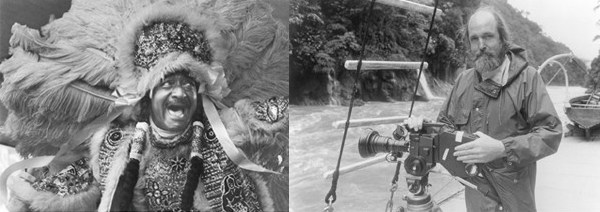
“One critic said about Always for Pleasure that it looked like it was shot by a guy wandering through New Orleans with a bottle of beer in one hand and a camera in the other,” says Blank. What the camera captures is glorious and trance-inducing. The filmmaker’s loose, intimate style comes through wonderfully in this document of New Orleans’ singular celebrations: Second-line parades, Mardi Gras, and Jazz Fest. Features live music from Professor Longhair, the Wild Tchoupitoulas, the Neville Brothers and more. Directed by Les Blank, 1978, 58 min

~New Orleans style red beans & rice will be served on the Spanish Patio between films.~

$10

TICKETS & INFO


This just in…

Star Explodes Halfway Across Universe

By THE ASSOCIATED PRESS
Published: March 21, 2008

Filed at 3:01 p.m. ET

WASHINGTON (AP) — The explosion of a star halfway across the universe was so huge it set a record for the most distant object that could be seen on Earth by the naked eye.

The aging star, in a previously unknown galaxy, exploded in a gamma ray burst 7.5 billion light years away, its light finally reaching Earth early Wednesday.

The gamma rays were detected by NASA’s Swift satellite at 2:12 a.m. ”We’d never seen one before so bright and at such a distance,” NASA’s Neil Gehrels said. It was bright enough to be seen with the naked eye.

However, NASA has no reports that any skywatchers spotted the burst, which lasted less than an hour. Telescopic measurements show that the burst — which occurred when the universe was about half its current age — was bright enough to be seen without a telescope.

”Someone would have had to run out and look at it with a naked eye, but didn’t,” said Gehrels, chief of NASA’s astroparticles physics lab at Goddard Space Flight Center in Greenbelt, Md.

The starburst would have appeared as bright as some of the stars in the handle of the Little Dipper constellation, said Penn State University astronomer David Burrows. How it looked wasn’t remarkable, but the distance traveled was.

The 7.5 billion light years away far eclipses the previous naked eye record of 2.5 million light years. One light year is 5.9 trillion miles.

”This is roughly halfway to the edge of the universe,” Burrows said.

Before it exploded, the star was about 40 times bigger than our sun. The explosion vaporized any planet nearby, Gehrels said.

http://www.nasa.gov/mission–pages/swift/main/index.html