The bee-you-tea-full MISS KK’s rainbow masterpiece will be on display at the SHOW CAVE this week, along with many amazing works of love. Closing reception for the COSMIC LOVE show next Saturday, Psychic Space Dance Party!***
Various British news sources are reporting the sad news that visionary author J. G. Ballard died this morning. From The Guardian:
JG Ballard, novelist and short-story writer, has died after a long battle with illness, his agent has said.
The 78-year-old author, who was best known for the award-winning Empire of the Sun, a semi-autobiographical novel written in 1984, and his controversial novel, Crash, later adapted into film by David Cronenberg.
His agent, Margaret Hanbury, said it was “with great sadness” that Ballard had passed away this morning after several years of ill health.
In early 2005, Arthur published a recent interview with Ballard by longtime enthusiast and counterculture historian V. Vale, whose Re/Search publishing house was just then releasing a new collection of Ballard interviews (J.G. Ballard: Conversations). Author Michael Moorcock, Ballard’s friend and sometime editor, graciously supplied Arthur with a short introduction for the piece.
Here is what Mike wrote:
J.G. BALLARD: Our Greatest Living Visionary Writer
by Michael Moorcock (originally published in Arthur No. 15/March 2005)
Born in 1930, J.G.Ballard spent his formative years in a Shanghai civilian prison camp, experiences which form the basis of his autobiographical novel Empire of the Sun, filmed by Steven Spielberg. In England he abandoned his medicine degree at Cambridge to become a technical journalist. His first stories in New Worlds, Science Fantasy and Science Fictions Adventure from 1956 including “The Voices of Time,” “Vermilion Sands” and “Chronopolis” are in The Complete Short Stories of J.G.Ballard (2002). Three novels, The Drowned World (predicting climate change), The Crystal World and The Drought increasingly reflected his interest in surrealist painting. The Terminal Beach in Science Fantasy (1964) marked a new phase, dispensing altogether with the conventions of science fiction.
Appearing in New Worlds, which by then I was editing, “The Assassination Weapon” (1966) was the first of Ballard’s “condensed novels” where iconographic personalities and events became the basis of narrative. Other stories included “The Atrocity Exhibition Weapon,” “You: Coma: Marilyn Monroe” and “Plan For The Assassination of Jaqueline Kennedy” in New Worlds and, increasingly, in literary magazines such as Ambit and Transatlantic Review. His work encountered considerable hostility in the United States, where its irony went largely undetected. Doubleday, the publisher of The Atrocity Exhibition, ordered all copies pulped after it was printed. It eventually appeared from Grove Press in 1970. Meanwhile, “Why I Want to Fuck Ronald Reagan” became the basis of a UK court case, while his “Assassination of John Fitzgerald Kennedy Considered as a Downhill Motor Race,” “lost” by his U. S. agent, eventually appeared in New Worlds and Evergreen Review.
He remains a seminally controversial writer hugely admired by the likes of Martin Amis, Salman Rushdie, Fay Weldon, Angela Carter, Iain Sinclair and most of the best science fiction writers. Described as pornographic and psychotic when first reviewed, Crash (1973) was filmed by David Cronenberg starring James Spader in 1996. Concrete Island (1974) and High Rise (1975) continued similar themes of our psychological and sexual relationship with contemporary phenomena and iconography. The Unlimited Dream Company (1979) and Hello America (1981) are enjoyable satires; his autobiographical The Kindness of Women (1991) was a sequel to Empire of the Sun. Recent novels like Cocaine Nights (1996), Super-Cannes (2000) and Millennium People (2003) continue to develop techniques describing his unique experience and his notion that contemporary bourgeousie have become the new slave class.
Today he lives in the same London suburb where he settled some 45 years ago and, as a widower, raised three children, eschewing electronics and still working at his typewriter. Combining the creative insight and originality of a modern William Blake, Ballard is our greatest living visionary writer.
April 19 — Lord Byron
Wit, dandy, into incest and man-boy love. Died fighting for Greek freedom and romantic ideals. Good poet, too.
APRIL 19, 2009 HOLIDAYS AND FESTIVALS
*Snakes Return to Ireland Day
ALSO ON APRIL 19 IN HISTORY…
1824 — British romantic poet Lord Byron dies of malaria, Missolonghi, Greece.
1943 — Warsaw Uprising begins in Jewish ghetto, Poland.
1993 — Feds end siege of Branch Dividians near Waco, Texas.
2005 — German Joseph Cardinal Ratzinger elected Pope Bendect XVI.
This Saturday, Phantasmaphile‘s Pam Grossman hosts “Mirror Horror” at the Observatory, a brand new event space in Gowanus run collaboratively by seven Brooklyn-based bloggers and artists. Trinie Dalton, Arthur contributor and creator of the multidisciplinary modern myth anthology MYTHTYM, will be giving a visually-enhanced talk on the theme of mirrors in horror films and art, followed by a book signing. Should be a grand old time!
When: Saturday, April 25th, 7pm
Where: Observatory (same building as Proteus Gowanus, Cabinet Magazine, & Morbid Anatomy Library). 543 Union Street (at Nevins), Brooklyn, NY 11215
Subway: R/M to Union Street or F/G to Carroll St. Directions here.
Admission: Free. But bring cash for wine & copies of the gorgeous book, MYTHTYM. Trinie will be happy to sign it for you.
Some more background on Trinie Dalton:
“Trinie Dalton has long made popular zines on variety of subjects. She brings together artists, musicians, critics, novelists and cartoonists in one gorgeous stew. MYTHTYM compiles the best work from her previous zines on Werewolves, mythical beings, and the natural world. But best of all, this volume includes an entirely new, 100-page body of work on the theme of mirrors. This new section will investigate the mirror as a symbolic object in horror stories. The metaphorical mirror within the scope of mental illnesses such as schizophrenia. The metaphysical implications of mirroring, especially in the ancient world of alchemy. Reflective surfaces. Disco. The mirror’s role in psychedelic, symmetrical art. The first mirrors to emerge in primitive cultures, and the roles they played in early mythologies. Mirrors as scrying tools. It can branch out from there, into light, rainbows, death, vampirism, magic. Not restricted legally to mirrors by any means. In fact if it were all about mirrors that would be too many mirrors.” — PictureBox, Inc
“Community Resources for People with Autism has served Western MA families since 1989. We are the ONLY Autism Support Center for all four counties of Western MA. We currently serve more than 990 families with new referrals coming to our agency every month. Our mission is to ensure that every individual with autism fulfills their highest potential and be fully included in their community. Due to the state budget crisis we are in danger of losing funding used to directly support families” (CRPA website)
Join us on Saturday, April 25 for a dance-a-thon/fundraiser with DJ Snack Attack (George Myers, of Breaking World Records and Grey Skull fame) and friends, amazing raffle prizes, food, drinks, and the knowledge that you are helping members of your community.
Saturday, April 25, 6pm – 12am
American Legion Club Post 224
190 Pleasant Street
Easthampton, MA 01027
Requested Donation of $20
For tickets, info, or to pledge, call (413) 529-2428 or visit the CRPA website.
ALSO ON APRIL 18 IN HISTORY…
1839 — French decadent Charles Baudelaire expelled from college.
1850 — American anarchist poet Jo Labadie born, Paw Paw, Michagan.
1857 — American lawyer for the underdog Clarence Darrow born.
1898 — French Symbolist painter Gustave Moreau dies, Paris, France.
1906 — Great San Francisco earthquake destroys much of the city.
1955 — Relativist theorist Albert Einstein dies, Princeton, New Jersey.
Above: A Zapatista, photographed in Chiapas by Shawn Mortensen. Courtesy Peter Relic.
Shawn Mortensen was a passionate photographer, activist, storyteller and human being, who expected the best out of everybody. He gave much, much more than this world gave him.
Shawn was a friend, a fellow traveler, a comrade.
It is fair to say that his personal and professional support helped bring Arthur Magazine into being, and without him there would be no Arthur. He helped me see that I could edit and publish a culture magazine—not just that I could, but that I had to—and he rallied support from others, and provided countless instances of support, much of it in private. I still have an email he sent to me and our friend Peter Relic on July 28, 2000 at 1:30am, entitled ‘MORTY”S MANIFESTD,’ [sic] which was a typically typo’d, irreverent, stream-of-Mortensen call to (publishing) arms, written from the green zone (the real one, not the one that they’d build in Baghdad three years later) where we had spent so much time together, turning each other on to stuff, generating ideas and figuring out how to get The Work done.
Shawn realized how it (culture, politics, love) all fit together; his success was in embodying it, to the degree that he could; his frustration was that others couldn’t (yet) see what he did. But of course, who could, really? Who else among us had seen as much as Shawn had—the good, the great, the bad, and the really bad? Shawn was almost over-aware.
Shawn’s photograph of Beck performing at Aron’s Records was used in Arthur’s pre-launch promotional materials. His photograph of Peaches ran in Arthur No. 1. For our ‘real’ first issue, Arthur No. 2, he photographed Devendra Banhart (possibly Devendra’s first-ever “photo shoot”?) and Genesis P-Orridge & Douglas Rushkoff. As the magazine matured, Shawn always offered his services, free of charge, in addition to his contacts, his wealth of knowledge, his archives and his moral support. That we did not collaborate further was (mostly) a matter of bad timing. I profoundly regret that we did not achieve together what we had set out to do, on the scale we had hoped for.
That said: Without Shawn, my life would be significantly different, and not nearly as good.
I am in shock that he is gone at this moment, forever.
For those who never met him, or who want to see (and hear) him today, this video shows a lot of what he was about.
Journalist Drew Tewksbury has posted a long piece from Shawn about the early to mid ’90s, composed in 2007 for Flaunt Magazine, on his website. Shawn’s writing voice was always enthusiastic, manic, exciting to read. This is no different, and I am happy that it’s been shared with us all.
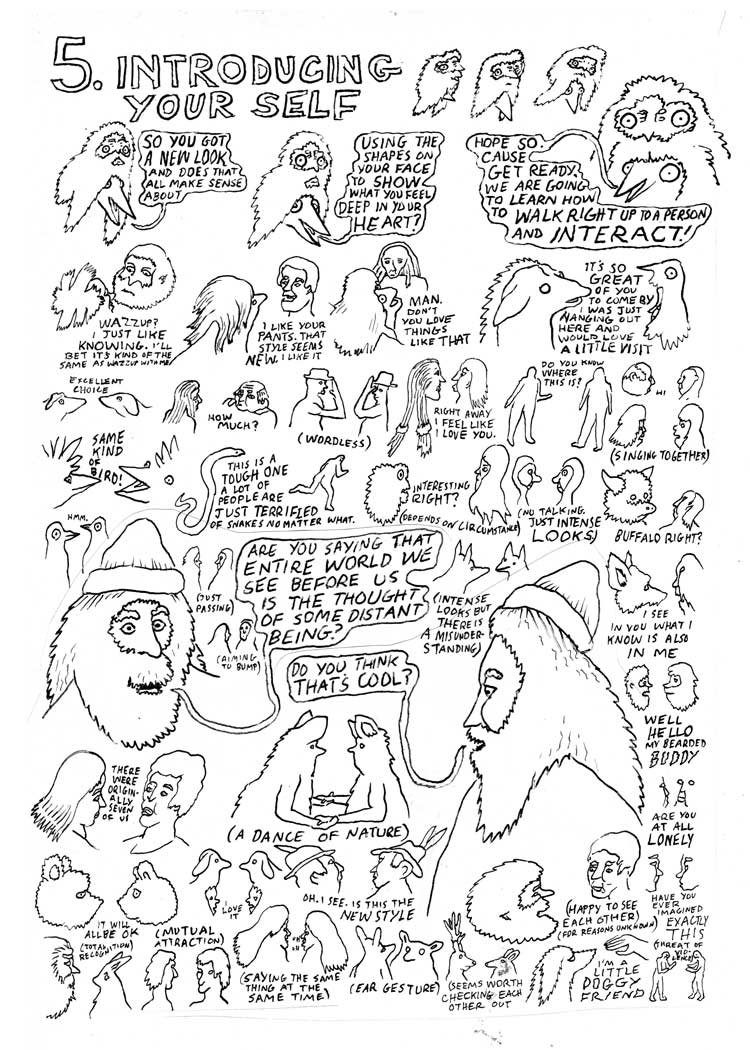
Kevin Hooyman shares the next couple pages from his new book Love to Live. This is the third excerpt, “Facial Expressions” and “Introducing Your Self.” So in this first part you’re gonna learn about your face. Once you’re feeling comfortable with that, get ready for the next section: putting your shapes out in the world and making them work for you! Uaaaaa! If you missed the first couple chapters, or if you feel you need a refresher, you can read them here and here. Hmm, did we skip anything? Let us know in the comments!
Above: Seascape by Ashley May, Acrylic on found painting
Brooklyn Artists Gym presents a recession-themed art show including paintings, drawings and other works by 7 young artists (all artwork is priced cheap to encourage sales). The opening will feature a live performance by the Acrylics and complementary refreshments. If you’ve got some extra cash, consider taking a piece home!
Date & Time: Opening Saturday, April 18th, 6-10PM (On view til April 23rd) Venue: BAG Gallery Location: 168 7th St at 3rd Ave / Gowanus, BROOKLYN 11215 Price:F-r-e-e





 Arthur Magazine