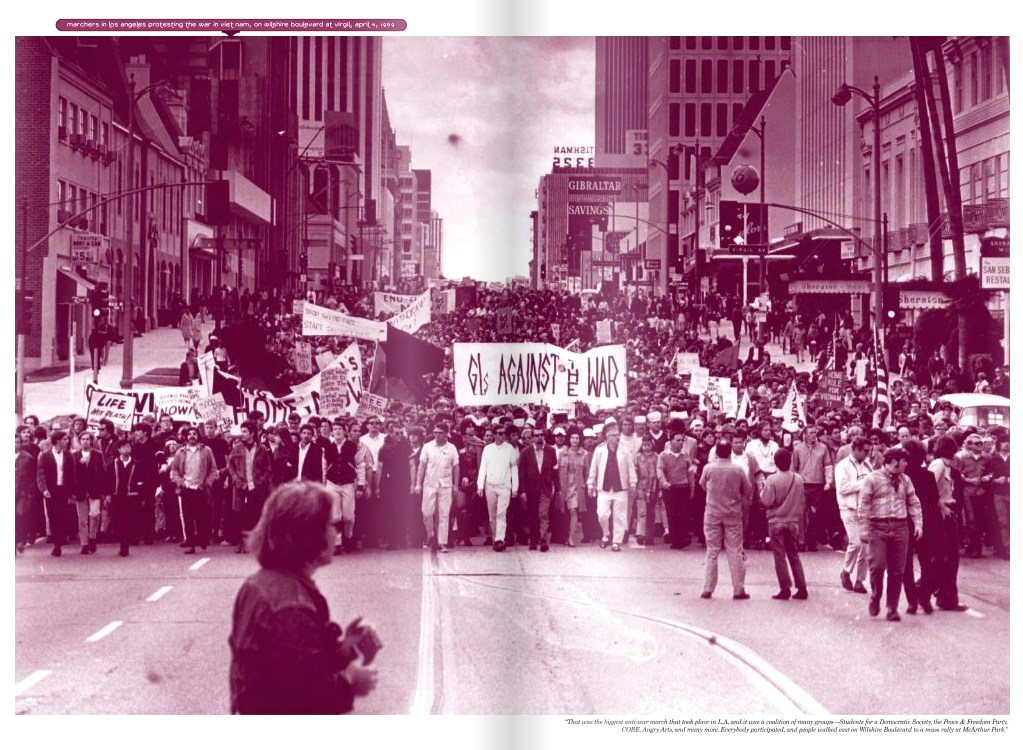
Poster-sized centerfold (17 in x 34 in) from Arthur’s January 2003 issue, published as mainstream USA was going all in to invade Iraq: an incredible, previously unpublished photograph by Charles Brittin of the April, 1969 anti-Vietnam War march down Wilshire Boulevard in Los Angeles .
Self-described “desk-bound journalist” Susan Carpenter decided to find out firsthand and feet-first how the females of the species are transforming the 21st-century circus. Now her back hurts. Photography by Lauren Klain.
Originally published in Arthur No. 2 (January 2003). Layout by W.T. Nelson.
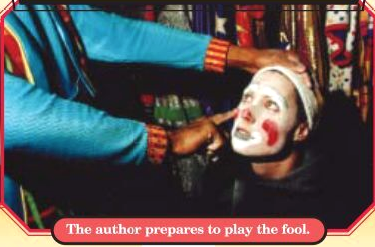
Xia Kemin has Ember pinned. He’s got her left leg lodged under a foot-thick gym mat while he presses her right ankle up behind her ear. Ember is crying. Kemin, the former Chinese acrobat who is her teacher, just laughs. He knows that pain is the only way Ember, a 20-year-old daycare worker and wannabe contortionist, will ever become the human pretzel she’s dreamed of.
Ember is a beginning student at San Francisco’s Circus Center, a school that teaches “anything in the air, upside down, backwards and humanly impossible” to aspiring circus performers. The Center is also my first stop before joining Ringling Brothers for a couple days as I attempt to figure out why women are still running away to join the circus–and whether they do anything more these days than sit pretty on a trapeze.
I’ve never been to the circus, not even as a child, but it’s getting harder to avoid it. Circus is everywhere, nudging itself into the public consciousness through books like Katherine Dunn’s carnivalesque Geek Love, movies such as Freaks and the neo-pagan art ritual known as Burning Man. I knew it had reached critical mass last summer when a friend from San Francisco asked if 20 of her friends could stay at my house while their gypsy caravan whirled through L.A. in a flourish of fire wands, wigs and stilts.
Circus used to mean men wrestling snakes while women in glittery unitards flew through the air in front of sticky-fingered children. That all changed when the flashy French Cirque du Soleil came to town in 1987, throwing mimes, bungee jumpers and Chinese pole dancers into the mix and attracting a more adult crowd. Circus hasn’t been the same since. Today, there are not only more circuses–and schools to train for them–but there’s also more women joining the circus, fusing their own sense of style with traditional techniques. The centuries-old art form, it seems, is finally getting a much-needed kick in the pants.
Originally published in Arthur No. 6 (Sept. 2003), with photography by Peter G. Whitfield, on the occasion of the Stooges’ reunion as a live force.
If you’ve never read Iggy Pop’s 1982 autobiography, I Need More, do yourself a favor and go out and buy it. It’s a totally inspiring book. Talk about triumph of the will! There he was, Jim Osterberg, a slightly built, asthmatic only child growing up in a shabby mobile home in a sleepy Midwestern town during the ‘50s. The chances of his metamorphosing into a rock avatar who would channel the id of an entire generation were not good. But Jim came in with an extra hit of the life force, and that’s exactly what he did.
Perhaps I should backtrack for a moment and recap the story so far. James Newell Osterberg was born on April 21, 1947, in Muskegon, Michigan. His father, Newell Sr., was an English teacher, and his family lived in a trailer park in Ypsilanti Michigan. When he was 15 he formed his first band, the Iguanas, which is how he wound up with the stage name Iggy. He was playing drums at the time, and after three years of practice and local gigs, the Iguanas recorded a single; the year was 1965, and the song was Mona, backed with I Don’t Know Why. A short time later he joined the Prime Movers Blues Band, an experience that prompted him to head for Chicago to serve some kind of apprenticeship with real blues guys. Eight months later he’d come to the conclusion he was barking up the wrong tree, so he returned to Ann Arbor and formed the Psychedelic Stooges with Ron and Scott Asheton. They played their first gig on Halloween in 1967.
It was then that Iggy began redefining the parameters of rock’n’ roll with a show unlike anything that had been seen before. Synthesizing elements of shamanic ritual, blues, Artaud’s Theater of Cruelty, psychedelia, and performance art, Iggy invented a frightening and transformational form of musical theater that soared into the stratosphere. A crucial ingredient in his show was his extraordinary body — a perfectly constructed skeleton with an overlay of muscle in a wrapping of taut skin — which he deployed to maximum effect. He was also hilarious. All of Iggy’s work has been inflected with a bracing current of self-deprecating humor that makes him very easy to love. Describing himself in the early days of his career in I Need More, he says ‘got gotta’ understand that I was still like Topcat, the cartoon character. I was very lazy and happiest dozing in a garbage can.’ Who can’t relate to that?
The Stooges were extreme and definitely weren’t for everyone, but incredibly enough, they were signed to Elektra Records just a year after they debuted. The next five years were a tornado of wild gigs, drugs and escalating conflict, and at the end of 1973 Iggy quit the band. His downward spiral gathered momentum, and in 1975 he suffered a breakdown that resulted in several weeks of hospitalization. His longtime fan David Bowie helped him relocate to Berlin, got him back on his feet, and produced his first two solos albums, The Idiot, and Lust for Life.
It was shortly after that, in 1979, that I interviewed Iggy for the first time. We met in his tiny room at the now defunct Tropicana Motel, and to tell the truth, I was afraid of him — his reputation at that point was rather formidable. He surprised me, though. He came across as a somewhat reserved, well-spoken man who’d clearly thought long and hard about the world and his place in it.
At the end of our meeting, he said ‘if I have any goal it’s to be an unchanging beacon in this world full of health foods and good vibes. I wish not to change.’ Twenty-four years later it seems safe to say he’s achieved that goal, and with his recent reunion with the Stooges he comes full circle. His new album, Skull Ring, includes four new songs written and recorded with his childhood pals from Michigan, along with six new songs by Iggy and his band of the past twelve years, the Trolls. Green Day, Peaches, and Sum 41 also turn up on the album, which was recorded in Miami where Iggy’s lived since 1999. (He moved there from New York following his divorce from his companion of 16 years, Suchi Asano Osterberg.) Miami seems to suit him; he seemed strong, focused and in excellent spirits when we spoke in late July. — Kristine McKenna
What is the source of your strength?
Whatever strength I have is probably the result of the fact that I made some good emotional investments at an early age. I went for a certain kind of music and maintained the naïve belief that I could do something wonderful in music, and that that would help me move towards what is wonderful in life. I looked like I was nuts at the time, and those beliefs caused me a lot of grief for a while, but it paid off for me big time.
A long time ago when we switched servers the Arthur Magazine domain code got messed up for some reason and a lot of images on the blog stopped displaying, line breaks went awry, and so on. I knew this had happened but I’ve neglected fixing it for years as it’s quite a bit of work.
But now, here we are. I’m going through and fixing stuff by hand, one post at a time. There are over 5,300 posts.
Oh gawd.
As I go about this custodial work inevitably I’m seeing lots of stuff for the first time in a while. If you want to follow along, I’ll be sharing highlights or just stuff I find interesting on my twitter feed: https://twitter.com/jaywbabcock.
I’m still doing an email newsletter called Landline. Might be moving it to Substack soon. For now, sign-up and free archive are here: https://tinyletter.com/jaywbabcock/archive
Against the Light, A Nightside Narrative by Kenneth Grant (Starfire Publishing, 1997)
“This is a terrible defect in your outlook on life; you cannot be content with the simplicity of reality and fact; you have to go off into a pipe-dream. ” – Aleister Crowley, writing to Kenneth Grant, February 15th, 1945.
As fascinating and as ultimately mystifying as a giant squid in a cocktail dress, what shall we make of Kenneth Grant? I know few occultists without at least a passing interest in his work, and I know fewer still who would profess to have the first idea what he is on about. What he is on. To open any Grant text following his relatively lucid Magical Revival is to plunge into an information soup, an overwhelming and hallucinatory bouillon of arcane fact, mystic speculation and apparent outright fantasy, as appetising (and as structured) as a dish of gumbo. The delicious esoteric fragments tumble past in an incessant boil of prose, each morsel having the authentic taste of magic, each entirely disconnected from the morsel which preceded it. Sometimes it seems as if inferior ingredients have been included, from an unreliable source: the occult data and the correspondences that simply fail to check out when investigated, knowledge that appears to have been channelled rather than researched. Doubtful transmissions from the Mauve Zone.
Spicing this delirious broth, characteristically we come across bewildering yet urgent outbursts in which Grant repeatedly protests that the eleventh degree ritual of the O.T.O involves no homosexual practices, or jaw-dropping accounts of magic workings that defy all credibility, with live baboons dragged screeching into nothingness by extra-human forces, this delivered casually, almost as after-dinner anecdote. The onslaught of compulsive weirdness in Grant’s work is unrelenting, filled with jumpy fast-cuts that remind one less of text than television: H.P. Lovecraft’s House Party. Each chapter an emetic gush of curdling chthonic biles and juices served up steaming; a hot shrapnel of ideas, intense and indiscriminate. A shotgun full of snails and amethysts discharged point blank into the reader’s face.



 Arthur Magazine