THE REDS & THE WHITES & THE BLUES by Michael Moorcock (Arthur, 2003)

THE REDS & THE  WHITES & THE BLUES

Waving the flags of empire in the 21st century

by Michael Moorcock

Originally published in Arthur No. 5 (July 2003)


“It’s not easy to get everyone against you.”

                           Imran Khan, Pakistani cricketer, April 2002

“What God hates most is arrogance. And what I see in the United States is sheer arrogance.”

                          Mullah Anar M. Anif, Peshawar, Pakistan, April 2002

“Chap in a dishdash coming through.”

                          British officer in Iraq, March 2003

BLOOD RUNS DOWN  the camera lens. The American plane has shot up a column of Kurds, US Special Forces and a BBC TV crew. “A scene from hell,” says journalist John Simpson, whose interpreter has just been killed. Some of the footage, sans the blood, is shown on American network TV for a few seconds. Most of these scenes from hell, of course, are not filmed. They are happening to people who don’t own video cameras. 

Sitting here in Texas watching BBC TV on my computer reminds me that there is no film from Amritsar except the fictional reconstruction offered in Richard Attenborough’s Gandhi. That hypocritical piece of imperial self-serving posed as an authentic account. The massacre was portrayed as an aberration rather than the norm. I also start thinking of Lawrence of Arabia, David Lean’s powerful piece of romanticized imperial history. I recall how disgusted I was by Attenborough’s other essay into whitewashing middle-class liberal sensibilities, Cry, Freedom, about the murder of Steve Bitko in South Africa. The British are good at this kind of misleading sentimentality. They’re subtler than Americans who crudely rewrite history to show themselves or versions of themselves as simple heroes, whether it’s Errol Flynn single-handedly ‘liberating’ Burma in WW2, Mel Gibson defeating the British in The Patriot, Mel Gibson pretending to be a Norman baron gone native in Braveheart, the falsifications of Blackhawk Down, or Americans (rather than British) discovering how to beat the Germans with the Enigma machine. The British are ultimately more persuasive, I suspect. They’ve had more practice at this kind of patriotic propaganda than the Americans, by and large. Everyone’s learned from Goebbels, whether they know it or not, of course.

“Chap in a dishdash…”

Dishdash?

Those of us still alert to the language of Empire remember the teenage soldiers coming home to Britain to tell stories of the tricks they played on brown civilians across the globe in the 1940s and 50s as the British slowly gave ground to angry freedom fighters in, for instance, Burma, Malaya, Kenya, Palestine and Cyprus.

Dishdash.

I’d forgotten about dishdash, which in the language of British imperialism is used as a generic for almost any Middle Eastern garment, though I hadn’t forgotten about ‘imshi’, for instance. I’ve written a bit about British colonial occupations in, my book Breakfast in the Ruins (available free on the net at RevolutionSF off the SF Site, if you’re interested). My book A Nomad of the Time Streams also dealt with the idealism of Empire and how it gets decent people to do its dirty work (that isn’t free, but it’s pretty cheap, second hand). All my writing life, in fact, I’ve been addressing the matter of Empire and I’d rather hoped I was seeing the end of that particular aggressive folly…

Continue reading

T-Model Knows Better: an advice column by life coach/musician T-Model Ford (Arthur, November 2003)

Originally published in Arthur No. 7 (Nov. 2003)

T-Model Ford says a lot. He says he’s 79 years old. He says he’s “the Boss of the Blues! The Taildragger! From Greenvillllllllle….Mississippi!“ He says he doesn’t need his cane anymore. And he says he can help us. So, every two months, an Arthur staffer calls T-Model and asks him about certain topics of the day. T-Model gives his answers over the phone, then we transcribe the conversation, with some help from Bruce Watson at Fat Possum, the Oxford, Mississippi record label that releases T-Model’s amazing albums. If you have any non-math questions for T-Model, and we suspect that you do, email them to editorial@arthurmag.com

Public school or private school? What about home schooling? Are the schools good enough for the kids these days?

Well, regular schools is good enough for ‘em. I wouldn’t put ’em in no private school. Nuh unh. It cause a whole lot of problems. But just regular school, that’d be the best, cuz it give ‘em a whole chance to meet one another and get trained with one another, get used to one another. You put ‘em in a private school, then when they get up a little higher, they don’t wanna act right. 

You take me, I never been to school a day in my life. I ain’t never been to school. I had a mean daddy, he didn’t let me go to school. He started me to plowin’ a mule when I got to six years old. And I worked all of my life since then up until say somewhere about 10 years ago. I fell and hurt myself, knocked my hip out of place on a job I was workin’ for Greenville Head & Block… I didn’t tell nobody and I just kept on workin’. Finally though it overtook me. 

You wanted to go to school?

He wouldn’t let me go to school. I had to do what he said to do or else get a beating. After he was so tough and mean to me, I just forgot about going to school. I didn’t think I’d ever learn anything, not in school. But he did learn me how to work and provide for myself. He learnt me that! But as far as readin’ and writin’, I can’t do it. 

You’ve done pretty good for someone who didn’t go to school, don’t you think?

I don’t know. I can’t tell that cuz I never had a chance to read or be in nothin’ in the schools, or be around children going to school, so… I don’t know what I lost. But I lost something. So far, as far as I done, as old as I done got, I know a heap but I just can’t read and write. 

Why wouldn’t you put a child in a private school?

Well when you get where you wouldn’t be around to carry them to private school, or for them to be in school…? I just think, really, the public school—he can go with anybody. He can visit anybody. With that private school, he can’t be with everybody cuz he don’t know if his parents are gonna have a ride for him to go, or if he’ll be where he can catch the bus to go. And he gon’ miss some. And he ain’t gonna get all what he needs to get. 

What about these people who want to teach reading and writing themselves? Teach their kids at home?

Welllllll… I was at home but I didn’t have anybody teach me nothin’! So, it’s pretty hard for me to say about that, cuz’n I don’t know.

Okay. Here’s the other question. A lot of our readers are pretty unhappy with living in the United States. They don’t like the politics. The economy is bad. It’s hard to find a job. Some of them are thinking about leaving. Where should they go? If you had to live somewhere besides the United States, where would you live?

Well, I would like Switzerland. And I would like France. Over there it look like the people are more friendly to one another than they do here. They’re not friendly [here]. It’s done got really rough. Peoples live here, they’re not friendly with one another. I don’t know what’s the causin’ of it, but they really ain’t friendly. All they know is go to somebody’s house and talk about somebody, low-rate somebody, mis-use people’s who try to help you. You don’t want that! They wanna do’s it… You helping them, they wanna be against you, do you wrong and all like that. You’ve got to have a heart to stand up to all to that kind of mess. Now I’ve got a heart to stand up and…. They do me like they wanna! And I still try to help ‘em. I’m in a situation right now, I help the woman I’ve been with six years, and it’s the other way now. They’s stealing from one another… It’s rough. 

But it seems different in Switzerland and France, they treat each other different?

There, everybody’s happy. As far as I can see, they friendly, they stick together. But here they don’t. Yeah, if I was gonna go somewhere to stay as long as I live, I’d go to either one of them places…or I would go to Sweden. 

T-Model Knows Better: an advice column by life coach/musician T-Model Ford (Arthur, January 2004)

Originally published in Arthur No. 8 (Jan 2004):

T-Model Ford says a lot. He says he’s 79 years old. He says he’s “the Boss of the Blues! The Taildragger! From Greenvillllllllle….Mississippi!“ He says he doesn’t need his cane anymore. And he says he can help us. So, every two months, an Arthur staffer calls T-Model and asks him about certain topics of the day. T-Model gives his answers over the phone, then we transcribe the conversation with some help from Bruce Watson at Fat Possum, the Oxford, Mississippi record label that releases T-Model’s one-of-a-kind blues albums (more info on ‘em at fatpossum.com). If you have any non-geography questions for T-Model, and we suspect that you do, email them to editorial@arthurmag.com

Arthur: T-Model one of our readers wrote in and said, “I’m worried about one of my longtime friends. He’s been hanging out with this woman who I know smokes crack. I’m afraid he’s going to start smoking crack too. What should I do?”

T-Model Ford: Well, be worried. If you like him, and he in it, best for you to stay away from him much as you can. Cuz you’ll get in trouble. You’ll be doin’ what he be doin’, or what the othern’ doin’. That crack helped cause a-many young people to mess up. I don’t know what it do, but some I hear say it mess the brains up. It must do somethin’ ‘cos they all want to fool with it. They wild, they don’t do right. They stay in trouble, meddlin’, breakin’ in, fightin’, do anything. I never seen none of it when [I was a young man], and I ain’t never smoked none of it. Now I done quit smokin’…quit about 20 years… I wouldn’t smoke another cigarette. Ain’t got no feeling for it. And I do good and I feeeel good. As old a man as I is, I’m still gettin’ up and goin’. 

How can you tell when someone is on crack?

I seen some of ‘em since they done got way in it. Everywhere that smokin’ that crack got a good thing going, it breaks it up. Greenville looks like a ghost town now. You don’t see nothin’ hanging around. That crack? I hate to even see anybody smoking that mess. They don’t look right, they don’t act right. They look wild and stupid. If anybody smoke it, you can tell it. In the way they acts. Get on away from ‘em. 

Is there anyway to get ‘em someone off of crack who‘s already in it?

Not hardly. Not ‘til they get in enough of a mess, then they have to get out of trouble. 

Okay. Next question. One of our older readers writes in to say, “Dear T-Model, I thought I was a good father, my wife and I have been very loving, we have a beautiful daughter, she’s 15 years old, but we’re worried that she’s started to have sex.”

Uh-ohhhhh. 

“She hasn’t admitted it to us, but we think it’s happening. We don’t know what to do. Should we leave her alone?”

Yes. Leave her alone. Cause next thing she’ll start sassin’ you, blessin’ YOU out, tellin’ you what you can’t do! What SHE can do! “I’m grown, I can do what I wanna do.” Blowin’ back. First thing you wanna hearin’. Seem you can’t raise your children now. You have to let ‘em go til they get their selves in trouble or mess up. Then they go to see anybody, but it be too late. They all do. 

Is there a way for these parents to tell if  their daughter is having sex? Can you tell? 

Yeah, you can tell. Watch the breasts. They get sassy and nasty and … Once it get started, then let ‘em get their own place to stay. That’ll whoop ‘em quicker than anything! That’s right. They’ll find out they can’t. That a home’s where they at. It’s somethin’ else. You wanna go and get out like that, remember one thing gets turned over to the Good Lord. Ever where she head, let her go. She get into somethin’, don’t get her out, let her get out the hard way. Once she get out, she’ll make something out of herself.

A reader in his late teens writes, “Dear T-Model, I gotta buy a new car. I’m just drivin’ around town. I don’t need a truck. What should I look for? You got any suggestions on what kind of car I should get?”

If you gon’ do that, just to ride around in, find you an old model. The Lincoln, if it’s in good shape when you get it, take care of it, keep the oil changed and filter changed, and it’ll last a loooong time. Or a good Chevrolet or a good Ford or a good Buick. 

You like those American cars.

Yes indeed. They all been good to me. They go longer. They last longer. And I had good safeties out of ‘em. I love ‘em. I got a ‘79 Lincoln here. It’s an antique, I want to buy an antique tag for it. It look good right now. Everybody’s trying to buy it. They want me to sell it. I told ‘em, It ain’t for sale. But still they want it. They like it. 

Now, you know how to fix cars, right?

Well I can but I’m not able now, I done got broke up by that limb. Tree fell on me and I can’t get around. Before that tree fell on me, I’d work on and build motors and everything.

How did you learn how to do all that?

Go ‘round where people workin‘, and WATCH em. Watch em. I can’t read and write, can’t spell nothin’… but I never did carry my car to the shop. 

T-Model Knows Better: an advice column by life coach/musician T-Model Ford (Arthur, March 2004)

Originally published in Arthur No. 9 (March, 2004)


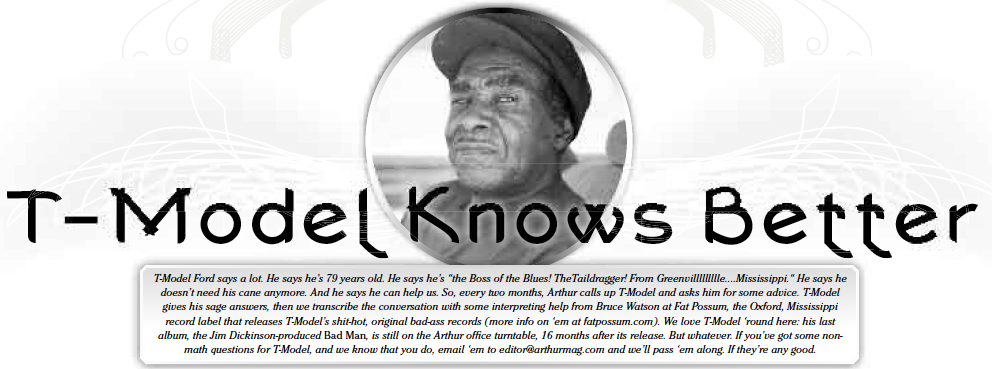
T-Model Ford says a lot. He says he’s 79 years old. He says he’s “the Boss of the Blues! TheTaildragger! From Greenvillllllllle….Mississippi.“ He says he doesn’t need his cane anymore. And he says he can help us. So, every two months, Arthur calls up T-Model and asks him for some advice. T-Model gives his sage answers, then we transcribe the conversation with some interpreting help from Bruce Watson at Fat Possum, the Oxford, Mississippi record label that releases T-Model’s shit-hot, original bad-ass records (more info on ‘em at fatpossum.com). We love T-Model round here: his last album, the Jim Dickinson-produced Bad Man, is still on the office Arthur turntable, 16 months after its release. But whatever. If you’ve got some non-math questions for T-Model, and we know that you do, email ‘em to editor@arthurmag.com and we’ll pass ‘em along. If they’re any good.

Arthur: What if you find out that an old friend of yours has been saying bad stuff about you around town. Telling people that you do business with, that you’re no good.  What should you do?

T-Model: Just let him talk, don’t have nothing to do with him. They’ll find out! That’s the way I do. They talk about me, I just let ‘em talk. But when they need something, they gotta come to ME. 

But what if you were a younger man? You know how younger men get upset: they wanna settle it with a fight. Is that a bad way to go?

Well, you got to study that yourself. Just don’t associate with ‘em, that’s the way I do. They talk about me, I don’t associate with ‘em. Then when they come running, want to talk, I say: “Well when you had a chance, you didn’t take it, so forget about it.” That’s the way I do. 

Have you always been that way? Or did you handle stuff differently when you were younger? 

No, I’ve been that way all my life. I go friendly with people if they friendly with me. If they ain’t friendly with me, I go my way and they go theirs. You take me, when I go to go somewhere around here, I get in my car by myself. I don’t be ridin’ with nobody. Can’t be nobody speaks… If they TELL somethin’, it won’t be me, it’ll be them, making up somethin’, to try to get up somethin’. That’s the way it do here. 

You ever seen a fight in a bar?

Yeah, I have seen a fight in a bar. And I have fought in a bar. 

You have? But you sound like a peaceful man.

Well, the man was pickin’ at ME! He about six foot tall, went snatching my cigarette — at that time I was smokin’ — snatched that cigarette out of my mouth, and come back to start it to me, and I met him. And I said, “Man, what you trying to do? Are you trying to start somethin’ with me?” He made a pistol break. That’s all he remember. 

You didn’t walk away.

No.

You stood up for yourself.

I thought he gonna get up but he couldn’t. It take a good-hearted person to stand up what I be standing up under, a good one. Yes indeed.

When two men don’t get along, do you think they should go to court to settle their differences then? Or should they just let it go. 

I just let it go. Go on about my business, and tell ‘em, don’t follow me. 

HOW LOUD WERE THE MC5 REALLY? Wayne Kramer, John Sinclair, Ted Nugent and Leigh Stephens (Blue Cheer) weigh in (Arthur, 2004)

“FEEEEEEEEEEEEEEEEEDBACK”

The MC5 were unbelievably intense live. They were also very, very loud (but not as loud as Blue Cheer). Wayne Kramer, John Sinclair, Ted Nugent and Leigh Stephens of Blue Cheer offer testimony to Jay Babcock.

Originally published in Arthur No. 9 (March 2004)


“Loudness was a big part of the concept,” says MC5 manager/chief theorist John Sinclair. “Our concept, as I remember, was that if you gave yourself up to the music, then the loudness wouldn’t just go through your EARS, it would go through your entire body. And if you were to immerse yourself in the sound, it wouldn’t hurt you: it would just THRILL you…

“But you could never get loud enough with those damn sound systems! It was always tough for us. You didn’t use the amplification on the amps in those days: you just amplified the singer. You didn’t mic the drums, you didn’t mic the guitar cabinets. Club owners, show promoters, teen center directors? They HATED it. The authorities hated it. They couldn’t understand why it had to be so loud. They would pull the power, threaten not to pay.”

Eventually the MC5 gained a following that allowed them to play larger local venues where they could do their thing better. Louder.

“The MC5 was the first band in Detroit to get their hands on the new line of Vox amps from England, these Super-Beetle amplifiers,” remembers Wayne Kramer, one of the MC5’s two guitarists. “They were real 100-watts amplifiers: true power. They had these gigantic speaker cabinets with four twelve-inch speakers and two metal high-frequency horns in them. No one had ever heard anything this loud before. We ratcheted the level up, we raised the bar considerably. This was when the MC5 was leaving the scale of a club band, a teen dance band, a local community center gig band, and going up to the next level, where we were playing the Grande Ballroom. That was the first place we could play them loud enough to get enough to get a good tone and didn’t clear the room. So the next step was the Marshall amplifiers, and they were, I don’t know how you quantify it, but they were twice as loud. You had twice as much speaker all of a sudden, and an even more powerful amplifier, so you’re pushing twice as much air.”

“The technology for amplifiers was progressing faster than for the sound systems,” says Sinclair. “So you go from Super Beetles to Sunns to Marshalls. The guitars would get louder and louder, heh heh heh. The singer would always be struggling to be heard in that mess.”

“There was no such thing as monitors, so we never heard ourselves sing—ever,” says Kramer. “Venues didn’t provide PA’s in those days. And the PA system would lag so far behind the guitar amplification system that it was ridiculous. So, you had to carry your own PA.  We built three or four PA systems! We had some money coming in, and we’d meet a friend of a friend who was an electronics genius. And what he’d say is, ‘What you guys need is 12 of these XL-77 amplifiers’ and we’d give the guy a pile of money and he’d come back with this big monstrosity that would catch on fire. Oh well, that wouldn’t work. And then the next guy would come along and say, ‘No what you need is these new Crown amplifiers.’ Okay, let’s try those. 

What was the point of all this? Why the need to be so loud?

“I think it was just a thing of, I need MORE: the teenage fascination with power,” says Kramer. “This was a chance to make sure that everybody in the area had to listen to ME. It’s all about ME and MY guitar playing. I even had a guy who came down and hooked up some high-frequency industrial metal horns to go on top of my amp to make it even more brutally loud.”

“Ah, feedback,” says Sinclair. “I loved feedback. Ohhhh man, that was part of the MC5’s stock in trade. Feeeeedback. Yes! Loud! Penetrating! Well, you know, the social milieu then, everything was so numb. So you wanted to feel something. And the loudness was part of it. That would make you FEEL. I think I can characterize part of our outlook that way. Ha ha ha. We were trying to shake people up. The goal was to make them feel something, to make ‘em enter a new world. Ha! And drop some acid if possible. Heheh.” 

It was a point of pride for the MC5 that they were louder than every band local band they played with… Bob Seger, the Stooges, and, of course, Ted Nugent and the Amboy Dukes.

“We kicked their asses, hundreds of times,” says Sinclair, gleefully. “We did! We loved it. They would come up pale.”

“As far as street fuck you-ness goes, they definitely had us,” admits Nugent. “There was an energy to the 5 that was nothing short of mesmerizing. It was their uninhibitedness and the fact that they focused on the sheer unadulterated middle finger quality of all their music. Where the Amboy Dukes, we wanted to make rhythm and blues songs. Really emulated the Young Rascals and Stax and Volt and Motown and James Brown and Sam & Dave and Wilson Pickett. So we were playing those kind of things. Even though the MC5 came from the same genre, really, cuz they would play It’s A Man’s World by James Brown and they’d play Papa’s Got a Brand New Bag and those kind of songs, but they’d already figured out how to just do it unlike the original black artists. They just did it like white idiots. So they were whiter than we were.”

“We’d got even louder because we started using two amplifiers on each instrument, and that was the point where it was too much,” says Kramer. “But that was the point where I knew… Well, let me tell you how I knew. Blue Cheer had come to Detroit to play at the Grande Ballroom. And they used two hundred-watt Marshalls on their guitar, two hundred-watt Marshalls on their bass. It was TOO loud. I was out in the audience, and the place was kinda empty. It was kinda exacerbated by the fact that they weren’t very good. They really just droned on. There was no dynamic to it, it just droned, but it droned at a level that was like a 747 in your face.”

“The MC5 didn’t reach the levels of volume we did,” recalls Leigh Stephens of Blue Cheer. “I really don’t know in decibels how loud we were, [but] we were louder than anyone we ever played with, not that that is necessarily a good thing. We were going for… Just the overwhelming pushing of air. If the speakers blew your hair around, it was loud enough. Hey we were kids, we thought that was cool.”

“Blue Cheer were incredibly loud,” says Sinclair, “louder than we were, but not as…gratifying. They weren’t as interesting musically, I didn’t think. But, loudness was a huge part of their aesthetic. It was pretty much what they had to offer. Ha! Nice people, though.”

“Just because something is loud doesn’t mean that it’s powerful,” says Kramer. “Intensity doesn’t come from volume. Intensity comes from focus, from the application of dynamic. So I knew when I heard Blue Cheer have two 100-hundred watt Marshalls that it was too loud. And we had two guitar players in our band, so we [had to have been] twice as loud as they were. I remember when we played in Boston once, this was at the point where we were into our two 100-watt Marshalls-each and I had people that I knew coming around who really wanted to listen to the band but they had to go stand outdoors! That’s too loud. We went through a phase when we were too loud. Too fuckin’ loud. Cleared the room. Caused people pain.”

Sinclair: “If you stood there and tried to listened to it with your ears, it would hurt. It would be ‘too loud.’ I lost some top end standing there in front of the MC5 there for a couple of years every night. But I still hear pretty good, for an old person. 

“I don’t want to hear nothing that loud now, though! Ha ha ha. Not anymore.”

##

Liars’ Angus Andrews talks about misguided angst and paranoia through the ages with Jay Babcock (Arthur, 2004)

HISTORY REPEATS ITSELF

Liars make it witchy (again). Jay Babcock finds out why.

Originally published in Arthur No. 9 (March 2004)


Liars boiled up in the midst of New York City’s earliest 21st century underground rock resurgence, when the same style-era of music — angular guitar-driven art-funk circa 1979 a la Gang of Four/Public Image Ltd./Pop Group, etc.– was simultaneously revived by several bands within miles of each other. The whys are tricky but they can also be a distraction from considering what really matters: How was the actual music? How were the performances? Did you witness something that moved you…moved you in the head, moved you in the heart, moved you in the shoulders and in the hips? In other words was this electroclash or was it something significant?

Whatever it was, Liars seem to have been the most defensive about observations that the music they and these other bands was slavishly derivative.

“That was brought up a lot, and we had not heard the Pop Group,” acknowledges Angus Andrews, on the phone one recent morning from his home in the New Jersey woods. “We went to England and someone gave us a CD of it and we listened to it and we got really depressed about it.

He laughs. Why was it depressing?

“It was all these ideas that we had that now we couldn’t do! I dunno. I listened to them once, then. Didn’t really get that much into it. Maybe it was just because…you start rejecting all these influences that people tell you that you have.”

And so, apparently resentful at being categorized, resentful at being lumped in with a herd of copycatters, resentful perhaps even towards the authority represented by the categorizing itself, Liars made a strategic redirection.

Continue reading

HIDE THE BEER: Some advice from Sue Carpenter on running a pirate radio station out of your own apartment (Arthur, 2004)

HIDE THE BEER

Some advice from SUE CARPENTER about running a pirate radio station out of your own apartment.

Originally published in Arthur No. 9 (March 2004)


It terrified my parents, amused my friends and inspired the DJs who got involved, but for me, squatting on a piece of prime FM real estate was simply a challenge—to change a system I did not like and break the mold of my overly ordinary, and earnest, existence. Here’s what I learned in the three years I was on air in Los Angeles:  

1. Don’t let a puny record collection and a laughable knowledge of music think you can’t program a radio station better than the guys who are paid to do it. 

I only owned a couple dozen records when I built a radio station from scratch and began broadcasting from my bedroom. I didn’t know much about music. I just knew what I liked—and that was exactly the problem. The only music I knew was what I heard on the radio, and most of that was over-produced shlock that was over hyped and then over played. In the ‘60s, commercial FM DJs relied on their own ears to pick music. Now it’s one-size-fits-all formats programmed by suits and spun by monkeys. There’s a lot of great music out there. If you don’t know what it is, there are plenty of people who do who’d be more than happy to clue you in.

2. Just because you’re serious about what you’re doing doesn’t mean you should lose your sense of humor. 

When I went on the air in 1995, all of the other micro radio operators in the Bay Area were broadcasting politics, not music. As a lefty liberal, I was sympathetic to their causes. Pro-environment, anti-establishment and generally angry around the edges, I’m sure I would have learned a lot had I listened to their programs. But I didn’t. After tuning in once, I tuned back out, turned off by their overly earnest discussions. Heavy subjects don’t need a heavy hand. Lightening up with humor doesn’t mean taking the subject lightly. 

3. Don’t marry your own plans. 

I had a very specific idea of how I wanted the station to sound when I started it. I wanted it to sound like college radio only better. My station wouldn’t just play indie rock—it would play only the indie rock I liked. Of course that plan was contingent on getting a bunch of DJs who shared my musical taste, which was possible. I just had to decide if that was the real purpose of unlicensed radio: to impose my musical preferences or to allow the DJs to make those decisions themselves. I decided on the latter and, in the end, wound up with programming that was far more interesting and enlightening than anything I could have dreamed up on my own.

4. If you open your private home to a public activity, prepare to be unwelcome in your own living room. 

Volunteering at a pirate radio station, DJs are prepared to encounter certain things: shoddy equipment, a limited music library, unwelcome visits by the police or FCC. But no one was ready to see the station manager wandering the premises in a baby blue bathrobe and filthy pink slippers. The sight of a freshly showered woman combing out her hair and doling out advice was a little much for some people. 

5. If you’re a woman, most people will have a hard time believing you run the show, especially when mechanics are involved. 

Whether they work as managers, programmers or DJs, lots of women hold powerful positions in radio. It’s easy to understand what they do because the stations that employ them most likely existed before they got there. But when I tell people that my radio station started with me, a motherboard and a soldering iron and grew into a round-the-clock operation staffed with more than a hundred DJs, it’s hard for them to believe.  Radio stations aren’t inherently masculine, but starting one apparently is. 

6. Never keep your refrigerator stocked, especially with beer. 

DJs get thirsty.


Sue Carpenter’s 40 Watts From Nowhere: A Journey Into Pirate Radio is published this month by Scribner’s. It is her first book.

MAKING GHOSTS WALK IN PUBLIC: the role of Brion Gysin’s Dream Machine in the consciousness exploration of the ’60s, by John Geiger (Arthur, 2003)

Making Ghosts Walk In Public

Explained: the role of the legendary stroboscopic Dream Machine in the consciousness exploration of the ‘60s. 

by John Geiger

Excerpted from: Chapel of Extreme Experience: A Short History of Stroboscopic Light, Flicker and the Dream Machine. Copyright © 2003 John Geiger. Published by Soft Skull Press. Reproduced by arrangement with the publisher. All rights reserved.  This excerpt published in Arthur No. 7 (Nov., 2003)


On December 21, 1958 Brion Gysin, a painter and writer, and at the time a resident of Beat Hotel in Paris, momentarily and unexpectedly entered the place where, in Aldous Huxley’s words, “the visual merges with the visionary.” 

Gysin was traveling by bus from Paris to an artists’ colony on the Mediterranean. As the bus passed through a long avenue of trees Gysin, closing his eyes against the setting sun, encountered “a transcendental storm of color visions.” He recorded the experience in his journal: “An overwhelming flood of intensely bright patterns in supernatural colors exploded behind my eyelids: a multi-dimensional kaleidoscope whirling out through space. I was swept out of time.” The phenomenon ended abruptly as the bus left the trees. “Was that a vision? What happened to me?” asked Gysin. The flicker experience recalled the first films he had seen as a child in Alberta in the 1920s, films using the often explosive silver halide base which gave a “magic light to the film, a flickering shimmer cut stroboscopically by the frames of each image.” Gysin immediately wrote William S. Burroughs, a close artistic collaborator, with an account of his fall out of rational space. Burroughs replied portentiously: “We must storm the citadels of enlightenment. The means are at hand.” The means, Gysin determined, would be to develop a machine to harness the visionary potential of flicker, a device that would make illusory experience available at the flick of a switch: a Dream Machine.

Once he understood the scientific explanation for his random encounter with flicker (an explanation provided in physiologist W. Grey Walter’s 1953 book The Living Brain), Gysin determined to find a way to mechanically reproduce the effect in a manner that could be mass produced. He saw in flicker the potential for human advancement. Gysin discussed it with Ian Sommerville, a mathematics student at Cambridge University and young boyhood friend of Burroughs’. Somerville had a genius for electrical improvisation, and indeed had a unique relationship with the electrical current: his thin blonde hair often stood up as if a charge ran through it, he was not fond of water and found rain oddly menacing. Gysin wanted to find a way, he said, to “make the ghosts walk in public.” 

Continue reading

SHAKE THAT STICK!: A word on magic(k) wands (Arthur, 2008)

Shake that Stick! (A Word on Magic(k) Wands)

Applied Magic(k) column by the Center for Tactical Magic

Illustration by M. Wartella

Originally published in Arthur No. 28 (March 2008)


Shorty don’t believe me? 

Then come with me tonight

And I’ll show you magic

(What? What?) Magic (uh huh uh huh)

I got the magic stick

– 50 Cent

It doesn’t matter whether you survey stage magicians, witches, or a screaming horde of pre-pubescent Harry Potter fans, the magic wand is perhaps the most encompassing symbol of magic. Equally at home in the white glove of a dapper, tuxedo-wrapped conjuror or in the clenched fist of a cackling old crone, the magic wand immediately summons a magical mood. While such depictions are still commonplace in pop culture, most folks are of the opinion that magic wands are vestiges of a bygone era.

It’s certainly true that magic wands have been around for a long, long time. Some of the earliest known examples belong to Egyptian magicians and priests from the 2nd Century B.C.—more than four thousand years ago.But for anyone who’s sat around a campfire and raised the glowing tip of a fire-kissed stick into the night sky, it’s not hard to imagine that our ancestors have been waving magic wands through the air for a good many millennia.

Over the years, wands have played a variety of roles: instruments for measurement, props for illusions, scepters for governance, and, as 50 Cent can attest, as phallic symbols noted for their procreative ability. As tools for healing we see their continued use in the hands of Reiki practitioners; however, the connection to the healing arts goes way back. The ancient Greeks, for example, used the rod of Asclepius (featuring a snake coiled around a stick) to represent medicine; a tradition still carried on by today’s medical professionals.  Ironically, the rod of Asclepius is often substituted with Mercury’s wand (two snakes forming a double helix around a winged staff), which traditionally represented both commerce and thievery, two traits often associated with the contemporary medical establishment. 

Performing magicians have employed wands in their performances for at least the last few hundred years. Waved over top hats and ornamented boxes, wands have frequently added an air of mysterious theatrics while assisting the magician in feats of misdirection. Similarly, wands in the form of scepters have also appeared in the hands of governing leaders. In this case, they can be seen either as symbols of constituent power or as fancy, but ultimately useless baubles that will never yield the positive results one hopes for. And the same could be said of the scepters.

Continue reading

Mobilizing Vehicles for Change: “Applied Magic(k)” column by the Center for Tactical Magic (Arthur, 2007)

Mobilizing Vehicles for Change

Applied Magic(k) column by the Center for Tactical Magic

Originally published in Arthur No. 26 (Sept. 2007)

Much of magic(k) is an attempt to augment our natural abilities; to provide us with a supernatural physicality to overcome the obstacles of the material world. Nowhere is this more evident than in our efforts to move our bodies and our belongings from one place to another. Even some of the most famous illusions in stage magic have focused audience attention on bewildering levitations and miraculous transpositions. From the ingenuity of our ancestors who recognized the unique properties of rolling discs and floating hulls, to more mystical means of mobility such as broomsticks and flying carpets, we often underestimate the magic(k) of re-location. The banality of modern transportation not only distances us from our point of departure but also from the journey itself. Too easily we forget that vehicles are equally the means of conveyance and the agents of transmission. 

Let’s face it. Rarely do automobiles function like ordinary tools used to simply accomplish the task at hand. Quite the contrary. Low-riders, hot rods, and pimped out SUV’s merely begin to scratch the enamel that glosses over our collective obsession with the means of transportation. Beyond the mods and custom accessories, motor vehicles themselves become points of departure, rather than the mere carriers of goods and bodies.  With names like Cougar and Jaguar, Bronco and Mustang, Thunderbird and Skylark, cars and trucks are transformed from mere technologies into totemic objects imbued with a sense of power and identity. The Cherokee and Navajo are equally stripped of any real identity as a people and forced to participate in a fetishistic masquerade. Mercury and Saturn are likewise invoked. Even Mazda shares a name with Zoroaster’s divine King of Light, the likely religious precedent for benevolent monotheism (Persia, 7th Century BC). If we look beyond the gods and planets, we see the Astro, Aerostar, and Nova (which translates in Spanish to “doesn’t go”). And let us not forget American Motor Company’s subcompact Gremlin which scratched its way into 1970s obscurity along with its ’80s offspring the Spirit. Indeed, the magic(k) of transportation lies buried deep in a veritable scrap yard of consumer manipulation, hollow fantasy and a lost sense of adventure. But we can salvage something of worth from amidst the rot.

Just as the introduction of the great iron horse changed the way travelers perceived time and distance, so too are our senses manipulated by contemporary forms of locomotion. No one can deny that we experience the world differently when we ride in a glammed-out gas-guzzling behemoth, a compact beater, or on a two-wheeled dream machine powered by our own two legs. And fewer are denying the material effects of our choices as well. Even the vestigial cynics of global warming—folks like G.W. Bush and some CEOs in Detroit—are finally acknowledging the links between climate change and fuel consumption. Perhaps this has something to do with an unpopular war that consumes nearly 400,000 barrels of oil per day just for military usage alone (approx. 144 MILLION barrels a year). Or maybe, when automakers like Ford post record losses (nearly $12.7 BILLION) they’re finally forced to reckon with the dissatisfaction and/or guilt of the consuming citizenry. Either way, we seem to be moving in the right direction, although we’ve still got a long way to go.

Technological innovations can carry us into a future either golden or grim depending on how they shape our realities. We trust enough in the laws of physics and the intelligence of engineers to ensure our confidence in the ability of a great hulking chunk of metal to float speedily though the clouds and deliver us to our chosen destinations. And rarely do we account for the great paradox of travel: our simultaneous conveyance across thousands of miles of sky while cramped practically motionless in the same small airplane seat wedged between two snoring salesmen. With the exception of the occasional trip to the toilet, we go absolutely nowhere. Yet, when we disembark several hours later we find ourselves in another land far from home. Logically, of course we understand how this happens. However, for all intents and purposes it wouldn’t really matter if the airplane were actually a sci-fi teleporter that took five hours to program once you were inside of it. In fact, it’s almost too easy to imagine a futuristic teleportation station where travelers get crammed into small seats in stuffy cabins with meager entertainment options and crappy snacks as they wait for hours for the operators to adjust all the right settings to get everyone to the proper destination.

Fortunately, we’ll probably never have to endure that bleak future. According to a de-commissioned research document funded by the US Air Force in 2004, the possibilities for teleportation are limited and fairly undeveloped. (see “Teleportation Physics Study” by Eric Davis, Federation of American Scientists) Limited, mind you; not “impossible,” “improbable” or even “non-existent.” Although the report does rule out Star Trek-style teleporters as an option, it suggests the need for additional research in psychic teleportation, worm-hole manipulation, quantum entanglement and extra-dimensional travel. It also cites Chinese studies claiming that children have been used in double-blind and triple-blind laboratory tests to successfully teleport a variety of small objects including radio transmitters, chemically-sensitive paper and live insects. Sound too weird to be true? Maybe. But the fact that the USAF actually funded the research is not the least bit in doubt since their spokesmen have publicly commented on the study in major news media. But before you get too excited, experts largely agree that we’re a long ways away from any practical applications of such theoretical physics. Still feeling a bit eager? If so, ask yourself if a teleporter truly existed, would the auto industry or Big Oil welcome it with open arms? Would it be turned into public transportation, or would it be restricted to those who could afford it at a premium? Would it be a public domain technology or would it be limited to the military for covert use long before the public was even informed?

Don’t misunderstand. Our aim here is not to promote a conspiracy theory about the secret existence of bizarre military technology. After all, why wander down a murky alley of speculation when we can cruise a stretch of established fact. Take for instance the Pentagon’s newly released “Active Denial System (ADS).” If the strangeness of the aforementioned teleportation study caused you a minor meltdown, this one’ll really fry your brain. Literally. The ADS is a giant heat-ray mounted on a military Hummer that is intended for use as mobile crowd control by beaming out a silent, invisible wave that heats up people’s skin up to half a kilometer away. This futuristic sci-fi vehicle is already developed and ready for deployment in situations where people might ordinarily be subjected to water cannons, tear gas, pepper spray and/or rubber bullets. If you thought Hummers were repulsive before, just wait until they start showing up at your local peace rally. Like most military technologies that eventually steer their way into the consumer marketplace, Raytheon is also manufacturing a commercial model they call the “Silent Guardian.” Care to invoke a “Silent Guardian” for your next birthday party, BBQ or bar mitzvah? We called Raytheon to inquire about the purchase price (in dollars, not souls) but their “business relations development associate” has yet to give us a fixed number.

The illusion of technological neutrality is left stranded by the wayside when we consider how the vehicle so often predetermines the nature of the voyage. Just as a train is limited to travel only where the tracks lead, so too can we predetermine some of the future destinations of society based on its machinations. While technology and magic(k) enhance our abilities to navigate a variety of terrain, they are not always free to embark on the path of our choosing. As such, it’s important to develop the right vehicle for the right journey, both literally and metaphorically. 

A vehicle for change does not need to be complicated. All that is required is a bit of consideration regarding where you want to go and how you might go about getting there. Obviously if you’re trying to get to a city 300 miles away, riding a tricycle isn’t the easiest way to go. Hitchhiking, jumping a train, driving, riding, or flying generally tends to be more expedient. But if the destination is less concrete, then the mode of transportation may not be so obvious. Look for existing forces that are already flowing in the direction you want to go, and harness them for the ride. The right vehicle for the right journey might just be a remote-controlled car, a smokescreen, a bicycle-repair clinic, or the rolling thunder. But it probably isn’t a giant heat-ray mounted on a Hummer.

Continue reading