
RIP JOHN LEONARD

leonard_span.jpg

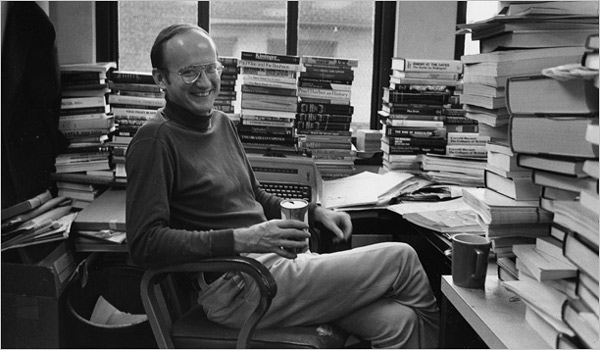
John Leonard in 1974, when he was the editor of The New York Times Book Review. (Jill Krementz)

John Leonard, 69, Cultural Critic, Dies
By MARGALIT FOX

New York Times – November 7, 2008

John Leonard, a widely influential and enduringly visible cultural critic known for the breadth of his knowledge, the depth of his inquiries and the lavish passion of his prose, died on Wednesday in Manhattan. He was 69 and lived in Manhattan.

His death, at Mount Sinai Hospital, was from complications of lung cancer, his stepdaughter, Jen Nessel, said.

Considered one of his profession’s most eminent practitioners, Mr. Leonard was at his death the television critic for New York magazine and a regular book critic for Harper’s Magazine. For many years he was a cultural critic for “CBS Sunday Morning.”

Mr. Leonard had a long association with The New York Times. In the 1970s he was the editor of The Times Book Review and was afterward a cultural critic at the paper. He contributed freelance reviews to The Times until last year.

A contributing editor of The Nation till his death, Mr. Leonard was also a past literary editor there, a post he held jointly with his wife, Sue Leonard, from 1995 to 1998.

His work was also found in The New York Review of Books, The Atlantic Monthly, The Village Voice and The Washington Post Book World, as well as on the National Public Radio program “Fresh Air.”

His portfolio took in books and television, the subjects for which he was best known, and film and politics, among other areas. Much of his work was infused, directly or obliquely, with autobiography, including forthright mentions of his struggle with alcoholism. In the late ’70s Mr. Leonard wrote a weekly column in The Times titled Private Lives, in which he chronicled doings in his Upper East Side home.

Mr. Leonard wrote a dozen books. These included several early novels and many volumes of criticism, among them “Smoke and Mirrors: Violence, Television and Other American Cultures” (New Press, 1997) and the profusely titled “When the Kissing Had to Stop: Cult Studs, Khmer Newts, Langley Spooks, Techno-Geeks, Video Drones, Author Gods, Serial Killers, Vampire Media, Alien Sperm-Suckers, Satanic Therapists, and Those of Us Who Hold a Left-Wing Grudge in the Post Toasties New World Hip-Hop” (New Press, 1999).

As a critic, Mr. Leonard was far less interested in saying yea or nay about a work of art than he was in scrutinizing the who, the what and the why of it. His writing opened a window onto the contemporary American scene, examining a book or film or television show as it was shaped by the cultural winds of the day.

Amid the thicket of book galleys he received each week, Mr. Leonard often spied glimmers that other critics had not yet noticed. He was known as an early champion of a string of writers who are now household names, among them Mary Gordon, Maxine Hong Kingston and the Nobel Prize winners Toni Morrison and Gabriel García Márquez.

Mr. Leonard’s prose was known not only for its erudition, but also for its sheer revelry in the sounds and sentences of English. Stylistic hallmarks included wit, wordplay, a carefully constructed acerbity and a syntax so unabashedly baroque that some readers found it overwhelming. The comma seemed to have been invented expressly for him.

In The Times Book Review in 2005, Mr. Leonard opened a review of an anthology of the writer James Agee with this single sweeping paragraph:

“Not every photograph ever snapped of James Agee caught him between pulls on a bottle or puffs on a cigarette. It only seems that way because the journalist/critic/novelist/screenwriter drank and smoked himself to death at 45, in 1955, at a time when postwar American culture conflated art with martyrdom and manhood with excess. Think of the poets lost to lithium, loony bins and suicide, the jazz musicians strung up and out on heroin, the abstract expressionists who slashed and burned themselves. Delmore Schwartz, Charlie Parker and Jackson Pollock pointed the way for Jack Kerouac, James Dean, Truman Capote, John Berryman, Elvis, Janis and Jimi. Like the Greek warrior Philoctetes, hadn’t they been allowed to play so brilliantly with their bows and arrows because they suffered suppurating wounds? So the iconic image, emblematic and self-destructive, was the Shadow Man — a Humphrey Bogart, a J. D. Salinger, an Edward R. Murrow, maybe even an Albert Camus. Agee, with his cold blue eyes, his thick dark hair and his handsome hillbilly Huguenot hatchet face, belonged on this wall of tragic-hero masks, at least till he inflated like a frog, from drinking alone in a Hollywood bungalow, and got kicked out of the 20th Century Fox studio commissary because he smelled so bad from never taking a bath.”

Mr. Leonard did not hesitate to be caustic when he felt it was required. He did not spare himself. Writing in The Nation, he reviewed “Private Lives in the Imperial City” (Knopf, 1979), a collection of his columns from The Times:

“It was hard enough for some of us to work up much interest in his cats and his stoop and his coffee grinder and his fondue pot and his qualms on the first go-round,” Mr. Leonard wrote, adding, “a book-length rerun is an exacerbation.”

John Dillon Leonard was born on Feb. 25, 1939, in Washington and reared there and in Jackson Heights, Queens, and Long Beach, Calif. He attended Harvard from 1956 to 1958 before dropping out to go to work; he later studied briefly at the University of California, Berkeley.

An ardent leftist all his life, Mr. Leonard worked early on as a teacher in Roxbury, a depressed Boston neighborhood; as an organizer of migrant workers in New Hampshire apple orchards; and as a community activist in Massachusetts during the “Vietnam Summer” of 1967. In an irony lost on no one, Mr. Leonard was ushered into journalism by William F. Buckley Jr., who in 1959 made him an editorial assistant on the National Review, a proud bastion of conservatism.

In September 1967, Mr. Leonard joined The Times as an editor in The Sunday Book Review. He became the paper’s daily book critic in 1969 and the head of The Book Review in December 1970. One of the signal events of his tenure there was a widely praised issue, published on March 28, 1971, devoted largely to books about the Vietnam War, many of them critical of United States policy. In 1975 Mr. Leonard became a cultural critic at The Times. He left the paper in 1982.

Mr. Leonard’s first marriage, to Christiana Morison, ended in divorce. Besides his stepdaughter, Ms. Nessel, he is survived by his second wife, Sue; two children from his first marriage, Andrew and Amy; his mother, Ruth Smith; and three grandchildren.

In 2006 Mr. Leonard received the Ivan Sandrof Lifetime Achievement Award from the National Book Critics Circle. In his acceptance speech, he thanked the writers who had occupied his time, day in and day out, for decades.

“My whole life I have been waving the names of writers, as if we needed rescue,” Mr. Leonard said. “From these writers, for almost 50 years, I have received narrative, witness, companionship, sanctuary, shock and steely strangeness; good advice, bad news, deep chords, hurtful discrepancy and amazing grace. At an average of five books a week, not counting all those sighed at and nibbled on before they go to the Strand, I will read 13,000. Then I’m dead. Thirteen thousand in a lifetime.”
Continue reading

TWO OUTRAGEOUS FILMS TONIGHT AT CINEFAMILY IN L.A.

SERIES: ROBERT DOWNEY, SR. – A PRINCE
“After being thrown out of the house, four schools and the United States Army, I discovered that I was on the right track.” – Robert Downey, Sr.

Robert Downey, Sr.’s early films are just as rebellious, reckless and fun-loving as their maker was in his youth. While perhaps best known for his advertising industry send-up Putney Swope, Downey actually emerged from the early-’60s New American Cinema scene. Breakout hits from the underground movie circuit of that era, his outlandish satires Chafed Elbows, No More Excuses and Babo 73 are as barbed as Lenny Bruce, as absurd as Alfred Jarry and as out-to-lunch as Eric Dolphy. Rough around the edges and all-around hilarious, Downey’s first films stand as landmark works in the history of independent cinema. The Cinefamily is proud to have the L.A. premiere of brand-new restored 35mm prints of Chafed Elbows and No More Excuses preserved by Anthology Film Archives with the support of The Film Foundation, alongside the recently-discovered “lost” Downey film Moment To Moment, and very rare theatrical screenings of Pound and Putney Swope.

Co-Presented by Arthur Magazine

Thursday:
11/6 @ 8pm
“Putney Swope”
shown with
“Pound”

Come to this incredibly rare 35mm screening (using quite possibly the only print in existence) of one of the legendary cinematic fuck-yous of its time. Putney Swope still delivers an brazen, acidic portrait of advertising culture during the height of the counterculture era. Putney Swope, the only black exec in his firm, finds himself unexpectedly elected its president due to a by-law messup, and turns the industry on its ear as his new Black Power-driven company churns out outrageous, taboo-breaking TV commercials (strewn throughout the film like comedic landmines). Truth and Soul, Inc. becomes the most powerful ad company in the world, giving Downey a chance to skewer across the political spectrum, as Swope rises from token black to the fascistic Generalissimo of Madison Avenue. Shot in a mix of both black-and-white and color, Swope plays out in a series of absurd vignettes perfectly sequenced for its original intoxicated audience. Pound, Downey’s barely-released follow-up to Putney Swope (a chagrined United Artists thought Downey was producing an animated feature!), is performed like a conceptual theatre piece, as as humans play dogs with nothing signifying their doggieness–no makeup, no costumes–but what they have to say and think. Trapped in an animal shelter as they await the “doggie gas chamber”, they see flashbacks of their former lives, watch TV and yammer at each other. Downey’s fast-and-loose dialogue, zany musical numbers and broad, wild performances from his large ensemble (including a five-year-old Downey, Jr.) keeps Pound consistently unpredictable and entertaining.
Putney Swope Dir. Robert Downey, 1969, 35mm, 84 min.
Pound Dir. Robert Downey, 1970, DigiBeta, 92 min.
Tickets – $10

www.cinefamily.org


A POEM FOR AMERICA IN THIS GREAT BLAZING MOMENT

Let America be America Again
by Langston Hughes

Let America be America again.
Let it be the dream it used to be.
Let it be the pioneer on the plain
Seeking a home where he himself is free.

(America never was America to me.)

Let America be the dream the dreamers dreamed–
Let it be that great strong land of love
Where never kings connive nor tyrants scheme
That any man be crushed by one above.

(It never was America to me.)

O, let my land be a land where Liberty
Is crowned with no false patriotic wreath,
But opportunity is real, and life is free,
Equality is in the air we breathe.

(There’s never been equality for me,
Nor freedom in this “homeland of the free.”)

Say, who are you that mumbles in the dark?
And who are you that draws your veil across the stars?

I am the poor white, fooled and pushed apart,
I am the Negro bearing slavery’s scars.
I am the red man driven from the land,
I am the immigrant clutching the hope I seek–
And finding only the same old stupid plan
Of dog eat dog, of mighty crush the weak.

I am the young man, full of strength and hope,
Tangled in that ancient endless chain
Of profit, power, gain, of grab the land!
Of grab the gold! Of grab the ways of satisfying need!
Of work the men! Of take the pay!
Of owning everything for one’s own greed!

I am the farmer, bondsman to the soil.
I am the worker sold to the machine.
I am the Negro, servant to you all.
I am the people, humble, hungry, mean–
Hungry yet today despite the dream.
Beaten yet today–O, Pioneers!
I am the man who never got ahead,
The poorest worker bartered through the years.

Yet I’m the one who dreamt our basic dream
In the Old World while still a serf of kings,
Who dreamt a dream so strong, so brave, so true,
That even yet its mighty daring sings
In every brick and stone, in every furrow turned
That’s made America the land it has become.
O, I’m the man who sailed those early seas
In search of what I meant to be my home–
For I’m the one who left dark Ireland’s shore,
And Poland’s plain, and England’s grassy lea,
And torn from Black Africa’s strand I came
To build a “homeland of the free.”

The free?

Who said the free? Not me?
Surely not me? The millions on relief today?
The millions shot down when we strike?
The millions who have nothing for our pay?
For all the dreams we’ve dreamed
And all the songs we’ve sung
And all the hopes we’ve held
And all the flags we’ve hung,
The millions who have nothing for our pay–
Except the dream that’s almost dead today.

O, let America be America again–
The land that never has been yet–
And yet must be–the land where every man is free.
The land that’s mine–the poor man’s, Indian’s, Negro’s, ME–
Who made America,
Whose sweat and blood, whose faith and pain,
Whose hand at the foundry, whose plow in the rain,
Must bring back our mighty dream again.

Sure, call me any ugly name you choose–
The steel of freedom does not stain.
From those who live like leeches on the people’s lives,
We must take back our land again,
America!

O, yes,
I say it plain,
America never was America to me,
And yet I swear this oath–
America will be!

Out of the rack and ruin of our gangster death,
The rape and rot of graft, and stealth, and lies,
We, the people, must redeem
The land, the mines, the plants, the rivers.
The mountains and the endless plain–
All, all the stretch of these great green states–
And make America again!

Via 3quarksdaily.

CAROLYN CHUTE: "Your community is your survival."

thechutes.jpg

The New York Times – November 4, 2008

A Writer in a Living Novel
By CHARLES McGRATH

PARSONSFIELD, Me. — The novelist Carolyn Chute doesn’t have a working phone, a fax or a computer. She writes on a washtub-size electric typewriter that was probably state of the art in the ’70s. Ms. Chute (pronounced CHOOT) and her husband, Michael, live in a small compound at the end of an unpaved road in this rural Maine village near the New Hampshire border. There are stacks of old tires in the yard, a rusted bedstead, a pen full of Scottish terriers and an assortment of well-used vehicles. A bumper sticker on Mr. Chute’s pickup reads, “School Takes 13 Years Because That’s How Long It Takes to Break a Child’s Spirit.”

Mr. Chute, who looks like a 19th-century hunting guide, spends most of his time drawing and making sculptures in an unfinished, uninsulated building he calls the security office. He has a beard of ZZ Top proportions, wears checked shirts and round felt hats, and in Down East fashion frequently uses “wicked” as an adverb.

Ms. Chute, 61, a wry, direct and earthy woman who favors bandannas, peasant skirts and stout hiking boots, works in their home, which is guarded by a sign that reads: “Woa. Visitors Turn Back.” Neither building is heated, except by wood stove, or has hot water. The compound’s sole toilet is a tin-roofed outhouse.

Continue reading