
Author Archives for Jay Babcock

SEMINAL "DIRECT FILM" SCREENINGS IN MANHATTAN AT THE DRAWING ROOM


Drawing on Film
May 29 – July 24, 2008
The Drawing Center
35 Wooster Street, New York, NY, 10013
t212-219-2166
Tuesday – Friday, 10 AM – 6 PM; Saturday, 11 AM – 6 PM
“Drawing on Film” will survey the practice of “direct film”—the process of drawing, scratching, or otherwise manipulating film stock to create images without a camera. The exhibition will present works spanning from the late 1930s to the present and will highlight an overlooked facet of experimental film. Many of the works to be exhibited are seminal films in the history of the genre—including Len Lye’s A Colour Box and Norman McLaren’s Blinkity Blank—while other, more contemporary works are being screened for the first time. By showcasing films from over seven decades, Drawing on Film will present an overview of the rich legacy of direct film.
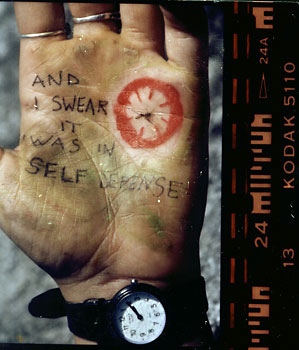
The exhibition will transform the Drawing Room into a screening room with a program of films by eleven artists that will screen multiple times each day. In addition, individual installations, one by Jennifer Reeves and one by Jennifer West, will run for one week each. Two separate evening screenings will feature works by Stan Brakhage and by Dieter Roth and Amy Granat, respectively.
Artists include: Stan Brakhage, Robert Breer, Amy Granat, Pierre Hébert, Len Lye, Norman McLaren, Bärbel Neubauer, Jenny Perlin, Jennifer Reeves, Richard Reeves, Dieter Roth, Harry Smith, and Jennifer West.
Screening Schedule
Thursday, May 29 – Saturday, July 5 (daily)
Tuesday, July 22 – Thursday, July 24 (daily)
Len Lye, A Colour Box, 1935, 4 min.; Norman McLaren, Blinkity Blank, 1955, 5:15 min.; Harry Smith, Early Abstractions no. 3: Interwoven, 1947–49, 3:20 min.; Bärbel Neubauer, Roots, 1996, 3:44 min.; Dieter Roth, Dot, 1956–62, 2:39 min; Jenny Perlin, Lost Treasures, 1999, 2:33 min.; Pierre Hébert, Op Hop – Hop Op, 1966, 3:30 min.; Richard Reeves, Linear Dreams, 1997, 7 min.; Jennifer West, Double Fast Luck Film (16mm film leader sprinkled with Red Luck Oil, Green Luck perfume, soaked in mint, cinnamon and vanilla), 2006, 2:44 min.; Len Lye, Free Radicals, 1958 (revised 1979), 4 min.; Robert Breer, Eyewash, 1959, 3 min.; Pierre Hébert, Memories of War, 1983, 16:10 min.; Bärbel Neubauer, Moonlight, 1997, 4:11 min.; Norman McLaren, Scherzo, 1939, 1:25 min.; and Amy Granat, Valentines Day Film, 2008, 6:57 min.
Courtesy BKD!
Slowing it down with Erykah…
Thanks: DCT, SFJ
WEST NILE TAKES CHELSEA
“West Nile Style”
at D’Amelio Terras
M.V. Carbon with works and performances by Cat Chow, Tony Conrad, Chris Duffy, Nicholas Emmet, Brooke Hamre Gillespie, Jay King, Severiano Martinez, Zeljko McMullen and Doron Sadja with a special appearance by Johnny Misheff
Opening reception Wednesday July 9th from 6-8pm
Summer Hours Monday through Friday 10-6
D’Amelio Terras
525 W 22nd St
New York, NY 10011
D’Amelio Terras invites Brooklyn-based, artistic performance space Paris London / West Nile to inhabit the gallery and present a group exhibition of animated objects, sound, sculptures and performance. “West Nile” is a street-level warehouse founded in October 2006 by M.V. Carbon, Zeljko McMullen and Doron Sadja. In addition to free events open to the public, West Nile houses studios used for photography, painting, video and sound. With high, arched, corrugated metal ceilings, West Nile is hot for live recording and rehearsing. Their selective program brings together an array of internationally active performers working at the forefront of visual music.
The spirit of collaboration central to West Nile’s programming will be highlighted in the multifarious display of works at D’Amelio Terras. Workspace installations will theatrically reframe active atmospheres, punctuated with live performance. West Nile produces experimental ideas in a shared site where people meet, perform, work and influence one another. This re-presentation of West Nile artists and actions aims to address new models for exhibiting time-based media.
M.V. Carbon (Violet Raid) is a painter, composer, “soundscaper and scraper”. Her recent paintings explore concepts of territory, impact and atmosphere. She is interested in defragmentation that occurs within landscape, rhythm, physiology and narrative perception. She is a co-founder of Paris London West Nile.
Cat Chow is an artist, designer, educator and performer. Her labor-intensive work, minimal in form, suggests paradoxical tensions between seduction/repulsion, beauty/desire, control/restraint and fetishism/power.
Tony Conrad is a composer, filmmaker, video artist, media activist and writer. While occasionally exhibiting and teaching, he continues to produce, perform and record at West Nile. He presents basic theoretical and practical aspects of the harmonic perception of sound.
Chris Duffy “had a hot sweaty love affair with glass blowing that lasted about four years, now they are just good friends.” His recent works incorporate electrified mixed media sculptures, drawings, machines and social chartings.
Nicholas Emmet states, “every piece of metal can be an antenna or a fork, and I want to find out which is more essential.” Through sculpture and performance, composting all the experiential remnants he can, Nicholas hopes to “nurture the neurons in our exquisitely damp and frenetic lives.”
Brooke Hamre Gillespie is an experimental artist and musical-innovator-inventor-performer-visionary. Brooke employs modern alchemy in creating new sounds through voice, various instruments and electronics that take on old forms.
Jay King is an artist, director, videographer and performer. He plays in the ensemble SYMBOL and Forrest Gillespie’s Dome Theater. He has presented solo and collaborative work at venues including Glasslands Gallery, The Juilliard School, Peabody Conservatory (Baltimore), “a goth speakeasy in Greenpoint”, the Reina Sofia Museum (Madrid) and PS1.
Zeljko McMullen studied orchestral and electronic composition and sound art/installation and is currently pursuing an MFA in Music/Sound at Bard College. He creates immersive environments with walls of acoustic and electronic sound as imaginary architecture. He is an active experimenter with both binaural perceptive beating and spatial recordings. He co-founded both Shinkoyo art + music collective and Paris London West Nile.
Doron Sadja is a sound/visual artist who studied in London, Berlin, at Oberlin Conservatory of Music and is now pursuing an MFA at Bard College. Doron creates dark, psychological collages. Visually, he uses dense splashes of color, texture and action. Sonically, he employs electronic and acoustic feedback, mutated instruments, multiple speaker arrangements and extreme frequencies. Doron co-founded both Shinkoyo art + music collective and Paris London West Nile.
For more information about West Nile and for live performances at D’Amelio Terras visit http://www.shinkoyo.com
D’Amelio Terras
525 W 22nd St
New York, NY 10011
t 212 352 9460
gallery@damelioterras.com
Bruce Conner, 1933–2008
Mea Culpa by Brian Eno & David Byrne. A film by Bruce Conner.
Mongoloid by Devo. A film by Bruce Conner.
Bruce Conner, a San Francisco artist renowned for working fluently across media, died at his home of natural causes on Monday. He was 74.
Mr. Conner was one of the last survivors of the Bay Area Beat era art scene that included Jay DeFeo (1929-1989), Wallace Berman (1926-1976), and Wally Hedrick (1928-2003).
“We were all anonymous artists here in the ’50s,” Mr. Conner told The Chronicle in 2000, shortly before the opening of his retrospective “2000 BC The Bruce Conner Story, Part II,” at the de Young Museum.
Despite an enviably long record of gallery and museum exhibitions, Mr. Conner met with little recognition outside the worlds of contemporary art and independent film. More.
PAUL KRASSNER ON STARBUCKS CLOSURES…
WE MADE IT
re: June 26, 2007 – Arthur Emergency Appeal
We made it!
Thank you to everyone who contributed either monetarily or with positive thoughts.
We are eternally grateful.
Thanks to you, not only are we able to continue publishing the magazine, we are going to be able to grow into self-sustainability in the coming months without losing an ounce of autonomy. That is a HUGE accomplishment, and we could not have done it without you. Thank you.
New issue of Arthur is out in two weeks!
More news soon!
Kisses,
The Arthur Gang
Brooklyn * Atwater * Nevada City * wherever you are
The behind-the-scenes hand of the military
Los Angeles Times – July 7, 2008
The Iraq war movie: Military hopes to shape genre
Burned by portrayals of Vietnam, the Pentagon focuses on a new era of filmmakers. ‘It’s important to tell the full story,’ says Army Lt. Col. J. Todd Breasseale, who is deployed to Wilshire Boulevard.
By Julian E. Barnes, Los Angeles Times Staff Writer
There’s a war going on, and Army Lt. Col. J. Todd Breasseale has a mission.
But it’s far removed from the captured Iraqi palace where he was once stationed. He fights his war now from an office on Wilshire Boulevard lined with movie posters chronicling conflicts real and imagined, from “Patton” to “War of the Worlds.”
Breasseale’s desk is piled high with scripts, each marked with his name and stamped “confidential.” It’s his job to help decide which movies should get Army help.
The mission is both harder and more important than it might appear.
After the Vietnam War, movies like “Apocalypse Now” and “Born on the Fourth of July” helped cement an image of psychologically damaged Vietnam veterans.
“In the ’80s and early ’90s, the Vietnam War vet was the ‘other,’ ” Breasseale said. “Hollywood had created the crazy Nam vet.”
For the Army, it was a bitter lesson.
With the country now enmeshed in another long, unpopular war, Breasseale is hoping to influence a new generation of filmmakers in order to avoid repeating the experience.
So far, Breasseale feels, most of the movies made about Iraq have really been about Vietnam.
“It is the self-licking ice cream cone of Hollywood: They make a war movie based on another war movie,” Breasseale said. “It’s important to tell the full story, not a story based on a weird Vietnam-era idea of what the military is like.”
The Army has been helping filmmakers ever since it furnished aircraft and pilots for 1927’s “Wings” — winner of the first best picture Academy Award.
With military assistance, moviemakers get access to bases, ships, planes, tanks and Humvees. Military leaders also offer script advice.
And unless a filmmaker agrees to address any problems, the Pentagon generally opts out.
Most movies involving the military have been summer action films, like this year’s “Iron Man,” which was made with Air Force help.
But Army officials are eager to work with filmmakers making serious movies about Iraq — the kind of pictures that have the power to shape the public’s view of the war and its warriors.
“In the past, have there been instances of disagreements with scripts? Yes,” said Maj. Gen. Anthony A. Cucolo III, chief of Army public affairs. “The message I would send is: Give us a try.”
The problem for military officials is that some in Hollywood see their script advice as a subtle form of censorship or an attempt to spin the war.
Paul Haggis, writer and director of the Iraq war movie “In the Valley of Elah,” said he concluded that the Army was not interested in telling honest stories about the war or soldiers.
“They are trying to put the best spin on what they are doing,” Haggis said. “Of course they want to publicize what is good. But it doesn’t mean that it is true.”
Few directors focused on Iraq or Afghanistan have approached the military for help. Haggis did.
Haggis said that after he submitted his script, the producers received 21 pages of objections to parts of the film. Haggis, who did not review the notes, said his producers told him they amounted to a refusal to participate.
“We needed their help,” Haggis said. “If they had reasonable input I would have taken it. But I am not there to do publicity for the Army. I am there to do a movie that I see as true.”
Military officers say flatly that they do not censor films.
“There is no way that we are going to go in and to steamroll anyone’s vision,” said Phil Strub, the top Pentagon liaison to the film industry. “They will just tell us to drop dead and go away.”
Officials will ask for changes, or decline to participate, if they believe military policies or practices are grossly misrepresented — especially if a movie purports to be based on real-life events, as Haggis’ film did.
Breasseale says movies about Iraq and Afghanistan have been one-dimensional.
“There doesn’t seem to be a lot of room for nuance,” he said. “What sells a script to a studio is an easy concept, like ‘This guy is crazy because he has been at war.’ ‘Easy, I love it,’ the executive says.”
Breasseale is particularly critical of Brian De Palma’s “Redacted,” a film released last year and based on a real-life incident in which U.S. soldiers raped an Iraqi girl, then murdered her and her family. Breasseale, who was serving in Iraq at the time of the incident, says De Palma’s movie intimates that all soldiers serving in Iraq are criminals.
“It was so wildly offensive to me that he would group all soldiers together,” Breasseale said.
De Palma did not respond to several requests for an interview.
Many Hollywood filmmakers reject the criticism of Iraq war movies. Haggis said he worked hard to shade his portrayals of soldiers, even those who commit heinous crimes.
“I did want to have a balanced and nuanced film,” Haggis said. “If anything, I tried to be empathetic. I try not to make these kids into villains.”
Iraq war movies as a group have not done well at the box office. Film critics have speculated that moviegoers see enough of war on the news or don’t care to watch films about an ongoing conflict. The Army suggests another possibility: The public is rejecting films that feel didactic or inauthentic.
“The public does not deal too well with being preached at,” Breasseale said.
The military has assisted with one Iraq war film that officials hope will be unlike “Redacted” or “In the Valley of Elah.”
“The Lucky Ones,” due out in the fall, follows three combat-scarred soldiers as they travel from New York to Las Vegas. The Army says the film — which stars Tim Robbins, an outspoken war critic — offers a more refined portrayal of soldiers.
During production, Robbins had a long conversation with Breasseale about what life might be like for his character, Staff Sgt. Cheever — what would motivate an enlisted man through two combat tours in Iraq.
“It captures the nuance. It is not a broad brush stroke or just about PTSD” — post-traumatic stress disorder — Breasseale said. “They manage to tell a story that is familiar but different.”
Producer Rick Schwartz agrees his film is unlike other war movies. It takes place almost entirely in America, and although it deals with the aftereffects of war, the word “Iraq” is never mentioned.
Schwartz hopes audiences draw their own conclusions about whether “The Lucky Ones” is pro-war or antiwar, he said.
Though some Iraq war movies have been influenced by post-Vietnam films, he said, makers of “The Lucky Ones” avoided Vietnam references.
“You want to be able look back in 20 years from now and say, ‘That’s what was going on then,’ ” Schwartz said. “We don’t want to make a metaphor for any other war.”
The tension between Hollywood and the Army may never fully dissipate.
But Breasseale is confident that he and officers who follow him will persuade more filmmakers to view them as a resource, not a censor.
“I am the last of the eternal optimists. I believe there is always a way to make things happen,” Breasseale said. “My job is to help filmmakers tell an accurate story and help the American public understand their Army. End scene.”
julian.barnes@latimes.com
YOUNG LORDS ORIGINS – SLIDE SHOW
Announcement: ARTHUR re-locates editorial HQ to Brooklyn.
After six years in Los Angeles, Arthur editor/publisher Jay Babcock has relocated Arthur’s editorial headquarters to Brooklyn, effective immediately.
Please direct all correspondence to do with editorial (not advertising!) matters to:
Arthur Editorial Office
Jay Babcock
339 South Fifth Street, Third Floor
Brooklyn, New York 11211
Are you based in New York City and interested in working on Arthur? Tell Jay what you want to do.
jay at arthurmag dot com
 Arthur Magazine