CROWDSOURCING THE BANK RECOVERY by Douglas Rushkoff

Crowdsourcing the Bank Recovery
by Douglas Rushkoff

March 27, 2009

I don’t believe Tim Geithner’s toxic asset auction plan will work to change the basic problem of bank insolvency, but that doesn’t stop me from appreciating the sheer brilliance and post-partisan nature of the approach.

Most commentators and economists are focusing on the way the plan distributes risk, perhaps unfairly—with the government guaranteeing most losses while giving hedge funds and investors half of the gains. But that misses the point of the whole thing.

The underlying problem with the toxic assets currently on the books of most banks is that no one knows quite how to value them. (Their market value is very low right now—lower than most believe it should be. This is what is meant by “mark to market.” In time, when things are better and the world is generally less risk-averse, they should be worth more. Most banks need their balance sheets to look better now, and they can’t while they have these—perhaps artificially—deflated securities on their books).

Continue reading

HACK MONEY, HACK BANKING: Rushkoff on the economy

HACK MONEY, HACK BANKING
by Douglas Rushkoff

March 20, 2009

I’ve received a ton of great email and response from last week’s piece [“Let It Die”] on letting the banks die and letting the market go down another 70 percent. My commentary also generated some confusion, though, so I’d like to clarify and expand on a few points. (I’ll do this again on WFMU on Monday evening, when I’ll have the opportunity to take some calls and actually converse.)

First off, and I can’t stress this enough: Commerce is good. Commerce is not the problem. Monopolies are.

Except in a few rare cases, corporate charters and centralized currency were never intended to promote commerce. They were intended to prevent locals and non-chartered entities from creating and exchanging value. They are not extensions of the free market, but efforts at extracting value from the free market. Corporate monopoly charters were extended to a king’s favorite companies in return for shares. Then, no one else was allowed to do business in that industry. Centralized currency forced businesses to run their revenue through the king’s coffers. Likewise, in its current form, centralized currency is more akin to a ponzi scheme of interest rates, each borrower paying up to the banker above him.

Both of these innovations—corporate charters and centralized currency—tend towards resource exploitation rather than innovation. They are extractive in nature, not productive. And, more importantly, these particular innovations cause wealth to end up being generated through speculation rather than creation. They cause scarcity, not abundance. Over time, it becomes easier to make money by having money than by doing anything. And this was the pure, stated intent of centralized currency and banking in the early Renaissance: to keep the wealthy wealthy, in the face of a rising merchant class.

This isn’t some extremist perspective. It’s just historical fact, though largely forgotten and seemingly refuted by our collective false memory of the Renaissance’s greatness. If you’re interested in finding out more about this, or seeing the evidence on which my research is based, take a look at the best historians writing about the era: Fernand Braudel (The Wheels of Commerce: Civilization and Capitalism: 15th-18th Century, Volume 2, Univ. of California Press, 1992), Carlo M. Cipolla (Before the Industrial Revolution: European Society and Economy, 1000-1700, WW Norton, 1994) or Bernard A. Lietaer, whose book On Human Wealth used to be available for free download off his site, but doesn’t seem to be anymore. In these books, you can find out about the sustainable local economic systems of the Late Middle Ages, learn that the Black Plague actually began after mandated centralized currency had impoverished Europe, and find support of my contention that cathedrals were built with local money before the Renaissance, not Vatican money during the Renaissance.

For reasons I cannot understand, people seem to think that my explaining this phenomenon somehow means I want us to go back to a hunter-gatherer stage. Or that I long nostalgically for a return to a late-middle-ages lifestyle. Or that I am somehow renouncing my earlier enthusiasm for new technology and media.

Nothing of the kind.

The cyberpunk ethos was actually based in the very same DIY (do-it-yourself) ethos I’m espousing now. Cyberpunk was about reclaiming technology, making modifications oneself or with one’s friends, generating value from the bottom up, exchanging goods and services in an alternative economy. I’m not saying we get rid of money—only that we learn to make it ourselves, as communities. I’m not saying we get rid of banks—only that we stop outsourcing our banking to Wall Street firms that mean only to extract value from our communities.

I have always admired hackers—computer hackers and social hackers. I’m just trying to expand the range of technologies and institutions we feel ready and willing to hack. We should hack money. We should hack banking. We should hack business. This doesn’t necessarily mean hacking the dollar, which is just one kind of closed source currency. We should hack money by coding new kinds. Bank hacking has been around for a long time—it’s just that credit unions and other local or community-based bank models were driven down by the anti-competitive practice of banking conglomerates. It’s time for those institutions to be renewed, as well.

When I say it’s okay if the Dow Jones goes down another 70 percent, I’m not calling for an apocalypse. I’m calling for the re-balancing of the speculative economy. The speculative economy owns, represents and controls a disproportionate amount of money. There are simply too many investors, traders, and brokers trying to get rich off moving pieces of paper back and forth. These pieces of paper represent shares in companies (or derivatives based on the value of these shares), and trade at valuations unsustainable by real world commerce and activity. That’s why it’s a good thing, and not a bad thing, for these valuations to move back down to a level corresponding to the revenue stream of the company. This helps the company make decisions consonant with the needs of its customers and employees—its real culture—rather than people who invest from afar, with little personal human stake in its affairs.

The banking bailout is a fiasco because it is taking money from future generations to restore the lending-based economy. I believe it would be cheaper and better to use a tiny fraction of the money to actually employ people, and to educate communities in how to rebuild local economies.

This doesn’t necessarily mean the global economy has to go away—just that it be balanced by local activity. This doesn’t necessarily mean computers go away, or that we lose our internet. We can still work in big groups making really complex stuff. We can still enjoy cities and farms, Radiohead and Britney. We can still ship refrigerators from South Korea to Australia.

It’s just that this activity would be based less on the requirements of corporate debt structures than it would on actual supply and demand. It would be a much more efficient economy, by virtue of being one that would require people to create real value. I think it’s that final part that scares people so much at the mere mention of such reforms: they think the last time people actually created value was back in the Middle Ages, when folks made shoes or raised chickens.

Well, there are many different things people can do to create value for one another. And a few people can still be bankers and brokers. Just not so many of them. Maybe about 70 percent less.

Longtime Arthur columnist Douglas Rushkoff has just finished his life’s work, “Life Inc: How the world became a corporation and how to take it back,” to be published June 2, 2009 by Random House. (Pre-order info: Amazon). His talk radio show, Media Squat Radio, broadcasts Mondays 7-8pm EDT on WFMU. Streams and archived shows at www.wfmu.org and iTunes.

Previous Rushkoff columns on the economy:
“Let It Die” (arthurmag.com, March 16, 2009)
“No Money Down” (Arthur No. 31/Oct 2008)
“Riding Out the Credit Crisis” (Arthur No. 29/May 2008)

LET IT DIE: Rushkoff on the economy (Arthur online, 2009)

Originally published online March 15, 2009

“Final Bell” by Arik Roper

(UPDATE: “Hack Money, Hack Banking” by Douglas Rushkoff, the March 20 follow-up to “Let It Die,” is available here.)

LET IT DIE
by Douglas Rushkoff

March 15, 2009

With any luck, the economy will never recover.

In a perfect world, the stock market would decline another 70 or 80 percent along with the shuttering of about that fraction of our nation’s banks. Yes, unemployment would rise as hundreds of thousands of formerly well-paid brokers and bankers lost their jobs; but at least they would no longer be extracting wealth at our expense. They would need to be fed, but that would be a lot cheaper than keeping them in the luxurious conditions they’re enjoying now. Even Bernie Madoff costs us less in jail than he does on Park Avenue.

Alas, I’m not being sarcastic. If you had spent the last decade, as I have, reviewing the way a centralized economic plan ravaged the real world over the past 500 years, you would appreciate the current financial meltdown for what it is: a comeuppance. This is the sound of the other shoe dropping; it’s what happens when the chickens come home to roost; it’s justice, equilibrium reasserting itself, and ultimately a good thing.

I started writing a book three years ago through which I hoped to help people see the artificial and ultimately dehumanizing landscape of corporatism on which we conduct so much of our lives. It’s not just that I saw the downturn coming—it’s that I feared it wouldn’t come quickly or clearly enough to help us wake up from the self-destructive fantasy of an eternally expanding economic frontier. The planet, and its people, were being taxed beyond their capacity to produce. Try arguing that to a banker whose livelihood is based on perpetuating that illusion, or to people whose retirement incomes depend on just one more generation falling for the scam. It’s like arguing to Brooklyn’s latest crop of brownstone buyers that they’ve invested in real estate at the very moment the whole market is about to tank. (I did; it wasn’t pretty.)

Continue reading

NO MONEY DOWN: Rushkoff on the rigged credit system (Arthur, 2008)

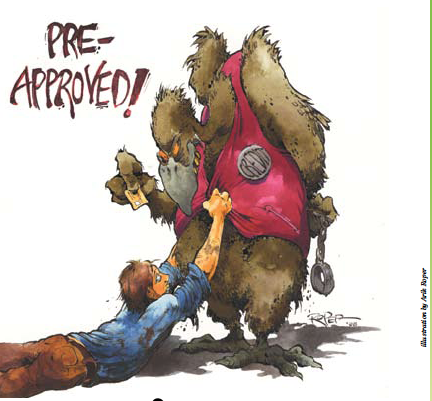
NO MONEY DOWN
by Douglas Rushkoff

Illustration by Arik Roper

from Arthur Magazine No. 31, Oct 2008

I poked my head up from writing my book a couple of months ago to engage with Arthur readers about the subject I was working on: the credit crunch and what to do about it [see “Riding Out the Credit Crisis” in Arthur No. 29/May 2008]. I got more email about that piece than anything I have written since a column threatening to defect from the Mac community back in the Quadra days.

Many readers thought I was hinting at something under the surface—a conspiracy, of sorts, to take money from the poor and give it to the rich. It sounded to many like I was describing an economic system actually designed—planned—to redistribute income in the worst possible ways.

I guess I’d have to agree with that premise. Only it’s not a secret conspiracy. It’s an overt one, and playing out in full view of anyone who has time (time is money, after all) to observe it.

The mortgage and credit crisis wasn’t merely predictable; it was predicted. And not by a market bear or conspiracy theorist, but by the people and institutions responsible. The record number of foreclosures, credit defaults, and, now, institutional collapses is not the result of the churn of random market forces, but rather a series of highly lobbied changes to law, highly promoted ideologies of wealth and home ownership, and monetary policies highly biased toward corporate greed.

keynote_ban.jpg

It all started to make sense to me when I attended Learning Annex’s Wealth Expo earlier this year—a seminar where teachers of The Secret, the hosts of Flip This House, George Foreman, Tony Robbins and former Fed Chairman Alan Greenspan [pictured above in banner from Learning Annex website] purportedly taught the thousands in attendance how to take advantage of the current foreclosure boom.

Continue reading

IT BEARS REPEATING: Rushkoff on the credit crisis (Arthur Magazine, May 2008)

“Riding Out the Credit Crisis” by Douglas Rushkoff

from Arthur Magazine No. 29/May 2008

There’s two kinds of people asking me about the economy lately: people with money wanting to know how to keep it “safe,” and people without money, wanting to know how to keep safe, themselves.

Maybe it’s the difference between those two concerns that best explains the underlying nature of today’s fiscal crisis.

Is what’s going on in the economy right now really worse than anything that’s happened in the past few decades? Are we heading towards a bank collapse like what happened in 1929? Or something even worse?

On a certain level, none of these questions really matter. Not as they’re being phrased, anyway. What we think of as “the economy” today isn’t real, it’s virtual. It’s a speculative marketplace that has very little to do with getting real things to the people who need them, and much more to do with providing ways for passive investors to grow their capital.

Continue reading

WILLING DUPES: Douglas Rushkoff on the credit crisis

“Riding Out the Credit Crisis” by Douglas Rushkoff

from Arthur Magazine No. 29/May 2008

There’s two kinds of people asking me about the economy lately: people with money wanting to know how to keep it “safe,” and people without money, wanting to know how to keep safe, themselves.

Maybe it’s the difference between those two concerns that best explains the underlying nature of today’s fiscal crisis.

Is what’s going on in the economy right now really worse than anything that’s happened in the past few decades? Are we heading towards a bank collapse like what happened in 1929? Or something even worse?

On a certain level, none of these questions really matter. Not as they’re being phrased, anyway. What we think of as “the economy” today isn’t real, it’s virtual. It’s a speculative marketplace that has very little to do with getting real things to the people who need them, and much more to do with providing ways for passive investors to grow their capital.

This economy of markets was created to give the rising merchant class in the late middle ages a way to invest their winnings. Instead of actually working, or even injecting capital into new enterprises, they learned to “make markets” in things that were scarce. Or, rather, in things that could be made scarce, like land.

That’s how speculation was born. Speculation in land, gold, coal, food…pretty much anything. Because the wealthy had such so much excess capital to invest, they made markets in stuff that the rest of us actually used. The problem is that when coal or corn isn’t just fuel or food but also an asset class, the laws of supply and demand cease to be the principal forces determining their price. When there’s a lot of money and few places to invest it, anything considered a speculative asset becomes overpriced. And then real people can’t afford the stuff they need.

The speculative economy is related to the real economy, but more as a parasite than a positive force. It is detached from the real needs of people, and even detached from the real commerce that goes on between humans. It is a form of meta-commerce, like a Las Vegas casino betting on the outcome of a political election. Only the bets, in this case, change the real costs of the things being bet on.

That’s what happened in the housing market and the credit market—which, these days, are actually the same thing. Here’s the story, in the simplest terms:

Bush’s tax cuts and other measures favoring the rich led to the biggest redistribution of wealth from poor to rich in American history. The result was that the wealthy—the investment class—had more money to invest, or lend, than there were people and businesses looking to borrow.

The easiest way to bring more borrowers into the system—and to create more of a market for money—was to promote homeownership in America. This is precisely what the Bush administration did, touting home ownership as an American right. Of course, they weren’t talking about home ownership at all, but rather pushing people to borrow money tied to the value of a house. If people could be persuaded to take mortgages on homes, real estate values would go up for those already invested (like land trusts and real estate funds) and banks would have a market for the excess money they had accumulated.

In short, there was a surplus of credit in the system. Americans were encouraged to borrow in the form of mortgages, which created demand for the credit banks wanted to sell. In many cases the credit itself wasn’t even real, but leveraged off some other inflated commodity that the bank or investor may have owned.

Banks and mortgage companies invented some really shady and difficult-to-understand mortgage contracts, designed to get people to borrow more money than they could. Banks didn’t care so much about lending money to people who wouldn’t be able to pay it back, because that’s not how they were going to earn their money, anyway. They provided the money for mortgage companies to lend, and in return won the rights to underwrite the loans when they were packaged and sold to other people and institutions.

So a bank might provide the cash for a bunch of loans, but then get it back, plus a huge commission, when those loans were packaged and sold to someone else.

Lots of people take out mortgages, and housing prices rise. This is used as evidence to convince more people that real estate is a great investment, and more people buy into the housing bubble. Lots of these people put little or no money down, and buy mortgages whose interests rates are going to change for the worse. But they believe the price of their home is inevitably going to go up, and pin their futures on the idea that they can refinance their mortgage before their rate changes. Since the house will be worth more, the mortgage for what they owe should be easier to get; it will represent a smaller percentage of the new total cost of the house.

Of course, this was dumb. Banks didn’t really care (because they weren’t holding the bad paper) but the people investing in those “mortgage-backed securities” were slowly getting wise to the fact that many of the borrowers were in over their heads. What to do? The credit industry went ahead and lobbied Washington to change the bankruptcy laws. While corporations could claim bankruptcy and stop paying for their retirees’ health coverage, individuals would no longer be able to claim bankruptcy, and even if they did, they would still owe their creditors the money they borrowed, forever. The credit industry spent over $100 million lobbying lawmakers for the new provisions.

Then, just like the credit industry predicted, loans start going bad. (The industry labels these loans “sub prime” because they want to make it look like the borrowers were somehow less-than-respectable people. But the term really just refers to a less-than-respectable loan.) As homeowners default on their mortgages, housing prices start to go down. This, in turn, makes it impossible for people to refinance their mortgages when they thought they would; in fact, now many homeowners actually owe more on their home than the home is worth. How can you refinance a million-dollar loan on a house that is only worth half that? You can’t, so instead you have to hold onto the variable-rate loan that you foolishly bought from the predatory lender. The rate rises higher and faster than you can pay it.

Lenders go ahead and start foreclosing on properties, kicking out the mortgage holders who can’t pay. But this creates another problem: what to do with the house? It’s not even worth the outstanding portion of the loan, in many cases. And even if they can sell it, how to distribute the money? No one even really knows whose mortgages belong to whom, as they’ve been sold as parts of packages, again and again, to different lenders, pension funds, money markets…you name it.

This leads to what became known as the “credit crunch” or “liquidity crisis.” No one feels good about lending money anymore because so much of it was tied in one way or another to these bad mortgages. The creditors don’t want to take possession of all these foreclosed homes, and they turn to the government for help.

Under the guise of helping homeowners “stay in their homes,” the government starts bandying about various “relief packages.” The Treasury department and the Fed are actually taking a two-pronged strategy towards fixing the problem. One prong is cynical PR, and the other is just plain stupid.

First, they want to create the illusion that something is being done, so they talk about “superfunds” to bail out homeowners, freezes on rate hikes, checks mailed to every taxpayer, and other useless gestures. They do all this to appease angry consumers and consumer advocates because they won’t want real lending industry regulation (like what Barney Frank and other progressives are pushing for) to gain any traction.

Second, they want to make more money available to the creditors (banks), so they can keep lending money—because this is their business. So the Fed lowers interest rates again and again. Banks get more money, and guess what? We’re back where we started: with tons of money and nowhere to invest it! By lowering the “prime lending rate,” they simply add to the surplus cash that created the problem in the first place.

Of course, both measures serve to stave off panic selling, because it seems as though something real is being done. Homeowners may get a slight delay in the paralyzing rate increases on their mortgages, giving banks and creditors the chance to make a more orderly exit. They will bail from these mortgages while selling the artificially secured credit to the likes of you and me through money market accounts and other retail products. They just need time to make sure the real losses trickle down to someone else.

And remember: this whole mortgage fiasco is just a little preview of what happens next year when the credit card industry faces the very same self-imposed “crunch.” In the case of mortgage lenders, at least the terms of the loans were disclosed. Credit card companies—which are some of the very same banks that are in the mortgage mess today—are busy rewriting their policies, increasing rates, and adding fees to the policies of people already in debt to them.

You know those little ‘inserts’ in your credit card bill? Read them, and you’ll find out, like I did, that some credit card companies have begun charging interest on your purchases from the moment you make the purchase. You pay finance charges even if you pay your whole bill every month. Most people carry big balances, so they won’t notice the additional charges, or at least that’s what the credit card companies are—quite literally—banking on.

* * *

After a certain point, consumers just won’t be able to pay their bills. Even though they’ve paid the cost of their purchases several times over, they’re simply buried in interest and interest on the interest, sometimes compounding at a rate of 30 or 40 percent per year. The creditors know this, which is why they’ve sold a lot of this debt to other banks, pension plans, money market funds…you get the picture: the kinds of places where we invest our retirement money. The banks invested in us; we were the assets. Now that we’re about to go broke, they’re busy selling us to other financial institutions in a game of musical chairs that will cost the last debtholder a lot of money. Of course, unless we can convince some foreign sheiks to buy some lousy US assets with their oil money, that last debt holder will end up being you and me.

Over the past few months I’ve spoken to top strategists at some of the biggest banks in the world, and they share my perception of the scenario. Most of them are “holding cash” as their main investment strategy, spread out over a few of the major currencies. Those making money are doing so by short-selling shares of other companies in the same finance industry that they supposedly work for.

The bigger picture, of course, is that speculation just worked too well for too long. The disparity between the market values and real values (rich people and poor people) got too large. Every asset class, even money itself, got too expensive. We became more valuable for our borrowing power than our labor—which also meant there was no way to work off our debt. Meanwhile, the people using reality as an investment vehicle have overwhelmed the real economy on which their “structured investments” are based.

Sure, this has happened before. It’s just that, traditionally, when wealth disparity got too great and there wasn’t enough money in the right places, the wealthiest bankers temporarily suspended their greed to bail out the system. Or progressive tax policies opened corporate coffers, permitting a “New Deal” that employed people while rebuilding the infrastructure required to make real things and provide real services to citizens.

Today, however, such temporary restraints on greed are systematically untenable and philosophically unthinkable. Conservatives are still so angry about New Deal reforms of the 1930s that that they have infused politics and banking with an economic ideology that sees any regulation of worker exploitation or predatory investment as anti-capitalist, anti-American, and even anti-God.

So instead we are the beneficiaries of “wink” reform: stuff that’s supposed to make us feel good while reassuring the speculators that their interests will remain paramount. A few hundred dollars mailed to every American family creates the illusion that government is lending a helping hand, but this money is not redistributing anything. It’s being taken from the same people who are receiving it, in the hope that they’ll just pump it back into the system at Wal-Mart or the Exxon station.

Whether the coming economic crisis will be deep or shallow is left to be seen. We may be at the start of the kind of depression our grandparents lived through in the ’30s, or we may simply experience what our parents lived through back in the ’70s. Foreign investment trusts may come in and buy our biggest banks and turn us into global citizens through the very World Bank policies we were hoping would turn all of them into US vassals.

Whatever the case, the best thing you can do to protect yourself and your interests is to make friends. The more we are willing to do for each other on our own terms and for compensation that doesn’t necessarily involve the until-recently-almighty dollar, the less vulnerable we are to the movements of markets that, quite frankly, have nothing to do with us.

If you’re sourcing your garlic from your neighbor over the hill instead of the Big Ag conglomerate over the ocean, then shifts in the exchange rate won’t matter much. If you’re using a local currency to pay your mechanic to adjust your brakes, or your chiropractor to adjust your back, then a global liquidity crisis won’t affect your ability to pay for either. If you move to a place because you’re looking for smart people instead of a smart real estate investment, you’re less likely to be suckered by high costs of a “hot” city or neighborhood, and more likely to find the kinds of people willing to serve as a social network, if for no other reason than they’re less busy servicing their mortgages.

The more connected you are to the real world, and the more consciously you reject the lure of the speculative ladder, the less of a willing dupe you’ll be in the pyramid scheme that’s in the process of collapsing all around us at this moment.

Think small. Buy local. Make friends. Print money. Grow food. Teach children. Learn nutrition. And if you do have money to invest, put it into whatever lets you and your friends do those things.

Douglas Rushkoff writes books about media, technology, and values. He’s currently working on a project called “Corporatized,” which will explore how chartered corporations disconnected us from reality. rushkoff.com


RUSHKOFF on 9/11 conspiracy theorists

CONSPIRACIES OF DUNCES
by Douglas Rushkoff
(from Arthur No. 26)

I have to admit that I do this with some trepidation. I can already feel the assault on my inbox. But after a good long think about potential time and energy being lost by our entire community to senseless and ultimately inconsequential musings, I have to come out and say it: the alternative theories about 9-11 are wrong. Worse, the endless theorizing and speculation about trajectories, explosives, military tests, fake airplane parts and remote control navigation actually distracts some of our best potential activists from addressing the more substantive matters at hand.

Yes, I believe that 9-11 theorizing debilitates the counterculture. It robs us of some potentially creative thinkers. It replaces truly important questions with trivial ones. It marginalizes more constructive investigation of American participation in the development of Al Qaeda as well as its subsequent aggravation. And perhaps worst of all, it is precisely the sort of activity that government disinformation specialists would want us to be involved with.

9-11 theorists are unwittingly performing as the unpaid minions of the administration’s propaganda wing. (At least most of them are unpaid; no doubt, some of the loudest are working as contractors for the same agencies whose activities they pretend to deconstruct.) That’s why, instead of nodding along with their long-winded, preposterous yarns under the false belief that any critique is better than no critique, we—the informed, intelligent, and reasonable members of the war resistance—must instead disassociate ourselves from this drivel. In other words, we must draw the line between the kind of analysis done by Greg Palast and that done by Pilots for Truth. If we don’t apply discipline to our thinking, we risk falling into the trap that even some of our best intellectuals have—like Harper’s editor Lewis Lapham, who on reading a bit too much 9-11 conspiracy, has concluded that it all has some merit.

I’m all for supposing. It’s how the best science fiction gets written, the best science gets speculated, the best innovations get developed, and the wildest thoughts get hatched. But forensics is a different beast. As any detective will tell you, the most straightforward solution is usually the right one. As one NYPD detective explained to me, “Nineteen hijackers took four planes and crashed them at different places: WTC 1, 2, the Pentagon and a field in PA. These accounts broadly correspond to all that was observed and heard that day, who was on the flight manifests, where they came from and what they claimed to want to do, and yet do not involve vast US government conspiracies and do not need the coordinated, perfect lying of tens of thousands of people about the mass murder of their fellow citizens and those they gave their oath to spend their careers protecting.”

True enough, these huge incidents have produced many unexpected details. The plane in Pennsylvania scattered its parts differently than we might have expected it to. Lamp posts near the Pentagon got knocked over when we wouldn’t have thought were vulnerable given the altitude of the approaching plane. Building number 7 fell hours later, even though it was never directly hit by a plane. Video photography of the collapses show the towers falling quite neatly, as if in a planned detonation.

But strange and unexpected details don’t necessarily point to the fallacy of the central premise—especially when the alternative involves the active coordination of thousands, if not tens of thousands of citizens in a conspiracy to attack the United States. We must look at what each intriguing detail or inconsistency actually says about how the crime took place. Again, in the words of my favorite member of the NYPD, “These explanations are principally based on the fatally flawed idea that any confusion or misinterpretation or differing accounts in times of crisis must be the product of purposeful lies. They neglect the idea that in crises, and when there is mass confusion, people do not have specific recollections, only general ones that are highly subjective, such as what direction a plane sounded like it was coming from. Their stories seek to poke holes in prevailing truth, yet offer no alternative that could be seen as remotely plausible.”

For example, the Pilots for 911 Truth website explains: “Why was Capt. Burlingame, a retired Military Officer with training in anti-terrorism, reported to have given up his airplane to 5 foot nothing. 100 and nothing Hani Hanjour holding a “boxcutter”. (Exaggeration added for size of Hani, he was tiny, lets just put it that way). We at pilotsfor911truth.org feel the same as his family in that Capt. Burlingame would not have given up his airplane unlike what is reported in this linked article from CNN.”

What, exactly, is this supposed to mean? Was Captain Burlingame murdered? Or was he the willing participant in the government’s effort to sell the invasion of Iraq to America—so much so that he chose to enter into a suicidal pact? Or was the hijacker bigger than his passport suggests? Or is it implausible that a small dark man from an undeveloped country was able to overpower a big, trained, white man from a Superpower?

And that’s where I suspect all this theorizing really takes us: to the heart of a racist jingoism worse even than the triumphalism justifying our foreign policy to begin with. They can’t bring themselves to accept that our big bad government can really be so swiftly outfoxed by a dozen relatively untrained Arab guys. And rather than go there, they’d prefer to maintain the myth of American hegemony. On a certain level, it feels better to believe that we are only vulnerable by our leaders’ sick choice—not by our adversarsies’ increasing strength and prowess.

But maintaining this comforting illusion comes at a price. It paralyzes our ability to do the real work necessary to parse what is going on. I mean, on a certain level, what does it matter whether Osama Bin Laden, a CIA-trained former ally is currently acting on his own or as an operative of some covert semi-governmental organization or corporation? We can’t even begin to ask these questions when the people who might be most qualified to look into them are instead crippled by their own ethnocentrism.

The cultivation of a critically aware public is too important right now for us to entertain this silliness any longer. When a full 40 percent of the American public believes that Saddam Hussein was responsible for 9-11, we can’t afford the luxury of this delusional behavior. We are the alternative to the FoxNews version of events, and we must strive to present a more responsible alternative to Karl Rove’s disinformation.

The war profiteers are absolutely delighted that so many of us are still distracted by this phantom menace. And they delight in our belief that the central government is really powerful enough to pull something like this off. I’ve been interacting with intelligence people for the past three years, going to conferences and writing articles promoting an open-source approach to national security. After these encounters, I can assure you—anyone who knows anything about our government knows that a conspiracy on this order is well beyond their capabilities. Hell, the administration couldn’t even “find” weapons of mass destruction in Iraq. They can’t even reveal a Valerie Plame or fire the few remaining honest US attorneys without a complete backfire. Conspiracy is not what these folks are good at.

Our government excels at doing its really bad stuff out in the open. They break laws in order to spy on citizens, and refuse to acknowledge objections from lawmakers or justice. They take taxpayers money and give it to the companies they run. They acknowledge the many billions of dollars that go missing, and offer not even a shrug. They put the people who formerly lobbied on behalf of industries in positions running the agencies that are supposed to be regulating them.

By looking under the rug for what isn’t even there, we neglect the horror show that is in plain view. In the process, we make it even easier for the criminals running our government to perpetuate their illegal, unethical and un-American activities.

In fact, the most logical conclusion I can draw from the existing evidence is that 9-11 theorists are themselves covert government operatives, dedicated to confusing the public, distracting activists from their tasks, equating all dissent with the lunatic fringe, and provoking the counterculture’s misplaced belief in the competency of its foes.
That’s the real conspiracy.

"Net Loss" by Douglas Rushkoff

(intended for publication in the cancelled Arthur Vol. 1, No. 26 [March 2007])

NET LOSS
by Douglas Rushkoff

I’m a bit down on the Internet these days.

Sure, a lot of it has to do with that obsequiously pandering Time magazine cover—the one with the little mirror on it telling us all that each of us is the “person of the year.” That is, each of us connected to the Internet and throwing our photos and personal consumer histories up on the web for everyone to see. We’re supposedly undergoing a revolution because now, instead of paying for movie tickets, we can pay for computers, hard drives and access time—often to the very same media conglomerate we think we’re ripping off.

And some of my misgivings have to do with a recent mistake I made myself, posting to my weblog the fact that I had gotten mugged, and how that had caused me to reflect on my own participation in the gentrification of my part of Brooklyn. Diehard Brooklynites (no doubt harboring mixed feelings about whoever they may have displaced in order to live here and make it “cool” instead) went on something of a rampage against me, posting all sorts of nonsense on bulletin boards about how Rushkoff was leaving Park Slope because he’d got mugged. A few real-world newspapers even quoted fake postings in the comments section of my blog, mistakenly attributing those posts to me.

Adding insult to injury, some Zionist extremists (or their paid online shills) who don’t like me took the opportunity to create a “sock mob” effect —a term I coined to describe how one or two people can post dozens or even hundreds of comments online under different pseudonyms to make it look like there’s a mob of people agreeing to hate a particular person or idea. (Think Swift Boat Veterans, on a much smaller scale.)

So the Internet—the place where I actually grew up as a thinker and writer—was no longer a safe place for me to engage with others about the ideas that are most personally important to me. Even the “discussion” in the unmoderated comments section of my blog could at a moment’s notice turn as mean, vitriolic and ultimately fake as any conversation taking place anywhere online. The Internet didn’t elevate our discourse—it left us in the same pit we were in to begin with. In fact, the ability to conceal one’s identity, combined with the ability to attack others without ever looking them in the eye, has made discourse on the Internet even more prone to cruelty than in real life.

Meanwhile, on a daily basis, my inbox fills with messages from people I know and people I don’t. Everyone expects an answer from me the same way they expect an answer from the customer service department of the Gap. At least from me they get one. But am I making the most considered response I can? Of course not— for the most part, I’m simply trying to get through the stack of email and respond as sufficiently as necessary. But that’s not the way I want to interact with anyone—even if they’re treating me like the complaints desk. And it undermines the quality of the remaining exchanges with people whose queries really do merit consideration and response.

And all this keyboard activity has become quite draining. Back in the ’90s, I would log off the Well or a Usenet board feeling exhilarated by what I had learned and who I had “met.” Today I can’t get off the Internet fast enough. It’s as if my very chi is being absorbed by this pulsing datastructure—an avatar of the combined will of both humanity and the marketplace on each one of us.

We can’t help but want to respond when people reach out to us by email or on a discussion board—after all, there’s a real person on the other end of each transmission. But for me, anyway, it feels as if the transmissions themselves have been stripped of all prana—of all the nutrients otherwise associated with organic exchange. Think of the difference between teaching a person in a real bar how to play pool, and describing to someone in an email “how to play pool.” Almost the same information can be exchanged, but without any contact. Now, it’s not the lechery of live pool instruction I miss. Not exactly. What I miss is what one gets back during an exchange in person. The joy, the contact, the full range of subtle communication, is gone.

I’d argue that the data we’re exchanging —from pool lessons to political theories—are themselves just media for our social interactions. Yes, it’s great to have a cause to rally around, but for the most part these causes are excuses to rally. In our highly rational, highly time-pressured schedules, we need excuses to be with each other, from the woman taking a French class in the hopes of finding a husband to the guy taking yoga to check out girls in tight sweats. Somehow, the Internet convinces us that the content we’re exchanging is the end in itself—when it’s actually just a means to an end. And that end will never be found online.

I’ve been saying since the late ’80s—before the Internet really existed—that our networks are not a thing in themselves. They are a trial run, a social experiment: a way of practicing collective social engagement so that we might see whether or not such a thing is possible in real life. The Internet of the early to mid-’90s really was such a collaborative space, and a few of the projects that remain from those days, from Wikipedia to Craig’s List, still bear some resemblance to that earliest ethos of provisional collectivism.

But Wikipedia has now fallen victim, to some extent, to politicians and others with agendas, who change entries about their opposition to make them look bad. And Craig’s List has become increasingly difficult to patrol for scams and ruthless profiteers. Each organization has to spend more time and resources preventing abuse than it does doing the thing it originally set out to do. And that’s pretty much the definition of the “point of diminishing returns.”

I’m not signing off the Internet just yet. I need it for all the same reasons all of us do. But I no longer assume as much about the experiences I’m going to have online as I used to. I don’t take for granted the existence of a community on the other side the screen. I don’t read my email before my morning coffee—I wait until I’ve got my best psychological defense mechanisms in place. I don’t socialize online; I make appointments to socialize (as time allows these days) offline in some real place. Or even on the phone, which feels intimate compared to the asynchronous communication via computer screen.

I still refuse to believe the experiment in developing a virtual culture has failed. Even if the Internet doesn’t foster the gentle, compassionate, and open-minded society we might like to see in the real world, its descent into heated polarities, exhibitionism and profiteering should serve as an example of how even our best intentions can be undone. It makes us aware of how easily manipulated we are, how prone we are to excitation of the basest kind and how desperately we want attention from others. That is, each of the things we may dislike about the Internet—from its extreme forms of marketing to the cruelty and humiliation that pass as entertainment—are merely exaggerations of our tendencies in real life. But the Internet allows those tendencies to be rebroadcast and absorbed by us as if they were real—and they go on to influence the actions of individuals, organizations, corporations and governments in the real world.

People see an erroneous, venomous post somewhere, and can’t help but take in some part of that sentiment as justified or factual. Hell, I’m still getting emails from friends asking why I’m moving to Long Island, or why I denied the Holocaust—both completely fictitious constructions of anonymous Internet users that nevertheless trickle back out from the virtual world into the real one. A music reviewer I know became the recipient of death threats by phone and email after a band whose album she panned invited its fans—via their website—to go on the rampage. And we writers are a hell of a lot less victimized by these sorts of fabrications than the artists, scholars and activists who really stick their necks out, from Paul Krugman and Noam Chomsky to Tony Kushner and Al Gore.

The more monstrous thought-forms constructed online needn’t be allowed to feed back into the real world any more than the monsters of our nightmares need to invade our waking lives. They only lead to equally artificial extremes of thought and behavior — dangerously divorced from local, organic and social moderation. They grow into false polarities like the red-state/blue-state divide; they foment antagonism over religion and race; and they give license to the most ruthless marketers and profiteers.

Rather, we must remember that the expressions thriving in the online universe have been divorced of their connection to the flesh, the heart, and the neo-cortex.

Consumed in their raw form, many of them are toxic.


"The Light at the End of the Reality Tunnel" by Douglas Rushkoff, from Arthur No. 25/Winter 02006

“The Light at the End of the Reality Tunnel”
by columnist Douglas Rushkoff

(Originally published in Arthur No. 25/Winter 02006)

This has been a very bizarre couple of weeks for me. I changed literary agents, did a bookstore discussion/debate with former Arthur columnist Daniel Pinchbeck, learned of Robert Anton Wilson’s dire end-of-life financial predicament, and then left my wife and 21-month-old daughter to fly to Germany (where I am right now, stuck in an airport thanks to a canceled flight) to give a talk to a big magazine conglomerate about what makes their publications relevant in a mediaspace fast migrating online.

And I’ve found myself alternatively inspired and unnerved, about each and every one of these events. I feel their connection on an emotional level —as if the microcosm in which I’m participating reflects a greater theme. Like an archipelago, this seemingly disconnected string of islands is all connected beneath the surface. And that connection is about how we make value—for ourselves and one another.

Take the Pinchbeck event. Now it’s no secret to Arthur readers that he and I come from different ends of the spiritual spectrum. When he was writing columns in these pages about channeling the wisdom of Quetzalcoatl, I was warning the same readers not to take any prophecy too seriously—and certainly not literally. Then, I ran into Daniel in a coffeeshop just a week after a particularly critical screed on him and the “psychedelic elite” came out in Rolling Stone—an article in which I was quoted on the value of communities over heroes.

We concluded that a face-to-face discussion was in order, and figured we might as well do it in public. So Daniel asked a bookstore where he was scheduled to speak if we could turn it into a two-man show. Almost as soon as the discussion was announced, email started coming in, asking how I was going to “take him on” or “take him out”—the assumption being that we’d have a take-no-prisoners debate. And while I’m certain we’ve pissed each other off over the years, I thought the point of mixing it up a bit would be to learn something from one another. Find common ground. Meanwhile, we’d end up bringing together a rather unlikely audience of media students, recent Burning Man returnees, psychedelics enthusiasts and comics readers. In business terms, we were “creating value” for one another and our separate readerships by introducing them to each other.

I’ll admit, the event both inspired and disturbed me. Sure, the assembled crowd was varied and eager. But the conversation itself was too competitive, no matter how I intended otherwise. All I meant to show was that we each have our own reality tunnels – and that no matter how spectacularly “real” something may appear, especially on super-strong shamanic entheogens, it’s just one metaphor for whatever it is that might really be going on. None of us knows what happens when we die, whether there’s anything or anyone else “out there,” or whether the connections we seem to perceive all around us are conspiring or coincidental.

Daniel tended to dismiss my points he disagreed with as “thoughts,” to which I finally snapped that “everything we’re saying is just thoughts, buddy.” I leave it to you to choose who of us is more Zen, but my lasting impression of the conversation was that we didn’t quite transcend the zero-sum game as I had imagined we would. It was still just two white guys with microphones, competing for mindshare and the marketshare that goes along with it. Had I been used simply to get more people to show up at his book signing? Was I seeing in him the qualities I dislike in myself? Why should such misgivings even arise?

Then came word from a truer pioneer of mind and cosmos than either of us, Robert Anton Wilson: his post-polio syndrome had gotten worse, and the attendant medical bills combined with some trouble with the IRS had tapped him out. He was three days away from not being able to make his rent.

Say what? Robert Anton Wilson, author of Cosmic Trigger and Prometheus Rising, the guy who put the number 23 on the map, and delightfully upgraded the minds of thousands if not millions, forever, could no longer support himself? For those who may be unfamiliar with his work, Wilson is the man who put the many insights of Sixties into perspective. By approaching the seeming interconnectedness of everything with a grain of salt and two grains of humor, he’s helped to demonstrate the value of seeing one’s own reality tunnel for what it is: a limited take on a much greater whole. Rather than getting lost in any particular tunnel (or, worse, pushing it on other people) the object of the game was to learn to move between them.

On learning of his predicament, I felt an anger welling up. I refused to be a member of a generation that could allow an author and philosopher of his caliber to die penniless in a state hospital, so I dashed out a blog post (http://www.rushkoff.com/2006/10/robert-anton-wilson-needs-our-help.php) alerting the “community,” along with Bob’s Paypal address (olgaceline@gmail.com). Thanks to a link from BoingBoing.net, we raised over $68,000 dollars in just the first couple of days, along with a few hundred heartfelt testimonials in the comments section.

But there was a second thread in the comments section that disturbed me. “How do we know this is not a hoax?” some people were asking. Indeed, I wondered. How do I prove I’m not a scam artist of some kind, putting up my own Paypal address? This is the Internet, after all. Further down in the comments, someone had posted the response I might have been embarrassed to make for myself: “just look at Rushkoff’s site and his work.”

And that’s when the value of “reputation”—what business folks call “brand”—actually made sense to me as a good thing rather than just some ego trip. The fact that I’ve been writing books for 15 years and have been hosting an online community of one sort or another for nearly as long has earned me the trust required to communicate an urgent fact and have it believed. At least by enough people to make a difference.

While by far the majority of comments and email since then have been very positive both towards Bob and about the effort to keep him solvent and cared for, there’s plenty of cynicism out there, too. “Why should he get cared for over some other sick and poor person?” one egalitarian asked. “He should have managed his money better,” another complained to me (like I have time to read emails from people who have decided not to help Bob when I can barely process the ones from people looking to help). “I already paid him when I bought his book,” explained another, who best exemplified the trend. It’s the logic of a perverted sort of libertarianism —one that can’t see beyond its own very limited notion of the competitive marketplace.

For even if we use the raw logic of the market, Bob is simply being paid back for the value he created. Those of us who are contributing to Robert Anton Wilson now are still, in effect, paying residuals on what we got from him. We’ve all bought plenty of twenty-dollar books—but few have been worth as much to us as Bob’s. The works generated value for us over time, and we see fit to share this wealth in the form of cash energy with the person who created it for us. This is not the order of a free market economy, but of what might better be called a free market ecology.

“Economics” is based on the assumption that people act in ways that maximize their wealth as individuals. It holds true for many situations. All else being equal, we’ll buy products at the best price we can get them and take the highest wage we can find. The assumption is that we act out of selfishness—and economics is just its rational application. Under the laws of economics, we wouldn’t pay for the same book twice.

An ecology, on the other hand, though wildly competitive and occasionally just as cruel as any economy, is based on interdependency. The members of a coral reef or slime mold know how to take coordinated action when it’s called for. The shit of one organism is fertilizer for another. An ecology still operates under the assumption of maximizing wealth, but of the whole collective organism —and over time.

By refusing to let Robert Anton Wilson die penniless, we—as a culture, or at least part of a culture—are caring for a certain kind of thinking and activity, even if this is after the fact. By doing so, we not only acknowledge to Robert Anton Wilson the tremendous contributions he made to our lives, but we have the opportunity to reaffirm the same thing to ourselves. Like college alumni who reinforce their own positive feelings about their alma maters when they make donations to keep the institution going, we publicly affirm the value of Bob’s legacy —thus making it more valuable or at least less dismissible for a society bent on recontextualizing the Sixties, psychedelia and mental adventurousness as an embarrassing phase.

Just look at the recent spate of articles accompanying the tenth anniversary of Timothy Leary’s death, as well as Bob Greenfield’s recent biography. These writers are all-too ready to condemn Leary for his undeniably self-centered personality, but all-too reluctant to acknowledge his even more powerfully compassionate, activist nature that spurred him to sacrifice pretty much everything for his vision of an intelligent human species that needn’t destroy itself. It’s as if embracing our inner “hope fiend” is as uncool today as, I dunno, believing that anyone who sets pen to paper or text to a blog is doing it for an ulterior, profit-based motive.

And all this is what I attempted to explain to the magazine executives in Germany yesterday. At their best, magazines —like any cultural product—serve their audiences not merely through their own value, but by allowing their readers to create value for themselves and one another. Sure, this means understanding that a magazine’s true customers are the readers, not the advertisers—a lesson that quality pay-TV is fast teaching their ad-based broadcast counterparts.

It’s also why I changed agents. Not because the first one was bad in any way, but because I met one who challenged me to consider what I thought was the most significant contribution to the world, rather than what might be expected to sell the most out of the gate. This is not the way most people who call themselves “literary agents” speak. It’s economics in reverse; not “how can I get the most value from my efforts,” but “how can I create the most value for everyone through them?”

Those of us dedicated to keeping Robert Anton Wilson’s flesh and finale as dignified as possible are rewarding a great writer for never selling out. But this ethos must not end with the passage of this individual, however heroic—not when he’s given us so many of the tools required to turn this society’s notion of value inside-out. If we’ve learned anything through all this, it’s that the universe we’re creating together needn’t be one where no good deed is left unpunished.