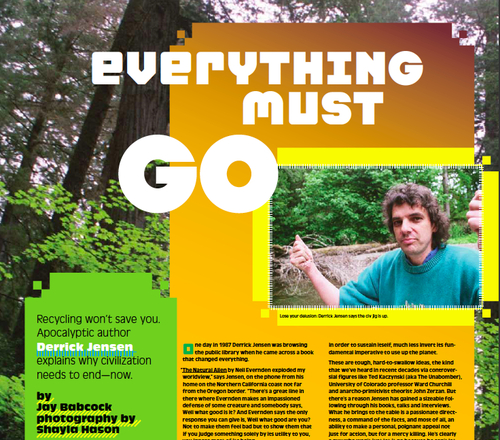
From Arthur 23/July 2006.
One day in 1987 Derrick Jensen was browsing the public library when he came across a book that changed everything.
“The Natural Alien by Neil Evernden exploded my worldview,” says Jensen, on the phone from his home on the Northern California coast not far from the Oregon border. “There’s a great line in there where Evernden makes an impassioned defense of some creature and somebody says, Well what good is it? And Evernden says the only response you can give is, Well what good are you? Not to make them feel bad but to show them that if you judge something solely by its utility to you, you ignore most of its being.
“It was the first book I ever read that talked about the basic stupidity of the utilitarian worldview.”
In his new book Endgame, Jensen argues that civilization—the utilitarian worldview put into practice—is not only stupid, it’s terminal. All forms of human civilization have historically worked to steadily exhaust the planet’s non-renewable resources, he says; therefore, no amount of technological ingenuity, no amount of political reform, no amount of Al Gore documentaries or carpool lanes or farmers’ markets or solar credits or biodiesel vehicles or Daryl Hannah in a tree will ever adequately replace what civilization has consumed in order to sustain itself, much less invert its fundamental imperative to use up the planet.
These are tough, hard-to-swallow ideas, the kind that we’ve heard in recent decades via controversial figures like Ted Kaczynski (aka The Unabomber), University of Colorado professor Ward Churchill and anarcho-primitivist theorist John Zerzan. But there’s a reason Jensen has gained a sizable following through his books, talks and interviews. What he brings to the table is a passionate directness, a command of the facts, and most of all, an ability to make a personal, poignant appeal not just for action, but for a mercy killing. He’s clearly a guy who won’t just let it go because he can’t let it go; he’s stayed up all night, doing some serious heavy lifting on all the inconvenient truths—the hopeless doomsday statistics, the possibility of imminent system crash—that the rest of us try to forget as we stumble to bed.
Of course he could’ve saved himself some of the trouble; at 900-plus pages, Endgame is far too long and rambling to be the definitive anarcho-primitivist text that its title and scope suggest. Still, it’s packed with provocative ideas that can explode your worldview, and so, in late April, I talked with Derrick about the ideas in Endgame that had provoked the most discussion around the Arthur office.
ARTHUR: Why does civilization need to be brought down now?
DERRICK JENSEN: A few years ago, I began to feel pretty apocalyptic but I didn’t want to use that word because it’s so loaded. And then a friend, George Draffan, said, ‘So Derrick, what’s it gonna take for you to finally use that word? Give me a specific threshold, Derrick, a specific point at which you’ll finally use that word. Will it take global warming? The ozone hole? The reduction of krill populations off Antarctica by 90 percent? How about the end of the great coral reefs? The extirpation of 200 species per day? 400? 600? Will it take the death of the salmon?’ And I thought about that. Salmon were once so thick around here that you couldn’t see the bottom of the river. You could hear the runs coming from miles before you’d see them. People were afraid to put their boats in the water for fear they’d capsize. And now, when I go out to Mill Creek, I start crying because I see two salmon spawning.
This civilization is killing the planet. They say that one sign of intelligence is the ability to recognize patterns. I’m gonna lay out a pattern here and let’s see if we can recognize it in less than 6,000 years. When you think of the hills and plains of Iraq, do you normally think of cedar forests so thick the sunlight never touches the ground? That’s how it was before. The first written myth of this culture is that of Gilgamesh deforesting that area to make cities. Plato complained that deforestation was drying up springs and destroying the water quality in Greece. The forests of North Africa went down to make the Phoenician and Egyptian navies. We can go north and ask, Where are the lions who were in Greece? Where are the indigenous of Europe? They’ve been massacred, or assimilated—in any case, genocide was perpetrated against them by definition because they’re no longer there.
If you start asking questions, the questions just keep moving back and back and back. This is a pattern that’s been going on for a long, long time. This culture has been unsustainable from the beginning. On a finite planet, you would think that we would think about that. You can’t exploit a planet and live on it too. At this stage, since there are no new frontiers to exploit, the planet’s falling apart.
So you genuinely believe the planet is nearing death?
Well, what measure do you want to use to determine the planet’s health? The climate is changing. 90% of the large fish in the oceans are gone. Phytoplankton populations are collapsing. Each summer a dead zone covers 8000 square miles in the Gulf of Mexico. Another blankets Chesapeake Bay. Another the Baltic Sea. Altogether, there are almost 150 dead zones, places where the water contains too little oxygen to sustain life. This number has doubled each decade since the 1960s. The cause? Industrial agriculture. Seabird populations are collapsing off the UK. American chestnuts are gone. The cod are effectively gone. Passenger pigeons used to fly in flocks so large they darkened the sky for days at a time. Same with Eskimo curlews. They’re gone. And do you know why there are no penguins in the northern hemisphere? Because they were eradicated. The great auk. Prior to the arrival of this culture they were present in unimaginable numbers. One of the early French explorers commented that you could fill every ship in France with them and it wouldn’t make a dent. The last one was killed in the nineteenth century.The grizzly bears that are on the California state flag, they’re essentially gone. I mean, somebody could certainly say, There’s still a tree standing, obviously things are okay. But that’s obviously an insane position. Nonetheless people keep taking it. That’s why I keep saying, Give me a threshold. At what point will you finally say that the oceans are getting hammered. If it’s not 90% of the large fish gone, is it 93%? 95?% 100%? How acidified does it have to get? What percent of the coral reefs have to die before we admit there’s a problem, and more importantly, do something about it? Give me a threshold.
We can choose whatever measure we want, and we find that stuff is falling apart. That shouldn’t surprise us. It’s just like any other relationship. If you have a girlfriend, do you believe you can sort of mercilessly exploit her and beat the hell out of her and cut her up and then expect for her to be able to maintain a relationship? Of course, given the rates of domestic violence, there are a lot of men who believe this too.
Why is it bad that certain species go extinct? Is it because all species have an inherent value and right to existence, or is it because they are useful to the ecosystem, and it’s their utility that we’re losing?
Well, it’s all of those. First, obviously salmon and sturgeon and smelt and migratory songbirds, they all… It’s simply WRONG to exterminate them. They are beautiful and wonderful beings on their own. The purpose of salmon is to be salmon. The purpose of forests is to be forests. That’s really critical. Second, forests suffer tremendously without the existence of salmon. Salmon provide a tremendous influx of nutrients into the forest. They put on about 95 percent of their weight in the ocean, and carry this weight into the forest and die. When the salmon come in, it’s time for a feast. In the Pacific Northwest, 66 different vertebrates eat salmon. Between industrial fishing, dams, industrial forestry, and the other ways the civilized torment and destroy salmon, and rivers in the Northwest starve: they only receive about six percent of the nutrients they did a century ago. Natural communities can only undergo so much stress. After that they collapse.
And yet civilization keeps chugging along, despite the deforestation and extinctions. People seem to believe that everything will work out via new technology or the system balancing itself out, even if they don’t know exactly how.
There’s something called carrying capacity, which is the number of any given species that a certain area can support permanently. Certainly populations can overshoot carrying capacity—you can have an island that can support a thousand deer forever but if you put 10,000 deer on it they’re gonna eat too much vegetation, they’re gonna cause erosion, they’re gonna permanently reduce carrying capacity. You can temporarily exceed carrying capacity, which is clearly what’s happening here.
There’s a machine image that Paul Ehrlich or somebody was using about how you have this airplane and you have rivets popping off the airplane. You keep saying I’m not worried about it. Well, eventually enough rivets are gonna come off that the wing’s gonna fall off and the plane is going to go down.
This way of thinking, that if we just ignore the problems, things are going to be okay, is really really easy, and it’s one of the things the Nazis used to great effect. At every step of the way, it was in the Jews’ rational self-interest not to resist. Because they kept pretending that things couldn’t get worse. So, would you rather get an ID card, or resist and possibly get killed? Do you want to get on a cattle car or do you want to resist and possibly get killed? Do you want to take a shower, or resist and possibly get killed? At every step of the way they could talk themselves into not resisting. Zygmund Baumann has this great line, this is a direct quote, that “rational people will quietly meekly go into gas chambers if only you allow them to believe they’re bathrooms.” It’s the same thing. Rational people will go quietly and meekly to the end of the world if you’ll only allow them to believe that the salmon don’t matter.
So your argument is that the sooner civilization falls, the better—not just for animals and plants, but for humans.
If someone had brought down civilization, whatever that means, 200 years ago, people who live in the eastern US could still eat passenger pigeons and Eskimo curlews. People in the West, in the Northwest, could still eat salmon. I live on Tolowa land. The Tolowa Indians lived where I live now for at least 12,500 years if you believe the myths of science. If you believe the myths of the Tolowa, they’ve lived here since the beginning of time. When this culture arrived here a couple hundred years ago, the area was, as was true of so much of this continent, just ridiculously fecund. The indigenous peoples could have lived here essentially forever, so far as we know—12,500 years is long enough for me to call it ‘sustainable.’ If civilization had come down 200 years ago, the people who live here would still be able to support themselves. But if it comes down in another 30 years, 50 years, 60 years, a hundred years, 10 years, whatever, the people who live here —who live in this place right here—won’t be able to eat salmon. At some point the current system is going to crash, and there are going to be people sitting along the banks of the Columbia, which will be glowing from the radiation at Hanford, and they will be saying, “I’m starving to death because you didn’t remove the dams that were killing salmon. God damn you.”
So, even from the purely selfish human perspective, yeah, it would be good for civilization to end. The sooner this civilization goes the better, because there’ll be more left.
Can you honestly tell Joe and Jane Sixpack that they’d be better off if this civilization were suddenly gone?
My audience is generally people who recognize that the system is really messing things up, and I want to push them harder, as some people have pushed me harder. That said, I guess it depends on how “Joe Sixpack” defines himself. I used to have this habit of asking people if they liked their jobs. About 90% say no. Most people work jobs they don’t love to buy stuff they don’t want to live lives that are pretty unhappy, etc etc. This culture is killing the planet, and it isn’t even making most of us happy. Also, I often ask people at my talks, How many of you have had someone you love die of cancer? Usually about 70-80% say yes. The air in Los Angeles is so toxic that children born there inhale more carcinogenic pollutants in the first two weeks of their lives than the EPA (which routinely understates risks so as not to impede economic production) considers safe for a lifetime. In San Francisco it takes about three weeks.
Of course cancer is a disease of civilization, made far worse by the toxification of our entire environment. I have Crohn’s disease, which is a disease of civilization. I know people who have MS, which is a disease of civilization. My mom has diabetes. That’s another part of my argument against civilization: it’s toxifying our own bodies. There’s dioxin in every mother’s breast milk. It’s not just salmon. It’s all of us.
Yes, but couldn’t you say the same civilization gives us medicine and modern, miracle-working health care? Don’t civilized peoples, on balance, come out ahead of pre-industrial hunter-gatherer societies?
I have a bunch of responses. The first is that modern medicine—available to the rich, not the global poor—is horribly ironic, in that industrial health care is one of the most toxic industries on earth. It produces PVC medical devices to treat someone’s cancer, then puts them in the hospital incinerator to send back out and give someone else cancer. Or uses mercury in thermometers in the hospital, then send that up the incinerator to be deposited in fish and to eventually give more children—human and nonhuman—brain damage. Where does this make sense? Modern industrial medicine cures the cancer of some rich American who became sick because of the toxification of the total environment, and these processes lead to even more toxification, causing yet more poor people—and nonhumans—to die. The real wonder of modern medicine is that the poor buy into this at all.
There’s also some sleight-of-hand there. Part of that is there’s a really high infant mortality among wild humans, as there is among a lot of wild creatures. If you make it to 4-5 years old in the wild, you make it a long way. Read Health and the Rise of Civilization by Mark Nathan Cohen, a forensic archaeologist.
Thirdly, people who think bringing down civilization would bring mass misery are ignoring that this is what’s already happening! It’s just that most of us don’t see it. There are people dying right now, starving to death in India, now, because of the global economy. Seventy-eight percent of the countries reporting child malnutrition export food. During the much-publicized famine in Ethiopia during the 1980s, that country exported green beans to Europe. During the infamous potato famine, Ireland exported grain to England (and part of the reason the potato blight took hold in the first place was that the Irish were pushed to the poorest land). The famines come a lot of the time because a) people have been dispossessed, b) the land they were on is now used for cash crops for export and c), the water’s been stolen for semiconductor plants or aluminum smelters or whatever. The current system is already enslaving them and exploiting them. Several years ago I asked Anuradha Mittal, former executive director of Food First, if the people of India be better off if the world economy disappeared tomorrow. She laughed and said, Of course. One of the examples she gave is there are former granaries in India that now export dog food and tulips to Europe. These are people who are dying right now.
Water is a great example of the world economy killing people. People say the world’s running out of water? The thing is, 90% of the planet’s drinkable water is used for agriculture and industry. People are dying of thirst in India right now because the groundwater is being used to make Coca-Cola. This whole lifestyle is based on exploitation.
So what I’m really talking about when I’m talking about bringing down civilization is depriving the rich of their ability to steal from the poor, and depriving the powerful of their ability to destroy the planet. I don’t think there’s many people who would not be behind that. Then everything else is just tactics, you know? The question becomes one of targeting.
In Endgame, you talk about specific actions that can be taken by individuals or small groups that could bring civilization down immediately. You discuss E-bombs: devices that destroy electronics, cause no harm to humans and, according to the September 2001 issue of Popular Mechanics, can be built for $400. Are you really advocating the use of these weapons?
Before we go there, I have to say that my emphasis is not on technologies or on particular tactics or actions. My point is that we need to recognize that this way of life is killing life on the planet, and we need to stop it. After that it’s kind of like the old line by JFK about those who make nonviolent revolution impossible make violent revolution inevitable. Let’s stop this by the most peaceful means possible. But in the end let’s stop this, because there is nothing worse than planetary murder. Nothing.
We also need to recognize that those in power are not going to give up their stranglehold because we ask nicely. They won’t stop exploiting the poor and deforesting because we circulate an online petition. We need to recognize that. And we need to recognize that Harriet Tubman carried a gun. Now that she’s long dead she can be a hero, but if she were alive now she’s be wanted for theft (“stealing” slaves) and terrorism. Geronimo had a gun. Tecumseh had a gun.
I’m not saying that people should willy-nilly pick up guns or that everyone should go drop E-bombs everywhere. I’m saying we need to have our seriousness called into question. What do we want? Do we want smaller clearcuts, kinder clearcuts, fewer clearcuts? Do we want the Giants to win the World Series and oh, by the way, it would be nice if we still have a world? Do we want to keep our cars and computers and lawns and grocery stores even at the expense of life on the planet? More to the point, do we want to allow others to keep their cars and computers and lawns and grocery stores even at the expense of life on the planet, which of course includes at the expense of poor humans? Even more to the point, do we want to allow those in power to perpetuate this system at the expense of the poor and life on the planet.
Bringing down civilization is not a monolithic act. It’s a billion different acts done by a billion different people. First, it’s recognizing that this culture is killing the planet. Next it’s realizing we can do something to stop it. Next it’s finding what you love. And next, it’s determining to act to defend your beloved. Everything after that is tactics.
And every different action has a different morality. It would be outrageously immoral to set off an E-bomb at a hospital. But on the other hand I think it’s almost impossible to make a moral case against taking out cell phone towers, which kill between five and 50 million migratory songbirds every year. If one cares about migratory songbirds—or if you care about not having the jerk at the next table yammer on about his latest financial conquest while you’re trying to eat, or if you care about the EMF waves which might or might not be dangerous—then it’s impossible to make a moral case against taking out those towers.
If E-bombs are so easy to make, why hasn’t one been detonated since Popular Mechanics put them on their cover?
I have no idea. That’s a good question. Except of course they have been detonated: by the US military, which tests and produces them.
I wonder that about a lot of things. Years ago—and before I say this I have to make absolutely clear that in no way am I even in the slightest advocating this—I was talking to a genetic engineer who said it’s really a piece of cake to make genetically modified diseases—all you really needed was three graduate students and a $100,000 laboratory, which is no big deal. He was stunned that it hadn’t happened yet. Once again, both of us are opposed to this, and were surprised no one has done it yet.
Another important thing to say about taking down civilization is that even before we get to the E-bomb stage there is a lot of other work to be done. And a lot of this work is not tremendously dramatic. A guy at one of my talks said, “I wanna go to China and take out a dam but I can’t do that ’cause it’ll kill villagers below.” Of course that comment ignores the villages destroyed by the erection of the dams. I responded, “Look before we even talk about this, of the two million dams in the United States, probably three-quarters of a million of them are tiny, illegal, not serving any economic function, and the only reason they’re standing is because of inertia. Nobody’s bothered to take them out. If you want to take out a dam, go take out one of these. Not even the cops will care.” The point is that we can get all excited about doing underground illegal stuff, but there’s a tremendous amount of entirely legal work we’re not doing.
The whole reform vs revolution question is bullshit. I used to teach creative writing at Pelican Bay, which is a Supermax security prison. I fully recognized that every time I walked in to that prison that I was participating in the biggest, most racist gulag on the planet. You can’t get much more reformist than teaching creative writing there. But at the same time many of my students said that the only thing that was keeping them sane was our classes. So in that moment any sort of belief I had in reform vs revolution question just fell apart, because once again: we need it all. That’s one of the great things about everything being so fucked up, that no matter where you look there’s great work to be done. If your call, if where your heart leads you is to work for battered woman’s shelters, wonderful. Wonderful, wonderful. If it calls you to write for Arthur and to push a perspective that is anti-authoritarian or whatever: wonderful, wonderful, wonderful. If it pushes you to do a timber sales appeal: wonderful also. We need it all.
But your book is about bringing down civilization—it’s not about filing timber sales appeals.
True, but I don’t exclude that by any means. I talk about the military strategy of hammer and anvil, a strategy used by Lee at the battle of Chancellorsville, where you keep a large part of your army back as an anvil, as a defensive force, and you send the rest of your army around to act as a hammer, an offensive force. Defensive work is incredibly important because if we all wait for the great glorious revolution, there’s not going to be anything worth saving left anyway. But at the same time if all we do is this defensive work, this culture is gonna just keep grinding away at everything, and there’ll be nothing left then either.
It’s like any revolution. The Black Panthers said this, the Zapatistas said this: 95% of any revolution is non-violent. A lot of it is education. A lot of it is this other stuff. And yes, of course the situation is desperately urgent, and yeah, dramatic stuff needs to be done. But I don’t even see, for the most part, people doing the less dramatic stuff. That’s what I find the most horrifying.
Having said this, that’s not an attack on most people because I understand… I’ve got friends who have two kids and are working jobs that they and their partner are making seven bucks an hour and they’re trying to raise two kids: “What, you actually want me to do something for the fairy shrimp in addition? Are you out of your mind?” I’m not judging my friends or other people for that but I also know that a tremendous amount of time is wasted watching television. I’m not saying anything against downtime either. I like to play online poker or whatever. I’m not saying that we need to spend every waking moment pushing and pushing. But we need to start doing the work. And we need to start doing it soon.
I kind of make fun of ‘fair trade’ but I gotta tell you, I think ‘fair trade’ is way better than ‘slave trade.’ But the problem I have is that’s not sufficient. Timber sales appeals aren’t sufficient. Working at battered women’s shelters isn’t sufficient. That’s really the whole point: what we’re doing isn’t sufficient.
You’re just talking about re-prioritizing.
Thank you! End of interview, you know? Every cell in my body wants for us to have a voluntary transformation to a sustainable way of living, where we would voluntarily have a softer landing, where we would recognize that we’ve overshot carrying capacity, that our way of living, which is based on the use of nonrenewable resources, won’t last. But I don’t think that’s going to happen.
If your concern is for the well-being of the humans who will be alive during and immediately after the crash, then what you need to do is start preparing people for the crash. Because it’s gonna come anyway. And if you don’t believe it’s gonna come, then we really honestly have nothing to say to each other. We can talk about what do you think about JD Drew for the Dodgers this year. What the hell’s wrong with the Angels? But if you do believe that a) there’s going to be a crash and b) it’s going to be messy and c) the current economic system is dismantling the ecological infrastructure of the planet, which means the longer it takes, the worse things are going to be, what that means is what you need to do is to start finding out what local plants can be used for antibiotics. What are local water purification systems you’ll be able to use. How are you going to build shelters. How will you pull up parking lots to make gardens. Learning self-defense and forming committees to deal with the additional violence that might (or might not) break out. Getting to know your neighbors, both human and nonhuman. How’s that for a start?
In the end, I think the primary measure by which we will be judged by those who come after will be the health of the landbase. Everything else builds from there. The people who come after aren’t going to give a shit as to whether we voted Democrat, Republican, Green, anarchist, or none of the above. They’re not going to give a shit about whether we were pacifists or not pacifists. They’re not going to give a shit about whether we signed or didn’t sign online petitions. They’re not going to give a shit about how hard we tried. It’s no good to live in a groovy eco-socialist utopia with free love if the planet is toxified. Those who come after are going to care about whether they can breathe the air, whether they can drink the water, whether the land can support them. Everything else comes from that. This seems so obvious I’m embarrassed to have to say it, but this culture is so insane it needs to be said. And it needs to be lived.
(From Arthur 23/July 2006..)

 Arthur Magazine