FREE BIKE MOVEMENT ON COLLEGE CAMPUSES GROWS…

20bikes-inline2-650.jpg

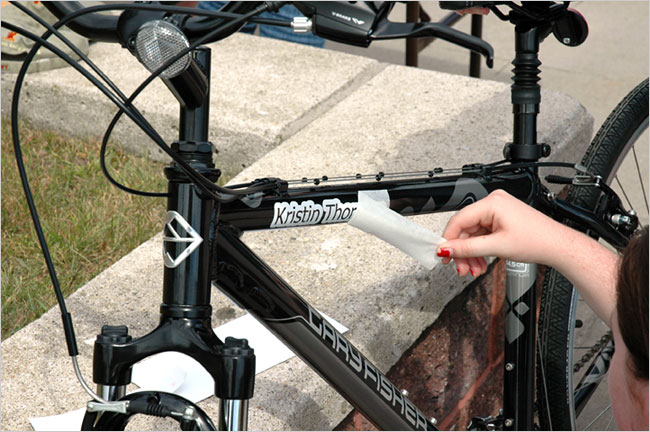
The University of New England bikes are personalized. Free or subsidized bike programs at colleges have had mixed success.

With Free Bikes, Challenging Car Culture on Campus
By KATIE ZEZIMA

The New York Times – October 20, 2008

BIDDEFORD, Me. — When Kylie Galliani started at the University of New England in August, she was given a key to her dorm, a class schedule and something more unusual: a $480 bicycle.

“I was like, ‘A free bike, no catch?’ ” Ms. Galliani, 17, a freshman from Fort Bragg, Calif., asked. “It’s really an ideal way to get around the campus.”

University administrators and students nationwide are increasingly feeling that way too.

The University of New England and Ripon College in Wisconsin are giving free bikes to freshmen who promise to leave their cars at home. Other colleges are setting up free bike sharing or rental programs, and some universities are partnering with bike shops to offer discounts on purchases.

The goal, college and university officials said, is to ease critical shortages of parking and to change the car culture that clogs campus roadways and erodes the community feel that comes with walking or biking around campus.

“We’re seeing an explosion in bike activity,” said Julian Dautremont-Smith, associate director of the Association for the Advancement of Sustainability in Higher Education, a nonprofit association of colleges and universities. “It seems like every week we hear about a new bike sharing or bike rental program.”

While many new bike programs are starting up, some are shutting down because of problems with theft and vandalism. The program at St. Mary’s College in Maryland was suspended because bikes were being vandalized.

“Ours was one that was totally based on voluntary taking care of the bike,” said Chip Jackson, a spokesman for St. Mary’s, “and I guess that was maybe a tad unwise. So the next generation of this idea will have a few more checks and balances.”

At Ripon, and the University of New England, officials say that giving students a bike of their own might encourage them to be more responsible. Ripon’s president, David C. Joyce, a competitive mountain biker, said the free bike idea came in a meeting about how to reduce cars on campus.

The college committed $50,000 to the program and plans to continue it with next year’s freshmen. Some 200 Trek mountain bikes, helmets and locks were bought, and about 180 freshmen signed up for the program. “We did it as a means of reducing the need for parking,” Dr. Joyce said, “but as we looked at it from the standpoint of fitness, health and sustainability, we realized we have the opportunity to create a change.”

The University of New England here in Biddeford had a similar problem — too many cars, not enough space and a desire to make the campus greener. So it copied the Ripon program, handing out 105 bikes in the first week of school. Because of the program, only 25 percent of freshmen brought cars with them this year, officials said, compared with 75 percent last year.

“We felt the campus could devolve to asphalt parking lots, and a lot of people didn’t want that to happen,” said Michael Daley, head of the university’s environmental council and a professor of economics.

The bikes are marked with each student’s name.

“I don’t have to fill it with gas, and it doesn’t hurt the environment,” said Kaitlyn Birwell, 18. “With a car, you need a parking permit, gas, and it breaks down. I’m a college student and don’t have the money for that.”

Michelle Provencal, 18, said she hopes her bike will help her avoid a dreaded side effect of being a college freshman. “Maybe instead of gaining the freshman 15 I’ll lose it,” Ms. Provencal said.

When Mercer University in Macon, Ga., asked for donations of old bikes, it received 60, which are being fixed up and painted orange and black, the university colors. Forty are available for weeklong rentals, and Mercer has organized mass rides to downtown Macon, about three miles away, to promote the program.

“A lot of students haven’t ridden a bike since middle school or even younger, but when they get back on it their faces light up,” said Allan J. Rene de Cotret, director of the program. “So why not leave your car parked where you live or back home with your parents and ride your bike around campus?”

Emory University has partnered with Fuji Bikes and Bicycle South, a local bike shop, to provide 50 bikes that can be rented at no charge at six spots on campus. Students can also buy Fuji bikes at a discount and receive a free helmet, lock and lights from Emory.

Students, faculty and staff can go to a rental station, show their Emory ID and check out bikes. The program plans to add 70 more bikes and four checkout points in the next year. In addition, about 150 bikes have been sold through the partnership in the past year, said Jamie Smith, who runs the program, called Bike Emory.

“We like the idea of bolstering the cycling culture here,” Mr. Smith said, “and ultimately it supports alternative transportation.”

Bikes at some campuses were treated as toys rather than transportation. Others were difficult to maintain or were not used.

“The kids weren’t taking care of the bikes, leaving them wherever instead of parking them in the bike racks,” said John Wall, a spokesman for Juniata College in Huntingdon, Pa., which eliminated its two-year-old bike-sharing program this year. “The other problem was that the bikes weren’t the greatest to begin with. They were donated by Wal-Mart, and others were rehabbed. They had also been out in the weather. It just didn’t work out.”

The elements are a concern at other universities as well. More than 150 students at the University at Buffalo signed up for a city bike-sharing program that has drop-off points on campus, but it suspends service from November to April.

“It’s hard to maintain all the bikes during winter, and usage drops dramatically,” said Jim Simon, an associate environmental educator at Buffalo.

Here at the University of New England, officials wonder what will happen when snow starts falling, but they are looking toward bike-sharing programs in cities like Copenhagen and Montreal as proof that they can work in the cold.

St. Xavier University in Chicago this month is unveiling the first computer-driven bike sharing system on a college campus.

Students can wave their ID card over a docking port. The port is attached to a rubber tube, which can be used as a lock and opened by entering an access code. Students must enter the bike’s condition before it can be unlocked. The system is used in Europe, but with credit cards.

The first 15 minutes are free, and users pay 60 cents for each additional 15 minutes, or $2.40 per hour. All 925 resident students automatically become members through their ID cards. The system was intended to be environmentally friendly, with solar panels powering the ports.

A tracking system similar to G.P.S. will keep tabs on the bikes.

“You can’t throw it in Lake Michigan,” said Paul Matthews, the university’s vice president for facilities management, “because we’ll know if you throw it in Lake Michigan.”


TONIGHT – FREE, ALL-AGES Doug Aitken happening with White Rainbow, Lichens, Arp in NYC

sonic.jpg

Doug Aitken: ‘sonic happening’
Featuring performances by White Rainbow, Lichens and Arp

Wednesday Oct 22, 2008 6-8pm
303 Gallery at 547 west 21st street

“the sonic happening (migration)”

In conjunction with Doug Aitken’s current exhibition, 303 Gallery is pleased to present a special viewing of Doug Aitken’s film based installation “migration”. For this event the artist has turned off the film’s soundtrack and invited the musicians Lichens, White Rainbow and Arp to create live improvisational scores set to the work.

Doug Aitken currently has concurrent installations at 303 Gallery’s two spaces. The performance, event, and ‘happening’ have been integral elements in his work. Aitken has organized ‘happenings’ in Los Angeles, New York, Basel, Manchester and Philadelphia.

In Lichens, wordless vocals are looped into curtains of drone, adding acoustic and electric guitars, percussion and other effects to create alternately thick and delicate works. Lichens has recorded and released two full-length LPs, “The Psychic Nature of Being” and “Omns”. In addition his work appears in the score of the film “migration”.

Portland-based White Rainbow, has released 7 full length albums since 2000. Creating morphing soundscapes that alternately reference minimalism, eastern prayer musics and trance ritual, White Rainbow weaves a unique web of sound meant to interact directly with its environment. He also provides the score to Aitken’s installation “to give it all away.”

Arp is the most recent project of Alexis Georgopoulos, a San Francisco-based artist, writer and musician brought up in France, Greece and the United States. As Arp, he released 2008’s “In Light”, an album recorded almost entirely live, and meant to serve as a bridge between the natural and electronic worlds.

“Migration” is included in the 55th Carnegie International exhibition “Life on Mars” where the piece is projected on the museum’s façade through January 2009. Aitken has also had solo exhibitions at the Museum of Modern Art, New York, ARC Musée d’Art Moderne de la Ville de Paris, the Serpentine Gallery, London, Kunsthalle Zurich, Switzerland, Kunsthaus Bregenz, Austria and Tokyo Opera City Art Gallery, Japan. Aitken’s newest book “99 cent Dreams” was published in 2008 by Aspen Art Museum following his solo exhibition there, and his artist’s book “Write In Jerry Brown President” will be published by the Museum of Modern Art, New York in October 2008.

303 gallery
525 west 22nd street
new york, ny 10011
t. 212 255 1121
http://www.303gallery.com


REVERSING MONOCULTURALISM

The New York Times – October 17, 2008

Its Native Tongue Facing Extinction, Arapaho Tribe Teaches the Young
By DAN FROSCH

RIVERTON, Wyo. — At 69, her eyes soft and creased with age, Alvena Oldman remembers how the teachers at St. Stephens boarding school on the Wind River Reservation would strike students with rulers if they dared to talk in their native Arapaho language.

“We were afraid to speak it,” she said. “We knew we would be punished.”

More than a half-century later, only about 200 Arapaho speakers are still alive, and tribal leaders at Wind River, Wyoming’s only Indian reservation, fear their language will not survive. As part of an intensifying effort to save that language, this tribe of 8,791, known as the Northern Arapaho, recently opened a new school where students will be taught in Arapaho. Elders and educators say they hope it will create a new generation of native speakers.

“This is a race against the clock, and we’re in the 59th minute of the last hour,” said a National Indian Education Association board member, Ryan Wilson, whom the tribe hired as a consultant to help get the school off the ground. Like other tribes, the Northern Arapaho have suffered from the legacy of Indian boarding institutions, established by the federal government in the late 1800s to “Americanize” Native American children. It was at such schools that teachers instilled the “kill the Indian, save the man” philosophy, young boys had their traditional braids shorn, and students were forbidden to speak tribal languages.

The discipline of those days was drummed into an entire generation of Northern Arapaho, and most tribal members never passed down the language. Of all the remaining fluent speakers, none are younger than 55.

That is what tribal leaders hope to change. About 22 children from pre-kindergarten through first grade started classes at the school — a rectangular one-story structure with a fresh coat of white paint and the words Hinono’ Eitiino’ Oowu’ (translation: Arapaho Language Lodge) written across its siding.

Here, set against an endless stretch of windswept plains and tufts of cottonwoods, instructors are using a state-approved curriculum to teach students exclusively in Arapaho. All costs related to the school, which has an operating budget of $340,000 a year, are paid for by the tribe and private donors. Administrators plan to add a grade each year until it comprises pre-kindergarten through 12th-grade classes.

“This environment is a complete reversal of what occurs too often in schools, where a child is ridiculed or reprimanded for speaking one’s heritage language,” said Inée Y. Slaughter, executive director of the Indigenous Language Institute, a group in Santa Fe, N.M., that works with tribes on native languages.

“I want my son to talk nothing but Arapaho to me and my grandparents,” said Kayla Howling Buffalo, who enrolled her 4-year-old son, RyLee, in the school.

Ms. Howling Buffalo, 25, said she, too, had been inspired to take Arapaho classes because her grandmother no longer has anyone to speak with and fears she is losing her first language.

Such sentiments are not uncommon on the reservation and have become more pronounced in the five years since Helen Cedar Tree, at 96 the oldest living Northern Arapaho, made an impassioned plea to the tribe’s council of elders.

“She said: ‘Look at all of you guys talking English, and you know your own language. It’s like the white man has conquered us,’ ” said Gerald Redman Sr., the chairman of the council of elders. “It was a wake-up call.”

A group of Arapaho families had sent their children to a pre-kindergarten language program for years, but it was not enough. Heeding Ms. Cedar Tree’s words, the tribe began using Arapaho dictionaries, night classes, CDs made by the tribe, and anything they could find to help resuscitate the language. In the end, “we knew in our hearts that immersion was the only way we were going to turn this around,” said Mr. Wilson, a member of the Oglala Lakota tribe.

He was referring not just to the potential for the Arapaho language’s extinction but to a host of other problems that have long plagued the vast reservation, which the tribe shares with the Eastern Shoshone.

“Language-immersion schools offer an environment that goes beyond teaching the language,” Ms. Slaughter said. “It provides a safe place where a child’s roots are nurtured, its culture honored, and its being valued.”

According to tribal statistics and the United States Attorney’s Office in Wyoming, 78 percent of household heads on the reservation are unemployed, the student dropout rate is 52 percent and crime has been rising.

Most recently, in June, three teenage girls were found dead in a low-income housing complex. The F.B.I. has not yet released autopsy results, but many tribal members think drugs or alcohol were involved. The deaths left the reservation reeling. Officials here hope that the school will herald a positive change, just as programs elsewhere have helped native youth become conversational in their tribal languages, enhancing cultural pride and participation in the process. A groundswell of language revitalization efforts has led to successful Indian immersion schools in Hawaii, Montana and New York.

Studies show that language fluency among young Indians is tied to overall academic achievement, and experts say such learning can have other positive effects.

“Language seems to be a healing force for Native American communities,” said Ellen Lutz, executive director of Cultural Survival, a group based in Cambridge, Mass., that is working with the Northern Arapaho. At a recent ceremony to celebrate the school’s opening, held in an old tribal meeting hall, three young girls sang shyly in Arapaho. Behind them, a row of elders sat quietly, their faces wizened and stoic, legs shuffling rhythmically as familiar words carried through the building.

“They are the ones who whispered it on the playground when nobody was looking,” Mr. Wilson said, referring to the elders. “If we lose that language, we lose who we are.”


Ian Mackaye public Q & As in Southern California

Click here for more info on Ian Mackaye Q&A Dates 2008. Here’s a summary:

Sun Oct 19
Riverside Art Gallery
Riverside CA
A Question and Answer Speaking Engagement. $5,
7:30 PM All-Ages Welcome

Mon Oct 20
UC San Diego Price Center
San Diego CA
A Question and Answer Speaking Engagement. $5,
7:30 PM All-Ages Welcome, click here for more info.

Tue Oct 21
UC Irvine Humanities Hall 178
Irvine CA
A Question and Answer Speaking Engagement. $5,
8:00 PM All-Ages Welcome, click here for more info.

Wed Oct 22
Ventura Library
Ventura CA
A Question and Answer Speaking Engagement. $5,
7:30 PM All-Ages Welcome, click here for more info

Wed Oct 22
Mary Pickford Auditorium
Pitzer College
Claremont CA
A Question and Answer Speaking Engagement.
THIS IS AN EARLY SHOW, 12:00 Noon, free, All-Ages Welcome.

Thu Oct 23
Sunken City Skates
San Pedro CA
A Question and Answer Speaking Engagement. $5,
7:30 Doors All-Ages Welcome

Sun Oct 26
Hollywood High School
Hollywood CA
A Question and Answer Speaking Engagement. $5
(Hollywood High students free with i.d.),
6:30doors/7pm show, All-Ages Welcome