Arthur presents screening of Rani Singh's HARRY SMITH documentary

Thursday, May 15 at 8pm

SERIES: FOLK AMERICANA

The Old, Weird America: Harry Smith’s Anthology of American Folk Music

Imagine a world without rock and roll, or without that obsessive breed of cultural anthropology that favors the margins over the center. That’s the world you’d get without Harry Smith. No one better anticipated the sea change of the ’60s and its post-revolutionary landscape than this son of Theosophists, experimental filmmaker, Native American ethnographer, alchemical evangelist, speed freak, town crier and collector extraordinaire. His three-volume Anthology of American Folk Music, with its archive of “blues singers, hillbilly musicians and gospel chanters,” in the words of Greil Marcus (whose Old Weird America lends its title), launched Bob Dylan, the Grateful Dead and the folk revival of the early ’60s, just for starters. This loving portrait by Rani Singh, Smith’s one-time assistant and co-curator of his archives, blends biography with concert footage of Beck, Elvis Costello, Lou Reed, Nick Cave and other musical archaeologists performing songs from the Anthology, to capture the life of one of America’s secular saints.

Dir. Rani Singh, 2006, DigiBeta, 90 min.

Tickets $10

Cinefamily at the Silent Movie Theatre
611 N Fairfax Avenue
Los Angeles, 90036
323-655-2510

More info and tix…


"THE FUTURE BELONGS TO THE GOURMET"

The New York Times -May 11, 2008

Change We Can Stomach
By DAN BARBER

TARRYTOWN, N.Y.

COOKING, like farming, for all its down-home community spirit, is essentially a solitary craft. But lately it’s feeling more like a lonely burden. Finding guilt-free food for our menus — food that’s clean, green and humane — is about as easy as securing a housing loan. And we’re suddenly paying more — 75 percent more in the last six years — to stock our pantries. Around the world, from Cairo to Port-au-Prince, increases in food prices have governments facing riots born of shortages and hunger. It’s enough to make you want to toss in the toque.

But here’s the good news: if you’re a chef, or an eater who cares about where your food comes from (and there are a lot of you out there), we can have a hand in making food for the future downright delicious.

Farming has the potential to go through the greatest upheaval since the Green Revolution, bringing harvests that are more healthful, sustainable and, yes, even more flavorful. The change is being pushed along by market forces that influence how our farmers farm.

Until now, food production has been controlled by Big Agriculture, with its macho fixation on “average tonnage” and “record harvests.” But there’s a cost to its breadbasket-to-the-world bragging rights. Like those big Industrial Age factories that once billowed black smoke, American agriculture is mired in a mind-set that relies on capital, chemistry and machines. Food production is dependent on oil, in the form of fertilizers and pesticides, in the distances produce travels from farm to plate and in the energy it takes to process it.

For decades, environmentalists and small farmers have claimed that this is several kinds of madness. But industrial agriculture has simply responded that if we’re feeding more people more cheaply using less land, how terrible can our food system be?

Now that argument no longer holds true. With the price of oil at more than $120 a barrel (up from less than $30 for most of the last 50 years), small and midsize nonpolluting farms, the ones growing the healthiest and best-tasting food, are gaining a competitive advantage. They aren’t as reliant on oil, because they use fewer large machines and less pesticide and fertilizer.

In fact, small farms are the most productive on earth. A four-acre farm in the United States nets, on average, $1,400 per acre; a 1,364-acre farm nets $39 an acre. Big farms have long compensated for the disequilibrium with sheer quantity. But their economies of scale come from mass distribution, and with diesel fuel costing more than $4 per gallon in many locations, it’s no longer efficient to transport food 1,500 miles from where it’s grown.

The high cost of oil alone will not be enough to reform American agriculture, however. As long as agricultural companies exploit the poor and extract labor from them at slave wages, and as long as they aren’t required to pay the price for the pollution they so brazenly produce, their system will stay afloat. If financially pinched Americans opt for the cheapest (and the least healthful) foods rather than cook their own, the food industry will continue to reach for the lowest common denominator.

But it is possible to nudge the revolution along — for instance, by changing how we measure the value of food. If we stop calculating the cost per quantity and begin considering the cost per nutrient value, the demand for higher-quality food would rise.

Organic fruits and vegetables contain 40 percent more nutrients than their chemical-fed counterparts. And animals raised on pasture provide us with meat and dairy products containing more beta carotene and at least three times as much C.L.A. (conjugated linoleic acid, shown in animal studies to reduce the risk of cancer) than those raised on grain.

Where good nutrition goes, flavor tends to follow. Chefs are the first to admit that an impossibly sweet, flavor-filled carrot has nothing to do with our work. It has to do with growing the right seed in healthy, nutrient-rich soil.

Increasingly we can see the wisdom of diversified farming operations, where there are built-in relationships among plants and animals. A dairy farm can provide manure for a neighboring potato farm, for example, which can in turn offer potato scraps as extra feed for the herd. When crops and livestock are judiciously mixed, agriculture wisely mimics nature.

To encourage small, diversified farms is not to make a nostalgic bid to revert to the agrarian ways of our ancestors. It is to look toward the future, leapfrogging past the age of heavy machinery and pollution, to farms that take advantage of the sun’s free energy and use the waste of one species as food for another.

Chefs can help move our food system into the future by continuing to demand the most flavorful food. Our support of the local food movement is an important example of this approach, but it’s not enough. As demand for fresh, local food rises, we cannot continue to rely entirely on farmers’ markets. Asking every farmer to plant, harvest, drive his pickup truck to a market and sell his goods there is like asking me to cook, take reservations, serve and wash the dishes.

We now need to support a system of well-coordinated regional farm networks, each suited to the food it can best grow. Farmers organized into marketing networks that can promote their common brands (like the Organic Valley Family of Farms in the Midwest) can ease the economic and ecological burden of food production and transportation. They can also distribute their products to new markets, including poor communities that have relied mainly on food from convenience stores.

Similar networks could also operate in the countries that are now experiencing food shortages. For years, the United States has flooded the world with food exports, displacing small farmers and disrupting domestic markets. As escalating food prices threaten an additional 100 million people with hunger, a new concept of humanitarian aid is required. Local farming efforts focused on conserving natural resources and biodiversity are essential to improving food security in developing countries, as a report just published by the International Assessment of Agriculture Science and Technology for Development has concluded. We must build on these tenets, providing financial and technical assistance to small farmers across the world.

But regional systems will work only if there is enough small-scale farming going on to make them viable. With a less energy-intensive food system in place, we will need more muscle power devoted to food production, and more people on the farm. (The need is especially urgent when you consider that the average age of today’s American farmer is over 55.) In order to move gracefully into a post-industrial agriculture economy, we also need to rethink how we educate the people who will grow our food. Land-grant universities and agricultural schools, dependent on financing from agribusiness, focus on maximum extraction from the land — take more, sell more, waste more.

Leave our agricultural future to chefs and anyone who takes food and cooking seriously. We never bought into the “bigger is better” mantra, not because it left us too dependent on oil, but because it never produced anything really good to eat. Truly great cooking — not faddish 1.5-pound rib-eye steaks with butter sauce, but food that has evolved from the world’s thriving peasant cuisines — is based on the correspondence of good farming to a healthy environment and good nutrition. It’s never been any other way, and we should be grateful. The future belongs to the gourmet.

Dan Barber is the chef and co-owner of Blue Hill and Blue Hill at Stone Barns.

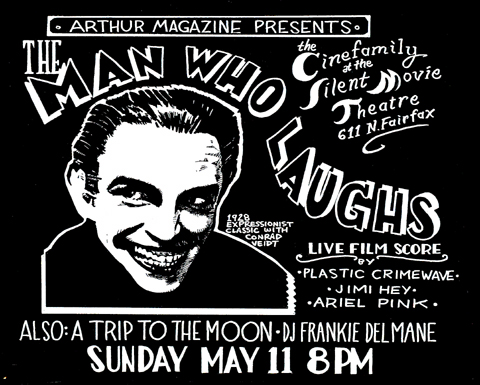
TONIGHT (Sunday) at Cinefamily… Arthur presents PLASTIC CRIMEWAVE, ARIEL PINK and JIMY HEY do live score to "The Man Who Laughs" and "A Trip to the Moon"

manwholaughs.jpg

May 11 at 8pm
THE MAN WHO LAUGHS
with live accompaniment by Plastic Crimewave, Ariel Pink and Jimi Hey
Co-Presented by Arthur Magazine

Arthur proudly presents live scores to both the classic 1928 German expressionist film The Man Who Laughs and Georges Méliès’ classic turn-of-the-century silent short A Trip To The Moon.

Based on the Victor Hugo novel, The Man Who Laughs is a moody masterpiece by director Paul Leni, a tragic melodrama starring Conrad Veidt (The Cabinet of Dr. Caligari) as an abandoned 17th-century British aristocrat disfigured at a young age by gypsies to have a freakish eternal grin.

Performing the soundtrack will be an ensemble of Chicago’s own Plastic Crimewave aka Steve Krakow (who also writes and draws the GALACTIC ZOO DOSSIER magazine, as well as contributing to Arthur), and locals Jimi Hey and Ariel Pink.

Also DJing before and after the films will be Frankie Delmane of the Teenage Frames.

The Man Who Laughs Dir. Paul Leni, 1928, DVD, 110 min.
Tickets – $12/ $8 for Cinefamily members

More info here…


GOOD LISTENING

LABEL PROMO TEXT:

“Clone Therapy”

“The latest and greatest from Greenfield’s own Weirding Module. You go out and have fun while your clone stays home and heals. S/he’ll tell you all about it! Two secret tracks from another decade on side 2. Fifty minutes of just what your clone needs. Edition of 50.”


OTHER NATIONS PREPARING TO PROSECUTE BUSH ADMINISTRATION OFFICIALS FOR AUTHORIZING TORTURE.

Panel Subpoenas Close Cheney Aide

By SCOTT SHANE

May 6, 2008 New York Times

WASHINGTON — A House subcommittee investigating the Bush administration’s approval for harsh interrogation methods voted on Tuesday to issue a subpoena to David S. Addington, chief of staff to Vice President Dick Cheney and a major proponent of the methods, which some legal experts have condemned as illegal torture.

Two former administration officials, John Ashcroft, the former attorney general, and John C. Yoo, who wrote controversial legal opinions justifying harsh techniques, have agreed to give public testimony to a House Judiciary subcommittee, staff members said.

Their testimony and that of several other administration officials invited to speak at a future hearing might provide the fullest public account to date of the internal discussions that led the administration to break with American tradition in 2002 and authorize waterboarding and other physical pressure against terrorist suspects.

The panel, the House Judiciary subcommittee on the constitution, civil rights and civil liberties, took the action at a hearing on Tuesday. During the session, law professors called for a full investigation by Congress or by an independent commission of the adoption of the harsh techniques.

Philippe Sands, a British law professor and author of a new book on the approval of coercive interrogation by high-level American military officials, “Torture Team,” said that if no such inquiry took place in the United States, foreign prosecutors might seek to charge American officials with authorizing torture. He said two foreign prosecutors, whom he did not name, had asked him for the materials on which his book is based.

“If the U.S. doesn’t address this, other countries will,” Mr. Sands said.

Witnesses at the hearing clashed over whether coercive interrogation methods can be effective or whether they produce unreliable answers from prisoners who want the pain to stop. Under pressure from Congress and the courts, the administration has dropped the harshest methods, including waterboarding, in which water is poured over a prisoner’s mouth and nose to produce a feeling of suffocation.

Mr. Ashcroft’s testimony might shed new light on discussions of interrogation methods at the highest level of the administration. ABC News reported last month that the so-called “enhanced” interrogation techniques used by the Central Intelligence Agency were approved after they were discussed at the White House by Mr. Ashcroft and other top officials.

Mr. Yoo was the principal author of several key legal opinions on the issue, including two dated August 1, 2002, and March 14, 2003, that argued that the president could legally approve the harshest methods as part of his powers as commander in chief. Both were subsequently withdrawn by Justice Department officials.

Mr. Yoo’s attorney, John C. Millian, said in a letter to the committee that the Justice Department has directed him to protect the confidentiality of executive branch deliberations. But he said Mr. Yoo would be willing to answer questions that did not violate that confidentiality.

A spokeswoman for the vice president’s office, Megan Mitchell, said she could not predict whether Mr. Addington would appear if subpoenaed. “If we receive a subpoena we’ll review it and respond accordingly,” she said.

The committee is still negotiating possible testimony with other former officials, including George J. Tenet, the former C.I.A. director; Douglas Feith, former undersecretary of defense for policy; and Daniel Levin, former assistant attorney general.


FARMING IN NEW YORK CITY

The New York Times – May 7, 2008

Urban Farmers’ Crops Go From Vacant Lot to Market
By TRACIE McMILLAN

In the shadows of the elevated tracks toward the end of the No. 3 line in East New York, Brooklyn, with an April chill still in the air, Denniston and Marlene Wilks gently pulled clusters of slender green shoots from the earth, revealing a blush of tiny red shallots at the base.

“Dennis used to keep them big, and people didn’t buy them,” Mrs. Wilks said. “They love to buy scallions.”

Growing up in rural Jamaica, the Wilkses helped their families raise crops like sugar cane, coffee and yams, and take them to market. Now, in Brooklyn, they are farmers once again, catering to their neighbors’ tastes: for scallions, for bitter melons like those from the West Indies and East Asia and for cilantro for Latin-American dinner tables.

“We never dreamed of it,” said Mr. Wilks, nor did his relatives in Jamaica. “They are totally astonished when you tell them that you farm and go to the market.”

For years, New Yorkers have grown basil, tomatoes and greens in window boxes, backyard plots and community gardens. But more and more New Yorkers like the Wilkses are raising fruits and vegetables, and not just to feed their families but to sell to people on their block.

This urban agriculture movement has grown even more vigorously elsewhere. Hundreds of farmers are at work in Detroit, Milwaukee, Oakland and other areas that, like East New York, have low-income residents, high rates of obesity and diabetes, limited sources of fresh produce and available, undeveloped land.

Local officials and nonprofit groups have been providing land, training and financial encouragement. But the impetus, in almost every case, has come from the farmers, who often till when their day jobs are done, overcoming peculiarly urban obstacles.

The Wilkses’ return to farming began in 1990 when their daughter planted a watermelon in their backyard. Before long, Mrs. Wilks, an administrator in the city’s Department of Education, was digging in the yard after work. Once their ambition outgrew their yard, she and Mr. Wilks, a city surveyor, along with other gardening neighbors, received permission to use a vacant lot across from a garment factory at the end of their block.

They cleared it of trash and tested its soil with help from GreenThumb, a Parks Department gardening program. They found traces of lead, so to ensure their food’s safety, they built raised beds of compost. (Heavy metals are common contaminants in city soil because of vehicle exhaust and remnants of old construction. Some studies have found that such ground can be cultivated as long as the pH is kept neutral.)

They wanted their crops to be organic, a commitment they shared with many other farmers in this grimy landscape. They planted some marigolds to deter squirrels; they have not had rat problems, which can plague urban gardens; and they abandoned crops, like corn, that could attract rodents. They put up fences to thwart other pests — thieves and vandals — and posted signs to let people know that this was a garden and no longer a dump.

There were also benefits to farming in the city. The Wilkses took advantage of city composting programs, trucking home decomposed leaves from the Starrett City development in Brooklyn and ZooDoo from the Bronx Zoo’s manure composting program. They got free seedlings from GreenThumb and took courses on growing and selling food from the City Farms project at the local nonprofit Just Food.

“The city really has been good to us,” Mrs. Wilks said. “All of the property we work on, it’s city property.”

The Wilkses now cultivate plots at four sites in East New York, paying as little as $2 a bed (usually 4 feet by 8 feet) in addition to modest membership fees. Last year the couple sold $3,116 in produce at a market run by the community group East New York Farms, more than any of their neighbors.

Florence Russell is looking forward to this year’s offerings. On a recent Saturday she watched from the end of Alabama Avenue as gardeners worked compost into beds at Hands and Hearts Garden, one of the sites where the Wilkses keep beds, along with 24 other growers. Fresh greens, she said, would be a welcome alternative to tough collards from the local grocery.

“This is something good happening here,” Ms. Russell said.

The city’s cultivators are a varied lot. The high school students at the Added Value community farm in Red Hook, Brooklyn, last year supplied Italian arugula, Asian greens and heirloom tomatoes to three restaurants, a community-supported agriculture buying club and two farmers’ markets.

In the South Bronx a group of gardens called La Familia Verde started a farmers’ market in 2003 to sell surpluses of herbs like papalo and the Caribbean green callaloo.

At a less established operation, the Brooklyn Rescue Mission’s Bed-Stuy Farm, mission staff members began growing produce in the vacant lot behind their food pantry in 2004, and ended up with a surplus last year. So they enlisted their teenage volunteers to run a sidewalk farm stand selling collards, tomatoes and figs; this year they plan to open a full farmers’ market.

The city’s success with urban farming will receive international attention on Saturday when, during an 11-day conference in New York, 60 delegates from the United Nations Commission on Sustainable Development are scheduled to visit Hands and Hearts, the Bed-Stuy Farm and two traditional community gardens in Brooklyn.

There was not always so much enthusiasm for city farming, though.

John Ameroso, a Cornell Cooperative Extension agent who has worked with local farmers and gardeners for 32 years, said that when he first suggested urban farm stands in the early 1990s, city environmental officials dismissed the idea. “ ‘Oh, you could never grow enough stuff with the urban markets,’ ” he said he was told. ‘ “That can’t be done. You have to have farmers.’ ”

But local officials have come around.

Holly Leicht, an associate assistant commissioner at the city’s Department of Housing Preservation and Development, helped provide two half-acre parcels of city land last year. One became Hands and Hearts and the other is in Ocean Hill-Brownsville, Brooklyn.

The Red Hook farm began in 2003 when the Parks Department gave the youth group Added Value permission to use an abandoned three-acre asphalt ball field. The group started with two raised beds, built a hoop house where it could start seeds, then laid down an acre of compost two feet deep on top of the asphalt. Last year the young farmers sold more than $25,000 in goods.

Urban agriculture has been an even larger undertaking in other cities, particularly those with weaker real estate markets and a declining population.

In Detroit, where locals refer to stretches of the city as urban prairie, food gardens are scattered through backyards, schoolyards and even more unlikely spots, including the floor of an abandoned roofless furniture factory and a vacant lot owned by a local order of Catholic friars. The number of gardens has grown to nearly 450 since the Garden Resource Program Collaborative began coordinating them in 2003.

The gardeners grow much of the food for themselves, but they have also organized a co-op, Grown in Detroit, to sell their surplus peas, onions, yams and greens. From farm stands in health center parking lots and at a prime booth in Eastern Market, the city’s chaotic maze of wholesalers and local farmers, gardeners lure customers to take their first bite of a garlic scape, or compare their young spinach with that in a Del Monte box down the aisle. Next year two and a half acres that were waist high with weeds last summer will be set aside for market-bound produce.

City Slicker Farms in West Oakland, Calif., started in 2001 with a quarter-acre garden and a farm stand selling neighborhood favorites like collards and mustard greens. It has since persuaded local elementary students to volunteer and gotten owners of five additional vacant lots to let it grow food on their land.

Some operations have figured out how to make real money.

On a fringe of Philadelphia, a nonprofit demonstration project used densely planted rows in a half-acre plot and generated $67,000 from high-value crops like lettuces, carrots and radishes.

In Milwaukee, the nonprofit Growing Power operates a one-acre farm crammed with plastic greenhouses, compost piles, do-it-yourself contraptions, tilapia tanks and pens full of hens, ducks and goats — and grossed over $220,000 last year from the sale of lettuces, winter greens, sprouts and fish to local restaurants and consumers.

One key to financial success is having customers with the wherewithal to buy your goods. In New York, Bob Lewis, the head of the city office for the state Department of Agriculture and Markets, helped make this happen by getting 21 farmers at 16 sites approved to accept checks from the Farmers’ Market Nutrition Program, a supplement to the Women, Infants and Children (WIC) and senior nutrition programs.

Sarita Daftary, the program director for East New York Farms, estimates that about 60 percent of the market’s gross revenue came from the farmers’ market checks. And by the end of this year, changes to WIC will give city residents another $14 million specifically for fresh fruits and vegetables.

But land and demand are not all that successful farmers need. They have to know how to run a business or a farm.

So Growing Power, the Milwaukee group, offers several training sessions each year, and Just Food’s City Farms project holds an annual series of workshops on running farm stands.

For more formal training there is the Center for Agroecology and Sustainable Food Systems at the University of California, Santa Cruz. Founded in 1967, the center runs a six-month course for 39 students each year on its two farms.

Patricia Allen, the center’s executive director, said roughly three-fourths of her students today were interested in urban growing.

“We’re not looking at a back-to-the-land movement in any sense,” she said.

Just ask Karen Washington. She began growing food in 1985, after a city program offering a house with a yard lured her, then a single mother of two, to the South Bronx from Harlem.

Though she works as a physical therapist, Ms. Washington always knew she had another calling. “When I was a little kid I used to watch the farm report,” she said. “I always wanted to grow and be a farmer.”

Wary of chemicals and their effect on her health, Ms. Washington was determined to farm organically. She learned how to deter pests with mild soapy sprays and marigolds, encourage natural pest killers like ladybugs, and turn food scraps into fertile compost. As her skills grew, so did her ambitions. First she helped turn a vacant lot on her block into the Garden of Happiness. Then she helped defend local gardens from developers, and later persuaded the resulting coalition, La Familia Verde, to run a farm stand and test the waters for a farmers’ market.

“It’s not about making money,” Ms. Washington said. “We’re selling so that people in our neighborhood have good quality. There’s no Whole Foods in my neighborhood.”

Like many markets that sell neighborhood produce, La Familia Verde’s has attracted upstate farmers who did not venture into these areas until the locals showed them there was a market. The professionals do not compete with the amateurs though; they sell crops like corn and apples.

All this has not quenched Ms. Washington’s agricultural ambitions. In April she took a six-month leave from her job and headed to the Center for Agroecology with two other city growers. She said she hoped to take notes and start an urban farm school in New York.

With that in place, Ms. Washington said, the possibilities could be endless.

“So that the next time we ask a kid where a tomato comes from,” she said, “he won’t have to say a supermarket. He can say, Here’s an urban farm, and here is where I’m growing that tomato that you’re talking about. How great is that?”



CLUSTER IS COMING!

Please join us as we welcome legendary electronic music pioneers CLUSTER to the state of California.

Presented by DONUTS, FOLKYEAH!, ARTHUR MAGAZINE, AQUARIUS RECORDS, KUSF, FAMILY BOOKSTORE, WESTADDRADIO + others

CLUSTER WILL HEADLINE EVERY SHOW BUT WITH DIFFERENT OPENERS, VENUES, ARTISTS and DJs EACH TIME!!!

CLUSTER CALIFORNIA TOUR 2008
May 22 thru May 25!!

Joining us in Los Angeles:

DJ LOVEFINGERS!!!
You may remember him from our crazy all-nite DONUTS New Years Eve party where we all danced our panties off… FOR THIS EVENT, LOVEFINGERS WILL BE JOINED BY HIS BLACK DISCO PARTNER NITEDOG!!!!!


MEGA CRAZY DANCE PARTY!!!!!!!!!!!

LUCKY DRAGONS
(Los Angeles)


<img src="http://www.glaciersofnice.com/gifs/il_corral.gif&quot;

MI AMI
(San Francisco)

A DIY FASHION SHOW featuring a local designer!!

+ more…. TBA!!!!!

Tickets will be available for Los Angeles soooooon!

donutsparty.com

Joining us at the beautiful Henry Miller Library in Big Sur:
6pm – 11pm
WOODEN SHJIPS
(San Francisco)


ARP
(San Francisco)

DJs PICKPOCKET
& BLACK FJORD

(DONUTS, AQUARIUS RECORDS)

Pickpocket!

Black Fjord!!

Live Visuals by AC
(DONUTS & AC/AC)


Followed by a FREE afterparty at FERNWOOD RESORT!!!!!
10pm – 2am
JONAS REINHARDT (San Francisco)

+ A DONUTS DISCO DANCE PARTY!!!

TICKETS ARE AVAILABLE NOW!!!!! : Book your lodging quick quick quick!!!!
donutsparty.com

Joining us at the HAUNTED Brookdale Lodge in Santa Cruz:

ARIEL PINK
(Los Angeles)

HOWLIN’ RAIN
(San Francisco)


BRONZE
(San Francisco)

ASCENDED MASTER
(San Francisco)

A Mermaid Fashion Show by CRISTALETTE!!
This special DIY fashion show will happen in the POOL of the Brookdale Lodge with pool views available through the Lodge’s Mermaid Room Looking Glass!!!!


Cristalette’s designs have been suiting up the likes of Gravy Train, Hot Tub, Von Iva and DONUTS models galore!!!

DJs PICKPOCKET & IRWIN!!!!
(DONUTS, KUSF)

DONUTS DANCE PARTY!!!

Live Visuals by AC
(DONUTS & AC/AC)


TICKETS ARE AVAILABLE NOW!!!!! : Don’t forget to book your lodging!!!!
donutsparty.com

Joining us at the amazing GREAT AMERICAN MUSIC HALL in San Francisco:

TUSSLE!
(San Francisco)


WHITE RAINBOW!
(Portland)


DJs PICKPOCKET
& WOBBLY!!!!


Wobbly is seen here with his good buddies, Matmos and Safety Scissors!

Live Visuals by AC
(DONUTS & AC/AC)


TICKETS ARE AVAILABLE NOW!!!!!: GAMH offers dinner while you watch the show!
donutsparty.com

And of course, HEADLINING each show:

CLUSTER
(Berlin, Vienna)
Featuring the original founding members, Hans-Joachim Roedelius and Dieter Moebius!!!!!


Pictured above with their fan, Brian Eno, at their recording studio in Forst.

CLUSTER, ZUCKERZEIT – album art by Dieter Moebius!!!

CLUSTER CALIFORNIA TOUR 2008
May 22nd thru May 25th!!

ALSO PLEASE NOTE:
POSTERS designed by some amazing artists (many of whom are also musicians), Rick Froberg (Hot Snakes, Drive Like Jehu), Tim Koh (Ariel Pink, White Magic), Bert Bergen (Ascended Master), Mike Calvert, Hisham Bharoocha (Soft Circle, Black Dice), Harrison Haynes (Les Savy Fav) and others will be for sale on our site as well as at each show. Don’t miss this incredible tour – these elements all combined together will never happen again!!!! COME ON TOUR WITH US!!!!

donutsparty.com