
Albert Hofmann by Dean Chamberlain.


Tuesday, April 29: Arthur presents ETRAN FINATAWA at the Temple Bar in Santa Monica – first ever West Coast appearance – over 21 only, sorry….
Jon Pareles in New York Times: “Two groups of desert nomads meld their music in the sparse, spellbinding songs of Etran Finatawa, a band from Niger. Etran Finatawa, which means ‘stars of tradition,’ played its mesmerizing United States debut at Symphony Space on Friday in a World Music Institute concert. It was easy to tell who was who. Three Wodaabe musicians wore long, almost rectangular robes, hats with a single feather pointing skyward and white stripes of face paint down their foreheads and noses. Three Tuareg musicians wore ornately embroidered burnooses and robes.
“For centuries Tuareg and Wodaabe nomads have traversed the Sahel grasslands and Sahara in northern Africa, herding cows, camels and goats, and sometimes feuding over water and pastures. They now face the erosion of their age-old cultures and the desertification of their lands. Etran Finatawa responds in its songs while it symbolically reconciles the two groups. “A man is nothing when he is alone/People need other people,” they sang in “Jama’aare,” from their second album, “Desert Crossroads” (Riverboat/World Music Network).
“Many of Etran Finatawa’s lyrics insist on the value of heritage. Meanwhile, the music looks forward, altering that heritage by bringing together Wodaabe and Tuareg musicians and by using instruments that were introduced to Tuareg music in the 1970s: electric guitar and bass.
“From stoner rock in California to African nomad songs, the desert fosters drones. Most of Etran Finatawa’s songs revolve around one of Alhousseini Mohamed Anivolla’s repeating guitar lines: not chords, but picked, syncopated notes and trills. While the guitar lines probably derive from regional fiddle music, Americans might also hear a kinship with the oldest Delta blues.
“The other instruments are portable and unplugged: calabashes, clapping hands and the jingling, metallic percussion that Bammo Angonla, a Wodaabe, held in his hands and had strapped to his leg. Their instruments use the environment. A Tuareg drum is stabilized by sand; the Wodaabe float a calabash in a larger calabash basin of water, for a steady, deep-toned pulse. The songs ride multilayered six-beat and four-beat rhythms that seemed easy and natural until clapping audience members tried, and failed, to keep up.
“While the rhythm section was merged, the vocal styles were distinct. The Tuaregs sang in open, equable voices while the Wodaabes sang in high, pinched tones that must carry a long way across sand and savanna. In the Tuareg songs, in the Tamashek language, the vocal melody usually ran parallel to the guitar line. The Wodaabe songs, in Fulfulde, were more contrapuntal, with voice and guitar diverging and multiple singers in call and response. There were also Wodaabe songs that began with a lone, unaccompanied singer sustaining a note in a long crescendo until the other voices converged to join him: the sound of a community forging itself in a wilderness.”
More info at ETRAN FINATAWA
Saddled With Legacy of Dioxin, Town Considers an Odd Ally: The Mushroom
By ANNIE CORREAL
FORT BRAGG, Calif. — On a warm April evening, 90 people crowded into the cafeteria of Redwood Elementary School here to meet with representatives of the State Department of Toxic Substances Control.
The substance at issue was dioxin, a pollutant that infests the site of a former lumber mill in this town 130 miles north of San Francisco. And the method of cleanup being proposed was a novel one: mushrooms.
Mushrooms have been used in the cleaning up of oil spills, a process called bioremediation, but they have not been used to treat dioxin.
“I am going to make a heretical suggestion,” said Debra Scott, who works at a health food collective and has lived in the area for more than two decades, to whoops and cheers. “We could be the pilot study.”
Fort Bragg is in Mendocino County, a stretch of coast known for its grand seascapes, organic wineries and trailblazing politics: the county was the first in the nation to legalize medical marijuana and to ban genetically modified crops and animals.
Fort Bragg, population 7,000, never fit in here. Home to the country’s second-largest redwood mill for over a century, it was a working man’s town where the only wine tasting was at a row of smoky taverns. But change has come since the mill closed in 2002.
The town already has a Fair Trade coffee company and a raw food cooking school. The City Council is considering a ban on plastic grocery bags. And with the push for mushrooms, the town seems to have officially exchanged its grit for green.
The mill, owned by Georgia-Pacific, took up 420 acres, a space roughly half the size of Central Park, between downtown Fort Bragg and the Pacific Ocean. Among several toxic hot spots discovered here were five plots of soil with high levels of dioxin that Georgia-Pacific says were ash piles from 2001-2, when the mill burned wood from Bay Area landfills to create power and sell it to Pacific Gas & Electric.
Debate remains about how toxic dioxin is to humans, but the Department of Toxic Substances Control says there is no safe level of exposure.
Kimi Klein, a human health toxicologist with the department, said that although the dioxin on the mill site was not the most toxic dioxin out there, there was “very good evidence” that chronic exposure to dioxin caused cancer and “it is our policy to say if any chemical causes cancer there is no safe level.”
Fort Bragg must clean the dioxin-contaminated coastline this year or risk losing a $4.2 million grant from the California Coastal Conservancy for a coastal trail. Its options: haul the soil in a thousand truckloads to a landfill about 200 miles away, or bury it on site in a plastic-lined, 1.3-acre landfill.
Alarmed by the ultimatum, residents called in Paul E. Stamets, author of “Mycelium Running: How Mushrooms Can Help Save the World.”
Typically, contaminated soil is hauled off, buried or burned. Using the mushroom method, Mr. Stamets said, it is put in plots, strewn with straw and left alone with mushroom spawn. The spawn release a fine, threadlike web called mycelium that secretes enzymes “like little Pac-Mans that break down molecular bonds,” Mr. Stamets said. And presto: toxins fall apart.
In January, Mr. Stamets came down from Fungi Perfecti, his mushroom farm in Olympia, Wash. He walked the three-mile coastline at the site, winding around rocky coves on wind-swept bluffs where grass has grown over an airstrip but barely conceals the ash piles. It was “one of the most beautiful places in the world, hands down,” he said.
Quick to caution against easy remedies — “I am not a panacea for all their problems” — he said he had hope for cleaning up dioxin and other hazardous substances on the site. “The less recalcitrant toxins could be broken down within 10 years.”
At least two dioxin-degrading species of mushroom indigenous to the Northern California coast could work, he said: turkey tail and oyster mushrooms. Turkey tails have ruffled edges and are made into medicinal tea. Oyster mushrooms have domed tops and are frequently found in Asian food.
Local mushroom enthusiasts envision the site as a global center for the study of bioremediation that could even export fungi to other polluted communities.
“Eventually, it could be covered in mushrooms,” said Antonio Wuttke, who lives in neighboring Mendocino and describes his occupation as environmental landscape designer, over a cup of organic Sumatra at the Headlands Coffeehouse.
The proposal is not without critics, however.
“There still needs to be further testing on whether it works on dioxin,” said Edgardo R. Gillera, a hazardous substances scientist for the State Department of Toxic Substances Control. “There has only been a handful of tests, in labs and field studies on a much smaller scale. I need to see more studies on a larger scale to consider it a viable option.”
On April 14, at a packed City Council meeting, an environmental consultant hired by the city voiced skepticism, citing a study finding that mushrooms reduced dioxins by only 50 percent. Jonathan Shepard, a soccer coach, stood up and asked: “Why ‘only’? I think we should rephrase that. I think we should give thanks and praise to a merciful God that provided a mushroom that eats the worst possible toxin that man can create.”
Jim Tarbell, an author and something of a sociologist of the Mendocino Coast, said the enthusiasm for bioremediation showed a change in the culture at large.
“We are trying to move from the extraction economy to the restoration economy,” Mr. Tarbell said. “I think that’s a choice that a broad cross-section of the country is going to have to look at.”
At the April 14 meeting, Georgia-Pacific promised to finance a pilot project. Roger J. Hilarides, who manages cleanups for the company, offered the city at least one 10-cubic-yard bin of dioxin-laced soil and a 5-year lease on the site’s greenhouse and drying sheds for mushroom testing. And the City Council said it would approve the landfill but only if it came with bioremediation experiments.
So, sometime later this year, Mr. Stamets is scheduled to begin testing a dump truck’s load of dioxin-laced dirt in Fort Bragg.
“One bin. Ten cubic yards. That’s a beginning,” said Dave Turner, a Council member. “I have hope — I wouldn’t bet my house on it — but I have a hope we can bioremediate this.”
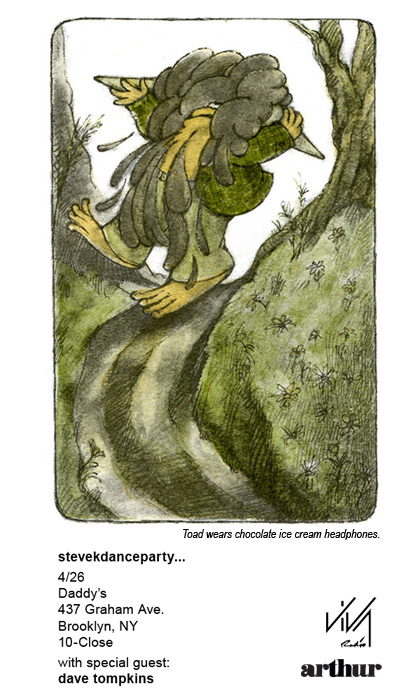
This Saturday, April 26th
Daddy’s
437 Graham Ave
Brooklyn, NY
3rd stop on the L
10-Close
Special Guest: Dave Tompkins
LOOK OUT FOR: Toadcoders, Das Boot bass, 4-part harmony soul mostly about relationships haunted by the shadow of a jilted string section, classy electronic handclaps, don’t stuff my ears with busted ice cream, robot woodpeckers headbutting telephone polls, a song called “Cold Wind Madness,” more handclaps.
From Soft Machine to Pere Ubu, bands have been drawn to surrealist writer Alfred Jarry and the bizarre ‘science’ he invented. Mike Barnes on what happens when music meets absurdism.
Mike Barnes
Friday April 25, 2008
The Guardian
When Firmin Gémier, the actor playing Père Ubu, uttered the opening line of Alfred Jarry’s play Ubu Roi at its Paris premiere in 1896, its author gained instant notoriety. Although consisting of just one made-up word, “merdre” – for which one English translation is “shittr” – it was enough to cause 15 minutes of uproar in the audience. When the play continued, its mix of absurd humour and obscenity provoked heckling, and scuffles broke out. in the auditorium. Nobody had seen anything like it. A perplexed WB Yeats, who attended the performance, famously said: “What more is possible? After us, the Savage God.”
The Savage God sounds suspiciously like a rock band, and Jarry managed, in fact, to create one of music’s odder distributaries, thanks to the concept of ‘pataphysics. Jarry’s school physics teacher – nicknamed Père Hébé by his pupils – managed to influence his charge in ways he never intended. As well as providing the seed of Père Ubu’s name, Hébé’s bungling manner, disastrous experiments and inability to control a class led Jarry to the creation of the spoof science of ‘pataphysics, in which contradictions are embraced, with all possible viewpoints having equal validity. (The apostrophe was apparently necessary to “avoid a simple pun”, although what that pun was has never been explained.)
To the extent that people are familiar in any way with ‘pataphysics, it would probably be through the Beatles. Paul McCartney heard a radio production of Jarry’s play Ubu Coco (Ubu Cuckolded) and was inspired to mention ‘pataphysics in song. Unfortunately, he dropped it into Maxwell’s Silver Hammer, one of his very worst. But, that disaster notwithstanding, ‘pataphysics has a curious place in music, a place that will be marked tonight at the Queen Elizabeth Hall in London, with a musical production, Bring Me the Head of Ubu Roi, featuring the veteran US avant-rock band Pere Ubu, which will be preceded by a free ‘Pataphysics in Sound concert in the venue’s foyer.
Put into a brief idiot’s guide – which, one assumes, would be as ‘pataphysically valid as any other guide – ‘pataphysics is, in Jarry’s words, “the science of imaginary solutions” and “the law governing exceptions”. In it, science’s apparently immutable laws are scoffed at. To Jarry, they are merely “the correlation of exceptions, albeit more frequent ones … which reduced to the status of unexceptional exceptions, possess no longer even the virtue of originality”. ‘Pataphysics was, he said, “the greatest of all sciences”.
Jarry claimed that “talking about things that are understandable only weighs down the mind and falsifies the memory, but the absurd exercises the mind and makes the memory work”. He was a singular artist who aimed to live life as a total hallucination. To this end, he drank formidable quantities of wine and absinthe, which precipitated his demise at the age of 34 in 1907.
Jarry’s legacy was formalised posthumously in 1948 by the founding of the Collège de ‘Pataphysique in Paris. Its constitution asserts that all people are ‘pataphysicians whether they know it or not, but paid-up Collège members have included artists Asger Jorn, Marcel Duchamp, Max Ernst, Jean Dubuffet, Eugene Ionesco, Jean Baudrillard, Umberto Eco, and the Marx Brothers. And its precepts have produced music more interesting and challenging than Maxwell’s Silver Hammer.
Duchamp created a number of musical compositions, many purely conceptual. But when Stephane Ginsburgh recorded Duchamp’s 1913 opus Erratum Musical a few years back, he took into account Duchamp’s observation that ‘pataphysics involved “canned chance” and ensured all the piece’s 88 piano notes were picked out in a random order with no emphasis on any one in particular. In 1960, Jean Dubuffet, who originated the term Art Brut, taped a series of improvisations with Asger Jorn, choosing from his collection of more than 50 instruments, few of which he could play to any recognised standard. These energetic, chaotic recordings were released as Expériences Musicales in 1961. And in 1975, the English composer Gavin Bryars – a member of the Collège de ‘Pataphysique – wrote Ponukélian Melody, a slow piece for wheezing organ, parping tuba, cello and bells. It was his musical response to Raymond Roussel’s novel Impressions d’Afrique, which was set in an imaginary African country.
But ‘pataphysics first truly overlapped with rock music in 1967, when Soft Machine – a psychedelic pop group with a penchant for improvisation – performed a live soundtrack to Jarry’s play Ubu Enchainé (Ubu Enchained) at the Traverse theatre in Edinburgh during that year’s Fringe festival. Early in the band’s career, drummer and vocalist Robert Wyatt’s whimsical, absurdist lyrics were often described as Dadaist. But were they, more accurately, ‘pataphysical?
“I wasn’t drawn to Jarry and ‘pataphysics from reading about it,” Wyatt explains. “I think we were chosen to be ‘pataphysicians before I knew what it was. Later, we were playing in Paris, and some representatives of the College of ‘Pataphysics came to the concert. A venerable old member of their group heard it for about five minutes, thought we played the most incomprehensible and appalling music he had ever heard, gave us his blessing and gave us certificates. So we are officially Petits Fils Ubu – Ubu’s grandchildren – and in our case it gives us the right to lead the marching band at the front of the victory parade of the ‘pataphysical movement. But nobody who gave it to us thought to explain it any more than you would explain a football match to a teddy bear mascot.”
For Soft Machine Volume Two, recorded in 1968, Wyatt wrote A ‘Pataphysical Introduction and A Concise British Alphabet. The latter is in two parts: he sings the alphabet forwards in the first, backwards in the second. This followed in the footsteps of Luc Etienne’s 1957 composition L’Apres-Midi d’Un Magnétophone: Palindromes Phonétiques, which has a similarly palindromic form – a recording of speech played normally, then with the tape running backwards . This emphasised that, ‘pataphyscially speaking, it meant as much, or as little, either way around, and ‘pataphysicians would describe the relationship of Etienne’s composition to Wyatt’s as an example of “plagiarism by anticipation”.
Was Wyatt guided by any of these concepts? “I don’t think I was guided by any thought at all,” he admits. “But I just decided that singing the alphabet backwards was a ‘pataphysical activity. Some people get upset by art that doesn’t make sense to them – I never had that problem. I never saw what was the sense that modern art wasn’t making. I was always at home with the science of imaginary solutions.”
Tonight’s performance of Bring Me the Head of Ubu Roi is just the latest in a long line of different treatments of Ubu Roi, from Jan Lenica’s 1977 cartoon version to a 1991 opera by Polish composer Krzysztof Penderecki. Jarry had an interest in the notion of “horrible beauty” in which an aesthetic appreciation of the monstrous was allowable and discordant elements could be counterbalanced by humour. Pere Ubu’s singer, David Thomas, agrees that this is a pretty good description of the band’s music, which is surmounted by squalling, untempered synthesiser and his own squawking vocals. But apart from their name and the fact that the title track of their 1977 debut album, The Modern Dance, includes the refrain “Merdre, merdre”, was Jarry an influence on Pere Ubu’s music?
‘The thing that impressed me over the time of immersing myself in Jarry in high school and the point at which I formed Pere Ubu, was Jarry’s theatrical production ideas,” Thomas explains. “It seemed to me that his method called for the engaging of the audience’s imaginations in the creative process, with his use of placards, ‘pataphysical notions, and anti-naturalism. As synthesised, concrète and abstract sound techniques and technology developed, and were integrated into rock music, then pure sound as a powerful narrative voice in its own right came into play.
“The object was the same as Jarry’s seemed to be, to engage the imagination of the audience in the creative process. To confound, illuminate, generate chaos for its own sake, to overlay intentions with counter-intentions, self-doubt, fear and hope, to create an art that, as accurately as possible in a three-minute song, mimics the human condition.”
Thomas has edited the play to concentrate on the two main characters. He has also added elements that he feels are in “the spirit of the original, particularly in the area that originally interested me in this project – the notion that the Politico-Media-Industrial Complex is filled with characters far more grotesque than Jarry’s characters could have ever been.”
Jarry wrote The Song of Disembraining for Ubu Roi, but Thomas has decided not to use it. “It’s not really a very good song,” he says. “The title is great but it meanders on and on forever.” He has instead translated parts of the plot into original song structures “where elegant to do so”, for which he is unabashed. “We are a rock band. We are Americans. We’re not going to pretend to be something we’re not,” he says. “The justification is that we’re the only band in the world which has for more than 30 years followed a Jarry-esque, or even ‘pataphysical course in rock music. We got a right to do what we want. The play is about ideas. The clothes you put on ideas are fashions that come and go. The ideas are what count and what survive.”
Uber dot com — an artist-run, independent web publishing platform — is in need
of interns to work on Arthur World Service, Arthur Magazine’s Uber-powered
online video channel, among other projects.
Responsibilities include:
* Online research
* Writing commentary and headlines
* Posting content
The ideal candidate will have a passion for media, the news, and the online
world. Previous online experience, a familiarity with Arthur Magazine and
strong computer skills, a plus. Candidate should have strong writing skills
and be a regular consumer of online media as well.
Hours: M-F, 3-4 hours each day
Location: Uber’s office in Beverly Hills
Compensation: unpaid or school-credit
Please send writing sample and resume to: dan at uber dot com
The New York Times – April 20, 2008
Why Bother?
By MICHAEL POLLAN
Why bother? That really is the big question facing us as individuals hoping to do something about climate change, and it’s not an easy one to answer. I don’t know about you, but for me the most upsetting moment in “An Inconvenient Truth” came long after Al Gore scared the hell out of me, constructing an utterly convincing case that the very survival of life on earth as we know it is threatened by climate change. No, the really dark moment came during the closing credits, when we are asked to . . . change our light bulbs. That’s when it got really depressing. The immense disproportion between the magnitude of the problem Gore had described and the puniness of what he was asking us to do about it was enough to sink your heart.
But the drop-in-the-bucket issue is not the only problem lurking behind the “why bother” question. Let’s say I do bother, big time. I turn my life upside-down, start biking to work, plant a big garden, turn down the thermostat so low I need the Jimmy Carter signature cardigan, forsake the clothes dryer for a laundry line across the yard, trade in the station wagon for a hybrid, get off the beef, go completely local. I could theoretically do all that, but what would be the point when I know full well that halfway around the world there lives my evil twin, some carbon-footprint doppelgänger in Shanghai or Chongqing who has just bought his first car (Chinese car ownership is where ours was back in 1918), is eager to swallow every bite of meat I forswear and who’s positively itching to replace every last pound of CO2 I’m struggling no longer to emit. So what exactly would I have to show for all my trouble?
A sense of personal virtue, you might suggest, somewhat sheepishly. But what good is that when virtue itself is quickly becoming a term of derision? And not just on the editorial pages of The Wall Street Journal or on the lips of the vice president, who famously dismissed energy conservation as a “sign of personal virtue.” No, even in the pages of The New York Times and The New Yorker, it seems the epithet “virtuous,” when applied to an act of personal environmental responsibility, may be used only ironically. Tell me: How did it come to pass that virtue — a quality that for most of history has generally been deemed, well, a virtue — became a mark of liberal softheadedness? How peculiar, that doing the right thing by the environment — buying the hybrid, eating like a locavore — should now set you up for the Ed Begley Jr. treatment.
And even if in the face of this derision I decide I am going to bother, there arises the whole vexed question of getting it right. Is eating local or walking to work really going to reduce my carbon footprint? According to one analysis, if walking to work increases your appetite and you consume more meat or milk as a result, walking might actually emit more carbon than driving. A handful of studies have recently suggested that in certain cases under certain conditions, produce from places as far away as New Zealand might account for less carbon than comparable domestic products. True, at least one of these studies was co-written by a representative of agribusiness interests in (surprise!) New Zealand, but even so, they make you wonder. If determining the carbon footprint of food is really this complicated, and I’ve got to consider not only “food miles” but also whether the food came by ship or truck and how lushly the grass grows in New Zealand, then maybe on second thought I’ll just buy the imported chops at Costco, at least until the experts get their footprints sorted out.
There are so many stories we can tell ourselves to justify doing nothing, but perhaps the most insidious is that, whatever we do manage to do, it will be too little too late. Climate change is upon us, and it has arrived well ahead of schedule. Scientists’ projections that seemed dire a decade ago turn out to have been unduly optimistic: the warming and the melting is occurring much faster than the models predicted. Now truly terrifying feedback loops threaten to boost the rate of change exponentially, as the shift from white ice to blue water in the Arctic absorbs more sunlight and warming soils everywhere become more biologically active, causing them to release their vast stores of carbon into the air. Have you looked into the eyes of a climate scientist recently? They look really scared.
So do you still want to talk about planting gardens?
I do.
Whatever we can do as individuals to change the way we live at this suddenly very late date does seem utterly inadequate to the challenge. It’s hard to argue with Michael Specter, in a recent New Yorker piece on carbon footprints, when he says: “Personal choices, no matter how virtuous [N.B.!], cannot do enough. It will also take laws and money.” So it will. Yet it is no less accurate or hardheaded to say that laws and money cannot do enough, either; that it will also take profound changes in the way we live. Why? Because the climate-change crisis is at its very bottom a crisis of lifestyle — of character, even. The Big Problem is nothing more or less than the sum total of countless little everyday choices, most of them made by us (consumer spending represents 70 percent of our economy), and most of the rest of them made in the name of our needs and desires and preferences.
For us to wait for legislation or technology to solve the problem of how we’re living our lives suggests we’re not really serious about changing — something our politicians cannot fail to notice. They will not move until we do. Indeed, to look to leaders and experts, to laws and money and grand schemes, to save us from our predicament represents precisely the sort of thinking — passive, delegated, dependent for solutions on specialists — that helped get us into this mess in the first place. It’s hard to believe that the same sort of thinking could now get us out of it.
Thirty years ago, Wendell Berry, the Kentucky farmer and writer, put forward a blunt analysis of precisely this mentality. He argued that the environmental crisis of the 1970s — an era innocent of climate change; what we would give to have back that environmental crisis! — was at its heart a crisis of character and would have to be addressed first at that level: at home, as it were. He was impatient with people who wrote checks to environmental organizations while thoughtlessly squandering fossil fuel in their everyday lives — the 1970s equivalent of people buying carbon offsets to atone for their Tahoes and Durangos. Nothing was likely to change until we healed the “split between what we think and what we do.” For Berry, the “why bother” question came down to a moral imperative: “Once our personal connection to what is wrong becomes clear, then we have to choose: we can go on as before, recognizing our dishonesty and living with it the best we can, or we can begin the effort to change the way we think and live.”
For Berry, the deep problem standing behind all the other problems of industrial civilization is “specialization,” which he regards as the “disease of the modern character.” Our society assigns us a tiny number of roles: we’re producers (of one thing) at work, consumers of a great many other things the rest of the time, and then once a year or so we vote as citizens. Virtually all of our needs and desires we delegate to specialists of one kind or another — our meals to agribusiness, health to the doctor, education to the teacher, entertainment to the media, care for the environment to the environmentalist, political action to the politician.
As Adam Smith and many others have pointed out, this division of labor has given us many of the blessings of civilization. Specialization is what allows me to sit at a computer thinking about climate change. Yet this same division of labor obscures the lines of connection — and responsibility — linking our everyday acts to their real-world consequences, making it easy for me to overlook the coal-fired power plant that is lighting my screen, or the mountaintop in Kentucky that had to be destroyed to provide the coal to that plant, or the streams running crimson with heavy metals as a result.
Of course, what made this sort of specialization possible in the first place was cheap energy. Cheap fossil fuel allows us to pay distant others to process our food for us, to entertain us and to (try to) solve our problems, with the result that there is very little we know how to accomplish for ourselves. Think for a moment of all the things you suddenly need to do for yourself when the power goes out — up to and including entertaining yourself. Think, too, about how a power failure causes your neighbors — your community — to suddenly loom so much larger in your life. Cheap energy allowed us to leapfrog community by making it possible to sell our specialty over great distances as well as summon into our lives the specialties of countless distant others.
Here’s the point: Cheap energy, which gives us climate change, fosters precisely the mentality that makes dealing with climate change in our own lives seem impossibly difficult. Specialists ourselves, we can no longer imagine anyone but an expert, or anything but a new technology or law, solving our problems. Al Gore asks us to change the light bulbs because he probably can’t imagine us doing anything much more challenging, like, say, growing some portion of our own food. We can’t imagine it, either, which is probably why we prefer to cross our fingers and talk about the promise of ethanol and nuclear power — new liquids and electrons to power the same old cars and houses and lives.
The “cheap-energy mind,” as Wendell Berry called it, is the mind that asks, “Why bother?” because it is helpless to imagine — much less attempt — a different sort of life, one less divided, less reliant. Since the cheap-energy mind translates everything into money, its proxy, it prefers to put its faith in market-based solutions — carbon taxes and pollution-trading schemes. If we could just get the incentives right, it believes, the economy will properly value everything that matters and nudge our self-interest down the proper channels. The best we can hope for is a greener version of the old invisible hand. Visible hands it has no use for.
But while some such grand scheme may well be necessary, it’s doubtful that it will be sufficient or that it will be politically sustainable before we’ve demonstrated to ourselves that change is possible. Merely to give, to spend, even to vote, is not to do, and there is so much that needs to be done — without further delay. In the judgment of James Hansen, the NASA climate scientist who began sounding the alarm on global warming 20 years ago, we have only 10 years left to start cutting — not just slowing — the amount of carbon we’re emitting or face a “different planet.” Hansen said this more than two years ago, however; two years have gone by, and nothing of consequence has been done. So: eight years left to go and a great deal left to do.
Which brings us back to the “why bother” question and how we might better answer it. The reasons not to bother are many and compelling, at least to the cheap-energy mind. But let me offer a few admittedly tentative reasons that we might put on the other side of the scale:
If you do bother, you will set an example for other people. If enough other people bother, each one influencing yet another in a chain reaction of behavioral change, markets for all manner of green products and alternative technologies will prosper and expand. (Just look at the market for hybrid cars.) Consciousness will be raised, perhaps even changed: new moral imperatives and new taboos might take root in the culture. Driving an S.U.V. or eating a 24-ounce steak or illuminating your McMansion like an airport runway at night might come to be regarded as outrages to human conscience. Not having things might become cooler than having them. And those who did change the way they live would acquire the moral standing to demand changes in behavior from others — from other people, other corporations, even other countries.
All of this could, theoretically, happen. What I’m describing (imagining would probably be more accurate) is a process of viral social change, and change of this kind, which is nonlinear, is never something anyone can plan or predict or count on. Who knows, maybe the virus will reach all the way to Chongqing and infect my Chinese evil twin. Or not. Maybe going green will prove a passing fad and will lose steam after a few years, just as it did in the 1980s, when Ronald Reagan took down Jimmy Carter’s solar panels from the roof of the White House.
Going personally green is a bet, nothing more or less, though it’s one we probably all should make, even if the odds of it paying off aren’t great. Sometimes you have to act as if acting will make a difference, even when you can’t prove that it will. That, after all, was precisely what happened in Communist Czechoslovakia and Poland, when a handful of individuals like Vaclav Havel and Adam Michnik resolved that they would simply conduct their lives “as if” they lived in a free society. That improbable bet created a tiny space of liberty that, in time, expanded to take in, and then help take down, the whole of the Eastern bloc.
So what would be a comparable bet that the individual might make in the case of the environmental crisis? Havel himself has suggested that people begin to “conduct themselves as if they were to live on this earth forever and be answerable for its condition one day.” Fair enough, but let me propose a slightly less abstract and daunting wager. The idea is to find one thing to do in your life that doesn’t involve spending or voting, that may or may not virally rock the world but is real and particular (as well as symbolic) and that, come what may, will offer its own rewards. Maybe you decide to give up meat, an act that would reduce your carbon footprint by as much as a quarter. Or you could try this: determine to observe the Sabbath. For one day a week, abstain completely from economic activity: no shopping, no driving, no electronics.
But the act I want to talk about is growing some — even just a little — of your own food. Rip out your lawn, if you have one, and if you don’t — if you live in a high-rise, or have a yard shrouded in shade — look into getting a plot in a community garden. Measured against the Problem We Face, planting a garden sounds pretty benign, I know, but in fact it’s one of the most powerful things an individual can do — to reduce your carbon footprint, sure, but more important, to reduce your sense of dependence and dividedness: to change the cheap-energy mind.
A great many things happen when you plant a vegetable garden, some of them directly related to climate change, others indirect but related nevertheless. Growing food, we forget, comprises the original solar technology: calories produced by means of photosynthesis. Years ago the cheap-energy mind discovered that more food could be produced with less effort by replacing sunlight with fossil-fuel fertilizers and pesticides, with a result that the typical calorie of food energy in your diet now requires about 10 calories of fossil-fuel energy to produce. It’s estimated that the way we feed ourselves (or rather, allow ourselves to be fed) accounts for about a fifth of the greenhouse gas for which each of us is responsible.
Yet the sun still shines down on your yard, and photosynthesis still works so abundantly that in a thoughtfully organized vegetable garden (one planted from seed, nourished by compost from the kitchen and involving not too many drives to the garden center), you can grow the proverbial free lunch — CO2-free and dollar-free. This is the most-local food you can possibly eat (not to mention the freshest, tastiest and most nutritious), with a carbon footprint so faint that even the New Zealand lamb council dares not challenge it. And while we’re counting carbon, consider too your compost pile, which shrinks the heap of garbage your household needs trucked away even as it feeds your vegetables and sequesters carbon in your soil. What else? Well, you will probably notice that you’re getting a pretty good workout there in your garden, burning calories without having to get into the car to drive to the gym. (It is one of the absurdities of the modern division of labor that, having replaced physical labor with fossil fuel, we now have to burn even more fossil fuel to keep our unemployed bodies in shape.) Also, by engaging both body and mind, time spent in the garden is time (and energy) subtracted from electronic forms of entertainment.
You begin to see that growing even a little of your own food is, as Wendell Berry pointed out 30 years ago, one of those solutions that, instead of begetting a new set of problems — the way “solutions” like ethanol or nuclear power inevitably do — actually beget other solutions, and not only of the kind that save carbon. Still more valuable are the habits of mind that growing a little of your own food can yield. You quickly learn that you need not be dependent on specialists to provide for yourself — that your body is still good for something and may actually be enlisted in its own support. If the experts are right, if both oil and time are running out, these are skills and habits of mind we’re all very soon going to need. We may also need the food. Could gardens provide it? Well, during World War II, victory gardens supplied as much as 40 percent of the produce Americans ate.
But there are sweeter reasons to plant that garden, to bother. At least in this one corner of your yard and life, you will have begun to heal the split between what you think and what you do, to commingle your identities as consumer and producer and citizen. Chances are, your garden will re-engage you with your neighbors, for you will have produce to give away and the need to borrow their tools. You will have reduced the power of the cheap-energy mind by personally overcoming its most debilitating weakness: its helplessness and the fact that it can’t do much of anything that doesn’t involve division or subtraction. The garden’s season-long transit from seed to ripe fruit — will you get a load of that zucchini?! — suggests that the operations of addition and multiplication still obtain, that the abundance of nature is not exhausted. The single greatest lesson the garden teaches is that our relationship to the planet need not be zero-sum, and that as long as the sun still shines and people still can plan and plant, think and do, we can, if we bother to try, find ways to provide for ourselves without diminishing the world.
Michael Pollan, a contributing writer for the magazine, is the author, most recently, of “In Defense of Food: An Eater’s Manifesto.”
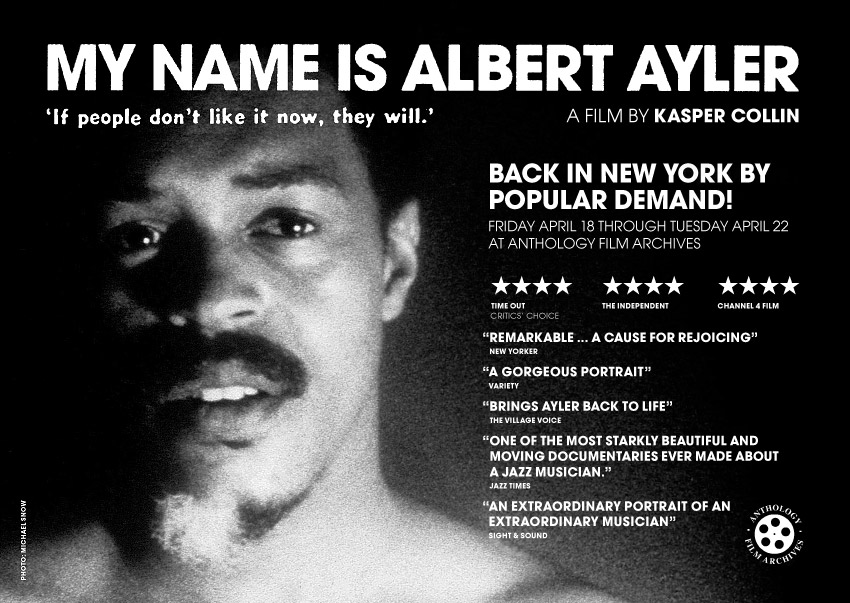
“My Name Is Albert Ayler was a major success when it had its New York theatrical premiere run late last year. Now it’s back for five days of encore screenings.
“Opens Friday April 18 at Anthology Film Archives.
“Screens through Tuesday April 22 at 7.00 & 9.00. Additional screenings on Saturday and Sunday at 5:00.
http://www.anthologyfilmarchives.org/schedule/search/film/?id=8792
ANTHOLOGY FILM ARCHIVES
32 SECOND AVENUE (@ 2nd St.) NYC
(212) 505-5181
—————————————————
‘If people don’t like it now, they will.’ (Albert Ayler)
featuring…
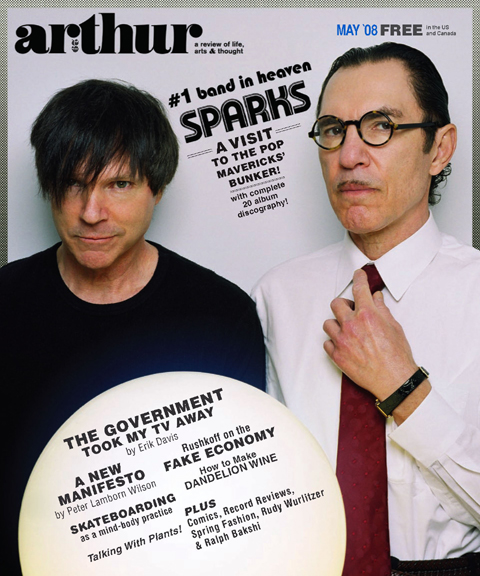
Chris Ziegler and Kevin Ferguson visit veteran sui generis pop duo SPARKS in L.A. as they prepare to perform their entire 20-album, 240-song ouevre in a single three-wek London engagement in May. “We’re actually better than we thought,” reveal the brothers Mael. Plus: an appropriately outsized ‘Listener’s guide to Sparks’ by Ned Raggett. With photography by Jeaneen Lund.
ENDARKENMENT MANIFESTO: “The last agreeable year for us was 1941, the ideal is about 10,000 BC, but we’re not purists. We might be willing to accept steam power or hydraulics.” Arthur proudly presents poet/scholar Peter Lamborn Wilson‘s half-serious proposal for a political movement to uphold and propagate the ideals of Green Hermeticism–the “coherent spiritual movement that constitutes the only imaginable alternative to unending degradation of Earth and humanity.” Wilson, using the pen name Hakim Bey, is the author of the Temporary Autonomous Zone concept, introduced in 1990…
The debut of “Advanced Standing,” a new column by Greg Shewchuk which asks, What if we thought of SKATEBOARDING as a mind-body practice? Illustration by Joseph Remnant.
Joe O’Brien has a drink with RUDY WURLITZER, the legendary author (Nog, Quake, Flats), screenwriter (Two Lane Blacktop, Walker) and aimless wanderer.
New columnist NANCE KLEHM explains how to make dandelion wine and what to do with human pee. Illustration by Aiyana Udessen.
DAVE REEVES on why we can’t let the President kill himself, with an illustration by Sharon Rudahl.
TWO PAGES OF FULL-COLOR ARTHUR COMICS, edited by Buenaventura Press, featuring new comics by Anna Sommer, Matt Furie, Kevin Huizenga, Jeffrey Brown, Anders Nilsen, Al Columbia, Tim Hensley, C.F., Ted May, Souther Salazar, Tom Gauld, Jonathan Bennett, Helge Reumann, Lisa Hanawalt, Dan Zettwoch, P.W.E. and Simon Evans.
“The Day Is Long”: SPRING FASHION on a Los Angeles afternoon, with photography and styling by Molly Frances and Mark Frohman.
Why you’ve always wanted to TALK TO PLANTS, and some of the best ways to do it, according to the Center for Tactical Magic.
Artist Arik Roper on the art and inspiration of animator RALPH BAKSHI.
“Bull Tongue” columnists BYRON COLEY & THURSTON MOORE review choice finds from the deep underground including work by Jackie O Motherfucker, Cookie, Times New Viking, “Guitar Army” by John Sinclair, “Eye Mind: The Sage of Roky Erickson” by Paul Drummond, “Moondog: The Viking of 6th Avenue” by Robert Scotto, Uneven Universe, Mors Ontologica, Hall of Fame, Egypt Is the Magick #, Baretta, Log and Toilet, Toylit, Bill Nace, Daniel Higgs, Mouthus, Hive Mind, Aaron Dilloway, Psychatrone Rhonedakk, WFMU’s “The Best of LCD,” Ashtray Navigations, Slurp Dogs, Wally Shoup/Nels Cline/Greg Campbell, Wally Shoup/Chris Corsano/Paul Flaherty, Ghidra, “Ugly Things” No. 26, “Like, Misunderstood” by Rick Brown and Mike Stax, Sunburned Circle, Testicle Hazard, Trash Ritual, Chrome, “Duplex Planet” No. 180, San Francisco Water Cooler, Jorge Boerhringer/Core of the Coalman, Take Up Serpents, Usputuspud, Henry Kuntz, Opeye, “People Take Warning!” comp, Robert Martin and Bobb Trimble reissues.
The Magik Markers’ ELISA AMBROGIO waxes enthusiastic about Blake Bailey’s Richard Yates bio, Alex Nielson & Richard Youngs, Evolution of a Cromagnon by John Joseph, Joshua Burkett, the Center for Constitutional Rights, Spectre Folk, Joan Acocella, VizUSA, Donovan Quinn, Luc Sante, Mick Turner, Colossal Yes, Mick Barr (Ocrilim), Buckingham/Nicks, Tony Rettman, Jason Wambsgans, Joe Carducci, Mick Flower, and Falk, California. Plus other stuff.
The fake economy’s parasitical relationship with the real economy isn’t going to last much longer, says columnist DOUGLAS RUSHKOFF. Illustration by M. Wartella.
The government is obsoleting analog television in February, 2009. ERIK DAVIS examines what we are losing. Illustration by Chris Rubino.
PLUS: Noisician/author Gabe Soria reports from New Orleans, singer-songwriter-bandleader Stephen Malkmus updates us on OLIGARCHY ’08 and Plastic Crimewave memorializes the late great KLAUS DINGER.
The magazine is out now in Los Angeles, and this coming weekend in the rest of the country.
You can download the complete 64-page magazine as a PDF in three parts:
Part 1 (8.1mb)
Part 2 (7.3mb)
Part 3 (9.5mb)
Click here to subscribe to Arthur now via PayPal and receive Arthur for a year, starting with this issue.
Or, order only Arthur No. 29, via PayPal (credit cards ok!):
USA – $6 postpaid
Canada – $8 postpaid
World – $11 airmail
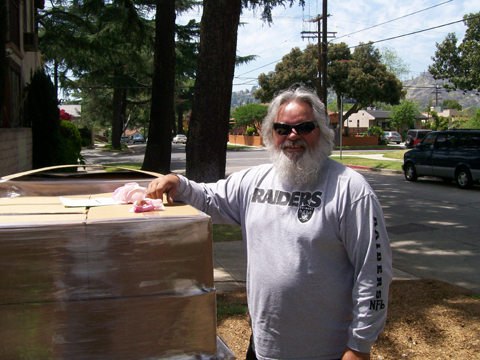
And gets a fresh rose or two for his big rig cabin.
 Arthur Magazine