Peakniks.

April 6, 2008 New York Times

Duck and Cover: It’s the New Survivalism

By ALEX WILLIAMS

THE traditional face of survivalism is that of a shaggy loner in camouflage, holed up in a cabin in the wilderness and surrounded by cases of canned goods and ammunition.

It is not that of Barton M. Biggs, the former chief global strategist at Morgan Stanley. Yet in Mr. Biggs’s new book, “Wealth, War and Wisdom,” he says people should “assume the possibility of a breakdown of the civilized infrastructure.”

“Your safe haven must be self-sufficient and capable of growing some kind of food,” Mr. Biggs writes. “It should be well-stocked with seed, fertilizer, canned food, wine, medicine, clothes, etc. Think Swiss Family Robinson. Even in America and Europe there could be moments of riot and rebellion when law and order temporarily completely breaks down.”

Survivalism, it seems, is not just for survivalists anymore.

Faced with a confluence of diverse threats — a tanking economy, a housing crisis, looming environmental disasters, and a sharp spike in oil prices — people who do not consider themselves extremists are starting to discuss doomsday measures once associated with the social fringes.

They stockpile or grow food in case of a supply breakdown, or buy precious metals in case of economic collapse. Some try to take their houses off the electricity grid, or plan safe houses far away. The point is not to drop out of society, but to be prepared in case the future turns out like something out of “An Inconvenient Truth,” if not “Mad Max.”

“I’m not a gun-nut, camo-wearing skinhead. I don’t even hunt or fish,” said Bill Marcom, 53, a construction executive in Dallas.

Still, motivated by a belief that the credit crunch and a bursting housing bubble might spark widespread economic chaos — “the Greater Depression,” as he put it — Mr. Marcom began to take measures to prepare for the unknown over the last few years: buying old silver coins to use as currency; buying G.P.S. units, a satellite telephone and a hydroponic kit; and building a simple cabin in a remote West Texas desert.

“If all these planets line up and things do get really bad,” Mr. Marcom said, “those who have not prepared will be trapped in the city with thousands of other people needing food and propane and everything else.”

Interest in survivalism — in either its traditional hard-core version or a middle-class “lite” variation — functions as a leading economic indicator of social anxiety, preparedness experts said: It spikes at times of peril real (the post-Sept. 11 period) or imagined (the chaos that was supposed to follow the so-called Y2K computer bug in 2000).

At times, a degree of paranoia is officially sanctioned. In the 1950s, civil defense authorities encouraged people to build personal bomb shelters because of the nuclear threat. In 2003, the Department of Homeland Security encouraged Americans to stock up on plastic sheeting and duct tape to seal windows in case of biological or chemical attacks.

Now, however, the government, while still conducting business under a yellow terrorism alert, is no longer taking a lead role in encouraging preparedness. For some, this leaves a vacuum of reassurance, and plenty to worry about.

Esteemed economists debate whether the credit crisis could result in a complete meltdown of the financial system. A former vice president of the United States informs us that global warming could result in mass flooding, disease and starvation, perhaps even a new Ice Age.

“You just can’t help wonder if there’s a train wreck coming,” said David Anderson, 50, a database administrator in Colorado Springs who said he was moved by economic uncertainties and high energy prices, among other factors, to stockpile months’ worth of canned goods in his basement for his wife, his two young children and himself.

Popular culture also provides reinforcement, in books like “The Road,” Cormac McCarthy’s novel about a father and son journeying through a post-apocalyptic wasteland, and films like “I Am Legend,” which stars Will Smith as a survivor of a man-made virus wandering the barren streets of New York.

Middle-class survivalists can also browse among a growing number of how-to books with titles like “Dare to Prepare!” a self-published work by Holly Drennan Deyo, or “When All Hell Breaks Loose” by Cody Lundin (Gibbs Smith, 2007), which instructs readers how to dispose of bodies and dine on rats and dogs in the event of disaster.

Preparedness activity is difficult to track statistically, since people who take measures are usually highly circumspect by nature, said Jim Rawles, the editor of http://www.survivalblog.com, a preparedness Web site. Nevertheless, interest in the survivalist movement “is experiencing its largest growth since the late 1970s,” Mr. Rawles said in an e-mail, adding that traffic at his blog has more than doubled in the past 11 months, with more than 67,000 unique visitors per week. And its base is growing.

“Our core readership is still solidly conservative,” he said. “But in recent months I’ve noticed an increasing number of stridently green and left-of-center readers.”

One left-of-center environmentalist who is taking action is Alex Steffen, the executive editor of http://www.Worldchanging.com, a Web site devoted to sustainability. With only slight irony, Mr. Steffen, 40, said he and his girlfriend could serve as “poster children for the well-adjusted, urban liberal survivalist,” given that they keep a six-week cache of food and supplies in his basement in Seattle (although they polished off their bottle of doomsday whiskey at a party).

He said the chaos following Hurricane Katrina served as a wake-up call for him and others that the government might not be able to protect them in an emergency or environmental crisis.

“The ‘where do we land when climate change gets crazy?’ question seems to be an increasingly common one,” said Mr. Steffen in an e-mail message, adding that such questions have “really gone mainstream.”

Many of the new, nontraditional preparedness converts are “Peakniks,” Mr. Rawles said, referring to adherents of the “Peak Oil” theory. This concept holds that the world will soon, or has already, reached a peak in oil production, and that coming supply shortages might threaten society. While the theory is still disputed by many industry analysts and executives, it has inched toward the mainstream in the last two years, as oil prices have nearly doubled, surpassing $100 a barrel. The topic, which was the subject of a United States Department of Energy report in 2005, has attracted attention in publications like The New York Times Magazine and The Wall Street Journal, and was a primary focus of “Megadisasters: Oil Apocalypse,” a recent History Channel special.

Another book, “The Long Emergency” (Atlantic Monthly Press, 2005), by James Howard Kunstler, an author and journalist who writes about economic and environmental issues, argues that American suburbs and cities may soon lay desolate as people, starved of oil, are forced back to the land to adopt a hardscrabble, 19th-century-style agrarian life.

Such fears caused Joyce Jimerson of Bellingham, Wash., a coordinator for a recycling-composting program affiliated with Washington State University, to make her yard an “edible garden,” with fruit trees and vegetables, in case supplies are threatened by oil shortages, climate change or economic collapse. “It’s all the same ball of wax, as far as I’m concerned,” she said.

Scott Troyer, an energy consultant in Sunnyvale, Calif., said he was spurred by discussions of peak oil — “it’s not a theory,” he said — and other energy concerns to remake his suburban house in anticipation of a petroleum-starved future. Mr. Troyer, 57, installed a photovoltaic electricity system, a pellet stove and a “cool roof” to reflect the sun’s rays, among other measures.

Mr. Troyer remains cautiously optimistic that Americans can wean themselves from oil through smart engineering and careful planning. But, he said, “the doomsday scenarios will happen if people don’t prepare.”

Some middle-class preparedness converts, like Val Vontourne, a musician and paralegal in Olympia, Wash., recoil at the term “survivalist,” even as they stock their homes with food, gasoline and water.

“I think of survivalists as being an extreme case of preparedness,” said Ms. Vontourne, 44, “people who stockpile guns and weapons, anticipating extreme aggression. Whereas what I’m doing, I think of as something responsible people do.

“I now think of storing extra food, water, medicine and gasoline in the same way I think of buying health insurance and putting money in my 401k,” she said. “It just makes sense.”
Exposition Universelle, 1900

Old expositions and world’s fairs are a persistent obsession over at Coulthart Towers. Many of the 20th century manifestations of these events fashioned visions of a science fiction future made of gleaming Modernist architecture, geodesic domes and monorails. The 19th and early 20th century, by contrast, was all about weird extrapolations of historical pastiche which too our eyes look like the dreams of Winsor McCay‘s Slumberland become real for the briefest moment. What follows is a few recent posts from { feuilleton } concerning the Paris Exposition Universelle of 1900, reproduced here at the request of Monsieur Babcock. JC.

exposition1.jpg

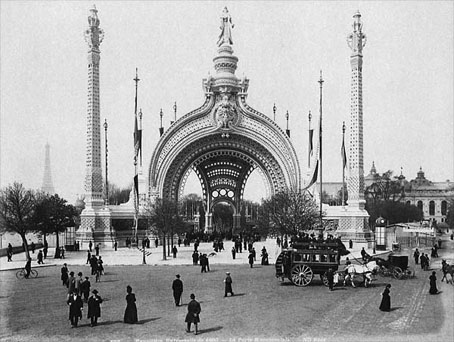
La porte monumentale.

Was the Paris Exposition of 1900 the most gloriously excessive of them all? Judging by these photos it certainly looks it. The Eiffel Tower was built for the 1889 exposition (and was famously intended to be a temporary structure) but became the centrepiece of the 1900 fair. Wikipedia has a large plan of the entire layout and two of the halls, the Grand and Petit Palais, are still in existence and used as exhibition spaces.

exposition2.jpg

Le palais des illusions.

exposition3.jpg

La salle des fêtes.

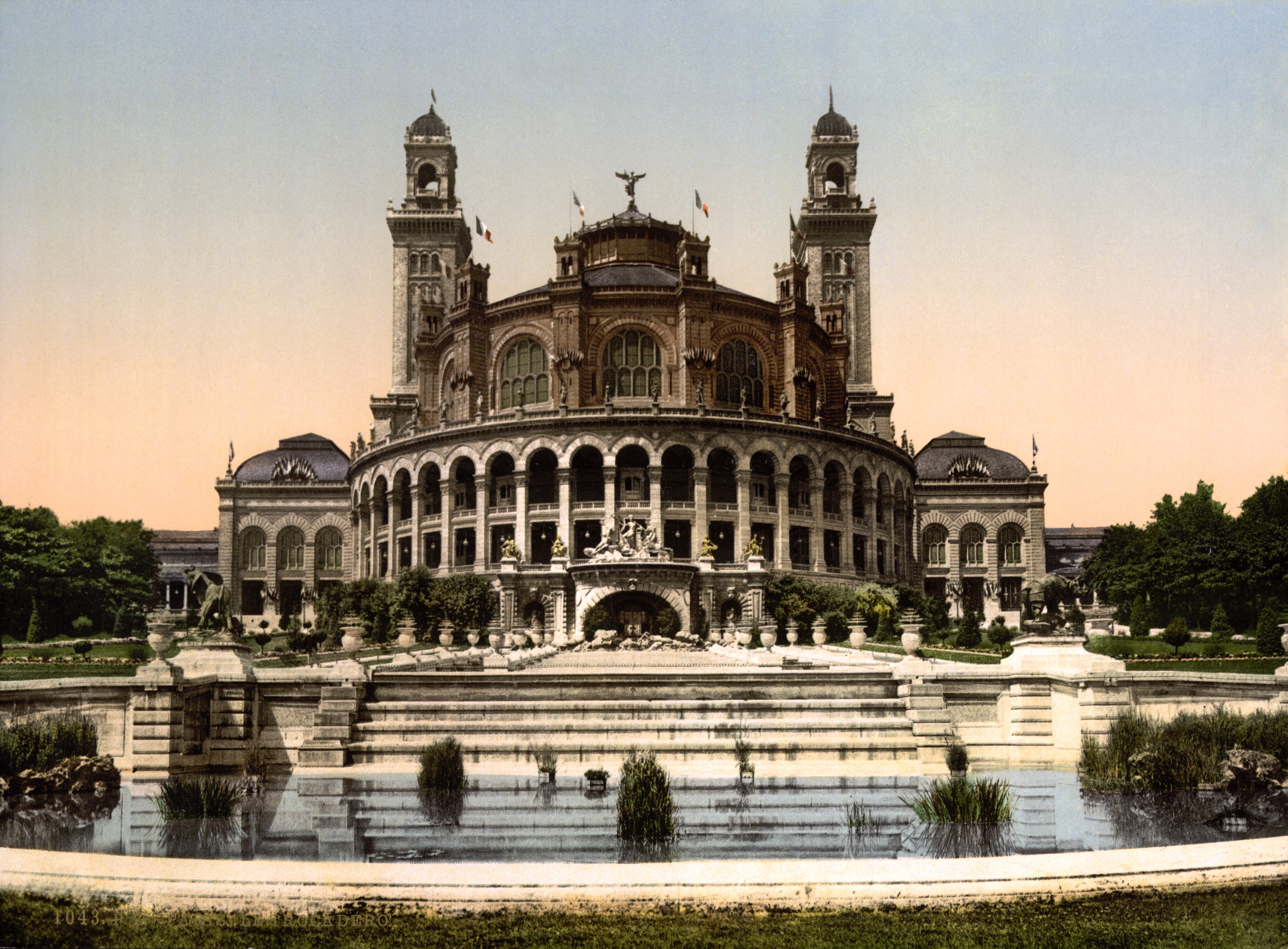
trocadero.jpg

The Palais du Trocadéro was designed by Gabriel Davioud for the 1878 World’s Fair and until its demolition in the 1930s faced the Eiffel Tower across the Seine. The 1900 Exposition included the Trocadéro among its buildings which makes it one of the more unusual exposition structures, having survived several of these events and seen off many of the temporary buildings that were raised around it.

The Trocadéro was something of a heavy-handed confection, ostensibly “Moorish” in that Orientalist fashion favoured by 19th century architects. The numerous photographs of the place give it the same quality of ghostly grandeur that so many these long-demolished buildings possess; we’re able to look at a very real place which has now vanished utterly. The bridge in the picture below still stands, however, and the balcony of the Trocadéro’s replacement, the Palais de Chaillot, gives great views of the Eiffel Tower and the river.

trocadero1.jpg

bonnier1.jpg

Globe terrestre by Louis Bonnier.

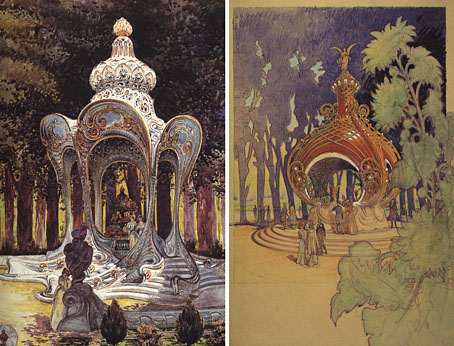
The Exposition Universelle would have been more grand/fabulous/excessive (delete as appropriate) if architect Louis Bonnier had been given free reign. The building above was intended to stand before the Palais du Trocadéro and house a huge globe which visitors could peruse from surrounding galleries. Bonnier also designed a series of kiosks (below) for different exhibitors which look more like over-sized Art Nouveau ornaments than pieces of architecture.

Three of these pictures are scanned from a book; the only site I found with examples of Bonnier’s work was this one which unfortunately spoils the pictures with enormous watermarks.

bonnier2.jpg

Exposition kiosks.

lumineux.jpg

The Palais Lumineux.

And lastly, a piece of pastiche that looks like Satine’s boudoir on the back of the elephant in Moulin Rouge. The Palais Lumineux was a work of period Chinoiserie built for the Exposition in the Champ de Mars close to the Eiffel Tower. I forget where I found this tinted view but Wikipedia has what appears to be the same photograph coloured so as to resemble a night scene.

KLAUS DINGER MOVES ON

Klaus Dinger, Drummer of Influential German Beat, Dies at 61

By BEN SISARIO
New York Times – April 4, 2008

Klaus Dinger, the drummer for the 1970s German band Neu!, whose mechanically repetitive yet buoyant beats had a wide influence in underground rock, died on March 20. He was 61.

The cause was heart failure, according to an announcement on Wednesday by his German record label, Grönland, which did not say where he died.

Mr. Dinger formed Neu!, which means New!, with the guitarist Michael Rother in Düsseldorf in 1971, after both had played in an early incarnation of the group Kraftwerk. Over three albums, the two perfected a droning, hypnotic style made up of Mr. Dinger’s simple, perpetual-motion rhythms and Mr. Rother’s fluid guitar effects.

Exemplified in songs like the 10-minute “Hallogallo,” Mr. Dinger’s beat was a steady pulse that seemed to extend rock’s most basic rhythmic patterns infinitely. The beat came to be known as Motorik, an allusion to the industrial style then prevalent among German groups. (The name Kraftwerk means power station.)

Along with records by Kraftwerk, Can, Faust and a few other groups, the original Neu! albums — “Neu!” (1972), “Neu! 2” (1973) and “Neu! ’75” (1975) — are landmarks of German experimental rock, a genre that was quickly labeled Krautrock by journalists and fans, both affectionately and derisively. (The musicians preferred the term Kosmische Musik, or cosmic music.)

Though the Neu! albums were long out of print before being reissued in 2001, they inspired countless artists, including David Bowie, Sonic Youth, Radiohead and Stereolab. The Neu! beat can also be heard in recent work by such groups as the Boredoms, from Japan.

Brian Eno, the British producer who championed Neu! and later worked with Mr. Rother, once said, “There were three great beats in the ’70s: Fela Kuti’s Afrobeat, James Brown’s funk and Klaus Dinger’s Neu! beat.”

In his student days in the 1960s, Mr. Dinger played in rock bands that he has described as influenced by the Beatles and the Kinks. He studied architecture but dropped out after three years to pursue music.

Mr. Dinger and Mr. Rother parted ways after the third Neu! album, and Mr. Dinger formed La Düsseldorf and later La! Neu? He reunited with Mr. Rother briefly in the mid-1980s and recorded an album, “Neu! 4,” that was released in 1995.

In a 1998 interview Mr. Dinger complained that he never called his beat Motorik.

“That sounds more like a machine, and it was very much a human beat,” he said. “It is essentially about life, how you have to keep moving, get on and stay in motion.”


Using common sense instead of kneejerk Econ 101 to understand what poor people face daily.

THE STING OF POVERTY

What bees and dented cars can teach about what it means to be poor – and the flaws of economics

By Drake Bennett | March 30, 2008 Boston Globe

IMAGINE GETTING A bee sting; then imagine getting six more. You are now in a position to think about what it means to be poor, according to Charles Karelis, a philosopher and former president of Colgate University.

In the community of people dedicated to analyzing poverty, one of the sharpest debates is over why some poor people act in ways that ensure their continued indigence. Compared with the middle class or the wealthy, the poor are disproportionately likely to drop out of school, to have children while in their teens, to abuse drugs, to commit crimes, to not save when extra money comes their way, to not work.

To an economist, this is irrational behavior. It might make sense for a wealthy person to quit his job, or to eschew education or develop a costly drug habit. But a poor person, having little money, would seem to have the strongest incentive to subscribe to the Puritan work ethic, since each dollar earned would be worth more to him than to someone higher on the income scale. Social conservatives have tended to argue that poor people lack the smarts or willpower to make the right choices. Social liberals have countered by blaming racial prejudice and the crippling conditions of the ghetto for denying the poor any choice in their fate. Neoconservatives have argued that antipoverty programs themselves are to blame for essentially bribing people to stay poor.

Karelis, a professor at George Washington University, has a simpler but far more radical argument to make: traditional economics just doesn’t apply to the poor. When we’re poor, Karelis argues, our economic worldview is shaped by deprivation, and we see the world around us not in terms of goods to be consumed but as problems to be alleviated. This is where the bee stings come in: A person with one bee sting is highly motivated to get it treated. But a person with multiple bee stings does not have much incentive to get one sting treated, because the others will still throb. The more of a painful or undesirable thing one has (i.e. the poorer one is) the less likely one is to do anything about any one problem. Poverty is less a matter of having few goods than having lots of problems.

Poverty and wealth, by this logic, don’t just fall along a continuum the way hot and cold or short and tall do. They are instead fundamentally different experiences, each working on the human psyche in its own way. At some point between the two, people stop thinking in terms of goods and start thinking in terms of problems, and that shift has enormous consequences. Perhaps because economists, by and large, are well-off, he suggests, they’ve failed to see the shift at all.

If Karelis is right, antipoverty initiatives championed all along the ideological spectrum are unlikely to work – from work requirements, time-limited benefits, and marriage and drug counseling to overhauling inner-city education and replacing ghettos with commercially vibrant mixed-income neighborhoods. It also means, Karelis argues, that at one level economists and poverty experts will have to reconsider scarcity, one of the most basic ideas in economics.

“It’s Econ 101 that’s to blame,” Karelis says. “It’s created this tired, phony debate about what causes poverty.”

In challenging decades of poverty research, Karelis draws on some economic data and some sociological research. But, more than that, he makes his case as a philosopher, arguing by analogy and induction. This approach means that he remains relatively unknown, even among poverty researchers. The book in which he laid out his argument, “The Persistence of Poverty: Why the Economics of the Well-Off Can’t Help the Poor,” wasn’t widely read when it was published last year.

A few, though, have taken notice, and are arguing that Karelis does have something important to say.

“There’s not much evidence in the book, and there are a lot of bold claims, but it’s great that he’s making them,” says Tyler Cowen, an economics professor at George Mason University. It “was a really great book, and it was totally neglected.”

The economist’s term for the idea Karelis takes issue with is the law of diminishing marginal utility. In brief, it means the more we have of something, the less any additional unit of that thing means to us. It undergirds, among other things, how the US government taxes people. We assume that taking $40,000 in taxes from Warren Buffett will be a lot less onerous to him than to an elementary school teacher, because he has so much more to begin with.

In many cases, Karelis says, diminishing marginal utility certainly does apply: Our seventh ice cream cone will no doubt be less pleasurable than our first. But the logic flips when we are dealing with privation rather than plenty. To understand why, he argues, we need only think about how we all deal with certain familiar situations.

If, for example, our car has several dents on it, and then we get one more, we’re far less likely to get that one fixed than if the car was pristine before. If we have a sink full of dishes, the prospect of washing a few of them is much more daunting than if there are only a few in the sink to begin with. Karelis’s name for goods that reduce or salve these sort of burdens is “relievers.”

Karelis argues that being poor is defined by having to deal with a multitude of problems: One doesn’t have enough money to pay rent or car insurance or credit card bills or day care or sometimes even food. Even if one works hard enough to pay off half of those costs, some fairly imposing ones still remain, which creates a large disincentive to bestir oneself to work at all.

“The core of the problem has not been self-discipline or a lack of opportunity,” Karelis says. “My argument is that the cause of poverty has been poverty.”

The upshot of this for policy makers, Karelis believes, is that they don’t need to fret so much about the fragility of the work ethic among the poor. In recent decades, experts and policy makers all along the ideological spectrum have worried that the more aid the government gives the poor, the less likely they are to work to provide for themselves. David Ellwood, an economist and the dean of Harvard’s John F. Kennedy School of Government, has called this “the helping conundrum.” It was this concern that drove the Clinton administration’s welfare reform efforts.

But, according to Karelis, that argument is exactly backward. Reducing the number of economic hardships that the poor have to deal with actually make them more, not less, likely to work, just as repairing most of the dents on a car makes the owner more likely to fix the last couple on his own. Simply giving the poor money with no strings attached, rather than using it, as federal and state governments do now, to try to encourage specific behaviors – food stamps to make sure money doesn’t get spent on drugs or non-necessities, education grants to encourage schooling, time limits on benefits to encourage recipients to look for work – would be just as effective, and with far less bureaucracy. (One federal measure Karelis particularly likes is the Earned Income Tax Credit, which, by subsidizing work, helps strengthen the “reliever” effect he identifies.)

Few economists are familiar with Karelis’s work, and when it’s presented to them, they tend to be skeptical of its explanatory power. If Karelis is right, we should see even more defeatist behavior than we do from the poor, says Kevin Lang, chairman of the Boston University economics department and author of “Poverty and Discrimination.” Plus, he argues, there’s little evidence that simply making poor people less poor increases their work ethic – and some evidence that it does the opposite. In the early 1970s, a large-scale study gave poor people in four cities a so-called “negative income tax,” a no-strings-attached payment based on how little money they made. The conclusion: the aid tended to discourage work.

Karelis responds that the data from that experiment is in fact quite ambiguous, and there has been debate among economists over how to interpret the results. But ultimately, he believes, the strength of his arguments is less in how they fit with the economic work that’s been done to date on poverty – much of which he is suspicious of anyway – but in how familiar they feel to all of us, rich or poor.

“The bee sting argument, or the car dent one,” he says, “I’ve never had anybody say that that isn’t true.”

Drake Bennett is the staff writer for Ideas. E-mail drbennett@globe.com.


HOLLOW EARTH RADIO


earthexploding.jpg

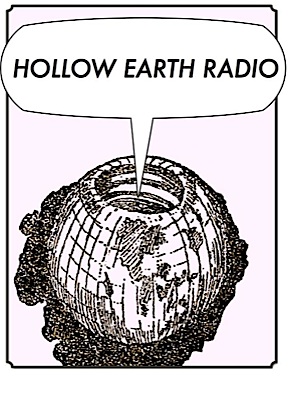
HOLLOW EARTH RADIO

“Our Vision
“We have two main goals. Our first emphasis is on exposing works that have yet to be unearthed or have long been dormant. We seek out content that is raw and undiscovered such as found sound from answering machine tapes scavenged from yard sales or bedroom recordings that have never seen the light of day or old gospel records found at thrift stores or stories from everyday life from people in our neighborhood, or music from bands that mostly play house shows.

“The second part of our vision is to support programs that highlight human experience. We feel that the way we consume music is becoming more and more abstract, where, for instance, it is common to buy a 99 cent song from an online music store that distances us from really becoming connected to the actual people who create the songs. We want to talk to the musicians, reveal the stories behind the artists, and learn about the actual people involved.”

How We Got Our Name
“The term Hollow Earth comes from a theory that describes an opening in the earth at the North and South Poles. From that point, there are all sorts of speculations about whether there is another world of life within the center of the Earth. The theories on who inhabits this inner realm involve fairies, leprechauns, aliens, angels, lost civilizations – the list goes on and on. We like the idea of a Hollow Earth because our educated guess would suggest that the Hollow Earth Theory is not true, but this type of theory symbolizes the many things in life that we take for granted. Scientists have made hypotheses, but does anyone really know what is in the center of our planet?

“In one way, the Hollow Earth Radio station seeks to examine these underground paranormal oddities through programs of conversations and music. We also feel this name mirrors our desire to move inward to unexplored places within ourselves.”

Mike Wolf on Carducci

SST, L.A. and all that…
by Mike Wolf
April 1st, 2008
Time Out New York

It’s rare that a book concerning music history can uproot long-held beliefs in you. By you, yeah, I mean me. More often, when you read about how and why they did it back whenever, your reactions tend more toward the, “Oh, wow, I did not know that,” and, “That’s interesting, I’ll have to look into that more,” and, “Really—Satan himself?” Joe Carducci’s Enter Naomi, which came out last year, was different. It had more of a “knock me down, pick me up by the feet and shake out a dose of the stupid that had been rattling around my brainpan” sort of effect.

Having grown up as a kid out East, and grown up the rest of the way (such as I am) in the Midwest, I had a too-typical unexamined bias against SoCal punk (all the more dumb on account of Agent Orange was my first punk show). It wasn’t that I saw the West Coast stuff as second-rate—more like I just didn’t think about it much at all beyond Black Flag and the Germs and the Urinals. In fact, looking back, I think it just intimidated me. Straight-up punk nihilism was easy to figure out—these guys were smart though.

In Enter Naomi, Carducci lays out the desperate skin-of-their-teeth’s-ass day-by-day of the early SST bands and the label itself (where he worked) in Orange County, time-slipping ahead and back to reconstruct the enthusiastic life of Naomi Petersen, a punk kid who bum-rushed her way through the door and across a testosterone minefield to become the label’s staff photographer. That Carducci is able to tell us about his late friend Naomi, the times, the bands and the label simultaneously, lovingly and often hilariously but without much nostalgia or sentimentality, is what made the book one of 2007’s musts for anyone who wonders why most music today seems dry and weak and lacking in effort and desire. It reads the way good music vibes, when you feel like you’re really getting it.

You don’t need to take my word for it, though—Carducci’s in town to read and talk tonight (Wed 2) at Other Music, at 7:30pm, for free.


Bingo was his name

From Tamala Poljak:

Hello friends,

Many of you have probably heard this sad, sad news already but our sweet BINGO, (Sarah Dale’s dog, the king of Silverlake/Sunset Junction, Pull My Daisy’s mascot, bacon eater, champion of wiener races and a lover to many… just to name a few) was hit by a car last Sunday and passed away. It’s really sad. He was an unbelievable little man who made everyone smile. I knew him since he was a little puppy. He had the best social skills of any being I know and taught me a lot about love & affection.

There will be a memorial in his honor on Sunday, April 6 at noon near the mural at the Surplus store on Hyperion and Sunset, near the Casbah. Please join us to celebrate his life, bring some flowers or some pictures or bacon…

He was magic and there will forever be a void in that space he filled.

With love,

Tamala

Silver Lake’s Top Dog
By Seven McDonald
LAWeekly – Thursday, October 28, 2004

Everybody here loves Bingo. See for yourself. That gray-haired man carrying his newspaper: “Hi! Bingo.” Those three cool rocker girls with their cell phones out: “Hey, Bingo!” That cute N.Y.-looking couple wearing blazers and holding hands, they’re all crazy for Bingo.

“He has definitely helped business,” says 30-year-old bleached blond Sarah Dale, owner of Silver Lake’s Pull My Daisy boutique and Bingo, the 12-pound dachshund.

“He’s a pied piper,” she says, eyeing Bingo, who sits in the doorway looking out. “He brings in all kinds of people.

“Dachshunds were bred for badger hunting. They’re perimeter dogs, they burrow and patrol, and he definitely likes to patrol. He guards his turf. Every morning the first thing he does is walk up and down the block and check in at all the stores. He doesn’t like skateboarders or anyone running.”

Bingo’s beat is Sunset Boulevard between Sanborn and Lucille avenues, i.e. the heart of Silver Lake. His block, which includes Casbah café, Eat Well, Flea’s Silverlake Conservatory of Music, the Cheese Store of Silver Lake and Gilly flowers, has such a small-town feel that the shop owners refer to it as “Mayberry L.A.”

Bingo takes his neighborhood so seriously he seems to have lost all interest in normal dog activities.

“We used to go to the dog park or go on hikes,” says Dale, a former Eat Well waitress, who bought her business four years ago, essentially on her credit cards.

“Now he’s sort of over dogs. He’d rather socialize and hang out around people. On my days off I’ll just drop him off at the store. That’s the way he likes it.”

Dale, who is currently single and lives in the apartment above her store, estimates that 90 percent of the people she meets out at night are acquaintances who ask her about Bingo.

“He’s way more popular than I am,” says Dale, walking out onto the sidewalk to smoke a cigarette.

Like something out of a punk rock Moss Hart script, Bingo’s impact on the neighborhood didn’t become completely clear until he got sick a few years back.

“He couldn’t be in the store for 10 days,” recalls Dale, watching a man reach down to pat Bingo on the head. “It actually got annoying. ‘Where’s Bingo?’ ‘How’s Bingo?’ People made cards; people offered to pay his medical bills. I think maybe a hundred people came in. He got so skinny in the hospital we started calling him Perry Farrell. He was very ‘comin’ down the mountain.’”

Bingo, who was named after the dog on the Cracker Jack box, isn’t actually related to the famous Jane’s Addiction singer, though there is a faint resemblance. He does in fact have a litter of rock-star pals, including Marilyn Manson, the guys from NOFX, the girls from Sleater-Kinney, drag star Jackie Beat, and Brett and Tim from the band Rancid.

“Tim Armstrong from Rancid used to have a dachshund growing up. He always comes by and says, ‘Bingo reminds me of Shatzi.’”

Does Bingo know Flea?

“No. He hasn’t met Flea yet, but the kids from the school come down all the time.”

Bingo also seems to have some sort of Lindsay Lohan/Hilary Duff–style feud going with Mr. Winkle, that weird wind-up-teddy-bear-like dog that has been on Sex and the City and the daytime-TV circuit.

“Bingo and Mr. Winkle came up together in the dog park,” explains Dale.

“We used to go there every morning. Before we had the store. Before Bingo was Bingo. Before Mr. Winkle was Mr. Winkle. They’re both small dogs; they got along very well. Winkle’s owner [Lara Regan] was like, ‘I’m gonna make a book of my dog, ’cause he’s a hootsy-flootsy alien man,’” says Dale, snidely referring to Regan’s claim that her dog, who now has a popular calendar and book line, might have come from another planet to heal this world.

“I mean, we always thought Winkle was great,” Dale continues, putting out her cigarette and going back inside.

“I mean, he’s so weird looking. But I was shocked to see how popular he became. And I was worried that Bingo might be jealous. But Bingo is a dog of the people. He’s here every day. He is in the trenches. I think Winkle has gone to a whole new level.”

Are you implying Winkle is lost?

“I think Winkle sold out, if that’s what you mean. I think we know who’s still in Silver Lake. Who’s the real indie-rock dog and who sold out to the merchandising gods.”

That said, Bingo does have his own T-shirt line, which features the announcement: “My name is Bingo and I like Bacon!” Which he does. As well as pork patties, hot dogs and, strangely, those small to-go creamers, especially from McDonald’s.

Dale claims all the money goes directly to Bingo’s vet bills and other expenses. “Basically, whatever Bingo wants Bingo gets.”

They’ve sold a thousand shirts in three years (that’s a lot of bacon), and recently Bingo fans have taken to wearing the shirts in vacation photos, which Dale posts in the back of the store. There are people wearing Bingo shirts at the Great Wall of China, the Eiffel Tower and even beside coconut-clad Polynesian dancers at a Hawaiian luau.

Dale won’t go so far as to say her Bingo shares any of Mr. Winkle’s purported healing powers, but she will admit that he seems to make people happy.

“I think for a lot of people who can’t have a dog, Bingo has become their unofficial dog. There’s a girl up the street who was studying for her finals, and she would come here every day just to see Bingo. She said it calmed her down. I feel he is a real credit to his breed.”

How do you feel about Chihuahuas?

“You know what I love? What they call Cha-Weiners. A mix between a dachshund and a Chihuahua. It’s a great-looking combo.”

Do you think Chihuahuas are out?

“Chihuahuas have been out since Yo Quiero Taco Bell.”

Any other Bingo stories?

“Well, I told you they burrow . . . It was the winter, so it was extra cold. I woke up and he had burrowed into my pajama pants. I was like, What? What? I couldn’t get him out. I was, like, to my ex-husband, ‘Derek, the dog’s in my pants.’”