First 2008 nomination for 60s-70s folk hero revival. Carl Ogelsby has the best tunes and most relevant/vital dialogue…

https://i0.wp.com/www.simonsays.com/assets/isbn/1416547363/BC_1416547363.jpg

The Time of Their Lives
– Elsa Dixler, NY Times 2-10-08

Campaigning against a president who refused to respond to the growing opposition to a cruel, dishonest war, the charismatic young candidate insisted: “What we need in the United States is not division.  What we need in the United States is not hatred. What we need in the United States is … love and wisdom and compassion toward one another.” That wasn’t last week — it was April 1968, and two months later Robert Kennedy was dead. Opposition to the war continued and
broadened after the election of Richard Nixon that fall, but one of the engines of the antiwar movement, Students for
a Democratic Society, largely disbanded after a split in 1969; the next year its leaders, gripped by revolutionary fantasies, went underground.

Among the casualties of S.D.S.’s implosion was a former president, Carl Oglesby, who was pushed out of the organization in 1969, accused of being a “hopeless bourgeois liberal” and possibly a government agent. In “Ravens in the Storm,”
Oglesby not only tells his own amazing story, but also provides an interesting angle on the contested history of S.D.S.

When he became president of the organization in June 1965, Oglesby (whom I knew slightly some years after the period covered in his book) was neither a student nor especially young. Born in 1935, he was the first in his family to hold a white-collar job. His father and mother had fled to Akron, Ohio, from Southern rural poverty, and Oglesby left his parents’ life far behind. He dropped out of Kent State to try his luck as an actor in New York but returned to school determined to become a playwright. Oglesby’s theatrical training served him well; in his memoir he says several times that it prepared him to be a public speaker.

Oglesby hung out with Kent State’s beatniks and immersed himself in poetry and jazz. After he married and became a father, he needed more money than he could make working part time at a pizzeria. He became a technical editor in Akron and later was hired by the Bendix Corporation’s Systems Division. By 1963 he was the supervisor of a 90-person technical editing section, while the company allowed him time to finish his B.A. at the University of Michigan. Oglesby and his wife, Beth, who by then had three children, settled on Ann Arbor’s appropriately named Sunnyside Street.

But Oglesby did not keep on the Sunnyside. Invited to write a research paper about the expanding American commitment in Vietnam for a Democratic candidate for Congress in 1964, Oglesby concluded that immediate disengagement was the only solution; the candidate was horrified. The publication of the position paper in the university’s literary magazine alongside one of Oglesby’s plays led to a visit from a graduate student who thought Oglesby belonged in S.D.S.

The organization, which by 1965 had 2,000 members, seems to have made a major effort to recruit Oglesby; he met its current president, Paul Potter, and its past presidents Tom Hayden and Todd Gitlin. Eventually he left Bendix and became S.D.S.’s director of research,information and publications. Then in June 1965, Oglesby was elected president. Pretty wild for a nearly 30-year-old father of three who only a few months earlier had worked for a defense contractor and held an F.B.I. secret clearance.

Oglesby presided over S.D.S. at a time of incredibly rapid expansion. He traveled around the country speaking against the war, and to South Vietnam. At an antiwar march on Washington in November 1965, he denounced what was coming to be known as corporate liberalism. Appealing to “humanist liberals,” he urged: “Help us build. Help us shape the future in the name of plain human hope.” Oglesby was an inspiring speaker, appealing to a broad audience in the name of “democracy and the vision that wise and brave men saw in the time of our own Revolution.”

But that was not the direction in which S.D.S., which by 1968 had approximately 100,000 members (and many more sympathetic nonmembers), was moving. More and more there was pressure not to end the war but to “bring the war home.” Oglesby’s belief that S.D.S. “could become a builder of the radical center” and “a serious force on the political scene” came into conflict with the organization’s increasingly confrontational style. Oglesby reproduces a series of conversations — based, he says, on his recollections and contemporary notes — with Bernardine Dohrn, who became an S.D.S. national secretary in 1968 and later a leader of the Weathermen. These dialogues are presumably meant to show the difference between Oglesby’s realism and decency and Dohrn’s melodramatic arrogance, but in them she often seems to get the better of Oglesby. Her main point is that she is a revolutionary and he is a mere liberal. Her politics were deluded and self-indulgent, but it is hard not to conclude that she had a point. As a “centrist libertarian,” Oglesby seemed determined to embark on causes — like a relationship with the director of an international consulting firm that may well have been a C.I.A.front — that seem odd and diversionary. His continual circling back to his arguments with Dohrn gives the book something of the stuck feel of a complaint from a still-bitter former spouse.

“Ravens in the Storm” is most interesting as the story of a life transformed. The author insists that it is memoir, not history, and he is right. The book ends in 1970 with Oglesby driven out of S.D.S. and demoralized, and he does not push beyond his point of view at that time to present his current thinking about S.D.S. (does he still see things the way he
did in 1969?) or the new student organization that has revived its name. Nor does he discuss current politics or let us know what he has been doing in the intervening decades.


It might be argued that the movements of the 1960s were far more successful culturally than they were politically… Shortly before he was forced out of S.D.S., Oglesby’s wife urged him to leave the organization. “You could go back to school, try to get another teaching job,” she suggests. “You could write another play … hang out with our kids.” But Oglesby continues to try to convince his comrades that it is possible to maintain a nonviolent opposition to the war and remain “a significant force in American education.” Unfortunately — for Carl Oglesby and for the American left — it wasn’t.


Another take on this period comes from “Students for a Democratic Society: A Graphic History” (Hill & Wang, $22). Written by Harvey Pekar, drawn by Gary Dumm and edited by Paul Buhle,who was the founding editor of the journal Radical America (and whom I also knew slightly), the book contains a history of S.D.S. by Pekar and illustrated recollections by a range of former S.D.S. members. I found the personal stories frustratingly brief and uneven, and wasn’t sure what the graphics added to most of them, but I’m not the target audience. The book should serve as an introduction to S.D.S. for curious students who aren’t committed enough for Kirkpatrick Sale’s 750-page version.

After leaving Pete Seeger’s Weavermen, singer/guitar player Carl Oglesby embarked on his own solo career, recording two albums for Vanguard (1969-1971), both works, here available on this single CD, are characterized by a psychedelic folk rock sound. Features some of the era’s most talented sidemen – Vinnie Bell, David Spinozza, Joe Meck, and John Frangipane. Both albums are considered lost jewels of the Vanguard collection. Cardboard gatefold sleeve. Universe. 2003.

(Note:  Nat Hentoff suggested Carl Ogelsby to Vanguard!!!  – SK)

Powered by ScribeFire.
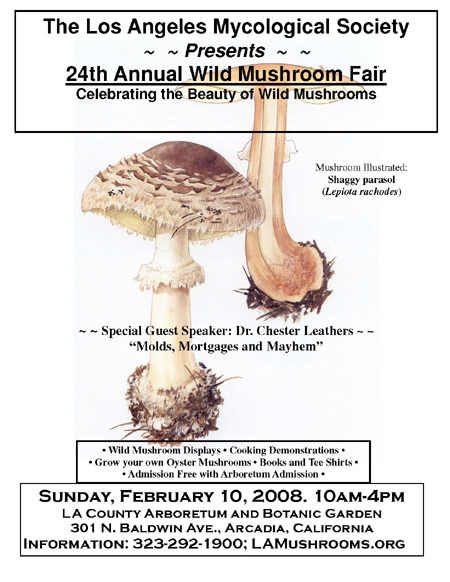
TODAY: 24th Annual Los Angeles Wild Mushroom Fair

lams_fairposter_2008.jpg

24th Annual Wild Mushroom Fair
Celebrating the Beauty of Wild Mushrooms

Keynote Speaker: Dr. Chester R. Leathers on “Mold, Mortgages and Mayhem”

Mushroom Cooking demonstration

Mushroom Cultivation demonstration

We will have experts on hand to identify any mushrooms you bring in.

Sunday, February 10, 2008. 10AM-4PM
Los Angeles County Arboretum and Botanic Garden
301 N. Baldwin Ave.
Arcadia, CA 91007

More info: http://www.lamushrooms.org/fair-2008.html


Hey man do you want to live on a planet of weeds?

Paths to Survival
by Rick Ridgeway

(first published in Patagonia’s Heart of Winter 2008 catalog)

For many wild animals, to roam means to survive. Seasonal migration between habitats is a pattern passed from generation to generation of eagles, waterfowl, elk and hundreds of other species. To locate a new place to survive and breed, the young of many species must roam far and wide. And freedom to roam often determines whether or not wild creatures can adapt to change. Even for species that do not seasonally migrate, the ability to find new mates in new places protects genetic health and diversity.

What happens when habitats are isolated by cities and highways, or fragmented by fences and fields? Since the 1960s, conservation biologists have been able to measure with increasing accuracy the minimum sizes of protected areas needed to ensure the long-term survival of all the species in a given ecozone. No surprise: Big animals need big spaces. If territories are balkanized by highways, energy development and housing, the long-term survival of large mammals – as well as the multitude of smaller creatures connected to them – is jeopardized. Imagine it this way: As writer David Quammen has noted, if you cut a beautiful, handwoven Turkish rug into 36 pieces, you don’t end up with 36 Turkish rugs. You have instead 36 worthless remnants.

That’s the first problem. The second one has come into focus only in the last few years: What happens when habitats change because of global warming? What happens when species are marooned in isolated islands of shifting habitat? Many of us followed last year’s reports from the Intergovernmental Panel on Climate Change – the most exhaustive and authoritative studies to date on the likely effects of global warming. If animals remain trapped in their habitats, the IPCC predicted, one-quarter of the earth’s plants and animals could disappear by the end of this century. Nothing like that has happened on this planet since the extinction of the dinosaurs 65 million years ago. It can be argued convincingly that nothing of this magnitude has challenged our own species in our relatively short history on this planet.

What to do? In the 1980s, Michael Soulé, a leading conservation biologist, and Arne Naess, a leading environmental thinker, were discussing the problem of fragmented habitats over breakfast in Soulé’s kitchen. This was before Bill McKibben wrote his seminal work The End of Nature, the first sounding of the tocsin on global warming, but after E. O. Wilson, Tom Lovejoy and others had defined the minimal size of protected areas needed for all wildlife in a region to survive. Soulé was staring out the window of his Santa Cruz home when an idea popped into his head: Corridors, he thought to himself.

“Reconnect the isolated patches of wildlands throughout North America,” he told Naess, “so animals can freely move and ecological fluxes are restored.”

Naess’s eyes lit up and a eureka smile crossed his face. The effort to create corridors up and down North America was launched, and at Patagonia, we picked up the theme as our annual environmental campaign in 2002-2003. For 12 months, we ran articles in our catalogs and put up displays in our stores to increase awareness for landscapes that were “Big, Wild & Connected.” Now, with global warming compressing the timetable for planetary change, we return to our earlier effort. Freedom to Roam, however, is more than a campaign – more than a one- or two-year effort to bring awareness to an important and complex environmental challenge, as we have done with issues like genetic engineering, the plight of salmon and, most recently, the plight of the oceans. Freedom to Roam is an initiative to use our resources and our communication skills, not only to bring awareness to this challenge, but to bring together environmentalists, recreationalists, ranchers, hunters and anglers, urban folk and rural folk in a commitment to the wild and to future generations who love the wild.

Our first goal is to educate all of us regarding the three great north-south corridors – “wildways” that connect existing protected areas along the Pacific Crest, the Continental Divide and the Atlantic Spine. These three wildways, in turn, connect to The Big Wild, that great arc of boreal forest north of the Trans-Canadian Highway. Second, we hope to coordinate groups already working to protect parcels within the three wildways so that, united, their voices will have more volume and influence in the governments of countries on the North American continent. (This includes ranchers and those in rural communities who live within the wildways. Without accommodating the needs and wisdom of rural residents, this initiative will not succeed.) Third, we want to inspire a broad and deep grassroots awareness of this challenge and mobilize thousands of people to venture into the wildways, to hike and climb and paddle and camp, to bear witness to the wonders of the wildlands and the wildlife within them. Finally, we plan to entreat, implore, cajole, embarrass – whatever it takes – to persuade our lawmakers to pass legislation and to allocate the resources needed to establish the corridors.

If we fail? Biologists are calling this the Sixth Mass Extinction; there have been five other such events in the last 250 million years. As with these past events, it is unlikely there will be a complete collapse of life on earth. But what will be left? Recall the “wildlife” you see in cities and suburbs: pigeons, crows, rats, cockroaches. Very adaptable species that will likely fill the vacancies left by meadowlarks, lynx, wolverine, panther, grizzly. What is left will be (again to quote Quammen) the “weed species.” It comes down to whether or not you want to live on a planet of weeds.

Bio: Rick Ridgeway has been part of the Patagonia family since the company started in the early ‘70s. Currently, he is Patagonia’s VP of Environmental Initiatives.

More info on Patagonia’s FREEDOM TO ROAM initiative


LATimes on Feb 3 Arthur Sunday Evening at McCabe's

Feb 5, 2007 Los Angeles Times
POP MUSIC REVIEW
Live: The Entrance Band
With raw psychedelic rock and Eastern and blues influences, the Entrance Band may open ears and minds.

By Sarah Tomlinson, Special to The Times

When Los Angeles-based psychedelic rock trio the Entrance Band plays a show, it’s a happening. Not only because band members take sound and style inspiration from the ’60s counterculture that coined the term, as they demonstrated during a short set Sunday at the new Arthur Magazine Sunday Evenings music series at McCabe’s in Santa Monica. But also because their music creates the feeling that something fresh and powerful is afoot. A potent mix of political mindedness — including a few conspiracy theories — and musical virtuosity, their songs throb and wail and strive to open minds.

The band, the brainchild of Baltimore transplant Guy Blakeslee, who has toured with friends Cat Power and Devendra Banhart as solo artist Entrance, features drummer Derek James and bassist Paz Lenchantin (A Perfect Circle, Zwan). While built on a raw ’60s-rock foundation, it also draws on blues and Eastern influences, creating a sound so fresh it’s almost experimental and yet so infectious it got the audience of nearly 150 up out of their seats and dancing.

The 40-plus-minute set featured a mix of new material and songs taken from Entrance’s three solo albums, including the most recent, 2006’s “Prayer of Death.” “Valium Blues” opens with a militaristic beat before fluidly moving between blues and Eastern European gypsy music. During what Blakeslee called the “topical song section of the evening,” he showed off his intense falsetto on psychedelic torch song “Pretty Baby.”

New songs written since the trio coalesced last year included “Still Be There Shorty,” a wild blues number with shamanistic vocals and a scrawling guitar solo, and joyous rocker “MLK,” which honors the legacy of Martin Luther King Jr. by urging listeners to be better, freer people.

The trio, which also plays the Silverlake Lounge the first three Thursdays in February, harks back to a time when peace and love were invoked without irony and makes a fresh argument for their power as rallying cry and musical inspiration today.