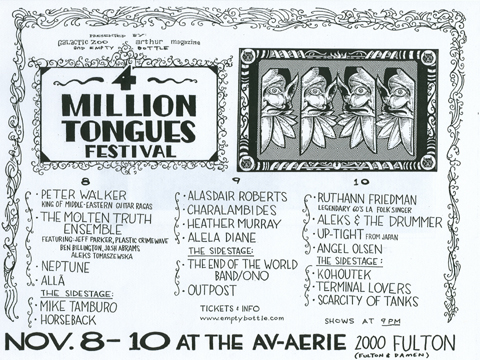
Arthur presents "Four Million Tongues" festival Nov. 8-10 in Chicago

fourmiltongues.jpg

thu nov. 8th
the valerie project at the lakeshore theater–8pm
all other shows at the av-aerie: (9pm, 2000 w.fulton at damen,
formerly ‘open end gallery’)

thu nov.8th (con’t)
peter walker (eastern-style raga guitar god who had two amazing 60’s
Lps on vanguard, and was timothy leary’s music advisor!!)
molten truth ensemble (debut performance, featuring jeff parker, josh
abrams, plastic crimewave, aleks tomaszewska and ben billington)
neptune
alla

sidestage-
mike tamburo
horseback

fri 9th
alasdair roberts
charalambides
heather murray
alela diane

sidestage-
end of the world band
outpost

sat 10th
ruthann friedman (first chicago appearance by famed LA 60’s acid folk singer/songwriter, who wrote ‘windy’ for the association!)
aleks and the drummer
up-tight
angel olsen

sidestage:
kahoutek
scarcity of tanks
terminal lovers

TICKETS AVAILABLE FROM THE EMPTY BOTTLE

Arthur presents THE VALERIE PROJECT tonight in Los Angeles

poster artwork by Tracy Nakayama

THE VALERIE PROJECT is a rarely-screened film from the Czech New Wave presented with live music by some of the heroes of the new folk/psychedelic movement.

Jaromil Jires’ Valerie and Her Week of Wonders (1970) is a haunting, psychedelic vision which plunges the beautiful heroine Valerie into a phantasmagoric world of vampires, the dark arts and dreamy free love. At once terrifying and beautiful, this feast for the eyes is accompanied by a lush, orchestral and acid-charged new live score performed by a nine-piece ensemble including members of Espers, Fursaxa and Fern Knight. The sound goes off and the amps get cranked (do harps need amps?) [Yes—Editor]

Presented by Drag City, Arthur Magazine and Cinespia in Los Angeles:
Monday November 5 at 8pm at Silent Movie Theatre (followed by reception with DJs Tracy Nakayama and Jeremy Yoder)

Don’t miss this rare opportunity to see The Valerie Project in LA on the last leg of their one-time-only West Coast tour with this gorgeous, newly struck 35mm print.

Tickets – $15

A recording of THE VALERIE PROJECT‘s original composition soundtrack to “Valerie and Her Week of Wonders” will be available on CD/2LP from Nov. 20 through Drag City.

REAL food, please

November 4, 2007 New York Times

Weed It and Reap
By MICHAEL POLLAN

Berkeley, Calif.

For Americans who have been looking to Congress to reform the food system, these past few weeks have been, well, the best of times and the worst of times. A new politics has sprouted up around the farm bill, traditionally a parochial piece of legislation thrashed out in private between the various agricultural interests (wheat growers versus corn growers; meatpackers versus ranchers) without a whole lot of input or attention from mere eaters.

Not this year. The eaters have spoken, much to the consternation of farm-state legislators who have fought hard — and at least so far with success — to preserve the status quo.

Americans have begun to ask why the farm bill is subsidizing high-fructose corn syrup and hydrogenated oils at a time when rates of diabetes and obesity among children are soaring, or why the farm bill is underwriting factory farming (with subsidized grain) when feedlot wastes are polluting the countryside and, all too often, the meat supply. For the first time, the public health community has raised its voice in support of overturning farm policies that subsidize precisely the wrong kind of calories (added fat and added sugar), helping to make Twinkies cheaper than carrots and Coca-Cola competitive with water. Also for the first time, the international development community has weighed in on the debate, arguing that subsidized American exports are hobbling cotton farmers in Nigeria and corn farmers in Mexico.

On Capitol Hill, hearings on the farm bill have been packed, and newspapers like The San Francisco Chronicle are covering the legislation as closely as The Des Moines Register, bringing an unprecedented level of attention to what has long been one of the most obscure and least sexy pieces of legislation in Congress. Sensing the winds of reform at his back, Senator Tom Harkin of Iowa, chairman of the Senate Agriculture Committee, told a reporter in July: “This is not just a farm bill. It’s a food bill, and Americans who eat want a stake in it.”

Right now, that stake is looking more like a toothpick. Americans who eat have little to celebrate in the bill that Mr. Harkin is expected to bring to the floor this week. Like the House bill passed in July, the Senate product is very much a farm bill in the traditional let-them-eat-high-fructose-corn-syrup mold.

For starters, the Old Guard on both agriculture committees has managed to preserve the entire hoary contraption of direct payments, countercyclical payments and loan deficiency payments that subsidize the five big commodity crops — corn, wheat, rice, soybeans and cotton — to the tune of $42 billion over five years.

The Old Guard has also managed to add a $5 billion “permanent disaster” program (excuse me, but isn’t a permanent disaster a contradiction in terms?) to help farmers in the High Plains struggling to grow crops in a drought-prone region that, as the chronic need for disaster aid suggests, might not be the best place to grow crops.

When you consider that farm income is at record levels (thanks to the ethanol boom, itself fueled by another set of federal subsidies); that the World Trade Organization has ruled that several of these subsidies are illegal; that the federal government is broke and the president is threatening a veto, bringing forth a $288 billion farm bill that guarantees billions in payments to commodity farmers seems impressively defiant.

How could this have happened? For starters, farm bill critics did a far better job demonizing subsidies, and depicting commodity farmers as welfare queens, than they did proposing alternative — and politically appealing — forms of farm support. And then the farm lobby did what it has always done: bought off its critics with “programs.” For that reason “Americans who eat” can expect some nutritious crumbs from the farm bill, just enough to ensure that reform-minded legislators will hold their noses and support it.

It’s an old story: the “hunger lobby” gets its food stamps so long as the farm lobby can have its subsidies. Similar, if less lavish, terms are now being offered to the public health and environmental “interests” to get them on board. That’s why there’s more money in this farm bill for nutrition programs and, for the first time, about $2 billion to support “specialty crops” — farm-bill-speak for the kind of food people actually eat. (Since California grows most of the nation’s specialty crops, this was the price for the state delegation’s support. Cheap indeed!)

There’s also money for the environment: an additional $4 billion in the Senate bill to protect wetlands and grasslands and reward farmers for environmental stewardship, and billions in the House bill for environmental cleanup. There’s an important provision in both bills that will make it easier for schools to buy food from local farmers. And there’s money to promote farmers’ markets and otherwise support the local food movement.

But as important as these programs are, they are just programs — mere fleas on the elephant in the room. The name of that elephant is the commodity title, the all-important subsidy section of the bill. It dictates the rules of the entire food system. As long as the commodity title remains untouched, the way we eat will remain unchanged.

The explanation for this is straightforward. We would not need all these nutrition programs if the commodity title didn’t do such a good job making junk food and fast food so ubiquitous and cheap. Food stamps are crucial, surely, but they will be spent on processed rather than real food as long as the commodity title makes calories of fat and sugar the best deal in the supermarket. We would not need all these conservation programs if the commodity title, by paying farmers by the bushel, didn’t encourage them to maximize production with agrochemicals and plant their farms with just one crop fence row to fence row.

And the government would not need to pay feedlots to clean up the water or upgrade their manure pits if subsidized grain didn’t make rearing animals on feedlots more economical than keeping them on farms. Why does the farm bill pay feedlots to install waste treatment systems rather than simply pay ranchers to keep their animals on grass, where the soil would be only too happy to treat their waste at no cost?

However many worthwhile programs get tacked onto the farm bill to buy off its critics, they won’t bring meaningful reform to the American food system until the subsidies are addressed — until the underlying rules of the food game are rewritten. This is a conversation that the Old Guard on the agriculture committees simply does not want to have, at least not with us.

But its defiance on the subsidy question may actually be a sign of weakness, for one detects a note of defensiveness creeping into the rhetoric. “I know people on the outside can sit and complain about this,” Representative Collin Peterson of Minnesota, chairman of the House Agriculture Committee, told The San Francisco Chronicle last summer. “But frankly most of those people have no clue what they’re talking about. Most people in the city have no concept of what’s going on here.”

It seems more likely that, this time around, people in the city and all across the country know exactly what’s going on — they just don’t like it.

Mr. Peterson’s farm bill passed the House by the smallest margin in years, and might have been picked apart on the floor if Representative Nancy Pelosi, the speaker of the House, hadn’t leapt to its defense.

(She claimed to be helping freshmen Democrats from rural districts.)

But Senate rules are different, and Mr. Harkin’s bill will be challenged on the floor and very possibly improved. One sensible amendment that Senator Byron Dorgan, Democrat of North Dakota, and Senator Chuck Grassley, Republican of Iowa, are expected to introduce would put a $250,000 cap on the payments any one farmer can receive in a year. This would free roughly $1 billion for other purposes (like food stamps and conservation) and slow the consolidation of farms in the Midwest.

A more radical alternative proposed by Senator Richard Lugar, Republican of Indiana, and Senator Frank Lautenberg, Democrat of New Jersey, would scrap the current subsidy system and replace it with a form of free government revenue insurance for all American farmers and ranchers, including the ones who grow actual food. Commodity farmers would receive a payment only when their income dropped more than 15 percent as the result of bad weather or price collapse. The $20 billion saved under this plan, called the Fresh Act, would go to conservation and nutrition programs, as well as to deficit reduction.

What finally emerges from Congress depends on exactly who is paying closest attention next week on the Senate floor and then later in the conference committee. We know the American Farm Bureau will be on the case, defending the commodity title on behalf of those who benefit from it most: the biggest commodity farmers, the corporations who sell them chemicals and equipment and, most of all, the buyers of cheap agricultural commodities — companies like Archer Daniels Midland, Cargill, Coca-Cola and McDonald’s.

In the past that alliance could have passed a farm bill like this one without breaking a sweat. But the politics of food have changed, and probably for good. If the eaters and all the other “people on the outside” make themselves heard, we just might end up with something that looks less like a farm bill and more like the food bill a poorly fed America so badly needs.

Michael Pollan, a contributing writer at The Times Magazine and a professor of journalism at the University of California at Berkeley, is the author of “The Omnivore’s Dilemma” and the forthcoming “In Defense of Food: An Eater’s Manifesto.”

American Girl® Dolls: Julie Doll & Hardcover Book Set

Julie opens up a whole world of play with authentic styles from the ’70s:

  • A crinkle-gauze peasant blouse over a turtleneck
  • Two-tone bell-bottom jeans and butterfly screen-printed underwear
  • Stylish sandals and a braided, beaded belt
  • Long, straight blond hair with a single braid

Julie’s 18-inch doll body is soft cloth; her head and limbs are
smooth vinyl. She’s posable for hundreds of playtimes and can be
treasured for years to come.

Her six-book set comes in a protective slipcase and features Julie’s
stories of growing up in San Francisco in the 1970s. They include Meet Julie; Julie Tells Her Story; Happy New Year, Julie; Julie and the Eagles; Julie’s Journey; and Changes for Julie.

These stories of a fun-loving, determined girl offer lessons about
choices and friendship that still touch girls today. Author: Megan
McDonald. Hardcover.

From Seventies Something (NY Times)…

Last month, American Girl introduced Julie of 1974, the latest doll in
the company’s “historical” line, with a set of accompanying books,
written by the children’s author and seventies girl Megan McDonald and
filled with fun facts about Shirley Chisholm, the ERA, Title IX, Billie
Jean King and the etymology of Ms.

Powered by ScribeFire.

Can I Get An Amen?

deck.jpg

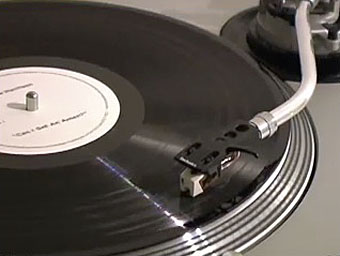
Can I Get An Amen? (2004), recording on acetate, turntable, PA system, paper documents
total run time: 17 minutes, 46 seconds

Can I Get An Amen? (by Nate Harrison) is an audio installation that unfolds a critical perspective of perhaps the most sampled drum beat in the history of recorded music, the Amen Break. It begins with the pop track Amen Brother by 60’s soul band The Winstons, and traces the transformation of their drum solo from its original context as part of a ‘B’ side vinyl single into its use as a key aural ingredient in contemporary cultural expression. The work attempts to bring into scrutiny the techno-utopian notion that ‘information wants to be free’—it questions its effectiveness as a democratizing agent. This as well as other issues are foregrounded through a history of the Amen Break and its peculiar relationship to current copyright law.

New book on VALI!

“The Australian artist, Vali Myers, was a legend in her own time. Première danseuse of the Melbourne Modern Ballet at seventeen, she left home and spent ten years in Paris, living much of the time on the streets but never ceasing to draw. Ed van der Elsken famously put her on the cover of his Love on the Left Bank, that manifesto of Paris in the 1950’s and her work was praised by George Plimpton in his Paris Review. Then, saying goodbye to all that, she spent forty years in semi-seclusion in a wild canyon in Italy, where she continued producing her minute, mystical, and passionate drawings. Tough as nails, she fought the local authorities who wanted to introduce loggers into the valley, after a long struggle succeeding in having it designated an Environmental Oasis. Finally, Vali returned triumphant to her native Melbourne, where she was recognized as an artist sui generis.

“In this brilliant memoir by her friend and lover, Gianni Menichetti, her art, times, and personality come through unforgettably. For thirty years, Gianni Menichetti, the author of this memoir, lived with Vali Myers in the wild canyon of ‘Il Porto’—first as lover and willing slave, ultimately as friend, confidant, and protector.”

“You saw in her the personalization of something torn and loose and deep down primitive in all of us.” —George Plimpton, Paris Review

“Vali’s dogs, Vali’s trees, Vali’s donkey, the birds, the flowers, the caves, the spiders of Vali. We have seen for the first time the old skeleton of nature.” —Bernardo Bertolucci, film-maker, Last Tango in Paris, Stealing Beauty

More vintage Charlie Nothing pics

from the late Charlie Nothing‘s website at charlesmartinsimon.com


“The Superfabulous Dingulators – mid-70-s
Patrick Bisconti with his own superfabulous thing;
John Kertisz, bamboo flute
the late great Jesse Ward Jr., percussion
Charlie Nothing, Ocean Floor Dingulator™”


“Nearly Naked Nothing”


“All New CD – 2007
All new songs
All new Dingalator”


“Dingulatin Clown” – 1993

“We just have an unorthodox approach to doing good.”

heroes600.jpg

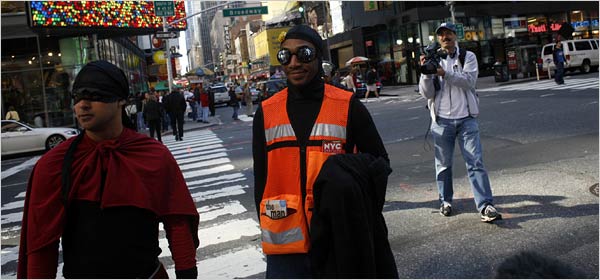
Red Justice, left, and Direction Man, so-called real-life superheroes, on patrol in Times Square.

Dressed for Halloween? No, to Clean Up Times Square
By TRYMAINE LEE
October 29, 2007 New York Times

She calls herself Street Hero, says she is a former prostitute, knows martial arts and takes to the city’s underbelly to protect women who work the streets. Her uniform includes a black eye mask, a black bustier and black knee-high boots.

A Brooklyn man who calls himself Direction Man prefers helping lost tourists and locals. He wears a bright orange vest, a pair of thick black goggles and has numerous maps spilling from his pockets.

Then there is Red Justice, a substitute teacher from Woodside, Queens, who wears red boxer briefs over jeans, a red cape made from an old T-shirt and a sock with eyeholes to mask his identity. He trolls the subways encouraging young people to give their seats to those who need them more.

They call themselves real-life superheroes, and they were just a few of the do-gooders who gathered near Times Square yesterday for what was billed as the first meeting of a group called Superheroes Anonymous. They all declined to give their real names because they said they wanted to protect their identities.

The meeting was part news conference, part documentary film shoot and part patrol duty. There were locals and out-of-towners, most were in uniform (don’t dare call them costumes) and all said they were serious about helping make their respective communities cleaner, safer and kinder places.

The 13 or so who gathered yesterday are part of a growing community of activists across the country and beyond who use the Internet to communicate.

Chaim Lazaros, 23, a student at Columbia University and an independent filmmaker, founded Superheroes Anonymous to bring to New York as many superheroes as he could for interviews and to record them for a documentary he is making about the movement.

“I found these people on MySpace,” Mr. Lazaros said, referring to the social networking Web site, “and I knew I had to tell the story.”

Shortly after noon yesterday, Mr. Lazaros stood at a lectern in a park on West 48th Street where the attendees gathered before going on patrol in Times Square to pick up litter and hand out crime prevention literature.

“This is a serious job,” Mr. Lazaros said. “We are out in the streets fighting crime in a legal way. But most of all we are fighting the worst crime of all, apathy.”

“We’re not these crazy people,” said one man, Geist, who traveled to New York from Minnesota. “We just have an unorthodox approach to doing good.”

As the group walked down Broadway in Times Square, a Manhattan woman known as the Cleanser picked up soggy debris and errant paper bags. She wore a white cape and yellow rubber gloves.

The woman who calls herself Street Hero was with the group. She says she decided to stop being a prostitute after she was arrested. Now she offers to help prostitutes in whatever way she can. “I do it on my own,” she said. “Mostly after dark. Around the city.”

The Super is a superintendent of a building in Crown Heights, Brooklyn, who fixes faucets and does electrical work for people in need. Yesterday, he wore a red cape, a yellow shirt, green suspenders and green tights under black soccer shorts.

The Super, who also declined to give his real name, said he took on the alter ego after a friend was hurt by debris that had fallen from scaffolding. “I said to myself, if we have to wait around for the city or the mayor to fix everything wrong or dangerous in this city, it’ll never get done,” the Super said.

He acknowledged that his self-proclaimed role — as well as what he wears — has drawn derision.

He said he had been laughed at, stared at, egged and stoned. Once, he said, someone in a high-rise apartment building threw a frozen piece of meat at him.

“I don’t have many friends,” he said. “A lot of real-life superheroes stumble along the way. And part of it can definitely make you feel isolated, like nobody understands you.”