

Category Archives for Uncategorized
ETERNAL ADVICE FOR DICK CHENEY.
Steve K's seven-year quest for the quintessential live version of Zevon's 'Werewolves of London' ends in TOTAL SUCCESS

For the past seven years I’ve searched for the most refined and complete version of Warren Zevon performing Werewolves of London live. Recently, I came across the definitive version and and would like to share my findings.

The beginning of the song is well known and seems to vary only slightly from time to time. This version is live June 12th, 1986 in Buffalo, New York and Warren makes a few regional adjustments.
I saw a werewolf with a Chinese menu in his hand
Walking through the streets of Buffalo in the rain
He was looking for a place called Lee Ho Fuk’s
Gonna get a big dish of…chicken wings
Howls…

Chicken wings are typically served in bowls.
The main refrain continues and the crowd is amped, excited to hear Warren sing his most popular tune. I remember seeing Warren Zevon once on David Letterman and he said that everyone always yelled for him to play Werewolves of London. He even sublimely goofed himself on Larry Sanders. But this recording is years before all of that, back when HBO was for perverts and Michael Milken had more money the Roman Catholic Church.
At first the song remains the same, but toward the end, things start to get perverse. Everyone knows that Warren was a smart, super talented, hedonistic, over the top, friend of Hunter and all around notorious bad guy of the singer songwriter set, but I think it’s fascinating to think about him creeping around Buffalo in the height of the Reagan years thinking up new ways to make a hit song more interesting to sing while not being self-effacing. That seems like quite a life, also one that seems increasingly distant in today’s cross-platform society. Maybe that’s why he wrote Transverse City? Ok, back to the topic at hand…
You can hear him howlin’ ’round your kitchen door
Better not let him in
Little old lady got mutilated again late last night
Werewolves of Buffalo again
Crowd joins in howling…
He’s that hairy handed gent,
who ran amok in Kent.
Lately, he’s been overheard in Mayfair.
You better stay away from him;
He’ll rip your lungs out Jim.
And he’s lookin’ for James Taylor.

James Taylor gets into swimming in the mid-80s.
Whoa!! He’s sinking his teeth into James Taylor?!? Did Sweet Baby James steal Warren’s dope on the road? Because he pissed in Carly Simon’s cornflakes? What happened here? True believers, this is only the beginning. Say tuned because before the tirade continues, he name checks The Dude back before actors like Jeff Bridges needed to slum around in baggy shorts.
I saw Jeff Bridges tryin’ to buy a used car in Del Mar.
It was a blood red coupe deville.
Said he was drivin’ it to Mexico.
Going down to Tijuana to kill somebody in the films.

Directed by Hal Ashby (1986) – Incredibly underrated
It’s amazing to think about Warren and Jeff Bridges in Del Mar, much less hanging out before he went to shoot 8 Million Ways to Die. Not only was it directed by Hal Ashby, but the screenplay was written by Oliver Stone. It’s as good, if not better, than Scarface. I know that’s a bold statement, but give it a chance. There’s an amazing scene with Andy Garcia and a trunk filled with ice cream long before he started slumming in the movies with blondes and drunks. Check it.
The lyrics continue, but the sharpness of the barbs increase…
The Queen City crowd’s interest is noticeably piqued as the main chorus, untainted, rings out.

Lon Chaney, Jr. as the Wolfman
I saw Lon Chaney walking with the Queen.
They were doing the Werewolves of London.
I saw Lon Chaney, Jr. walking with the Queen.
They were doing the Werewolves of London.

I saw Bruce Springsteen walking with the Queen.
They were doing the Werewolves of London.
Well, it’s no surprise that Bruce gets led to the slaughter, but up next is peacenik and long time friend of Warren: Jackson Browne.

I saw Jackson Browne walkin’ down Sherman Way.
He’s just tryin’ to get along.
Ok, let me pause here for a moment and reflect on the 1980s, politics and folk singers. First, I am proud to be the first person on the Magpie to say that Jackson Browne rocks. He is an incredible songwriter, singer, performer and all around amazing dude. He wrote heartbreaking songs like The Circle Game and Shadow Dream Song while still in high school (like Brian Wilson) and he’s featured on the Fast Times at Ridgemont High and Taxi Driver soundtrack. His songs have been covered by Tom Rush, Linda Ronstadt, the Eagles and, famously, by Nico. He wrote whole albums (filled with award winning hit songs) that directly criticized the Reagan administration’s policies in South America. If you want to check him out and get directly to the good stuff, check out Sleep’s Dark and Silent Gate and Linda Paloma.
But back to the song…
I don’t think that Warren is openly goofing Jackson, but instead using him as a gateway to elevate how harsh those years really were. The times they were a-chooglin’…
Jackson’s goin’ over to Gary Gilmore’s house,
Crowd starts to realize what’s happening…more clapping and cheers!

Norman Mailer writes in cold blood about Utah bad man Gary Gilmore’s stay of execution.

Gary Gilmore in happier, hippier times.
and Gary’s gonna teach him The Executioner’s Song.
Piano continues and song ends…
The crowd at the Tralf emphatically claps for Mr. Bad Example and his rougher than leather songwriting skills.
To conclude, the reason why I feel this is the quintessential version is precisely because of this ending. As a songwriter, Warren found a way to make a hit song MORE relevant by bringing together the personal influences in his life with what was currently happening around him at the time.
It should be no surprise to anyone that the death penalty in the 80s was an extemely hot button topic. Gary Gilmore was the first person executed after a reinstatement of the punishment in the 70s. He was from Utah, he killed two people, he could either choose hanging or the firing squad and so: he chose the firing squad. No appeals, no reprisals.
At the time, the press and those concerned jumped all over this case looking to help, aid, abet, capitalize and understand. Gary Gilmore had no remorse, YET he tried to commit suicide in jail which gave him a stay of execution. His last meal was a hamburger, hard-boiled eggs, a baked potato, a few cups of coffee, and three shots of whiskey.
I’ve heard all sort of people referred to during this ending refrain. Oliver Reed, Glenda Jackson, Jack Nicholson, Carl Douglas…but the harshness of putting Jackson and Gary together, just as literary tropes, is devastating. It’s like the The Clash of the Titans of 70s and 80s counter to the over-the-counter cultural figures at the time. Many people tried to capitalize on Gilmore’s story at the time, including Mailer, Larry Schiller, etc., so many that it became absurd. Gilmore’s case, at the time and today, clouds the mind and when focused upon replacing decency and common wisdom with bleak confusion.
AND that’s why this is the GREATEST live version of The Werewolves of London ever recorded.
Kudos to Warren, long may you dig in the dirt.
DOWNLOAD AND LISTEN YOURSELF:
Warren Zevon Live at Tralfamadore Cafe on 1986-06-12 (June 12, 1986)
Werewolves of London (mp3)
Out of the Army, into Canada.
Q&A: Why Soldiers are Deserting the Army
The number of soldiers deserting the U.S. Army is rising. A defense lawyer discusses what they’re saying about leaving their posts-and whether they’re likely to find sanctuary in Canada.
By Sarah Childress, Newsweek
March 27, 2007 – Why are so many soldiers deserting their posts? This week, the Army announced that 3,301 active-duty soldiers had deserted the Army in 2006— over 800 more than had been previously reported. (The initial figure, the Army said, had been tallied incorrectly.) It’s hardly at Vietnam-era levels, but it’s still a significant number given that the Iraq and Afghanistan wars are being fought by an all-volunteer military.
From the American Revolution through World War II, U.S. Army deserters, defined as those who abandoned their posts without permission for at least 30 days, faced harsh penalties if they were caught. Death is still the maximum penalty for deserting in wartime, but no one’s been executed for leaving the current conflicts. They’re more likely to face up to five years in jail and a dishonorable discharge or another deployment into a combat zone, as commanders are more focused on filling their ranks than punishing prodigals. Still, the 101 convictions last year were at the highest they’ve been in nearly a decade. “It’s a more serious offense during a time of war,” says spokesman Robert Tallman in an e-mail. “A soldier who deserts the Army and thus his or her fellow soldiers, has a negative impact on unit readiness and morale.”
Today’s deserters are different than their conscripted counterparts from previous wars. According to Jeffry House, one of the most well-known defense lawyers for these cases, the troops usually have served a term or two in Iraq and Afghanistan already, and don’t want to go back. A Vietnam-era draft-dodger now living in Toronto, House currently represents over 30 American military personnel who are seeking refugee status in Canada to escape prosecution for desertion. He spoke to NEWSWEEK’s Sarah Childress in between cases. Excerpts:
NEWSWEEK: Why are so many soldiers deserting?
Jeffry House: The common idea is that the war in Iraq is going nowhere, and it’s bogus, as I’ve been told [by soldiers] many times. In other words, there was no justifiable reason to attack Iraq in the first place. People are now telling me stuff like, “We clear out a section of Baghdad, hand it over to the government, and the next day 70 bodies would appear.” They feel like they’re helping the Iraqi government, which [they feel] actually is a bunch of death squads in disguise. So they begin to feel responsible. People can’t justify to their own selves what they’re doing there, it just seems wrong, wrong, wrong to them. I have a couple of guys who actually finished a six-year commitment. They were given an honorable discharge. They got nice medals and a nice party, and when they drive up in their driveway at home there’s somebody giving them a stop-loss document, which means you’re back in [the service] at the [military’s] pleasure. People are very disheartened.
Have you been seeing more since the war began?
We did have a surge at the same time that President Bush announced his surge [in troop numbers]. We had 15 within two weeks. I’d say it’s just steady. I wouldn’t say it’s gone up. The raw number goes up but that doesn’t mean that we’re getting vast new flows.
The soldiers who flee to Canada claim refugee status. What’s the argument there?
They’re arguing that it is persecutory—it is persecution—for them to be jailed for refusal to serve in Iraq. That is so if either the war itself is illegal—that’s our argument—or if they’ve come too close to violations of the Geneva Conventions. Joshua Key [one of the deserters], in his testimony, he said they were raiding houses at night, they’d take all men over five feet tall, hood them, handcuff them and throw them on a truck. They’d be taken to Abu Ghraib prison or Camp Bucca and never be heard from again.
Have any of these soldiers tried to claim conscientious objector status?
It is possible to claim conscientious objector status. Unfortunately the way the U.S. system works, it depends in part on the army’s manpower needs. If you read the actual policy, it says at the very end, subject to needs for soldiers. Now they have this incredible need for soldiers… The other thing is the conscientious objectors have to object to all wars. If your real objection is to this war—say you’re somebody who’s served in Baghdad—you’re really not objecting to all wars.
What’s your sense of what these soldiers are going through mentally?
It’s very wrenching for them. A lot of them had a certain concept of what a soldier is, and that concept has been blown sky high. I have one fellow here who was educated at the Citadel [military school.] He says when he went overseas to Afghanistan, he was given an axe handle and told to beat prisoners. [His commanders told him,] ‘These guys caused 9/11, so don’t hit them in the back of the head ’cause you’ll kill them, but give ’em a good beating.’ It’s contrary to any traditional understanding of what a soldier is supposed to do. It ruins their mental image of themselves. They no longer know who they are because they had some idea that they were going to fight for truth, justice and the American way.
What happens when a soldier asks you to defend him?
I’d like to know why. If they tell me, “I’m now opposed to all wars,” I tell them they do have a possibility of making that claim in the U.S. and should make that claim there, as a first step. If they say, I’ve been too close to war crimes, I feel like I’m a war criminal, I’ve seen too many things and I feel the war is illegal, I’ll say many people are making refugee claims. We’ll see how that goes. I tell them I can probably assure them a number of years here, and at the end of that process I believe we have the stronger argument, but it’ll be determined by the Supreme Court of Canada. It’s a hard decision for lower courts to make, to say, “Yep, the war in Iraq is illegal so therefore, all American soldiers can come here.” They seem to be hesitant to make that call. We often talk about other possibilities. Some people do university educations that will keep them here for four years. Others try to get work permits, which are harder to get but if you have a specific skill you can get them. Some have married Canadians. I believe a chunk are just here illegally. The reality is that it’s quite easy to meld into the background in Canada if you’re white, English speaking from birth. This is all illegal and I’m not saying I’m telling them to do this, but it’s openly known.
You’re waiting for an appeals court ruling on two cases right now. Do you think you can win by arguing that the war is illegal?
I believe everyone will eventually stay [in Canada] if they want to. It’s certainly not 100 percent, and I tell people that. Right now it’s being done through the courts, and if they can’t decide whether the war in Iraq is illegal or not, I think it will become a political issue. We’ll see who wants to be saddled with the burden of being a George Bush supporter. I don’t think too many of our politicians are comfortable with that.
So if you succeed, any American soldier could be granted refugee status in Canada.
That’s their fear. That’s why the lower courts have been dancing around the issue. I would think you’d have to establish some basis to show that you actually thought the war was illegal. You’d have to show, in the same way a conscientious objector has to show a history of conscientious objection. Obviously it would open the door to a lot more people.
What happens if you lose?
If we can’t make the argument legally then it’ll be a political argument and that depends on the politics of the day. Right now we have a minority conservative government but they’re trying to distance themselves from the U.S. conservative government, so it’s an open question what they would do… Losing your refugee case does not necessarily mean you’ll be removed from Canada.
TOWARDS A FAIR-TRADE WORLD

New York Times – April 22, 2007
In Brooklyn, Hipsters Sip ‘Fair Trade’ Brews
By LIZA FEATHERSTONE
WHEN Kazi Hossain, a real estate broker in Ditmas Park, Brooklyn, telephoned a client recently to describe a house for sale, he played up one of the property’s most desirable attributes. “One block from Vox Pop!” he exclaimed. “You know Vox Pop?”
It seems like everyone in that newly gentrifying neighborhood knows Vox Pop, a cafe and bookstore that, by day, draws young families and office job escapees. But perhaps more important than the knitting classes and band performances that establish the business as a kind of community center is its coffee, proudly described on well-placed signs and on the menu as “fair trade” brews.
“The fact that the coffee is fair trade is certainly more sustainable for the farmers, and having this coffeehouse also helps sustain our community,” said Willow Fodor, 29, a customer who said she moved to Ditmas Park because of the cafe. “I just loved the vibe.”
Fair trade, like more familiar labels such as organic, cruelty-free and sustainable, is another in a series of ethical claims to appear on products — a kind of hipster seal of approval. The fair trade ethic is spreading eastward from the West Coast, where it has been promoted by well-financed activist campaigns and where progressive politics are more intertwined with youth culture. Scott Codey, a member of the New York City Fair Trade Coalition, said the number of retailers in the city selling fair trade products like coffee, tea, wine and clothing has grown to hundreds, from 25, in the last three years.
In general, the fair trade label means that farmers of crops like coffee or cocoa in the third world, or workers who stitch T-shirts in factories abroad, are paid fairly. The label is intended as a guide for socially conscious consumers in rich countries when buying goods that originate primarily in Latin America, Asia and Africa.
Amid the wine bars and boutiques that line Fifth Avenue in Park Slope, Jonathan Coulton, 36, a musician wearing black rectangular glasses, was hunched over a laptop at Gorilla Coffee, where a blackboard proclaims all its coffees are fair trade. It “makes you feel like you’re doing something good just by drinking a cup,” he said.
It may be trendier to advertise clothing as green, or, in the words of a recent Barney’s Co-Op window display, as “insanely sustainable,” but fair trade — and its cousin, “sweatshop-free” — are gaining in popularity. Emily Santamore, a founder and a designer of Moral Fervor — a line of yoga clothing made from an eco-friendly fabric and, according to its Web site, “produced sweatshop-free in Portugal” — said boutiques regularly ask about the origins of her products. For her customers, she added, fair trade assurances are “becoming almost necessary.”
TransFair USA, a nonprofit group in Oakland, Calif., that awards a Fair Trade Certified label to farm products, says fair trade coffee is the fastest-growing specialty coffee in the United States. It claims that since 1999, its programs have put $60 million more into the pockets of third-world coffee growers than they would have otherwise earned. Such goods were once stigmatized as uncool: the weird Guatemalan pants worn by a high school art teacher, or the muddy-flavored coffee served at a student-run cafe. But savvy marketing, and better products, have helped the fair trade label shed its frumpy image. American Apparel, the fast-growing chain that pays most of its factory workers above the garment-industry standard, and which runs advertisements featuring skinny hipsters in provocative poses, has increased many customers’ awareness of labor issues and raised the design ante for products promoted as socially conscious.
Proponents of the fair-trade movement, which began in the 1980s in Europe (and where flowers and even soccer balls are labeled fair trade), say the low prices that most companies pay to producers in economically disadvantaged countries cause widespread misery: poverty, unsafe work conditions and forced child labor.
TransFair USA, founded by a group of activists in 1998, says it audits American companies that receive its certification to ensure that third world farmers of coffee, cocoa, fruit and other crops receive a “fair, above-market price.” The group says the system has improved conditions on farms and that the additional income, subsidized by higher consumer prices, has enabled farmers to send their children to universities and communities to build clinics and schools.
Fair trade has a particular appeal to a generation of consumers that came of age during campus labor protests. In 1996, Kathie Lee Gifford was humiliated on national television by the news that children in Honduras were making clothing bearing her name, and, in the ensuing years, student protesters demanded better conditions for workers making clothing with university logos; some streaked through campus because they would “rather go naked than wear sweatshop clothes.”
After graduating from the New School with a degree in literature in 1993, Sander Hicks, 36, the founder of Vox Pop, worked at a Kinko’s, where he and his fellow workers experimented with union organizing and even a worker collective. Now, he’s proud of his high-quality coffee, but asserts that the fair trade label gives it an additional “karmic kick.”
Not everyone is feeling it.
Some industry observers and journalists have identified labor abuses on farms producing crops that have been certified as fair trade by international groups, like paying migrant workers below a country’s legal minimum wage.
Jean Walsh, a spokeswoman for TransFair, conceded that this was sometimes the case. “But the fair trade system,” she said in an e-mail message, “is the only mechanism that begins to guarantee small-scale farmers the income they need to be able to improve the wages of laborers on their farms.”
(Unlike food, items such as clothing and other non-agricultural goods, when sold in the United States, have no single recognized certification system. Instead, consumers have to trust the wholesalers and retailers.)
And though many people buy fair trade products in reaction to what Mr. Codey of the New York fair trade coalition calls “mainstream commercial culture,” others point out that to make a real impact, fair trade has to become much more widespread, even if that means losing some of its in-group appeal.
Larger corporations, including McDonald’s, Starbucks and Dunkin’ Donuts, now offer some fair trade coffee, but, “it’s still too limited in the United States, to just a few commodities,” said Kevin Danaher, a founder of TransFair.
“It’s not places like Gorilla that are going to make a difference,” said Janice Allen, 27, a barista at Gorilla Coffee, with a piercing just over her lip and chipped blue nail polish. “Maxwell House going fair trade, that would make a difference.”
Fascist America, in 10 easy steps
Fascist America, in 10 easy steps
From Hitler to Pinochet and beyond, history shows there are certain steps that any would-be dictator must take to destroy constitutional freedoms. And, argues Naomi Wolf, George Bush and his administration seem to be taking them all
Naomi Wolf
Tuesday April 24, 2007
The Guardian
Last autumn, there was a military coup in Thailand. The leaders of the coup took a number of steps, rather systematically, as if they had a shopping list. In a sense, they did. Within a matter of days, democracy had been closed down: the coup leaders declared martial law, sent armed soldiers into residential areas, took over radio and TV stations, issued restrictions on the press, tightened some limits on travel, and took certain activists into custody.
They were not figuring these things out as they went along. If you look at history, you can see that there is essentially a blueprint for turning an open society into a dictatorship. That blueprint has been used again and again in more and less bloody, more and less terrifying ways. But it is always effective. It is very difficult and arduous to create and sustain a democracy – but history shows that closing one down is much simpler. You simply have to be willing to take the 10 steps.
As difficult as this is to contemplate, it is clear, if you are willing to look, that each of these 10 steps has already been initiated today in the United States by the Bush administration.
Because Americans like me were born in freedom, we have a hard time even considering that it is possible for us to become as unfree – domestically – as many other nations. Because we no longer learn much about our rights or our system of government – the task of being aware of the constitution has been outsourced from citizens’ ownership to being the domain of professionals such as lawyers and professors – we scarcely recognise the checks and balances that the founders put in place, even as they are being systematically dismantled. Because we don’t learn much about European history, the setting up of a department of “homeland” security – remember who else was keen on the word “homeland” – didn’t raise the alarm bells it might have.
It is my argument that, beneath our very noses, George Bush and his administration are using time-tested tactics to close down an open society. It is time for us to be willing to think the unthinkable – as the author and political journalist Joe Conason, has put it, that it can happen here. And that we are further along than we realise.
Conason eloquently warned of the danger of American authoritarianism. I am arguing that we need also to look at the lessons of European and other kinds of fascism to understand the potential seriousness of the events we see unfolding in the US.
1 Invoke a terrifying internal and external enemy
After we were hit on September 11 2001, we were in a state of national shock. Less than six weeks later, on October 26 2001, the USA Patriot Act was passed by a Congress that had little chance to debate it; many said that they scarcely had time to read it. We were told we were now on a “war footing”; we were in a “global war” against a “global caliphate” intending to “wipe out civilisation”. There have been other times of crisis in which the US accepted limits on civil liberties, such as during the civil war, when Lincoln declared martial law, and the second world war, when thousands of Japanese-American citizens were interned. But this situation, as Bruce Fein of the American Freedom Agenda notes, is unprecedented: all our other wars had an endpoint, so the pendulum was able to swing back toward freedom; this war is defined as open-ended in time and without national boundaries in space – the globe itself is the battlefield. “This time,” Fein says, “there will be no defined end.”
Creating a terrifying threat – hydra-like, secretive, evil – is an old trick. It can, like Hitler’s invocation of a communist threat to the nation’s security, be based on actual events (one Wisconsin academic has faced calls for his dismissal because he noted, among other things, that the alleged communist arson, the Reichstag fire of February 1933, was swiftly followed in Nazi Germany by passage of the Enabling Act, which replaced constitutional law with an open-ended state of emergency). Or the terrifying threat can be based, like the National Socialist evocation of the “global conspiracy of world Jewry”, on myth.
It is not that global Islamist terrorism is not a severe danger; of course it is. I am arguing rather that the language used to convey the nature of the threat is different in a country such as Spain – which has also suffered violent terrorist attacks – than it is in America. Spanish citizens know that they face a grave security threat; what we as American citizens believe is that we are potentially threatened with the end of civilisation as we know it. Of course, this makes us more willing to accept restrictions on our freedoms.
2 Create a gulag
Once you have got everyone scared, the next step is to create a prison system outside the rule of law (as Bush put it, he wanted the American detention centre at Guantánamo Bay to be situated in legal “outer space”) – where torture takes place.
At first, the people who are sent there are seen by citizens as outsiders: troublemakers, spies, “enemies of the people” or “criminals”. Initially, citizens tend to support the secret prison system; it makes them feel safer and they do not identify with the prisoners. But soon enough, civil society leaders – opposition members, labour activists, clergy and journalists – are arrested and sent there as well.
This process took place in fascist shifts or anti-democracy crackdowns ranging from Italy and Germany in the 1920s and 1930s to the Latin American coups of the 1970s and beyond. It is standard practice for closing down an open society or crushing a pro-democracy uprising.
With its jails in Iraq and Afghanistan, and, of course, Guantánamo in Cuba, where detainees are abused, and kept indefinitely without trial and without access to the due process of the law, America certainly has its gulag now. Bush and his allies in Congress recently announced they would issue no information about the secret CIA “black site” prisons throughout the world, which are used to incarcerate people who have been seized off the street.
Gulags in history tend to metastasise, becoming ever larger and more secretive, ever more deadly and formalised. We know from first-hand accounts, photographs, videos and government documents that people, innocent and guilty, have been tortured in the US-run prisons we are aware of and those we can’t investigate adequately.
But Americans still assume this system and detainee abuses involve only scary brown people with whom they don’t generally identify. It was brave of the conservative pundit William Safire to quote the anti-Nazi pastor Martin Niemöller, who had been seized as a political prisoner: “First they came for the Jews.” Most Americans don’t understand yet that the destruction of the rule of law at Guantánamo set a dangerous precedent for them, too.
By the way, the establishment of military tribunals that deny prisoners due process tends to come early on in a fascist shift. Mussolini and Stalin set up such tribunals. On April 24 1934, the Nazis, too, set up the People’s Court, which also bypassed the judicial system: prisoners were held indefinitely, often in isolation, and tortured, without being charged with offences, and were subjected to show trials. Eventually, the Special Courts became a parallel system that put pressure on the regular courts to abandon the rule of law in favour of Nazi ideology when making decisions.
GUITAR ARMY by John Sinclair — BACK IN PRINT!
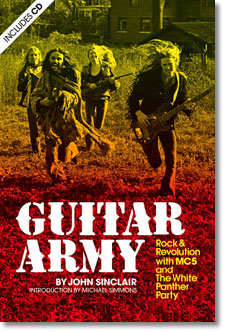
GUITAR ARMY
Rock and Revolution with MC5 and the White Panther Party
By John Sinclair
With introduction by Michael Simmons
35th ANNIVERSARY EDITION
* First time in print since 1972
* 40 additional photographs
* Includes 18-track CD with rare recordings
“Guitar Army was our manual for revolt. It’s a rainbow-colored Howl, still resonating today with the singular value of idealism.”
—Michael Simmons
Guitar Army is the incendiary book that proclaimed “Rock and Roll is a Weapon of Cultural Revolution” for young, revved-up readers in 1972. Author John Sinclair spearheaded the leftist revolutionary vanguard White Panther Party and managed the Detroit rock band MC5, leading them from the ferment of the Detroit riots to the Chicago Democratic Convention of 1968, where the band played minutes before police clubbed antiwar demonstrators.
In October of 1970, the FBI referred to the White Panthers as “potentially the largest and most dangerous of revolutionary organizations in the United States.” However, just three years earlier, the group’s leaders hosted a “Love-In” on Detroit’s Belle Isle, presided over by Sinclair, whom the Detroit News proclaimed “High Priest of the Detroit hippies.” In 1970 he was arrested and sentenced to 9 ½ to 10 years for giving an undercover officer two marijuana joints. Sinclair then became the most celebrated political prisoner of the original war on drugs. After 18 months in prison, John Lennon, Allen Ginsberg, Stevie Wonder, Phil Ochs, and others demanded his freedom with a televised benefit concert attended by 15,000 people. Three days later, Sinclair was released.
Guitar Army chronicles these years of revolution through Sinclair’s “street writings” and prison writings, with over 80 photographs, illustrations, concert flyers and comics from the period. This 35th anniversary edition of Guitar Army includes two dozen previously unpublished period photographs, recent writings from John Sinclair, and an introduction from Michael Simmons that leads the reader through the revolutionary times to Sinclair’s life today. Author John Sinclair is the still-charging embodiment of a dazzlingly optimistic time in which change felt necessary and possible.
A bonus CD contains rare recordings of MC5 and other Detroit-area revolutionary bands, Allen Ginsberg, Black Panther Bobby Seale on the White Panthers, and original White Panther Party meetings.
6 x 9 in, 360 pages, CD attached, ISBN 978-1-934170-007, $22.95
Pub date: May 2007
JOHN SINCLAIR HITS LOS ANGELES….
THURSDAY, APRIL 26 – DETROIT POETS SOUND OFF! – ART SHARE LA. 801 EAST 4th PLACE – LA, CA 90013 – 213-687-4278
John Sinclair will reunite with brother Motor City poetry-&-music bards M.L. Liebler and Ron Allen for an evening of high-energy music & verse at Artshare Theater in downtown LA at 8:00 pm Thursday, April 26. Sinclair’s Detroit Artists Workshop put poetry on the map in the Motor City in the 1960s. Poet-playwright Ron Allen was a founder of Horizons in Poetry, the collective that revived public poetry in Detroit in the 1970s & 80s. M.L. Liebler, leader of the Magic Poetry Band, has been a major force in the Detroit poetry movement for the 1990s and 2000s. This will be a very special reunion for all three participants and a real treat for modern poetry lovers who like some music with their verse—a rare opportunity to witness the Detroit Sound at its finest.
FRIDAY, APRIL 27 – BEYOND BAROQUE – AN HISTORIC EVENING! – THE GUITAR ARMY RE-LAUNCH PARTY, PANEL, PERFORMANCE
BEYOND BAROQUE – 681 Venice Blvd. Venice, CA 90291 – 310-822-3006 – 7:30 PM
JOHN SINCLAIR and FRIENDS – GUITAR ARMY, with ADAM PARFREY, WAYNE KRAMER, DR. CHARLES MOORE, M. L. LIEBLER, PUN PLAMONDON, MICHAEL SIMMONS, a PANEL and PERFORMANCE
Also present for a panel rap will be WAYNE KRAMER (renowned solo artist & MC5 guitarist), PUN PLAMONDON (author & White Panther vet), M. L. LIEBLER (Detroit poet & poetry organizer), DR. CHARLES MOORE (divine musician), and MICHAEL SIMMONS (hyphenated revolutionary & introduction specialist).
Saturday, APRIL 28 – WAYNE KRAMER with special guest JOHN SINCLAIR
HOTEL CAFE – 1623 1/2 N. Cahuenga Blvd. LA 90028 – 10 to 11 PM – http://www.hotelcafe.com
Avant-Rock legend Wayne Kramer headlines and will be joined by special guest John Sinclair, along with Doug Lunn (bass), Dr. Charles Moore (trumpet), Ralph “Buzzy” Jones (saxophone), Phil Ranelin (trombone), and others.
4) Sunday, APRIL 29 – LA Times Book Festival of Books – GUITAR ARMY Book Signing with John Sinclair
1 pm – UCLA – http://www.latimes.com/extras/festivalofbooks/
5) TUESDAY, MAY 1 – MAYDAY! (of course!) – Official Release party for Guitar Army – Appearance & signing with John Sinclair at…
La Luz de Jesus – 7 pm – 4633 Hollywood Blvd – Los Angeles, CA 90027 – (323) 666-7667 – www.laluzdejesus.com
See here for full schedule: www.guitararmy.org
“Weaving in and out of the shaman's body, which is the same as the body of the song, these songs are the medium by which spirits are conjured, witchcraft laid to rest, and the universe put on edge. Treat them accordingly. They might change your life."

Santiago Mutumbajoy
Yage Pinta!
latitude 05
CD
2007-03-06
Nearly 80 minutes of hypnotic, droning wild microphone field recordings of shamanic ceremonies recorded by celebrated anthropologist Michael Taussig.
“Weaving in and out of the shaman’s body, which is the same as the body of the song, these songs are the medium by which spirits are conjured, witchcraft laid to rest, and the universe put on edge. Treat them accordingly. They might change your life. They did, mine.They are sung by Santiago Mutumbajoy whom I taped with a cheap old tape-recorder at different times, mostly in 1976, when I was living with him and his wife Ambrosia. Their two room wooden house sat on a hill in the cloudforest near the town of Mocoa where the Andes drop into the Putumayo River Basin in southwest Colombia. Today their son, Luciano, carries on the practice there, while their daughter, Natividad, sustains it in neighbouring Caqueta province. For the whole night, under the influence of a hallucinogen called yagé, the healer sings his song the power of which is due not to words, lyrics or poetry. Instead it lies in the quality of the sound and the way that sound creates pictures in your mind while dissolving your body. The singing is the key to the magical power. It is that power. It is what brings the healer and the patient into the realms of the spirits that lie within and behind every visible thing.” — Michael Taussig
Proceeds from the sale of this compact disc will be go to Fundación Renacer, a Bogota, Columbia based outreach& rehabilitation organization for sexually exploited children and adolescents.
Buy Yage Pinta
São Paulo No Logo

Great photos of a city shorn of its commercial noise.
JULIAN COPE on Sacrificial Totem's "Hurqalya"


