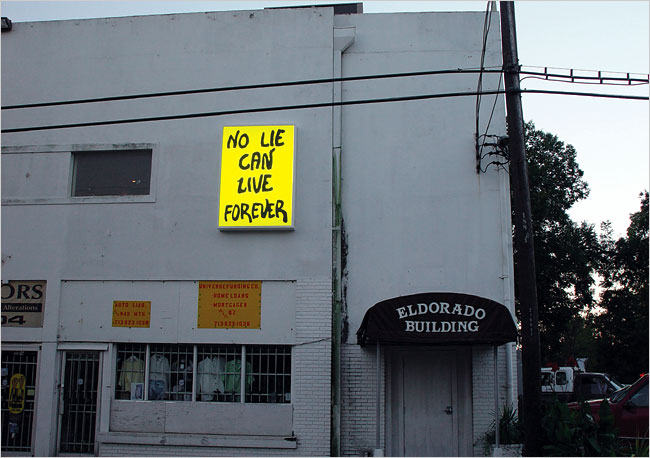
“Change depends on people who know, live and stay in a community; it has to come from inside, and starts with an artist’s mindset.”


In Houston, Art Is Where the Home Is

December 17, 2006 New York Times

By MICHAEL KIMMELMAN
HOUSTON

ON a strangely balmy late autumn afternoon, while the art world busied itself in Miami with beachfront reservations and limo drivers, Rick Lowe was, as he generally is, on Holman Street in southeast Houston’s predominantly black Third Ward, greeting another out-of-towner.

In the gloaming, decrepit houses and weedy lots dotted some surrounding blocks, on the edges of which were new double-garage brick homes — signs of encroaching gentrification, an unwanted side effect of Mr. Lowe’s work.

Although it’s hard to tell at a glance, this stretch of Holman may be the most impressive and visionary public art project in the country — a project that is miles away, geographically and philosophically, from Chelsea and Art Basel and the whole money-besotted paper-thin art scene.

Mr. Lowe, a lanky, amiable, remarkably youthful-looking 45-year-old artist from Alabama, moved to Houston 21 years ago and lives here in the Third Ward, where he founded Project Row Houses. In 1990, “a group of high school students came over to my studio,” he recalled. “I was doing big, billboard-size paintings and cutout sculptures dealing with social issues, and one of the students told me that, sure, the work reflected what was going on in his community, but it wasn’t what the community needed. If I was an artist, he said, why didn’t I come up with some kind of creative solution to issues instead of just telling people like him what they already knew. That was the defining moment that pushed me out of the studio.”

He tried to think afresh what it meant to be a truly political artist, beyond devising the familiar agitprop, gallery decoration and plop-art-style public sculpture. He considered what the German artist Joseph Beuys once described as “the enlarged conception of Art,” which includes, as Beuys put it, “every human action.” Life itself might be a work of art, Mr. Lowe realized: art can be the way people live.

And the Third Ward could be his canvas. He was inspired by John Biggers, the late African-American muralist who painted black neighborhoods of shotgun houses like the ones on Holman Street and showed them to be places of pride and community, not poverty and crime. “It hit me,” Mr. Lowe recalled, “that we should find an area like the one that Biggers painted that was historically significant and bring it to life.”

Continue reading

"False Premises, False Promises: A Quantitative History of Ownership Consolidation in the Radio Industry" by Peter DiCola for the Future of Music Coaltion

From the Future of Music Coalition’s Radio Study – December, 2006:

Executive Summary
This report is a quantitative history of ownership consolidation in the radio industry over the past decade, studying the impact of the Telecommunications Act of 1996 and accompanying FCC regulations.

A Brief History of Radio Regulation
Since the 1930s, the federal government has limited the number of radio stations that one entity could own or control. In the 1980s and early 1990s, the Federal Communications Commission (FCC) began gradually to relax these limits. Finally, in the Telecommuni-cations Act of 1996 (Telecom Act), Congress eliminated the national cap on station ownership, allowing unlimited national consolidation. With the same law, Congress also raised the local caps on station ownership. In addition, as this study describes in detail, the FCC regulations implementing the Telecom Act allowed more consolidation to occur than alternative regulations would have allowed.

Methodology and Data Sources
To keep the quantitative analysis as simple and transparent as possible, we have not included technical statistical analysis. Instead, we have filled this report with standard, antitrust-style measures of concentration; our own new methodologies for measuring localism and diversity; and many time-series analyses that simply track who owned what when. The study covers thirty years of historical data wherever possible; in other places, the study focuses on the last ten to twelve years—the main period of interest for examining the impact of the Telecom Act.

The FCC’s own efforts at collecting data on the radio industry are inadequate, as we emphasize throughout the study. Just as the FCC does, we have relied on industry-collected data to measure changes in radio consolidation and programming. These proprietary sources include: Media Access Pro (Radio Version) from industry consultants BIA Financial Networks, Duncan’s American Radio, and Radio and Records magazine.

Major Findings of the Study
Highlights from the study are organized here in similar fashion to its three chapters. The first chapter focuses on national radio consolidation, the second on local radio consolidation, and the third on radio programming.

Emergence of Nationwide Radio Companies
Fewer radio companies
: The number of companies that own radio stations peaked in 1995 and has declined dramatically over the past decade. This has occurred largely because of industry consolidation but partly because many of the hundreds of new licenses issued since 1995 have gone to a handful of companies and organizations.

Larger radio companies: Radio-station holdings of the ten largest companies in the industry increased by almost fifteen times from 1985 to 2005. Over that same period, holdings of the fifty largest companies increased almost sevenfold.

Increasing revenue concentration: National concentration of advertising revenue increased from 12 percent market share for the top four companies in 1993 to 50 percent market share for the top four companies in 2004.
Increasing ratings concentration: National concentration of listenership continued in 2005—the top four firms have 48 percent of the listeners, and the top ten firms have almost two-thirds of listeners.

Declining listenership: Across 155 markets, radio listenership has declined over the past fourteen years for which data are available, a 22 percent drop since its peak in 1989.

Consolidation in Local Radio Markets
The Largest Local Owners Got Larger
: The number of stations owned by the largest radio entity in the market has increased in every local market since 1992 and has increased considerably since 1996.

More Markets with Owners Over the Local Cap: The FCC’s signal-contour market definition allowed companies to exceed local ownership caps in 104 markets.

Increasing Local Concentration: Concentration of ownership in the vast majority of local markets has increased dramatically.

How Lower Caps Can Be Justified: The FCC’s local caps—in fact, even lower caps than the current caps—can be justified by analyzing how the caps prevent excessive concentration of market share.

Declining Local Ownership: The Local Ownership Index, created by Future of Music Coalition, shows that the localness of radio ownership has declined from an average of 97.1 to an average of 69.9, a 28 percent drop.

Restoration of Local Ownership is Possible: To restore the Local Ownership Index to even 90 percent of its pre-1996 level, the FCC would have to license dozens of new full power and low-power radio licenses to new local entrants and re-allocate spectrum to new local entrants during the digital audio broadcast transition.

Radio Programming in the Wake of Consolidation
Homogenized Programming
: Just fifteen formats make up 76% of commercial programming.

Large Station Groups Program Narrowly: Owners who exceed or exactly meet the local ownership cap tend to program heavily in just eight formats.

Only Small Station Groups Offer Niche Formats: Niche musical formats like Classical, Jazz, Americana, Bluegrass, New Rock, and Folk, where they exist, are provided almost exclusively by smaller station groups.

Small Station Groups Sustain Public-Interest Programming: Children’s programming, religious programming, foreign-language and ethnic-community programming, are also predominantly provided by smaller station groups.

Format Overlap Remains Extensive: Radio formats with different names can overlap up to 80% in terms of the songs played on them.

Individual Stations Use Highly Similar Playlists: Playlists for commonly owned stations in the same format can overlap up to 97%. For large companies, even the average pairwise overlap usually exceeds 50%

Network Ownership Is Also Concentrated: The three largest radio companies in terms of station ownership are also the three largest companies in terms of programming-network ownership.

Conclusion
Radio consolidation has no demonstrated benefits for the public. Nor does it have any demonstrated benefits for the working people of the music and media industries, including DJs, programmers—and musicians. The Telecom Act unleashed an unprecedented wave of radio mergers that left a highly consolidated national radio market and extremely consolidated local radio markets. Radio programming from the largest station groups remains focused on just a few formats—many of which overlap with each other, enhancing the homogenization of the airwaves.

From the recent new-payola scandal to the even more recent acknowledgements that giant media conglomerates have begun to fail as business models, we can see that government and business are catching up to the reality that radio consolidation did not work. Instead, the Telecom Act worked to reduce competition, diversity, and localism, doing precisely the opposite of Congress’s stated goals for the FCC’s media policy. Future debates about how to regulate information industries should look to the radio consolidation story for a warning about the dangers of consolidated control of a media platform.

About Future of Music Coalition
Future of Music Coalition (FMC) is a national non-profit education, research and advocacy organization that identifies, examines, interprets and translates the challenging issues at the intersection of music, law, technology and policy. FMC achieves this through continuous interaction with its primary constituency—musicians—and in collaboration with other creator/citizen groups.

About the Primary Author
Peter DiCola is a Ph.D. candidate in economics at the University of Michigan in Ann Arbor. He received his J.D. magna cum laude from the University of Michigan Law School in May 2005, and was awarded the Henry M. Bates Memorial Scholarship. Currently, he serves as the Research Director of the Future of Music Coalition while he works on his dissertation. He has research interests in the fields of telecommunications law, intellectual property law, law and economics, labor economics, and industrial organization. He is the co-author, with Kristin Thomson, of Radio Deregulation: Has It Served Citizens and Musicians? (2002), which was cited by the U.S. Court of Appeals for the Third Circuit in Prometheus Radio Project v. FCC. He has also written a chapter, “Employment and Wage Effects of Radio Consolidation,” for the scholarly collection Media Diversity and Localism (Lawrence Erlbaum and Associates, 2006).

HIGHLY RECOMMENDED BY ARTHUR MAGAZINE: NEW GREG IRONS RETROSPECTIVE FROM FANTAGRAPHICS.

From the publisher:
“Greg Irons was a psychedelic poster artist, underground cartoonist, book illustrator, and an emerging tattoo art virtuoso who brought a new sensibility to an age-old art form. This retrospective book spans his whole artistic career, from his earliest dance posters, to his groundbreaking science fiction and horror comix, to his innovative and colorful tattoo art. Greg Irons was one of the elite among poster artists who worked for Bill Graham’s Fillmore Ballroom in San Francisco during the Age of Aquarius, designing posters for Chuck Berry, Jefferson Airplane, Big Brother, and Paul Butterfield. You Call This Art?! reprints his finest psychedelic posters in full-color, as well as complete comic stories from Slow Death Funnies, Legions of Charlies, Deviant Slice, Yellow Dog, Thrilling Murder, and many other underground comic books. It also includes rarely seen album cover art for Jerry Garcia, Blue Cheer, Jefferson Starship and other counterculture musicians. Irons has a third career as an illustrator of children’s coloring books, and pages from books including One Old Oxford Ox, Last of the Dinosaurs, Pirates, and Wyf of Bathe appear as well. Many examples of his tattoo art are also included. Think you’ve seen it all already? Not a chance. This book reproduces not only his greatest artistic hits, but also never-before-seen pages from his private sketchbooks and journals, personal photographs, and works that appeared in obscure publications, like the San Francisco Organ, which published the lurid story that Mick Jagger tried to suppress.”

296-page softcover $29.95

Survival Town

“This ‘Survival Town’ house, some 7,500 feet from a 29-kiloton nuclear detonation, remained essentially intact. Survival Town consisted of houses, office buildings, fallout shelters, power systems, communications equipment, radio broadcasting station,and trailer homes. The town was built for a Civil Defense exercise and not previously subjected to a nuclear blast. The test, called Apple II, was fired on May 5, 1955.

Photo courtesy of National Nuclear Security Administration / Nevada Site Office”

Link courtesy Gabie Strong!

NO SERIAL NUMBERS FOR DONATED GUNS? ANOTHER GENIUS MOVE BY USA IN IRAQ.

Black-Market Weapon Prices Surge in Iraq Chaos

By C. J. CHIVERS
SULAIMANIYA, Iraq, Dec. 8 — The Kurdish security contractor placed the black plastic box on the table. Inside was a new Glock 19, one of the 9-millimeter pistols that the United States issued by the tens of thousands to the Iraqi Army and police.

This pistol was no longer in the custody of the Iraqi Army or police. It had been stolen or sold, and it found its way to an open-air grocery stand that does a lively black-market business in police and infantry arms. The contractor bought it there.

He displayed other purchases, including a short-barreled Kalashnikov assault rifle with a collapsible stock that makes it easy to conceal under a coat or fire from a car. “I bought this for $450 last year,” he said of the rifle. “Now it costs $650. The prices keep going up.”

The market for this American-issued pistol and the ubiquitous assault rifle illustrated how fear, mismanagement and malfeasance are shaping the small-arms market in Iraq.

Weapon prices are soaring along with an expanding sectarian war, as more buyers push prices several times higher than those that existed at the time of the American-led invasion nearly four years ago. Rising prices, in turn, have encouraged an insidious form of Iraqi corruption — the migration of army and police weapons from Iraqi state armories to black-market sales.

All manner of infantry arms, from rocket-propelled grenade launchers to weathered and dented Kalashnikovs, have circulated within Iraq for decades.

But three types of American-issued weapons are now readily visible in shops and bazaars here as well: Glock and Walther 9-millimeter pistols, and pristine, unused Kalashnikovs from post-Soviet Eastern European countries. These are three of the principal types of the 370,000 weapons purchased by the United States for Iraq’s security forces, a program that was criticized by a special inspector general this fall for, among other things, failing to properly account for the arms.

The weapons are easy to find, resting among others in the semihidden street markets here, where weapons are sold in tea houses, the back rooms of grocery kiosks, cosmetics stores and rug shops, or from the trunks of cars. Proprietors show samples for immediate purchase and offer to take orders — 10 guns can be had in two hours, they say, and 100 or more the next day.

“Every type of gun that the Americans give comes to the market,” said Brig. Hassan Nouri, chief of the political investigations bureau for the Sulaimaniya district. “They go from the U.S. Army to the Iraqi Army to the smugglers. I have captured many of these guns that the terrorists bought.”

The forces propelling the trade can be seen in the price fluctuations of the country’s most abundant firearm, the Kalashnikov.

In early 2003, a Kalashnikov in northern Iraq typically cost from $75 to $150, depending on its condition, origin and style. Immediately after the invasion, as fleeing soldiers abandoned their rifles and armories were looted, prices fell, pushed down by a glut and a brief sense of optimism.

Today, the same weapons typically cost $210 to $650, according to interviews with seven arms dealers, two senior Kurdish security officials and several customers. In other areas of Iraq, prices have climbed as high as $800, according to Phillip Killicoat, a researcher who has been assembling data on Kalashnikov prices worldwide for the Small Arms Survey, a Geneva-based organization.

The price ranges reflect not only a weapon’s condition but its model. A Kalashnikov made in a former Soviet-bloc factory costs more than a Kalashnikov made in China, North Korea or Iraq. Collapsible-stock models have become disproportionately expensive. The price ranges do not include the most compact Kalashnikovs, like those Osama bin Laden has been photographed with, which now have a collector’s value in Iraq and can cost as much as $2,000.

In many ways, weapon prices provide a condensed history of Iraq’s slide into chaos.

Prices began moving upward in the summer of 2003 as several classes of customers entered the market together, Iraqi security officials and the arms dealers said. Western security contractors, Sunni insurgent groups, Shiite paramilitary units and criminals who were released from prison by Saddam Hussein before the war all sought the same weapons at once.

Kalashnikov prices quickly reached $200, they said. Since late last year, prices have been moving up again, as sectarian war has spread. Militias have been growing at the same time that more civilians have been seeking weapons for self-defense — twin demand pressures that pushed prices to new heights this fall.

“Now the Sunni want the weapons because they fear the Shia, and the Shia want the weapons because they fear the Sunni,” said Brig. Sarkawt Hassan Jalal, the chief of security in the Sulaimaniya district. “So prices go up.”

Mr. Killicoat put it another way. “When households start entering the market, that’s a free-for-all,” he said.

The surge is evident across a spectrum of arms. Pistol prices have nearly tripled since 2003. Western 9-millimeter pistols now sell for $1,100 to $1,800 in the bazaars of this city. Sniper rifles cost $1,100 to $2,000, the dealers said. In the West, similar pistols sell for $400 to $600.

Arms dealers say that rising prices have led to more extensive pilfering from state armories, including the widespread theft of weapons the United States had issued to Iraq’s police officers and soldiers.

“In the south, if the Americans give the Iraqis weapons, the next day you can buy them here,” said one dealer, who sold groceries in the front of his kiosk and offered weapons in the back. “The Iraqi Army, the Iraqi police — they all sell them right away.”

No weapons were displayed when two visitors arrived. But when asked, the owner and a friend swiftly retrieved six pistols, a rocket-propelled grenade launcher and three Kalashnikovs from a car and another room.

The rifles and the grenade launcher were wrapped in rice sacks. He slipped two of the rifles out of the cloth. They were spotless and unworn, inside and out, and appeared never to have been used. They had folding stocks and were priced at $560 each.

The dealer said they had recently been taken from an Iraqi armory. “Almost all of the weapons come from the Iraqi police and army,” he said. “They are our best suppliers.”

One pistol was a new Walther P99, a 9-millimeter pistol that the dealer said had been issued by the Americans to the Iraqi police. It was still in its box.

Glock pistols were also easy to find. One young Iraqi man, Rebwar Mustafa, showed a Glock 19 he had bought at the bazaar in Kirkuk last year for $900. Five of his friends have bought identical models, he said.

When asked if he was surprised that the Iraqi police and soldiers sold their own guns, he scoffed.

“Everything goes to the bazaar,” he said.

He added: “It is not only pistols. A lot of police cars are being sold. The smugglers brought us three cars and asked if we wanted to buy them. Their doors were still blue, and police labels were on them. The lights were still on top.”

Although the scale of weapons sales is unmistakably large, it is impossible to measure precisely. Sales are almost always hidden and unrecorded.

Tracing American-issued weapons back to Iraqi units that sell them is especially difficult because the United States did not register serial numbers for almost all of the 370,000 small arms purchased for Iraqi security forces, according to a report by the Special Inspector General for Iraq Reconstruction.

The weapons were paid for with $133 million from the Iraq Relief and Reconstruction Fund. Among them were at least 138,000 new Glock pistols and at least 165,000 Kalashnikov assault rifles that had not previously been used, according to the report.

Lt. Gen. Martin E. Dempsey, commander of the Multi-National Security Transition Command-Iraq, agreed that weapons provided by the United States had slipped from custody.

“I certainly concede that there are weapons that have been lost, stolen and misappropriated,” General Dempsey said. He noted that the inspector general had estimated that 4 percent, or about 14,000 weapons, were lost between arriving in Iraq and being transferred to Iraqi forces. Most of the weapons were pistols.

The general said that he thought the estimate was high and that accountability was improving. A weapons registry was being created, he said. “Serial numbers are being registered,” he said.

But the estimate of a 4 percent loss did not include weapons that were lost or stolen after being issued to Iraqi units. The arms dealers said this was the main source of their goods.

The arms dealers described several factors that kept weapons flowing from state custody.

Some have been taken by insurgents in ambushes or raids. Defections and resignations have also been common in Iraqi police and army units, they said, and often departing soldiers and officers leave with their weapons, which are worth more than several months of pay.

Aaron Karp, a small-arms researcher at Old Dominion University, said Iraq resembled African countries that had had extraordinary difficulties with the police selling off their guns. “The gun becomes the most valuable thing in the household,” he said.

“If anything happens to a police officer’s family and he needs money, he walks into work the next day and says, ‘Hey, my gun got stolen.’ ”

Another weapons dealer, who Kurdish officials said had been providing them with weapons since 1991, said the latest black-market sales followed an old pattern precisely.

Throughout Mr. Hussein’s rule, Iraqi Army officers were in the arms trade, he said, selling weapons to smugglers. This was how the Kurdish guerrillas kept themselves supplied.

Now, he said, the smugglers remain in business, and their trade is made easier because the units often do not have inventories. “I am surprised sometimes by the numbers,” he said. “Sometimes they come by the hundreds.”

James Glanz contributed reporting from Baghdad.

Title and link courtesy Arthur “Do the Math” columnist Dave Reeves

An inspiration to us all.

“New York-based artist and sculptor Jason Middlebrook will dismantle a building by hand from Dec. 4 through 16, in a performance piece called ‘Live Building.’

He will tear into the Wurms Janitorial Building, in preparation for the opening of the Barbara and Art Culver Center of the Arts on the downtown mall. And as a result, he will be reusing parts of the building as furniture or other useful objects, under the theory that architecture is a living part of a community. The title of the project, “Live Building,” will be cut into the side wall, which faces a parking lot, making the project and the ideas behind it visible to passers-by and the Riverside community.

Middlebrook will talk about his vision for the project at 4 p.m. Thursday, Dec. 7 in ARTS 335. A grand finale is set for 7:30 p.m. Saturday, Dec. 16, on the ARTSblock, an event that will include the use of a bulldozer.

The Wurms Building anchored the Riverside block on Main Street for many years and was part of the landscape. Through this event, and the unique and functional pieces created from this landmark, the building lives on.

“This is a great way to kick off the Culver Center and I congratulate UC Riverside and artist Jason Middlebrook on the sustainable and artistic nature of the project,” said Dom Betro, a Riverside City Council member. “I look forward to the completion of the Culver Center and the exhibits, performances and classes that the UCR ARTSblock will bring to the city.”

The UCR/California Museum of Photography, the Sweeney Art Gallery, and the planned Culver Center of the Arts are now part of UCR ARTSblock, an integrated complex located on a single block which will bring exciting art exhibitions, live performances, and special events to Riverside and the Inland Empire communities. The Culver Center is expected to be finished by November, 2008.

Jason Middlebrook completed his masters of fine arts at the San Francisco Art Institute in 1994. His work has been exhibited at Palazzo Delle Papesse Centro Arte Contemporanea, Siena, The New Museum of Contemporary Art, New York, The Addison Gallery of American Art, Andover, The Whitney Museum at Altria, The Wellcome Trust, London, and the Public Art Fund, New York, among other institutions. Middlebrook’s work is housed in renowned private and institutional collections around the world. He currently has a new commission in China.”

J Spaceman 'Acoustic Mainlines' Tour at the London QEH

Drowned in Sound –
Date: 23/10/2006
Venue: London Queen Elizabeth Hall
Dan Gavin

You’d be forgiven for suspecting that, after 20 years of blowing minds, traumatizing ears and shattering hearts with Spacemen 3 and Spiritualized, Jason Pierce might now have exhausted his ability to inspire, innovate and surprise. After all, Amazing Grace, Spiritualized’s most recent full length, was an uncharacteristically flat affair – all throwaway garage rock noise and limp ballads. Yet this show, part of his current Acoustic Mainlines tour, not only marks a powerful return to form, it heralds a shift in direction which could yet see the Spaceman truly break out of the leftfield indie niche which, despite Spiritualized’s relative chart success, he has inhabited his whole career.

This is because this arrangement – Pierce’s vocals and acoustic guitar embellished by Spiritualized cohort Doggen on electric piano, three-piece gospel choir and string quartet – produces the most inclusive and accessible music of the Spaceman’s career, bringing out the magisterial purity and jaw-dropping beauty of the material more effectively than ever before. The world and his wife know of Pierce’s love for gospel music, yet never has it been more evident that so much of his material has actually been, in essence, pure gospel, which just happened to have been performed by white men with guitars. ‘Cool Waves’, for instance, has everything bar the overenthusiastic priest rousing the congregation to join in for the choruses. The rarely-performed Spacemen 3 track ‘Hey Man’ (the clue’s in the title) sees Pierce’s plaintive tones mesh with the heavenly gospel backing to suggest a devotion to the good Lord that, whilst undoubtedly unconventional, is no less pure or intense.

As impressive as the full-on electric assault of Spiritualized tours in recent years has been, the beauty and fragility of the songs have increasingly been blasted out of the equation in favour of dazzling lights and hypno-monotonous bombast. Yet this arrangement brings everything back to the essence, and never have Pierce’s vocals – often a weak link over the years – been so strong and yet so disarming. When ‘The Straight And The Narrow’ appeared on 2001’s Let It Come Down album, the excellence of Spaceman’s voice was striking – belting it out tonight, in a performance arguably even stronger that on record, it is just par for the course amidst showstopper after showstopper.

Perhaps the biggest highlight of all is the segue of the criminally underrated ‘Anything More’ into the rarely performed ‘Ladies And Gentlemen We Are Floating In Space’ – arguably the most precious gem of all in the Spaceman’s glittering canon – extracting the biggest cheer of the night with the inclusion of the original Elvis Presley lyrics Pierce was legally obliged to cut from the final recording.

As well as a handful of new Spiritualized numbers – whose undeniable quality casts even more unfavourable light upon the Amazing Grace material – tonight’s setlist includes no less than three Daniel Johnston covers; one hell of a doff of the cap to the troubled American songwriter at whose tribute show back in April Pierce debuted his latest musical incarnation. The Johnston standard ‘True Love Will Find You In The End’ is transformed from the tender yet clumsy acoustic ramble it originally was into a glorious, sweeping mass of swirling strings and gospel harmonies, while ‘Funeral Home’ mutates from throwaway black comedy into an intense, swooning meditation on life after death.

For all of his career’s courageous sonic adventuring, his personality’s notorious singularity and his medication cabinet’s prodigious volume, Jason Pierce is, above all, an artist inordinately skilled in communicating human emotion in all its vulnerability, erraticness and wondrousness, plumbing the depths and soaring with the highs, able to unlock and engage previously neglected corners of listeners’ hearts and minds. It is this that made Ladies And Gentlemen We Are Floating In Space the truly landmark album that it remains almost ten years on from release, and now, with this latest incarnation, the Spaceman reminds us exactly why he is just so very, very special.