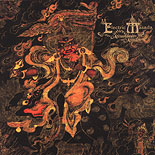
NEW ELECTRIC MASADA

Electric Masada
At The Mountains Of Madness
(Tzadik)

Cat. # 7352-2
Released Nov 2005
cd 1 time – 77:54
cd 2 time – 74:54
US Price $25.00

“Electric Masada combines the raw power and manic speed of Naked City, the improvisational edge of Cobra and the spiritual lyricism of the Masada songbook. Their second release captures them at the end of a long European tour, at the very peak of their powers. Tight as a drum and as hot as a blow torch, these two incredible live performances will leave you breathless. Featuring a level of musical communication, excitement, versatility and complexity very few bands have been able to attain, this is Zorn at his very best. Astonishing group conductions, searing solos and crazed insanity from one of the most amazing bands Zorn has ever had.”

Personnel:
Cyro Baptista: Percussion
Joey Baron: Drums
Trevor Dunn: Bass
Ikue Mori: Electronics
Marc Ribot: Guitar
Jamie Saft: Keyboards
Kenny Wollesen: Drums
John Zorn: Alto Sax

THE CATERER Comic color reprint!

THE CATERER COMI

An oblong gift to fans of 70s pulp and of cult author Jeff Lint

Thirty years after the spectacular collapse of Pearl Comics, a celebration of the cause of that collapse – Jeff Lint’s THE CATERER.

Described by Alan Moore as “the holy barnacle of failure”, The Caterer dragged Pearl into a legal hell when its hero spent the whole of Issue 9 on a killing spree in Disneyland. The smirking Jack Marsden became a cult figure and role model for enigmatic idiots in the mid-70s. His style and catchphrases were such an insider code that hundreds of people got beaten up by baffled or enraged onlookers.

Steve Aylett presents a reprint of Issue 3: this stand-out issue includes the beginning of Marsden’s goat obsession, a fierce appearance by the ghostly Hoston Pete, a great example of the Marsden ‘stillness’ and no less than four classic Marsden hallucinations. The leaning Chief Bayard’s preoccupation with our hero results in the violent deaths of six people, and Jack delivers his infamous ‘lipstick for dog’ diatribe.

Color cover and strange 1970s color throughout – full use of the word ‘thru’, the term ‘strides’ for pants, and repetition of the phrase ‘stroll on’, never used by a single person in real life ever.

For those who read LINT and those who love Lint, an artifact to baffle friends and scorch the eyelashes of one’s enemies.

Includes ads and letters pages in the Caterer style.

This is an oblong gift to fans of 70s pulp and of cult author Jeff Lint.

Color reprint of Jeff Lint’s THE CATERER issue 3
Color cover + 28 color pages.
6.625ins width x 10.25ins depth
(16.83cm width x 26cm depth)
32 pages
$9.45 (around Ôø?5.67)

COURTESY S. AYLETT!

"When Saddam used WP it was a chemical weapon, but when the Americans use it, it's a conventional weapon."

US intelligence classified white phosphorus as ‘chemical weapon’

By Peter Popham and Anne Penketh
Published: 23 November 2005
The Independent

The Italian journalist who launched the controversy over the American use of white phosphorus (WP) as a weapon of war in the Fallujah siege has accused the Americans of hypocrisy.

Sigfrido Ranucci, who made the documentary for the RAI television channel aired two weeks ago, said that a US intelligence assessment had characterised WP after the first Gulf War as a “chemical weapon”.

The assessment was published in a declassified report on the American Department of Defence website. The file was headed: “Possible use of phosphorous chemical weapons by Iraq in Kurdish areas along the Iraqi-Turkish-Iranian borders.”

In late February 1991, an intelligence source reported, during the Iraqi crackdown on the Kurdish uprising that followed the coalition victory against Iraq, “Iraqi forces loyal to President Saddam may have possibly used white phosphorous chemical weapons against Kurdish rebels and the populace in Erbil and Dohuk. The WP chemical was delivered by artillery rounds and helicopter gunships.”

According to the intelligence report, the “reports of possible WP chemical weapon attacks spread quickly among the populace in Erbil and Dohuk. As a result, hundreds of thousands of Kurds fled from these two areas” across the border into Turkey.

“When Saddam used WP it was a chemical weapon,” said Mr Ranucci, “but when the Americans use it, it’s a conventional weapon. The injuries it inflicts, however, are just as terrible however you describe it.”

In the television documentary, eyewitnesses inside Fallujah during the bombardment in November last year described the terror and agony suffered by victims of the shells . Two former American soldiers who fought at Fallujah told how they had been ordered to prepare for the use of the weapons. The film and still photographs posted on the website of the channel that made the film – rainews24.it – show the strange corpses found after the city’s destruction, many with their skin apparently melted or caramelised so their features were indistinguishable. Mr Ranucci said he had seen photographs of “more than 100” of what he described as “anomalous corpses” in the city.

The US State Department and the Pentagon have shifted their position repeatedly in the aftermath of the film’s showing. After initially saying that US forces do not use white phosphorus as a weapon, the Pentagon now says that WP had been used against insurgents in Fallujah. The use of WP against civilians as a weapon is prohibited.

Military analysts said that there remain questions about the official US position regarding its observance of the 1980 conventional weapons treaty which governs the use of WP as an incendiary weapon and sets out clear guidelines about the protection of civilians.

Daryl Kimball, director of the Arms Control Association in Washington, called for an independent investigation of the use of WP during the Fallujah siege. “If it was used as an incendiary weapon, clear restrictions apply,” he said.

“Given that the US and UK went into Iraq on the ground that Saddam Hussein had used chemical weapons against his own people, we need to make sure that we are not violating the laws that we have subscribed to,” he added.

Yesterday Adam Mynott, a BBC correspondent in Nassiriya in April 2003, told Rai News 24 that he had seen WP apparently used as a weapon against insurgents in that city.

Flashback to September 27, 2002

CNN.com – Bush calls Saddam ‘the guy who tried to kill my dad’ – Sep. 27, 2002
From John King (CNN)
Friday, September 27, 2002 Posted: 1:48 AM EDT (0548 GMT)

HOUSTON, Texas (CNN) — President Bush leveled harsh criticism Thursday at the Senate on homeland security issues, but he revised his stump speech to make clear “there are fine senators from both parties who care deeply about our country.”

And, in discussing the threat posed by Iraqi President Saddam Hussein, Bush said: “After all, this is the guy who tried to kill my dad.”

Bush was speaking in Houston at a fund-raiser for Texas Attorney General John Cornyn, the Republican nominee for the U.S. Senate seat being vacated by Republican Phil Gramm.

Houston is the adopted hometown of the president’s father, former President Bush, and in discussing the threat posed by Saddam, the current president offered his staple list of complaints about Iraq’s defiance of the United Nations and his contention that Iraq is working aggressively on chemical, biological and nuclear weapons programs. “This is a man who continually lies,” Bush said.

He said the Iraqi leader’s “hatred” was largely directed at the United States and added: “After all, this is the guy who tried to kill my dad.”

In his speech September 12 to the United Nations on Iraq, Bush mentioned the alleged plot to kill a former U.S. president but did not mention that it was his father. The alleged assassination attempt came when former President Bush visited Kuwait during the Clinton administration. The former president had orchestrated the U.S.-led coalition that pushed the Iraqi army from Kuwait in the Persian Gulf War.

Corruption in corporate American culture, part 917.

Warner Music Settles With Spitzer on Radio Payoffs – New York Times

By JENNIFER BAYOT
Published: November 22, 2005
The Warner Music Group, the country’s No. 3 record company, agreed today to cease using pricey gifts and promotional giveaways to buy radio airtime for its artists. It was the second settlement to emerge from the New York attorney general’s investigation into such pay-for-play arrangements.

Home to more than a dozen record labels, including Atlantic, Bad Boy and Lava, Warner Music said that as part of the agreement it would give $5 million to New York music charities and pay the state’s $50,000 in legal expenses. It said it would disclose any valuable items given to radio stations in the future.

” Warner Music Group Corp. acknowledges that various employees pursued some radio promotion practices on behalf of the company that were wrong and improper, and apologizes for such conduct,” the company said in a statement.

“What has been described generically as ‘payola’ for spins has continued to be an unfortunately prevalent aspect of radio promotion,” Warner said, adding that it “looks forward to defining a new, higher standard in radio promotion.”

Eliot Spitzer, the New York attorney general, described the pay-for-play deals as bribes that violate state and federal law while duping listeners into thinking that songs are selected for their popularity or artistic merit. “Unfortunately, other companies continue to engage in them,” Mr. Spitzer said in a statement.

The incentives typically include personal benefits offered directly to radio programmers who decide which songs will receive airtime. Warner offered the programmers electronics, airfare and tickets to major sporting events like the Super Bowl and World Series, Mr. Spitzer said.

Other payments help radio stations cover operational expenses or provide prizes for the stations’ giveaways, like iPods, digital cameras and tickets to events like the Grammy Awards, the MTV Video Music Awards and the American Music Awards.

“Z100 has approached us for a Linkin Park Flyaway to L.A. or Glasgow for a grand prize in their big match game contest on the morning show,” says an internal promotions message dated Feb. 28, 2004. “Can we approve this??” The sender and recipient of the message were obscured.

By increasing a song’s radio presence – described by Mr. Spitzer as the single-biggest driver of music sales – the practices are designed to inflate profits and manipulate a song or album’s ranking on record charts.

Warner’s settlement follows a similar agreement in July by Sony BMG Music Entertainment, a unit of Bertelsmann and one of the country’s largest record companies. The investigation by Mr. Spitzer’s office is continuing, and he has encouraged other music companies to step forward and abandon similar incentives.

The settlement statement released by Mr. Spitzer’s office described many of the practices at Warner in detail. It said the company used independent promoters as a conduit for illegal payments to the radio stations and hired outside venders to call radio stations posing as listeners requesting Warner artists’ songs.

In the 45 years since federal statues banned similar, if less elaborate, inducements, the record industry’s promotional tactics have evolved along with the structure of radio stations, Mr. Spitzer said. As disk jockeys’ power to choose songs has dwindled, radio programmers and the station’s day-to-day expenses have become targets.

For instance, David Universal, a former program director at WKSE in Buffalo, received a trip to Miami, a laptop and several other perks, Mr. Spitzer said. “We all had to do business with Dave if we were going to get our records on,” a promotion manger with Atlantic Records was quoted as saying. “It was a game that you either played or you didn’t have a shot at getting your records on the air.”

Another Warner promotions employee urged colleagues to be aggressive in demanding “spins,” or song plays. “We need to jump into spins immediately this morning,” said an Oct. 13, 2003, e-mail message tagged as high priority. “No one should be less than 21x per week. Will send you a list of offenders. Close the holes!!!”

NEW NARBY.

Intelligence in Nature
by Jeremy Narby
Hardcover: 267 pages
Publisher: Tarcher (March 3, 2005)

From Publishers Weekly:

In The Cosmic Serpent, anthropologist Narby hypothesized that Amazonian shamans can “gain access in their visions to information related to DNA” comparable to what molecular biologists know. In this intriguing treatise, he carries his project of syncretizing all forms of knowledge a step further, arguing that animals and plants exhibit intelligence comparable in many ways to that of humans. His shaman friends heartily endorse the idea, regaling him, over a friendly pot of hallucinogenic ayahuasca brew, with conversations they have had in the trance state with animal and plant spirits. For further confirmation, he talks to Western scientists who have done remarkable research on cases of nonhuman intelligence, like bees with abstract reasoning, crows that manufacture standardized tools, pigeons that distinguish between the works of Van Gogh and Chagall about as well as college students do, octopuses that break out of and into their tanks and slime molds that solve mazes. Scientists may find Narby’s ongoing efforts to assimilate shamanic mysticism to Western science – he associates, for example, Amazonian legends about humans turning into jaguars with Darwin’s theory of evolution – naÔø?ve and illogical. But Narby has done his homework – the endnotes themselves make excellent reading – and his well-researched and engagingly presented account of the “braininess” of even literally brainless creatures raises fascinating questions about the boundaries between man and nature.
Copyright Ôø? Reed Business Information, a division of Reed Elsevier Inc. All rights reserved.

Book Description
Anthropologist Jeremy Narby has altered how we understand the shamanic cultures and traditions that have undergone a worldwide revival in recent years. Now, in one of his most extraordinary journeys, Narby travels around the globe-from the Amazon basin to the Far East-to probe what traditional healers and pioneering researchers perceive about the intelligence present in all forms of life.

Intelligence in Nature offers overwhelming illustrative evidence that independent intelligence is not unique to humanity. Indeed, bacteria, plants, animals, and other forms of nonhuman life display an uncanny proclivity for self-deterministic decisions, patterns, and actions. The Japanese possess a word for this universal knowing: chi-sei. For the first time, Narby presents an in-depth anthropological study of this concept in the West. He not only uncovers a mysterious thread of intelligent behavior within the natural world but also probes the question of what humanity can learn from nature’s economy and knowingness in its own search for a saner and more sustainable way of life.

Pilgrims flock to see 'Buddha boy' said to have fasted six months

(The Telegraph 21/11/2005)

By Thomas Bell in Bara District, Nepal

Thousands of pilgrims are pouring into the dense jungle of southern Nepal to worship a 15-year-old boy who has been hailed as a new Buddha.

Devotees claim that Ram Bomjon, who is silently meditating beneath a tree, has not eaten or drunk anything since he sat down at his chosen spot six months ago.

Ram Bomjon maintains his vigil in the shade of his pipal tree
Witnesses say they have seen light emanating from the teenager’s forehead.

“It looks a bit like when you shine a torch through your hand,” said Tek Bahadur Lama, a member of the committee responsible for dealing with the growing number of visitors from India and elsewhere in Nepal.

Photographs of Ram Bomjon, available for five rupees (4p) from his makeshift shrine, have become ubiquitous across the region. “Far and wide, it’s the only topic of conversation,” said Upendra Lamichami, a local journalist.

He said no allegation had yet emerged of Ram breaking his fast or moving, even to relieve himself.

Santa Raj Subedi, the chief government official in Bara district, appealed to the capital, Kathmandu, for assistance in dealing with the influx of visitors, and for a team of scients to examine the case.

Local doctors failed to reach a final conclusion, although they were allowed no closer than five yards from the boy mystic, declaring that they could confirm no more than that he was alive.

The popularity of the phenomenon is partly because it resembles an episode in the life of the historical Buddha, who was born 160 miles away around 543 BC. The Buddha achieved enlightenment when he meditated beneath a sacred pipal tree for 49 days.

Ram Bomjon is also sitting beneath a pipal tree, in the same posture as the Buddha is depicted, but his vigil has already taken longer.

Ram’s mother, who is called Maya Devi, like the Buddha’s mother, admits to anxiety, particularly at meal times. But she tells herself: “God took him to the forest and I have faith that God will feed him.”

She said: “He’s definitely got thinner. Early in the morning he looks sunken, like there’s no blood in him, but as the sun rises he seems to get brighter and brighter.”

The fervour increased last week when a snake is said to have bitten Ram, and a curtain was drawn around him.

After five days it was opened and he spoke. “Tell the people not to call me a Buddha. I don’t have the Buddha’s energy. I am at the level of rinpoche [lesser divinity].

“A snake bit me but I do not need treatment. I need six years of deep meditation.”

Despite his protestations, “Buddha boy” is famous.

A thriving market has grown in the once pristine forest, supplying pilgrims with everything from chewing tobacco and bicycle repairs to incense and sacred amulets. The ground is covered in litter.

A fence was built around Ram’s tree to prevent pilgrims prodding him, then a second, and now a third is planned, as well as a bus park, leaving Ram at the centre of an ever growing circle of rubbish.

Prakash Lamsal, a businessman said: “Some people are selling 2,500 rupees [Ôø?20] worth of tea a day.

“These lamas [monks] are going to build mansions out of this. If I wasn’t a bit embarrassed I’d take a van down there and set up a stall.”

Pentagon Team's War Plan Probed

Nov. 19, 2005 – Los Angeles Times

An intelligence unit helped make the case for invading Iraq, saying the CIA overlooked links to Al Qaeda — claims now largely discredited.

By Greg Miller and Mark Mazzetti, Times Staff Writers

WASHINGTON Ôø? The Defense Department’s inspector general’s office said Friday it had begun investigating a Pentagon team that former Undersecretary of Defense Douglas J. Feith used to build the U.S. case against Saddam Hussein and to plan the war in Iraq.

The investigation is likely to call new attention to the Bush administration’s case for war as the White House faces criticism that it exaggerated Baghdad’s threat. House and Senate Democrats held news conferences Friday to criticize the administration’s prewar claims that Iraq had stockpiles of banned weapons and ties to Al Qaeda and other terrorist groups.

Shelton R. Young, the Pentagon’s acting deputy inspector general for intelligence, told senior Pentagon officials Wednesday that his office would investigate whether Feith’s operation “conducted unauthorized, unlawful or inappropriate intelligence activities.”

Sen. Pat Roberts (R-Kan.), chairman of the Senate Intelligence Committee, and Sen. Carl Levin of Michigan, a senior Democrat on the panel, requested the investigation. The Pentagon released Young’s memo Friday evening describing the inquiry.

The investigation is expected to focus on the work of analysts who spent months before the U.S. invasion of Iraq sifting intelligence reports for evidence that Hussein’s government had ties to Al Qaeda — a claim administration officials used in making the case for war.

A Pentagon spokesman refused to comment Friday on the investigation.

As the Pentagon’s third-ranking civilian official, Feith was one of the administration’s most influential advocates of toppling Hussein’s regime. His advocacy of a hard line toward Hussein turned his office into the nerve center for U.S. policy toward Iraq. Feith resigned this year.

Soon after the Sept. 11 attacks, Feith assigned two Pentagon staff members, Michael Maloof and David Wurmser, to sift raw intelligence to determine whether the U.S. intelligence community had missed links between rogue nations and international terrorist networks.

The two-member intelligence unit, called the Policy Counterterrorism Evaluation Group, said it had discovered links that the CIA had overlooked, and it briefed the National Security Council, the CIA and members of Vice President Dick Cheney’s staff.

A Feith memorandum about the group’s discoveries was leaked to the news media. Cheney presented it as the “best source” on the links between Al Qaeda and Iraq.

During a congressional hearing, then-CIA Director George J. Tenet said the agency “did not agree with the way the data was characterized in that document.”

At a White House briefing, the team denigrated the CIA for failing to recognize alleged ties between Baghdad and Al Qaeda. The CIA was skeptical of such claims before the war. Subsequent probes have found scant evidence of any significant link.

This month, newly declassified documents cast doubt on the credibility of a source whom administration officials had cited in arguing that Iraq provided training to members of Al Qaeda. Similarly, FBI and CIA investigations have concluded that it was unlikely that an alleged 2001 meeting between one of the Sept. 11 hijackers and an Iraqi intelligence agent in Prague, Czech Republic, ever occurred.

President Bush acknowledged in 2003: “We have no evidence that Saddam Hussein was involved with the Sept. 11 attacks.”

Roberts, the intelligence committee chief, has said in recent weeks that his panel would delay its examination of Feith’s office until the inspector general’s report was completed.

As the administration began building its case for war in late 2002, Feith enlarged the office of Middle Eastern analysts working for him and renamed it the Office of Special Plans. It became the primary office in Washington for planning the war and the reconstruction efforts.

A graduate of Harvard University and Georgetown University Law, Feith worked on the staff of the Reagan administration’s National Security Council and in the Defense Department.

Feith’s office has also faced scrutiny for sending representatives shortly after the Sept. 11 attacks to a meeting with Manucher Ghorbanifar, an Iranian exile and discredited figure involved in the Iran-Contra scandal of the 1980s.

A Senate Intelligence Committee examination found “nothing improper” about the meeting, a committee aide said.