
Comix historian R.C Harvey reviews Gilbert Shelton’s 624-page “The Fabulous Furry Freak Brothers Omnibus” over at The Comics Journal site…

Comix historian R.C Harvey reviews Gilbert Shelton’s 624-page “The Fabulous Furry Freak Brothers Omnibus” over at The Comics Journal site…

From the Upriver/Downriver newsletter Number 10, circa 1991…
“Things That Really Work”
by Gary Snyder
DON’T MOVE!
Without further rhetoric or utopian scheming, I have a simple suggestion that if followed would begin to bring wilderness, farmers, people, and the economies back. That is: don’t move. Stay still. Once you find a place that feels halfway right, and it seems time, settle down with a vow not to move any more. Then, take a look at one place on earth, one circle of people, on realm of beings over time, conviviality and maintenance will improve. School boards and planning commissions will have better people on them, and larger and more widely concerned audiences will be attending. Small environmental issues will be attended to. More voters will turn out, because local issues at least make a difference, can be won—and national scale politics too might improve, with enough folks getting out there. People begin to really notice the plants, birds, stars, when they see themselves as members of a place. Not only do they begin to work the soil, they go out hiking, explore the back country or the beach, get on the Freddies’ ass for mismanaging Peoples’ land, and doing that as locals counts! Early settlers, old folks, are valued and respected, we make an effort to learn their stories and pass it on to our children, who will live here too. We look deeply back in time to the original inhabitants, and far ahead to our own descendants, in the mind of knowing a context, with its own kind of tools, boots, songs. Mainstream thinkers have overlooked it: real people stay put. And when things are coasting along ok, they can also take off and travel, there’s no delight like swapping stories downstream. Don’t Move! I’d say this really works because here on our side of the Sierra, Yuba river country, we can begin to see some fruits of a mere fifteen years’ inhabitation, it looks good.
Gary Snyder: wikipedia
Recent (Sun-Mon-Tue-this morning) stuff on http://twitter.com/arthurmagazine…
RC Harvey reviews “The Fabulous Furry Freak Brothers Omnibus” by Gilbert Shelton (625 pages!)
http://bit.ly/apZsSk
#ubuweb [download] Another great Queer music comp, this time a bunch of novelty records from the 60s: Queer To The Core!:
http://is.gd/hi90z
#johncoulthart New blog post: Through the Psychedelic Looking-Glass: the 2011 calendar
http://bit.ly/9fyPnj
“I think in the next three to five years, you’ll see half the bookstores in this country close.”
http://bit.ly/aS2TFT
Arik Roper’s “TUFF WIZARD” Arthur t-shirt in forest green on cactus green now available $18.95 postpaid
http://bit.ly/aV5cOr
November 16, 1938 – Albert Hofmann synthesizes LSD
http://bit.ly/982Z3D
“William S. Burroughs: A Man Within” biodoc screening sched
http://bit.ly/8ZxWMD
Bitches’ Brew ale
http://on.fb.me/9LkWbF
Soaking the Rich, Cutting the Deficit
http://nyti.ms/9wpYwd
Weird that NYT neglects to mention of EMI’s current troubles (er) with Citigroup w/r/t Beatles/iTunes
http://nyti.ms/9Q5AiC
That is, Citigroup v Terra Firma (who own EMI)
http://nyti.ms/bkAzri
Via Sean Carnage – CONCERTPAGE 1.1 arrives! Monthly one-sheet guide to LA DIY throwdowns
http://bit.ly/aQswd8
#cinefamily: DEVO! THE CRAMPS! DEAD KENNEDYS! Get in gear for our punk weekend with the URGH! A MUSIC WAR soundtrack.
http://bit.ly/c5SscM
Super news: JOSH T PEARSON (ex-LIFT TO EXPERIENCE) is releasing a new album on Mute next year. Paris rooftop performance of Woman When I’ve Raised Hell by Josh T. Pearson
http://bit.ly/a1Oezh
“Sweetheart I Ain’t Your Christ” by Josh T. Pearson
http://mysp.ac/dnhKlx
#johncoulthart: Iain Sinclair’s ‘Compass Road’ watch: British road sign design with Blake, Wells, Ballard, etc as destinations
http://bit.ly/9phmhX
#ubuweb – 35 Viennese Actionist Films (1957-1995)
http://is.gd/h7Zpy
“The apocryphal story is that this book of drawings, which form a loose narrative, is about Moebius giving up weed.”
http://bit.ly/ddLYU5
“The Sioux sometimes showed their contempt for their enemies by…displaying their genitals or buttocks”
http://nyti.ms/bwQsXS
My plan for the deficit via @nytgraphics
http://t.co/IgsvY8L
#samarov: Daniel Higgs artwork on @roundmyskull:
http://bit.ly/bsitgQ
#johncoulthart – New blog post: Weekend links: Hodgson edition
http://bit.ly/cAUbKd
#ubuweb – [download MP3] Sorry to hear about Górecki. His Symphony No. 3 w/Dawn Upshaw is still staggeringly moving
http://is.gd/gYDnM
“It is better to die on your feet than to live on your knees,” she famously exclaimed. * http://bit.ly/d1RZb4
#SirRichardB Happy Birthday Gocher! I miss you brother. Hope you are creating more havoc than ever. Stop by sometime, will be good to see you!
#SirRichardB Sun City Girls on Lebanese TV. We’ze in trouble now! @ 23:25
http://tumblr.com/xkcpnlwrm
“You say this sounds like turning the whole world into a national park? Precisely.” (Kenneth Rexroth, May 1969)
http://bit.ly/csf2g2
“I have formatted 78 of my Sixties photographs as Tarot cards”
http://bit.ly/b3eT6p
#comicsreporter – great piece on Doonesbury from the historian Garry Wills
http://is.gd/gRBGG
Eagerly awaiting the “Arrest or kill Dick Cheney and George Bush for war crimes” mission on “Call of Duty” videogame
http://nyti.ms/aRKS2f
“Mike Jay, the author of High Society, a history of mind-altering drugs, introduces his new book and heads to China to cover the opium wars.
“High Society explores the spectrum of drug use across the globe and throughout history, from its roots in animal intoxication to its future in designer neurochemicals.
“Designed to accompany the 2010 Wellcome Collection exhibition, the book is beautifully illustrated with rarely seen material from the museum’s collections.”

This just in from the Living Theatre:
Join us in an epic evening of music, poetry, dance, comedy and performance art
Activation and Sizzling Celebration Honoring the legendary Ira Cohen and Judith Malina
Fantuzzi & band: Latin, Reggae, Afro funk
Alice Kabira Frank, Alan Graubard, Valery Oisteanu,
Steve Ben Israel, Steve Dalachinsky: poetry
dj Cloud
Nov. 17th 8pm-11pm
@ The Living Theatre
21 Clinton St. NY , NYC 10002
$ 10 contribution

More from/on contemporary artist Alexander Ross at the ever-wonderful A Journey Round My Skull
Tuli plays God in this 1972 film by Canadian cineastes Michael Hirsh and Jack Christie, screening in the USA for the first time as part of the FUG ON FILM Tuli Kupferberg memorial screenings happening in New York THIS SUNDAY, NOV 14 at Anthology Film Archives.
J. Hoberman’s review in this week’s Village Voice
Details here: Arthur presents Tuli Kupferberg Memorial Screening – Nov. 14

Masters of Reality’s Chris Goss, musician, with wild desert tortoise. Photograph by Stephanie Smith, in Joshua Tree, California. Interview by Arthur editor Jay Babcock at LAWeekly.
Pure Poetry
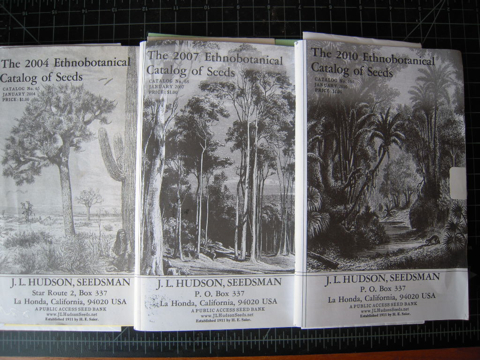
Matthew Erickson on the J.L. Hudson Ethnobotanical Catalog of Seeds
Compared with artists’ books, mimeograph-era poetry rags, record-nerd fanzines, silkscreen and letterpress ephemera, a seed catalog may seem to be the least covetable of printed matter. But the J.L. Hudson Ethnobotanical Catalog of Seeds surely belongs within that cultural niche. It must be the only seed catalog that has simultaneously appeal to those with a taste for fine printed works, radical politics, early Natural History, botany and gardening practices. The work being done by the company called J.L. Hudson, Seedsman is already well known and loved by plant growers, who have been ordering from the company’s stock for the past 100-plus years. Yet as far as I know, little has been written about the Hudson catalogs themselves, and what they represent aesthetically and politically.
My first exposure to the catalogs was through a copy of the 2003 issue of The Free Press Death Ship, the beautifully assembled (now defunct?) compendium of all forms of micro-press publications under the sun. After browsing through the Death Ship’s seemingly endless list of entries on widely-varied zines, pamphlets and newspapers I stumbled on what seemed like an unusual listing for an unusual item:
Thousands of rare and hard-to-find seeds from every continent…a life-long effort combining the practical motivation to earn an honest living with the ethical inspiration to preserve rare and endangered plants by disseminating them into new areas of the world…typed on a Linotype caster and proofed on a Vandercook press…this is a catalog, not a fanzine. But it’s a magnificent example of independent publishing and do-it-yourself ethics all the same.
After trying to envision what this kind of thing would look like, I sent my dollar bill to the address listed beneath the listing and a few weeks later got a copy of the J.L. Hudson catalog.
J.L. Hudson, Seedsman does indeed, like nearly all businesses these days, have a website (http://www.jlhudsonseeds.net). It’s a fairly basic one at that, but it does have their whole seed list. However, I think that the way that I discovered the catalogs, via their printed matter, is the key to what makes the whole enterprise so great. Through perusing their reading materials, it seems as though the owners may or may not have phone lines, may or may not have proper street mailing address at their HQ in the Santa Cruz mountains, and, though they use computers to update their website, they continue to typeset their catalogs without them. Yet it doesn’t really seem to be a matter of mere Luddism that keeps it that way, more of an aesthetic-ethical choice. (Another publication in a similar vein called The Match, also anti-computer and espousing anarchist politics, had an entertaining essay in its Summer 2003 issue by J.L. Hudson’s proprietor David Theodoropoulos called “A Trip to Hell” about his experiences doing computer layout for his self-published book Invasion Biology: Critique of a Pseudoscience.) Perhaps a parallel could be drawn between the desire to print your own periodical with your own set of skills and the desire to grow your own food from seed with your own hands?

The motto of the company is “Preservation Through Dissemination” and is emblazoned around their seal of a bird clasping a seed between its beak while an airplane flies far overhead. The motto on the seal is placed between two Latin words, “vendimus” (sell) and “semina” (seed), the latter of which can’t but remind me of Wallace Berman’s era-defining art-poetry magazine/lifework of the same name from the early 1960s (http://www.lalouver.com/html/publications/publications44.html). Like the Hudson catalogs, Berman’s entirely self-published proto-zine was in part about spreading ideas in the same fashion as one sows seeds and shaping a broad community around a shared set of values. (If you can recall the scene in Easy Rider where the boys end up at the back-to-the-land commune, Berman has a few seconds of screen time there as a hippie tossing seed onto a bare field.) The J.L. Hudson catalogs have the subtle, ineffable feeling that other self-realized publications have when you are holding the result one person’s (or a few people’s, as the case may be) singular creative vision and craftsmanship.

Aside from the fact that the Hudson seed catalogs were produced via Linotype and Vandercook, the whole of the text/image within each annual edition comes close to becoming an encyclopedia on the poetics and ethnograhics of plants. Frequently boxed within the four columns of entries for the seeds are wonderfully detailed and semi-Victorian illustrations of selected plants, with the wide flowers rising through the surrounding words. They give a kind of time shift, making you not sure which epoch of utopianism the thing in your hands originated.
Yet it’s the image paired with the writing that sets the tone for the whole vibe. From the entry for Primula veris:
Bright yellow fragrant nodding inch-wide flowers clustered on 8–12” stems in spring. The petals each have a red spot. Attractive rosettes of crinkled leaves. Europe. A legendary plant of the herbalists, with a long history of use. Norse mythology dedicated it to the goddess Freya, and it was held to be the entrance to the treasure palace. The sedative flowers are made into cowslip wine, an old folk remedy for insomnia, giddiness & nervous troubles. The fresh blossoms are made into conserves. They were once held in high esteem as a cosmetic, believed to remove spots and wrinkles. Seed viable 2-5 years. Give seed 2 weeks warm, then 8 weeks cold, to sprout in 1-2 w.
Pure poetry! Many entries have input from the network of people who have tried growing specific seeds. From the entry for the E. Californica: ‘California Poppy’: “During the summer, they form a dense carpet of finely cut, blue-green foliage, smothered with a profusion of vivid, glossy flowers – Booth.” Or, from one of the many tobacco varieties: “You might like to know that tobacco grows very well outdoors in Alaska, reaching 6 feet tall and flowering even in cold wet summers. I just start the plants early, like tomatoes. – V. Robeson, 11/98.” And then in the next column over: “‘Desert Tobacco’ Creamy white ½-1” long trumpets in spikes. Vigorous annual from 8” to 3 feet tall. Desert washes from S. California to Texas. Smoked by the Hopi, Pima, Papago, Maricopa, Cocopa, Mojave, Yuma and Cahuilla, who believed it one of the first plants created by the god Mukat.” The tone is folksy and populist, peppered with anecdotes, wisdom and, in the case of the many vegetable seeds, occasional cooking tips from active participants in the wider project of preserving through disseminating.
Apart from the great visual and material qualities of these catalogs as objects, they pique my interest for a variety of other reasons, not the least of which is that, along with converting a dullard into an aspiring botanist, they try to shake some apathy out of the apolitical greenthumb. How many other seed companies maintain a table every year at the San Francisco Anarchist Bookfair? How many seed catalogs have detailed descriptions of available specimens with quotes from Proudhon, Kropotkin, Goldman, the (17th century) Diggers (along with Plutarch, Burroughs and LeGuin, among others) nestled within the margins?
Yet the political aspect of this project reaches beyond only tabling and quotations. J.L Hudson could be seen as an articulation on the forms of political organization: open vs. closed, decentralized vs. centralized, localized vs. Statist, decontrolled vs. controlled, etc. For the past decade or so, immense seed banks have been slowly sprouting around the world. The Svalbard Global Seed Vault, the enormous and expensive so-called “Doomsday seed bank” (pictured above), is perhaps the antithesis to the kind of eco-political project that the Hudson seed catalogs have been building. In 2008 the government of Norway finished construction on the vault on the remote Arctic island of Spitsbergen with a stated goal of preserving biological diversity and protecting the world’s food crops through climate change, plant disease and population growth. (See: http://www.regjeringen.no/en/dep/lmd/campain/svalbard-global-seed-vault.html) Designed to withstand any number of possible catastrophes, climatic and/or apocalyptic, the Svalbard Global Seed Vault is the epitome of a bureaucratic, centralized form of biological preservation. At the beginning of a lengthy article in the August 27, 2007 issue of The New Yorker, John Seabrook wrote of the potential magnitude of the project: “We tend to imagine apocalypse coming in the form of a bomb, an asteroid, or a tsunami, but should a catastrophe strike one of the world’s major crops [Cary] Fowler [the head of the Global Crop Diversity Fund] and his fellow seed bankers may be all that stand between us and widespread starvation.” As noble as the project’s intentions may be, is there not something slightly unsettling about a small handful of scientists standing between the world’s populace and their crops? Thankfully, that’s only one end of the seed-saving spectrum.
In many respects the work of J.L. Hudson is more akin to the widespread decentralized seed exchange and seed library movements taking place in rural and urban locales around the country (some of which have been written about in these pages: see “Seedy Sunday, Skeeball and the Ides of March” by Nance Klehm). As an Emma Goldman quote from the margins of the 2007 catalog states: “They do not want to know that centralization is not only the death-knell of liberty, but also if health and beauty, of art and science, all these being impossible in a clock-like, mechanical atmosphere.” The political project that the catalogs represent is a kind of disassembling of government-run seed preservation so prevalent today. Their motto of “preservation through dissemination” is about keeping plant diversity alive by circulating seeds to the public of interested gardeners—who in turn can send their heirloom varieties to J.L. Hudson’s own seed bank project—rather than a geographically isolated type of preservation through collection and burial in temperature-controlled chambers for private interests.
In bold type within the colophon of the catalogs is a declaration of “uncopyright” for its material, stating that the content therein is of the Public Domain: “We believe the unrestricted exchange of seeds and knowledge are essential to a free society.” This cuts to the core of considering these seed catalogs as fine printed matter, as anarchist propaganda and as small press art objects. While by all practical measures these are just seed catalogs, with product descriptions and prices, they quietly open up questions of how we interact within our natural environment, of how ideas and plant species can be sustained through a horizontal circulation without borders. Were it not for the careful print and design of the physical catalogs, I’m not sure if I would have given them much attention or noticed the Brion Gysin quote nestled beneath the listing for Anagallis: “Kick that habit, man.”
There are several related essays—on organics, hybrids, public domain seeds, the “white list” on invasive species, on “native”/“invasive” plants (the subject of Theodoropoulos’ self-published book)—within the J.L. Hudson website that are worthwhile reads for understanding the ethics behind the project. While there, you can also get info on how to request a print catalog.

Arthur compilation/mixtape curated by editor Jay Babcock, available as pay-what-thou-wilt (starting at $4.20) digital download, here: http://www.arthurmag.com/blackout
 Arthur Magazine