
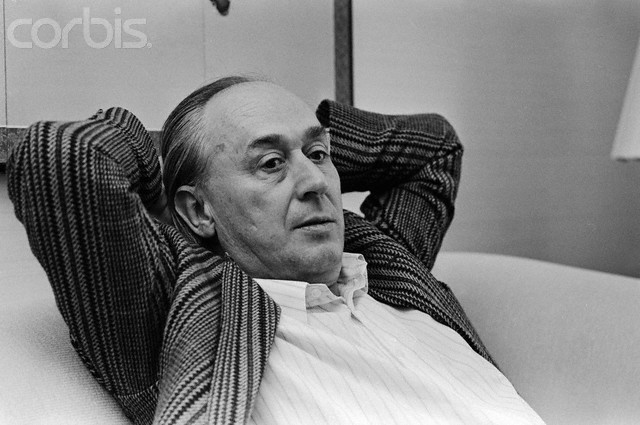
J.G. Ballard, 2004: "A soft totalitarianism prevails, as obsequious as a wine waiter."

From a 2004 interview with Jeannette Baxter in The Guardian, touching on themes from Ballard’s latest novel, Millennium People

JGB: I suspect that many of the great cultural shifts that prepare the way for political change are largely aesthetic. A Buick radiator grille is as much a political statement as a Rolls Royce radiator grille, one enshrining a machine aesthetic driven by a populist optimism, the other enshrining a hierarchical and exclusive social order. The ocean liner art deco of the 1930s, used to sell everything from beach holidays to vacuum cleaners, may have helped the 1945 British electorate to vote out the Tories.

… There is something deeply suffocating about life today in the prosperous west. Bourgeoisification, the suburbanisation of the soul, proceeds at an unnerving pace. Tyranny becomes docile and subservient, and a soft totalitarianism prevails, as obsequious as a wine waiter. Nothing is allowed to distress and unsettle us. The politics of the playgroup rules us all.

The chief role of the universities is to prolong adolescence into middle age, at which point early retirement ensures that we lack the means or the will to enforce significant change. When Markham [not JGB] uses the phrase “upholstered apocalypse” he reveals that he knows what is really going on in Chelsea Marina. That is why he is drawn to Gould, who offers a desperate escape.

My real fear is that boredom and inertia may lead people to follow a deranged leader with far fewer moral scruples than Richard Gould, that we will put on jackboots and black uniforms and the aspect of the killer simply to relieve the boredom. A vicious and genuinely mindless neo-fascism, a skilfully aestheticised racism, might be the first consequence of globalisation, when Classic Coke and California merlot are the only drinks on the menu. At times I look around the executive housing estates of the Thames Valley and feel that it is already here, quietly waiting its day, and largely unknown to itself.”

Q: Am I right in thinking that one critique which your latest novel throws up is that, in the glare of the consumerist spectacle, we have lost all sense of critical distance to the realities of capitalism and globalisation? I’m thinking specifically here of the reality of terrorism. John Gray propounds a similar thesis in Straw Dogs (your chosen book of the year for 2003) when he suggests that al-Qaida is “a byproduct of globalisation, it successfully privatised terror and projected it worldwide.” What’s your feeling on this?

JGB: I agree with John Gray, and was very impressed by both Straw Dogs and his al-Qaida book. What is so disturbing about the 9/11 hijackers is that they had not spent the previous years squatting in the dust on some Afghan hillside with a rusty Kalashnikov. These were highly educated engineers and architects who had spent years sitting around in shopping malls in Hamburg and London, drinking coffee and listening to the muzak. There was certainly something very modern about their chosen method of attack, from the flying school lessons, hours on the flight simulator, the use of hijacked airliners and so on. The reaction they provoked, a huge paranoid spasm that led to the Iraq war and the rise of the neo-cons, would have delighted them.

COURTESY ANDREW M.!

Garage sale to feature Burroughs memorabilia

The last time she counted, Patricia Elliott Marvin had about 30 boxes of books, posters, drawings and other assorted leftovers from the Beat Generation.

“I want to get down (to) two boxes,” Marvin said Thursday while sorting through a pile of William S. Burroughs paperbacks, many of them signed by her good friend, the author.

“I need to simplify my life,” she said.

Marvin, 56, is having a Beat Generation garage sale Saturday in her home at 810 E. 13th St.

“The art will be in the front room, the books will be in the dining room,” she said. “The cookbooks — I have about 800 of them — will be in the back library.”

Marvin met and befriended Burroughs in 1978 in Austin, Texas. “I liked him right away,” she said.

They remained close confidants until Burroughs’ death in Lawrence in 1997. He was 83.

Burroughs, best known for his experimental novel “The Naked Lunch,” and his influence on writers Allen Ginsberg and Jack Kerouac, settled in Lawrence in 1981.
  
“I think Lawrence restored his soul,” Marvin said.

Sale items include:

• A short stack of programs from the River City Reunion, an event that brought the best of the Beats to Lawrence in 1987.
‚Ä¢ Signed copies of Burroughs’ “The Place of Dead Roads,” “The Wild Boys: A Book of the Dead,” “Tornado Alley,” “Queer,” “The Western Lands” and “Letters to Allen Ginsberg.”
‚Ä¢ A Carl Apfelschnitt poster commemorating Burroughs’ 70th birthday in New York, signed by Burroughs and Apfelschnitt.
‚Ä¢ A complete set of “City Moons,” a Lawrence-area underground newspaper from the late 1960s.
• A letter to Marvin from Burroughs, explaining how to care for his cats while he was away.
• A collection of art prints and small-press publications from Lawrence, 1968 to the present.
‚Ä¢ Black-and-white drawings by risqu?© underground comic artist S. Clay Wilson.
• Dozens of Burroughs T-shirts.

“These are the only T-shirts authorized by Burroughs that bear his image,” said Marian O’Dwyer, former owner of the Phoenix Gallery who’s helping Marvin.

So far, Marvin said, she’s not had second thoughts about parting with so many prized possessions.

“I know this is going to sound weird, but I finally figured out why I am doing this,” Marvin said. “It’s because I miss (Burroughs). I have all this stuff, sitting dead in a box. That’s not where it belongs. It’s alive, it ought to be with people who will appreciate it, who will read it. I want them to have it.”

The sale starts a 9 a.m. No early callers will be allowed.

Marvin said she expected the sale to turn into a mini-reunion of Burroughs alumni.

“I’m hoping it will be an event,” she said, “and not just a sale.”


The deserters: Awol crisis hits the US forces

The Independent

As the death toll of troops mounts in Iraq and Afghanistan, America’s military recruiting figures have plummeted to an all-time low. Thousands of US servicemen and women are now refusing to serve their country. Andrew Buncombe reports

16 May 2005

Sergeant Kevin Benderman cannot shake the images from his head. There are bombed villages and desperate people. There are dogs eating corpses thrown into a mass grave. And most unremitting of all, there is the image of a young Iraqi girl, no more than eight or nine, one arm severely burnt and blistered, and the sound of her screams.

Last January, these memories became too much for this veteran of the war in Iraq. Informed his unit was about to return, he told his commanders he wanted out and applied to be considered a conscientious objector. The Army refused and charged him with desertion. Last week, his case – which carries a penalty of up to seven years’ imprisonment – started before a military judge at Fort Stewart in Georgia.

“If I am sincere in what I say and there’s consequences because of my actions, I am prepared to stand up and take it,” Sgt Benderman said. “If I have to go to prison because I don’t want to kill anybody, so be it.”

Continue reading

Annette Peacock


From a 1989 interview:

I wrote a song called “I Belong to a World That’s Destroying Itself” in 1969. That was 20 years ago. It’s getting worse, not better. People are victims of habit. It’s very difficult to break behaviour patterns. Not many people are able or willing to take the effort to do that. Unless it becomes a socially accepted lifestyle to change your behaviour patterns very quickly, I can’t feel too positive.

Spirit's "Model Shop"!


SPIRIT óTHE GROUNDBREAKING L.A. COMBO EQUALLY swayed by moody jazz and Hendrix-style rockíní rollówas born to record movie soundtracks. Unfortunately, they cut only one, for the seldom-seen 1969 Jacques Demy film Model Shop, but what a triumph it is: a magical blend of John Lockeís eerie keyboards, the soaring guitar of Randy California and Jay Fergusonís impassioned vocals and percussion, backed by the rock-steady bass and drums of Mark Andes and Ed Cassidy. Itís mindboggling that something as dazzling as the Model Shop soundtrackórecorded by the classic Spirit lineupó has been languishing unreleased in the vaults for over 35 years! The stuff of longplaying-legends and vinyl-myths, this full-length album was recorded in late 1968, but the completed master was shelved before release. Rescued from obscurity at last by Sundazed, this much rumored film-score gem is now center-stage where it can take a much deserved bow.

Horse invasion.

New York Times
By JENNIFER 8. LEE
Published: May 13, 2005

Two one-ton horses broke loose near the Meatpacking district this morning, galloping down sidewalks among startled morning commuters, after the stagecoach they were pulling tipped over and the drivers were flung from their seats.

The horses were caught unharmed several blocks away, but one coach driver, Kazim Palaz, was taken to St. Vincent’s Hospital complaining of shoulder pain.

The red stagecoach, promoting a new Shania Twain fragrance by Stetson’s, was heading east on 14th Street between Eighth and Ninth Avenues about 9:30 a.m. when it was struck from the rear by a white van, Mr. Palaz told the police.

The stagecoach tipped over, letting the horses slip free of their harness and bolt east, past a Starbucks, Gristedes and Papaya King. The van sped off, too.

The horses, named Princess and Hero, charged down sidewalks as one of the drivers gave chase, yelling at people to get out of the way. Shocked pedestrians darted into the street and took refuge in building entryways.

“I heard someone screaming, ‘Look out! Watch out!’ ” said Carla Morreale, a software company employee, who had just come out of the Subway stop when she saw the horses bearing down on her. She ducked into a building entryway with two other women. “You don’t expect horses to be charging towards you on your way to work on the sidewalk in Manhattan,” she said.

Chester Burroughs, 62, was sitting at his desk just inside the lobby of the Teamsters building on 14th street when he saw the horses run by. “I had to get up and look again,” he said. “It was strange to see two horses loose on 14th Street.”

Hero was corralled at 14th Street and Sixth Avenue by police officers who happened to be in Union Square for an anti-terrorism drill. They tethered him to a lamppost, surrounded by yellow police tape.

But Princess continued on, galloping east to Fifth Avenue, where she made a right turn, and then another right turn at 13th Street.

“It was flying with the flow of traffic,” said Bob Di Giorgio, a crane operator, who was working behind a barrier at a construction site when he first spotted Princess.

But then the light turned red. As the cars came to a stop, Princess skidded to a halt herself, right behind a sedan, Mr. Di Giorgio said.

He saw his opportunity. “I leaned over the barrier, grabbed the reins and restrained the horse,” he said, describing a move that would have been far more practiced a century ago, when horses were still commonplace on city streets.

A motorist leaped out to help. “It was a joint effort,” Mr. Di Giorgio said of the effort to restrain and calm the animal. They tied Princess to a tree and waited for help.

“Luckily, the light turned red,” Mr. Di Giorgio said, reflecting.

While horses were still familiar fixtures of urban American life early in the 20th century, stagecoaches, used mostly for long-distance travel, were virtually phased out of New York City by the 1830’s, superseded by trains, according to Kathleen Hulser, the public historian of the New York Historical Society. However, they continued to be used in western states, where lower demand for transportation meant railways were not an economic option.

UC does "Homeland Security"

UC-Industry Networks of Expertise
Homeland Security
Strengthening Californiaís R&D leadership

This online tool brings together UC researchers and California companies to understand whoís doing R&D in homeland security or related areas, what they are doing, and where, in order to facilitate large-scale R&D collaborations and strategic planning. aligned against the funding targets defined by the Department of Homeland Security and allied federal agencies.

The member database is organized around ten major homeland security R&D focus areas, aligned with the funding targets defined by the Department of Homeland Security and allied federal agencies. Clicking on an R&D focus area below will give a brief description of that area:

Army to order 1-day break from recruiting – May 11, 2005

CNN.com
Army to order 1-day break from recruiting

Move comes amid reports of inappropriate sign-up methods

From Jamie McIntyre
CNN Washington Bureau

Wednesday, May 11, 2005 Posted: 12:04 PM EDT (1604 GMT)

WASHINGTON (CNN) — The U.S. Army plans to stop recruiting activities for one day this month to review procedures that its 7,500 recruiters use, an Army official said.

Maj. Gen. Michael Rochelle, head of the Army Recruiting Command, is expected to make the announcement, which could come as early as Thursday.

The move follows a CBS News report of least two allegations of recruiting abuse.

In one case, the network reported a recruiter suggesting how a potential volunteer might cheat to pass a drug test, and in another, a sergeant threatened a prospect with arrest if he didn’t report to a recruiting station.

The Army said it is investigating the allegations.

A senior Army officer said Wednesday that the “stand-down” is being ordered not only because of possible misconduct but also because the service has had a difficult time attracting volunteers. The Army wants to assess the stress facing recruiters.

With the war in Iraq, recruiters face increased pressure to meet their recruiting goals. The Army has missed its recruiting targets for three months, and the National Guard and Army Reserve also have fallen short of their goals.

The purpose of halting recruitment for a day is to refocus recruiters on their mission, reinforce the Army’s core values and ensure its procedures are carried out consistently at all 1,700 stations, an Army spokesman said.

The procedure is highly unusual for the Recruiting Command, but “safety stand-downs” are routinely ordered in military aviation following a series of accidents that appear to have a common thread.

In the case of aviation, pilots and air crews are grounded for a day while they review proper procedures. An Army official could not say whether a recruiting stand-down has been ordered before.