The second and final issue of Lewis’s BLAST The War Number appeared in July, 1915, and is a very worthy successor of the first BLAST published in 1914. It features a dynamic cover by Lewis and more of his highly charged propaganda on behalf of Vorticism in painting, sculpture and literature. It also contains prose and poetry by Ezra Pound and T. S. Eliot, and the historic instructive aesthetics of ”Vortex (written from the Trenches)” by Gaudier-Brzeska a piece composed just before the sculptor’s death in France.
L o n g L i v e t h e V o r t e x !
Long live the great art vortex sprung up in the centre of this town!
We stand for the Reality of the Present not for the sentimental Future, or the sacripant Past.
We want to leave Nature and men alone.
The only way Humanity can help artists is to remain independent and work unconsciously.
WE NEED THE UNCONSCIOUSNESS OF HUMANITY their stupidity, animalism and dreams.
We believe in no perfectibility except our own.
Intrinsic beauty is in the Interpreter and Seer, not in the object or content.
WE ONLY WANT THE WORLD TO LIVE, and to feel its crude energy flowing through us.
Blast sets out to be a venue for all those vivid and violent ideas that could reach the Public in no other way.
Blast will be popular, essentially. It will not apppeal to any particular class, but to the fundamental and popular instincts in every class and description of people. TO THE INDIVIDUAL. The moment a man feels or realizes himself as an artist, he ceases to belong to any milieu or time. Blast is created for this timeless, fundamental Artist that exists in everybody.
We want to make in England not a popular art, not a revival of lost folk art, or a romantic fostering of such unactual conditions, but to make individuals, wherever found.
Saddam’s concessions will never be enough for the US
Unless it can engineer a war, Bush’s administration is political roadkill
Simon Tisdall
Wednesday September 18, 2002
The Guardian
To the “man in the street”, on whose support Tony Blair and George Bush ultimately depend, it looks like a fair enough offer. For months the US has been huffing and puffing, mouthing and mithering, making waves over Iraq, demanding that it do what Washington wants. Now, finally, it has received a simple answer: yes. So what does the US do? Ask for more.
It is worth recalling how this pseudo-epiphany was reached. The build-up began in earnest with Bush’s “axis of evil” speech in January; then came his doctrine of “pre-emptive attack” (what security adviser Condoleezza Rice sweetly calls “anticipatory defence”). Then a startled world learned that “rogue states” holding weapons of mass destruction were more or less on the team with Osama and al-Qaida. That, it transpired, made them legitimate targets for America’s “war on terror” and “regime change”.
Last week, Bush turned his screw yet more fiercely. If Iraq truly wished peace, he hectored, it must not only agree to full, certified disarmament under UN auspices (and on US terms). It must also swiftly honour all the numerous obligations laid upon it after the Gulf war.
But Iraq’s weapons remained the principal focus. Some chemical and biological capability is still most likely at Saddam Hussein’s disposal, according to the final reports of the UN inspectors in 1998. He may since have developed more. Scarier still, hawks squawk, Iraq may be only three years, or three months, or who knows, three weeks away from acquiring a nuclear weapon. An image was conjured of the Baghdad bazaar. “Pop round next Tuesday Mr Saddam. Your package will be waiting.”
Such angst with all this blethering did Bush and his cohorts inspire. Such discomfiture and war-feverish unease did they spread among European allies such as Blair and his party followers. What strains and stresses stole like shadows of the night over the deserts of the Middle East as Arab allies and foes alike contemplated a coming US onslaught. How greatly did they clamour and cringe, to the delight of the Cheneys and Rumsfelds, Wolfowitzs and Perles. One by one, slinking Saudis followed chapeau-chomping French into the American sheepfold.
And then, after all this hot and bother fuss, suddenly and out of the blue, even before General Tommy Franks, the wannabe “Stormin’ Norman”, has unpacked his Qatar camp bed, Iraq simply says “OK”. To all these provocations, Baghdad puts a timely stopper.
Nor is there any doubting the popularity of Saddam’s shift, enough to make the White House sick. Security council members declare themselves encouraged. Russia looks forward to a political settlement and an end to threats of war. China discerns a positive sign. Backsliding Germany’s Joschka Fischer rubs it in with a told-you-so about the efficacy of the UN-centred, multilateral approach. Even in London, predictions fly suggesting that war, if it comes, has now been put back a year, that Bush and Blair are split over how to proceed, and that Downing Street will be blamed by US hardliners for steering their president up a diplomatic blind alley. Some Muslim countries, meanwhile, demand a lifting of sanctions.
Worse still, the no-strings nature of Iraq’s riposte has plain-spoken appeal. And to the “man in the street”, increasingly bowed, browbeaten and bamboozled by the government’s line (as polls show) but now relieved and hopeful, it seems reasonable. After all, what more do these people want?
Quite a lot, actually, and the Bushmen’s demands will increase rather than diminish as yesterday’s momentary flummoxing fades. The gap between what America might wisely do, and what it really does, may yet grow schismatically chasmatic.
The US has a “moral obligation”, says sensible Liberal Democrat Menzies Campbell, to take the Iraqi offer seriously and explore it fully. Will it do so? The initially scornful and dismissive response can be expected to harden in the days ahead into a firm line insisting the threat has not diminished one whit, that Iraq will be judged by actions, not words, and that merely “tactical” manoeuvres of this sort have been seen before.
Far from welcoming Iraq’s prima facie compliance with weapons inspections resolutions, the coming US emphasis will be on the several other “materially breached” UN decrees. And whatever Moscow says, the dogged pursuit of a new resolution authorising a yet tougher line will continue apace.
Far from facilitating the inspections process, quickly agreeing a timetable and fixing an end point, as Iraq has previously asked, the stress now will be on anywhere, anytime coercion, intrusion, paramilitary enforcement, and re-extraction of inspectors at the first glimmer of obstruction. The public message will be scepticism, that anything worth finding has already been hidden, that “cheat and retreat” is Iraq’s game, and that the military option may still be the only option.
To this end, despite yesterday’s developments, the military build-up will continue, the ships and tanks, planes and carriers so vital to America’s sense of self-worth will edge towards Iraq, the tone-deaf Rumsfeld’s Pentagon will bang on at what Syria calls the drums of war and deathly ominous B52s, like so many unChristian soldiers marching as to war, will once more silence the hedgerows of Gloucestershire. Expect US pretexts for escalation, fake and insincere negotiations, and false horizons.
For Saddam, with every concession, the bar will be raised ever higher. Almost whatever he says or does, the gun will remain at his head, the trigger ever cocked for the commencement of a battle which Bush et al will not be denied. Despite a broad international consensus against it, regime change and nothing less will remain the ultimate objective.
And why, the “man in the street” might ask, do they appear so set on violence? Because Bush’s misconceived, over-hyped global “war on terror” has run out of targets and is far from won. Because Iraq is oil-rich (the second biggest reserves) and the Saudis grow unreliable. Because, purely in domestic policy terms, especially post-Enron, this government is political roadkill. Because the administration’s predominant, evangelical clique believes it is solo superpower America’s historic mission (Bush says it is a “calling”) to spread its universal values and rescue a muddled world from itself. Because the Bush family has old scores to settle and new elections to win. Because Bush lacks the insight and imagination to act differently. Because in their September 11 pain and unforgotten anger, not nearly enough of America’s “men in the street”, and in high places too, are prepared to say stop, pause, and consider what it is they do.
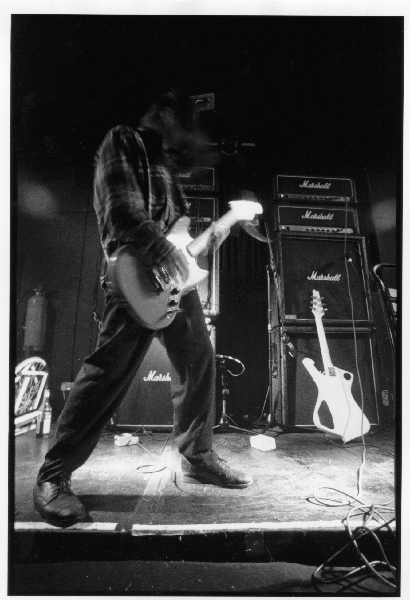
Earth formed in olywa. In early 90(?). d. carlson wants to call the band wormwood but compromises with then members Slim Moon (later to found kill rock stars), and Greg babior. Original lineup 2 guitars, vocals, and the now trendy and de rigeur old analog synths (earth misses out on hipdom by 4 years). TDG becomes revolving bass player and does white noise side project the fragile sphincter with d. carlson. Greg is very caught up in sound proofing the practice space. Greg departs over the rest of the bands ineptitude at jazz improvising over a three note riff. TDG caught up in ascendancy of his band. Move to Seattle. D.carlson meets Dave Harwell at Hard-On’s show. Joe Preston signs on while waiting for his dream to materialize. Slim and D. war over vocals and their place; or lack thereof; in the band. 1st show at Portlands Blue gallery. Last with Slim and vocals. TDG and his bass player are driving earth. Earth get in wreck at gas station 3 blocks from house. Bass player and the assailant go off to smoke pot while waiting for insurance companies to call back. Not the last time earth’s transport will be hampered by chemical dependancy/abuse. 2nd show in Portland. Earth is Heavy Metal cover band. Set includes ‘Animal Magnetism’ by Scorps, ‘One Track Mind’ by Motorhead and a handful of Saint Vitus tunes. 3rd show in Olywa. Sets trend of audience participating from the outside. We record in Portland at Smegma Studios with Mike Lastra. The studio is in his house, which is besieged by ‘coons. TDG and Kelly Canary along for vocals. TDG sleeps a lot during sessions. Earth opens for L7 at Vogue. Most of Sub-Pop are in attendance. D.C. behind amps at this point. After show Bruce and John asks Earth to release something. Earth volunteer Portland tapes and sign-on -board. Extra-Capsular Extraction (earth 1) released sometime in ’91. We play our best show as a three piece. 5 people watch us open for Hell-Cows. Next weekend earth blows chunks opening for TDG’s band. Play in Olywa. with Blake Babies. They spend their entire sound check playing riff from Yes’s “Owner of a lonely heart”. During show with Screaming Trees the drum machine first becomes a problem, with Joe repeatedly stepping on the pedal and restarting songs half way through.
Joe’s dream becomes reality. He is asked to join the Melvins. He can’t leave earth fast enough. Dream becomes nightmare when his bitter, money-grubbing ways do not endear him to his employers. The Melvins can him. He takes revenge by bootlegging earth 7in’s. Carl Anala formerly of Hell Cows joins briefly. He departs rapidly. Earth is a two piece. 1992. Earth are interviewed by then up and comer Tabitha Soren for MTV. Dave not realizing who she will become in the near future repeatedly offends her with a knowing and friendly hand on her thigh during each response to a question. Earth is delighted. Last show with the drum machine. MTV is unaccountably filming the show. Earth is opening for a speed metal band so there are plenty of mustaches and long shorty hair do’s . The drum machine gives up the ghost early in the first song. Dave wisely exits the stage. D.C. remains to play an open chord for 35 minutes. Fists and fingers raised the audience chants “you suck” emphatically. Downer use begins in earnest among one half of the band. Earth 2 recorded in august at Avast studios with Stewart Hallerman at the helm. Many consider this record a definitive statement of the drone triumphant. Others merely the inevitable result of the damage downers do to perception of time and duration. Earth plays the Ultra-Lamefest with many other labelmates. Earth only wants to do one song. The powers that be want the band off after 15 minutes. Earth holds on and finishes the song, all 25 minutes of it. Sometime after the release party Dave decides his life and new interest in gardening would be better off without Earth. Earth is a one piece. Downer use at atrocious, possibly toxic levels in remaining member of band.
Fall of ’93 recording begins on Phase3. D.Carlson, for a variety of sordid reasons, misses the first 2 1/2 days of recording. For these sessions Tommy Hansen (formerly of the Fartz and Crisis Party) plays second guitar. Sub-Pop pull the plug on the sessions. Anger and recriminations follow. Earth’s standing with the Company are at a low-ebb. D.C.’s imminent demise predicted. Ian Dickson leaps into the breach and stakes job on completion of record. A year later (fall ’94) sessions are booked at the Soundhouse with Scott Benson on the board. Rick Cambern does drums on one track. Sessions in trouble Ian locks D.C. in isolation booth for 6 hours. Due to a medical emergency the sessions crash to a halt. D.C.: “_____ went out in the bathroom, Scott won’t keep recording.” Ian: ” How much do we have recorded, is it enough for a record?” D.C.: ” It’s 58 minutes, long enough.” The album is a critical masterpiece (well, at least 2 critics). Phase 3 released April ’95. May of ’95 Paul Smith invites earth to play Disobey night for Blast First and record a live record. When the fax arrives at Sub-Pop they think its a bad joke. Earth is supposed to play for 45 minutes. They play for 26 and 2 english kids play the last 5 minutes of feedback. Ian is now member. Earth is a 2 piece again. The album is mixed at Mute’s Worldwide studios with PK at the helm. Earth mess with Texas. Too much of everything (3 oz. Methamphetamine, 80 valiums, 25 Xanax, riding a white horse). Disaster at Dripping Springs. Redemption (a very wet version) at Emo’s. If they take me back to Texas they wont take me back alive. June Earth play the MacIntosh New Music Seminar. Sub-Pop decides to re-sign earth for 3 more records. February ’96 finds earth with 2 new members, Shawn McElligot on lead guitar and Mike McDaniels on drums. Mike Deming is engineering and playing organ. The recording takes place at Studio .45, which happens to be in the old Colt manufacturing plant in Hartford, Connecticut. Recording and mixing take about 2 weeks. Before the album is released, earth is invited to play Hyperstrings in Austria. It’s a festival of modern guitar (especially non-traditional manipulation) techniques. Other people playing included K.K. Null, E.A.R.(with Sonic Boom), Jim O’Rourke, fellow Seattleites Magnog, and DJ Haswell. The album is released July 23rd. On to the future. Re-mixes of a few songs are in the works. Look for them on Sweet Mother. They should include versions by DJ Nasir, Spooky and Constantine. Coming soon, the franchise.
Colombia: Violence explodes in province where army, under U.S. pressure, focuses on protecting an Occidental pipeline.
By T. CHRISTIAN MILLER, TIMES STAFF WRITER
ARAUCA, Colombia — Under pressure from Los Angeles-based Occidental Petroleum and the U.S. government, the Colombian military has redeployed its forces to protect a key oil pipeline, leading to an explosion of violence in the undefended countryside.
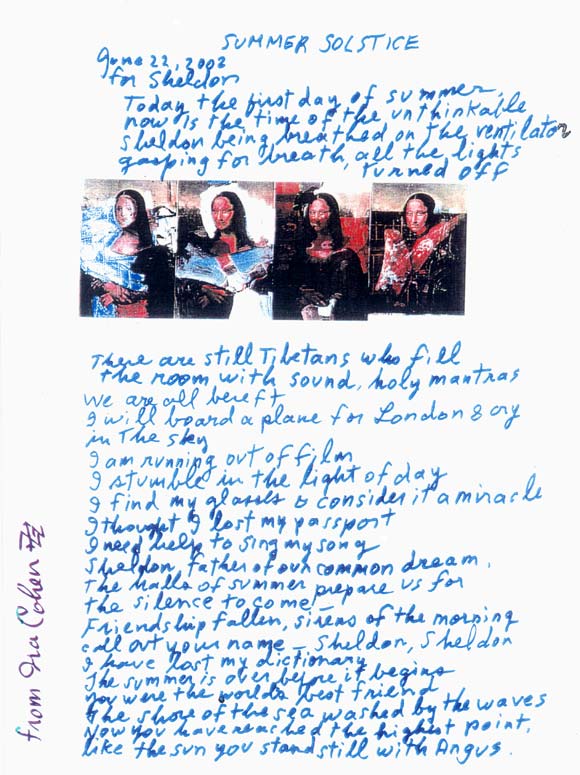
Sheldon Rochlin, filmmaker,publisher, producer and founder of Mystic Fire Video, left his body on June 24th 2002 of pneumonia in New York City. He was 63. The arc of his life and creativity covered an extraordinary and diverse ground. He touched many lives.
From 1960 to 1970 he was part of the New York independent and experimental film scene and traveled to Europe where he completed his first films Vali-The Witch of Positano and Dope, which are considered underground classics. In 1968 he filmed two historic cultural events of the time: The Living Theatres performance of Paradise Now at the Sportspalast in Berlin and Electric Bath, his documentary of The Bath Festival in England.Mr. Rochlin then traveled to India where he resided at the Sri Aurobindo ashram where he met the Mother and documented her last Darsham. He recorded the Breaking of the Ground at Auroville and established a video archival project there. He traveled then to Dharamsala where he met His Holiness The IVth Dalai Lama and arranged the first trip out of India of the Gyuto Monks with whom he traveled and filmed Tantra of Gyuto: Sacred Rituals of Tibet. His other films of that period include: Tibetan Medicine in which he documents the insights and practice of Tibet’s first woman doctor, Lopsang Dolma and Nepal Land of the Gods.
In 1977 he joined forces with Maxine Harris with whom he established Mystic Fire Video. Their filmic collaborations include: Hymn to the Mystic Fire; Secret Egypt; Signals Through the Flames, Metamorphosis, the Essential Teachings of the Buddha by His Holiness the Dalai Lama, and Sukhavati Place of Bliss with Joseph Campbell. Mystic Fire Video continues to produce, publish and distribute.
He was currently finishing an in-depth documentary of the Kalachakra ceremony documenting the Dalai Lama who performs the foundational liturgy of the Tantric teachings which are his mandate to preserve; and Coincidencia Oppositirum, a work of alchemy with Terence McKenna.
He is survived by his wife, Maxine Harris, his step-children, Rhana, Branwyn, and Morgan Harris, and Ptolemy Mann; and his sister Bernice Brown.
German filmmaker Rainer Fassbinder in an undated portrait (Photo: DPA/AFP).
Theo Hinz, the longtime producer of Rainer Fassbinder’s films, gives details of the controversial German filmmaker’s life.
WPR: For many years, you were very close to Fassbinder and knew him well. Do you still think he was a mixture of a genius and lunatic, as you once called him? What was it like to work with him?
Hinz: When I met Rainer Fassbinder for the first time I didn’t know that there was to be a lot of joint work ahead of us, including several films that transformed Rainer into a world-famous director. My first impression was accurate: I was dealing with a fanatic, a man who was ready to sacrifice anything to create a good film. Until the shooting was over he would work for months without a break. Life for Rainer was an endless movie in which he played the roles that formed the lives of the people around him.
He lived at the very edge of sacrifice and self-destruction, as if he had decided to realize in a short span of years the fantasies and illusory dreams created by his astonishing imagination.
Rainer Fassbinder usually worked with the same crew. They knew his weak and his strong points.
We were overwhelmed by his working style: the German film world spoke of the director who in only one year had created three movies of the highest caliber. Rainer possessed a very special, unforgettable, and very individual cinema language. He was a highly qualified cameraman and could work in the lab as well. He was, simply speaking, a universally talented man.
And he always wanted to be the centre of the action. Even if he sometimes happened to be involved in a scandal.
Was the suicide of his lover Armin Meyer such a scandal?
Indeed. This tragedy, heavily covered by the popular press, deeply affected his personality. It was a heavy blow that strongly affected Rainer’s life. And then there were the drugs….
Speaking frankly, drugs, especially, cocaine, are frequent enough in the lives of the celebrities. The scandal surrounding Constantine Wecker, a famous German singer, is still a hot topic in the German mass media, and Rainer Fassbinder surely was not an exception in this particular area.
Rainer considered cocaine an integral part of his image, and saw it as a booster that helped propel his creativity. He claimed to me numerous times that drugs gave him an ability to perform better and faster.
Rainer thought he would be able to stop using drugs at any time. Unfortunately, he hung on to this belief until the very end.
During the scripting of Berlin Alexanderplatz he stayed at his desk for four consecutive days and nights. And then, without any rest, he started work on the scenario of a new movie. It was self-destruction that could have led only to an early end.
He could sometimes live without drugs. But it didn’t last long. As a result, his natural balance was irreparably broken and we lost a man who was probably the most talented German director of all time.
I remember how he felt after Armin’s suicide. At the time of this tragedy, we were in Cannes, where we were showing our new film Maria Braun. We were staying at an expensive hotel, eating wonderful meals. You name it!
And then, we heard the news. It literally destroyed Rainer Fassbinder. He came into my room completely beside himself and kept asking me: “Uncle Theo, what should I do?”
I told him, “Get yourself together and make a movie. Talk about a man you knew and loved, about his habits, his weak and strong sides, about his tragic fate.”
“I have to go to Frankfurt at once and I need money!”
“How much?”
“Probably a million.”
And off we went, collecting the money for a new movie. You will not believe me, but the next day Rainer was busy with a new scenario. He never missed an hour or a day of workthat was his style.
Why do you think Fassbinder almost always picked Hannah Schygulla to star in his movies? Was there an absence of good performers, or was she simply the best?
Rainer ran into Schygulla when she was only beginning her career, on the stage of the “Anti-Theatre.” He immediately recognized her great talent. Hannah, in turn, saw in Rainer a great director who was able to give her a very much-needed boost. They needed each other. To speak frankly, there were actresses more talented than Hannah, but she was the lucky one who was noticed by Fassbinder.
Rainer Fassbinder was and remains the most prolific director in the history of German cinema. The movie The Fear That Eats Your Soul was completed in just 15 days. His incredible work ethic produced 41 movies in just 13 years.
The Fear that Eats Your Soul tells the story of Ali, a guest-worker from Morocco. He comes to Germany to make his living and falls in love with a German cleaning woman, Emmie. The relations between Ali and Emmie in many ways reflect the way German society approaches foreigners.
Fassbinder was clearly sympathetic to Ali. Perhaps it stems from experiences in his own background: When Fassbinder was 15 years old, he moved to Cologne to live with his father, who had converted several rundown buildings into housing for foreign workers. The young boy had to collect the rent. The people he met along the way would later be seen in his movies.
Fassbinders play, The Garbage, the City, and Death drew protests from the local Frankfurt Jewish community, seeing in it certain anti-Semitic outbursts. Do you think Fassbinder was an anti-Semite?
It is true that this play caused loud protests in Germany. If I am not mistaken, the main character was a Jewish speculator. I believe that the public’s perception of the play was wrong, since Fassbinder did not target Jews, but the system itself, in his play. Unfortunately, this has never been understood.
He was never an anti-Semite and treated all people equally. Their race, the color of their skin, or their religion played no role in his attitude towards people.
What about his political orientation? There were rumours that Fassbinder supported the “lefties” and, in particular, the terrorists of the Red Army Faction.
Not at all. He never belonged to any political party, though sometimes one could have noticed in his remarks some sympathy towards the left wing in our society. It was, probably, a result of, or reaction to, a generally conservative atmosphere in German cinematography, which affected our young generation. But Rainer never liked the leftist radicals. When he finished The Third Generation, in which he made fun of the radical left, he didn’t show up at the cinema for the opening of the film because he was afraid of being beaten.
Los Angeles is our community, and we share it with millions of disenfranchised people who have been, and continue to be, humiliated. They live in fear because the US government has refused to recognize them as fully franchised members of our society. This has resulted in a society in deniala society looking more and more like a well designed apartheid system…a society in contradiction, collecting taxes from people they conveniently ignore.
Most companies operating within this apartheid-like system don’t seem to care. Some are afraid of immigration reprisals and others remain silent while salting away unconscionable profits. Others, move their operations off shore where they are free to pay poverty level wages with impunity.
American Apparel is addressing this civil liberties crisis as it applies to California, the country as a whole, and the apparel industry.






 Arthur Magazine