
FROM DETROIT: THE SOLEDAD BROTHERS.

‘The way that school seemed to me was that there was an overt curriculum – reading, writing and arithmetic – and a covert curriculum, which was more or less punctuality, obedience and the acceptance of monotony? In a lot of cases it seemed that school was like aversion therapy. It wasn’t there to teach you knowledge, it was there to put you off learning. You’d associate learning or reading with work and you’d associate work with drudgery. This is why most people are happy to just sit down in front of the television at night. “I’m not actually doing any work, therefore I must be having a perfect time.”‘
Real messages in the Queen Mother Book of condolences!!!!!
“I think that the Queen Mum and Princess Diana are our very own Twin Trade Towers. At last we can look the people of New York in the face”.
L.Ward, Mansfield.
“When Diana died I swore I would never smile again, but eventually I did. Now the Queen Mum has gone I cannot image that I will ever smile for the rest of my life, but I will probably break that one too”.
A.Christie,Hendon.
“She was one of the old school,
all the remaining royals are shít”
J.Clement. Grantham.
“I thought she would never
die, she has let us all down very badly”
D.Holmes, Somerset.
“She was a trooper and she
never gave up. I remember one time she
was visiting a school
and I asked her if she would like to make a
visit to the cloakroom before
she left. ‘No’ she replied, ‘I didn’t give in
to the Nazis and I won’t
give in to the bladder’. That’s how she was, a
fighter, who refused to
be beaten by anything. She píssed herself
later though, it was sickening”.
B. Forrester, North Yorkshire.
“She was a marvelous woman,
and a wonderful lover”.
L. J.Worthington, Penrith
“I am absolutely devastated,
at least we could have got the
dayoff”.
S.Wilson, Bristol.
“How refreshing to
be able to mourn the death of a member of the
Royal family without being
accused of being homosexual”.
J. Fletcher, High Wycombe.
“Her death should act as
a warning to others who think it is cool
to experiment with drugs”.
E. Franks, Cheshire.
“On behalf on all blacks,
I send the sincerest condolences”.
T.Watson, Ilford.
“Perhaps if we automated
her old golf buggy it could still drive
around The Mall on
its own and bring pleasure to the tourists”.
Y. Howell, Slough.
“Once again the Queen
is not upset enough for my liking, the woman
should have a bit more compassion,
how would she feel if it was her
mother?”
W.Waugh, Richmond.
“It is such a loss, God has
shat on our heads”.
K. O’Neil, Inverness.
“I am sure the Queen Mum
will not let this setback put an end to
her public duties”.
N. Wallace, Swansea.
“I hold Princess Margaret
in no small way responsible for this
terrible event”
E. Thompson, West Lothian.
“Bomb Iraq for us Tony, its
the only thing that will make us feel
better”
P.McGregor, Southampton.
“We must do all we can, send
blankets, food parcels,
jumpers, anything to help
these brave souls who are queuing up to
walk past her coffin”.
R. Thompson, Bath.
“I have been unable to masturbate
for five days, and will not do
so again until her majesty
is buried”
E. Gorman, Derbyshire.
“Good God, who is next, Geri
Halliwell?”.
R. Combes, Romford.
“No matter how she felt,
no matter the situation, she always wore
a smile. just like a retard”
G. Hollins, East Sussex.
“I remember she came to visit
us in the East End one time. She was
so kind, so generous and
so sweet. She whispered softly in my ear,
‘you know its not true’
she said, ‘you don’t smell of shít’. She
was a wondrous person”.
E.Collier, London.
“Whichever way you look at
it, it just is not as exciting as
Diana”.
G.Williams, West Midlands.
“She was one of us,
and by that I don’t mean she
perpetrated insurance fraud
or lied about expense claims. She was
like us in a good way. God
bless you ma’am”.
L. Weller, Harlow.
“If only I could get
my hands on that fish bone right now, you
Heartless bástard!”
J. Hedges, Cowdenbeath.
“She had such a difficult
life, always battling against
adversity and misfortune.
Let us hope that if there is a next time
round she is given
a life of privilege and comfort”
T.D.Wainwright, Hastings.
COURTESY OF THE LADY M!
16 APRIL 02: ANOTHER
BUSH ADMINISTRATION FOREIGN POLICY OUTRAGE.
http://www.nytimes.com/2002/04/16/international/americas/16DIPL.html
April 16, 2002
Bush Officials Met With Venezuelans
Who Ousted Leader
By CHRISTOPHER MARQUIS
WASHINGTON, April 15 Senior
members of the Bush administration met several times in recent months with
leaders of a coalition that ousted the Venezuelan president, Hugo Chávez,
for two days last weekend, and agreed with them that he should be removed
from office, administration officials said today.
But administration
officials gave conflicting accounts of what the United States told those
opponents of Mr. Chávez about acceptable ways of ousting him.
One senior
official involved in the discussions insisted that the Venezuelans use
constitutional means, like a referendum, to effect an overthrow.
“They
came here to complain,” the official said, referring to the anti-Chávez
group. “Our message was very clear: there are constitutional processes.
We did not even wink at anyone.”
But a Defense Department official who is involved in the development of
policy toward Venezuela said the administration’s message was less categorical.
“We were not discouraging people,” the official said. “We were sending
informal, subtle signals that we don’t like this guy. We didn’t say, `No,
don’t you dare,’ and we weren’t advocates saying, `Here’s some arms; we’ll
help you overthrow this guy.’ We were not doing that.”
The disclosures
come as rights advocates, Latin American diplomats and others accuse the
administration of having turned a blind eye to coup plotting activities,
or even encouraged the people who temporarily removed Mr. Chávez.
Such actions would place the United States at odds with its fellow members
of the Organization of American States, whose charter condemns the overthrow
of democratically elected governments.
In the
immediate aftermath of the ouster, the White House spokesman, Ari Fleischer,
suggested that the administration was pleased that Mr. Chávez was
gone. “The government suppressed what was a peaceful demonstration of the
people,” Mr. Fleischer said, which “led very quickly to a combustible situation
in which Chávez resigned.”
That
statement contrasted with a clear stand by other nations in the hemisphere,
which all condemned the removal of a democratically elected leader.
Mr. Chávez
has made himself very unpopular with the Bush administration with his pro-Cuban
stance and mouthing of revolutionary slogans and, most recently, by threatening
the independence of Venezuela’s state-owned oil company, Petróleos
de Venezuela, the third-largest foreign supplier of American oil.
Whether or not the administration knew about the pending action against
Mr. Chávez, critics note that it was slow to condemn the overthrow
and that it still refuses to acknowledge that a coup even took place.
One result,
according to the critics, is that in its zeal to rid itself of Mr. Chávez,
the administration has damaged its credibility as a chief defender of democratically
elected governments. And even though they deny having encouraged Mr. Chávez’s
ouster, administration officials did not hide their dismay at his restora
tion.
Asked
whether the administration now recognizes Mr. Chávez as Venezuela’s
legitimate president, one administration official replied, “He was democratically
elected,” then added, “Legitimacy is something that is conferred not just
by a majority of the voters, however.”
A senior
administration official said today that the anti-Chávez group had
not asked for American backing and that none had been offered. Still, one
American diplomat said, Mr. Chávez was so distressed by his opponents’
lobbying in Washington that he sent officials from his government to plead
his case there.
Mr. Chávez
returned to power on Sunday, after two days. The Bush administration swiftly
laid the blame for the episode on him, pointing out that troops loyal to
him had fired on unarmed civilians and wounded more than 100 demonstrators.
Mr. Fleischer,
the White House spokesman, stuck to that approach today, saying Mr. Chávez
should heed the message of his opponents and reach out to “all the democratic
forces in Venezuela.”
“The
people of Venezuela have sent a clear message to President Chávez
that they want both democracy and reform,” he said. “The Chávez
administration has an opportunity to respond to this message by correcting
its course and governing in a fully democratic manner.”
On Sunday,
President Bush’s national security adviser, Condoleezza Rice, expressed
hopes that Mr. Chávez would deal with his opponents in a less “highhanded
fashion.”
But to
some critics, it was the Bush administration that had displayed arrogance
in initially bucking the tide of international condemnation of the action
against Mr. Chavez, who was democratically elected in 1998.
Arturo
Valenzuela, the Latin America national security aide in the Clinton administration,
accused the Bush administration of running roughshod over more than a decade
of treaties and agreements for the collective defense of democracy. Since
1990, the United States has repeatedly invoked those agreements at the
Organization of American States to help restore democratic rule in such
countries as Haiti, Guatemala and Peru.
Mr. Valenzuela,
who now heads the Latin American studies department at Georgetown University
here, warned that the nations in the region might view the administration’s
tepid support of Venezuelan democracy as a green light to return to 1960’s
and 1970’s, when power was transferred from coup to coup.
“I think
it’s a very negative development for the principle of constitutional government
in Latin America,” Mr. Valenzuela said. “I think it’s going to come back
and haunt all of us.”
Administration
officials insist that they are firmly behind efforts at the Organization
of American States to determine what happened in Venezuela and restore
democratic rule. The secretary general of the O.A.S., César Gaviria,
left today for Caracas, the Venezuelan capital, and the organization is
scheduled to meet in Washington on Thursday.
Still,
critics say, there were several signs that the administration was too quick
to rally around the businessman Pedro Carmona Estanga as Mr. Chávez’s
successor.
One Democratic
foreign policy aide complained that the administration, in phone calls
to Congress on Friday, reported that Mr. Chávez had resigned, even
though officials now concede that they had no evidence of that.
And on
Saturday, the administration supported an O.A.S. resolution condemning
“the alteration of constitutional order in Venezuela” only after learning
that Mr. Chávez had regained control, Latin American diplomats said.
One official said political hard-liners in the administration might have
“gone overboard” in proclaiming Mr. Chávez’s ouster before the dust
settled.
The official
said there were competing impulses within the administration, signaling
a disagreement on the extent of trouble posed by Mr. Chávez, who
has thumbed his nose at American officials by maintaining ties with Cuba,
Libya and Iraq
“Audiences do become part of the music in their own way, they’re breathing it with you, they’re receiving
what you experience or perceive, but they also give. And then you find out you’re not just playing a solo, you’re not playing for yourself, it’s for everybody. We talked earlier about John’s idea: it’s for all people
for all the time, for the universe itself, for God. Sometimes people put themselves very deeply into sound–so deep into it that they give up everything. It’s like they renounce everything at that moment just to live those moments of music. And that I’ve seen several times.” – Alice Coltrane
FROM THE WIRE 218, INTERVIEW BY EDWIN POUNCEY
Interim head of Venezuela named after Chavez resignation [read: military-petrobusiness
coup]
April 12, 2002 Posted: 10:09
AM EDT (1409 GMT)
CARACAS, Venezuela (CNN)
— The head of Venezuela’s largest business association was named leader
of an interim government Friday, following the resignation of Venezuela’s
President Hugo Chavez.
The new
leader, Pedro Carmona Estanga, is the president of the Federation of Chambers
of Commerce and Industry. He was one of the most visible leaders of the
opposition movement.
Chavez
has been detained at the army’s general headquarters in Caracas, the nation’s
capital. It was not clear why Chavez was detained.
Estanga
appeared on television, flanked by all of the top military commanders,
saying one of his first acts in office would be to reinstate the workers
from state oil company fired by Chavez, which led to deadly protests Thursday.
The inspector
general of Venezuela’s armed forces, Lucas Rincon Romero, announced Chavez’s
resignation at 3:25 a.m. Friday. He asked the people of Venezuela to “remain
calm” and reiterated that Venezuela’s armed forces have control of the
country.
The armed
forces demanded Chavez’s resignation Thursday after a day of violent demonstrations
in which 12 people were killed and dozens more were wounded, according
to local television reports. Members of the government — including Chavez
— are expected to be investigated for their roles in the deaths.
The protesters
opposed what they said was Chavez’s authoritarian regime and the decisions
made by his top officials, especially the appointment of a new administration
for the oil industry.
A senior
U.S. official traveling with U.S. Secretary of State Colin Powell in Israel
said the United States is “following very closely what is happening” in
Venezuela.
Pedro
Carmona Estanga leaves the military base of Fort Tiuna Friday after accepting
an offer to lead a transitional government.
“Our interests are in democracy
and democratic institutions,” the official said.
Around
300 to 400 people gathered early Friday outside the Carlota Air Base, chanting
and singing in celebration of Chavez’s resignation.
Local
radio reports said armed Chavez supporters plan to confront the demonstrators.
So far, there have been no reports of violence Friday.
The resignations
mentioned in the statement left the path open for the army to name a new
government.
Chavez,
47, took office in 1999 after a sweeping election victory in December 1998.
Upon taking office, he promised constitutional reform, an end to corruption
and the redistribution of oil wealth.
Chavez
— a former army paratrooper who led a bloody 1992 failed coup attempt
— enjoys wide support from Venezuela’s poor, many of whom believe Chavez
has addressed issues facing them.
However,
Chavez has been unable to shake his image as a dictator-in-waiting. Critics
feared Chavez would use the constituent assembly to dissolve the other
two branches of government and change the law so he could stay in office
up to 14 years.
10 APRIL 02: “SONIC ITS
SOUND…DESTROYER COME DOWN.”

High On Fire
“Surrounded By Thieves”
(Relapse Records RLP6529)
Release Date: May 28, 2002
Formats: CD
Track Listing:
1. Eyes And Teeth
2. Hung, Drawn And Quartered
3. Speed Wolf
4. The Yeti
5. Nemesis
6. Thraft Of Cannan
7. Surrounded By Thieves
8. Razor Hoof
With a heavy-hoofed gallop,
the gargantuan High On Fire bash out towering dimensions of sound on the
highly-anticipated “Surrounded by Thieves”. Burning down the pillars of
time with quadrupled intensity, High On Fire inject tonal infectiousness
as the mammoth, plaster-cracking guitar and throaty war cries of founding
member Matt Pike (SLEEP) interlock with elephantine bass grooves and cannon-like
percussion, creating the last word in paralysis by sheer volume. “Surrounded
by Thieves” perfectly delivers the behemoth sounds of an immense band.
Sonic its sound… Destroyer comes down.

from the New York Times–
Memory Persists in a Dalí Pavilion Revisited
By STEPHEN KINZER
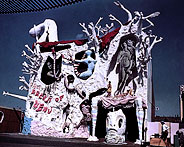
NORTH MIAMI, Fla. Languorous mermaids, grotesquely beautiful wild animals and a melting clock were all part of a Surrealist pavilion designed by Salvador Dalí for the 1939 World’s Fair in New York. Now an exhibition at the Museum of Contemporary Art here suggests that this all-but-forgotten showcase was the
first example of installation art in the United States.
Dalí’s pavilion was razed along with most of the fair’s buildings and all but lost to art history. But it was extensively documented, and the surviving film clips and photographs, along with design drawings, form the core of this show, which is the first museum exhibition that attempts to recall the pavilion’s influence.
“This is pre-happening and pre-Warhol,” said Bonnie Clearwater, the director and chief curator of the museum. “We’ve had very knowledgeable people from the art world come through this show, and they’re totally amazed. They tell me, `We had no idea this ever happened.'”
Even Ms. Clearwater had never heard of the pavilion until a chance meeting with an official of the Gala-Salvador Dalí Foundation in Figueres, Spain, where an earlier version of the exhibition was first shown.
“He handed me a book about the show they had put together,” she recalled. “I said: `Oh, my God, this is unbelievable. Would it be possible to bring it here?’
He said, `I think maybe we can.’ “
Response to the show has been highly positive. “It’s been packed,” Ms.
Clearwater said. “It’s a mob scene. We’re pulling in people from all over the country.”
Since moving into its new $3.75 million Cubist-influenced building in 1996, the Museum of Contemporary Art has presented a series of shows aimed at broadening the artistic taste of South Florida. Landing the respected Jacques and Natasha Gelman collection of Mexican art was a coup, and other exhibitions have featured artists including Cindy Sherman, Frank Stella, Anna Gaskell and Matthew Ritchie.
The Dalí show will be here, its only stop, through June 30.
The 1939 World’s Fair was held ostensibly to commemorate the 150th anniversary of George Washington’s inauguration, but a major goal was to shake Americans from the pessimism of the
Depression. Corporations like Ford and General Motors built dazzling pavilions intended to portray the United States as a consumer paradise.
There was also an amusement area, where attractions ranged from a parachute jump to a Cuban-style nightclub. That was where Dalí, encouraged by the New York art dealer Julien Levy, built his visionary pavilion, called the Dream of Venus.
Its rounded exterior was studded with protruding forms resembling hands, arms, mermaids, cactuses and the tips of crutches. Venus, in an image taken from Botticelli’s painting “The Birth of Venus,” towered above the ticket booth. This facade vividly asserted Dalí’s rejection of the sleek lines championed by
Bauhaus architects and modernist designers and referred to the architecture of Gaudí in his native
Spain.
Visitors bought tickets at a booth that looked like a giant fish head, and then entered the pavilion through
an opening shaped like a woman’s spread legs. This experience, along with the watery interior environment, was meant to symbolize a return to the womb.
Once inside the darkened pavilion, patrons passed into a lavishly decorated grotto centered on a 36-foot-long bed. On it a nude woman meant to symbolize Venus, the goddess of love and beauty, lay ostensibly asleep. Another woman sometimes sat nearby, pressing her index finger to her lips, warning spectators
not to wake the goddess.
The mattress was made to resemble glowing coals. Lobster and Champagne were on the table beside her, and above hung an enormous telephone receiver covered with liqueur glasses.
Odd objects and figures were strewn about the room, among them a chest with legs made of chocolate and an “aphrodisiac vampire” with a tiger’s head. A gramophone’s arm was in the shape of a hand, and the record was a breast.
Above the bed was a large oval glass plate through which Venus’s dream could be seen. It was acted out by performers, including women who swam in a water tank that symbolized the unconscious mind.
As the dream unfolded, the swimmers pretended to play a piano shaped like a woman, type on a floating typewriter, milk a cow wrapped in bandages or fondle a model of a man made from table tennis paddles. They wore scanty, topless costumes designed by Dalí that featured fins and seaweed shapes.
“When you get in, it is dark except for a dimly lit tank full of organs and rubber corpses of women,” one visitor wrote. “Ceaselessly a beautiful living siren, apparently amphibious, dives slowly around her own bubbles, completely naked to the waist. She fondles the turtles and kisses the rubber corpses’
mouths and hands.”
The presence of what newspapers called the liquid ladies undoubtedly attracted some visitors who were not especially interested in Surrealism. That was fine with Dalí, a self-defined subversive who was campaigning to wrest art from what he saw as the clutches of effete taste makers and bring it to the masses.
A critic for Time magazine called the swimmers Lady Godivers and said the pavilion “shrewdly combines Surrealism with sex.” Art News called the pavilion “a reconstruction of very Freudian subconscious.” One listing of events in New York described it as “frankly a girl show, but pepped up into something by the
Surrealist madness of Salvador Dalí.”
Anticipating the ideas of some modern installation artists, Dalí incorporated not just performance but
also sound into his pavilion. A copy of the film survives, and it plays at the North Miami show.
“Enter here men of all kinds and races, victims of reality, you who have the thirst for dreams,” Venus calls hypnotically. Her voice was that of Ruth Ford, who would become a B-movie legend, starring in “Lady Gangster” and other minor noir classics.
The corporate sponsor, a Pittsburgh rubber company called Gardner Displays, along with World’s Fair officials demanded several changes in Dalí’s original design. They succeeded in a few cases, for example forbidding Dalí to alter Botticelli’s image of Venus by transforming her upper torso into a fish head.
Dalí declared his outrage at the idea that anyone would dare to tamper with his work. He railed against the “lofty airs and superior quacking of middlemen of culture” and even hired a plane to fly over Manhattan and drop copies of a semicoherent manifesto denouncing what he saw as hypocrites and philistines in the art world. It was called “Declaration of the Independence of the Imagination and the Rights of Man to His Own Madness.”
 Arthur Magazine